brakes AUDI TT COUPE 2009 User Guide
[x] Cancel search | Manufacturer: AUDI, Model Year: 2009, Model line: TT COUPE, Model: AUDI TT COUPE 2009Pages: 316, PDF Size: 71.16 MB
Page 189 of 316
If t he brakes ar e not used frequently , or if corrosion has for med on
th e d iscs, i t is adv isa ble to cl ean off the pads a nd disc s by braki ng
firm ly a f ew times from a moderate ly high speed=:> &.
Faults in the brake system
I f yo u shou ld notice a
sudden i ncrease in bra ke pedal trave l, then
o ne of th e two b rake c ircui ts may hav e fa iled =:>& .
Low brake fluid level
M alf unc tions ca n occu r in the br ake system if th e b ra ke flu id leve l is
too low . Th e brake fluid level is monitored e lectronica lly.
Brake lining wear status
B ra ke l inin g wea r may be c hec ked by v is u al inspection of the condi
tion o f the b rake pads t hrou gh the ope ning s in th e wheel. If neces
sary, the wheel may be removed for this inspection=:> page 268,
' 'W hat s hou ld I be aw are o f wh en ch ang ing a ti re ?".
Brake power assist unit
T he bra ke po wer assist unit increas es the pressure that you
generate with the b ra ke peda l. It work s only when the engine is
r u n nin g.
& WARNING
• You should perform braking maneuvers for the purpose of
cleaning the brake system only if road conditions permit . Other
road users must not be put at risk -you may cause an accident!
• Before descending a steep grade , reduce speed and shift trans
mission into a lower gear or lower driving position . Do not ride the
brakes or hold the pedal down too long or too often. This could
cause the brakes to get hot and diminish braking efficiency .
• Do not "ride the brakes " by resting your foot on the pedal when
you do not intend to brake . This may cause the brakes to overheat ,
premature wear and increased stopping distance .
• Under certain climatic and operating conditions such as
passing through water , driving in heavy rain or after washing the
Controls and equip ment Safety first Vehicle operation
Intelligent technology
& WARNING
(continued )
vehicle, the effectiveness of the brakes can be reduced . In winter ,
ice can accumulate on the brake pads , linings , discs and drums .
Cautiously apply brakes for a test. Brakes will dry and ice coatings
will be cleaned off after a few cautious brake applications.
• Driving for an extended period of time on salt-covered roads
without using your brakes can also affect braking efficiency. Clean off accumulated salt coating from brake discs and pads with a few
cautious brake applications.
• If you damage the front spoiler , or if you install a different
spoiler, be sure the air flow to the front brakes is not obstructed.
Otherwise the brake system could overheat reducing the effective
ness of the entire brake system.
• Failure of one brake circuit will impair the braking capability
resulting in an increased stopping distance. Avoid driving the
vehicle and have it towed to the nearest Audi dealer or qualified
workshop.
• Never let the veh icle roll to a stop with the engine shut off .
• If the brake booster is not working, for example when towing
your vehicle , or because the brake booster has somehow been
damaged , the brake pedal must be pre ssed considerably harder to
make up for the lack of booster assistance . •
Anti- lock brake system CABS)
ABS preve nts th e wheels from lo cking under br aking.
The anti -loc k brake syste m (ABS) makes a major contribution to
i nc reas ing active d rivi ng sa fety . You s ho ul d not e xp e ct that braki ng
distances wi ll be
shortened und er all circumstances with ABS .
B ra kin g dis tance may even become s omewhat lon ger, for exa mple,
on gravel or in new snow on s lippery ground, even if you are driving
c aref ully a nd s lowly .
Vehicle care Do-it-yourself service Technical data
Page 190 of 316
___ ln_ t _e_ ll-'"ig ...,_ e_ n_t _t_ e_ c_ h _ n_o _ l_o _,.g= y,_ __________________________________________ _
ABS operation
When a vehicle speed of about 10 mph (20 km/h) is reached, an au to
matic test sequence is run. Some noise from the pump may be
audible .
I f the speed of a whee l slows down too much relative to vehic le
speed and it starts to lock, brake pressure to this wheel is reduced.
This adj ustment process can be felt as a
pulsing motion of the brake
pedal ,
accompanied by some no ises. You as the driver are intention
a lly being given the infor mation tha t the wheels are tending t o lock
(ABS control range). In order for ABS to be ab le to operate optima lly
in this range, you must keep the b rake pedal depressed -do not
"pump the brakes".
Brake assistant
The brake power assist un it increases the pressure that you
genera te wi th the brake pedal. I t wo rks only when the e ngine is
running.
Automatic full braking
T his function al lows fu ll bra king in spite of high brake pedal forces
(e .g. whe n the brakes are seve rely s tressed beca use the veh ic le is
fully loaded) . T he driver not ices this function through a reduction of
pedal force a nd increased pedal t ravel. When the brake peda l is
re leased, fu ll braking assist switches off again automatically .
If there is an ABS failure, the brake assistant and automatic fu ll
brak in g ass ist are not available.
& WARNING
• ABS cannot suspend the la ws of physic s. You should keep this
in mind in parti cular on an icy or wet road . If ABS control of braking
intervenes , you should adjust your speed immediately to road and
traffic condit ions . Do not be tempted by the increased safety
provided to take risks -danger of an accident.
• Please keep in mind that the risk of an accident is increased by
driving too fast , particularly in bends and on icy or wet roads , and
& WARNING (continued )
by driving too close to the vehicle ahead . The increased risk of an
accident cannot be redu ced by the brake a ssistant -danger of an
accident .
[ i ] Tips
If a ma lfunction occurs in the ABS, this is signalled by an indicator
l ight, se e =>
pag e 20.
E ectro-mechan-;cal power assist
The electro -me chanical po wer assist helps the driver
w hen steering.
The degree o f pow er assis t is electronically matched t o ve h ic le
speed .
The power stee ring system as sists the driver so that he can steer the
vehic le with reduced physica l effort.
P ower steering wil l not work if the engine is off. As a result, the
s te eri ng wheel wi ll be hard to turn .
& WARNING
If the system develops a problem , you must seek qualified profes
s ional assist ance .
0 Note
If there is an electronic ma lfunction, servotronic wi ll st ill function
li ke a conve ntio nal power stee rin g system, prov iding a constant
steering support force that is no longer proportionate to the vehicle
speed. This is most no ticeable when turni ng the s teering wheel at
l ow speeds (for examp le when parking), -more effort will be
r e q uired than usual. ._
Page 193 of 316

New brake pads
Remember that new brake pads do not have a full braking
effec t during the first 250 miles (400 kilometres) after they
are installed.
New brake pads have to be "burnished in" before they have optima l
grab=> &.
During the break -in period, you should avoid putting severe loads
on the brakes. Severe loads include, for example, sudden hard
braking, in particular at very high speeds or, for example, on moun
tain passes.
& WARNING
U ntil the y develop the m axim um "b ite " fo r be st stoppi ng p owe r,
th e s urfaces on new br ake p ads re quir e some " brea king -in " during
th e ini tia l 100 to 150 miles 1 150 to 200 k ilom etres) of nor ma l c ity
driving . You can comp ensa te fo r thi s by press ing the brak e ped al
more fi rml y. T his appl ie s w henev e r ne w pad s a re in sta lled . •
Catalytic converter
It is very important that your emission control system
(catalytic converter) is fu nctioning properly to ensure that
y o ur vehicle is running in an environmentally s ound
manner.
- Always use lead-free gasoline~ page 211, "Fuel supply".
- Never run the tank down a ll the way to empty.
- Never put too much motor o il in your engine~
page 222,
"Adding engine oi l 'l=:;r\11
•
- Neve r try to push -or tow -s tart your ve hicle.
Controls and equip
ment Safety first Vehicle operation
Dri
ving and environm ent
The catalytic converter is an efficient "clean-up" device built into the
exhaust system of the vehicle . The cataly tic converter burns many
of the pollutants in the exhaust gas before they are re leased into the
atmosphere.
The exclusive use of un leaded fuel is critica lly important for the l ife
of the catalytic converter and proper functioning of the engine.
& WARNING
• Do not park or oper ate th e ve hi cle in are a s whe re the hot
exha ust sys te m may c ome in conta ct wi th dr y grass, bru sh , fu el
s pill or other mat eri al which can cau se a fi re.
• Do not app ly a dditi onal u nder co at ing or ru stpr oofing on or
near the exhau st m anifold , exh au st pipe s, cata ly tic convert er or
he at shi elds. During dri ving, the s ubstance use d f or und ercoa ting
c ould ov erheat an d ca u se a fire.
0 Note
• Be aware that just one tank fi lling with
le ad ed fuel wi ll a lready
seriously degrade the performance of the catalytic converter.
• Do not exceed the correct engine oil level =>
page 222.
• Do not drive until the fuel tank becomes completely empty. The
engine could misfire . Unburned fuel could a lso get into the exhaust
system and this could cause the catalytic converter to overheat .
• Do not turn off the igni tion wh ile the vehicle is moving.
• Do not continue to operate your vehicle under these conditions,
as otherwise fue l can reach the cata lytic converter. This could resu lt
in overheating of the converter, requiring its replacement .
• To assure efficient operation of the Emiss ion Control System:
- Have your vehicle maintained properly and in accordance with
the service recommendations in your Warranty
& Maintenance
booklet.
Vehicle care Do-it-yourself service Technical data
Page 194 of 316
___ D_ r_ iv _i_ n-' g"'""'- a_ n_d_ e_ n _ v_i_r _ o _n_ m_ e_ n_t _____________________________________________ _
- Lack of proper maintenance as well as improper use of the
vehicle will impair the function of the emission con trol system
and could lead to damage.
exhaust gas can have a su lfur -like exhaust gas smell under some
operating states . This depends on the su lfur content of the fuel
being used. Using a different brand of fuel may he lp, or filling the
tank with lead-free super grade gasoline. •
Avoid damaging the vehicle
When you are driving on poor roads, or over curbs, steep ramps,
etc., make certain that low-lying parts such as spoilers and exhaust
system parts do not bottom out and get damaged.
This is especially true for vehicles with low-slung chassis (sports
chassis) and fully loaded vehicles. •
Operate your vehicle economically
and minimize pollution
General
Your personal style of driving will determine the economy
of your vehicle, as well as exhaust and noise levels.
Fuel economy, environmental impact, and wear on your engine,
brakes and t ires largely depend on three factors:
• your personal driving style
• operating condit ions
• technical limitations If
you anticipate what you need to do next and drive economically,
you can easily cut your fuel consumption by 10-15 percent . This
section will give you some tips on how you can he lp the environ
ment and your pocketbook .
[ i ] Tips
The consumption estimates as published by ENVIRONMENTAL
PROTECTION AGENCY (EPA) and Transport Canada may not corre
spond to your actua l consumption on the road, which will vary
depend ing upon vehicle load and speed, road and weather condi
tions, trip length, etc. •
Drive smoothly and keep a lookout ahead
Vehicles use the most fuel when they are accelerating.
Avoid unnecessary accelerating and braking.
Vehicles use the most fue l when they are accelerating . If you antici
pate what is going to happen next, you will need to brake less and,
thus, accelerate less. Let the vehicle coast whenever possible -for
example when you see that the next traffic light is red. •
Avoid full throttle
Driving at moderate speeds saves fuel and improves your
mileage.
- Try and keep well below your car's maximum speed.
Acce lerating gently reduces fuel consumption, engine wear, and
does not disturb the environment.
Fuel consumption, exhaust emissions and engine noise increase
disproportionately at high speeds. If you drive at approximately
three quarters of top speed, fuel consumption wil l be reduced by
9J,,
Page 200 of 316
___ C _l_e _a _ n_ in_g ~_ a_n _ d ___ p ___ r_ o _t _e _c_ t_ i_o _ n _____________________________________________ _
Cleaning and protection
General information
Regular care preserves vehicle value.
Any automobile is exposed to industrial fumes, corrosive road salt,
muddy dog feet, etc . A wel l cared for Audi can look like new many
years after purchase. Regu lar and correct ca re will contribute to
maintaining the beauty and value of your Audi.
Furthermore, good care may be a conditi on for substantiating a
war ranty claim should co rros ion d amage or p aint defec ts occur .
Your authorized Audi dealer has a variety of dedi cated vehicle- care
product s
and can advise whic h ones to use for cleaning the exterior
and interior of your vehicle.
Whether you use p roducts recommended by Audi or other commer
cially availab le cleaning agents , please make sure you apply them
correctly.
& WARNING
• Cleaning agents may be poisonous . Keep them out of the reach
of ch ildren .
• Heed all caution label s.
• Alway s read directions on the contai ner before u sing any
produ ct. Follow the di rection s carefull y.
• Most chemical cleaner s are concentrated and have to be
d iluted .
• Use s pot removing fluids only in well ventilated area s.
• Do not us e gasoline , ker osene , die sel fuel , nail polish rem over
or oth er volatile fluid s. They may be toxi c, flammable or ha zardous
in other way s. Do n ot w ash, wa x or dry the vehicle w it h the igni
tion on or the engine running.
& WA RNIN G (conti nued)
• Do not clean the under side s of chassis , fe nder s, wheel cove rs,
etc . without protecting your hands and arm s. You may cut yourself
on sha rp -edg ed metal part s.
• Moisture and ice on brakes may impair braking eff iciency
=> page 186 , "General info rm ation ". Test the brake s carefully each
time you wa sh the vehicle.
~ For the sake of the environment
Se lect only environmenta lly friend ly c leaning products . Leftover
clean ing products should not disposed of in the household waste. •
Care of exterior
Washing
Frequent washing protects the vehicle.
Th e best protection against envi ronmental influences is frequent
washing and waxing .
H ow often t his is required depends on:
• H ow much the vehic le is used
• Where the vehicle is pa rked (garage, in the open under t rees,
etc.)
• The seasonal and weather conditions
• Environmental influences
T he longer bird droppings, insects, tree resin, road a nd industrial
grime, tar, soot, road salt and other materials remain on the vehicle
p aint, the more lasting their dest ructive effects will be . _,,,
Page 206 of 316
___ C_ le_ a _ n_i_n ~g _ a_ n_ d __ p_r _o _t _e _c_ t_ i_o _n ___________________________________________ _
Paint scratches should be touched up as soon as possible to prevent
corrosion => page 202, "Touch -up pain t" .
& WARNING
• Moi sture and i ce on brake s may affect braking efficiency -
=> page 186 , "Gene ral inform ation ". Te st the brakes caref ully a fter
e ac h veh icle was h.
• Alway s read and heed all W ARNING S and t he infor mation
=> page 1 98. •
App lies to vehi cles : w ith Cast a lloy whee ls
Cast (light) alloy wheels
Cast (light) alloy wheels require special care.
- Wash the wheels with a spo nge or hose brush every
o ther week .
- For deep cleaning afte rwards, use only a dedicated
a cid
free
cast alloy whee l cleaner.
- Rub a coat of
liquid wa x onto the rims every t hree month .
Be sure to reach and treat all parts of the rim.
To preserve the decorative appearance of the cast alloy wheels,
some special care is necessary. In addition to road dirt and salt, brake dust is also corrosive . If left on for too long, brake dust can
cause pitting.
Use on ly specia l acid -free cleaners formu lated for a lloy rims . Safe
products are availab le at your Audi dealer . Never leave the cleaner
on the rims longer than specified on the label. If not rinsed off
promptly, the acid contained in some c leaners can attack the
threads on the wheel bo lts . Never use abrasive or metal polishing cleaning agents
. If the protec
t ive coating has been chipped, e.g . by kicked up road dirt, touch it
up as soon as possib le.
& WARNING
• Moisture and ice on br akes m ay affect braki ng effici ency
=> page 1 86, "Gen eral inf or mation ". Te st the brake s carefully each
ti m e you w ash th e vehi cle .
• Always read and heed all WARNINGS and other informa tion
=> page 198 . •
Body cavity sealing
T he body cavity se aling does not need to be checked.
All body cavities which could be affected by corrosion have been
given thorough protection at the fac tory.
This sealing does not require any inspection or additional treat
ment . If any wax should seep out of the cavi ty when the amb ient
temperature is high, it can be removed with a p lastic scraper and a
suitable solvent .
& WARNING
Solvents can be dangerou s.
• Ben zin e is flamm able and to xic. If you use b en zi ne for re moving
the wax, keep spark s, flame and lighted cigarette s away . Never
dump ben zine on the ground , into open st ream s or do wn sewage
dr ain s.
• Be sure to ob serve all safet y and env ironment al regul atio ns .
Follow all in stru ction s on the c ont ainer .
• Alwa ys read and heed all WARNINGS and the infor mation
=> page 1 98 . •
Page 237 of 316
Tires and wheels -
----------------
•
& WARNING (continu ed )
crashes and serious personal in jur ies . Have worn or da maged t ires
replaced immediately .
• Tires age even if they are not being u sed and can fail suddenly ,
especially at high speeds. T ires that are more than 6 years old can
only be used in an emergency and then w ith special care and at
low speed.
Glossary of tire and loading terminology
Accessory weight
means the co mbined we ig ht ( in excess o f those sta nda rd items
which may be rep laced) of automatic transmission, power steering,
power brakes, power w indows, powe r seats, rad io, a nd heater, to
the extent that these items are avai lab le as factory-installed equip
m ent (w hether insta lled or not).
Aspect ratio
means t he ratio o f th e height to t he w idt h of the tire in perce nt.
N umbers of 55 or lower indicate a low sidewa ll for improved
steer ing respo nse and b ette r overall ha ndl ing on dry pave ment.
Bead
means the part of the tire that is made of stee l wires, wrapped or
reinforced by ply cords and that is shaped to fit the rim.
Bead separation
means a breakdow n of the bond be tween co mponents i n the bead.
Cord
means the strands fo rmi ng the plies in the ti re.
& W ARNING (continued )
• Never mount used tires on your vehicle if you are not sure of
their "previous history. " Old used t ire s may ha ve been damaged
even though the damage cannot be seen that can lead to sudden
tire failure and lo ss of vehicle control.
• If you noti ce unusual vibration or if the vehicle pulls to one side
when driving , always stop as soon as it is safe to do so and check
the wheels and tires for damage . •
Cold tire inflation pressure
mea ns t he ti re pressure reco mm ended by the ve hicle ma nufacturer
for a tire of a designated size that has not been d riven for more tha n
a cou ple o f miles (k ilometers) at low speeds in t he t hre e ho ur per iod
before the tire pressure is measured or ad justed .
Curb weight
means the weight of a moto r vehic le with standard equipment
i nc lud ing the max imu m capac ity o f fue l, o il, and coola nt, a ir c ond i
tioning and additiona l weight of optional equipment.
Extra load tire
means a tire designed to ope rate at higher loads and at higher infla
tion pressures than the corresponding standard tire. Extra load tires
my be identified as "XL",
"xi", "EX TRA LOAD", or "RF" on the side
wa ll.
Gross Axle Weight Rating ("GAWR ")
means the load -carrying capacity of a sing le ax le system, measured
at the ti re -ground interfaces.
Gross Vehicle Weight Rating ("GVWR "l
means the ma ximum tot al l oade d weigh t of the vehicle.
Vehicle care I t •
Page 238 of 316
-~_T_ ir_e_ s_ a_ n_d _ w_ h_ e_e _l_s _________________________________________________ _
Groove
means the space between two adjacent tread ribs.
Load rating (code)
means the maximum load that a tire is rated to carry for a given
inflation pressure . You may not find this information on all tires
because it is not required by law.
Maximum load rating
means the load rating for a tire at the maximum permissible infla
tion pressure for that tire.
Maximum loaded vehicle weight
means the sum of:
(a) Curb weight
(b) Accessory weight
(c) Vehicle capacity weight, and
(d) Production options weight
Maximum (permissible) inflation pressure
means the maximum cold inflation pressure to which a tire may be
in flated. Also called "maximum inflation pressure ."
Normal occupant weight
means 150 lbs. (68 kilograms) times the number of occupants
seated in the vehicle up to the total seating capacity of your vehicle.
Occupant distribution
means distribution of occupants in a vehicle .
Outer diameter
means the overall diameter of an inflated new tire.
Overall width
means the linear distance between the exteriors of the sidewalls of
an inflated tire, including elevations due to labeling, decorations, or
protective bands or ribs .
Ply
means a layer of rubber -coated parallel cords.
Production options weight
means the combined weight of those installed regular production
options weighing over 5 lbs. (2.3 kg) in excess of those standard
items which they replace, not previously considered in curb weight
or accessory weight, including heavy duty brakes, ride levelers, roof rack, heavy duty battery, and special trim.
Radial ply tire
means a pneumatic tire in which the ply cords that extend to the
beads are laid at substantially 90 degrees to the centerline of the
tread.
Recommended inflation pressure
see =:> page 235, "Cold tire inflation pressure".
Reinforced tire
means a tire designed to operate at higher loads and at higher infla
tion pressures than the corresponding standard tire. Reinforced
tires my be identified as "XL", "xi", "EXTRA LOAD", or "RF" on the
sidewall.
Rim
means a metal support for a tire or a tire and tube assembly upon
which the tire beads are seated .
Rim diameter
means nominal diameter of the bead seat. If you change your wheel
size, you will have to purchase new tires to match the new rim diam
eter.
Rim size designation
means rim diameter and width.
Rim width
means nominal distance between rim flanges .
Page 242 of 316
-~_T_ ir_e_ s_ a_ n_d _ w_ h_ e_e _l_s _________________________________________________ _
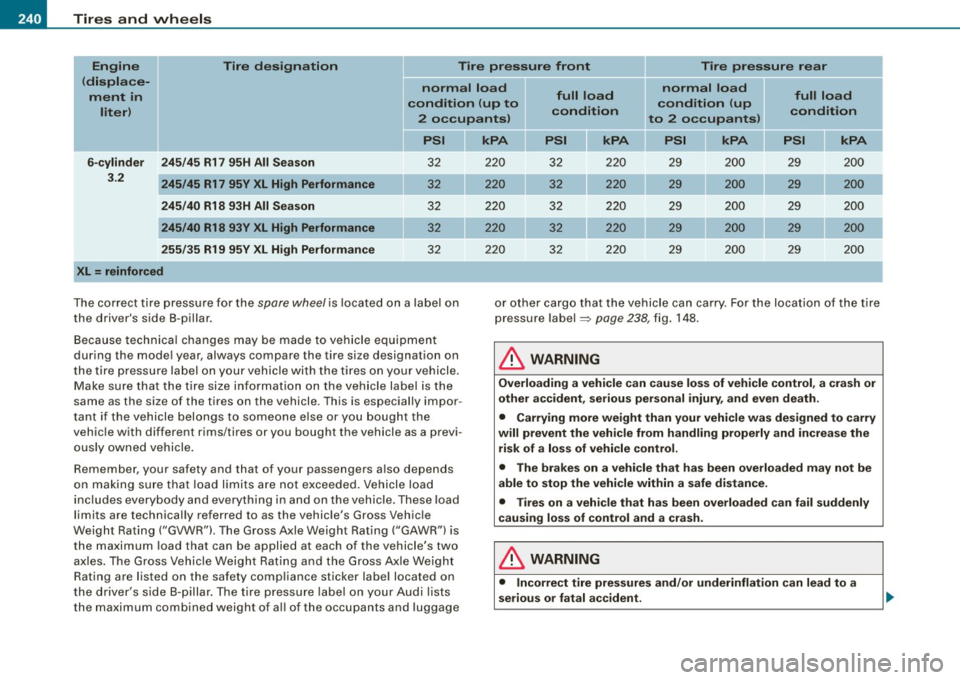
Engin e
(displa ce
ment in
lit er) Tire designation
Tir
e pressure front Tire pressure rear
normal load full load normal load
full load
condition (up to condition c
ondition (up
condition
2 o ccupants ) to 2 occupants)
6 -cylinder
3.2 245
/45 R1 7 95H All Season
245 /45 R17 95V XL High Performan ce
245 /40 R18 93H All Season
245 /40 R18 93V XL High Performan ce
255 /35 R19 95V XL High Performance
XL
= reinforced
PSI
32
32
32
32
32
The correct tire pressure for the spare wheel is located on a label on
the driver's side B-pillar .
Because technica l changes may be made to vehicle equip ment
during the mode l year, always compare the tire size designat ion on
the tire pressure la bel on y our vehicle with the tires on your vehicle.
Make sure tha t the t ire size information on the veh icle labe l is the
same as the size of the tires on the vehicle. Th is is especially impor
t ant if the vehicle belongs to someone e lse or you boug ht the
vehic le with different rims/tires or you bought the vehicle as a previ
ously owned vehicle.
Remember, your safety and that of your passengers a lso depends
on making su re tha t load limits a re not exceeded . Vehi cle loa d
inc ludes everybody and everything in and on the vehicle. These load
limits are technically referred to as the vehicle's Gross Vehicle
Weight Rating ("GVW R"). The Gross Axle Weight Rating ("GAWR") is
the maximum load that can be applied at each of the vehicle's two
ax les. The Gross Vehicle We ight Rat ing and the Gross Ax le Weig ht
Rating are listed on the safety comp liance sticker labe l located on
t he driver's side B- pillar. The tir e pressure labe l on y our Audi lists
the maximum combined weight of a ll of the occupants and luggage
kPA PSI kPA kPA kPA
220 32 220 29 2 00 29 200
220 32 220 29 200 29 200
220 3 2 220 29 2 00 29 200
220 32 220 29 2 00 29 200
220 3 2 220 29 200 29 200
or other ca rgo that the veh ic le can carry. For the location o f the t ire
pressure label::::;, page 238, fig. 148.
& WARNING
Overloading a vehi cle can cause loss of vehicle control , a crash or
other accident, serious personal injury, and even death .
• Carrying more weight th an your vehicle was de signed to carry
will prevent the vehicle from handling properly and increase the
risk of a loss of vehicle control.
• The brakes on a vehicle that has been overloaded may not be
able to stop the vehicle within a safe distance .
• Tires on a vehicle that has been overloaded c an fail suddenly
causing loss of control and a crash .
& WARNING
• Incorrect tire pressures and/or underinflation can lead to a
s erious o r fatal a ccident .
Page 245 of 316
______________________________________________ T_ ir_e _s_ a_n_ d_ w_ h_ e_ e_ls __ __
•
technically referred to as the vehicle's Gross Vehi cle We ight Rating
("GVWR") .
T he "GVWR" includes the weight of the bas ic veh icle, al l factory
insta lled accessor ies, a full tank of fue l, oil, coolant and other f luids
p lus ma ximum load. The maxim um load includes the number o f
passengers that the vehicle is intended to carry ("seating capacity")
w it h an assu med weight o f 15 0 l bs (68 kg) for eac h passe nger at a
designated seating position and the total weight of any luggage in
th e veh ic le .
T he
Gross Axle Weight Rating ("GAWR"l is the maximum load that
can be applied a t each of the vehic le's two axles .
The Gross Ve hicle W eig ht Rati ng and the Gross A xle Weigh t Rating
a re l isted on the safety compliance sticker labe l located on the
dr iver's s ide B -p il lar . Y o ur Aud i has 4 seat ing positions, 2 in the fron t
and 2 in the rear for total seating capacity of 4. Each seating posit ion
has a sa fet y b elt
=> page 125, "Safe ty be lts" .
T he fact t hat the re is an uppe r lim it to your ve hicle's G ross V ehic le
Weight Rati ng means tha t the total we igh t of w hateve r is bei ng
ca rried in the vehicle is lim it e d. T he m ore pass engers in t he veh ic le
or passengers who are heavier than the standard weights assumed
mean that less we igh t ca n be ca rried as lu ggage .
T he tire pressure labe l o n you r Audi also lists the max imum
c o m bined weig ht of all of t he oc cupan ts a nd lu ggage or other ca rgo
t h at the ve hicle can carry. For the locat ion of the label
=> page 238,
fig . 14 8.
& WARNING
Overloading a vehicle can cause loss of vehicle control, a crash or
other accident , serious personal injury , and even death .
• Carrying more weight than your vehicle was designed to carry
will prevent the vehicle from handling properly and increase the
risk of the loss of vehicle control.
• The brakes on a vehicle that has been overloaded may not be
able to stop the vehicle within a safe distance.
& WARNING (continued )
• Tires on a vehicle that has been overloaded can fail suddenly,
including a blowout and sudden deflation , causing loss of control
and a crash .•
Determining correct load limit
Use the example below to calculate the
total weight of the passengers and
luggage or other things that you plan to
transport so that you can make sure that
your vehicle will not be overloaded.
Steps for Determining Correct
Load Limit
1 . Locate the statement "THE COMBINED
WEIGHT OF OCCUPANTS AND CARGO SHOULD NEVER EXCEED XXX KG OR XXX
LBS "on your vehicle 's placard (tire infla
tion pressure label)~
page 238, fig. 148.
2. Determine the combined weight of the driver and passengers that will be riding
in your vehicle. ..,
Vehicle care I t •