child lock AUDI TT COUPE 2009 User Guide
[x] Cancel search | Manufacturer: AUDI, Model Year: 2009, Model line: TT COUPE, Model: AUDI TT COUPE 2009Pages: 316, PDF Size: 71.16 MB
Page 162 of 316
___ C_ h_ il_ d _S_ a_fe _ ty ______________________________________________ _
C. Forward-facing convertible child restraint systems,
manufactured on or after September 1, 2004:
• Britax Roundabout 161
• Britax Expressway
• Century Encore 4612
• Century STE 1000 4416
• Cosco Olympian 02803
• Cosco Touriva 02519
• Evenflo Horizon V 425
• Evenflo Medallion 254
• Safety First Comfort Ride 22-400
& WARNING
To reduce the risk of serious injury, make sure that the PASSENGER
AIR BAG OFF light comes on and stays on whenever a child
restraint is installed on the front passenger seat and the ignition
is switched on.
• Take the child restraint off the front passenger seat and install
it properly at one of the rear seat positions if the PASSENGER AIR
BAG OFF light does not stay on.
• Have the airbag system inspected by your authorized Audi
dealer immediately.
[ i] Tips
The child seats listed in categories A to C have been tested by Audi
only for the Advanced Airbag function. •
Important safety instructions for using child
safety seats
Correct use of child safety seats substantially reduces the
risk of injury in an accident!
As the driver, you are responsible for the safety of every
body in the vehicle, especially children:
- Always use the right child safety seat for each child and
always use it properly ::::> page 162.
- Always carefully follow the child safety seat manufac
turer's instructions on how to route the safety belt prop
erly through the child safety seat.
- When using the vehicle safety belt to install a child safety
seat, you must first activate the convertible locking
retractor on the safety belt to prevent the child safety
seat from moving ::::> page
168.
- Push the child safety seat down with your full weight to
get the safety belt really tight so that the seat cannot
move forward or sideways more than one inch (2.5 cm).
- If a strap or tether is being used to tie the child safety
seat to the front passenger seat, make sure that it is not
so tight that it causes the weight-sensing mat to
measure more weight than is actually on the seat.
Always remember: Even though your vehicle is equipped with an
Advanced Airbag system, all children, especially those 12 years and
younger, should always ride in the back seat properly restrained for
their age and size. _,,
Page 164 of 316
___ C_h_ i_ld _ S_ a_ f_ e_ t-= y'------------------------------------------------
& WARNING (continued)
-Always move the front passenger seat into the rearmost
position of the passenger seat's fore and aft adjustment range,
and as far away from the airbag as possible before installing
the child restraint.
- Always make sure that nothing prevents the front
passenger's seat from being moved to the rearmost position in
its fore and aft adjustment range .
- Always make sure that the backrest is in the upright posi
tion.
• Always buckle the child safety seat firmly in place even if a
child is not sitting in it. A loose child safety seat can fly around
during a sudden stop or in a collision.
• Always read and heed all WARNINGS whenever using a child
restrained in a vehicle is being used=>
page 125, "Safety belts",
=>
page 135, "Airbag system" and=> page 157, "Child Safety".
& WARNING
To reduce the risk of serious injury, make sure that the PASSENGER
AIR BAG OFF light comes on and stays on whenever a child
restraint is installed on the front passenger seat and the ignition
is switched on.
• Take the child restraint off the front passenger seat and install
it properly at one of the rear seat positions if the PASSENGER AIR
BAG OFF light does not stay on.
• Have the airbag system inspected by your authorized Audi
dealer immediately. •
Child safety seats
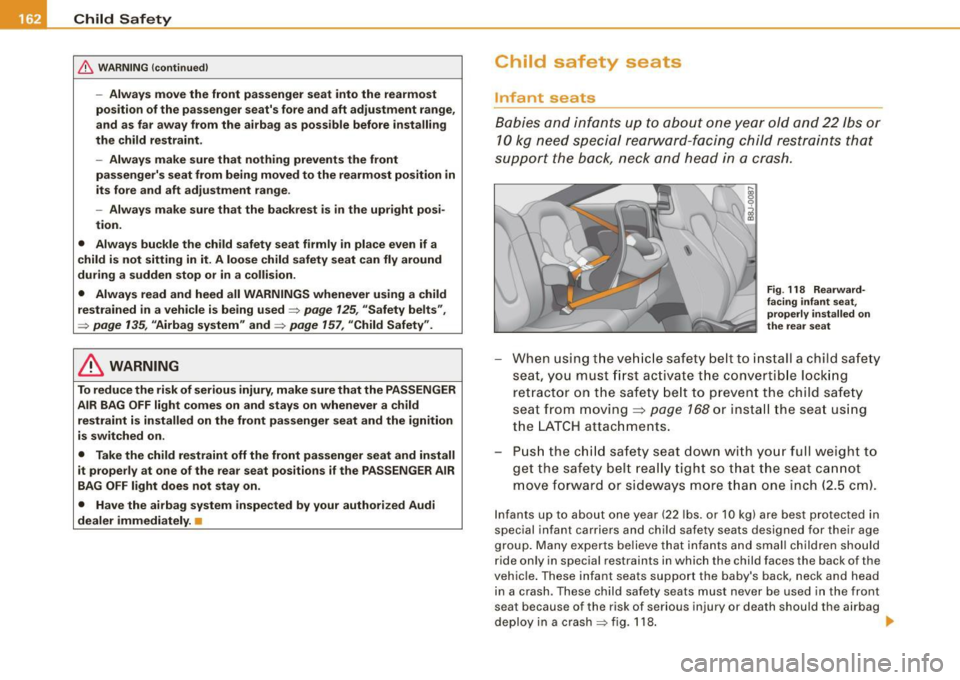
Infant seats
Babies and infants up to about one year old and 22 lbs or
10 kg need special rearward-facing child restraints that
support the back, neck and head in a crash.
Fig . 118 Rearward
facing infant seat,
properly installed on
the rear seat
-When using the vehicle safety belt to install a child safety
seat, you must first activate the convertible locking
retractor on the safety belt to prevent the child safety
seat from moving~
page 168 or install the seat using
the LATCH attachments.
- Push the child safety seat down with your full weight to
get the safety belt really tight so that the seat cannot
move forward or sideways more than one inch (2.5 cm).
Infants up to about one year (22 lbs. or 10 kg) are best protected in
special infant carriers and child safety seats designed for their age
group. Many experts believe that infants and small children should
ride only in special restraints in which the child faces the back of the
vehicle. These infant seats support the baby's back, neck and head
in a crash . These child safety seats must never be used in the front
seat because of the risk of serious injury or death should the airbag
deploy in a crash=> fig. 118. ..
Page 165 of 316

& WARNING
Not using a child safety seat, using the wrong child safety seat or
improperly installing a child restraint increases the risk of serious
personal injury and death in a crash.
• Never install rear-facing child safety seats or infant carriers on
the front passenger seat -even with an Advanced Airbag System .
A child will be seriously injured and can be killed when the
inflating airbag hits the child safety seat or infant carrier with
great force and smashes the child safety seat and child against the
backrest, or door=>
page 137, "Child restraints on the front seat -
some important things to know" .
• Always install rear-facing child safety seats or infant carriers on
the rear seat.
• Never install a rear-facing child restraint in the forward-facing
direction. Such restraints are designed for the special needs of
infants and very small children and cannot protect them properly
if the seat is forward-facing.
• If you must install a rearward facing child safety seat on the
front passenger seat because of exceptional circumstances and
the PASSENGER AIR BAG OFF light does not come on and stay on, immediately install the rear-facing child safety seat in a rear
seating position and have the airbag system inspected by your
Audi dealer .
• Always read and heed all WARNINGS whenever using a child
restrained in a vehicle is being used=>
page 125 , "Safety belts",
=> page 135, "Airbag system" and=> page 157, "Important things
to know". •
Safety first
Child Safety
Convertible child safety seats
Properly used convertible child safety seats can help
protect toddlers and children over age one who weigh
between 20 and 40 lbs. (10 and 20 kg) in a crash.
Fig. 119 Rear seat:
smalle r child in a prop
erly installed forward
facing convertible child
safety seat
When using the vehicle safety belt to install a child safety
seat, you must first activate the convertible locking
feature on the safety belt to prevent the child safety seat
from moving :::;,
page 168 or install the seat using the
LATCH attachment .
Push the child safety seat down with your full weight to
get the safety belt really tight so that the seat cannot
move forward or sideways more than one inch (2.5 cm)
:::;, page 168 .
A toddler or child is usually too large for an infant restraint if it is
more than one year old and weighs more than 22 lbs. (10 kg).
Toddlers and children who are older than one year up to about 4
years old and weigh more than 22 lbs (10 kg) up to 40 lbs . (18 kg)
should be properly res trained in a child safety seat certified for their
size and weight=> fig. 119 .
The airbag on the passenger side makes the front seat a potentially
dangerous place for a child to ride . The front seat is not the safest •
Vehicle care I I Technical data
Page 167 of 316
Booster seats
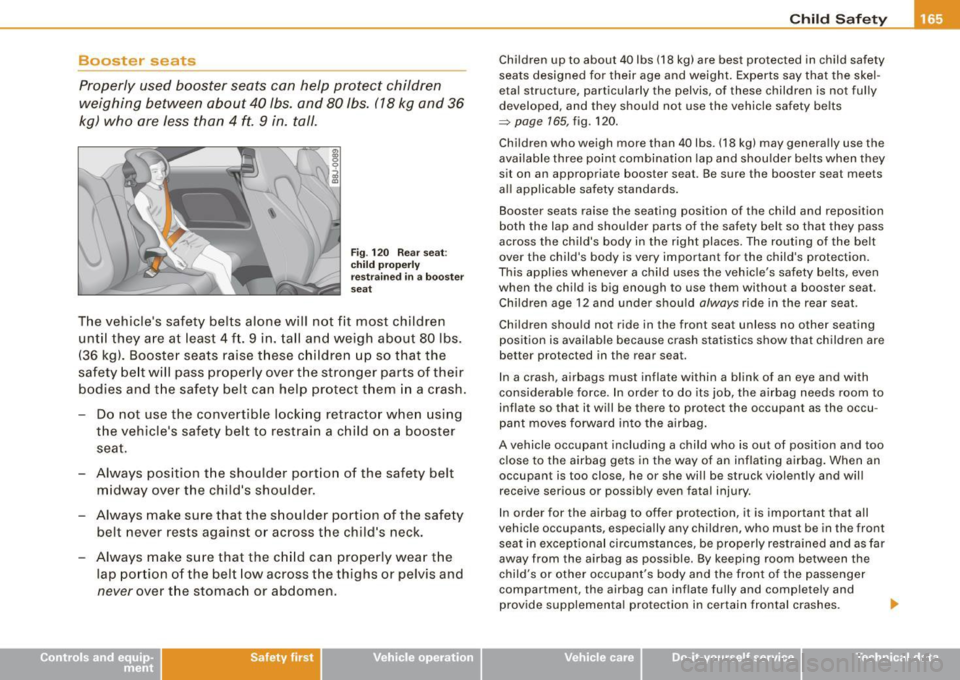
Properly used booster seats can help protect children
weighing between about 40 lbs. and 80 lbs. (18 kg and 36
kg) who are less than
4 ft. 9 in. tall.
Fig. 120 Rear seat :
child properly
restrained in a booster
seat
The vehicle's safety belts alone will not fit most children
until they are at least 4 ft. 9 in. tall and weigh about 80 lbs.
(36 kg). Booster seats raise these children up so that the
safety belt will pass properly over the stronger parts of their
bodies and the safety belt can help protect them in a crash.
- Do not use the convertible locking retractor when using
the vehicle's safety belt to restrain a child on a booster
seat.
- Always position the shoulder portion of the safety belt
midway over the child's shoulder.
- Always make sure that the shoulder portion of the safety
belt never rests against or across the child's neck.
- Always make sure that the child can properly wear the
lap portion of the belt low across the thighs or pelvis and
never over the stomach or abdomen.
Safety first
Child Safety
Children up to about 40 lbs (18 kg) are best protected in child safety
seats designed for their age and weight. Experts say that the skel
etal structure, particularly the pelvis, of these children is not fully
developed, and they should not use the vehicle safety belts
=> page 165, fig. 120.
Children who weigh more than 40 lbs. (18 kg) may generally use the
available three point combination lap and shoulder belts when they
sit on an appropriate booster seat . Be sure the booster seat meets
all applicable safety standards.
Booster seats raise the seating position of the child and reposition
both the lap and shoulder parts of the safety belt so that they pass
across the child's body in the right places. The routing of the belt
over the child's body is very important for the child's protection.
This applies whenever a child uses the vehicle's safety belts, even
when the child is big enough to use them without a booster seat.
Children age 12 and under should
always ride in the rear seat .
Children should not ride in the front seat unless no other seating
position is available because crash statistics show that children are
better protected in the rear seat.
In a crash, airbags must inflate within a blink of an eye and with
considerable force . In order to do its job, the airbag needs room to
inflate so that it will be there to protect the occupant as the occu
pant moves forward into the airbag.
A vehicle occupant including a child who is out of position and too
close to the airbag gets in the way of an inflating airbag. When an
occupant is too close, he or she will be struck violently and will
receive serious or possibly even fatal injury.
In order for the airbag to offer protection, it is important that all
vehicle occupants, especially any children, who must be in the front
seat in exceptional circumstances, be properly restrained and as far
away from the airbag as possible. By keeping room between the
child's or other occupant's body and the front of the passenger
compartment, the airbag can inflate fully and completely and
provide supplemental protection in certain frontal crashes. _.,
Vehicle care I I irechnical data
Page 170 of 316
___ C_h_ i_ ld _ S_ a_ f_ e_ t_y ____________________________________________ _
& WARNING (continued )
• An improperly worn safety belt will not provide the best protec
tion in a crash and may cause serious personal injury . Always
m ake sure that children and other veh icle occupants properly
wear available restraint sy stem s. Carefully follow the instructions
provided by the manufacturers of child restraints . •
Installing a child safety seat
Securing a child safety seat using a safety
belt
S afety belts f or the rear sea ts an d the front pa ssenger can
b e l ocke d wit h th e co nv erti ble lockin g ret racto r to p rop
erly secu re c hild safety sea ts.
The safe ty be lts eme rgency loc king re tr acto rs for th e rea r s eat s
saf ety belts an d for t he front pass enger's seat safety be lt have a
co nve rtible lock ing retracto r for c hild r estra int s. The sa fet y b elt
must be loc ked so t hat belt we bbing cannot u nre el. T he r etrac to r
can be activated to lock the safety be lt and prevent the safety be lt
w eb bing fr om l oos enin g up dur ing n ormal dr ivi ng . A ch ild safe ty
seat can only be properly instal led when the safety belt is locked so
th at the chi ld and chi ld sa fety seat will st ay in pla ce.
Al ways rem embe r: Even t hough you r vehic le is equ ipped with an
A dva nced Airb ag s ystem, a ll chil dre n, esp ecia lly th ose 12 yea rs and
youn ger, s hou ld always ri de in the back seat prop erly rest rained for
thei r age and size .
& WARNING
Improperly installed child safety seats increase the risk of serious
personal injury and death in a collision .
& WARNING (continued)
• Always make sure that the safety belt retractor is locked when
installing a child safety seat . An unlocked safety belt retractor
cannot hold the child safety seat in place during normal driving or
in a crash.
• Always buckle the child safety seat firmly in place even if a
child is not sitting in it . A loose child safety seat can fly around
during a sudden stop or in a collision
• If the backrest is not securely latched, the child and the child
restraint will be thrown forward together with the backrest and
will strike parts of the vehicle interior . The child can be seriously
injured or killed .
• Never install rear-facing child safety seats or infant carriers on
the front passenger seat . A child will be seriously injured and can
be killed when the passenger airbag inflates .
• The inflating airbag will hit the child safety seat or infant
carrier with great force and will smash the child safety seat and child against the backrest, door or roof .
• Always install rear -facing child safety seats or infant carriers on
the rear seat.
• Forward-facing child safety seats or infant carriers installed on
the front passenger's seat may interfere with the deployment of
the airbag and cause serious injury to the child.
• It is safer to install a forward-facing child safety seat on the rear
seat .
• Always read and heed all WARNINGS whenever using a child
restrained in a vehicle is being used=> page
157 . Special precau
tions apply when installing a child safety seat on the front passenger seat=> page
137, "Child restraints on the front seat -
some important things to know" . ._
Page 172 of 316
___ C_ h_ il_ d _S_ a_fe _ ty ______________________________________________ _
Activating the convertible locking retractor
Use the convertible locking retractor to secure a child
restraint.
Always heed the child safety seat manufacturer's instruc
tions when installing a ch ild restraint in your vehicle. To
activate the convertible locking retractor:
- Place the child restraint on a seat, preferably on the rear
seat.
- Slowly pull the belt
all the way out .
-Route it around or through the child restraint belt path
=>& -
- Push the child safety seat down with your full weight to
get the safety belt really tight.
- Insert the belt tongue into the buckle for that seating
position.
- Guide the safety belt back into the retractor unt il the belt
lies flat and snug on the child safety seat .
- You should hear a "clicking" noise as the belt winds back
into the inertia reel. Test the convertible locking retractor
by pulling on the belt. You should no longer be able to
pull the belt out of the retractor. The convertible locking
retractor is now act ivated.
- Make sure that the red release button is facing away from
the child restraint so that it can be unbuckled quickly.
- Pull on the belt to make sure the safety belt is properly
tight and fastened so that the seat cannot move forward or sideways more than one inch (2 .5 cm) .
& WARNING
Using the wrong child restraint or an improperly installed child
restraint can cause serious personal injury or death in a crash.
• Always make sure that the safety belt retractor is locked when
installing a child safety seat. An unlocked safety belt retractor
cannot hold the child safety seat in place during normal driving or
in a crash.
• Always buckle the child safety seat firmly in place even if a
child is not sitting in it. A loose child safety seat can fly around
during a sudden stop or in a crash.
• Always make sure the seat backrest to which the child restraint
is installed is in an upright position and securely latched into place
and cannot fold forward. Otherwise, the seat back with the child
safety seat attached to it could fly forward in the event of an acci
dent or other emergency situation.
• Always read and heed all WARNINGS whenever using a child
restrained in a vehicle is being used=>
page 157. Special precau
tions apply when installing a child safety seat on the front
passenger seat=>
page 137, "Child restraints on the front seat -
some important things to know" .•
Deactivating the convertible locking retractor
The convertible locking retractor for child restraints will
be deactivated automatically when the belt is wound all
the way back into the retractor.
-Press the red button on the safety belt buckle. The belt
tongue will pop out of the buckle.
- Guide the belt all the way back into its stowed position .
Always let the safety belt retract completely into its stowed position.
The safety belt can now be used as an ordinary safety belt without
the convertible locking retractor for child restraints.
IJll-
Page 173 of 316

Child Safety -
--------------------''---
If the convertible locking retractor should be activated inadvert
ently, the safety belt must be unfastened and gu ided co mple te ly
back into its stowed position to deactivate this feature. If the
convertible lock ing retractor is not deactivated, the safe ty be lt will
gradually become tighter and uncomfortab le to wear.
& WARNING
Improper ly in stalled child safet y seat s in crea se the risk of seri ous
personal injury and death in a colli sion.
• Never unfasten t he safety belt to d eactivate the c onvertible
locking retractor for child re straint s while the vehicle is moving .
You would not be re strained and could be seriou sly injured in an
accid ent.
• Alway s re ad and heed all WARNINGS whenever us ing a child
restrained in a vehicle is being used=:>
page 15 7. Spec ial precau
tion s app ly when in stalling a child safety se at on the fr ont
p assen ger seat =:>
pag e 13 7, "Child re straint s on the front seat -
s ome important thing s to know ".•
Additional Information
What types of child restraint anchors are
available and how are they related to child
safety?
For years, child restraints have been installed using the safety belts
a lready present i n every vehicle.
Since September 1, 1999, chi ld restraint manufacturers have been
providing tether straps that attach the top of the child restraint to
the vehicles structure, on most of their forward -facing systems in
order to comply with U.S. Federa l regu lations for child restraint
performance in a crash. Vehicle manufacture rs are required to
Controls and equip
ment Safety first Vehicle operation
phase-in tether anchorages for attachment of the tether strap in
t heir U.S. vehic les beg inn ing September 1, 1999 .
The combination of the tether anchorages and the lower anchor
ages is now genera lly called the
LATCH system for " Lower Anchors
and Tether for C hildren".
( T he term "ISOFIX" regarding lower anchorages had been used by
Audi and other manufacturers in t he pas t, but LATCH is now the
standard name for the new child restraint anchorage system.)
Some child restraint system manufacturers have been providing
tether straps on certain models o f their child restraint systems,
either as standard equipment or as a retrofit, for severa l years.
Check w ith the manufacturer of the child restraint sys te m f or tether
strap availabi lity.
To provide a simpler and more practicable way to attach the child restraint system on the vehicle seat, U.S . Federal regu lations require
t he phase -in of lower anchorages in veh icles an d devices on new
child restraint systems to attach to the veh ic le ancho rages .
Child restraint system manufacturers will probably offer two kinds
of lower anchorages on their child safety seats
They cou ld come with:
• hook-on or push-on connectors attached to adjustable straps or
• rigid latches on bars that extend out the back of the child
restraint and are released with re lease buttons at the bottom of the
child restraint.
I n addition to the LATCH lower anchorages, both of these child
restra int systems use tether straps to help keep the chi ld restraint
system firmly in p lace. •
Where can I get additional information about
child restraint application and usage?
There are a numbe r of sources of additional information about child
restra int select ion, installation and usage: _.,
Vehicle care Do-it-yourself service Technical data
Page 178 of 316
___ C_h_ i_ld _ S_ a_ f_ e_ t-= y'------------------------------------------------
& WARNING (continued)
fly forward and hit the interior of the vehicle, or be ejected from
the vehicle.
& WARNING
Improper installation of child restraints will increase the risk of
injury in an accident.
• Always follow the child restraint system manufacturer's
instructions for proper installation of the child restraint system
and proper use of tether straps as well as the lower anchorages or
safety belts in your vehicle.
• Always read and heed the important information and WARN
INGS about child safety and the installation of child restraint
systems =>
page 157, "Child Safety" .•
Mounting and releasing the anchorage hook
If you use a child restraint system with hooks or other
latches attached to adjustable straps.
Mounting
Press the anchorage hook with the spring catch release
onto the lower anchorage so that the anchorage hook
locks into place.
Pull on the anchorage hook to make sure that it has
securely engaged the lower anchorage .
Tighten the strap following the child restraint manufac
turer's instructions.
Releasing
- Loosen the tension on the strap following the child
restraint manufacturer's instructions. -
Depress the spring catch on the hook.
- Hold the spring catch in depressed posit ion .
- Move the hook in the direction of the vehicle floor so that
there is enough space to release the anchorage hook
from the lower anchorage.
& WARNING
• Improper installation of child restraints will increase the risk of
injuries in a crash.
• Always refer to the child restraints manufacturer's instructions
for proper installation of the child restraint and proper use of the
lower anchorages or safety belts in your vehicle.
ti
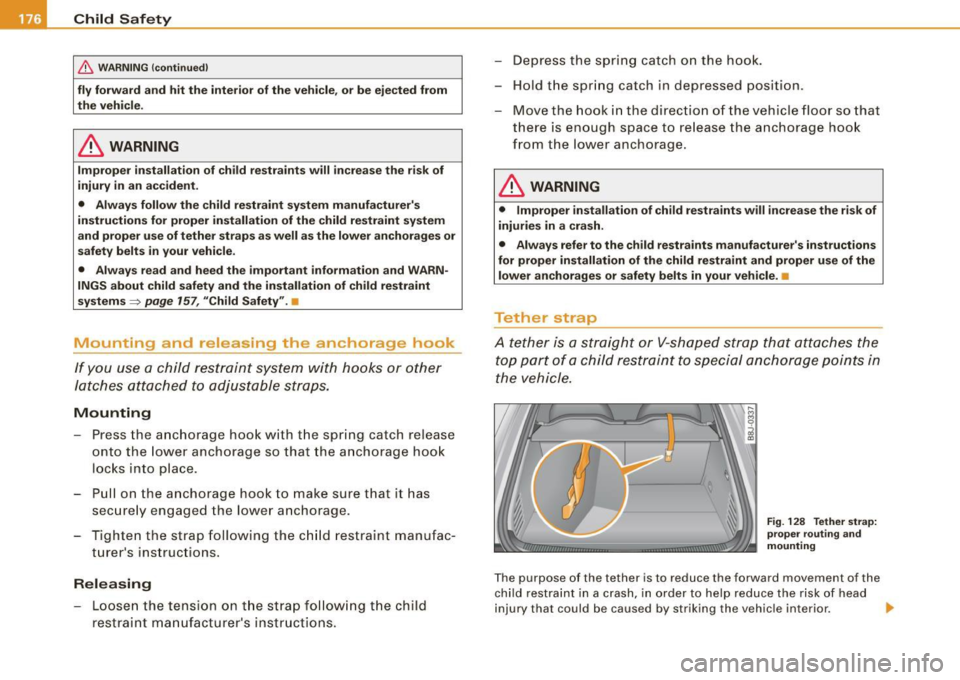
Tether strap
A tether is a straight or V-shaped strap that attaches the
top part of a child restraint to special anchorage points in
the vehicle.
Fig. 128 Tether strap:
proper routing and
mounting
Th e purpose of the tether is to reduce the forward movement of the
child restraint in a crash, in order to help reduce the risk of head
injury that could be caused by striking the vehicle int eri or. .,
Page 219 of 316

___________________________________________ C_ h_e _c_ k_ i_n _g _ a_n _d_ f_il _li _n _g __ fflllll
•
Closing the engine hood
- Pull the hood down until the pressure from the struts is
reduced .
- Let the hood
drop down and latch in place. Do not try to
push it shut;
it may fail to engage => &.
& WARNING
A hood that is not completely latched could fly up and block your
view while driving.
• When you close the engine hood, check it to make sure the
safety catch has properly engaged. The hood should be flush with
the surrounding vehicle body parts.
• If you notice while driving that the hood is not secured prop
erly, stop at once and close it. •
Working in the engine compartment
Be especially careful whenever you work in the engine
compartment!
Whenever you must perform any work in the engine compartment,
for example checking and filling the different fluids, there is a risk of injury, burns and accidents. To prevent personal injury always
observe the following WARNINGS. The engine compartment of any
vehicle is a hazardous area!
~ &
& WARNING
To help avoid injury, before you check anything under the hood :
• Switch off the engine.
• Remove the ignition key.
• Apply the parking brake .
& WARNING (continued)
• Move selector lever of automatic transmission to "P" (Park);
put manual transmission in Neutral .
• Always let the engine cool down. Hot components will burn
skin on contact.
• To reduce the risk of being burned, never open the hood if you
see or hear steam or coolant escaping from the engine compart
ment. Wait until no steam or coolant can be seen or heard before
carefully opening the hood .
• Keep children away from the engine compartment.
• Never spill fluids on hot engine components . They can cause a
fire.
• Never touch the radiator fan. The auxiliary electric fan is
temperature controlled and can switch on suddenly.
• Never open the coolant reservoir cap when the engine is still
warm. The coolant system is pressurized and hot coolant could
spray out.
• Protect your face, hands and arm from steam or hot engine
coolant by placing a thick rag over the cap when you open the
coolant reservoir.
• If work on the fuel system or the electrical system is necessary:
- Always disconnect the battery.
- Never smoke or work near heaters or open flames. Fluids in
the engine compartment could start a fire .
- Keep an approved fire extinguisher immediately available.
• To avoid electrical shock and personal injury while the engine
is running or being started, never touch :
- Ignition cables
- Other components of the high voltage electronic ignition
system.
• If you must perform a check or repair with the engine running: ..,
Vehicle care
I t •
Page 228 of 316
-~_C_ h_e _c _ k_ i_n ...:::g::;...._ a_n_ d_ f_ i_ll _in -'g:::;.._ ___________________________________________ _
-Pla ce a t hick ra g o ver the coola nt e xpansion tank
=>
page 225, fi g. 142 an d carefully tw ist the c ap counter
cl ockw ise=> &.
- Add coo lan t.
- Twist the cap on again
tightly .
Replacement engine coolant must conform to exact specifications
=>
page 224, "C oolant" . Even in an emerge ncy, if coo lant add it ive
G 12+ +, G 12+ or G12 is not availab le, do
not use a different additive.
Use p lain water instead until you ca n get the c orrec t addit ive and
can restore the correct ratio. This should be done as soon as possible.
If you have lost a considerable amount o f coo lant, then you should
add co ld antifreeze and cold water only when the engine is cold.
A lways use
new e ngine c oolan t when refil ling .
Do not fill coolant above the "MAX" mark. Excess coolant will be
forced ou t through the pressure relief va lve in the cap when the
engine becomes hot.
& WARNING
• The cooling sy stem is under pre ssure and can get very hot .
Reduce the risk of scalding from hot coolant by following these
s teps.
- Turn off the engine and allo w it to cool down .
- Protect your face, hands and arms from esc aping fluid and
steam by covering the cap with a large , thick rag .
- Turn the cap slo wly and very carefully in a counter -clockwise
dire ction while applying light , downward pressure on the top
of the cap .
- To avoid being burned, do not spill antifreeze or coolant on
the e xhaust system or hot engine parts . Under certain condi
tions, the ethylene glycol in engine coolant can catch fire .
& WARNING (continued )
• Antifreeze is poi sonous. Always store antifreeze in its original
container and well out of the re ach of children .
• If you drain the coolant , it must be caught and safely stored in
a proper container clearly marked "poison ".
0 Note
• Coo lant po llutes the environment and could cause an engine
fire. Excess coolant will be forced out through the pressure re lief
va lve in the cap when the engine becomes hot.
• If , in an eme rgency, o nly wa te r can be added, the correct rat io
between water and antifreeze=>
page 224 must be restored as soon
as possib le .
ffi For the sake of the environment
Drained coolant should not be reused. Always dispose of used
coo lant whi le observ ing all environmen tal regulat io n s. •
Radiator fan
The radi ator f an s witches on au tomati cally by itself.
T he e lectric radiator fan is control led bythe rmoswitches that switch
on and off depending on coolant and engine compartment temper
atures.
An auxiliary electric radiator fan* switches on and off depending on
coo la nt tempe rature a nd other veh ic le operati on cond itio ns.
After you switch the engine off, the aux iliary fan can continue
running for up to 10 m inutes -even with the ignition off. It can even
sw itch o n again later by itself=> & , if
• the temperature of the engine coo lant rises due to the heat
b ui ld-up fro m the eng ine in the eng ine co m partment, or