tire pressure AUDI TT COUPE 2009 User Guide
[x] Cancel search | Manufacturer: AUDI, Model Year: 2009, Model line: TT COUPE, Model: AUDI TT COUPE 2009Pages: 316, PDF Size: 71.16 MB
Page 189 of 316
If t he brakes ar e not used frequently , or if corrosion has for med on
th e d iscs, i t is adv isa ble to cl ean off the pads a nd disc s by braki ng
firm ly a f ew times from a moderate ly high speed=:> &.
Faults in the brake system
I f yo u shou ld notice a
sudden i ncrease in bra ke pedal trave l, then
o ne of th e two b rake c ircui ts may hav e fa iled =:>& .
Low brake fluid level
M alf unc tions ca n occu r in the br ake system if th e b ra ke flu id leve l is
too low . Th e brake fluid level is monitored e lectronica lly.
Brake lining wear status
B ra ke l inin g wea r may be c hec ked by v is u al inspection of the condi
tion o f the b rake pads t hrou gh the ope ning s in th e wheel. If neces
sary, the wheel may be removed for this inspection=:> page 268,
' 'W hat s hou ld I be aw are o f wh en ch ang ing a ti re ?".
Brake power assist unit
T he bra ke po wer assist unit increas es the pressure that you
generate with the b ra ke peda l. It work s only when the engine is
r u n nin g.
& WARNING
• You should perform braking maneuvers for the purpose of
cleaning the brake system only if road conditions permit . Other
road users must not be put at risk -you may cause an accident!
• Before descending a steep grade , reduce speed and shift trans
mission into a lower gear or lower driving position . Do not ride the
brakes or hold the pedal down too long or too often. This could
cause the brakes to get hot and diminish braking efficiency .
• Do not "ride the brakes " by resting your foot on the pedal when
you do not intend to brake . This may cause the brakes to overheat ,
premature wear and increased stopping distance .
• Under certain climatic and operating conditions such as
passing through water , driving in heavy rain or after washing the
Controls and equip ment Safety first Vehicle operation
Intelligent technology
& WARNING
(continued )
vehicle, the effectiveness of the brakes can be reduced . In winter ,
ice can accumulate on the brake pads , linings , discs and drums .
Cautiously apply brakes for a test. Brakes will dry and ice coatings
will be cleaned off after a few cautious brake applications.
• Driving for an extended period of time on salt-covered roads
without using your brakes can also affect braking efficiency. Clean off accumulated salt coating from brake discs and pads with a few
cautious brake applications.
• If you damage the front spoiler , or if you install a different
spoiler, be sure the air flow to the front brakes is not obstructed.
Otherwise the brake system could overheat reducing the effective
ness of the entire brake system.
• Failure of one brake circuit will impair the braking capability
resulting in an increased stopping distance. Avoid driving the
vehicle and have it towed to the nearest Audi dealer or qualified
workshop.
• Never let the veh icle roll to a stop with the engine shut off .
• If the brake booster is not working, for example when towing
your vehicle , or because the brake booster has somehow been
damaged , the brake pedal must be pre ssed considerably harder to
make up for the lack of booster assistance . •
Anti- lock brake system CABS)
ABS preve nts th e wheels from lo cking under br aking.
The anti -loc k brake syste m (ABS) makes a major contribution to
i nc reas ing active d rivi ng sa fety . You s ho ul d not e xp e ct that braki ng
distances wi ll be
shortened und er all circumstances with ABS .
B ra kin g dis tance may even become s omewhat lon ger, for exa mple,
on gravel or in new snow on s lippery ground, even if you are driving
c aref ully a nd s lowly .
Vehicle care Do-it-yourself service Technical data
Page 236 of 316
-~_T_ ir_e_ s_ a_ n_d _ w_ h_ e_e _l_s _________________________________________________ _
Tires and wheels
Tires
General notes
Tires may be the least appreciated and most abused parts
of a motor vehicle.
Tires may be the least appreciated and most abused parts of a
motor vehicle. Tires are, however, one of the most important parts
of a vehicle, particu larly considering the comparatively small patch
of rubber on each tire that assures that all -important contact
between you, your vehic le and the road.
Maintaining the correct tire pressure, making sure that your vehicle
and its tires do not have to carry more weight than they can safely
handle, avoiding damage from road hazards and regularly inspecting tires for damage inc luding cuts, s lashes irregular wear
and overa ll condition are the most important things that you can do
to help avoid sudden tire failure including tread separation and
blowouts.
A vo iding d am age
If you have to drive over a curb or similar obstac le, drive very slowly
and as close as possible at a right angle to the curb.
A lways keep chemica ls including grease, oi l, gaso line and brake
fluid off the tires.
Inspect the ti res regu larly for damage (cuts, cracks or b listers, etc.l .
Remove any foreign bodies embedded in the treads.
Storing tir es
Mark tires when you remove them to indicate the direction of rota
t ion. This ensures you to be able to mount them correctly when you
reinstal l them. When removed, the wheels or tires shou
ld be stored in a coo l, dry
and preferably dark place.
S tore tires in a vertical pos it ion if they a re not mounted on r ims, in
a horizonta l position if they are mounted on rims.
New tir es
New tires have to be broken in=>&.
The tread depth of new ti res may vary, according to the type and
make of tire and the tread pattern.
H idd en damage
Damage to tires and rims is often not readily visible. If you notice
unusual vibration or the vehicle pu lls to one s ide, this may indicate
that one of the tires has been damaged . The tires must be checked
immediately by an authorized Audi dealer or qualified workshop .
Unidire cti ona l t ires
A unidirectional tire can be identif ied by arrows on the sidewa ll, that
point in the direction the tire is designed to rotate . You must fo llow
t he specified directio n of rotation . This is necessary s o that these
tires can develop their optimum characteristics regarding grip, road noise, wear and hydrop laning resistance . For more information
=>
page 273.
& WARNING
New t ires o r ti re s th at a re old , worn or d am aged cann ot pro vid e
maximum cont rol and braking ability .
• New tires te nd to be slippery and mu st be bro ken in . To redu ce
the ri sk o f lo sin g co ntro l, a collis ion and serious per sonal injurie s,
dri ve w ith special care f or the fi rst 350 m ile s ( 560 km l.
• Driving w ith w orn or damaged tire s can lead to lo ss of control ,
sudd en tir e fa ilure , inc ludi ng a blowout a nd sudden defl atio n, ..,_
Page 237 of 316
Tires and wheels -
----------------
•
& WARNING (continu ed )
crashes and serious personal in jur ies . Have worn or da maged t ires
replaced immediately .
• Tires age even if they are not being u sed and can fail suddenly ,
especially at high speeds. T ires that are more than 6 years old can
only be used in an emergency and then w ith special care and at
low speed.
Glossary of tire and loading terminology
Accessory weight
means the co mbined we ig ht ( in excess o f those sta nda rd items
which may be rep laced) of automatic transmission, power steering,
power brakes, power w indows, powe r seats, rad io, a nd heater, to
the extent that these items are avai lab le as factory-installed equip
m ent (w hether insta lled or not).
Aspect ratio
means t he ratio o f th e height to t he w idt h of the tire in perce nt.
N umbers of 55 or lower indicate a low sidewa ll for improved
steer ing respo nse and b ette r overall ha ndl ing on dry pave ment.
Bead
means the part of the tire that is made of stee l wires, wrapped or
reinforced by ply cords and that is shaped to fit the rim.
Bead separation
means a breakdow n of the bond be tween co mponents i n the bead.
Cord
means the strands fo rmi ng the plies in the ti re.
& W ARNING (continued )
• Never mount used tires on your vehicle if you are not sure of
their "previous history. " Old used t ire s may ha ve been damaged
even though the damage cannot be seen that can lead to sudden
tire failure and lo ss of vehicle control.
• If you noti ce unusual vibration or if the vehicle pulls to one side
when driving , always stop as soon as it is safe to do so and check
the wheels and tires for damage . •
Cold tire inflation pressure
mea ns t he ti re pressure reco mm ended by the ve hicle ma nufacturer
for a tire of a designated size that has not been d riven for more tha n
a cou ple o f miles (k ilometers) at low speeds in t he t hre e ho ur per iod
before the tire pressure is measured or ad justed .
Curb weight
means the weight of a moto r vehic le with standard equipment
i nc lud ing the max imu m capac ity o f fue l, o il, and coola nt, a ir c ond i
tioning and additiona l weight of optional equipment.
Extra load tire
means a tire designed to ope rate at higher loads and at higher infla
tion pressures than the corresponding standard tire. Extra load tires
my be identified as "XL",
"xi", "EX TRA LOAD", or "RF" on the side
wa ll.
Gross Axle Weight Rating ("GAWR ")
means the load -carrying capacity of a sing le ax le system, measured
at the ti re -ground interfaces.
Gross Vehicle Weight Rating ("GVWR "l
means the ma ximum tot al l oade d weigh t of the vehicle.
Vehicle care I t •
Page 238 of 316
-~_T_ ir_e_ s_ a_ n_d _ w_ h_ e_e _l_s _________________________________________________ _
Groove
means the space between two adjacent tread ribs.
Load rating (code)
means the maximum load that a tire is rated to carry for a given
inflation pressure . You may not find this information on all tires
because it is not required by law.
Maximum load rating
means the load rating for a tire at the maximum permissible infla
tion pressure for that tire.
Maximum loaded vehicle weight
means the sum of:
(a) Curb weight
(b) Accessory weight
(c) Vehicle capacity weight, and
(d) Production options weight
Maximum (permissible) inflation pressure
means the maximum cold inflation pressure to which a tire may be
in flated. Also called "maximum inflation pressure ."
Normal occupant weight
means 150 lbs. (68 kilograms) times the number of occupants
seated in the vehicle up to the total seating capacity of your vehicle.
Occupant distribution
means distribution of occupants in a vehicle .
Outer diameter
means the overall diameter of an inflated new tire.
Overall width
means the linear distance between the exteriors of the sidewalls of
an inflated tire, including elevations due to labeling, decorations, or
protective bands or ribs .
Ply
means a layer of rubber -coated parallel cords.
Production options weight
means the combined weight of those installed regular production
options weighing over 5 lbs. (2.3 kg) in excess of those standard
items which they replace, not previously considered in curb weight
or accessory weight, including heavy duty brakes, ride levelers, roof rack, heavy duty battery, and special trim.
Radial ply tire
means a pneumatic tire in which the ply cords that extend to the
beads are laid at substantially 90 degrees to the centerline of the
tread.
Recommended inflation pressure
see =:> page 235, "Cold tire inflation pressure".
Reinforced tire
means a tire designed to operate at higher loads and at higher infla
tion pressures than the corresponding standard tire. Reinforced
tires my be identified as "XL", "xi", "EXTRA LOAD", or "RF" on the
sidewall.
Rim
means a metal support for a tire or a tire and tube assembly upon
which the tire beads are seated .
Rim diameter
means nominal diameter of the bead seat. If you change your wheel
size, you will have to purchase new tires to match the new rim diam
eter.
Rim size designation
means rim diameter and width.
Rim width
means nominal distance between rim flanges .
Page 239 of 316
________________________________________________ T_ i _r_e _s_ a_n_ d_ w_ h_ e_e _ l_s __ fflllll
•
S idewa ll
means that portion of a tire between the tread and bead.
Speed ra ting
extended periods of time. The ratings range from 93 mph (150 km/h)
t o 186 mph (298 km/h) =>
page 247. You may not find this informa
tion on all tires because it is not required by law.
The speed rating letter code, where applicab le, is molded on the tire
sidewa ll and indicates the maximum perm issible road speeds=>
&
in "Winter tires" on page 250.
T ire pre ssu re m onit orin g sys te m *
means a system that detects when one or more of a vehicle's tires
are under inflated and illuminates a low tire pressure warning tell
tale.
Tre ad
means that portion of a tire that comes into contact with the road .
Tread sepa ra ti on
means pu lling away of the tread from the tire carcass.
Tr ea dw ear indi cato rs ( TW I)
means the projections with in the principal grooves designed to give
a visual indication of the degrees of wear of the tread . See
~ page 244, "Tread Wear Indicator (TWI)" for more information on
measuring tire wear.
U ni form Tire Q ua lity G radin g
is a tire information system developed by the United States National
Highway Traffic Safety Administration (N HTSA) that is designed to
help buyers make re lative comparisons among tires. The UTQG is
not a safety rating and not a guarantee that a tire will last for a
prescribed number of miles or perform in a certain way. It simply
gives tire buyers additiona l information to combine with other
considerations, such as price, brand loya lty and dealer recommen- dations
. Under UTQG, tires are graded by the tire manufacturers in
three areas : treadwear, trac tion and temperature resistance. The
U TQG information on the tires, molded into the sidewalls.
U .S . DOT Tire Identifi cation Number (TIN )
This is the tire's "serial number" It begins with the letters "DOT" and
indicates that the ti re meets a ll federa l standards. The next two
numbers or letters indicate the plant where it was manufactured,
and the last four numbers represent the week a nd year of manufac
ture . For example,
DOT ... 2209 ...
means that the tire was produced in the 22t h week of 2009. The
other numbers are marketing codes that may or may not be used by
t he tire manufacturer. This information is used to contact
consumers if a tire defect requires a recall.
Vehi cle cap acity we ight
means the rated cargo and luggage load plus 150 lbs. (68 kilograms)
times the vehicle's tota l seating capacity as l is ted on the label
located on the driver's side B -pi llar.
V eh icle maximum load on the tire
means that load on an individual tire that is determined by distrib
uting to each ax le its share of the max imum loaded vehicle weight
and dividing by two.
Ve hic le normal lo ad on the tire
means that load on an individual tire that is determined by distrib
uting to each ax le its share of the curb weight, accessory we ight,
and normal occupant weight (distributed in accordance with tab le
below =>
page 238) and dividing by two . ._
Vehicle care I t •
Page 240 of 316
___ T_ i_ r_e _s_ a_ n_ d_ w_ h_ e_ e _ ls _________________________________________________ _
Occupant loading and distribution for vehicle normal load for various designated seating capacities
Designated seating capacity, num
ber of occupants Vehicle normal load, number of
occupants Occupant distribution in a normally
loaded vehicle
4
2 2 in front
Cold tire inflation pressure
Tire pressure affects the overall handling, performance and safety of a vehicle.
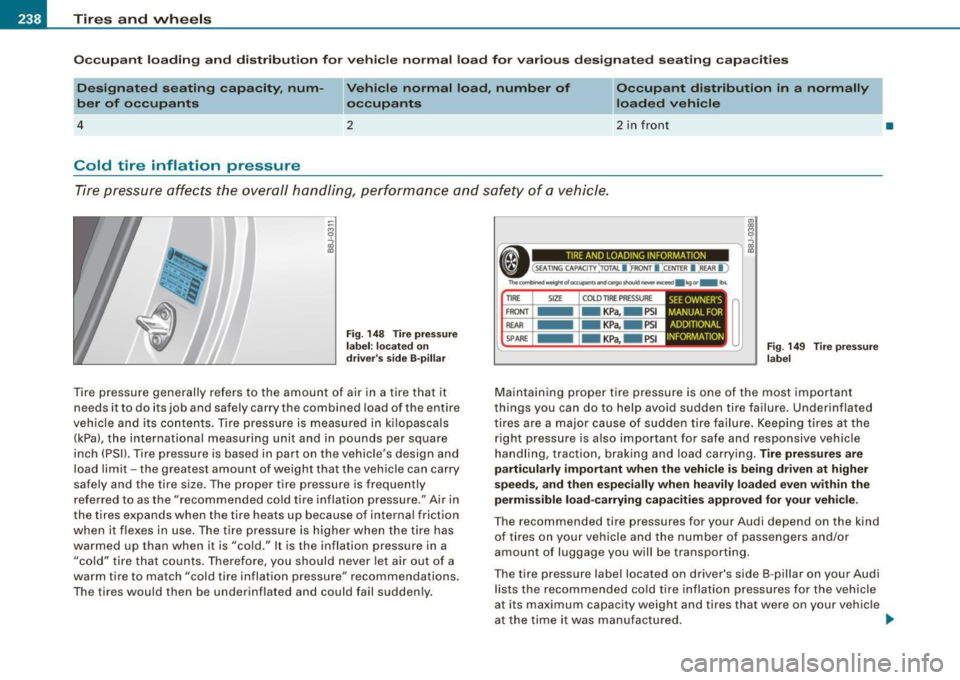
Fig. 148 Tire pressure
label: located
on
driver 's side B-pillar
Tire pressure generally refers to the amount of air in a tir e that it
needs it to do its job and safely carry the combined load of the entire
vehicle and its contents. Tire pressure is measured in kilopascals
(kPa), the international measuring unit and in pounds per square
inch (PSI). Tire pressure is based in part on the vehicle's design and
load limit -the greatest amount of weight that the vehicle can carry
safely and the tire size. The proper tire pressure is frequently
referred to as the "recommended cold tire inflation pressure." Air in
the tires expands when the tire heats up because of internal friction
when it flexes in use. The tire pressure is higher when the tire has
warmed up than when it is "cold ." It is the inflation pressure in a
"cold" tire that counts. Therefore, you should never let air out of a
warm tire to match "cold tire inflation pressure" recommendations .
The tires would then be underinflated and could fail suddenly.
* ,. ~ =cc- ------------------gl
( SEATING CAPAOTY '.TOTAl l :FRONT I :CE NTER I '.REAR I )
Toea,m....,_ oroa,.,pan11anda,golhould ,-!IICN
SIZE COLO TIRE PRESSURE
- KPa,- PSI
- KPa,- PSI
- KPa,- PSI MANUAL FOR
ADDITIONAL
INFORMATION SEEOWNER'S I
Fig . 149 Tire pressure
label
Maintaining proper tire pressure is one of the most important
things you can do to help avoid sudden tire failure . Underinflated
tires are a major cause of sudden tire failure. Keeping tires at the
right pressure is also important for safe and responsive vehicle
handling, traction, braking and load carrying .
Tire pressures are
particularly important when the vehicle is being driven at higher
speeds, and then especially when heavily loaded even within the
permissible load -carrying capacities approved for your vehicle.
The recommended tire pressures for your Audi depend on the kind
of tires on your vehicle and the number of passengers and/or
amount of luggage you will be transporting .
Th e tire pressure label located on driver's side 8 -pillar on your Audi
lists the recommended cold tire inflation pressures for the vehicle
at its maximum capacity weight and tires that were on your vehicle
•
at the time it was manufactured . .,
Page 241 of 316
________________________________________________ T_ i _r_e _s_ a_n_ d_ w_ h_ e_e _ l_s __ l'III
•
If yo u w is h to impr ove com fort when operat ing the vehi cle at
nor mal load (up t o 2 occupant s), you c an adju st tire pres sur es to
th ose spe cified f or norm al v ehi cle lo ad . B efo re op era tin g the vehicle
at maximum load , you mu st in crease the tire pre ssure s to tho se
s pe cifi ed for m aximum vehi cle lo ad =>
& .
Bear in mind that the tire pressure mon itor ing syst em * can only
monitor the tire pressures you have stored. The system does not
recogni ze th e load cond ition o f you r vehicle .
T he effec tiveness of the tire pressu re monitoring system * will be
impaired if you store no rmal load pressures bu t then operate the
vehicle at its maximum load=>& . See the
illustra tion=>
page 238, fig . 148 for the location of the label
on driver's side 8 -pillar (co lor of the actual label and exact location
on the vehic le wi ll vary slightly).
Note that the following tab le is accurate at the time of going to
press and is subject to change . In the event of discrepancies, the t ire
pressure label (on dr iver's side 8 -pillar) always takes precedence .
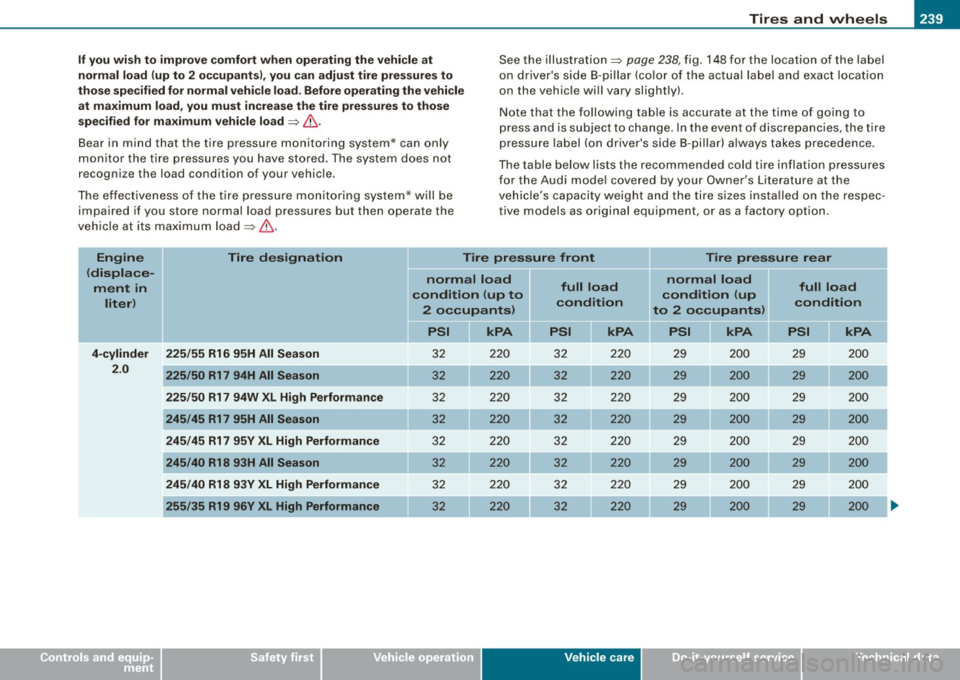
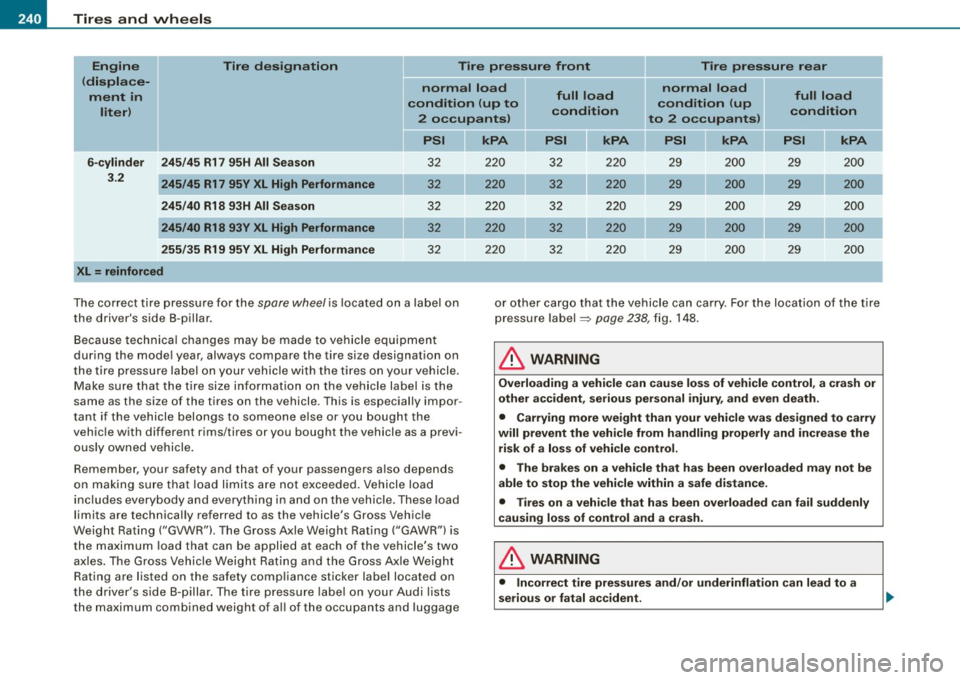
The table below lists the recommended cold tire i nflation pressures
for the Audi mode l covered by your Owner 's Litera ture at the
vehicle's capacity weight and the tire sizes insta lled on the respec
tive models as original equipment , or as a factory option .
Engine
(displ ace
m ent in
liter ) Tir
e design ation Tire pr es sur e front Tire press ure re ar
4 -c ylinder
2 .0 225
/55 R16 95H All Se ason
225 /50 R17 94H All S eason
2 2 5/5 0 R17 94W XL High Perf orma nce
245 /45 R17 95H All Sea son
2 45 /45 R17 95 V XL High Perform ance
245 /40 R18 93H All Se ason
245 /40 R18 93V XL High P erformance
255 /35 R19 96V XL High Perform ance
normal lo ad
conditi on (up to
2 occup ant s)
PSI kPA
32 220
32 220
32 220
32 220
32 220
32 220
32 220
32 220
full load
c ondition
PSI kPA
32 220
32 220
32 220
32 220
32 220
32 220
32 220
32 2 20
Vehicle care
n o rm al l oa d
full load
co ndition (up
condition
to 2 o ccupant s)
PSI kPA PSI kPA
29 200 29 200
29 200 29 200
29 200 29 200
29 200 29 200
29 200 29 200
29 200 29 200
29 200 29 200
29 200 29 200
I t •
Page 242 of 316
-~_T_ ir_e_ s_ a_ n_d _ w_ h_ e_e _l_s _________________________________________________ _
Engin e
(displa ce
ment in
lit er) Tire designation
Tir
e pressure front Tire pressure rear
normal load full load normal load
full load
condition (up to condition c
ondition (up
condition
2 o ccupants ) to 2 occupants)
6 -cylinder
3.2 245
/45 R1 7 95H All Season
245 /45 R17 95V XL High Performan ce
245 /40 R18 93H All Season
245 /40 R18 93V XL High Performan ce
255 /35 R19 95V XL High Performance
XL
= reinforced
PSI
32
32
32
32
32
The correct tire pressure for the spare wheel is located on a label on
the driver's side B-pillar .
Because technica l changes may be made to vehicle equip ment
during the mode l year, always compare the tire size designat ion on
the tire pressure la bel on y our vehicle with the tires on your vehicle.
Make sure tha t the t ire size information on the veh icle labe l is the
same as the size of the tires on the vehicle. Th is is especially impor
t ant if the vehicle belongs to someone e lse or you boug ht the
vehic le with different rims/tires or you bought the vehicle as a previ
ously owned vehicle.
Remember, your safety and that of your passengers a lso depends
on making su re tha t load limits a re not exceeded . Vehi cle loa d
inc ludes everybody and everything in and on the vehicle. These load
limits are technically referred to as the vehicle's Gross Vehicle
Weight Rating ("GVW R"). The Gross Axle Weight Rating ("GAWR") is
the maximum load that can be applied at each of the vehicle's two
ax les. The Gross Vehicle We ight Rat ing and the Gross Ax le Weig ht
Rating are listed on the safety comp liance sticker labe l located on
t he driver's side B- pillar. The tir e pressure labe l on y our Audi lists
the maximum combined weight of a ll of the occupants and luggage
kPA PSI kPA kPA kPA
220 32 220 29 2 00 29 200
220 32 220 29 200 29 200
220 3 2 220 29 2 00 29 200
220 32 220 29 2 00 29 200
220 3 2 220 29 200 29 200
or other ca rgo that the veh ic le can carry. For the location o f the t ire
pressure label::::;, page 238, fig. 148.
& WARNING
Overloading a vehi cle can cause loss of vehicle control , a crash or
other accident, serious personal injury, and even death .
• Carrying more weight th an your vehicle was de signed to carry
will prevent the vehicle from handling properly and increase the
risk of a loss of vehicle control.
• The brakes on a vehicle that has been overloaded may not be
able to stop the vehicle within a safe distance .
• Tires on a vehicle that has been overloaded c an fail suddenly
causing loss of control and a crash .
& WARNING
• Incorrect tire pressures and/or underinflation can lead to a
s erious o r fatal a ccident .
Page 243 of 316
__________________________________________________ T_ ir_e_ s_ a_ n_d _ w_ h_ e_ e_l_s __ _
•
& WARNING (continued)
• Incorrect tire pressures and/or underinflation cause increased
tire wear and can affect the handling of the vehicle.
• Incorrect tire pressures and/or underinflation can also lead to
sudden tire failure, including a blowout and sudden deflation,
causing loss of vehicle control. •
Checking tire pressure
The correct tire pressure for the tires originally installed
on your vehicle is listed on the tire pressure label located
on driver's side 8-pillar.
The recommended tire pressures are on the tire pressure label and
in the table=>
page 238, "Cold tire inflation pressure". This means
that the pressure must be checked and adjusted when the tire has
not been driven for more than a couple of miles (kilometers) at low
speeds during the previous three hours. Air in the tires expands
when the tire heats up as a result of internal friction as it flexes in
use. The tire pressure is higher when the tire has warmed up than
when it is "cold."
It is the inflation pressure in a "cold" tire that counts. Therefore, you
should never let air out of a warm tire to match "Cold tire inflation
pressure" recommendations =>
page 238. The tires would then be
underinflated and could fail suddenly.
The tire pressure label on your Audi lists the recommended cold tire
inflation pressures for the new, original equipment tires that were
on your vehicle at the time it was manufactured . For the location of
the label =>
page 238, fig. 148.
Most tires lose air naturally over time. They can also lose some air if
you drive over a pothole or hit a curb while parking. It is usually not
possible to see whether the radial tires used today are underinflated
just by looking at them. Therefore,
be sure to check tire pressures at least once a month and
always before going on a long trip. Make sure to take the number of
people and the amount of luggage into account when adjusting tire
pressure for a trip -even one that you would not consider to be
"long." See=>
page 242, "Tires and vehicle load limits" for more
important information.
Always use an accurate tire pressure gauge when checking and adjusting inflation pressures . Check all of the tires and be sure not
to forget the spare tire. If the pressure in any tire is too high when
the tire is "cold," let air out of the tire slowly with the edge of the tire
gauge and keep checking the pressure until you reach the pressure
that is correct for the load (passengers and luggage) and kind of driving you plan to do.
If the pressure in any tire is too low, note the difference between the
pressure in the cold tire and the pressure you need and add the air
that you need to reach the correct pressure for the vehicle load
(passengers and luggage) for the tires on your vehicle as listed on
the on your vehicle and in this manual and the kind of driving you
plan to do.
Never exceed the maximum inflation pressure listed on the tire
sidewall for any reason.
Remember that the vehicle manufacturer, not the tire manufacturer,
determines the correct tire pressure for the tires on your vehicle.
It is important to check the tire pressure when the tires are cold.
• Read the required tire pressure from the tire pressure label
located on driver's side 8-pillar.
• Turn the valve stem cap counter -clockwise to remove it from the
tire valve.
• Place the air pressure gauge on the valve.
• The tire pressures should only be checked and adjusted when
the tires are cold. The slightly raised pressures of warm tires must
not be reduced.
• Adjust the tire pressure to the load you are carrying.
• Reinstall the valve stem cap on the valve.
Vehicle care I t •
Page 244 of 316
-~_T_ ir_e_ s_ a_ n_d _ w_ h_ e_e _l_s _________________________________________________ _
When should I check the tir e pressure?
The correct ti re pressure is especially i mpor tant a t high speeds . The
pressure should therefore be checked at least o nce a month and
a lways before star tin g a j ourn ey.
When should I adjust the tire pressures?
Adjust the tire pres sure to the loa d you are ca rrying. After changing
a wheel
or replacing whee ls you have to adjust the tire pressures on
a ll whee ls. In addition, y ou must the n ini tia lize the new tire pres
sures in the tire pressu re monitoring system*:::::,
page 253.
& WARNING
Incorrect tire pressures and /or underinflation can lead sudden tire
failure, loss of control , collision, serious personal injury or even
death .
• When the warning symbol appears in the instrument
cluster , stop and in spect the tire s.
• Incorrect tire pressure and /or underinflation can cause
increased tire wear and can affect the handling of the vehicle and
stopping ability.
• Incorre ct t ire pressures and /or underinflation can also lead to
sudden tire failure, including a blowout and sudden deflation,
causing loss of vehicle control.
• The driver is responsible for the correct tire pre ssure s for all
tires on the vehicle . The appli cable pressure values are located on
a sticker on the driver' s side B -pillar.
• Onl y when all tires on the vehicle are filled to the correct pres
sure , the tire pre ssure monitoring system* can work correctly .
• The use of incorrect tire pressure values can lead to accidents
or other damage. Therefore it is essential that the driver observe
the spe cified tire pressure values for the tires and the correct pres
sures for the function of the tire pre ssure monitoring sy stem *.
• Always inflate tires to the recommended and correct tire pres
sure before driving off.
& WARNING (continued )
• Driving with underinflated tires bend more , letting them get
too hot re sulting in tread separation, sudden tire failure and lo ss
of control .
• Excessive speed and /overloading can cause heat build -up ,
sudden tire failure and loss of control.
• If the tire pressure is too low or too high , the tires will wear
prematurely and the vehicle will not handle well.
• If the tire is not flat and you do not have to change a wheel
immediately, drive at reduced speed to the nearest servi ce station
to che ck the tire pres sure and add air as required .
0 Note
Driving without valve stem caps can cause damage to the tire
va lves. To prevent this, always ma ke sure that fac tor y in st alled va lve
stem caps on all wh eels are securely mounted on the valv e.
'£> For the sake of the environment
Underinflated tires w ill also increase the fue l consumption. •
Tires and vehicle load limits
There are limits to the amount of load or weight that any vehic le and
any tire can ca rry. A vehicle that is overloaded wil l not handle wel l
and is more difficu lt to stop . Overloading can not on ly lead to loss
of vehic le contro l, but can also damage important parts of the
ve hicle a nd can l ead to sudden t ire fa ilure, i nclud ing a b lowout an d
sudden deflation that can cause the vehicle to crash .
Yo ur sa fety an d that o f yo ur passenge rs als o dep ends on making
sure that load limits are not exceeded . Vehicle load includes every -
b ody and eve rythi ng in and on the vehic le . These loa d limits are
~