tire pressure AUDI TT COUPE 2009 Owner's Manual
[x] Cancel search | Manufacturer: AUDI, Model Year: 2009, Model line: TT COUPE, Model: AUDI TT COUPE 2009Pages: 316, PDF Size: 71.16 MB
Page 245 of 316
______________________________________________ T_ ir_e _s_ a_n_ d_ w_ h_ e_ e_ls __ __
•
technically referred to as the vehicle's Gross Vehi cle We ight Rating
("GVWR") .
T he "GVWR" includes the weight of the bas ic veh icle, al l factory
insta lled accessor ies, a full tank of fue l, oil, coolant and other f luids
p lus ma ximum load. The maxim um load includes the number o f
passengers that the vehicle is intended to carry ("seating capacity")
w it h an assu med weight o f 15 0 l bs (68 kg) for eac h passe nger at a
designated seating position and the total weight of any luggage in
th e veh ic le .
T he
Gross Axle Weight Rating ("GAWR"l is the maximum load that
can be applied a t each of the vehic le's two axles .
The Gross Ve hicle W eig ht Rati ng and the Gross A xle Weigh t Rating
a re l isted on the safety compliance sticker labe l located on the
dr iver's s ide B -p il lar . Y o ur Aud i has 4 seat ing positions, 2 in the fron t
and 2 in the rear for total seating capacity of 4. Each seating posit ion
has a sa fet y b elt
=> page 125, "Safe ty be lts" .
T he fact t hat the re is an uppe r lim it to your ve hicle's G ross V ehic le
Weight Rati ng means tha t the total we igh t of w hateve r is bei ng
ca rried in the vehicle is lim it e d. T he m ore pass engers in t he veh ic le
or passengers who are heavier than the standard weights assumed
mean that less we igh t ca n be ca rried as lu ggage .
T he tire pressure labe l o n you r Audi also lists the max imum
c o m bined weig ht of all of t he oc cupan ts a nd lu ggage or other ca rgo
t h at the ve hicle can carry. For the locat ion of the label
=> page 238,
fig . 14 8.
& WARNING
Overloading a vehicle can cause loss of vehicle control, a crash or
other accident , serious personal injury , and even death .
• Carrying more weight than your vehicle was designed to carry
will prevent the vehicle from handling properly and increase the
risk of the loss of vehicle control.
• The brakes on a vehicle that has been overloaded may not be
able to stop the vehicle within a safe distance.
& WARNING (continued )
• Tires on a vehicle that has been overloaded can fail suddenly,
including a blowout and sudden deflation , causing loss of control
and a crash .•
Determining correct load limit
Use the example below to calculate the
total weight of the passengers and
luggage or other things that you plan to
transport so that you can make sure that
your vehicle will not be overloaded.
Steps for Determining Correct
Load Limit
1 . Locate the statement "THE COMBINED
WEIGHT OF OCCUPANTS AND CARGO SHOULD NEVER EXCEED XXX KG OR XXX
LBS "on your vehicle 's placard (tire infla
tion pressure label)~
page 238, fig. 148.
2. Determine the combined weight of the driver and passengers that will be riding
in your vehicle. ..,
Vehicle care I t •
Page 246 of 316
-Tires and wheels
3. Subtract the combined weight of the
driver and passengers from
"XXX" kilo
grams or
"XXX" pounds shown on the
sticker=>
page 238, fig. 148.
4. The resulting figure equals the available
amount of cargo and luggage load capacity. For example, if the
"XXX"
amount equals 1400 lbs. and there will
be five 150 lbs. passengers in your
vehicle, the amount of available cargo and luggage load capacity is 650 lbs. ( 1400- 750 (5
x 150) = 650 I bs.)
5. Determine the combined weight of luggage and cargo being loaded on the
vehicle. That weight may not safely exceed the available cargo and luggage load capacity calculated in Step 4.
6. If your vehicle will be towing a trailer, load from your trailer will be transferred
to your vehicle. Consult this manual to determine how this reduces the avail
able cargo and luggage load capacity of
your vehicle. -
Check the tire sidewall (=>
page 246,
fig. 152) to determine the designated
load rating for a specific tire . •
Tire service life
The service life of tires depends on a lot of different things
including proper installation and balancing, correct tire
pressure and driving style.
Fig. 150 Tire tread:
tread wear indicators
..__-lo..,.__,._~~--' (TWII
{ ------;g
0
r~~~~~~~~
• Fig. 151 Rotating tires
L_ __ ....::\ ;;~~~~~~~~~~~::::_ __ _J for more even wear
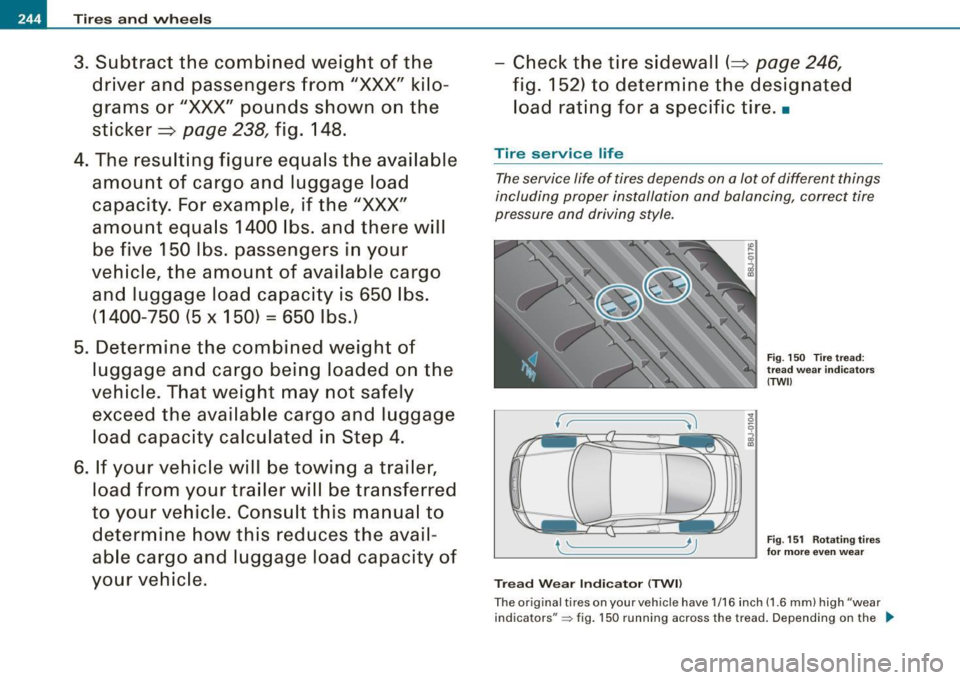
Tread Wear Indicator (TWll
The original tires on your vehicle have 1 /16 inch (1.6 mm) high "wear
indicators" ~ fig. 150 running across the tread. Depending on the
ai,.
Page 247 of 316
________________________________________________ T_ i _r_e _s_ a_n_ d_ w_ h_ e_e _ l_s __ _
•
make, th ere w ill be six to ei ght of them evenly placed around the
t ire. Ma rks o n th e tir e s idewall (f or e xam ple "TWI " or oth er symbo ls)
indicate the positions of t he tread wear indicators . Worn tires must
be re placed. Diffe re nt fig ure s may a ppl y in other countr ies=>& .
Tire pressure
Inc orr ect t ire p ressure causes prema ture wea r and ca n cause
sudden tire blow -out. For this reason, tire pressure must be checked
at leas t on ce a mont h=>
pag e 24 1.
Dri ving style
Dr ivi ng fa st aro und curves, heavy accele ration a nd hard bra king
increase tire wea r.
Rotating tires for more even wear
F or all four tires on your vehicle to have the same service life, we
r ec om men d that t he fr ont a nd rear ti res are rota ted acco rd ing to the
tire manufacturer 's suggested tire ro tation interva ls. Please
r eme mber the fo llo wi ng:
• Ti re rotation interva ls may differ from the vehicle servic e int er
va ls ou tlined in y our Wa rranty
& M ain te n ance Booklet .
• T he longer one tire is used in one location on the vehicle, the
mo re it wears a t ce rtai n poi nts ; th erefore, we recom men d th at you
follow t he tire manufac turer's su ggested t ire rotation interv als .
• Vehi cles w ith front -w hee l d rive ex per ience more trea d wea r on
the front wheels compared to all -wheel drive (quattro®l .
• Ple as e rota te tires as shown=>
page 244, fi g. 15 1.
• Extra care must be ta ken when rotating direction -specific tires
=>
p age 2 73 .
Wheel balancing
The w heels on new vehic les are balanced. However, various situa
tions du ring everyday dr iving can cause them to become unbal
anc ed, resu lt in g in v ibrat io ns y ou can usual ly fe e l throu gh th e
steering whee l. U
nba lanc ed wheels must be r eba lanced to avoid excessive wear on
ste erin g, sus pen sion and tire s. A wh ee l mu st als o b e re b ala nce d
when a new tire is insta lled.
Incorrect wheel alignment
I ncorrect wheel alignment can cause excess ive tire wear, impairing
t he sa fety of the v ehicle. If t ire s s how e xcess ive wear, hav e t he
whee l a lignment chec ked by an authoriz ed Aud i d eal er o r qua lif ied
wo rk shop.
All Wheel Drive
V eh icles w ith q uattro ® must alwa ys ha ve tire s of the same siz e,
construction and t read t ype . For detai ls see=>
page 189 .
& WARNING
Sudden tire failure can lead to loss of control , a crash and serious
personal injury!
• Never drive a vehicle when the tread on any tire is worn down
to the wear indicators.
• Worn tires are a safety hazard , they do not grip well on wet
roads and increase your risk of "hydroplaning" and loss of control.
• Always keep chemicals that can cause tire damage , such as
grease , oil , gasoline and brake fluid away from tires .
• Tires age even if they are not being used and can fail suddenly,
espe cially at high speeds . Tires that are more than 6 years old can
only be used in an emergency and then with special care and at
lower speeds .
• Never mount used tires on your vehicle if you are not sure of
their "previous history ." Old used tires may have been damaged
even though the damage cannot be seen that can lead to sudden
tire failure and loss of vehicle control. •
Vehicle care
I t •
Page 248 of 316
___ T_ i_ r_e _s_ a_ n_ d_ w_ h_ e_ e _ ls _________________________________________________ _
New tires and replacing tires and wheels
New tires and wheels have to be broken in.
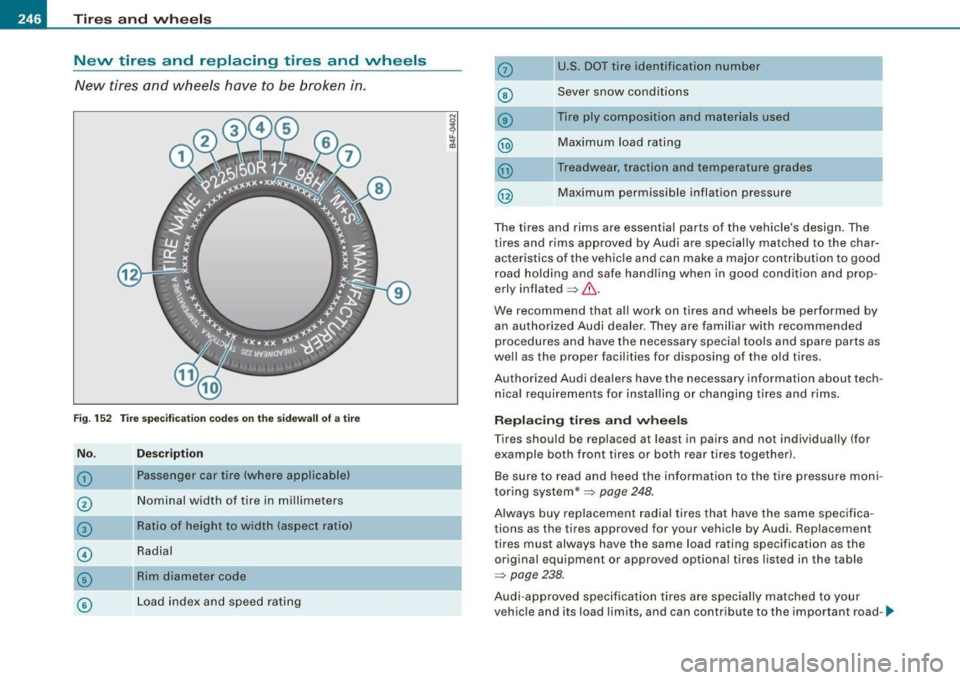
F ig . 1 52 Tir e spec ifi cati on co des o n the sid ewa ll of a t ire
No . Desc ription
G)
®
©
©
©
©
Passenger car tire (where a pplicable)
Nominal width of tire in mi llimeters
Ratio of he ight to width (aspect ratio)
Radial
Rim diameter code
Load index and speed rating
0
©
©
@
@
U.S. DOT tire identification number
Sever snow conditions
Tire ply composition and materials used
Maximum load rating
Treadwear, traction and temperature grades
@ Maximum permissible inflation pressure
The tires and rims are essential parts of the vehicle's design. The
tires and rims approved by Audi are special ly matched to the char
acteristics of the vehicle and can make a major contribution to good
road ho lding and safe hand ling when in good cond ition and prop
erly inflated
~ & .
We recommend that all work on tires and wheels be performed by
an authorized Audi dealer . They are familiar with recommended
procedures and have the necessary special too ls and spare parts as
well as the proper facilities for disposing of the old tires.
Authorized Audi dea lers have the necessary information about tech
n ical requirements for insta lling or changing tires and rims .
Replacing tires and wheel s
Tires should be replaced at least in pairs and not individual ly (for
example both front tires or both rear tires together) .
Be sure to read and heed the information to the tire pressure moni
toring system *~ page
248 .
Always buy replacement radial tires tha t have the same specifica
tions as the tires approved for your vehicle by Audi . Replacement
tires must always have the same load rating specification as the
original equipment or approved optiona l tires listed in the table
~ page 238.
Audi -app roved specification tires are specially ma tched to your
vehic le and its load limits, and can contribute to the important road-~
Page 249 of 316
________________________________________________ T_ i _r_e _s_ a_n_ d_ w_ h_ e_e _ l_s __ !II
•
holding, driving characteristics, and safety of the vehicle. The table
(::::>
page 238) l ists specifications of the tires approved for the Audi
models covered by your Owner's Literature.
The tire pressure labe l located on driver's side 8 -pillar (::::>
page 238,
fig. 149) lists the specifications of the or iginal equipment tires
installed on your vehicle at the time it was manufactured.
Federal law requires tire manufac turers to place standardized infor
mation on the sidewall of a ll tires::::>
page 246, fig . 152. This informa
tion identifies and describes the fundamenta l characteristics, the
quality grade of the tire and also provides a tire identification
number for safety standard certification a nd in case of a recall.
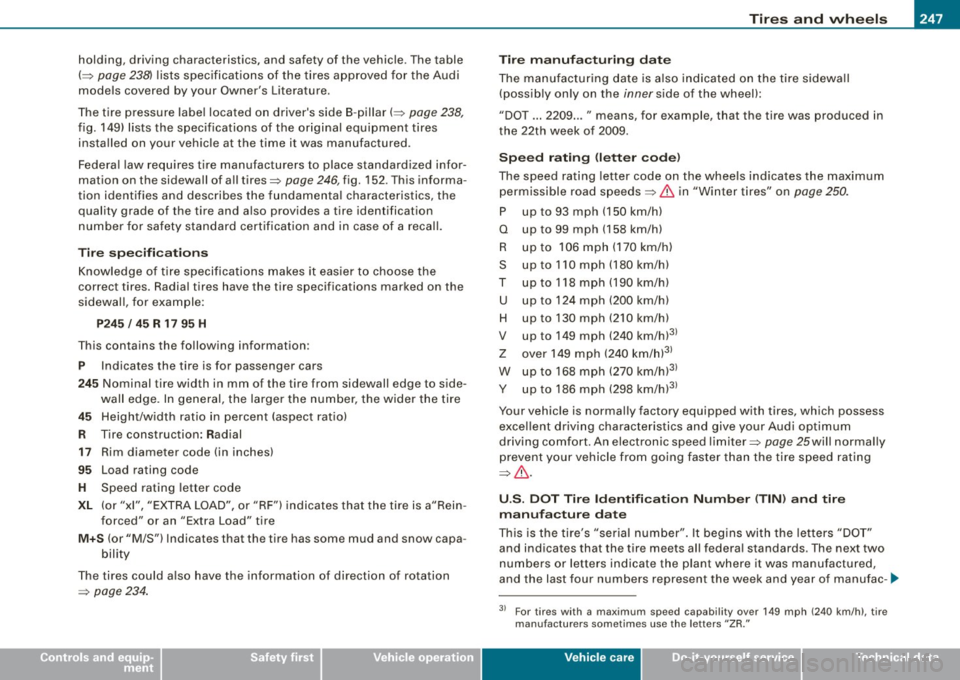
Tire sp ec ifica tio ns
Knowledge of tire specifications makes it easier to choose the
correct tires. Radial tires have the tire specifications marked on the
sidewall, for example:
P 245 / 45 R 17 9 5 H
This contains the following information :
P Indicates the tire is for passenger cars
245 Nominal tire width in mm of the tire from sidewall edge to side-
wall edge. In general, the larger the number, the w ider the tire
45 Height/width ratio in percent (aspect ratio)
R Tire construction: Radial
17 Rim diameter code (in inches)
95 Load rating code
H Speed rating letter code
XL (or "xi", "EXTRA LOAD", or "RF") indicates that the ti re is a"Rein
forced" or an "Extra Load" tire
M+ S (or "M/S") Indicates that the tire has some mud and snow capa
bility
The tires could a lso have the information of direction of rotation
=>
page 234 .
Tire manuf acturing date
The man ufact uring date is also indicated on the tire sidewall
(possibly on ly on the
inner side of the wheel):
"DOT ... 2209 . .. " means, for example, that the tire was produced in
the 22th week of 2009.
Speed rating (letter code )
The speed rating letter code on the wheels indicates the maximum
permissible road speeds=>
& in "Winter t ires" on page 250.
P up to 93 mph (150 km/h)
Q up to 99 mph (158 km/h)
R up to 106mph(170km/h)
S up to1 10mph(180km/h)
T upto118mph(190km/h)
U up to 124 mph (200 km/h) H up to 130 mph (2 10 km/h)
V up to 149 mph (240 km/h)3>
Z over 149 mph (240 km/h)3>
W up to 168 mph (270 km/h)3>
Y up to 186 mph (298 km/h)31
Your vehic le is normally factory equipped with tires, which possess
excellent driving characteris tics and give your Audi optimum
driving comfort. An electronic speed limiter:::>
page 25will normally
prevent your vehicle from going faster than the tire speed rat ing
=> & .
U.S . DOT Tire Identifi cation Number (TIN ) and tire
m anufa ctur e date
This is the tire's "serial number" . It begins with the letters "DOT"
and indicates that the tire meets all federa l standards . The next two
numbers o r letters indicate the plant where it was manufactured,
and the last four numbers represent the week and year of manufac -
~
31
For tires with a max imum speed capab il ity over 149 mph (240 km /h) , tire
manufacturers som etimes use th e le tters "ZR ."
Vehicle care I t •
Page 250 of 316

-~_T_ ir_e_ s_ a_ n_d _ w_ h_ e_e _l_s _________________________________________________ _
ture. For example, the numbers 2209 mean that the tire was
produced in the 22th week of 2009. The other numbers are
marketing codes that may or may not be used by the tire manufac
turer. This information is used to contact consumers if a tire defect
requires a recall.
Tire ply composition and materials used
The number of plies indicates the number of layers of rubber-coated
fabric in the tire. In general, the greater the number of plies, the
more weight a tire can support. Tire manufacturers also must indi
cate the materials in the tire, which include steel, nylon, polyester,
and others .
Maximum Load Rating
This number indicates the maximum load in kilograms and pounds
that can be carried by the tire.
Tire quality grading for treadwear, traction, and
temperature resistance
Tread wear, traction and temperature grades => page 249.
Maximum Permissible Inflation Pressure
This number is the greatest amount of air pressure that should ever
be put in the tire under normal driving conditions.
Replacing tires or rims on vehicles equipped with tire
pressure monitoring system*
The wheels on your vehicle are equipped with a sensor which
constantly monitors the air pressure inside the tire, and then trans
mits this information to the tire pressure monitoring system *. If you
are going to replace the wheel rims on your vehicle, make sure the
new rims also have these sensors . The sensors must be compatible
with the tire pressure monitoring system * on your vehicle.
If the sensors are to be installed on different rims , the seal, washer ,
and valve cap for each sensor must be replaced.
If you install rims, which do not have the sensors, or have sensors
which are not compatible, then the tire pressure monitoring system* will not work properly.
In this case, the tire pressure moni
toring system * would not be able to monitor the tire pressure or
warn you if it is necessary .
• The battery inside of the tire pressure sensor has a limited
service life.
• Always drive with the valve stem caps securely mounted. We
recommend using factory installed valve stem caps. Ask your autho
rized Audi dealer to replace lost valve stem caps.
The installation of replacement tires with steel cord body plies in
the tire sidewall may cause malfunction of the tire pressure moni
toring system*, and is not recommended (cord material information
in molded on the tire sidewall) .
Always check your tire pressure monitoring system* indicator after
replacing one or more tires on your vehicle. If the tire pressure
monitoring system* indicator flashes, or is on, your system is not
working properly. Your replacement tire might be incompatible with
your tire pressure monitoring sys tem* , or some component o f the
tire pressure monitoring system* may be damaged.
& WARNING
• Using incorrect or unmatched tires and/ or wheels or improper
tire and wheel combinations can lead to loss of control, collision
and serious personal injury.
• Always use tires, rims and wheel bolts that meet the specifica
tions of original factory-installed tires or other combinations that
have been specifically approved by the vehicle manufacturer .
• Tires age even if they are not being used and can fail suddenly,
especially at high speeds. Tires that are more than 6 years old can
only be used in an emergency and then with special care and at
lower speeds.
• Never mount used tires on your vehicle if you are not sure of
their "previous history." Old used tires may have been damaged
even though the damage cannot be seen that can lead to sudden
tire failure and loss of vehicle control. .,_
Page 251 of 316

________________________________________________ T.:......... ir--=e :....:s:......: a--=n..:.. d.::..:..... w..:....:.... h :....:..:e:....:e:..: 1-=s :...__IJlll
•
& W ARNING (continu ed )
• All four wheels must be fitted with radial tire s of the same type ,
s ize (rolling cir cumference ) and the same tread pattern . Driv ing
with different t ires redu ces vehicle h andling and can lead to a loss
of contro l.
• If the spare tire is not the same a s the tires that are mounted
on the vehicle -for e xample with winter tires -only use the spare
tire for a short period of time and dr ive with extra c are . Refit the
norm al road wheel as soon as safely possible .
• Never drive faster than the maximum speed for which the tires
on your vehicle are rated because tires that are driven faster than
their rated speed can fail suddenly .
• Overloading tires cause heat build-up , sudden tire failure ,
including a blowout and sudden deflation and loss of control.
• Temperature grades apply to t ires that are properly inflated and
not over or underinflated .
• For te chnical reasons it is not always possible to use wheels
from other vehicles -in some cases not even wheels from the
same vehicle model.
• If you install wheel trim discs on the vehicle wheels , make sure
that the air flow to the brakes is not blo cked . Redu ced airflow to
the brakes can them to overheat , in creasing stopp ing distances
and causing a collision .
• Run flat tires may only be u sed on vehicle s that were equipped
with them at the fa ctory . The vehicle must have a chassis de signed
for run flat tires and a factory -installed tire pressure monitoring
system* that indicates a loss of tire pressure. In correct use of run
flat tires can lead to vehicle damage or accidents . Check w ith an
autho riz ed Audi dealer or tire specialist to see if your vehicle can
be equipped with run flat tires . If run flat tires are used, they must
be installed on all four wheel s. Mixing tire types is not permitted .
0 Note
• For techn ica l reaso ns, it is not genera lly poss ib le to use t he
whee l rims from other vehicles. This can hold true fo r wheels of the
same vehicle type .
• I f the s pare t ire is d ifferent from the tires that you have mounted
on your vehicle ( fo r example win te r ti res or wide p rofile tires), then
use the spa re tire for a short period of time on ly and drive with extra
care. Replace t he flat tir e w ith the tire matching the others o n your
vehic le as soon as possib le.
• If you s hould put different whee ls a nd tires on your ve hic le (e.g.
winter wheels and tires), you must be certain that the whee ls and
t ires are co mpa tibl e w ith the tire pressure mon itor in g syste m*.
Otherwise the system w ill reg ister a malfunction and a fault
m essage w ill be d isplayed . For more info rma tion, co ntact your Aud i
dea ler.
0 Note
• When installing new tires, be careful not to damage the va lves or
tire p ressu re m on itoring system senso rs* .
• N ever drive without the valve stem cap. The valves could get
da mage d.
• I f the sensors must be replaced, then the valve must also be
r eplaced at the same time.
ci> For the sake of the environment
Dis p ose o f old tir es in acco rdance with the local requ ireme nts .•
Uniform tire quality grading
• Tread wear
• Traction AA A B C
• Temperature A B C
Vehicle care
I t •
Page 255 of 316
Tires a nd wh eels -
----------------
•
possible with a torque wrench -preferably by an authori zed Audi
dea ler or qua lified workshop. •
Low aspect ratio tires
Your Audi is factory-equipped with low aspect ratio tires. These t ires
have been thorough ly tested and been selected specifically for your
model for their superb performance , road feel and hand ling under
a variety of driving conditions . Ask your authorized Audi dealer for
more deta ils.
The low aspect rat io of these t ires is indicated by a numera l of
5 5 or
les s
in the tire's si ze designation. The numeral represents the ratio
of the tire's sidewa ll height in relation to its tread wid th expressed
in perc entage. Conv entiona l tires have a h eight/width ratio of 60 or
more .
The p erform an ce of lo w-aspe ct-r a tio tire s is pa rti cula rly sen siti ve to
improp er inflation pre ssure . It i s ther efore important that low
a spect ratio tir es are inflat ed to the sp ec ified pre ssure and th at the
i nflation pr es su re is regularl y checked and mainta ined . Tire pr es
s ure s should be che cked at le ast once a month and alw ay s before a
long tr ip :::;, page
247, "Checking tire pressure".
What you can d o to av oid tire and rim d amage
Low aspect ratio tires can be damaged more easi ly by impact with
potholes, curbs, gul lies or r idges on the road, particularly i f the t ire
is underinflated.
In order to min imize the occurrence of impact damage to the tires
of your vehicle , we recommend that you observe the following
precautions:
• Always maintain recommended inflat ion pressures . Check your
tire pressure every 2 ,000 miles (3,000 km) and add air if necessary.
• Drive carefully on roads with potholes , deep gullies or ridges.
The impact from driving through or over such obstacles can
damage your t ires. Impact with a curb may also cause damage to
your tires . •
After any impact , immediately inspect your tires or have them
inspected by the neares t authorized Audi dea ler . Replace a
damaged tire as soon as possib le.
• Inspec t you r tires every 2,000 miles (3,000 km) for damage and
wear . Damage is not always easy to see. Damage can lead to loss of
air and underin flation, which cou ld eventua lly cause tire fai lure. If
you be lieve that a tire may have been damaged , replace the tire as
soon as possible .
• These tires may wear more quickly than others.
• Please also remember that, while these tires de liver responsive
handling, they may ride less comfortably and make more noise than
other choices.
R edu ced p erform an ce in w int er/c old sea son
c ondition s
All tires are designed for c ertain purposes . The low aspect ratio,
ultra h igh performance tires origina lly instal led o n your vehic le are
intended for maximum dry and wet road performance and hand ling.
They are no t sui table for cold, snowy or icy weather conditions . If
you drive under those circumstances , you should equip your vehic le
with al l- season or winte r ti res, which offer better tract ion under
those conditions . We suggest you use the recommended snow or
all -season tires specified for your vehicle, or their equiva lent.
Refer to:::;,
page 250 for more de tai led information regarding winter
tires. •
Tire pressure monitoring system
Applies to vehi cles : with tire p ressu re mon itori ng sy stem
General notes ....J
Each t ire, including the spare (if p rovided), should be checked
month ly when co ld and inflated to the inflation pressure recom
mended by the vehicle manufacturer on the vehicle placa rd or tire
inf la tion pressure label. ( If your vehicle has tires of a different s ize _,.
Vehicle care I t •
Page 256 of 316
-~_T_ ir_e_ s_ a_ n_d _ w_ h_ e_e _l_s _________________________________________________ _
than the size indicated on the vehicle placard or tire inflation pres
sure label, you should determine the proper tire inflation pressure
for those tires.)
As an added safety feature, your vehicle has been equipped with a
tire pressure monitoring system* (TPMS) that illuminates a low tire
pressure telltale when one or more of your tires is significantly
under-inflated. Accord ingly, when the low tire pressure te lltale illu
minates, you should stop and check your tires as soon as possible,
and inflate them to the proper pressure. Driving on a significantly
under -inflated tire causes the tire to overheat and can lead to tire
failure . Under -inflation also reduces fuel efficiency and tire tread
life, and may affect the vehic le's handling and stopping ability.
Please note that the TPMS is not a substitute for proper tire mainte
nance, and it is the driver's responsibi lity to maintain correct tire
pressure, even if under -inflation has not reached the level to trigger
il lumination of the TPMS low tire pressure te lltale.
Your vehicle has also been equipped with a TPMS ma lfunction indi
cator to indicate when the system is not operating properly . The
TPMS malfunction indicator is combined with the low tire pressure
telltale. When the system detects a malfunction, the tellta le wi ll
flash for approximately one minute and then remain continuously illuminated. This sequence wil l continue upon subsequent vehicle
start -ups as long as the malfunction exists .
When the ma lfunction indicator is illuminated, the system may not
be able to detec t or signal low tire pressure as intended. TPMS
malfunctions may occur for a variety of reasons, including the
installat ion of replacement or a lternate tires or wheels on the
vehicle that prevent the TPMS from functioning properly . A lways
check the TPMS malfunction tellta le after replacing one or more
tires or whee ls on your vehicle to ensure that the rep lacement or
a lternate tires and wheels al low the TPMS to continue to function
proper ly .•
Ap plies to vehi cles : w it h tire pr ess ure monit oring sy ste m
Introduction
The tire pressure monitoring system* monitors air pres
sure in all four road wheels while the vehicle is moving.
As soon as the tire pressure monitoring system* senses a signifi
cant loss of air pressure in one or several tires, text messages and
yel low symbols appear in the instrument cluster disp lay to alert the
driver. The ) warning light in the instrument cluster comes on
when the tire is significantly underinflated
:::> page 17 .
The warning light Cl' also i lluminates in the case of a system
malfunction.
Be aware that tire pressure is a lso dependent on the temperature of
the tire. For every 18
°F (10 °C) increase in tire temperature, tire pres
sure increases by about 1.5 psi (0 .1 bar). The tire warms up while the
vehic le is moving and tire pressure rises. So you should adjust tire
pressure only when they are
cold, when the temperatu re of the t ires
is roughly the same as the ambient air temperature .
I n order to keep the tire pressure monitoring system * properly ca li
brated, tire pressure on all four tires shou ld be checked at regu lar
intervals, adjusted if necessary and saved in the proper setting
(recommended pressure)
:::> page 256 .
The tire pressure is shown on the label located on the driver's side
B -pillar (visible when the door is open) .
& WARNING
• When the tire pr essure monito ring system * wa rning light i s lit ,
on e or more of your t ires is s ignific antl y under -infl ated . You should
s top and ch eck your tire s as soon as possible , and inflat e th em to
the p rope r pr ess ure as indi cated on th e vehi cle' s tire pre ssure
lab el
:::> pag e 23 8. Driv ing on a sig nific antly under -inflated t ire
ca uses the ti re to overhe at and can le ad to tir e fai lure . Unde r-infl a
tio n also is likel y to imp air the vehi cle 's handlin g and stopping
a bility . .,
Page 257 of 316

Tires and wheels -
----------------
•
& WARNING (continued)
• Do not adjust tire pressure when tire temperature is excessive.
This could lead to serious tire damage and even cause the tire to
burst, with the additional danger of an accident.
tread life.
[ i] Tips
• Each tire should be checked monthly when the temperature of
the tires is about the same as ambient air temperature and set to the
recommended inflation pressure as specified on the tire pressure
label =>
page 238.
• The factory supplied spare wheel is equipped with a sensor for
the tire pressure monitoring system *. As long as the spare wheel is
not mounted, the tire pressure of this tire will not be monitored.
• The tire pressure monitoring system * helps the driver to keep an
eye on tire pressures. But the driver still has the responsibility for
maintaining the correct tire pressure.
• Tire pressure must only be adjusted when the temperature of the
tires is about the same as ambient air temperature.
• When tires are replaced, the sensors and valves should not be
exchanged . The valve core, nut, valve sealing and seal washer
(replacement kit) needs to be replaced. If necessary, the valve and
the wheel electronics have to be replaced.
• If you should put different wheels and tires on your vehicle (e.g.
winter wheels and tires), you must be certain that the wheels and
tires are compatible with the tire pressure monitoring system*.
Otherwise the system will register a malfunction and a fault
message will be displayed. For more information, contact your Audi
dealer. •
Adjust the tire pressure and store the pressure in the tire pres
sure monitoring system* to the load you are carrying.
• For Declaration of Compliance to United States FCC and Industry
Canada regulations =>
page 296. •
Applies to vehicles : with tire pressu re mon itoring system
Significant loss of air pressure }
The yellow symbol appears in the event of a significant
loss of air pressure.
Fig. 153 Display:
yellow symbol with message
If the I warning light in the instrument cluster comes on
and then the(•' symbol appears in the display ~ fig. 153,
pressure in at least one tire is too low.
- Stop driving as soon as possible without endangering
yourself and other drivers on the road.
Inspect all tires.
- Change the tire if necessary ~
page 268.
The, warning light in the instrument cluster comes on when the
tire is significantly underinflated .
In addition, the tire symbol
J appears in the display together with
the message Please check tire pressure=> fig. 153. .._
Vehicle care
I t •