tire pressure AUDI TT COUPE 2009 Owner's Guide
[x] Cancel search | Manufacturer: AUDI, Model Year: 2009, Model line: TT COUPE, Model: AUDI TT COUPE 2009Pages: 316, PDF Size: 71.16 MB
Page 258 of 316
___ T_ i_ r_e _s_ a_ n_ d_ w_ h_ e_ e _ ls _________________________________________________ _
After a few seconds, the message disappears again. If you would
like to show the message again, press the Set/Check button
=>
page 72 , fig. 2@ .
[ i) Tips
• In the case of an intentional loss of air pressure, for example,
when re -adjusting tire pressure, this has to be stored again after
wards=>
page 256.
• Tire pressure must only be adjusted when the temperature of the
tires is about the same as ambient air tempera ture.
• The yellow symbol disappears, when the tire pressure is
correc ted and the new pressure is stored in the system=>
page 256.
• After changing a wheel or replacing a wheel with the spare tire
you have to adjust the tire pressures on all wheels. In addition , you
must then initialize the new tire pressures in the tire pressure moni
toring system*=>
page 257. •
Ap plies to vehicles: w ith tir e pressure monitor in g system
Storing tire pressures
Correct storage of specified pressure is the basic require
ment for reliable tire pressure monitoring.
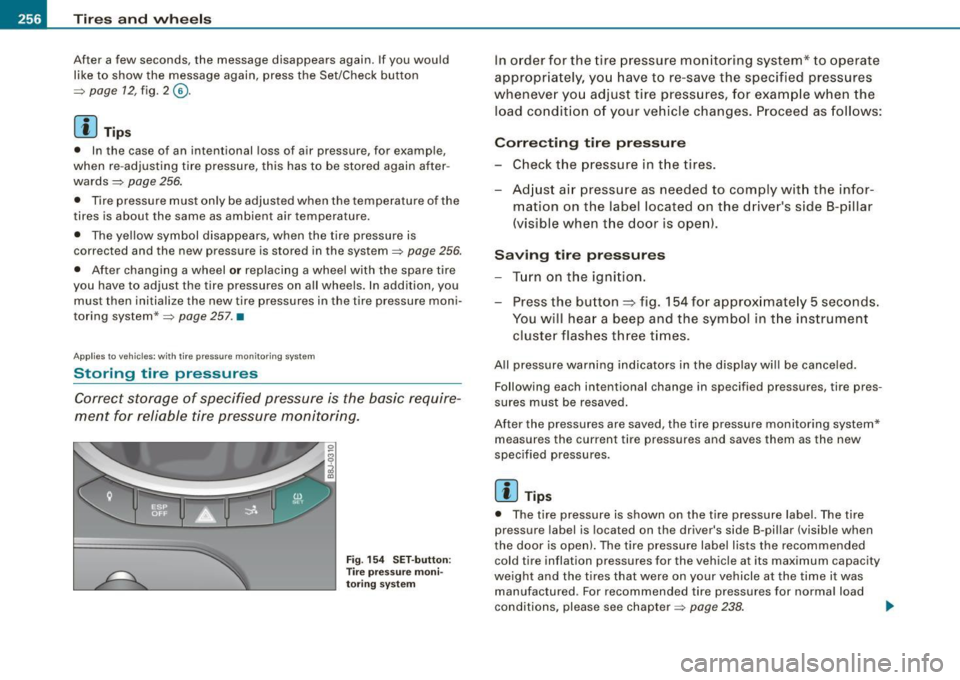
Fig. 154 SET-button :
Tire pressure moni
toring system
In order for the tire pressure monitoring system* to operate
appropriately, you have to re-save the specified pressures
whenever you adjust tire pressures, for example when the
load condition of your vehicle changes . Proceed as follows:
Correcting tire pressure
Check the pressure in the tires.
Adjust air pressure as needed to comply with the infor mation on the label located on the driver's side B -pillar
(vis ible when the door is open).
Saving tire pressures
Turn on the ignition.
Press the button=> fig. 154 for app roximately 5 seconds.
You will hear a beep and the symbol in the instrument
cluster flashes three times.
All pressure warning indicators in the display will be canceled.
Following each intentional change in specified pressures, tire pres
sures must be resaved.
After the pressures are saved, the tire pressure monitoring system* measures the current tire pressures and saves them as the new
specified pressures.
[ i J Tips
• The tire pressure is shown on the tire pressure label. The tire
pressure label is located on the driver's side B-pillar (visible when
the door is open). The tire pressure label lists the recommended cold tire inflation pressures for the vehicle at its maximum capacity
weight and the tires that were on your vehicle at the time it was
manufactured . For recommended tire pressures for normal load
conditions, please see chapter
=> page 238. .,_
Page 259 of 316

________________________________________________ T_ i _r_e _s_ a_n_ d_ w_ h_ e_e _ l_s __ !II
•
• The tire pressure monitoring system * helps the driver to keep an
eye on tire pressures. But the driver still has the responsibi lity for
maintaining the correct tire pressure .•
Applies to vehicles: with tire pressure mon itorin g system
Wheel change
If a wheel is changed, the wheels that were exchanged
have to be re-programmed .
- Turn on the ignition.
- Press the button~
page 256, fig. 154 for approximately 5
seconds. You will hear a beep and the symbol in the button flas hes three times.
Programming is necessary :
• after the tires have been rotated on the vehicle, or the spare tire
is used,
• if tires with new wheel sensors are used .
A ll pressure warning indicators in the display will be canceled. The
system malfunction error message wil l not disappear until the
vehicle is underway . With pressing the button~
page 256, fig. 154,
the re -programming of the new sensors and storing of ac tua l pres
sures starts. This learning phase can take up to 10 minutes driving
time .
During the learning process the tire pressure monitoring system* is
not avai lable. •
Applies to veh ic les: with tir e pressure monitoring system
Malfunctions •
A malfunction can have various causes.
F ig . 155 Display:
S yst e m m alfun ctio n
If the .J., warning light in the instrument cluster flashes for approxi
mately one minute and then remains continuously illuminated and
additional ly the T ~~ fig. 155 symbol appears in the display, the
tire pressure mon itoring system* is not available. This can have
various causes.
• If the message appears at the end of the lear ning process, the
system cannot recognize the wheels installed on the vehicle. This
can be because one or more wheels without a wheel sensor were
insta lled.
• A wheel sensor or other component may have failed .
• During initialization the system has detected more than 4 wheels
on the vehicle, for example whi le driving next to another car with a
tire pressure monitoring system*.
• A whee l change was made but the button
~ page 256 , fig. 154
was not pressed.
• Audi replacement parts were not used.
• I f snow chains are being used, system function can be compro
mised due to the shielding properties of the chains .
• The tire pressu re monitoring system* may not be available
because of a radio malfunction .
Vehicle care I t •
Page 260 of 316

-~_T_ ir_e_ s_ a_ n_d _ w_ h_ e_e _l_s _________________________________________________ _
• Transmitters with the same frequency , such as radio head
phones in the vehic le or radio equipment, can cause a temporary
disruption of the system through excessive electromagnetic fields .
• Elimina te the interference if possible/if you can and then
proceed as follows : Turn off the engine for 20 minutes . T hen drive
another
1 0 min. If the warning light comes on aga in, you should
contact your authorized Audi dealer immediately to have the problem corrected .
• Do not use commercially avai lable tire sea lants. Otherwise, the
e lectrical componen ts of the tire pressure monitoring system* wil l
no longer work properly and the sensor for the tire pressure moni
toring system * will have to be replaced by a qualified workshop .•
Run-flat tires
Ap plies to ve hic les : w it h R un -f la t tires
Introduction
Run-flat tires help keep you moving if a tire goes flat.
Re inforced sidewalls give the tires run -flat capability if t ire pressure
is lost .
We recommend that run -flat tires only be mounted on vehicles that
were origina lly equipped with these special tires at the factory and
have a Tire Pressure Monitoring System.
Run-flat tire s can be identified by the letter s "RSC" on the tire side
wa ll.
If you do change the tires on you r vehicle from normal to run -flat
tires , you must buy the special rims required for run -flat tires, and
the Tire Pressure Mon itoring System must be reprogrammed by an
authorized Audi dea ler or other qual ified workshop.
What do run -fl at tires do ?
These specia l tires have run-flat capabilities that help keep you
moving if a tire loses pressure and goes flat. Under favorab le condi -tions tires can be driven
a
t lea st 30 mile s (50 km ), but you must not
drive
fa ster than 50 mph (80 km/h )=> page 259, "Driving with run
flat tires".
The Tire Pressure Monitoring System constant ly checks the air pres
sure in the tires. If the run-flat system is active (shown in the center
display), you must inspect the affected t ire or t ires and then decide
whether to cont inue dr iving. Be sure to fol low these tips
=> page 259, "Driving with run -flat tir es" .
When it is n ot po ssible to c ontinue dri ving, ev en with
run-flat tir es?
• I f the Electronic Stabi lization Program (ESP) is not work ing o r
keeps coming on.
• I f the Tire Pressure Monitoring System does not work.
• I f the tire has been severely damaged, in a crash, for example .
T he t read can separate from a damaged tire as the wheel turns , and
hit parts of the vehicle, such as the fuel tank filler neck, fuel lines or
brake lines.
• Do not con tin ue d riving if severe vibra tion occurs or if the tire
starts to smoke because the tire is running hot.
• Do not conti nue drivi ng if da mage to the tire, such as cracks in
the sidewal l, appears .
& WARNING
Improper use of run -fl at tires can cause ve hic le da mage th at can
le ad to los s of vehicle control , a crash and seriou s personal injury .
• Run-flat t ires can only be used w ith spe cial rims .
• Run -fl at tires must always be monitored with a properly
programmed Tire Pre ssure Monitoring Sy stem.
• Alway s inspect a tire that ha s lo st air to make sure it i s safe to
drive with the tire in the run -flat mode .
• Never dr ive with run -fl at tire s th at have been dam aged in a
colli sion.
Page 261 of 316
________________________________________________ T_ ir_e _s_ a_n_ d_ w_ h _e_e_ l_s __ lfll
•
& WARNING (continued)
• Never drive with run-flat tires if heat build-up causes the tire to
give off smoke .
• Never drive with run-flat tires if the vehicle shakes or vibrates
severely.
• Never drive with a run-flat tire that develops sidewall cracks or
other damage while in use .
0 Note
Run-flat tires have specia l characteristics and requirements, that are
very different from conventional tires. Run-flat tires require special
rims for run-flat use and cannot be used on conventional wheel
rims.
[ i] Tips
• I f you are not able to continue driving with run -flat tires, please
seek professional assistance.
• Please contact your authorized Audi dealer or Audi of America,
Inc . if you have questions about tires and rims. •
Applies to vehic les: with Run-flat t ires
Driving with run-flat tires
Handling characteristics change when tire pressure is
low.
Driving on tires with low tire pressure changes the way a
vehicle handles, particularly when cornering and braking.
The handling characteristics of run-flat tires do not seem to
change a lot even when driving on low pressure or in the
run-flat mode. Nevertheless you must still take special
precautions when operating a vehicle on run-flat tires when
tire pressure is low or the tire(s) is flat: The
Electronic Stabilization Program (ESP) must be
switched on.
- Never drive faster than 50 mph (80 km/h)~
&-
Plan ahead when driving and anticipate what you will
have to do considering traffic and road conditions up
ahead.
- Accelerate carefully.
- Avoid unnecessary and sudden steering and braking
maneuvers.
Reduce your speed in plenty of time before intersections,
curves and other places where you may have to react
quickly.
Please see:=> page 258, "When it is not possible to continue driving,
even with run -flat tires?"
Handling characteristics change when driving with
low air pressure or with flat tires even with special run
flat tires
A low pressure or flat front tire affects vehicle handling characteris
tics by pulling the vehicle slightly to the side where the tire is
mounted and reduces braking performance.
A low pressure or flat rear tire also affects driving characteristics by
pulling to the side where the tire is mounted and also reduces
braking performance. The effect on vehicle handling is most notice
able when driving around curves.
& WARNING
Changed vehicle handling characteristics when driving in the run
flat mode can cause loss of vehicle control, a crash and serious personal injury. .,,,
Vehicle care
I t •
Page 267 of 316
_____________________________________________ w __ h_a _t _ d_ o_ l _d _o :.....:. n,;_ o::.. w..:....:,_ ?,;_· __ Ill
•
Your vehicle is equipped with a t ire repair kit, the Tire Mobility
System (TMSl *.
In the event of a tire fai lure, the TMS is in the luggage compartment
under the floor . It consists of the tire sealant and an e lectric ai r
pump.
Using
TMS , tire damage caused by foreign bodies up to about
0.16 inch (4 mm) in d iam ete r can be sea le d reli abl y.
T he foreign object can stay i n the tire .
The tire sealant mu st not be used :
• for cuts or punctures in the tire which are larger than
0.16 inch
(4 mm )=> page 264, fig . 157 G)
• for damage to the rim@
• if you have bee n drivin g wi th very lo w tir e pr essures o r tire s w it h
no air@
Usi ng th e
TMS is de scrib ed in th e se ction=> page 2 66, "Prel imina ry
steps" .
TMS can be used at temperat ures down to -4 °F ( -20 °C).
& WARNING
Take the following precautions after repairing the tire :
• Do not drive faster than 50 mph (80 km/h)!
• Avoid full -throttle acceleration , heavy braking and fast
cornering.
• The vehicle's road behavior can be affected.
• Tires sealed with TMS are intended only for temporary , short
term use .
• After using the tire sealant the tire pressure monitoring system
may no longer work properly . Drive carefully to the next profes
sional repair facility .
• TMS must NOT be used ,
& WARNING (continued )
-for cuts or punctures in the tire which are larger than
0 .16 inch (4 mm)
- for damage to the rim
- if you have been driving with very low tire pressures or tires
with no air
• Seek professional assistance if it is not possible to repair the
tire with the tire sealant.
& WARNING
The tire sealant must not come into contact with skin , eyes or
clothing.
• If you get any tire sealant in your eyes or come into conta ct
with it , rinse the affected area thoroughly with clean water. Find a
physician immediately!
• Change any clothing contaminated with tire sealant immedi
ately.
• Do not inhale the vapor!
• If you have swallowed tire sealant , rinse your mouth thor
oughly right away and drink plenty of water .
- Do not induce vomiting! Find a physician immediately!
• If you have allergic reactions, find a physician immediately .
• Keep the tire sealant away from children.
0 Note
Do not u se co mm ercially ava ilable tire sealants . The elec trical
components of the tire pressure monitoring system wi ll no lo nger
wo rk p roperly.
~ For the sake of the environment
U sed sealant bottles ca n be dropped off at a recycling faci lity .
Do-it -yourself service
Page 269 of 316
_____________________________________________ W.:..:..; h:..:.= a:.:t ..:.d=-= o:....:... I .::d :.:o :....:.. n:.:o::.. w.:...:.. ?:...___J
Assembling Tire Mobility System
Fig . 160 Connector for
the Tire Mobility System
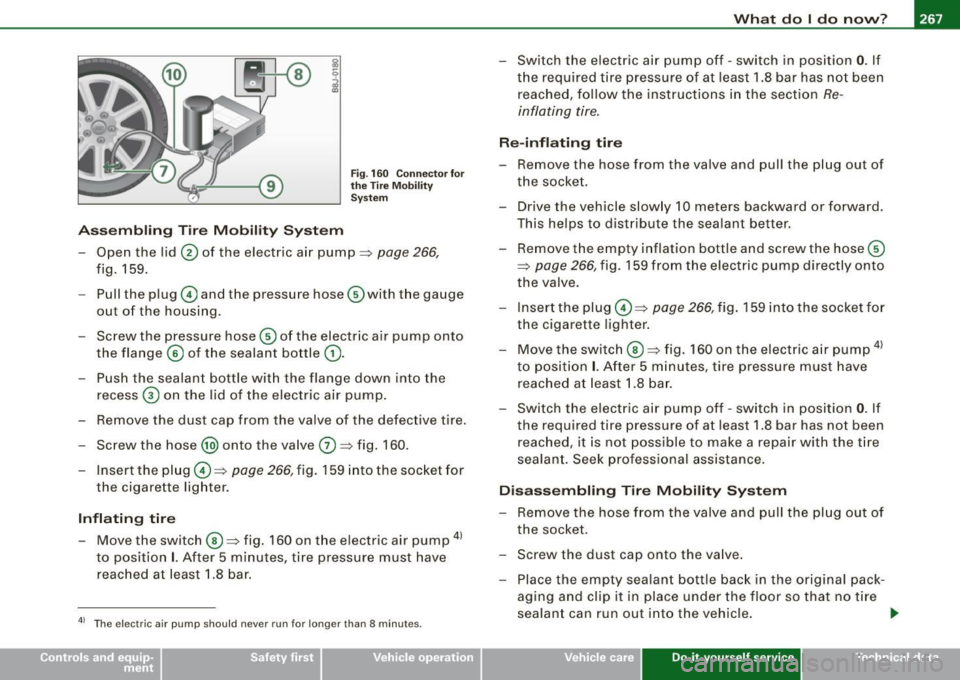
Open the lid 0 of the electric air pump:::;, page 266,
fig. 159.
- Pull the plug © and the pressure hose G)with the gauge
out of the housing.
- Screw the pressure hose© of the electric air pump onto
the flange © of the sealant bottle
G).
-Push the sealant bottle with the flange down into the
recess
0 on the lid of the electric air pump.
- Remove the dust cap from the valve of the defective tire.
- Screw the hose@) onto the valve
0:::;, fig. 160.
- Insert the plug©:::;,
page 266, fig. 159 into the socket for
the cigarette lighter.
Inflating tire
- Move the switch®:::;, fig. 160 on the electric air pump
4
l
to position I. After 5 minutes, tire pressure must have
reached at least 1.8 bar.
41 The electric a ir pump should never run for longer than 8 minutes .
-Switch the electric air pump off -switch in position 0. If
the required tire pressure of at least 1.8 bar has not been
reached, follow the instructions in the section
Re-
inflating tire.
Re-inflating tire
- Remove the hose from the valve and pull the plug out of
the socket.
- Drive the vehicle slowly 10 meters backward or forward.
This helps to distribute the sealant better.
- Remove the empty inflation bottle and screw the hose©
:::;, page 266, fig. 159 from the electric pump directly onto
the valve.
- Insert the plug ©:::;,
page 266, fig. 159 into the socket for
the cigarette lighter.
- Move the switch®:::;, fig. 160 on the electric air pump
4
l
to position I. After 5 minutes, tire pressure must have
reached at least 1.8 bar.
- Switch the electric air pump off -switch in position
0. If
the required tire pressure of at least 1.8 bar has not been
reached, it is not possible to make a repair with the tire
sealant. Seek professional assistance.
Disassembling Tire Mobility System
- Remove the hose from the valve and pull the plug out of
the socket.
- Screw the dust cap onto the valve.
- Place the empty sealant bottle back in the original pack-
aging and clip it in place under the floor so that no tire
sealant can run out into the vehicle. .,
Vehicle care Do-it-yourself service irechnical data
Page 270 of 316
11111.___W_ h_ a _ t_d_ o_ l _d _o_ n_ o_ w_ ? ______________________________________________ _
-Place the electric air pump in the luggage compartment
for the time being.
- Start driving right away so that the sealant is dist ributed
in the tire.
& WARNING
• Follow the manufacturer's safety instructions on the decal for
the air pump and the sealant bottle.
• If a tire pressure of 1.8 bar cannot be achieved after pumping
for 5 minutes, the tire is too severely damaged. Do not continue to
drive.
• Seek professional assistance if it is not possible to repair the
tire with the tire sealant.
[ i] Tips
• Do not operate the electric air pump for more than 8 minutes
without stopping, otherwise it can overheat. When the air pump has
cooled down, you can continue to use it.
• If sealant has escaped, allow it to dry, then you can peel it off. •
Applies to veh icles: with Tire Mob ili ty Sys tem
Final check
After driving for a short distance, tire pressure
must be checked
- After driving for about 10 minutes, stop and check the
tire pressure.
- If tire pressure is still at least 1.3 bar, inflate the tire to
specified pressure (see driveas side B-pillarl, drive to the
next repair shop and have the tire and the sealant bottle
replaced. -
If tire pressure is less than 1.3 bar, the tire is too severely
damaged. Do not continue to drive. Seek professional
assistance.
& WARNING
If tire pressure is less than 1.3 bar after driving for 10 minutes, the
tire is too severely damaged. Do not continue to drive. Seek profes
sional assistance.
[ i] Tips
After a tire repair, have the sealant bottle replaced at a dealership.
This restores full functionality to the Tire Mobility System. •
What should I be aware of when
changing a tire?
General information
The following sections will provide you with important information
on how to change a tire using the vehicle tool kit.
However, we recommend that you have a qualified service center
change the tire and perform all work associated with changing it. •
Page 275 of 316
What do I do now? -
----------------
•
• The whe el bo lts should be cl ean and easy to turn . C heck for dirt
an d corro sion on the mati ng s urfaces o f both th e wheel a nd the
hub. Remove a ll dirt fro m these surfaces before remountin g the
whee l.•
Notes on wheel change
Ple as e rea d th e informati on => pag e 246 , "New tir es an d r ep laci ng
tir es and whee ls", if you ar e goin g to us e a spar e tire which is
d ifferent from th e tir es on y our v ehic le .
After you ch ange a tire :
• Check the tire pressure on the spare immediately after
mounting.
• Have the wheel bolt tightening torque checked with a torque
wrench as soon as possible by your authorized Audi dealer or a qualified service station .
• With steel and alloy wheel rims, the wheel bolts are correctly
tightened at a torque of 90 ft lb (120 Nm l.
• If you notice while changing a tire that the wheel bolts are
corroded and difficult to turn , then they should be replaced before
you check the tightening torque.
• Replace the flat tire with a new one and have it installed on your
vehicle as soon as possible . Remount the wheel cover.
Until then , drive with extra care and at reduced speeds .
& WARNING
• If you are going to equip your vehicle with tires or rims which
differ from those which were factory installed , then be sure to read
the information
=> page 246, "New tires and replacing tires and
wheels ".
• Always store the tools securely in luggage compartment .
Otherwise, in an accident or sudden maneuver they could fly
forward, causing injury to passengers in the vehicle.
0 Note
D o not us e comme rc ia lly av ai labl e tire sea lants. Otherw ise, t he elec
trical components of the ti re pressure monitor ing system* will no
l o nger wor k properly a nd the se ns or fo r the tire pr essure moni
to ring system will have to be rep laced b y a qualified workshop. •
Tires with unidirectional tread design
T ires w ith unid ire ction al tread design must be m ounted
w ith their tread patte rn po inted t he r ight dire ction.
A un id irectiona l tir e ca n be iden tified by arrows on the sidewall ,
w hi ch point in th e dir ec tion of the r otation. You mus t follow th e
specified direction of rotati on. T his is necessa ry in o rder fo r these
t ire s to de ve lop their optimum ch arac ter ist ics rega rdin g grip, r oad
noise, wear, and h ydroplaning .•
Do-it -yourself service
Page 278 of 316

ffl.___F_ u_ s _ e_s _ a_n _ d_ b_ u_lb _ s _______________________________________________ _
Equipment No.
II Equipment
Amps I
Engine relay, fuel tank control unit, Airbag Off 16 A/C system (control unit) 10
1 light, light switch (switch illumination), diagnos-10
tic connector
17 Tire pressure monitoring system (control unit) 5
18 Not used
2 ABS, ASR, ESP, brake light switch 5
19
Not used
3 AFS headlight (left) 5 20
Not used
Oil level sensor (extended maintenance interval)
(WIVl, tire pressure monitoring system, switch
21 Fuel injectors (gasoline engine) 10
4 for Electronic Stability Program (ESP), AFS head-5 22 Wind deflector (Roadster) 30
lights (control unit), A/C system (pressure sen-23 Horn 20 llsorl, backup light switch
Automatic headlight range control, AFS head -
24 Transmission (control unit) 15
5
light (right)/ manual headlight range control, 5/10 25 Heater rear window Coupe/heated rear window 30/20
halogen headlights Roadster
Control unit for CAN data transfer (gateway),
26 Driver's side power window 30
6 electromechanical steering, automatic transmis-5 27 Passenger's side power window 30
sion shift gate
28 Not used
Acoustic Park Assist, automatic dipping interior
rear view mirror, garage door opener, heatable
29 Washer pump 15
7
windshield washer nozzles, washer pump, wind 5
30 Cigarette lighter 20
deflector relay (Roadster)
31 Starter 40
8
Haldex clutch 5 32 Steering column module 5
9
Control unit Audi magnetic ride 5 33
Instrument cluster 5
Airbag control unit 5 34 Radio navigation system, radio 15
1 1 Mass airflow sensor, crankcase heating 5/10
35
Audio amplifier 30
Door control unit (central locking driver/passen-12 10
36 Engine (control unit) 10 gerl
13 Diagnostic connector 10 37 CAN (Gateway) 5
Rain sensor, automatic transmission shift gate 5 38 Not used
15 Roof light (interior lighting) 5 39 Not
used
Page 299 of 316
_______________________________________________ C _o_ n _ s_u _ m_ e_ r_l_n _f_o _ r_ m_ a_ t _i _o _ n __ !II
• Remote control key
• Tire pressure monitoring system
FCC Part 1 5.1 9
This device complies with part 15 of the FCC Rules. Operation is
subject to the following two conditions :
(1) This device may not cause harmful interference, and
(2) this device must accept any interference received, including
interference that may cause undesired operation .
FCC Part 1 5.21
CAUTION:
Changes or modifications not expressly approved by the party
responsible for compliance could void the user's authority to
operate the equipment.
RSS-Gen Issue 1
Operation is subject to the following two conditions:
(1) this device may not cause interference, and
(2) this device must accept any interference, including interference
that may cause undesired operation of the device. •
Controls and equip
ment Safety first Vehicle operation
Vehicle care Do-it-yourself service Tec hn ica l da ta