brake light AUDI TT COUPE 2009 Owner's Manual
[x] Cancel search | Manufacturer: AUDI, Model Year: 2009, Model line: TT COUPE, Model: AUDI TT COUPE 2009Pages: 316, PDF Size: 71.16 MB
Page 110 of 316
• ..__H_ o_m_ e_ L_ i_ n _k_ @_R __________________________________________________ _
Applies to vehicles: with Home li nk® universal remote control
Programming the Homelink ® transmitt er
The transmitter is programmed in two phases. For rolling
code transmitters, a third phase is also necessary.
1----------------.....:!i:l
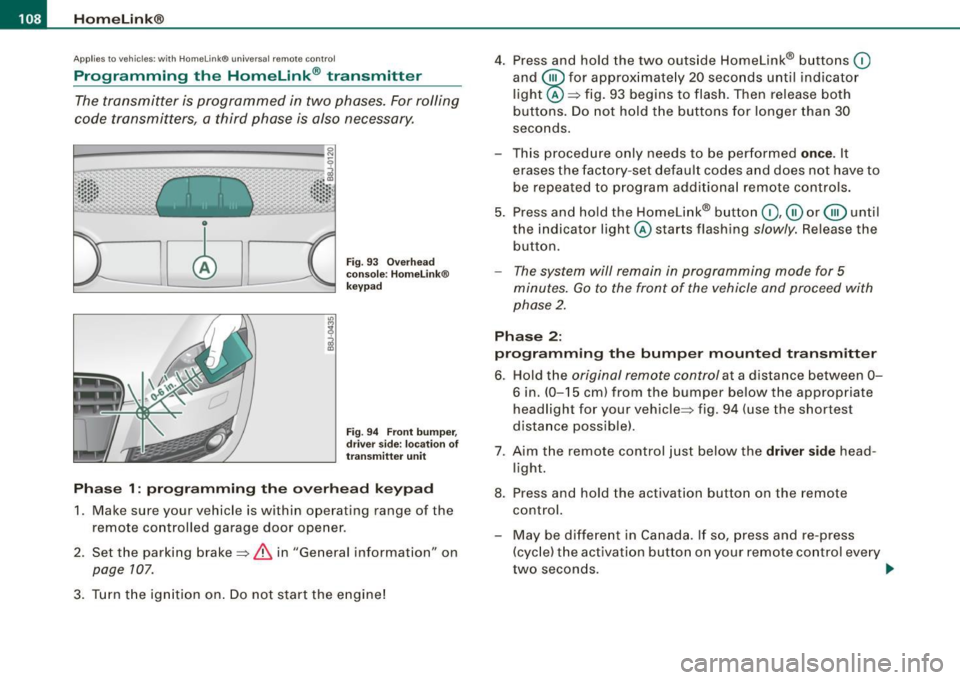
Fig . 93 Overhead
console : Homelink®
keypad
Fig. 94 Front bumper,
driver side: location of
transmitter unit
Phase 1: programming the overhead keypad
1. Make sure your vehicle is within operating range of the
remote controlled garage door opener .
2. Set the parking brake~
& in "General information" on
page 107.
3. Turn the ignition on. Do not start the engine! 4. Press and hold the two outside Homelink® buttons
(D
and
@for approximately 20 seconds until indicator
light @::::::, fig. 93 begins to flash. Then release both
buttons. Do not hold the buttons for longer than 30
seconds.
This procedure only needs to be performed
once . It
erases the factory-set default codes and does not have to
be repeated to program additional remote controls.
5. Press and hold the Homelink® button
(D , ® or @ until
the indicator light @starts flashing
slowly. Release the
button.
- The system will remain in programming mode for 5
minutes.
Go to the front of the vehicle and proceed with
phase 2.
Phase 2:
programming the bumper mounted transmitter
6. Hold the original remote control at a distance between 0-
6 in. (0-15 cm) from the bumper below the appropriate
headlight for your vehicle~ fig . 94 (use the shortest
distance possible) .
7. Aim the remote control just below the
driver side head
light.
8. Press and hold the activation button on the remote control.
- May be different in Canada. If so, press and re-press
(cycle) the activation button on your remote control every
two seconds. .-,,
Page 186 of 316

___ ln_ t _e_ ll-'"ig ...,_ e_ n_t _t_ e_ c_ h _ n_o _ l_o _,.g= y,_ __________________________________________ _
Electronic differential lock (EOL)
The electronic differential lock monitors the rotational
speed of the drive wheels.
General notes
The electronic differential lock (EDU helps the car to start moving,
accelerate and climb a gradient on surfaces providing poor or
almost no grip. Without EDL, this would be difficult, if not impos
sible.
How the system works
Th e EDL operates automatically. It monitors the rotational speed of
the drive wheels on an axle with the help of the ABS sensors
=> page 187. If a noticeable difference in rotational speed between
the drive wheels on one axle is detected (e.g. on slippery ground on
one side), the spinning wheel is braked, thereby transferring power
to the other drive wheel or wheels (all-wheel drivel. This is done up
to a speed of about 60 mph (100 km/hl. Noises from the brake
system signal that wheel spin is being controlled.
Driving off
When driving off, always be sure to keep road conditions in mind as
you accelerate . If one drive wheel spins because it is on a surface
with less grip, gradually increase the pressure on the accelerator
pedal until the car starts to move. The wheel less able to transfer
power spins.
Overheating of brakes
To prevent the disc brake of the braked wheel from overheating if
subjected to excessive loads, the EDL cuts out temporarily . The
vehicle remains operational and behaves in the same way as a
vehicle without EDL.
As soon as the brake has cooled down, EDL switches on again auto
matically.
& WARNING
• When accelerating on slippery surfaces, such as on ice or snow,
always be careful when depressing the accelerator pedal. Even
with the EDL working, the drive wheels can spin and reduce your ability to control your car. -Risk of crash!
• The increased safety afforded by EDL does not mean that you
can take safety risks. Always adapt your driving style to the road
conditions and traffic situation.
[ i] Tips
If a fault occurs in the ABS, the EDL is also not functioning . This is
indicated by the ABS warning light=> page 20. •
Anti-Slip Regulation System (ASR)
The Anti-Slip Regulation System prevents the driven
wheels from spinning when the car is accelerating.
General notes
The Anti-Slip Regulation System (ASR) is integrated in the electronic
stabilization program (ESP). When the vehicle starts up and acceler
ates , the wheels are prevented from spinning by adjusting the
engine power to match the amount of grip available from the road
surface .
How the system works
ASR performs automatically, i.e. without the driver's intervention .
With the aid of the ABS sensors => page
187, ASR monitors the
speed of the driven wheels. If the wheels start to spin, the engine
torque is reduced automatically until the tires find enough grip to
lock onto the road surface . The system is active across the entire
speed range.
The ASR works in conjunction with the ABS. If a malfunction should
occur in the ABS, the ASR will also be out of action .
~
Page 188 of 316
-Intelligent t echnology
-- -""'------------ ....::....:...:~---------------------------
After 15 cycles (deploy and retract) , manual operation is suspended
f o r up t o 2.5 minutes . Above 75 mph (120 km/h), operation swi tches
to automatic mode .
& WARNING
Driving at higher speeds witho ut the re ar spoiler deployed can
impair handling characteri stics, making the vehicle harder to
c ontrol.
• Always make sure that the spoiler i s deployed when driving at
speeds over 85 mph (140 k m/h). If the rear spoiler warning /ind i
c ator light in the in strument clu ster come s on , the rear spoiler
may not have deployed .
• Never drive at speed s higher than 85 mph (140 km /h ) if the
spoiler is not deployed . Have the spoiler inspe cted as soon as
po ssible by an authorized Audi dealer or qualified workshop.
• Always obey speed limits and other traff ic law s.
& WARNING
Improper operation of the rear spoiler can cause crushing injuries.
• Always make su re that nobody , especially children , is in the
way when the rear spoiler is deployed or retracted.
0 Note
Never push the vehicle or a pply force to the rear spoi ler -it cou ld be
damaged .
[ i ] Tips
Clean the spoi ler compartment every 2 to 3 months . The spoiler
compa rtment must always be free of ice, snow, leaves or other
debris .•
Braking
General "nformation
W hat aff ects braking effi cie ncy?
Operating condition s and driving habits
The brakes on today's automob iles a re sti ll sub ject to wea r,
depending large ly o n operati ng co nditions and driving habits~& .
On vehicles that are either driv en mostly in stop -and -go city traffic
or are driven hard, the brake pads shou ld be c hecked by you r au tho
ri ze d Audi dea ler mor e often than sp ecified in the
Warranty & Main
tenance booklet.
Fai lure to have your brake pads inspected can
resu lt in reduced brake performance.
On s teep sl opes, you should use the braking effec t of the engine .
T his way, you prevent unnecessary wear on the brake sys tem . If you
must use your brakes, do not hold the brakes down continuous ly.
P ump t he b rakes a t interva ls.
Moi sture or road salt
Under certa in conditions, for example , when driving through water
or
ve ry heavy rai n, o r even afte r washing you r ve hicle, the brak ing
e ff ect can be reduced due to moisture (or in freezing cond it io ns ice)
on the brake pads . A few cautious brake applications should dry off
the brake pads or remove any ice coat ings.
T he effectiveness of the brakes can be reduced when the vehic le is
driven on a sa lt-c o ve re d r oad and the brake s are not used . Likew ise,
you clean off accumulated sa lt coat ing from brake discs and pads
wit h a few cau tious applica tions of t he brake ~& .
Corrosion
There may be a tendency for d irt to buil d up o n the b rake pads a nd
corrosion to form on the discs if the car is not driven regular ly or
only for sho rt trips wi th lit t le use of the brakes. ._
Page 194 of 316
___ D_ r_ iv _i_ n-' g"'""'- a_ n_d_ e_ n _ v_i_r _ o _n_ m_ e_ n_t _____________________________________________ _
- Lack of proper maintenance as well as improper use of the
vehicle will impair the function of the emission con trol system
and could lead to damage.
exhaust gas can have a su lfur -like exhaust gas smell under some
operating states . This depends on the su lfur content of the fuel
being used. Using a different brand of fuel may he lp, or filling the
tank with lead-free super grade gasoline. •
Avoid damaging the vehicle
When you are driving on poor roads, or over curbs, steep ramps,
etc., make certain that low-lying parts such as spoilers and exhaust
system parts do not bottom out and get damaged.
This is especially true for vehicles with low-slung chassis (sports
chassis) and fully loaded vehicles. •
Operate your vehicle economically
and minimize pollution
General
Your personal style of driving will determine the economy
of your vehicle, as well as exhaust and noise levels.
Fuel economy, environmental impact, and wear on your engine,
brakes and t ires largely depend on three factors:
• your personal driving style
• operating condit ions
• technical limitations If
you anticipate what you need to do next and drive economically,
you can easily cut your fuel consumption by 10-15 percent . This
section will give you some tips on how you can he lp the environ
ment and your pocketbook .
[ i ] Tips
The consumption estimates as published by ENVIRONMENTAL
PROTECTION AGENCY (EPA) and Transport Canada may not corre
spond to your actua l consumption on the road, which will vary
depend ing upon vehicle load and speed, road and weather condi
tions, trip length, etc. •
Drive smoothly and keep a lookout ahead
Vehicles use the most fuel when they are accelerating.
Avoid unnecessary accelerating and braking.
Vehicles use the most fue l when they are accelerating . If you antici
pate what is going to happen next, you will need to brake less and,
thus, accelerate less. Let the vehicle coast whenever possible -for
example when you see that the next traffic light is red. •
Avoid full throttle
Driving at moderate speeds saves fuel and improves your
mileage.
- Try and keep well below your car's maximum speed.
Acce lerating gently reduces fuel consumption, engine wear, and
does not disturb the environment.
Fuel consumption, exhaust emissions and engine noise increase
disproportionately at high speeds. If you drive at approximately
three quarters of top speed, fuel consumption wil l be reduced by
9J,,
Page 206 of 316
___ C_ le_ a _ n_i_n ~g _ a_ n_ d __ p_r _o _t _e _c_ t_ i_o _n ___________________________________________ _
Paint scratches should be touched up as soon as possible to prevent
corrosion => page 202, "Touch -up pain t" .
& WARNING
• Moi sture and i ce on brake s may affect braking efficiency -
=> page 186 , "Gene ral inform ation ". Te st the brakes caref ully a fter
e ac h veh icle was h.
• Alway s read and heed all W ARNING S and t he infor mation
=> page 1 98. •
App lies to vehi cles : w ith Cast a lloy whee ls
Cast (light) alloy wheels
Cast (light) alloy wheels require special care.
- Wash the wheels with a spo nge or hose brush every
o ther week .
- For deep cleaning afte rwards, use only a dedicated
a cid
free
cast alloy whee l cleaner.
- Rub a coat of
liquid wa x onto the rims every t hree month .
Be sure to reach and treat all parts of the rim.
To preserve the decorative appearance of the cast alloy wheels,
some special care is necessary. In addition to road dirt and salt, brake dust is also corrosive . If left on for too long, brake dust can
cause pitting.
Use on ly specia l acid -free cleaners formu lated for a lloy rims . Safe
products are availab le at your Audi dealer . Never leave the cleaner
on the rims longer than specified on the label. If not rinsed off
promptly, the acid contained in some c leaners can attack the
threads on the wheel bo lts . Never use abrasive or metal polishing cleaning agents
. If the protec
t ive coating has been chipped, e.g . by kicked up road dirt, touch it
up as soon as possib le.
& WARNING
• Moisture and ice on br akes m ay affect braki ng effici ency
=> page 1 86, "Gen eral inf or mation ". Te st the brake s carefully each
ti m e you w ash th e vehi cle .
• Always read and heed all WARNINGS and other informa tion
=> page 198 . •
Body cavity sealing
T he body cavity se aling does not need to be checked.
All body cavities which could be affected by corrosion have been
given thorough protection at the fac tory.
This sealing does not require any inspection or additional treat
ment . If any wax should seep out of the cavi ty when the amb ient
temperature is high, it can be removed with a p lastic scraper and a
suitable solvent .
& WARNING
Solvents can be dangerou s.
• Ben zin e is flamm able and to xic. If you use b en zi ne for re moving
the wax, keep spark s, flame and lighted cigarette s away . Never
dump ben zine on the ground , into open st ream s or do wn sewage
dr ain s.
• Be sure to ob serve all safet y and env ironment al regul atio ns .
Follow all in stru ction s on the c ont ainer .
• Alwa ys read and heed all WARNINGS and the infor mation
=> page 1 98 . •
Page 221 of 316

_____________________________________________ C_h_ e_ c _ k_in -= g_a _ n_d _ f_il _li _n ..;::g =--____.ffllll
© Jump start points(+) under a cover, (-) bolt head ... .
© Windshield/head light washer container ( O ) .... ... .
& WARNING
Before you check anything in the engine compartment , always
read and heed all WARNINGS
=> & in "Working in the engine
compartment" on
page 217. •
Applies to v ehic le s : w ith 3,2 1 250 -hp eng ine
3 .21 250-hp engine
280
233
These are the most important items that you can check.
Fig. 138 Engine compartment: 3.21 250-hp engine
0
0
®
©
Coolant expansion tank (J _J
Engine oil dipstick (orange)
Engine oil filler cap
('l:::r.)
Brake fluid reservoir ( ) 225
221
222 227
© Jump start points (
+l under a cover, (-) bolt head .. . .
© Windshield/headlight washer container (Q ) ....... .
& WARNING
Before you check anything in the engine compartment , always
read and heed all WARNINGS
=> & in "Working in the engine
compartment" on
page 217. •
Engine oil
Engine oil specifications
280
233
The engine oil used in your Audi needs the right kind of
oil.
The engine in your Audi is a sophisticated powerplant that was built
to exacting spec ifications. This engine needs the right kind of
engine oil that meets specifications regarding quality and viscosity
so that it can run smoothly and reliably. Choosing the right oil and
changing oil within the time and mileage intervals printed in your
vehicle's Warranty
& Maintenance booklet matters a lot more today
than it did years ago . Audi has developed a special quality standard
for engine oil that will help assure that your vehicle's engine will ge t
the lubrication it needs for proper operation .
Modern engine lubrication has taken a quantum leap in the last few
years . Many synthetic oils available today provide better engine
lubrication that can outlast traditional petro leum -based oils ,
making them a smart choice for use throughout the life of your Audi.
Whether you use synthetic or petroleum -based engine oil, the oi l
that you use must conform to Audi's oil quality standard VW 502 00
to help keep your vehicle's engine running smoothly and help prevent the formation of harmful deposits, sometimes called
"s ludge," that over time can lead to expensive repairs.
~
Vehicle care I I irechnical data
Page 229 of 316

_____________________________________________ C_h_ e_ c _ k_in --= g'-a _ n_d _ f_il _li _n -=g =-- ____.•
• the engine compartment heats up because the vehicle is parked
in intense sunlight.
& WARNING
• To reduce the risk of personal injury never touch the radiator
fan.
• The auxiliary electric fan is temperature controlled and can
switch on suddenly even when the engine is not running .
• The auxiliary radiator fan switches on automatically when the
engine coolant reaches a certain temperature and will continue to
run until the coolant temperature drops. •
Brake fluid
Checking brake fluid level
The brake fluid level can be checked with a quick glance.
Fig. 143 Engine
compartment: brake
fluid reservoir
Before you check anything in the engine compartment,
always read and heed all WARNINGS=> & in "Working in
the engine compartment" on
page 217.
-Read the brake fluid level from the brake fluid reservoir
=> fig. 143. The brake fluid level must be between the
"MIN" and "MAX" markings.
The brake fluid reservoir is located behind the rear partition of the
engine compartment on the left side~ page 218.
The fluid level may drop slightly after some time due to the auto
matic adjustment of the brake pads. This is not cause for alarm.
If the brake fluid level falls considerably below the "MIN" mark, the
brake warning/indicator light (U.S. models:
BRAKE, Canadian models:
(Cf))) will come on~ page 19 and~ page 33. Do not continue to
operate the vehicle. The complete brake system should be thor
oughly checked by an authorized Audi dealer or other qualified
facility and the cause corrected. If the brake fluid level is too low, the
brake warning/indicator light will illuminate. Contact an authorized
Audi dealer
immediately. •
Changing brake fluid
Have the brake fluid changed by an experienced techni
cian.
Brake fluid absorbs moisture from the air. If the water content in the
brake fluid is too high, corrosion in the brake system may result
after a period of time . The boiling point of the brake fluid will also
decrease considerably and decrease braking performance.
Therefore, the brake fluid must be changed
every two years. Always
use new brake fluid which conforms to Federal Motor Vehicle Stan
dard "FMVSS 116 DOT 4".
The brake fluid reservoir can be difficult to reach, therefore, we
recommend that you have the brake fluid changed by your autho
rized
Audi dealer. Your dealer has the correct tools, the right brake
fluid and the know-how to do this for you.
~
Vehic le care I I irechnical data
Page 230 of 316

-~_C_ h_e _c _ k_ i_n ...:::g::;...._ a_n_d _ f_ i_ll _in -'g:::;.._ ___________________________________________ _
& WARNING
• Bra ke fluid i s poiso nou s. It must be stor ed only in the clo se d
original container out of the rea ch of children!
• Bra ke failure can re sult from old or inappropri ate br ake fluid .
Ob serve the se pre cauti ons:
- Use o nly br ake fluid th at m eets S AE spe cific ation
J 1703 and
co nform s to Fed era l Mo tor Vehic le Standard 11 6. Alway s check
w ith your authori zed Aud i de aler to mak e sure y ou are usi ng
the correc t brake fluid. The corre ct type of brake flu id i s also
indica ted on the br ake fl uid re se rvoi r.
- The brake fluid mu st be new . Heavy u se of the brake s can
ca use a vapor lock if th e bra ke fluid is left in the system too
long. Thi s can seriou sly affect the effic iency of the brake s as
w ell as y our safet y. T his c ould re s u lt in an a ccident .
0 Note
Brake fluid wil l damage the paint of your vehicle .
~ For the sake of the environment
Because of the problem of proper disposal of brake fluid as well as
the special tools required and the necessary expertise, we recom
mend that you have the brake fluid changed by your authorized Audi
dea ler. •
Battery
General information
Your vehicle is equipped with a specia l battery, an AGM battery. This
ba ttery is loca ted in the luggage compar tment and must be
replaced with an original equipment battery. Under normal oper
ating conditions, the battery is
ma inten anc e-free .
Have the battery checked when you take your vehicle in for service .
You a re well advised to replace a battery that is o lder than 5 years .
Disconn ecting th e batt ery te rmin als
Some vehicle functions (power w indow regulators, for example) are
lost if the battery terminals are disconnected. These functions have
to be relearned after the battery terminals are connected again. To prevent this, the battery should only be disconnected from the
vehic le electrical sys tem when abso lutely necessary for repairs .
Vehi cles not dri ven for lo ng p eriods
If you are going to let your vehic le stand for a long time and n ot
drive it, you should remember there are e lectrica l components
whic h are still functioning and they will draw energy from the
battery and drain it, for example, the engine immobilizer. To prevent
t his, you can eithe r charge the batte ry occasionally to keep it in
good working condition or you can disconnect the negative cable
on the battery.
W int er op erati on
During the winter months, batte ry capacity tends to decrease as
temperatures drop . This is because more power is also consumed
whi le starting, and the headlights, rear window defogger, etc ., are
used more often.
Avoid unnecessary power consumption, particularly in city traffic or
when trave ling o nly short distances . Let your authorized Audi dealer
check the capacity of the vehicle battery before winter sets in
~ page 232. A we ll charged battery will not only preven t starting
problems when the weather is cold, but will also last longer.
Repla cing batter y
The new battery must hav e the same capacity, voltage ( 12 volts),
amperage, construction and p lug sea ling, as the orig inal battery .
Specifications are listed on the battery housing. Batteries specia lly
developed by Aud i fulfill the main tenance, output, and safe ty
requirements. ...,
Page 260 of 316

-~_T_ ir_e_ s_ a_ n_d _ w_ h_ e_e _l_s _________________________________________________ _
• Transmitters with the same frequency , such as radio head
phones in the vehic le or radio equipment, can cause a temporary
disruption of the system through excessive electromagnetic fields .
• Elimina te the interference if possible/if you can and then
proceed as follows : Turn off the engine for 20 minutes . T hen drive
another
1 0 min. If the warning light comes on aga in, you should
contact your authorized Audi dealer immediately to have the problem corrected .
• Do not use commercially avai lable tire sea lants. Otherwise, the
e lectrical componen ts of the tire pressure monitoring system* wil l
no longer work properly and the sensor for the tire pressure moni
toring system * will have to be replaced by a qualified workshop .•
Run-flat tires
Ap plies to ve hic les : w it h R un -f la t tires
Introduction
Run-flat tires help keep you moving if a tire goes flat.
Re inforced sidewalls give the tires run -flat capability if t ire pressure
is lost .
We recommend that run -flat tires only be mounted on vehicles that
were origina lly equipped with these special tires at the factory and
have a Tire Pressure Monitoring System.
Run-flat tire s can be identified by the letter s "RSC" on the tire side
wa ll.
If you do change the tires on you r vehicle from normal to run -flat
tires , you must buy the special rims required for run -flat tires, and
the Tire Pressure Mon itoring System must be reprogrammed by an
authorized Audi dea ler or other qual ified workshop.
What do run -fl at tires do ?
These specia l tires have run-flat capabilities that help keep you
moving if a tire loses pressure and goes flat. Under favorab le condi -tions tires can be driven
a
t lea st 30 mile s (50 km ), but you must not
drive
fa ster than 50 mph (80 km/h )=> page 259, "Driving with run
flat tires".
The Tire Pressure Monitoring System constant ly checks the air pres
sure in the tires. If the run-flat system is active (shown in the center
display), you must inspect the affected t ire or t ires and then decide
whether to cont inue dr iving. Be sure to fol low these tips
=> page 259, "Driving with run -flat tir es" .
When it is n ot po ssible to c ontinue dri ving, ev en with
run-flat tir es?
• I f the Electronic Stabi lization Program (ESP) is not work ing o r
keeps coming on.
• I f the Tire Pressure Monitoring System does not work.
• I f the tire has been severely damaged, in a crash, for example .
T he t read can separate from a damaged tire as the wheel turns , and
hit parts of the vehicle, such as the fuel tank filler neck, fuel lines or
brake lines.
• Do not con tin ue d riving if severe vibra tion occurs or if the tire
starts to smoke because the tire is running hot.
• Do not conti nue drivi ng if da mage to the tire, such as cracks in
the sidewal l, appears .
& WARNING
Improper use of run -fl at tires can cause ve hic le da mage th at can
le ad to los s of vehicle control , a crash and seriou s personal injury .
• Run-flat t ires can only be used w ith spe cial rims .
• Run -fl at tires must always be monitored with a properly
programmed Tire Pre ssure Monitoring Sy stem.
• Alway s inspect a tire that ha s lo st air to make sure it i s safe to
drive with the tire in the run -flat mode .
• Never dr ive with run -fl at tire s th at have been dam aged in a
colli sion.
Page 278 of 316

ffl.___F_ u_ s _ e_s _ a_n _ d_ b_ u_lb _ s _______________________________________________ _
Equipment No.
II Equipment
Amps I
Engine relay, fuel tank control unit, Airbag Off 16 A/C system (control unit) 10
1 light, light switch (switch illumination), diagnos-10
tic connector
17 Tire pressure monitoring system (control unit) 5
18 Not used
2 ABS, ASR, ESP, brake light switch 5
19
Not used
3 AFS headlight (left) 5 20
Not used
Oil level sensor (extended maintenance interval)
(WIVl, tire pressure monitoring system, switch
21 Fuel injectors (gasoline engine) 10
4 for Electronic Stability Program (ESP), AFS head-5 22 Wind deflector (Roadster) 30
lights (control unit), A/C system (pressure sen-23 Horn 20 llsorl, backup light switch
Automatic headlight range control, AFS head -
24 Transmission (control unit) 15
5
light (right)/ manual headlight range control, 5/10 25 Heater rear window Coupe/heated rear window 30/20
halogen headlights Roadster
Control unit for CAN data transfer (gateway),
26 Driver's side power window 30
6 electromechanical steering, automatic transmis-5 27 Passenger's side power window 30
sion shift gate
28 Not used
Acoustic Park Assist, automatic dipping interior
rear view mirror, garage door opener, heatable
29 Washer pump 15
7
windshield washer nozzles, washer pump, wind 5
30 Cigarette lighter 20
deflector relay (Roadster)
31 Starter 40
8
Haldex clutch 5 32 Steering column module 5
9
Control unit Audi magnetic ride 5 33
Instrument cluster 5
Airbag control unit 5 34 Radio navigation system, radio 15
1 1 Mass airflow sensor, crankcase heating 5/10
35
Audio amplifier 30
Door control unit (central locking driver/passen-12 10
36 Engine (control unit) 10 gerl
13 Diagnostic connector 10 37 CAN (Gateway) 5
Rain sensor, automatic transmission shift gate 5 38 Not used
15 Roof light (interior lighting) 5 39 Not
used