door lock AUDI TT COUPE 2009 Owner's Manual
[x] Cancel search | Manufacturer: AUDI, Model Year: 2009, Model line: TT COUPE, Model: AUDI TT COUPE 2009Pages: 316, PDF Size: 71.16 MB
Page 207 of 316
_____________________________________________ C_ l_ e _a_ n_ in_ g_a _ n_d_ p_ r_ o_ t _e_ c_t _io _ n __ _
•
Chassis
Have the underco ating checke d for damage from time to
time .
The lower body shell of your Audi is a lso thorough ly protected
against corros ion.
Any damage to the undercoating caused by road hazards should be repa ired p romptly .
& WARNING
Too mu ch undercoat ing in the wrong place s can cau se a fire.
• Do not app ly additional undercoating or rustproofing on or
near the exhau st manifold , ex haust p ipe s, cat alytic con verter or
heat shields . While d riving, the sub stan ce used for undercoating
c o uld overhe at and cause a fire.
• Always read a nd heed all WARNINGS and other information
=> p age 198 . •
Care of interior
Aluminum trim
Use only neutral-pH products to remove spots and deposits from
a luminum surfaces. Chrome care products and alka line cleaners
w ill attack aluminum s urfaces and ca n damage them over time .
& WARNING
Always read and he ed all WARNINGS and the inform ation
=> page 198. •
Fabrics and fabric coverings
Fabrics and fabric coverings (e.g . seats, door trim pane ls, etc.)
shou ld be c leaned at regular intervals with a vacuum cleaner . This
removes surface dirt partic les which could become embedded in
t he fabric through use. Steam clea ners shou ld not be used, because
the steam tends to push the dirt deeper into the fabric and lock it
there .
No rmal cleaning
Genera lly, we recommend using a soft spo nge or a lint-free
microfiber c loth to the clean fabric . Brushes should on ly be used for
carpe ts and floor mats, since other fabric su rfaces co uld be harmed
by brushes.
N orma l surface stains can be cleaned using a commercially avail
able foam cleaner. Spread the foam on the surface o f the fabric with
a soft sponge and work it in gent ly. Do not saturate the fabric . Then
pat the foam dry us ing absorbent, dry cloths (e.g. microfiber cloth)
and vacuum it after it has dried completely .
C leaning stains
Stains caused by beverages (e.g. coffee, fruit juice, etc.) can be
t reated with a mild detergent so lution . Apply the detergent so lution
with a sponge. In the case of stubborn stains, a detergent paste can
be applied directly to the stain and worked into the fabric . After
wards, use copious amounts of clean water to remove the
re maining dete rgent . Apply the water w ith a damp cloth or sponge
and pat the fabric dry with an absorbent, dry c loth .
Stains from chocolate or makeup should have detergent paste (e.g .
ox -ga ll soap) rubbed into them. Afterwards, remove the soap with
water (damp sponge) .
A lcoho l can be used to treat s tains from grease, oi l, lipst ick or a ba ll
point pen . Melted grease or dye must be patted off using absorbent
ma terial. It may be neces sary to retrea t the areas with de tergent
paste and water. _.,
Vehicle care
I t •
Page 216 of 316
Fuel supply and filling your fuel tank
-Select a medium refuelling rate so that the nozzle
switches off automatically when the tank is full.
Putting the fuel cap back on
-After filling your tank, twist the fuel filler cap clockwise
until you hear a defin ite click.
Close the fuel filler flap.
To avoid fuel spilling or evaporating from the fuel tank always close
fuel filler cap properly and completely. An improperly closed fuel
filler cap may also cause the MIL lamp=> page
24 to come on.
& WARNING
Improper refueling or handling of fuel can cause fire, explosion
and severe burns.
• Fuel is highly flammable and can cause severe burns and other
injuries.
• Failure to shut the engine off while refueling and/or to insert
the pump nozzle fully into the fuel filler neck could cause fuel to
spray out of filler neck or to overflow. Fuel spray and overflowing
fuel can cause a fire.
• Never use a cellular telephone while refueling. The electromag
netic radiation can cause sparks that can ignite fuel vapors and
cause a fire.
• Never get back into your vehicle while refueling. If in excep
tional circumstances you must get back in your vehicle while refu eling, make certain that you close the door and touch metal to
discharge static electricity before touching the filler nozzle again.
Static electricity can cause sparks that can ignite fuel vapors
released during refueling.
• Never smoke or have an open flame anywhere in or near your
vehicle when refueling or filling a portable fuel container.
& WARNING (continued)
• For your safety, we strongly recommend that you do not travel
with a portable fuel container in your vehicle. The container, full or
empty may leak and could cause a fire, especially in a crash .
• If, under exceptional circumstances, you must transport a
portable fuel container, please observe the following:
-Never fill a portable fuel container while it is anywhere in or
on the vehicle (for example, in the luggage compartment, or on
the trunk). Static electricity can build up while filling and can ignite fuel vapors causing a fire.
- Always place a portable fuel container on the ground before
filling.
- Always keep the filler nozzle completely inside the portable
container before and during filling.
- If filling a portable container made of metal, the filler nozzle
must always be in contact with the container. This will help
prevent static electricity from discharging and cause a fire.
- Never spill fuel inside the vehicle or luggage compartment.
Fuel vapors are highly flammable.
- Always observe local and state/provincial laws regarding the
use, storage and transportation of fuel containers
- Make certain the fuel container meets industry standards
(ANSI / ASTM F852-86).
Q) Note
If any fuel has spilled onto the car, it should be removed immedi
ately to prevent damage to the paint.
W For the sake of the environment
As soon as the correctly operated nozzle switches off automatically
for the first time, the tank is full . Do not try to add more fuel becaus e
fuel may spill out. In addition, the expansion space in the fuel tank .,,_
Page 278 of 316

ffl.___F_ u_ s _ e_s _ a_n _ d_ b_ u_lb _ s _______________________________________________ _
Equipment No.
II Equipment
Amps I
Engine relay, fuel tank control unit, Airbag Off 16 A/C system (control unit) 10
1 light, light switch (switch illumination), diagnos-10
tic connector
17 Tire pressure monitoring system (control unit) 5
18 Not used
2 ABS, ASR, ESP, brake light switch 5
19
Not used
3 AFS headlight (left) 5 20
Not used
Oil level sensor (extended maintenance interval)
(WIVl, tire pressure monitoring system, switch
21 Fuel injectors (gasoline engine) 10
4 for Electronic Stability Program (ESP), AFS head-5 22 Wind deflector (Roadster) 30
lights (control unit), A/C system (pressure sen-23 Horn 20 llsorl, backup light switch
Automatic headlight range control, AFS head -
24 Transmission (control unit) 15
5
light (right)/ manual headlight range control, 5/10 25 Heater rear window Coupe/heated rear window 30/20
halogen headlights Roadster
Control unit for CAN data transfer (gateway),
26 Driver's side power window 30
6 electromechanical steering, automatic transmis-5 27 Passenger's side power window 30
sion shift gate
28 Not used
Acoustic Park Assist, automatic dipping interior
rear view mirror, garage door opener, heatable
29 Washer pump 15
7
windshield washer nozzles, washer pump, wind 5
30 Cigarette lighter 20
deflector relay (Roadster)
31 Starter 40
8
Haldex clutch 5 32 Steering column module 5
9
Control unit Audi magnetic ride 5 33
Instrument cluster 5
Airbag control unit 5 34 Radio navigation system, radio 15
1 1 Mass airflow sensor, crankcase heating 5/10
35
Audio amplifier 30
Door control unit (central locking driver/passen-12 10
36 Engine (control unit) 10 gerl
13 Diagnostic connector 10 37 CAN (Gateway) 5
Rain sensor, automatic transmission shift gate 5 38 Not used
15 Roof light (interior lighting) 5 39 Not
used
Page 291 of 316
_________________________________________________ G_ e_ n_ e_r _a _l_ i_n _f_o _ r_ m_ a_ t _i _o _ n __ lftlll
vehicle identification number of your vehicle (perforation) as well as
the Gross Vehicle Weight Rating (GVWR) and the Gross Axle Weight
Rating (GAWRl.
The high voltage warning label
is located on the lock carrier.
The spark ignition system complies with the Canadian
standard ICES-002. •
Displaying Vehicle Identification
Number in the Driver Information
display
Fig. 182 Driver Infor
mation display: Vehicle
ID number (VIN)
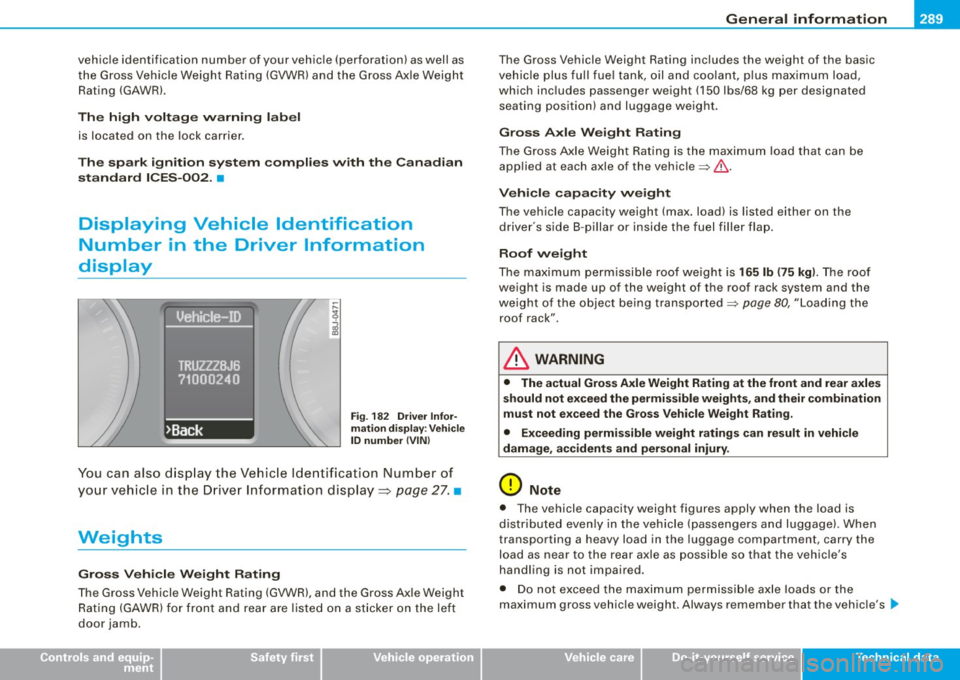
You can also display the Vehicle Identification Number of
your vehicle in the Driver Information display~ page
27. •
Weights
Gross Vehicle Weight Rating
The Gross Vehicle Weight Rating (GVWR), and the Gross Axle Weight
Rating (GAWR) for front and rear are listed on a sticker on the left
door jamb.
Controls and equip ment Safety first Vehicle operation
The
Gross Vehicle Weight Rating includes the weight of the basic
vehicle plus full fuel tank, oil and coolant, plus maximum load,
which includes passenger weight (150 lbs/68 kg per designated
seating position) and luggage weight.
Gross Axle Weight Rating
The Gross Axle Weight Rating is the maximum load that can be
applied at each axle of the vehicle~&.
Vehicle capacity weight
The vehicle capacity weight (max. load) is listed either on the
driver's side 8 -pillar or inside the fuel filler flap.
Roof weight
The maximum permissible roof weight is 165 lb (75 kg). The roof
weight is made up of the weight of the roof rack system and the
weight of the object being transported
~ page 80, "Loading the
roof rack".
& WARNING
• The actual Gross Axle Weight Rating at the front and rear axles
should not exceed the permissible weights, and their combination
must not exceed the Gross Vehicle Weight Rating.
• Exceeding permissible weight ratings can result in vehicle
damage, accidents and personal injury.
0 Note
• The vehicle capacity weight figures apply when the load is
distributed evenly in the vehicle (passengers and luggage). When
transporting a heavy load in the luggage compartment, carry the
load as near to the rear axle as possible so that the vehicle's
handling is not impaired.
• Do not exceed the maximum permissible axle loads or the
maximum gross vehicle weight. Always remember that the vehicle's .,_
Vehicle care Do-it-yourself service Tec hn ica l da ta
Page 305 of 316

______________________________________________ A_ l_,_ p _h_ a_ b_e _ t_i c_ a_l _in _ d_e _ x __ lllll
Daytime running lights .. ..... .. .... ... 53
Daytime running lights (Canada) . .... .. 53
Declaration of compliance Cell phone package ............... 296
Electronic immob ilizer . .... ... .... 296
Homelink® universal remote control 296
Remote control key . ... .. .... .... . 296
Tire pressure monitoring sys tem ... 296
de f
What does this mean when it appears in
the trip odometer display? .. ....... 14
Defect ive light bulb warning ...... .... . 36
Defrosting the windows .. .......... ... 88
Determining correct load lim it ... ... .. 243
Digital clock .... .... .... .... ... .... .. 13
Setting the time ................... 13
D igital compass . ...... ... ...... .... .. 67
Dimensions ... .. .... .... ... .... .... 290
Dipstick Reading the dipstick properly
Di rect Shift Gearbox 221
Emergency release . . . . . . . . . . . . . . . 106
Distance .. ...... .... .... ... .... .... . 26
Driver information ..... ... .. .... ..... . 33
Driver information system
Gearshift indicator ... .... .... .... .. 23
Menu button ..................... 28
Menu display . ... .... ...... .... ... 27
Open door or front lid warning ...... 22
Outside temperature display ....... . 22
Red symbols .. .... .... ... ... ... .. . 32
Service interval disp lay .... .... ..... 23
Setting .......................... 29
Controls and equip
ment Safety first
Sound system display
.... .. ..... .. . 22 Emergency starting . ... .. .... .... .... 279
Trip computer ............ ..... .. . 25
Emerge ncy towing ...... .... .... ... . 282
yellow symbo ls ................... 32
Engine
Driver seat Cecking and fil ling locations .. .... . 219
See Seating position .. ..... .... ... 116
Checking and fi lling locations .. ... . 218
Dr iving Coolant ...... .... ... .... .... .... 224
Run-flat tires ..... ... .. ...... .... . 259 Hood .. ...... .... .... ... .... .. .. 216
Dr iving safely .......... ............ . 114 Start
ing ...... .... .... ... .... .. 92, 93
Duplicate key .... ...... ... .. .... .... . 38 Start
ing with jumper cables .... .... 279
Dust filter ........................... 86 Stopping
...... .... ... .... .... .... 93
Engine compart ment .. ...... .... .... 218
E Safety instruc tions .. ...... .... ... . 217
Working in the engine compa rtment . 217
Elapsed time .... .... ........ ....... . 26
Engine coolant system ......... ...... 224
Electro -mecha n ica I power assist .. .. 20, 188 Adding coo
lant ..... ........ ...... 225
Electron ic different ial lock (EDU Check
ing the eng ine coolant level ... 225
How the sys te m works .. ...... .... 184 Radiator fan ..
.... ....... .... .... 226
Warning/indicator lights ...... ...... 20 Te
mpe rature gauge ...... .... .... .. 13
Electronic immobilizer .... ..... .. .. 14, 40 Engine cooling system
Electronic power cont ro l Malfunction
............ ... .. ..... 34
EPC warning/indicator light ......... 17 Engine data
... .. .... .... .... .... ... 29 1
E lectron ic speed limiter . ...... .... .... 25 E
ngine hood
Electronic Stability Program .. .... .... 182 Closing
... .... .... ... .... ...... . 217
Electronic stabilization program (ESP) How to release
the hood . ...... .... 216
Warning/indicator lights .. .... .... .. 17 Engine oil
..... .. .......... ... .. .... 219
Emergency flasher Warning/indicator lights ...... .... .. 18
Emergency flashers .................. 57
Emergency locking .. .... ........ ... .. 45
Emergency operation Adding
......... .... ........ ..... 222
Additives .. .... .... ......... ..... 222
Changing . ..... ... .... .... ... ... . 223
Checking the eng ine oi l leve l ....... 221
Indica tions and condit ions requiring ext ra
checking ....................... 221
Rear lid ...... ... .... .... .... .... . 46
Oil consumption ... ... ...... ...... 221
Emergency release for selector lever ... 106
Oil grades .... .... .... ..... .. .... 2 19
Vehicle operation Vehicle care Do-it-yourself service Technical data
Page 306 of 316

-Alphab eti ca l ind ex ----=------...:..:...::... ___________________________ _
Recommended oil check intervals .. 221
Specification and viscosity .. .. .. .. 219
Engine oil leve l .... .... ... ...... .... . 35
Engine oil pressure (malfunction) ... ... 35
Engine oil sensor defective ... .... .... . 35
Environment Break -in period . . . . . . . . . . . . . . . . . . 190
Catalytic converter . . . . . . . . . . . . . . . 191
Disposing of your vehicle battery . .. 228
Driving at high speeds ............ 192
Driving to minimize pollution and noise . 192
Fuel .... .... ... .. .... .... ...... . 213
Fuel economy . . . . . . . . . . . . . . . . . . . 192
Leakage from your vehicle . . . . . . . . . 217
Letting the vehicle stand and warm up . .
193
Proper disposal of drained brake fluid ... 227
Proper disposal of drained engine coolant ... .... .... .... .... .... . 225
Proper disposal of drained engine oil 222,223
Recycling used engine oil . .... .... 222
Un leaded fuel ... ... ..... .... .... 211
What should I do with an old battery? 228
EPC
See E lectronic power control . . . . . . . . 17
ESP
See Electronic Stability Program . ... 182
Event Data Recorder (EDR) . . . . . . . . . . . 182
Expansion tank .... .... .... .... ... .. 225
F
Fan .. ... .... .... ...... .... ... .. .... 87
Radiator . . . . . . . . . . . . . . . . . . . . . . . . 226
Fastening eyelets . .... .... .... .... ... 77
Flat t ire
Changing .... ....... .. ...... .... 268
Floor mats . . . . . . . . . . . . . . . . . . . . . . . . . 121
Fog lights, front ... .. ...... .... ... .. . 55
Fold ing master key with remote control . 38
Foot pedals . . . . . . . . . . . . . . . . . . . . . . . . 120
For the sake of the e nv ironment
Gasoline fumes and l the environment 213
Letting your engine warm up . .... .. 93
Reducing engine noise by early upshif ting ... ... ..... ... .... .... 12
Refue ling ... .. ...... ........ .... 213
Saving fuel by early upshifting .... .. 12
Front airbags Description . . . . . . . . . . . . . . . . . . . . . . 139
How they work . . . . . . . . . . . . . . . . . . . 144
Front seats . . . . . . . . . . . . . . . . . . . . . . . . . . 69
Ad ' .
Justing ...... .... ... .... .... .. 117
Adjusting the manual seats .. .... ... 71
Child restraints in the front seat .. .. 137
Fronta l collisions and the laws of physics .. .
126
Fuel Additives ...... ....... .... .... .. 211
Blended gasoline ........... .... .. 211
Current fuel mileage .. ... .... ..... . 26
Fi ller neck . .... ..... .. .... .... ... 212
Fuel gauge .............. .... ..... 14 Fuel supply too
low ..... .. . ... ... . . 35
Gaso line ... .... .... ... .... .... .. 211
Gasoline additives ................ 212
Octane rating .. .... .... .... .... .. 211
Recommendation .. ....... .... ... 211
Refue lling ... .. .... .... .... .... .. 213
Reserve ... ..... ... .... ... .... .... 14
Tank capacity ... .. .... .... .... ... 291
Un locking the fuel fi ller flap by hand 215
Fuel range ... ...... ... .. .... .... .... 26
Fuse arrangement ... .... ........ .... 275
G
Garage door opener . ...... ...... .... 107
Gas discharge lamps .... .. ... ... ... . 278
Gauges
Engine coolant temperature .... .. .. 13
Fuel gauge ............. ...... .... 14
Tachometer .... ....... ....... .... 12
Gear recommendation ........ ....... . 23
Gearshift indicator ... ...... ...... ... . 23
Gearshift lever
6 -speed manual transmission ... ... . 99
Generator Warning/indicator lights ........... . 18
G lossary of tire and loading terminology .. .
235
G love compartment ...... .... .... .... 8 4
Gross Vehicle Weight Rating (GVWR) ... 289
Page 308 of 316

___ A_l.:,. p _h_ a_ b_e _t _i c_ a_l _i n_ d_e _x ____________________________________________ _
L
LATCH ............................ 172
Descript ion ... ...... ...... ...... 173
Guidance fixtures for lower anchorages .
173
Installing a child restraint ......... 175
Location . . . . . . . . . . . . . . . . . . . . . . . . 172
Mounting and re leasing the anchorage
hook .. .... .... .... .... ........
176
Launch Control Program ............. 105
Leather . . . . . . . . . . . . . . . . . . . . . . . . . . . . 206
Cleaning ........................ 207
Leaving -home -function ..... .. ... ... .. 55
Lifting jack . . . . . . . . . . . . . . . . . . . . . . . . .
270
Lifting vehicle .. .... .... ... .. ...... . 284
Light sensor package
Automatic headlight control . . . . . . . .
52
Light/rain sensor defective .... ... .... . 37
Lights
Bi-Xenon headlights ... .... ...... ..
57
Coming -home/leaving-home-function 55
Emergency flasher . . . . . . . . . . . . . . . .
57
Front fog lights . . . . . . . . . . . . . . . . . . . 55
Headlights ... ......... ......... ..
51
High beam .... ... ... .. ... ... .. 51, 58
High beam warning/indicator light . .. 18
Instrument panel illum ination ... .... 56
Side marker lights . . . . . . . . . . . . . . . . . 51
Turn signals . ... .. .... ...... .... .. 58
Loading the luggage compartment .... 121
Loading the roof rack ... ..... ... . ... .. 80
Locking
Power locking switch ... .... .... ...
44
Rear lid/trunk lid .................. 45
Remote control key . . . . . . . . . . . . . . . . 42
Using the key . .... .... ... .... .... . 43
Lower universal anchorage bars (Canada) ...
172
Lower universal anchorages (Canada) 172
Luggage compartment
Cargo net . . . . . . . . . . . . . . . . . . . . . . . .
78
Cover .... .... ....... .... .... .... . 78
Expanding ....................... 76
Fastening eyelets . . . . . . . . . . . . . . . . . 77
Light .. .......................... 59
Loading . . . . . . . . . . . . . . . . . . . . . . . .
121
Lumbar support ... .. ...... .... .... .. 74
M
Maintenance ... .... ........... .... . 293
Malfunction Indicator Lamp (M ill ... 17, 25
Manual transmission ................. 99
Master key .. ..... ...... .... .... ... ..
39
Battery replacement . .... .... .... .. 40
Menu button . . . . . . . . . . . . . . . . . . . . . . . . 28
Menu display . . . . . . . . . . . . . . . . . . . . . . . . 27
Mirror Inside rearview mirror, manua l .. .. ..
64
Mirrors
Activating the digital compass ...... 67
Anti-glare rearview mirror .. ........
64
Automatic d imm ing for the outs ide Automatically dimming inside
mirror .
64
Manual glare dimming .. ...... ... .. 64
Outside mirrors ............... .... 65
Monitoring the Advanced Airbag System
146
N
Natural leather 206
New tires and wheels ................ 246
NHTSA Contacting .. ... .. .... .... .... ...
123
Number of seats ...... ........... ... 125
0
Occupant seat ing positions ... ..... ... 116
Octane rating .. .... .... ... ........ .. 211
Odometer ... .... .... ... .. ...... .... . 14
Oil
See Engine oil .... ....... ... .. ... 219
Older children and safety belts .... .... 167
On-Board Diagnost ic System (OBD)
Data Link Connector (DLC) ......... . 24
Electronic speed limiter ........... .
25
Malfunction Indicator Lamp (Mill .... 25
Open door or front lid warning . ........ 22
Operate your vehic le economically and mini -
mize pollution ..................
192
Optional equipment
Marked with an asterisk ........ ..... 6
Outlets . .... .... ... .... .... .... ... ..
83
mirrors ......................... 66 Outs·1de m1·rrors 65 ......... ........ .....
Page 309 of 316

______________________________________________ A_ l_,_ p _h_ a_ b_e _t_i c_ a _ l _in _ d_e _ x __ lll
Outside temperature display .. .. .. ... .. 22
Owner's manual How the Owner's Manual is organized . 6
p
Paint Touch -up . ... .... ...... ... .. ... .. 202
Paint No . .... .... .... .... .... .... ... 288
Parking . ...... .. ............ ....... . 94
Automatic transmission ... ... ... .. 102
Parking brake ........... .... ..... .. .. 94
Parking brake warning ................ 33
Parking on a decline (downhi ll) .. ... .. .. 94
Park ing on an incline (uphill) .. ..... .. .. 94
Parts replacement ..... .............. 295
P ASSENGER AI R BAG O FF light ... .. ... 147
Passive safety system ................ 114
Pedals .. ........ ... .... .... ........ 120
Physica l principles of a frontal collision 126
Polishing .......................... 201
Pollen filter ... .. ... ..... ... .... .... . 86
Pollutant fi lter . ... .. .... .... ... .... .. 86
P ower locking switch ... .... .... ...... 44
Power locking sys tem . ...... .... .... .. 41
Convenience close/open feature ... .. 49
Locking and unlocking the vehicle from inside .. .. ... ... .... ... .... .... . 44
Opening and c losing the windows .. . 49
Rear lid/trunk l id ... .. .... .... .... . 45
Remote control ...... .... ... .... .. 39
Un locking and locking vehicle ... .. .. 42
Controls and equip
ment Safety first
Power outlets .
...... ....... .. .. .... .. 83
Power seats
Adjusting the seatback .... .... .... . 73
Adjustment . ...... .... .... .... ... . 71
Fo lding the seatback forward .. ...... 73
Power steering
See Electro-mechanica l power assist 20,
188
Power window switches ... .. .... .... .. 48
Reactivating the system ...... ...... 50
Pregnant women Specia l considerations when wearing a
safety belt . .... ....... .... .... . 131
Prog ramming the Homelin k® universal re -
mote control .... ... ..... .... ... 107
P roper occupant seati111g pos itions ... .. 11 6
Proper safety belt posi tion ............ 130
P roper seating position
Front passenger .................. 117
Occupants ......... .. ... ... .. .... 116
Rear passengers ................. 118
a
Quartz clock .... .... ..... .. .... .... .. 13
quattro®
See All Wheel Drive .. .... .... .... . 189
Ques tion
What happens to u nbelted occupan ts? .
127
Why safety belts? ................. 125
R
Radiator fan ...... .. .... ........ .... 226
Rain sensor defective ..... ... .... .... . 37
Reading lights ....................... 59
Rear lid . ......... ... .... ..... .. ... .. 45
Emergency release ................ 46
Rear light defective ...... .... .... ... .. 36
Rear spoiler . .... ........ .... ...... . 185
Rear window defogger ... .... ... ..... . 89
Rear window shelf ... .... .... .... ... .. 76
Rearview mirror Inside rearview mirror .. ............ 64
See also Mirrors ... ... ... .. ...... .. 64
Refuelling .......................... 213
Release lever for hood . ...... .... .... 216
Remote control .. .... .... ...... .... .. 39
Resetting remote control ........... 43
Remote control garage door opener (Homelin k®l ................... 107
Remote control key Unlocking and locking .. ...... ... ... 42
Remote master key
Batte ry replacement ...... .... .... . 39
Check light . ...... .... ..... .. .... . 39
Remote rear lid release .... ... ... ... .. . 45
Repair manuals .. .... .... ........ ... 293
Repairs Airbag system .... .... .... ...... . 149
Replacement parts ... .... ... ... .... . 295
Replacing Wheel rims .................. 2 46, 248
Vehicle operation Vehicle care Do-it-yourself service Technical data