seats AUDI TT COUPE 2009 Owner's Manual
[x] Cancel search | Manufacturer: AUDI, Model Year: 2009, Model line: TT COUPE, Model: AUDI TT COUPE 2009Pages: 316, PDF Size: 71.16 MB
Page 116 of 316
___ o_ r_iv _ i _n....; g::;_ S_ a_f _e _ly=-- -------------------------------------------------
Driving Safely
General notes
Safe driving habits
Please remember -safety first!
This chapter contains important information , tips, instructions and
warnings that you need to read and observe for your own safety, the
safety of your passengers and others. We have summarized here
what you need to know about safety belts, airbags, child restraints as well as child safety. Your safety is for us
priority number 1. Always
observe the information and warnings in this section -for your own
safety as well as for that of your passengers.
The information in this section applies to all model versions of your
vehicle. Some of the features described in this sections may be
standard equipment on some models, or may be optional equip
ment on others. If you are not sure, ask your authorized Audi dealer.
& WARNING
• Make certain that you follow the instructions and heed the
WARNINGS in this Manual. It is in your interest and in the interest of your passengers.
• Always keep the complete Owner's Literature in your Audi
when you lend or sell your vehicle so that this important informa
tion will always be available to the driver and passengers.
• Always keep the Owner's literature handy so that you can find
it easily if you have questions. •
Safety equipment
The safety features are part of the occupant restraint
system and work together to help reduce the risk of injury
in a wide variety of accident situations.
Your safety and the safety of your passengers should not be left to
chance. Advances in technology have made a variety of features
available to help reduce the risk of injury in an accident. The
following is a listing of just a few of the safety features in your Audi:
• sophisticated safety belts for driver and all passenger seating
positions,
• safety belt pre-tensioners,
• front airbags,
• knee airbags for the front seats,
• side airbags in the front seats,
• LATCH anchorages for child restraints,
• adjustable steering column .
These individual safety features can work together as a system to
help protect you and your passengers in a wide range of accidents.
These features cannot work as a system if they are not always prop
erly adjusted and properly used!
Safety is everybody's responsibility! •
Important things to do before driving
Safety is everybody's job! Vehicle and occupant safety
always depends on the informed and careful driver.
For your safety and the safety of your passengers, before
driving always: .,_
Page 119 of 316

________________________________________________ D_r_iv _ i _n_ g~ S_ a_ fe_ ly __ !II
& WARNING (continued)
• Always adjust the driver's seat and the steering wheel so that
there are at least 4 inches (10 cm) between the knees and the
lower part of the instrument panel.
• Always hold the steering wheel on the outside of the steering
wheel rim with your hands at the
9 o'clock and 3 o'clock positions
to help reduce the risk of personal injury if the driver's airbag inflates .
• Never hold the steering wheel at the
12 o'clock position or with
your hands at other positions inside the steering wheel rim or on
the steering wheel hub. Holding the steering wheel the wrong way
can cause serious injuries to the hands, arms and head if the
driver's airbag inflates
• Pointing the steering wheel toward your face decreases the
ability of the supplemental driver's airbag to protect you in a colli
sion .
• Always sit in an upright position and never lean against or
place any part of your body too close to the area where the airbags
are located.
• Before driving, always adjust the front seats and head
restraints properly and make sure that all passengers are properly
restrained .
• Never adjust the seats while the vehicle is moving. Your seat
may move unexpectedly and you could lose control of the vehicle.
• Never drive with the backrest reclined or tilted far back! The
farther the backrests are tilted back, the greater the risk of injury due to incorrect positioning of the safety belt and improper
seating position.
• Children must always ride in child seats=>
page 157. Special
precautions apply when installing a child seat on the front
passenger seat =>
page 135. •
Controls and equip
ment Safety first
Vehicle operation
Proper seating position for the front
passenger
The proper front passenger seating position is important
for safe, relaxed driving.
For your own safety and to reduce the ris k of injury in the
event of an accident, we recommend that you adjust the
seat for the front passenger to the following pos ition:
- Move the front passenger seat back as far as possible.
There must be a minimum of 10 inches (25 cm) between
the breastbone and the instrument panel =>
&.
- Adjust the angle of the seatback so that it is in an upright
position and your back comes in full contact with it
whenever the vehicle is moving.
- Adjust the head restraint so that the upper edge is as
even with the top of your head as possible but not lower
than eye level and so that it is as close to the back of your
head as possible =>
page 119.
-Keep both feet flat on the floor in front of the front
passenger seat.
- Fasten and wear safety belts correctly=>
page 129.
For detailed information on how to adjust the front passenger's
seat, see => page 69.
& WARNING
Front seat passengers who are unbelted, out of position or too
close to the airbag can be seriously injured or killed by the airbag
as it unfolds. To help reduce the risk of serious personal injury : .,
Vehicle care Do-it-yourself service Technical data
Page 120 of 316
........ _o_ r_iv _i_ n""' g::;._ S_ a_f _e _ly =---------------------------------------------------
& WARNING (continued)
• Passengers must always sit in an upright position and never
lean against or place any part of their body too close to the area
where the airbags are located.
• Passengers who are unbelted, out of position or too close to the
airbag can be seriously injured by an airbag as it unfolds with
great force in the blink of an eye .
• Always make sure that there are at least 10 inches (25 cm)
between the front passenger's breastbone and the instrument
panel.
• Always make sure that there are at least 4 inches (10 cm)
between the front passenger's knees and the lower part of the
instrument panel .
• Each passenger must always sit on a seat of their own and
properly fasten and wear the safety belt belonging to that seat .
• Before driving, always adjust the front passenger seat and
head restraint properly.
• Always keep your feet on the floor in front of the seat. Never
rest them on the seat, instrument panel, out of the window, etc .
The airbag system and safety belt will not be able to protect you properly and can even increase the risk of injury in a crash .
• Never drive with the backrest reclined or tilted far back! The
farther the backrests are tilted back, the greater the risk of injury
due to incorrect positioning of the safety belt and improper
seating position.
• Children must always ride in child seats:::::,
page 157. Special
precautions apply when installing a child seat on the front
passenger seat
=:> page 135. •
Proper seating positions for passengers in
rear seats
Rear seat passengers must sit upright with both feet on
the floor consistent with their physical size and be prop
erly restrained whenever the vehicle is in use.
To reduce the risk of injury caused by an incorrect seating
position in the event of a sudden braking maneuver or an
accident, your passengers on the rear bench seat must
always observe the following:
- Make sure that the seatback is securely latched in the
upright position~
page 76.
Keep both feet flat in the footwell in front of the rear seat.
Fasten and wear safety belts properly ~
page 129.
-Make sure that children are always properly restrained in
a child restraint that is appropriate for their size and age
~ page 157.
& WARNING
Passengers who are improperly seated on the rear seat can be
seriously injured in a crash.
• Each passenger must always sit on a seat of their own and
properly fasten and wear the safety belt belonging to that seat.
• Safety belts only offer maximum protection when the seatback
is securely latched in the upright position and the safety belts are
properly positioned on the body . By not sitting upright, a rear seat
passenger increases the risk of personal injury from improperly
positioned safety belts! •
Page 122 of 316
........ _o_ r_iv _i_ n""' g::;._ S_ a_f _e _ly =---------------------------------------------------
examp les w ill make you mo re aware of seating positions that ar e
d an gerous .
Therefore, whenever the vehicle is moving:
• ne ver stan d up i n the vehicle
• never stand on the seats
• never knee l on th e seats
• n ever ride with th e seatba ck re cl in ed
• never lie down on the rear seat
• nev er lea n up aga inst t he instrument pa ne l
• n ever sit on the e dge of the seat
• never sit sideways
• ne ve r le an ou t th e w indo w
• never put your feet out the window
• never put your feet on t he instrument p ane l
• n ever re st yo ur f ee t on t he seat cus hion or back of the sea t
• never ride in the footwell
• n ever ride i n the car go area
& WARNING
Improper seating positions increase the risk of serious personal
injury and death whenever a vehicle is being used.
• Always make sure that all vehi cle occupants stay in a proper
seating position and are properly restrained whenever the vehicle
is being used . •
Driver and passenger side footwell
Important safety instructions
& WARNING
Always make sure that the knee airbag can inflate without inter
ference . Objects between yourself and the airbag can increase the
risk of injury in an a ccident by interfering with the way the airbag
deploys or by being pushed into you as the airbag deploys .
• No persons (children) or animals should ride in the footwell
in
front of the passenger seat . If the airbag deploys , this can result in
serious or fatal injuries .
• No objects of any kind should be carried in the footwell area in
front of the driver's or passenger 's seat . Bulky objects (shopping
bags , for example) can hamper or prevent proper deployment of
the airbag. Small objects can be thrown through the vehicle if the
airbag deploys and injure you or your passengers. •
Pedal area
Pedals
The pedal s must a lways be fre e to move a nd mus t never
b e in terfe red with by a flo or mat or a ny othe r objec t.
Make sure that all pedals move freely w ithout interfe rence and that
n oth ing preve nts t hem fr om retu rni ng to t heir or igin a l pos itions.
On ly use floor mats that leave the pedal a rea free and can be
se cured w ith flo or mat fa stene rs.
If a bra ke circu it fai ls, i ncr eased brake pedal travel is r equ ired to
bring the veh icle to a full stop.
Page 127 of 316

Safety belts -----------------=------
Safety belts
General notes
Always wear safety belts!
Wearing safety belts correctly saves lives!
This chapter explains why safety belts are necessary, how they work and how to adjust and wear them correctly.
- Read all the information that follows and heed all of the
instructions and WARNINGS.
& WARNING
Not wearing safety belts or wearing them improperly increases
the risk of serious personal injury and death.
• Safety belts are the single most effective means available to
reduce the risk of serious injury and death in automobile acci
dents. For your protection and that of your passengers, always
correctly wear safety belts when the vehicle is moving.
• Pregnant women, injured, or physically impaired persons must
also use safety belts . Like all vehicle occupants, they are more
likely to be seriously injured if they do not wear safety belts. The
best way to protect a fetus is to protect the mother -throughout
the entire pregnancy. •
Number of seats
Your Audi TI Coupe has two seating positions in the front and two
height-limited seating positions in the rear. Each seating position
has a safety belt. The rear seat area in your Audi TT Coupe does not
have enough room for passengers of all sizes. For reasons of safety,
Controls and equip ment Safety first
Vehicle operation
no person taller than 4'11" (1.5 meters) should ever ride in the rear
seat area.
& WARNING
Not wearing safety belts or wearing them improperly increases
the risk of serious personal injury and death.
• Never strap more than one person, including small children,
into any belt. It is especially dangerous to place a safety belt over
a child sitting on your lap.
• Never let more people ride in the vehicle than there are safety
belts available.
• Be sure everyone riding in the vehicle is properly restrained
with a separate safety belt or child restraint.
• Persons taller than 4'11" (1.5 m) as well as children in booster
seats who are too close to the rear window and roof can suffer
severe head and neck injuries when the rear lid is closed or in a
crash.
• The minimum clearance between the passenger's heads and
the rear window must never - under any circumstances -be less
that 1 inch (2.5 cm.I when the passengers sit fully upright.
• Always make sure that rear seat passengers cannot be struck
when the rear lid is closed. •
Vehicle care Do-it-yourself service Technical data
Page 130 of 316
___ S_a_ f_ e_ t-= y_ b_e_ l_ t _s _______________________________________________ _
supposed to deploy in all kinds of accidents. Although your Audi is
equipped with airbags, all vehicle occupants, including the driver, must wear safety belts correctly in order to minimize the risk of
severe injury or death in a crash.
Remember too, that airbags will deploy only once and that your
safety belts are always there to offer protection in those accidents
in which airbags are not supposed to deploy or when they have
already deployed. Unbelted occupants can also be thrown out of the
vehicle where even more severe or fatal injuries can occur.
It is also important for the rear passengers to wear safety belts
correctly. Unbelted passengers in the rear seats endanger not only
themselves but also the driver and other passengers:::::,
page 127,
fig. 104. In a frontal collision they will be thrown forward violently,
where they can hit and injure the driver and/or front seat passenger. •
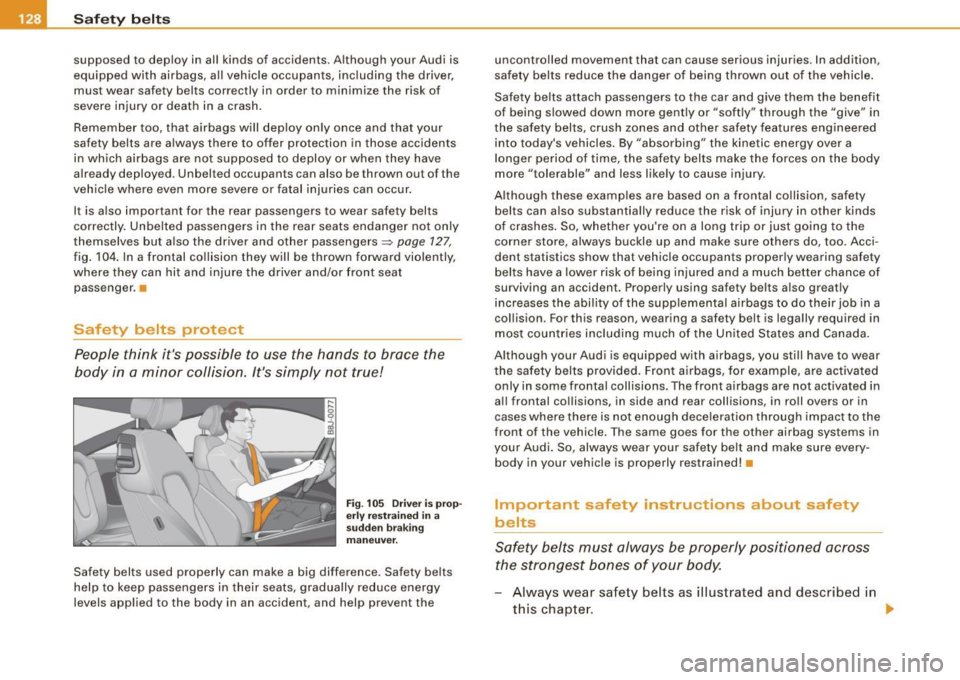
Safety belts protect
People think it's possible to use the hands to brace the
body in a minor collision. It's simply not true!
Fig . 105 Driver is prop
er ly restrained in a
sudden braking
maneuver.
Safety belts used properly can make a big difference . Safety belts
help to keep passengers in their seats, gradually reduce energy
levels applied to the body in an accident, and help prevent the uncontrolled movement that
can cause serious injuries. In addition,
safety belts reduce the danger of being thrown out of the vehicle.
Safety belts attach passengers to the car and give them the benefit
of being slowed down more gently or "softly" through the "give" in
the safety belts, crush zones and other safety features engineered
into today's vehicles. By "absorbing" the kinetic energy over a
longer period of time, the safety belts make the forces on the body
more "tolerable" and less likely to cause injury.
Although these examples are based on a frontal collision, safety belts can also substantially reduce the risk of injury in other kinds
of crashes. So, whether you're on a long trip or just going to the
corner store, always buckle up and make sure others do, too . Acci
dent statistics show that vehicle occupants properly wearing safety
belts have a lower risk of being injured and a much better chance of
surviving an accident. Properly using safety belts also greatly
increases the ability of the supplemental airbags to do their job in a
collision . For this reason, wearing a safety belt is legally required in
most countries including much of the United States and Canada.
Although your Audi is equipped with airbags, you still have to wear
the safety belts provided. Front airbags, for example, are activated
only in some frontal collisions. The front airbags are not activated in
all frontal collisions, in side and rear collisions, in roll overs or in
cases where there is not enough deceleration through impact to the
front of the vehicle. The same goes for the other airbag systems in
your Audi. So, always wear your safety belt and make sure every body in your vehicle is properly restrained! •
Important safety instruct~ons about safety
belts
Safety belts must always be properly positioned across
the strongest bones of your body.
Always wear safety belts as illustrated and described in
this chapter. _,
Page 132 of 316
___ S_a_ f_ e_ t-= y_ b_e_ l_ t _s _______________________________________________ _
To provide maximum protection, safety belts must always
be positioned correctly on the wearer's body.
Adjust the front seat and head restraint properly
=> page 69, "General recommendations ".
Hold the belt by the tongue and pull it evenly across the
chest and pelvis=>&.
- Insert the tongue into the correct buckle of your seat
until you hear it latch securely => page
129, fig. 106.
Pull on the belt to make sure that it is securely latched in
the buckle.
Automatic safety belt retractors
Every safety belt is equipped with an automatic belt retractor on the
shoulder belt. This feature locks the belt when the belt is pulled out
fast, during hard braking and in an accident . The belt may also lock
when you drive up or down a steep hill or through a sharp curve.
During normal driving the belt lets you move freely.
Safety belt pretensioners
The safety belts on the front seats are equipped with a belt preten
sion er that helps to tighten the safety belt and remove slack when
the pretensioner is activated. The function of the pretensioner is
monitored by a warning light:::::,
page 78, "Airbag system
t!A (USA models) /!.ir (Canada models)".
Switchable locking feature
Every safety belt except the one on the driver seat is equipped with
a switchable locking feature that
must be used when the safety belt
is used to attach a child seat. Be sure to read the important informa
tion about this feature:::::,
page 168.
& WARNING
Improperly positioned safety belts can cause serious injury in an
accident :::::,
page 130, "Safety belt position".
• Safety belts offer optimum protection only when the seat back
is upright and belts are properly positioned on the body.
• Never attach the safety belt to the buckle for another seat.
Attaching the belt to the wrong buckle will reduce safety belt
effectiveness and can cause serious personal injury.
• A passenger who is not properly restrained can be seriously
injured by the safety belt itself when it moves from the stronger
parts of the body into critical areas like the abdomen.
• Always lock the convertible locking retractor when you are
securing a child seat in the vehicle:::::,
page 170. •
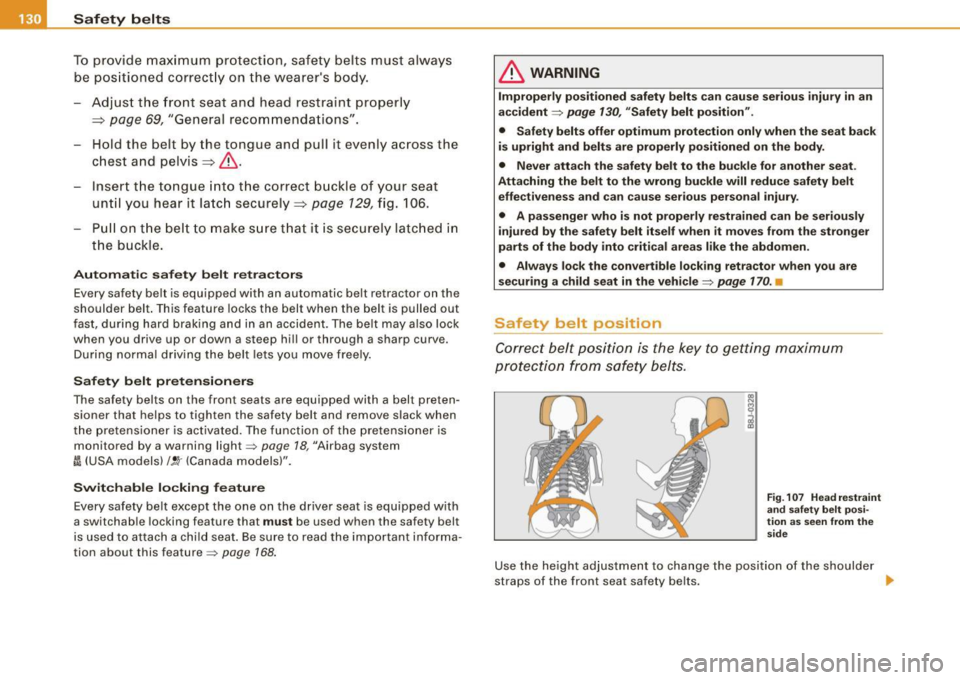
Safety belt position
Correct belt position is the key to getting maximum
protection f ram safety belts.
Fig. 107 Head restraint
and safety belt posi
tion as seen from the
side
Use the height adjustment to change the position of the shoulder
straps of the front seat safety belts.
~
Page 138 of 316
___ A_ ir_ b_ a-g _ s_y _s_ t_ e_ m _________________________________________________ _
repair costs or even the lack of vehicle dama ge is not necessa rily an
in dic ati on of wh ether a n airb ag s hould infl ate or not.
It is not possib le to define a ran ge of v ehicle spe eds t hat w ill cover
every possible kind and angle of impact that wi ll always trigge r the
a irbags, s ince the circu msta nce s will v ary co nside ra bl y bet ween
one co llision and another. Impo rtant factors include, for e xample,
th e nature (h ard or so ft) o f th e obje ct w hich th e ca r hi ts, the a ng le
of impact, vehicle speed, etc . T he front airbags will also not inflate
i n sid e or r ea r co ll isions, o r in roll-o ve rs.
Always remember : Airba gs will d ep loy only once, and on ly in c ertain
k ind s of co llision s. Yo ur s afe ty bel ts are a lways the re t o offe r protec
ti on i n tho se situat io n s in whic h airba gs a re not suppose d to dep loy,
or when they have a lready dep loye d; f or examp le, when yo ur veh ic le
str ikes o r is s truc k by anot her afte r the fi rst collision .
T his is just one of the reasons why an airbag is a supplementary
r es train t an d is not a su bstit u te fo r a sa fe ty belt. T he ai rbag system
works most eff ectively when used with the safety be lts . T herefore,
a lw ays pro per ly wea r your safe ty be lts ~
page 125.
& WARNING
Sitting too close to the steering wheel or instrument panel will
decrease the effectiveness of the airbags and will increase the risk
of personal injury in a collision.
• Never sit closer than 10 inches (25 cm) to the steering wheel or
instrument panel .
• If you cannot sit more than 10 inches (25 cm ) from the steering
wheel , investigate whether adaptive equipment may be available
to held you reach the pedals and increase your seating distance
from the steering wheel.
• If you are unrestrained , leaning forward, sitting sideways or out
of position in any way, your risk of injury is much higher.
• You will also receive serious injuries and could even be killed if
you are up against the airbag or too close to it when it inflates -
even with an Advanced Airbag .
& WARNING (continued)
• To reduce the risk of injury when an airbag inflates, always
wear safety belts properly=:>
page 129 , "Safety belts".
• Always make certain that children age 12 or younger always
ride in the rear seat. If children are not properly restrained , they
may be severely injured or killed when an airbag inflates.
• Never let children ride unrestrained or improperly restrained in
the vehicle. Adjust the front seats properly .
• Never ride with the backrest reclined.
• Always sit as far as possible from the steering wheel or the
instrument panel=:>
page 116 , "Proper occupant seating posi
tions ".
• Always sit upright with your back against the backrest of your
seat.
• Never place your feet on the instrument panel or on the seat .
Always keep both feet on the floor in front of the seat to help
prevent serious injuries to the legs and hips if the airbag inflates.
• Never recline the front passenger's seat to transport objects .
Items can also move into the area of the side airbag or the front
airbag during braking or in a sudden maneuver. Objects near the
airbags can become projectiles and cause injury when an a irbag
inflates.
& WARNING
Airbags that have deployed in a crash must be replaced .
• Use only original equipment airbags approved by Audi and
installed by a trained technician who has the necessary tools and
diagnostic equipment to properly replace any airbag in your
vehicle and assure system effectiveness in a crash .
• Never permit salvaged or recycled airbags to be installed in
your vehicle . •
Page 139 of 316

__________________________________________________ A_ i_ r _b _a...; g::- s_ y=--- s_t _e _m __ !II
Child restraints on the front seat -some
important things to know
- Be sure to read the important information and head the
WARNINGS for important details about children and
Advanced Airbags :=>
page 157.
Even though your vehicle is equipped with an Advanced Airbag
System, make certain that all children, especially those 12 years and
younger, always ride in the back seat properly restrained for their age and size . The airbag on the passenger side makes the front seat
a potentially dangerous place for a child to ride . The front seat is not
the safest place for a child in a forward -facing child safety seat. It
can be a very dangerous place for an infant or a child in a rearward
facing seat.
The Advanced Airbag System in your vehicle has been certified to
comply with the Requirements of United States Federal Motor
Vehicle Safety Standard 208 as applicable at the time your vehicle
was manufactured.
The Standard requires the front airbag on the passenger side to be
turned off ("suppressed") if a child up to about one year of age
restrained in one of the rear-facing or forward-facing infant
restraints listed in Federal Motor Vehicle Safety Standard 208 with
which the Advanced Airbag System in your vehicle was certified has been installed on the front passenger seat. For a listing of the child
restraints that were used to certify compliance with the US Safety
Standard =>
page 159.
The PASSENGER AIR BAG OFF light in the instrument panel tells you
when the front Advanced Airbag on the passenger side has been
turned off by the electronic control unit.
Each time you turn on the ignition, the
PASSENGER AIR BAG OFF
light will come on for a few seconds and:
• will stay on if the front passenger seat is not occupied,
Controls and equip
ment Safety first
Vehicle operation
• will stay on if there is a small child or child restraint on the front
passenger seat,
• will go off if the front passenger seat is occupied by an adult as
registered by the weight-sensing mat=>
page 146, "Monitoring the
Advanced Airbag System" .
The
PASSENGER AIR BAG OFF light comes on when the control unit
detects a total weight on the front passenger seat that requires the
front airbag to be turned off.
If the total weight on the front passenger seat is more than that of
a typical 1 year-old child but less than the weight of a small adult,
the front airbag on the passenger side can deploy (the
PASSENGER
AIR BAG OFF
light does not come on). If the PASSENGER AIR BAG
OFF
light does not come on, the front airbag on the passenger side
has not been turned off by the electronic control unit and can
deploy if the control unit senses an impact that meets the condi
tions stored in its memory.
For example, the airbag may deploy if:
• a small child that is heavier than a typical 1 year -old child is on
the front passenger seat (regardless of whether the child is in one
of the child safety seats listed=>
page 159), or
• a child who has outgrown child restraints is on the front
passenger seat.
If the front passenger airbag is turned off, the
PASSENGER AIR BAG
OFF
light comes on in the instrument cluster and stays on.
The front airbag on the passenger side may
not deploy (the
PASSENGER AIR BAG OFF light does not illuminate and stay lit) even
if a small adult or teenager, or a passenger who is not sitting upright
with their back against a non-reclined backrest with their feet on the
vehicle floor in front of the seat is on the front passenger seat
=>
page 116, "Proper seating position for the driver".
If the front passenger airbag deploys, the Federal Standard requires
the airbag to meet the "low risk" deployment criteria to reduce the risk of injury through interaction with the airbag . "Low risk" deploy
ment occurs in those crashes that take place at lower decelerations
I),
Vehicle care Do-it-yourself service Technical data
Page 140 of 316
___ A_ ir_ b_ a-g _ s_y _s_ t_ e_ m _________________________________________________ _
as defin ed i n th e el ectron ic contro l u n it=> page 147 , "PASSE NGER
AI R BAG OFF lig ht".
A lwa ys rem em ber, a c hild safet y se at or infant carr ier installe d on
the front seat may be str uck and k nocked o ut of po sition by t he
rap id ly in fla ting passe nger's air bag in a fron tal colli sion . The airb ag
cou ld great ly re duce the effectivene ss of the ch ild restrain t and
e ve n seri ous ly injure the chi ld dur ing in flatio n.
For th is reason, and beca use the bac k seat is the safest plac e for
chi ldren -wh en prop erly rest rained acc ording to th eir age and size
- we strong ly recommend that ch ildren a lways sit in the bac k se at
=> p age 157, "Ch ild Safe ty ".
& WARNING
A child in a rearward -facing child safety seat installed on the front
passenger seat will be ser iously injured and can be killed if the
front airbag inflates - even with an Advanced Airbag System .
• The inflating airbag will hit the child safety seat or infant
carrier with great force and will smash the child safety seat and
child against the backrest , door or roof .
• Always install rear -facing child safety seats on the rear seat .
• If you must install a rearward facing child safety seat on the
front passenger seat because of exceptional circumstances and
the PASSENGER AIR BAG OFF light does not come on and stay on ,
immediately install the rear-facing child safety seat in a rear
seating position and have the airbag system inspected by your
Audi dealer .
• Forward-facing child safety seats installed on the front
passenger's seat may interfere with the deployment of the airbag
and cause serious personal injury to the child .
& WARNING
If, in exceptional circumstances, you must install a forward-facing
child restraint on the front passenger's seat:
& WARNING (continued)
• Always make sure the forward-facing seat has been designed
and certified by its manufacturer for use on a front seat with a
passenger front and side airbag .
• Never put the forward-facing child restraint up against or very
near the instrument panel.
• Always move the passenger seat into its rearmost position in
the seat's fore and aft adjustment range, as far away from the
airbag as possible before installing the forward-facing child
restraint. The backrest must be adjusted to an upright position .
• Make sure that the PASSENGER AIR BAG OFF light comes on
and stays on all the time whenever the ignition is switched on.
& WARNING
To reduce the risk of serious injury , make sure that the PASSENGER
AIR BAG OFF light will be displayed whenever a child restraint is
installed on the front passenger seat and the ignition is switched
on.
• If the PASSENGER AIR BAG OFF light does not stay on , perform
the checks described=>
page 146, "Monitoring the Advanced
Airbag System" .
• Take the child restraint off the front passenger seat and install
it properly at one of the rear seat positions if the PASSENGER AIR
BAG OFF light does not stay on.
• Have the airbag system inspected by your Audi dealer immedi
ately .
• Always carefully follow instructions from child restraint manu
facturers when installing child restraints .
& WARNING
If, in exceptional circumstances, you must install a forward or
rearward-facing child restraint on the front passenger's seat :