warning AUDI TT COUPE 2009 Service Manual
[x] Cancel search | Manufacturer: AUDI, Model Year: 2009, Model line: TT COUPE, Model: AUDI TT COUPE 2009Pages: 316, PDF Size: 71.16 MB
Page 68 of 316
Clear vision Heated mirrors
- T urn th e kn ob to posi tio n @ .
Depending on the outside tem perature , the mirror surfaces are
h eate d unt il th e ig nitio n is s witche d off -eve n if t he k no b is no
longer in position
@ .
0 Note
• C urved (i .e. convex) mirror surfac es increas e your field of view .
Reme mber that ve hicles or other ob jec ts w ill appear smalle r and
farther away than when seen in a flat mirror . If you use this mirror to
e stimate d istances of fo llowing vehicles when changing lanes, yo u
cou ld estimat e in correc tly and cause a n acc id en t.
• I f the mirr or housing is moved uninten tionally (for e xample,
wh ile par king your veh icle), then you must first fold the mirro r elec
t rically. Do n ot readjust the mi rror housing man ually. You co uld
da mag e the motor w hic h con trol s the mirr or.
[ i ] Tips
If the re s hould be a malfu n ct ion i n th e electrical syste m, you ca n
sti ll adjus t the outside mirrors by pressing the edge of the mirror. •
Applies to vehicles : w ith aut oma tic dimming for ou ts id e mir ro rs
Automatic dimming for outside mirrors
The outsi de m irr or s are d immed t ogether w it h the au toma tic
dimming of the inside mirror. When the ignition is sw itched on, the
mi rrors dar ken automat ica lly depe nd ing on t he ligh t stri kin g th em
(e.g. headl ights from the rear) .
When the in te rior lighting is switched on and when reve rse gear is
engaged, the mi rrors a re switched back to their or iginal b rightness
(not dimmed) .
& WARNING
The glass of the inside rear view mirror is layered and contains an
electrolyte to achieve its properties. Be aware of liquid electrolyte
leaking from a broken mirror glass . This liquid can cause irr itation
to skin , eyes, and respiratory system . If you get electrolyte in your
eyes or on your skin , immed iately rinse with plenty of water . If irri
tation persists, seek medical attention .
0 Note
Electrolyte leaking from a bro ken mi rror glass attacks t he vehic le
p aint and plast ic su rfaces. Clea n up sp illed e lect ro lyte im med iately
with clear water and a sponge .
[ i ] Tips
• If automatic dimming for the inside mirror is switched off , the
outside mirrors are also not dimmed automatically.
• Automatic d imming for the mirror only operates properly if the
suns hade* fo r the rear w indow is re tr acted, or the l ig ht str iking the
inside mirror is not hindered by other objects .•
Page 70 of 316
Clear vision
Applies to ve hicles: wit h digita l compass
Calibrating the compass
The compass has to be recalibrated if the display is wrong
or inaccurate.
- Hold the@ button down until the letter C is displayed on
the interior rear view mirror.
- Drive in a circle at a speed of about 5 mph (10 km/h) until
a direction is shown on the interior rear view mirror.
& WARNING
The digital compass is to be used as a directional aid only. Even
though you may want to look at it while you are driving, you must
still pay attention to traffic, road and weather conditions as well
as other possible hazards. •
Page 71 of 316
Seats and storage
General recommendations
Why is your seat adjustment so important?
The safety belts and the airbag system can only provide
maximum protection if the front seats are correctly
adjusted.
There are various ways of adjusting the front seats to provide safe
and comfortable support for the driver and the front passenger.
Adjust your seat properly so that:
• you can easily and quickly reach all the switches and controls in
the instrument panel
• your body is properly supported thus reducing physical stress
and fatigue
• the safety belts and airbag system can offer maximum protec
tion
~ page 135.
In the following sections, you will see exactly how you can best
adjust your seats.
There are special regulations and instructions for installing a child safety seat on the front passenger's seat. Always heed the informa
tion regarding child safety provided in~
page 157, "Child Safety".
& WARNING
Incorrect seating position of the driver and all other passengers
can result in serious personal injury.
• Always keep your feet on the floor when the vehicle is in motion
- never put your feet on top of the instrument panel, out of the
window or on top of the seat cushion! This applies especially to
the passengers. If your seating position is incorrect you increase
the risk of injury in the case of sudden braking or an accident. If
Controls and equip
ment
Seats and storage
& WARNING (continued)
the airbag inflates and the seating position is incorrect this could
result in personal injury or even death.
• It is important for both the driver and front passenger to keep
a distance of at least 10 inches (25 cml between themselves and
the steering wheel and/or instrument panel. If you're sitting any closer than this, the airbag system cannot protect you properly. In
addition to this, the front seats and head restraints must be
adjusted to your body height so that they can give you maximum
protection.
• Always try to keep as much distance as possible between your
self and the steering wheel or instrument panel.
• Do not adjust the driver's or front passenger's seat while the
vehicle is moving. Your seat may move unexpectedly, causing
sudden loss of vehicle control and personal injury. If you adjust
your seat while the vehicle is moving, you are out of position. •
Driver's seat
The correct seat position is important for safe and relaxed
driving.
We recommend that you adjust the driver's seat in the
following manner:
- Adjust the seat in fore and aft direction so that you can
easily push the pedals to the floor while keeping your
knee slightly bent:::>
& in "Why is your seat adjustment
so important?".
Adjust the seatback so that when you sit with your back against the seatback, you can still grasp the top of the
steering wheel. _..
I • •
Page 72 of 316
Seats and storage
- Position the head restraint according to the occupant's height ~
page 74. For maximum protection, the top of
the head restraint should be at least at eye level, prefer
ably higher and ideally level with the top of the head
~ page 119, fig. 98.
& WARNING
Never place any objects in the driver's footwell. An object could
get into the pedal area and interfere with pedal function . In case
of sudden braking or an accident, you would not be able to brake
or accelerate! •
Front passenger's seat
Always move the front passenger seat into the rearmost position.
To avoid contact with the airbag while it is deploying, do not
sit any closer to the instrument panel than necessary and
always wear the three-point safety belt provided adjusted
correctly. We recommend that you adjust the passenger's
seat in the following manner :
- Move the front passenger seat into the rearmost position
of t he fore and aft adjustment range~
& in "Why is
your seat adjustment so important?" on
page 69.
- Bring the backrest up to an (a lmost) upright position . Do
not ride with the seat reclined.
- The ideal position for the head restraint is with the upper
edge of the restraint level with the top of your head
~ page 74. You should not lower the top of the restraint
below the level of your eyes. -
Place your feet on the floor in front of the passenger's
seat. •
Adjusting front seats manually
Applies to vehic les: with manua l seat ad justment
Adjustment controls
Various controls on the manual seats provide a wide
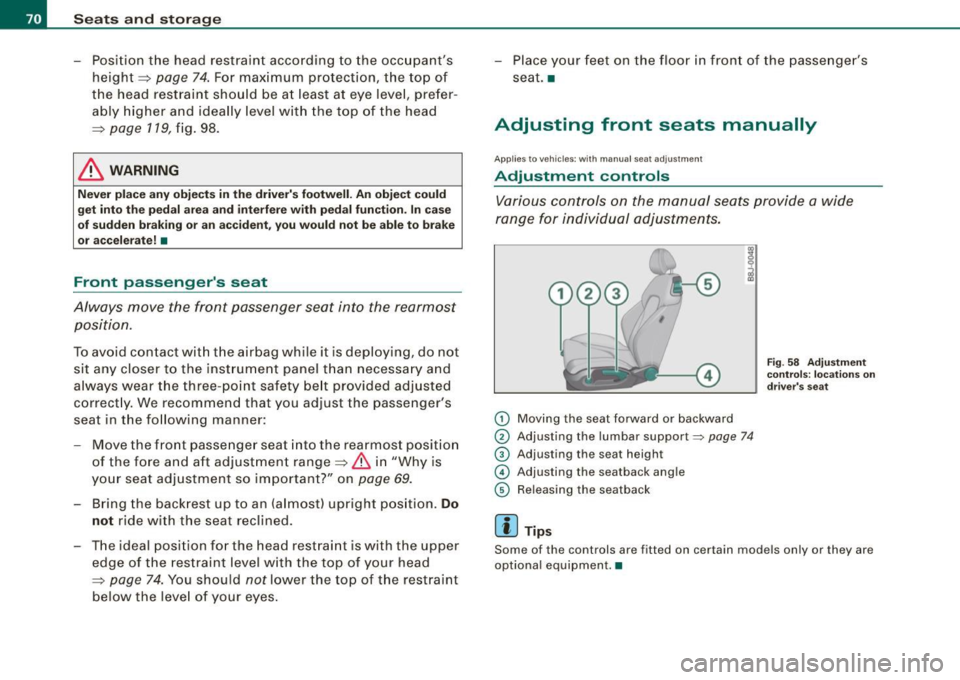
range for individual adjustments.
0 Moving the seat forward or backward
0 Adjusting the lumbar support~ page 74
® Adjusting the seat height
© Adjusting the seatback angle
© Releasing the seatback
[ i ] Tips
Fig. 58 Adjustment
controls: locations on
driver's seat
Some of the controls are fitted on certain models only or they are
optional equipment. •
Page 73 of 316
Applies to vehicles : wit h m anua l seat a djustment
Adjusting the manual seats
Position, angle and shape of the manual seats can be
adjusted to provide safe and comfortable seating.
Reed and heed all WARNINGS=:> & before you adjust your
seat.
Moving the front seats forward or backward
- Lift the lever (D =:> page 70, fig. 58 and slide the seat to
the desired position.
- Release the lever and then move the seat further until
you feel and hear it engage.
Adjusting the seat height
- Pull
the lever 0 up and pump it to raise the seat.
-Push the lever down and pump it to lower the seat.
Adjusting the seatback angle
-Lean forward to take your weight off the seatback.
- Turn the hand wheel© in the direction you want the
seatback to tilt .
Releasing seat back
-Pull the lever ® up.
- Push the seatback forward.
& WARNING
• Never adjust the driver's or front passenger's seat while the
vehicle is moving. If you do this while the vehicle is moving, you
Controls and equip
ment
Seats and storage
& WARNING (continued)
will be out of position . Always adjust the driver's or front
passenger's seat when the vehicle is not moving.
• Be careful when adjusting the seat height. Check to see that no
one is in the way, or serious injury could result!
• To reduce the risk of injury in the case of sudden braking or
accident, front passengers must never ride in a moving vehicle
with the seatback reclined . Safety belts and the airbag system
only offer maximum protection when the seatback is upright and
the safety belts are properly positioned on the body . The more the
seatback is reclined, the greater the risk of personal injury from an
incorrect seating position and improperly positioned safety
belts! •
Power seats
Applies to vehi cles : w it h p ower sea ts
Adjustment switches
The operating logic for the switches corresponds to the
construction and function of the seat.
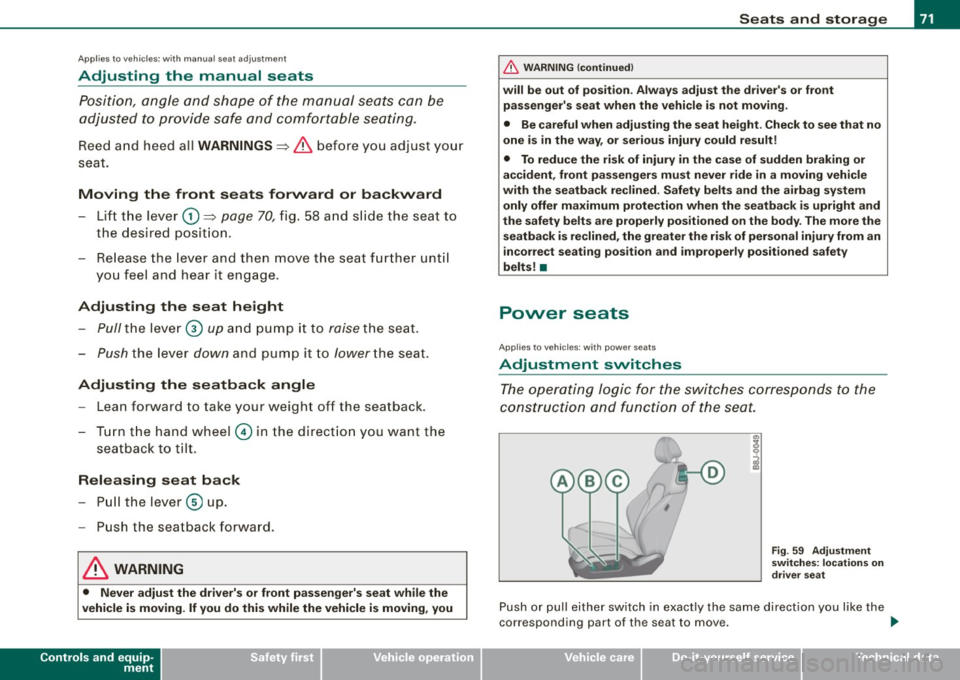
Fig. 59 Adjustment
switches: locations on
driver seat
Push or pull either switch in exactly the same direction you like the
corresponding part of the seat to move. ..,
I • •
Page 74 of 316
Seats and storage
© Adjusting the lumbar support=:> page 74
@ Seat adjustment =:> page 72
© Adjusting the angle of the seatback =:> page 73
@ Releasing the seatback
& WARNING
• Never adjust the driver's or front passenger seat while the
vehicle is moving. If you do this while the vehicle is moving, you
will be out of position. Always adjust the driver's or front
passenger seat when the vehicle is not moving.
• Be careful when adjusting the seat height. Check to see that no
one is in the way, or serious injury could result!
• Because the seats can be electrically adjusted with the ignition
key removed, never leave children unattended in the vehicle. Unsu
pervised use of the electric seat adjustments may cause serious
injury. •
Applies to vehi cles: with po wer seats
Power seat adjustment
The switches can be moved in various directions to allow
precise adjustment.
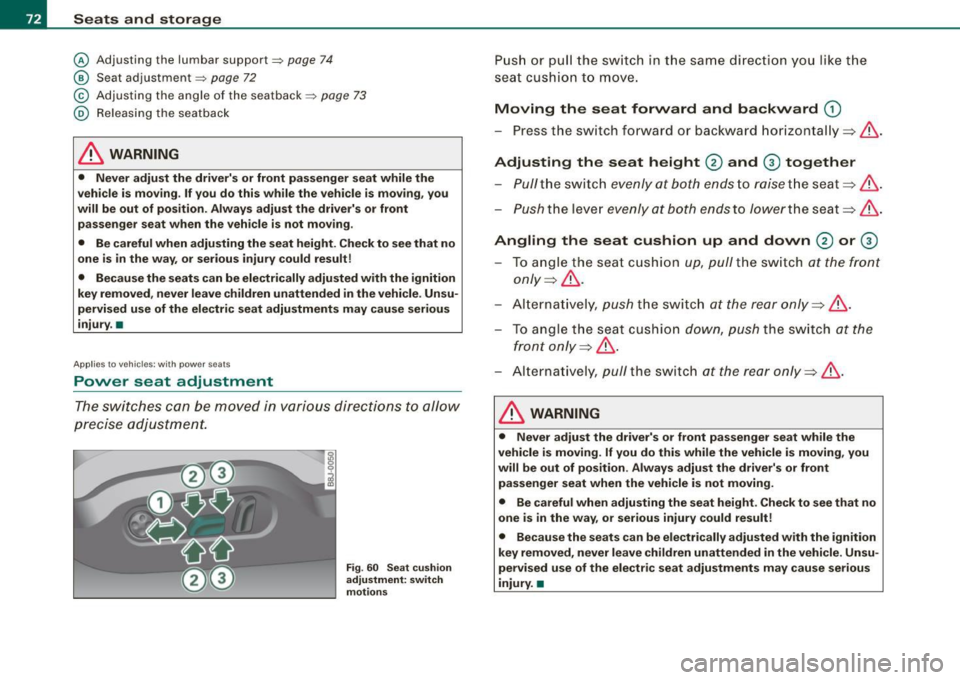
Fig . 60 Seat cushion
adjustment: switch
motions
Push or pull the switch in the same direction you like the
seat cushion to move.
Moving the seat forward and backward G)
-Press the switch forward or backward horizontally~& .
Adjusting the seat height 0 and 0 together
Pull the switch evenly at both ends to raise the seat ~& .
-Push the lever evenly at both ends to lower the seat ~& .
Angling the seat cushion up and down 0 or 0
To angle the seat cushion up, pull the switch at the front
only ~& -
Alternatively, push the switch at the rear only ~ &.
To angle the seat cushion
down, push the switch at the
front only~& .
Alternatively, pull the switch at the rear only~& .
& WARNING
• Never adjust the driver's or front passenger seat while the
vehicle is moving. If you do this while the vehicle is moving, you
will be out of position . Always adjust the driver's or front
passenger seat when the vehicle is not moving.
• Be careful when adjusting the seat height. Check to see that no
one is in the way, or serious injury could result!
• Because the seats can be electrically adjusted with the ignition
key removed, never leave children unattended in the vehicle. Unsu
pervised use of the electric seat adjustments may cause serious
injury. •
Page 75 of 316
Applies to vehicles: wi th powe r seats
Adjusting the seatback
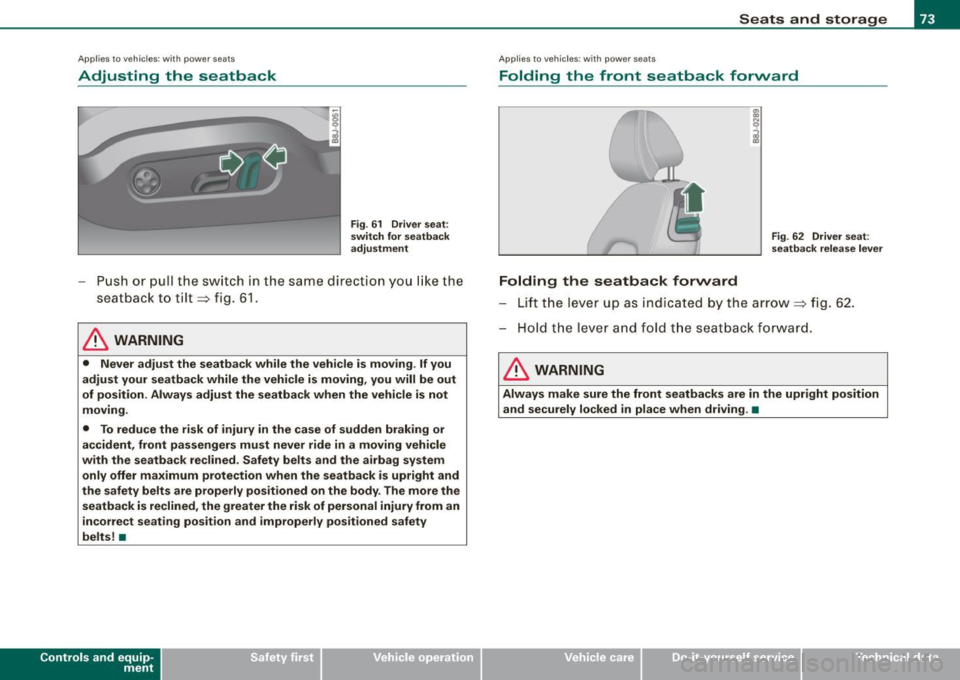
Fig . 61 Driver seat:
switch for seatback
adjustment
- Push or pull the switch in the same direction you like the
seatback to tilt => fig. 61.
& WARNING
• Never adjust the seatback while the vehicle is moving . If you
adjust your seatback while the vehicle is moving, you will be out
of position . Always adjust the seatback when the vehicle is not
moving.
• To reduce the risk of injury in the case of sudden braking or
accident, front passengers must never ride in a moving vehicle
with the seatback reclined. Safety belts and the airbag system
only offer maximum protection when the seatback is upright and
the safety belts are properly positioned on the body . The more the
seatback is reclined, the greater the risk of personal injury from an
incorrect seating position and improperly positioned safety
belts! •
Con tro ls and eq uip
ment
Seats and storage
A pp lies to vehicles: with power seats
Folding the front seatback forward
Folding the seatback forward
Fig. 62 Driver seat:
seatback release lever
Lift the lever up as indicated by the arrow=> fig. 62 .
Hold the lever and fold the seatback forward.
& WARNING
Always make sure the front seatbacks are in the upright position
and securely locked in place when driving . •
Vehicle care I I irechnical data
Page 76 of 316
Seats and storage
App lies to veh ic les: wi th lumbar suppo rt
Lumbar support
The lumbar support can be adjusted to fit the natural
curvature of the occupant's spine .
Adjusting the curvature
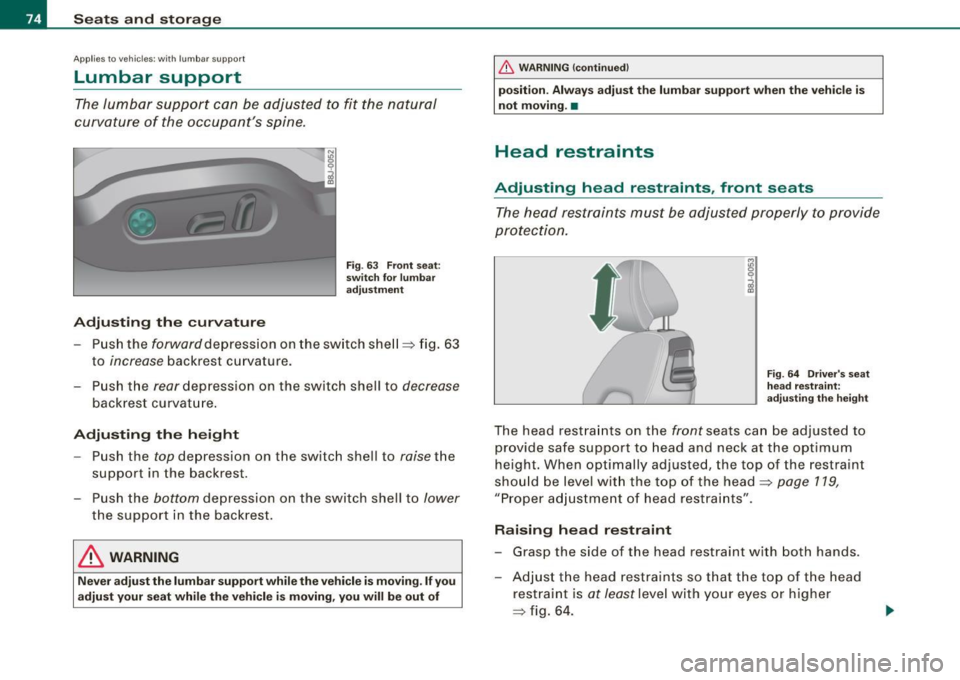
Fig. 63 Front seat:
switch for lumbar
adjustment
- Push the forward depression on the switch shell~ fig. 63
to
increase backrest curvatu re.
- Push the
rear depression on the switch shell to decrease
backrest curvature.
Adjusting the height
- Push the top depression on the sw itch shell to raise the
support in the backrest .
- Push the
bottom depression on the switch shell to lower
the support in the backrest.
& WARNING
Never adjust the lumbar support while the vehicle is moving. If you
adjust your seat while the vehicle is moving, you will be out of
& WARNING (continued)
position. Always adjust the lumbar support when the vehicle is
not moving. •
Head restraints
Adjusting head restraints , front seats
The head restraints must be adjusted properly to provide
protection.
Fig. 64 Driver's seat
head restraint:
adjusting the height
The head restraints on the front seats can be adjusted to
prov ide safe support to head and neck at the opt imum
height. When optimally adjusted, the top of the restra int
should be level with the top of the head~
page 119 ,
"Proper adjustment of head restraints" .
Raising head restraint
- Grasp the side of the head restraint with both hands .
- Adjust the head restraints so that the top of the head
r estraint is
at least level with your eyes or higher
~ fig. 64 .
Page 77 of 316
Lowering head restraint
- Grasp the sides of the head restraint with both hands.
-Press the button
=:> page 74, fig. 64 an d adjust the hea d
restraint .
- Adj us t the head restraints so tha t t he to p of th e he ad
re straint is
at least le vel with your eyes or higher
=:> page 7 4, fig . 64.
Refer to ~ page 119, "Prope r ad justment of head res traints" for
guide lines on how to ad just the height of the front head restraints
to fit the occupant 's body size.
& WARNING
• Driving without head restraint s or with head restraints that are
not properly adju sted increase s the ri sk of serious or fatal neck
injury dramatically .
• Read and heed all WARNINGS~
page 119.
[ i] Tips
Correctly adjusted head restraints and safety belts are an extremely
effective com bination of safety features. •
Controls and equip
ment
Seats and storage
Rear seats
General information
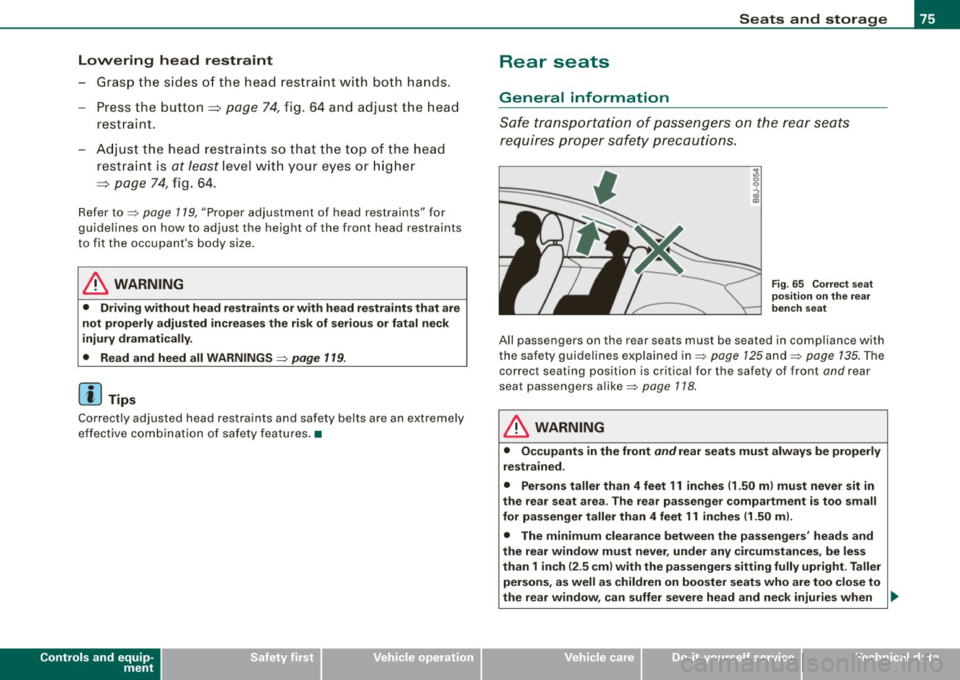
S a fe tr ansp ort atio n of passengers on t he re ar se ats
re quires prope r sa fety p rec autions.
Fig . 6 5 Corre ct se at
po sit ion on the re ar
bench seat
All passengers on the rear seats must be seated in compliance with
the safety guidelines exp lained in~ page 125 and ~ page 135. The
correct seating position is critical for the safety of front and rear
seat passengers alike ~ page
118.
& WARNING
• Occupants in the front and rear seats must always be properly
restrained .
• Per sons taller than 4 feet 11 inche s (1.50
ml must never sit in
the rear seat area . The rear pas senger comp artment is too small
for passenger taller than 4 feet 11 inches (1 .50
ml.
• The min imum clearance between the pas sengers ' head s and
the rear window must never , under any cir cum stance s, be less
than 1 inch (2 .5 cm ) with the pa ssenger s sitting fully upright . Taller
persons , as well a s children on boo ster seats who are too clo se to
the rear windo w, can suffer severe head and neck injurie s when _,,
I • •
Page 78 of 316
Seats and storage
& WARNING (continued)
the rear lid is closed or if a crash occurs. Always make sure that
rear seat passengers cannot be struck when the rear lid is closed.
• When the rear backrest is folded down do not allow passengers
to occupy the load surface available while the vehicle is in motion.
Vehicle occupants must always be properly restrained.
• Never store any heavy, hard objects on the rear lid cover. This
can be hazardous for rear seat occupants if the rear lid is opened
or if the vehicle is braked suddenly or in the event of a crash.
• Loose items inside the passenger compartment, can fly
forward in a crash or sudden maneuver and injure occupants.
Always store articles in the luggage compartment and use the
fastening eyes, especially when the rear seat backs have been
folded down .
• Read and heed all WARNINGS=:>
page 118, "Proper seating
positions for passengers in rear seats". •
Rear window shelf
You can place light articles of clothing on the rear
window shelf behind the seatback.
& WARNING
Whenever you are driving, do not leave any hard objects on the
rear window shelf or allow your pet to sit on the shelf. These could
become a hazard for vehicle occupants in the event of sudden
braking or a crash!
[ i ] Tips
• A vent slot is located between the shelf and the rear window. Do
not block the vent with any items you may place on the rear window
shelf. •
Do not place bulky items on the rear window shelf as they would
restrict or block the driver's vision through the rear view mirror. •
Luggage compartment
Expanding the luggage compartment
You can increase the available luggage space by folding
the rear seatback down.
Tilting the seat back forward
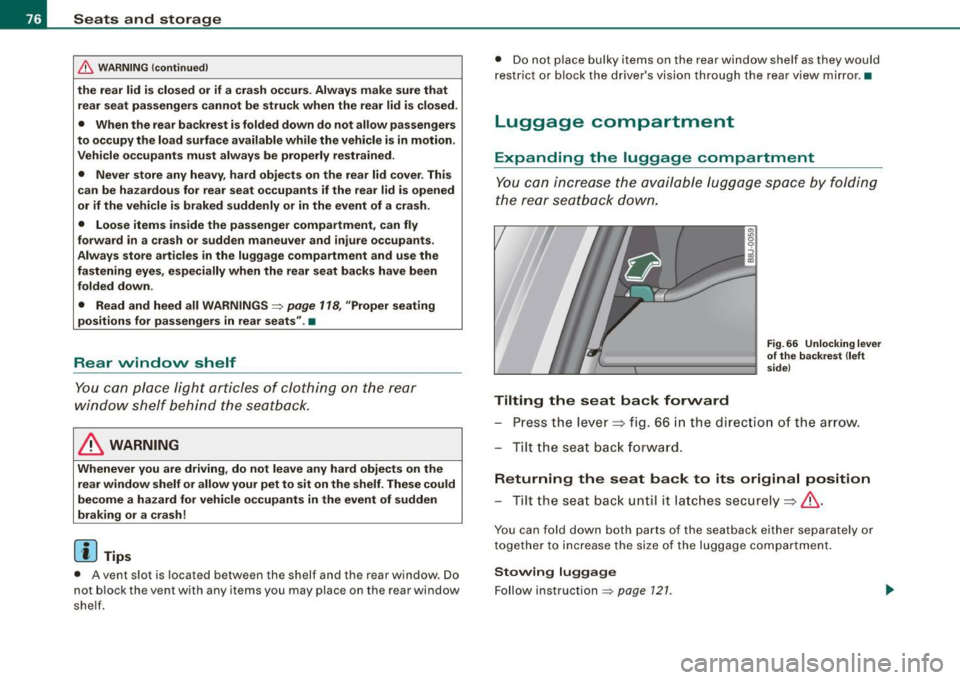
Fig. 66 Unlocking lever
of the backrest (left
side)
Press the lever~ fig. 66 in the direction of the arrow.
Tilt the seat back forward.
Returning the seat back to its original position
-Tilt the seat back until it latches securely~&.
You can fold down both parts of the seatback either separately or
together to increase the size of the luggage compartment.
Stowing luggage
Follow instruction =:> page 121.