ignition AUDI TT COUPE 2009 Workshop Manual
[x] Cancel search | Manufacturer: AUDI, Model Year: 2009, Model line: TT COUPE, Model: AUDI TT COUPE 2009Pages: 316, PDF Size: 71.16 MB
Page 103 of 316
_______________________________________________________ T_ r _a_ n_s_ m __ is_ s_ io_ n _ __. _
& WA RN ING !continue d)
hood). Other wise the vehi cle will immediately start to move -
s ometime s even if the p arking brake is firmly applied -ris k of an
a ccident !
• Before you or other per sons open the hood and work on a
running e ngine , the sel ector le ver must be moved to P and the
parking brake applied firmly -ris k of an a cc iden t! Follow the
wa rning sti ck ers
~ pag e 209, "Engine compa rt me nt".
[ i ] Tips
If you have inadvertently shifting into N while the vehic le is moving ,
you shou ld remove y our foo t from the acce lerator and wait unti l the
engine speed has dropped to idle before shifting back to Dor S . •
Ap plies to ve hicles : with S tro ni c®
Selector lever lock
The selector lever lock prevents a gear from being
engaged accidentally and unin tentionally setting the
vehicle in motion.
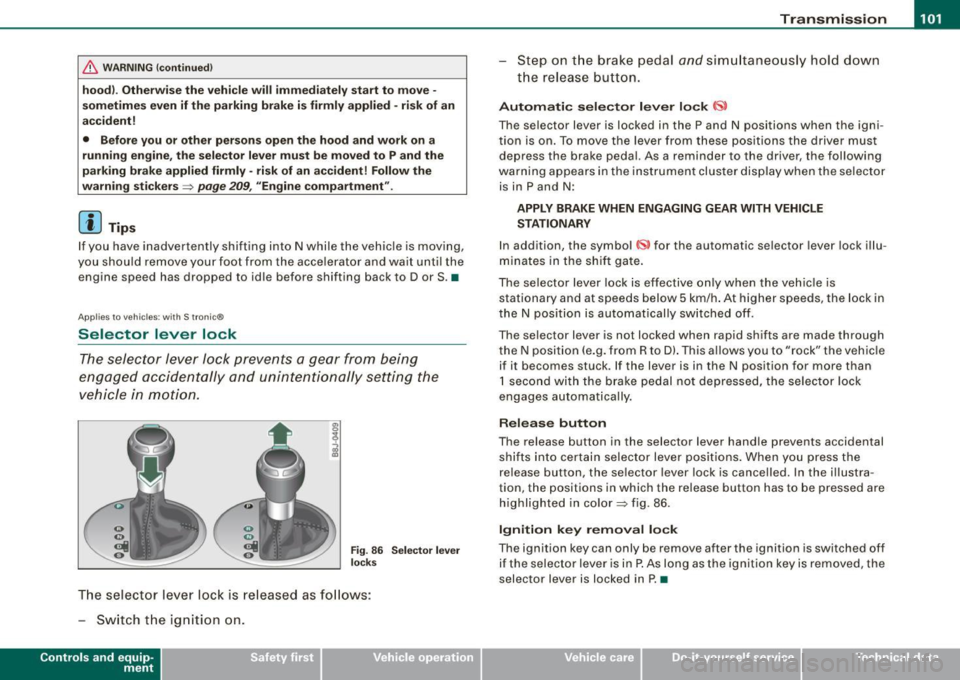
F ig . 8 6 Sel ector l ever
l oc ks
The selector lever lock is released as fo llows:
- Switch the ign ition on .
Contro ls and eq uip
ment
St ep on t he br ake pedal and simu ltan eously hold down
the rel ease button.
Autom ati c sele ctor le ver lo ck 6ll
The selector lever is locked in the P and N positions when the igni
tion is on. To move the lever fr om these pos itions the driver mus t
depress the brake pedal. As a reminder to the driver, the fol lowing
warning appears in the ins trument cluster display when the selector
is in P and N:
APPLY BRAKE WHEN ENGAGING GEAR WITH VEHICLE
S TATIONAR Y
In addition, the symbol «s> for the automatic selector lever lock i llu
minates in the shif t gate .
The selector lever lock is effective only when the vehic le is
stationary and at speeds below 5 km/h . At higher speeds, the lock in
the N position is automatically sw itched o ff .
The selector lever is not locked when rapid shifts are made through
the N posi tion (e .g. from R to DI. This allows you to "rock" the vehicle
if it becomes stuck . If the lever is in the N position for more than
1 second with the brake pedal not depressed, the selector lock
engages automatically.
Release button
The release button in the selector lever handle prevents accidental shifts into certain selector lever positions . When you press the
re lease button, the selector lever lock is cancelled. In the i llustra
tion , the positions in which the release button has to be pressed are
h ighlighted in co lor~ fig. 86 .
Ignition key removal lock
The ignition key can only be remove after the ignition is switched off
if the selector lever is in P . As long as the ignition key is removed, the
selector lever is locked in P. •
Vehicle care I I irechnical data
Page 110 of 316
• ..__H_ o_m_ e_ L_ i_ n _k_ @_R __________________________________________________ _
Applies to vehicles: with Home li nk® universal remote control
Programming the Homelink ® transmitt er
The transmitter is programmed in two phases. For rolling
code transmitters, a third phase is also necessary.
1----------------.....:!i:l
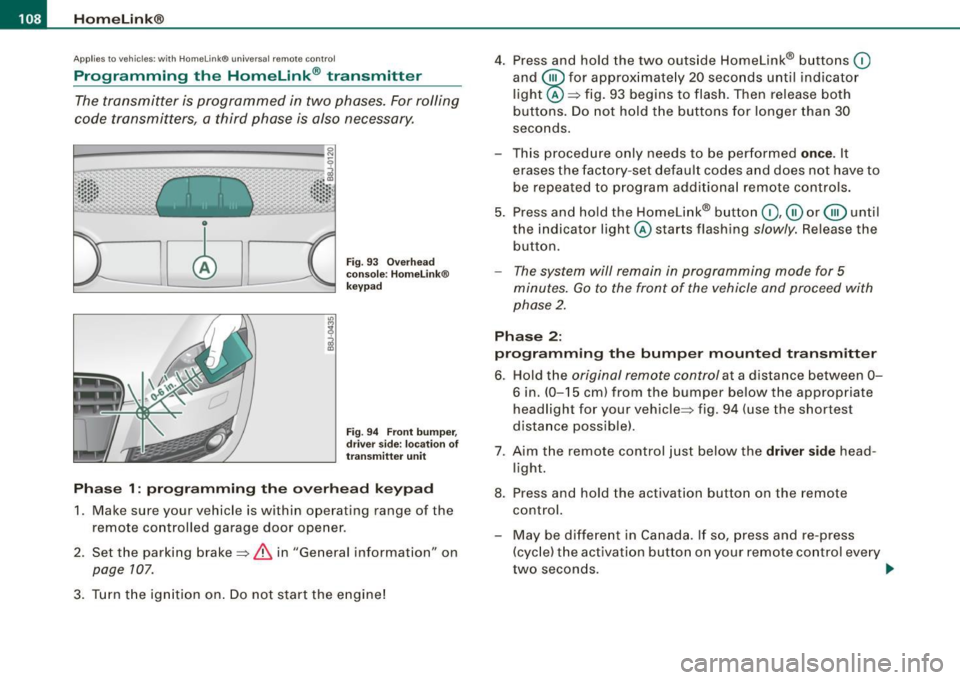
Fig . 93 Overhead
console : Homelink®
keypad
Fig. 94 Front bumper,
driver side: location of
transmitter unit
Phase 1: programming the overhead keypad
1. Make sure your vehicle is within operating range of the
remote controlled garage door opener .
2. Set the parking brake~
& in "General information" on
page 107.
3. Turn the ignition on. Do not start the engine! 4. Press and hold the two outside Homelink® buttons
(D
and
@for approximately 20 seconds until indicator
light @::::::, fig. 93 begins to flash. Then release both
buttons. Do not hold the buttons for longer than 30
seconds.
This procedure only needs to be performed
once . It
erases the factory-set default codes and does not have to
be repeated to program additional remote controls.
5. Press and hold the Homelink® button
(D , ® or @ until
the indicator light @starts flashing
slowly. Release the
button.
- The system will remain in programming mode for 5
minutes.
Go to the front of the vehicle and proceed with
phase 2.
Phase 2:
programming the bumper mounted transmitter
6. Hold the original remote control at a distance between 0-
6 in. (0-15 cm) from the bumper below the appropriate
headlight for your vehicle~ fig . 94 (use the shortest
distance possible) .
7. Aim the remote control just below the
driver side head
light.
8. Press and hold the activation button on the remote control.
- May be different in Canada. If so, press and re-press
(cycle) the activation button on your remote control every
two seconds. .-,,
Page 128 of 316
___ S_a_ f_ e_ t-= y_ b_e_ l_ t _s _______________________________________________ _
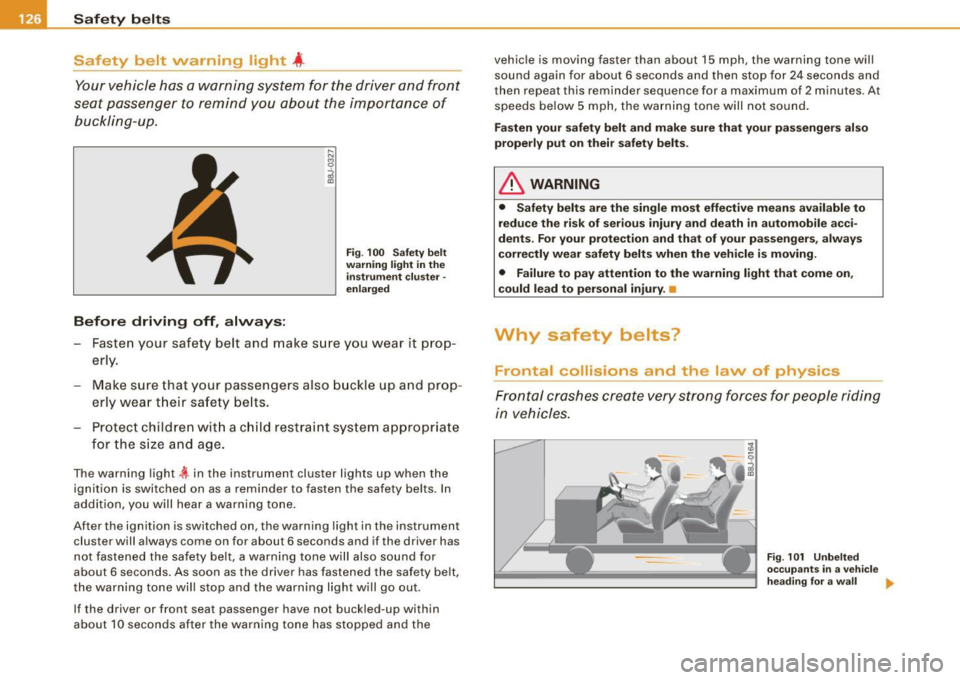
Safety belt warning light 4
Your vehicle has a warn ing system for the driver and front
seat passenger to remind you about the importance of buckling-up.
Before driving off , alw ays:
Fig . 100 Saf ety belt
w arn ing li ght in t he
in strum ent cluster -
e n la rge d
- Fasten your safety belt and make sure you wear it prop
erly.
Make sure that your passengers also buckle up and prop
erly wea r th eir safety be lts.
- Protect children wit h a c hild restraint sys tem appropria te
for the s ize and age.
The warning light tin the instrument cluster lights up when the
ignition is swi tched on as a reminder to fasten the safety belts. In
addition, you will hear a warning tone .
After the ignition is switched on , the warning light in the ins trumen t
cluster will a lways come on for about 6 seconds and if the driver has
not fastened the safety belt, a warning tone will also sound for
about 6 seconds. As soon as the driver has fastened the safety b elt,
the warning tone wil l stop and the warning light will go out.
If the driver or front seat passenger have not buckled-up within
about 10 seconds after the warning tone has stopped and the vehi
cle is moving faster than about 15 mph , the warning tone will
sound again for about 6 seconds and then stop for 24 seconds and
then repea t this reminder sequence for a maximum of 2 minu tes . At
speeds below 5 mph, the warning ton e will not sound .
Fas ten your safety belt and m ake sur e that your p as senger s al so
properly p ut o n the ir safety belt s.
& WARNING
• Saf ety belt s a re the single mo st effe ctive m ean s available to
r e d uc e the ri sk of ser iou s inj ury a nd death i n aut omobi le a cci
den ts. For your protection and that of your p assengers, always
corre ctly we ar sa fe ty belt s when the veh icle i s m oving.
• Failure to pay att ent ion t o th e w arning light that come on,
c ould l ead t o per sona l in jur y. •
Why safety be lts?
Frontal collisions and the law of physics
Frontal crashes create very strong forces for people riding
in vehicles.
--
Fig. 101 Unbe lt ed
o cc up ant s in a vehi cle
h ead ing fo r a w all
~
Page 139 of 316

__________________________________________________ A_ i_ r _b _a...; g::- s_ y=--- s_t _e _m __ !II
Child restraints on the front seat -some
important things to know
- Be sure to read the important information and head the
WARNINGS for important details about children and
Advanced Airbags :=>
page 157.
Even though your vehicle is equipped with an Advanced Airbag
System, make certain that all children, especially those 12 years and
younger, always ride in the back seat properly restrained for their age and size . The airbag on the passenger side makes the front seat
a potentially dangerous place for a child to ride . The front seat is not
the safest place for a child in a forward -facing child safety seat. It
can be a very dangerous place for an infant or a child in a rearward
facing seat.
The Advanced Airbag System in your vehicle has been certified to
comply with the Requirements of United States Federal Motor
Vehicle Safety Standard 208 as applicable at the time your vehicle
was manufactured.
The Standard requires the front airbag on the passenger side to be
turned off ("suppressed") if a child up to about one year of age
restrained in one of the rear-facing or forward-facing infant
restraints listed in Federal Motor Vehicle Safety Standard 208 with
which the Advanced Airbag System in your vehicle was certified has been installed on the front passenger seat. For a listing of the child
restraints that were used to certify compliance with the US Safety
Standard =>
page 159.
The PASSENGER AIR BAG OFF light in the instrument panel tells you
when the front Advanced Airbag on the passenger side has been
turned off by the electronic control unit.
Each time you turn on the ignition, the
PASSENGER AIR BAG OFF
light will come on for a few seconds and:
• will stay on if the front passenger seat is not occupied,
Controls and equip
ment Safety first
Vehicle operation
• will stay on if there is a small child or child restraint on the front
passenger seat,
• will go off if the front passenger seat is occupied by an adult as
registered by the weight-sensing mat=>
page 146, "Monitoring the
Advanced Airbag System" .
The
PASSENGER AIR BAG OFF light comes on when the control unit
detects a total weight on the front passenger seat that requires the
front airbag to be turned off.
If the total weight on the front passenger seat is more than that of
a typical 1 year-old child but less than the weight of a small adult,
the front airbag on the passenger side can deploy (the
PASSENGER
AIR BAG OFF
light does not come on). If the PASSENGER AIR BAG
OFF
light does not come on, the front airbag on the passenger side
has not been turned off by the electronic control unit and can
deploy if the control unit senses an impact that meets the condi
tions stored in its memory.
For example, the airbag may deploy if:
• a small child that is heavier than a typical 1 year -old child is on
the front passenger seat (regardless of whether the child is in one
of the child safety seats listed=>
page 159), or
• a child who has outgrown child restraints is on the front
passenger seat.
If the front passenger airbag is turned off, the
PASSENGER AIR BAG
OFF
light comes on in the instrument cluster and stays on.
The front airbag on the passenger side may
not deploy (the
PASSENGER AIR BAG OFF light does not illuminate and stay lit) even
if a small adult or teenager, or a passenger who is not sitting upright
with their back against a non-reclined backrest with their feet on the
vehicle floor in front of the seat is on the front passenger seat
=>
page 116, "Proper seating position for the driver".
If the front passenger airbag deploys, the Federal Standard requires
the airbag to meet the "low risk" deployment criteria to reduce the risk of injury through interaction with the airbag . "Low risk" deploy
ment occurs in those crashes that take place at lower decelerations
I),
Vehicle care Do-it-yourself service Technical data
Page 140 of 316
___ A_ ir_ b_ a-g _ s_y _s_ t_ e_ m _________________________________________________ _
as defin ed i n th e el ectron ic contro l u n it=> page 147 , "PASSE NGER
AI R BAG OFF lig ht".
A lwa ys rem em ber, a c hild safet y se at or infant carr ier installe d on
the front seat may be str uck and k nocked o ut of po sition by t he
rap id ly in fla ting passe nger's air bag in a fron tal colli sion . The airb ag
cou ld great ly re duce the effectivene ss of the ch ild restrain t and
e ve n seri ous ly injure the chi ld dur ing in flatio n.
For th is reason, and beca use the bac k seat is the safest plac e for
chi ldren -wh en prop erly rest rained acc ording to th eir age and size
- we strong ly recommend that ch ildren a lways sit in the bac k se at
=> p age 157, "Ch ild Safe ty ".
& WARNING
A child in a rearward -facing child safety seat installed on the front
passenger seat will be ser iously injured and can be killed if the
front airbag inflates - even with an Advanced Airbag System .
• The inflating airbag will hit the child safety seat or infant
carrier with great force and will smash the child safety seat and
child against the backrest , door or roof .
• Always install rear -facing child safety seats on the rear seat .
• If you must install a rearward facing child safety seat on the
front passenger seat because of exceptional circumstances and
the PASSENGER AIR BAG OFF light does not come on and stay on ,
immediately install the rear-facing child safety seat in a rear
seating position and have the airbag system inspected by your
Audi dealer .
• Forward-facing child safety seats installed on the front
passenger's seat may interfere with the deployment of the airbag
and cause serious personal injury to the child .
& WARNING
If, in exceptional circumstances, you must install a forward-facing
child restraint on the front passenger's seat:
& WARNING (continued)
• Always make sure the forward-facing seat has been designed
and certified by its manufacturer for use on a front seat with a
passenger front and side airbag .
• Never put the forward-facing child restraint up against or very
near the instrument panel.
• Always move the passenger seat into its rearmost position in
the seat's fore and aft adjustment range, as far away from the
airbag as possible before installing the forward-facing child
restraint. The backrest must be adjusted to an upright position .
• Make sure that the PASSENGER AIR BAG OFF light comes on
and stays on all the time whenever the ignition is switched on.
& WARNING
To reduce the risk of serious injury , make sure that the PASSENGER
AIR BAG OFF light will be displayed whenever a child restraint is
installed on the front passenger seat and the ignition is switched
on.
• If the PASSENGER AIR BAG OFF light does not stay on , perform
the checks described=>
page 146, "Monitoring the Advanced
Airbag System" .
• Take the child restraint off the front passenger seat and install
it properly at one of the rear seat positions if the PASSENGER AIR
BAG OFF light does not stay on.
• Have the airbag system inspected by your Audi dealer immedi
ately .
• Always carefully follow instructions from child restraint manu
facturers when installing child restraints .
& WARNING
If, in exceptional circumstances, you must install a forward or
rearward-facing child restraint on the front passenger's seat :
Page 144 of 316

___ A_ ir_ b_ a-g _ s_y _s_ t_ e_ m _________________________________________________ _
& WARNING (continued)
• If you must install a rearward facing child safety seat on the
front passenger seat because of exceptional circumstances and
the PASSENGER AIR BAG OFF light does not come on and stay on,
immediately install the rear-facing child safety seat in a rear
seating position and have the airbag system inspected by your
Audi dealer.
& WARNING
If, in exceptional circumstances, you must install a forward-facing
child restraint on the front passenger's seat:
• Always make sure the forward -facing seat has been designed
and certified by its manufacturer for use on a front seat with a
passenger front and side airbag.
• Never put the forward-facing child restraint up against or very
near the instrument panel.
• Always move the passenger seat into its rearmost position in
the seat's fore and aft adjustment range, as far away from the
airbag as possible, before installing the forward-facing child
restraint . The backrest must be adjusted to an upright position.
• Make sure that the PASSENGER AIR BAG OFF light comes on
and stays on all the time whenever the ignition is switched on. •
Advanced Airbag System components
The front passenger seat in your vehicle has a lot of very important
parts of the Advanced Airbag System in it. These parts include the
weight-sensing mat, sensors, wiring, brackets, and more. The func
tion of the system in the front passenger seat is checked by the elec
tronic control unit when the ignition is on. The control unit monitors
the Advanced Airbag System and turns the airbag indicator light on
when a malfunction in the system components is detected. The
function of the airbag indicator light is described in greater detail below
. Because the front passenger seat contains important parts
of the Advanced Airbag System, you must take care to prevent it
from being damaged. Damage to the seat may prevent the
Advanced Airbag for the front passenger seat from doing its job in
a crash .
The front Advanced Airbag System consists of the
following:
• Crash sensors in the front of the vehicle that measure vehicle
acceleration/deceleration to provide information to the Advanced
Airbag System about the severity of the crash.
• An electronic control unit, with integrated crash sensors for front
and side impacts. The control unit "decides" whether to fire the
front airbags based on the information received from the crash
sensors. The control unit also "decides" whether the safety belt
pretensioners should be activated.
• An Advanced Airbag with gas generator for the driver inside the
steering wheel hub .
• An Advanced Airbag with gas generator inside the instrument
panel for the front passenger.
• A weight-sensing mat under the upholstery padding of the front
passenger seat cushion that measures the total weight on the seat.
The information registered is sent continuously to the electronic
control unit to regulate deployment of the front Advanced Airbag on
the passenger side.
• An airbag monitoring system and indicator light in the instru
ment cluster ~
page 146.
• The PASSENGER AIR BAG OFF light comes on and stays on in the
center of the instrument panel~
page 147, fig. 113 and tells you
when the front Advanced Airbag on the passenger side has been
turned off.
• A sensor below the safety belt latch for the front seat passenger
to measure the tension on the safety belt. The tension on the safety
belt and the weight registered by the weight -sensing mat help the
control unit "decide" whether the front airbag for the front ..
Page 147 of 316

Airbag system 111111
---------------------------------------------=---='------
or the low er parts of the body. Front airba gs only suppl eme nt the
th ree point safe ty belt s i n so me frontal co lli sio ns in which t he
veh ic le dece lerat ion is h igh enou gh to deploy th e airbags.
Front airbags will not deploy:
• if the ignition is switched off when a crash occurs,
• in s ide collisions ,
• i n rea r- e nd c ollisions ,
• in ro llovers,
• when th e cras h d eceler ation m easured b y th e a irba g sys te m i s
less than the minimum threshold needed for airbag dep loyment as
r egi stere d by the ele ctronic control u nit.
The front passenger airbag will also not deploy :
• when the fron t passenger s eat i s not o ccupied,
• when the weight o n th e front pass enger seat as se nsed by the
Ad vanced Ai rbag S ystem indi cates tha t th e front airba g on the
pas senger side has to be tu rned off b y the e lectronic cont ro l unit
(th e PASSENGER AIR BAG OFF l ig ht co me s on and sta y s on ).
& WARNING
Sitting in the wrong position can increase the risk of ser ious injury
in crashes .
• To reduce the risk of injury when the airbags inflate , the driver
and passengers must always sit in an upright position , must not
lean against or place any part of their body too close to the area
where the airbags are located .
• Occupants who are unbelted , out of position or too close to the
airbag can be seriously injured by an airbag as it unfolds with
great force in the blink of an eye~ page 137.
Controls and equip ment Safety first
Vehicle operation
& WARNING
A child in a rearward-facing child safety seat installed on the front
passenger seat will be seriously injured and can be killed if the
front airbag inflates - even w ith an Advanced Airbag System .
• The inflating airbag will hit the child safety seat or infant
carrier with great force and will smash the child safety seat and
child against the backrest , center arm rest , door or roof.
• Always install rear-facing child safety seats on the rear seat .
• If you must install a rearward facing child safety seat on the
front passenger seat because of exceptional circumstances and
the PASSENGER AIR BAG OFF light does not come on and stay on, immediately install the rear-facing child safety seat in a rear
seating position and have the airbag system inspected by your
Audi dealer .
& WARNING
Objects between you and the airbag will in crease the risk of injury
in a crash by interfering with the way the airbag unfolds or by
being pushed into you as the airbag inflates .
• Never hold things in your hands or on your lap when the vehicle
is in use .
• Never transport items on or in the area of the front passenger
seat. Objects could move into the area of the front airbags during
braking or other sudden maneuver and become dangerous projec
tiles that can cause serious personal injury if the airbags inflate .
• Never place or attach accessories or other objects (such as cup
holders , telephone brackets , large , heavy or bulky objects ) on the
doors , over or near the area marked "AIRBAG " on the steering
wheel , instrument panel , seat backrests or between those areas
and yourself . These objects could cause injury in a crash , espe
cially when the airbags inflate .
• Never recline the front passenger's seat to transport objects.
Items can also move into the area of the side airbag or the front
IIJ,,
Vehicle care Do-it-yourself service Technical data
Page 148 of 316

___ A_ ir_ b_ a-g _ s_y _s_ t_ e_ m _________________________________________________ _
& WARN ING (continued )
airbag during br aking or in a sudden m aneuver . Obje cts near the
airbags can become proje ctiles and cause injury , parti cularly when
the seat is re clined .
• Never tilt the front p assenger seat ba ckrest forward when the
vehi cle is moving . An inflating airbag will force the backrest back
ward and can injure rear seat occupant s.
& WARNING
The fine dust created when airbags deploy can cause breathing
problems for people with a h istory of asthma or other breathing
conditions.
• To reduce the risk of breathing problems , those with asthma or
other respiratory conditions should get fresh air right away by
getting out of the veh icle or opening windows or doors .
• If you are in a collision in which airbags deploy , wash your
hands and face with mild soap and water before eating .
• Be c areful not to get the dust into your eyes , or into any cuts o r
scratches .
• If the residue should get into your eyes , flush them with
water .•
Monitoring the Advanced Airbag
System
Airbag monitoring indicator light :~
Two separ ate indi ca tor s m onitor the functi on of the
A dvance d Airbag Sys tem: th e air bag monitor ing i ndic ator
lig ht and t he
PASSENGER AIR BAG OFF light.
The Advanced Airbag Sys tem ( includ ing t he e lectronic co ntrol unit,
sensor circuits and system wiring ) is monito red continuous ly to ma
ke sure tha t it is functioning properly whenever the ignition is on .
Eac h tim e yo u turn o n the igniti on, the ai rbag m onito ring indica to r
li ght ~ wi ll come on for a few seconds (self diagnost ics).
The system must be inspected when the indicator light
m :
• does not co me o n w hen the igni tion is switche d on,
• does not go out a few seconds after you have switched on the
ig niti on, or
• comes on whi le driving.
If an a irbag sys tem malfu nction i s dete cted, the in dica tor lig ht will
first start f lashing to catch the driver 's attention and then stay on
c o nti nuou sly to serve as a c ons tan t re mind er to have the sys tem
inspected immediately.
I f a malfunction occu rs that turns the front airbag on the passenger
side o ff, the PASSENGER AIR BAG OF F lig ht w ill come on and stay on
whenever the ignition is on.
& WARNING
An airbag system that is not functioning properly cannot provide
supplemental protection in a frontal crash.
• If the airbag indicator light comes on , it means that there may
be something wrong with the Ad vanced Airbag System. It is
possible that the airbag will inflate when it is not supposed to , or
will not inflate when it should .
• Have the airbag system inspected immediately by your Audi
dealer .•
Page 149 of 316

PASSENGER AIR BAG OFF light
)
Fig. 113 Sec tion fr om
th e inst rum ent p anel :
PASSE NGER AIR B AG
OFF ligh t
The PASS ENGER AI R BAG OFF light is located in the center of the
instrument pane l
=> fig. 113.
The
PA SSE NGE R AIR BAG O FF light wil l come on and stay on to tell
you when the front Advanced Airbag on the passenger side has
been turned off by the electron ic control unit . Each time you turn on
the ignition, the
PA SS ENGER AIR BAG OFF light wi ll flash for a few
seconds and :
• will stay on if the front passenger seat is not occupied,
• will stay on if there is a small child or chi ld restra int on the front
passenger seat,
• will go out if the front passenger seat is occupied by an adult as
registered by the weight -sensing mat.
The
PAS SENGER AIR BAG OFF light mu st come on and stay on if the
ignition is on and
• a car bed has been instal led on the front seat, o r
• a rearward-facing child restraint has been installed on the front
passenger seat, or
• a forward-facing child restraint has been instal led on the front
passenger sea t, or
• the weight registered on the front passenger seat is equa l to or
less than the combined weigh t of a typica l 1 year-old restra ined in
Safety first
Airb ag sy ste m
one of the rear-facing or forward -facing infant restraints listed in
Federa l Motor Veh icle Safety S tandard 208 with which the Advanced
A irbag System in your vehicle was certified .
I f the front passenger seat is not occupied, the front airbag will not
deploy, and the
PASSEN GER AIR BA G OFF light will stay on . Never
install a rearward -facing child restraint on the front passenger seat,
t he sa fest place for a child in any kind of child restraint is at one of
the seating positions on the rear seat=>
page 137, "Child restraints
on the front seat- so me important things to know" and=>
page 157,
"Child Safety" .
If the PASSENGER AIR BAG OFF light come s on when one of the
conditions listed above is met, be sure to check the light regu lar ly
to make certain that the
PA SS ENGER AIR BAG OFF light stays on
continuously whenever the igni tion is on . If the
PA SS ENGER AIR
BAG OFF
light does not appear and not stay on all the time, stop as
soon as it is safe to do so and
• reactivate the system by turning the ignition off and then turning
it on again;
• remove and reinstall the child restraint. Make sure that the child
restraint is proper ly instal led and that the safety belt for the front
passenger seat has been correctly routed around the child restraint
as described in the child restraint manufacturer's instructions;
• make sure that the convertible locking feature on the safety belt
fo r the front passenger seat has been activated and that the safety
belt has been pulled tight . The belt must not be loose or have loops
of slack so that the sensor below the safety belt latch on the seat can
do its job
=> page 168.
• make sure that things that may increase the weight of the child
and child safety seat are not being transported on the front
passenger seat;
• make sure that the safety belt tension sensor is not blocked.
Shake the safety belt latch on the front passenger seat back and
forth;
• If a strap or te ther is being used to tie the child sa fety seat to the
front passenger seat, make sure that it is not so tight that it causes
~
Vehicle care I I irechnical data
Page 150 of 316
___ A_ ir_ b_ a-g _ s_y _s_ t_ e_ m _________________________________________________ _
the weight-sensing mat to measure more weight than is actual ly on
th e seat .
If the PASSENGER AIR BAG OFF light still does not come on and does
not stay on continuous ly (when the ignition is switched on),
• t ake the c hild res traint off t he front passe ng er seat a nd ins tall it
properly at one of the rear seat pos it ions. Have the a irbag system
insp ect ed by y our A udi deal er immedia tely .
• move the chi ld to a rear seat position and make sure that the
c h ild is pro pe rly restrai ned in a c hild restraint that is app ropriat e for
its size and age.
The
PASSENGER AIR BAG OFF l igh t sho uld NOT come on when the
ignition is on and an adult is sitt ing in a proper seating position on
the front passenge r seat . If the
PASSENGER AIR BAG OFF light
comes on a nd s tays o n or fl ashes for about 5 seco nds whi le d riving,
under these ci rcumstances, make sure that:
• the adult on the fron t pass enger sea t is pro perly s eate d on the
cent er of the seat cushion with his or her back up against the back
rest and the backrest is not reclined => page 116, "Proper occ upant
seating positions",
• t he ad ult is not ta king w eig ht o ff the sea t by hol ding o n to the
passenger assist hand le above the front passenger door or
su ppo rting their w eigh t on the arm res t,
• the safety be lt is being proper ly worn and that there is not a lot
o f sla c k in the sa fe ty b elt web bin g,
• accessory seat covers or cushions or other things that may cause
an incorrect read ing o r impression on t he w eight -s e nsi ng m at
under the upho lstery of the seat have been removed from the front
pass enger seat,
• a safety be lt extender has not been left in the safety be lt latc h for
th e fro nt passenger sea t.
In addition to the
PASSENGER AIR BAG OFF l ight in the center of the
instrument pane l, the mes sage
PASSENGER AIR BAG OFF o r
PASSENGER AIR BAG ON will br iefly appear in the instrument cluster display. This is to inform the driver of the curren
t front passenger
air bag status .•
Important safety instructions on monitoring
the Advanced Airbag System
& WARNING
An airbag system that is not functioning properly cannot provide
supplemental protect ion in a frontal crash.
• If the airbag indicator light comes on , it means that there may
be something wrong with the Advanced Airbag System . It is
possible that the airbag will inflate when it is not supposed to, or
will not inflate when it should .
• Have the airbag system inspected immediately by your Audi
dealer .
& WARNING
If the front airbag inflates , a child without a child restraint, in a
rear ward-facing child safety seat or
in a forward-facing child
restraint that has not been properly installed will be seriously
injured and can be killed .
• Even though your vehicle is equipped with an Advanced Airbag
System , make certain that all children , espec ially 12 years and
younger, always ride on the back seat properly restrained for their
age and size .
• Always install forward or rear -facing child safety seats on the
rear seat -even with an Advanced Airbag System .
• If you must install a rearward -facing child safety seat on the
front passenger seat be cause of exceptional cir cumstances and
the PASSENGER AIR BAG O FF light does not appear and stay on ,
immediately install the rear -facing child safety seat in a rear
~