ignition AUDI TT COUPE 2009 Repair Manual
[x] Cancel search | Manufacturer: AUDI, Model Year: 2009, Model line: TT COUPE, Model: AUDI TT COUPE 2009Pages: 316, PDF Size: 71.16 MB
Page 151 of 316

__________________________________________________ A_ i_ r _b _a...; g::- s_ y=--- s_t _e _m __ lllll
& W ARNING (continued )
seating position and have the airbag system inspected by your
Audi dealer .
• A tight tether or other str ap on a rearward-fac ing child restr aint
attached to the front pas senger seat can put too much pressure
on the weight-sensing mat in the seat and reg ister more weight
than i s actually on the seat. The heavier weight registered can
make the system work as though an adult were on the seat and
deploy the Advanced Airbag when it must be suppressed causing
s erious or even fatal injury to the child .
• If, in exceptional circumstance s, you mu st in stall a forward
fac ing child restra int on the front passenger seat , always move the
seat into its rearmost position in the seat 's fore and aft ad just
ment range , as far away from the airbag a s possible . The backrest
must be adjusted to an upright position . Make sure that the
PASSENGER AIR BAG OFF light comes on and stay s on all the time
whenever the ignition is switched on .
& WARNING
• If the PASSENGER AIR BAG OFF light does not go out when an
adult is sitting on the front passenger seat after taking the steps
described above, make sure the adult is properly seated and
restrained at one of the rear seating positions .
• Have the airbag system inspected by your Audi dealer before
transporting anyone on the front passenger seat .
[ i ] Tips
If the weight -sensing mat in the front passenger seat detects an
e mp ty seat, the fro nt air b ag on the pa ssenge r sid e will be t urned
off, and PASSENGER AIR BAG OFF will stay on.•
Controls and equip ment Safety first
Vehicle operation
Repair, care and disposal of the airbags
Parts of the airbag system are insta lled at many different places on
your Au di. In sta ll in g, re moving, ser vic in g or re pair in g a part in an
area of the vehicle can damage a part of an a irbag system and
pre ven t that system fro m wo rki ng p rope rly in a co llision .
There are some important things you have to know to make sure
that the effectiveness of the system will not be impai red an d that
d iscarded components do not cause inju ry or po llute t he e nv iron
ment .
& WARNING
Improper care , servicing and repair procedures can increase the
risk of personal injury and death by preventing an airbag from
deploying when needed or deploying an airbag unexpectedly:
• Never cover , obstruct , or change the steering wheel horn pad
or airbag cover or the instrument panel or modify them in any way .
• Never attach any obje cts su ch as cup holders or telephone
mountings to the surfaces covering the airbag units.
• For cleaning the horn pad or instrument panel, use only a soft ,
dry cloth or one moi stened with plain water . Solvents or cleaners
c ould damage the airbag cover or change the stiffness or strength
of the material so that the airbag cannot deploy and protect prop
erly .
• Never repair , adjust , or change any parts of the airbag system.
• All work on the steering wheel , instrument panel , front seats or
electrical system (including the installation of audio equipment ,
c ellular telephones and CB radios , etc .I must be performed by a
qualified technician who has the training and special equipment
necessary .
• For any work on the airbag system , we strongly recommend
that you see your authorized Audi dealer or qualified workshop .
• Never modify the front bumper or parts of the vehicle body .
Vehicle care Do-it-yourself service Technical data
Page 154 of 316
__ .....:::A::.::..:. ir..:b ::..:a::. 9:2...: s:::L y..::s :.:t ..::e :.:m.:..:... ________________________________________________ _
is why you should always wear your safety belt, not just because the
law requires you to do so~
page 125, "General notes".
The safety belt buckle for the driver and front seat passenger have switches that tell the airbag control module if the safety belt is
being used or not . If the safety belt is being used, the knee airbag
will deploy at a slightly higher rate of deceleration than if the belt is
not be ing used. Therefore, in a part icular collision, it is possible that
an airbag will not deploy at a seating position where the safety belt
is being used but will inflate a t the position where the safety belt is
not being used .
Remember too, airbags wi ll deploy only once and only in certain
kinds o f accidents -your safety belts are a lways there to offer
protection in those accidents in which airbags are not supposed to
deploy or when they have already deployed, for example when your
vehic le strikes or is struck by another after the first collision .
This is just one of the reasons why an airbag is not a substitute for
the safety be lt . The airbag system works most effectively when used
with the safety bel ts. Therefore, always wear your safety belts
correctly .
It is important to remember that while the supplemental airbag
system is des igned to reduce the likelihood of serious injuries, other
injuries, for example, swelling, bruising, and minor abrasions can
a lso be associated with airbags.
Th e kn ee a irbag s ystem b asica lly con sist s of:
• The electronic control module
• Two inflatable airbags (airbag and gas generator!, one for the
driver and one for the front passenger
• The airbag indicator light in the instrument panel
T he kn ee airb ag sys te m will not depl oy:
• when the ignition is turned off
• in front -end col lisions when the deceleration measured by the
control unit is too low
• in side collisions •
in rear-end collisions
• in rollovers
• in the event of a system malfunction (warning/indicator light illu
m inated)~
page 18 .
& WARNING
• Safet y belt s a nd th e airbag sy stem can onl y pr ovi de prote ction
when o ccupants are in the prop er seating posit ion ~
pag e 144.
• If the airbag i nd ica to r light com es whe n the vehi cle is being
used , have the sy ste m in spected imm ediat ely by y our authori zed
Audi deale r. The a irbag ma y not work p roperly when the v ehicl e
acceler ation in a sid e co llision i s high enou gh to deploy th e airbag.
S ee als o~
pag e 18. •
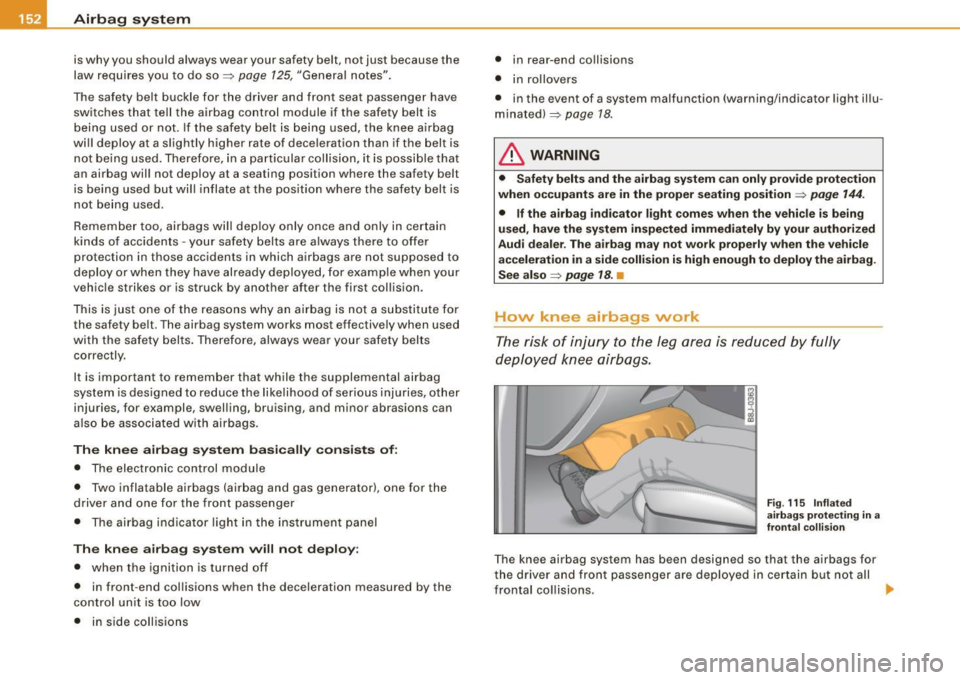
How knee airbags work
The risk of injury to the leg area is re duced by fully
deployed knee airbags.
Fig . 115 Inf lat ed
a ir bags pro tec ting in a
fr ontal co llision
The knee airbag system has been designed so that the airbags for
the driver and fron t passenger are deployed in certain but not all
frontal co llisions. .,.
Page 156 of 316

___ A_ ir_b _a_ g;:::;_ s--:.. y_s _t _e _m _________________________________________________ _
Side airbags
Description of side airbags
The airbag system can provide supplemental protection
to properly restrained front seat occupants.
Fig. 1 16 S ide a irbag
l oca tion i n the drive r's
seat
The side airbags are located in the sides of the front seat backrests
~ fig. 116 facing the doors. They are identified by the word
"AIRBAG".
Th e s ide a irba g sys te m bas ica lly consis ts o f:
• the e lectronic control module and external side impact sensors
• the two side airbags located in the sides of the front backrests
• the airbag warning light in the instrument cluster .
The airbag system is monitored electronica lly to make certain that
it is functioning properly at all times . Each time you turn on the igni
tion, the airbag system indicator light will come on for a few
seconds (self diagnostics).
The side airbag system supplements the safety belts and can help
to reduce the risk of injury to the driver's and front passenger's
upper torso on the side of the vehicle that is struck in a side colli
sion . The airbag deploys only in side impacts and only when the
vehic le acceleration registered by the control unit is high enough. If
this rate is below the reference value programmed into the control unit, the side airbags will not be
triggered, even though the car may
be badly damaged as a result of the collision. It is not possible to
define an airbag triggering range that wi ll cover every possible
angle of impact, since the circumstances will vary considerab ly
between one collision and another . Important factors include, for
example, the nature (hard or soft) of the impacting object, the angle
of impact, vehicle speed, etc.~
page 155, "Important safety
instructions on the side airbag system" .
Aside from their normal safety function, safety belts work to he lp
keep the driver or front passenger in position in the event of a side
collision so that the side airbags can provide protection.
The airbag system is
not a subs titute for your safety belt. Rather, it
is part of the overall occupant restraint system in your vehicle .
Always remember that the side airbag system can only help to protect you if you are wearing your safety belt and wearing it prop
erly. This is another reason why you should always wear your safety
belts, not just because the law requires you to do so~
page 125,
"General notes" .
It is important to remember that while the supplemental side airbag
system is designed to reduce the likelihood of serious injuries, other
injuries, for example, swel ling, bruis ing , and minor abrasions can
also be associated with deployed side airbags . Remember too, side
airbags will deploy only once and only in certain kinds of accidents
- your safety belts are a lways there to offer protection.
Vehicle damage, repair costs or even the lack of vehicle damage are not necessarily an indication of over-sensitive or failed airbag acti
va tion . In some collisions, both front and side airbags may inflate .
Remember too, that airbags will deploy only once and only in
certain kinds of col lisions -your safety belts are a lways there to
offer protection in those accidents in which airbags are not
supposed to deploy or when they have already deployed .
The s ide a irba g sy stem wi ll not deploy :
• whe n the ignition is turned off
• in side collisions when the acceleration measured by the sensor
is too low
~
Page 160 of 316

-Child Safety -------=---------------------------------------
& WAR NIN G (co ntinued )
• Alw ays in sta ll re ar-facin g child safety s eats on the r ear seat .
• If you m us t in sta ll a rear ward f acing child saf ety s eat on th e
fr ont pa ssenger seat in exceptional circum stan ces and the
PA SSEN GER AIR BAG OFF light do es not come on and sta y on ,
immediately in sta ll the re ar-facing child safety s eat in a rear
s eating po sit ion and ha ve th e airb ag s ystem insp ected immedi
atel y by your Audi dea ler .
& WARNING
If, in exceptional circum stance s, you mu st in sta ll a forward -f a cing
c hild re str ain t on th e fr ont p assenger's s eat:
• Always mak e sure the forward -fac ing seat ha s been de signed
a nd ce rt ified by it s m anufa cturer for u se on a fr ont se at w ith a
pa ssenger front and side airbag.
• Always follow the m anufacturer's instru ctions provided w ith
the child safety seat or carr ier.
• Alwa ys mo ve the pa ssenger seat into it s rea rmost positi on in
the seat' s fore and aft adju stment range , as far aw ay from the
ai rbag as possib le bef ore installing the ch ild r estr aint . The ba ck
re st mu st b e adjusted to an upright po sition.
• Alway s m ake sure that the PASSENGER AIR BAG OFF l ight
c om es on and sta y s on all the time whenever the ignition is
s w it c hed on . •
Advanced front airbag system and children
Your vehicle is equipped with an "Advanced Airbag System" in
complia nce with United States Federa l Motor Vehicle Safety Stan
dard (FMVSS) 208 as applicable at the time your vehicle was manu
factu red. T
he Advanced Airbag system in your vehicle has been certified to
meet the " low -risk" requirements for 3 and 6 year -old chi ldren on
the passenger side and smal l adults on the driver side . The low risk
deployment criteria are intended to reduce the risk of injury through
interaction with the airbag that can occur, for example, by being too
close to the steering wheel and instrument panel when the airbag
inflates. In addition, the system has been certified to comply with
the "suppression" requirements of the Safety Standard, to turn off
the front airbag for infants up to 12 months who are restrained on
the front passenger seat in child restraints that are listed in the
S tandard.
Even though your vehicle is equipped with an Advanced Airbag
system, all ch ildren, especially those 12 years and younger, should
always ride in the back seat properly restrained for their age and
size . The airbag on the passenger side makes the front seat a poten
tially dangerous p lace for a child to ride. The front seat is not the
safest p lace for a child in a forward -facing child safety seat. It can be
a very dangerous p lace for an infant or a larger ch ild in a rearward
facing seat. •
Advanced Airbags and the weight-sensing
mat in the front seat
The Advanced Airbag System in your vehicle detects the presence
of an infant or child in a chi ld restraint on the front passenger seat
using the weight -sensing mat in the seat cushion and the sensor
below the safety belt latch on the front passenger seat that
measures the tension on the safety belt.
The weight -sensing mat measures total weight of the chi ld and the
child safety seat and a child blanket on the front passenger seat . The
weight on the front passenger seat is related to the design of the
child restraint and its "footprint", the size and shape of the bottom
of the child restraint as it sits on the seat . The weight of a child
restraint and its "footprint" vary for different kinds of child ..,.
Page 162 of 316
___ C_ h_ il_ d _S_ a_fe _ ty ______________________________________________ _
C. Forward-facing convertible child restraint systems,
manufactured on or after September 1, 2004:
• Britax Roundabout 161
• Britax Expressway
• Century Encore 4612
• Century STE 1000 4416
• Cosco Olympian 02803
• Cosco Touriva 02519
• Evenflo Horizon V 425
• Evenflo Medallion 254
• Safety First Comfort Ride 22-400
& WARNING
To reduce the risk of serious injury, make sure that the PASSENGER
AIR BAG OFF light comes on and stays on whenever a child
restraint is installed on the front passenger seat and the ignition
is switched on.
• Take the child restraint off the front passenger seat and install
it properly at one of the rear seat positions if the PASSENGER AIR
BAG OFF light does not stay on.
• Have the airbag system inspected by your authorized Audi
dealer immediately.
[ i] Tips
The child seats listed in categories A to C have been tested by Audi
only for the Advanced Airbag function. •
Important safety instructions for using child
safety seats
Correct use of child safety seats substantially reduces the
risk of injury in an accident!
As the driver, you are responsible for the safety of every
body in the vehicle, especially children:
- Always use the right child safety seat for each child and
always use it properly ::::> page 162.
- Always carefully follow the child safety seat manufac
turer's instructions on how to route the safety belt prop
erly through the child safety seat.
- When using the vehicle safety belt to install a child safety
seat, you must first activate the convertible locking
retractor on the safety belt to prevent the child safety
seat from moving ::::> page
168.
- Push the child safety seat down with your full weight to
get the safety belt really tight so that the seat cannot
move forward or sideways more than one inch (2.5 cm).
- If a strap or tether is being used to tie the child safety
seat to the front passenger seat, make sure that it is not
so tight that it causes the weight-sensing mat to
measure more weight than is actually on the seat.
Always remember: Even though your vehicle is equipped with an
Advanced Airbag system, all children, especially those 12 years and
younger, should always ride in the back seat properly restrained for
their age and size. _,,
Page 164 of 316
___ C_h_ i_ld _ S_ a_ f_ e_ t-= y'------------------------------------------------
& WARNING (continued)
-Always move the front passenger seat into the rearmost
position of the passenger seat's fore and aft adjustment range,
and as far away from the airbag as possible before installing
the child restraint.
- Always make sure that nothing prevents the front
passenger's seat from being moved to the rearmost position in
its fore and aft adjustment range .
- Always make sure that the backrest is in the upright posi
tion.
• Always buckle the child safety seat firmly in place even if a
child is not sitting in it. A loose child safety seat can fly around
during a sudden stop or in a collision.
• Always read and heed all WARNINGS whenever using a child
restrained in a vehicle is being used=>
page 125, "Safety belts",
=>
page 135, "Airbag system" and=> page 157, "Child Safety".
& WARNING
To reduce the risk of serious injury, make sure that the PASSENGER
AIR BAG OFF light comes on and stays on whenever a child
restraint is installed on the front passenger seat and the ignition
is switched on.
• Take the child restraint off the front passenger seat and install
it properly at one of the rear seat positions if the PASSENGER AIR
BAG OFF light does not stay on.
• Have the airbag system inspected by your authorized Audi
dealer immediately. •
Child safety seats
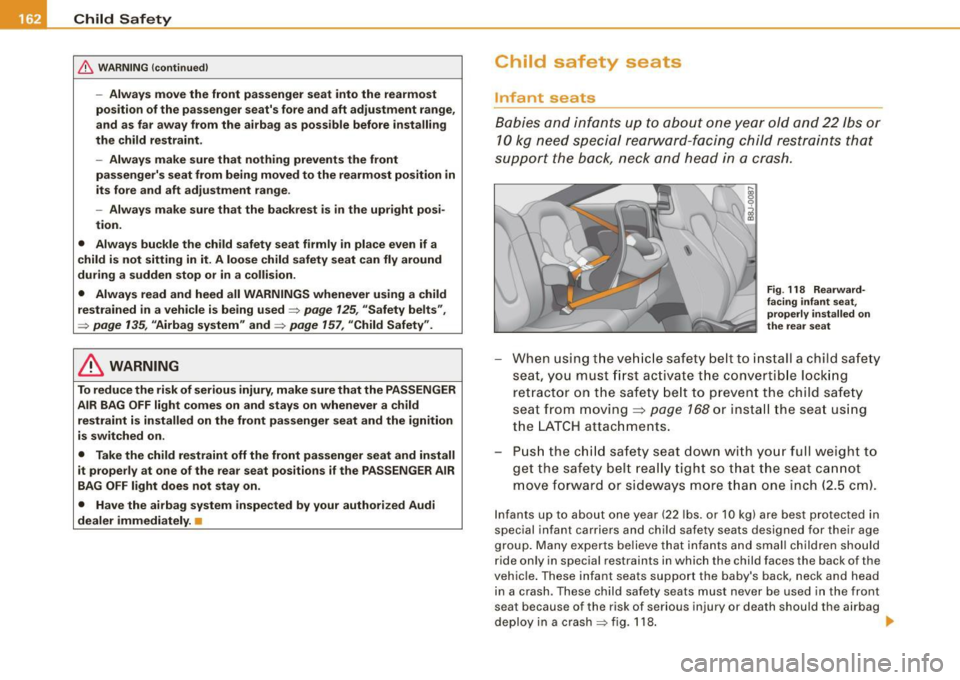
Infant seats
Babies and infants up to about one year old and 22 lbs or
10 kg need special rearward-facing child restraints that
support the back, neck and head in a crash.
Fig . 118 Rearward
facing infant seat,
properly installed on
the rear seat
-When using the vehicle safety belt to install a child safety
seat, you must first activate the convertible locking
retractor on the safety belt to prevent the child safety
seat from moving~
page 168 or install the seat using
the LATCH attachments.
- Push the child safety seat down with your full weight to
get the safety belt really tight so that the seat cannot
move forward or sideways more than one inch (2.5 cm).
Infants up to about one year (22 lbs. or 10 kg) are best protected in
special infant carriers and child safety seats designed for their age
group. Many experts believe that infants and small children should
ride only in special restraints in which the child faces the back of the
vehicle. These infant seats support the baby's back, neck and head
in a crash . These child safety seats must never be used in the front
seat because of the risk of serious injury or death should the airbag
deploy in a crash=> fig. 118. ..
Page 166 of 316
-Child Safety -------=--------------------------------------------
place for a chi ld in a forward -facing ch ild safety seat . It is a very
da ngerous p lace fo r an i nfan t or a large r ch ild in a re arw ard -f ac ing
s e at .
& WARNING
Not using a child safety seat , using the wrong child safety seat or
improperly installing a child restraint increases the risk of seriou s
personal injury and death in a collision or other emergency situa
tion.
• Children on the front seat of any car, even with Advanced
Airbags, can be seriously injured or even killed when an airbag inflates. A child in a rearward -facing child safety seat installed on
the front passenger seat will be seriously injured and can be killed if the front airbag inflates -even w ith an Advan ced Airbag System .
• The inflating airbag will hit the child safety seat or infant
carrier with great for ce and will smash the child safety seat and
child against the backrest or door.
• Always install rea r-facing child safety seats on the rear seat .
• If you must install a rearward facing child safety seat on the
front passenger seat because of exceptional circumstances and
the PASSENGER AIR BAG OFF light does not come on and stay on ,
immediately install the rear-facing child safety seat in a rear
seating position and have the airbag system inspected by your
Audi dealer .
• Always read and heed all WARNINGS whenever using a child
restrained in a vehicle is being used=>
page 125 , "Safety belts ",
=>
page 135 , "Airbag sy stem" and=> page 157 , "Important things
to know ".
& WARNING
If exceptional circumstances require the use of a forward-facing
child restraint on the front pas senger's seat , the child's safety and
well-being require that the following special precautions be taken :
& WARNING (continued )
• Make sure the forward-facing seat ha s been designed and certi
fied by its manufacturer for use on a front seat with a pa ssenger
front and side airbag .
• Always follow the manufacturer's inst ructions prov ided with
the child safety seat or carrier.
• Always move the front passenger seat into the rearmost posi
tion of the passenger seat's fore and aft adjustment range , and as
far away from the airbag as possible before installing the child restraint.
• Always make sure that nothing prevents the front passenger's
seat from being moved to the rearmost position in its fore and aft
adjustment range .
• Always make sure the backrest is in an upright position.
• Make sure that the PASSENGER AIR BAG OFF light comes on
and stays on all the time whenever the ignition i s switched on.
• If the light does not stay on , perform the checks=>
page 146,
"Monitoring the Advanced Airbag System" .
• Take the child restraint off the front passenger seat and install
it properly at one of the rear seat positions if the PASSENGER AIR
BAG OFF light does not stay on whenever the ignition is switched
on .a
Page 168 of 316
___ C_h_ i_ ld _ S_ a_ f_ e_ t_y ____________________________________________ _
& WARNING
Not using a booster seat, using the booster seat improperly , in cor
rectly installing a booster seat or using the vehicle safety belt
improperly in creases the risk of serious personal injury and death
in a collision or other emergency situation. To help reduce the risk
of serious personal injury and /or death:
• Always make sure to position the shoulder portion of the three
po int belt over the m iddle of ch ild's shoulder .
• Never let the shoulder portion of the belt rest against or across
the neck , face , chin, or throat of the child .
• Always make sure the lap belt portion of the three-point belt is
worn snug and passes as low as possible across the child 's pelvis.
Never let the belt pass over the soft abdomen.
• Failure to properly route safety belts over a child's body will
cause severe injuries in an accident or other emergency situation
=>
page 125 .
• Children on the front seat of any car, even with Advanced
Airbags , can be seriously injured or even killed when an airbag
inflates . A child in a rearward -facing child safety seat installed on
the front passenger seat will be seriously injured and can be killed
if the front airbag inflates.
• Never let a ch ild stand or kneel on any seat , for example the
front seat.
• Never let a child ride in the cargo area of your vehicle.
• Always remember that a child leaning forward , sitting s ide
ways or out of position in any way during an accident can be
struck by a deploying airbag . This will result in serious personal
injury or death .
• If you must install a rearward facing child safety seat on the
front passenger seat because of exceptional circumstances the
PASSENGER AIR BAG OFF light must come on and stay on, when
ever the ignition is switched on .
& WARNING (continued)
• If the PASSENGER AIR BAG OFF light does not come on and stay
on, perform the checks described=>
page 146, "Monitoring the
Advanced Airbag System ".
• Take the child restraint off the front passenger seat and in stall
it properly at one of the rear seat positions if the PASSENGER AIR
BAG OFF light does not stay on whenever the ignition is switched
on .
• Always read and heed all WARNINGS whenever using a child
restrained in a vehicle is being used =>
page 125, "Safety belts",
=>
page 135, " Airbag system " and => page 157, "Important things
to know" .•
Booster seats on the rear seat
Ch ildr en who are a bo ut 7 years and older, wh o weigh mor e tha n 55
l b ( 25 kg ) and ar e not taller than 4'1 1" (1.5 m) are best protected
when pro per ly restrained on the rea r seat.
D ue t o limite d re ar s eat he ad cleara nce chil dren 4'3" (1.3 m) a nd
tal ler must not use booster seats on the rear seat of your Audi TT
Co upe . T he rear sea t of yo ur A udi TT C oupe has been spec ially
designed to permit c hildr en who are b etween 4'3" (1. 3 m) and 4'11"
( 1. 5 m ) ta ll (a bout 7 to 1 2 years old) to u se the a vai lab le thr ee -point
l ap and shoulder safety belts.
& WARNING
• The rear seat area is too small to safely transport passengers
taller than 4'11" (1.5 ml.
• Persons taller than 4'11 " (1 .5 m) as well as children in booster
seats who are too close to the rear window and roof can suffer
severe head and neck injuries when the rear lid is closed or in a
crash .
Page 171 of 316

____________________________________________ __:C:::. h :....:..:..:. il.:::d ~S :::.:::a.:.:fe :::. t:.! y~ _ffllll
& WARNING
Always take special precautions if you must install a forward or
rearward -facing child restraint on the front passenger's seat in
exceptional situations:
• Whenever a forward or rearward -facing child restraint is
installed on the front passenger seat , the PASSENGER AIR BAG
OFF light must come on and stay on whenever the ignition is
switched on.
• If the PASSENGER AIR BAG OFF light does not come on and stay
on , perform the checks described
=> page 146, "Monitoring the
Advanced Airbag System".
• Take the child restraint off the front passenger seat and install
it properly at one of the rear seat positions if the PASSENGER AIR
BAG OFF light does not stay on whenever the ignition is switched
on .
• Improper installation of child restraints can reduce the ir effec
tiveness or even prevent them from providing any protection .
• An improperly installed ch ild restraint can interfere with the
airbag as it deploys and seriously injure or even kill the child.
• Always carefully follow the manufacturer's instructions
provided with the child safety seat or carrier.
• Never place additional items on the seat that can increase the
total weight registered by the weight-sensing mat and can cause
injury in a crash .
& WARNING
Forward-facing child restraints:
• Always make sure the forward -facing seat has been designed
and certified by its manufacturer for use on a front seat with a
passenger front and side airbag .
• Never put the forward -facing child restraint up , against or very
near the instrument panel .
Controls and equip ment Safety first
Vehicle operation
& WARNING (continued )
• Always move the passenger seat into its rearmost position in
the seat's fore and aft adjustment range, as far away from the airbag as possible before installing the forward-facing child
restraint. The backrest must be adjusted to an upright position .
• Make sure that the PASSENGER AIR BAG OFF light comes on
and stays on all the time whenever the ignition is switched on.
& WARNING
Rearward -facing child restraints :
• A child in a rearward -facing child safety seat installed on the
front passenger seat will be seriously injured and can be killed if
the front airbag inflates -even with an Advanced Airbag System .
• The inflating airbag will hit the child safety seat or infant
carrier with great force and will smash the child safety seat and
child against the backrest , door or roof .
• Always be especially careful if you must install a rearward
fac ing child safety seat on the front passenger seat in e xceptional
circumstances .
• A tight tether strap on a rearward-facing child restraint
attached to the front passenger seat can put too much pressure
on the weight-mat in the seat and register a heavier weight in the
Advanced Airbag System. The heavier weight registered can make
the system work as though an adult were on the seat and deploy
the Advanced Airbag when it must be suppressed causing serious or even fatal injury to the child .
• Make sure that the PASSENGER AIR BAG OFF light comes on
and stays on all the time whenever the ignition is sw itched on .
• If the PASSENGER AIR BAG OFF light does not come on and stay
on , immediately install the rear-fac ing child safety seat in a rear
seating position and have the airbag system inspected by your
Audi dealer. •
Vehicle care Do-it-yourself service Technical data
Page 195 of 316

one half. Never drive faster than the posted speed limit and weather
conditi ons permit. •
Reducing unnecessary Idling
Even when your car is just idling it burns up fuel.
- Shut the eng ine off when you are not driving the vehicle .
- Do not warm up the vehicle by letting the eng ine run at
idle.
I t makes sense to shut off the engine in traffic jams, when waiting
for trains to pass at railroad crossings, or at traffic lights that have long waits on red. Turning the engine off for just 30 -40 seconds
saves more fue l than is burned s tarting the engine again .
It takes a long time for the engine to warm up fully when it is
running at idle . However, wear and noxious emissions a re especial ly
high when the engine is warming up . So you should drive away as
soon as you start the engine and avoid running at high RPMs whi le
the engine is stil l warming up .
0 Note
Do not leave engine idling unattended after starting . If warning
lights should come on to indicate improper operation, they would
go unheeded. Extended idl ing also produces heat, wh ich cou ld
result in overheating or other damage to the vehicle or other
property .•
Regular maintenance
A badly tuned en gine unnecessarily wastes a lot of fuel.
- Have your v ehicl e serv ice d at reg ular intervals.
Controls and equip
ment Safety first Vehicle operation
Dri
ving and environm ent
By having your vehicle regularly serviced by an Audi dea ler helps to
ensure that i t runs properly and economically . The conditio n of your
vehic le not only affects its safety and abi lity to hold its va lue, it also
affects
fuel consumption .
Check your oil each time you fill your tank.
The amount of oil used is related to engine load and speed .
I t is normal for the oi l consumption of a new eng ine to reach its
lowest va lue after a certain mi leage has been driven.
You must drive your vehicle about 3,000 miles (5,000 kilometres) be fore you can proper ly assess o il consumpt ion.
This also applies to fuel consumption and engine output .
0 Note
• Have your vehicle maintained properly and in accordance with
t he service recommendations in you r Warranty
& Maintenance
booklet. Lack of proper ma intenance as well as improper use of the
vehicle wi ll impair the function of the emission control system and
cou ld lead to da mage.
• Do not alter or remove any component of the Emission Contro l
System unless approved by the manufacturer .
• Do no t al te r or remove any device, such as heat shields,
switches, ignition wires, valves, which are designed to protect your
veh ic le' s Emission Contr ol System and o ther i mportant vehicle
components. •
Fewer short trips
Fu el con su mp tion wi ll alwa ys be rel atively high on shor t
tri ps.
- Try to avo id driving short dista nce s wi th a cold engine.
Vehicle care Do-it-yourself service Technical data