service AUDI TT COUPE 2009 Workshop Manual
[x] Cancel search | Manufacturer: AUDI, Model Year: 2009, Model line: TT COUPE, Model: AUDI TT COUPE 2009Pages: 316, PDF Size: 71.16 MB
Page 247 of 316
________________________________________________ T_ i _r_e _s_ a_n_ d_ w_ h_ e_e _ l_s __ _
•
make, th ere w ill be six to ei ght of them evenly placed around the
t ire. Ma rks o n th e tir e s idewall (f or e xam ple "TWI " or oth er symbo ls)
indicate the positions of t he tread wear indicators . Worn tires must
be re placed. Diffe re nt fig ure s may a ppl y in other countr ies=>& .
Tire pressure
Inc orr ect t ire p ressure causes prema ture wea r and ca n cause
sudden tire blow -out. For this reason, tire pressure must be checked
at leas t on ce a mont h=>
pag e 24 1.
Dri ving style
Dr ivi ng fa st aro und curves, heavy accele ration a nd hard bra king
increase tire wea r.
Rotating tires for more even wear
F or all four tires on your vehicle to have the same service life, we
r ec om men d that t he fr ont a nd rear ti res are rota ted acco rd ing to the
tire manufacturer 's suggested tire ro tation interva ls. Please
r eme mber the fo llo wi ng:
• Ti re rotation interva ls may differ from the vehicle servic e int er
va ls ou tlined in y our Wa rranty
& M ain te n ance Booklet .
• T he longer one tire is used in one location on the vehicle, the
mo re it wears a t ce rtai n poi nts ; th erefore, we recom men d th at you
follow t he tire manufac turer's su ggested t ire rotation interv als .
• Vehi cles w ith front -w hee l d rive ex per ience more trea d wea r on
the front wheels compared to all -wheel drive (quattro®l .
• Ple as e rota te tires as shown=>
page 244, fi g. 15 1.
• Extra care must be ta ken when rotating direction -specific tires
=>
p age 2 73 .
Wheel balancing
The w heels on new vehic les are balanced. However, various situa
tions du ring everyday dr iving can cause them to become unbal
anc ed, resu lt in g in v ibrat io ns y ou can usual ly fe e l throu gh th e
steering whee l. U
nba lanc ed wheels must be r eba lanced to avoid excessive wear on
ste erin g, sus pen sion and tire s. A wh ee l mu st als o b e re b ala nce d
when a new tire is insta lled.
Incorrect wheel alignment
I ncorrect wheel alignment can cause excess ive tire wear, impairing
t he sa fety of the v ehicle. If t ire s s how e xcess ive wear, hav e t he
whee l a lignment chec ked by an authoriz ed Aud i d eal er o r qua lif ied
wo rk shop.
All Wheel Drive
V eh icles w ith q uattro ® must alwa ys ha ve tire s of the same siz e,
construction and t read t ype . For detai ls see=>
page 189 .
& WARNING
Sudden tire failure can lead to loss of control , a crash and serious
personal injury!
• Never drive a vehicle when the tread on any tire is worn down
to the wear indicators.
• Worn tires are a safety hazard , they do not grip well on wet
roads and increase your risk of "hydroplaning" and loss of control.
• Always keep chemicals that can cause tire damage , such as
grease , oil , gasoline and brake fluid away from tires .
• Tires age even if they are not being used and can fail suddenly,
espe cially at high speeds . Tires that are more than 6 years old can
only be used in an emergency and then with special care and at
lower speeds .
• Never mount used tires on your vehicle if you are not sure of
their "previous history ." Old used tires may have been damaged
even though the damage cannot be seen that can lead to sudden
tire failure and loss of vehicle control. •
Vehicle care
I t •
Page 250 of 316

-~_T_ ir_e_ s_ a_ n_d _ w_ h_ e_e _l_s _________________________________________________ _
ture. For example, the numbers 2209 mean that the tire was
produced in the 22th week of 2009. The other numbers are
marketing codes that may or may not be used by the tire manufac
turer. This information is used to contact consumers if a tire defect
requires a recall.
Tire ply composition and materials used
The number of plies indicates the number of layers of rubber-coated
fabric in the tire. In general, the greater the number of plies, the
more weight a tire can support. Tire manufacturers also must indi
cate the materials in the tire, which include steel, nylon, polyester,
and others .
Maximum Load Rating
This number indicates the maximum load in kilograms and pounds
that can be carried by the tire.
Tire quality grading for treadwear, traction, and
temperature resistance
Tread wear, traction and temperature grades => page 249.
Maximum Permissible Inflation Pressure
This number is the greatest amount of air pressure that should ever
be put in the tire under normal driving conditions.
Replacing tires or rims on vehicles equipped with tire
pressure monitoring system*
The wheels on your vehicle are equipped with a sensor which
constantly monitors the air pressure inside the tire, and then trans
mits this information to the tire pressure monitoring system *. If you
are going to replace the wheel rims on your vehicle, make sure the
new rims also have these sensors . The sensors must be compatible
with the tire pressure monitoring system * on your vehicle.
If the sensors are to be installed on different rims , the seal, washer ,
and valve cap for each sensor must be replaced.
If you install rims, which do not have the sensors, or have sensors
which are not compatible, then the tire pressure monitoring system* will not work properly.
In this case, the tire pressure moni
toring system * would not be able to monitor the tire pressure or
warn you if it is necessary .
• The battery inside of the tire pressure sensor has a limited
service life.
• Always drive with the valve stem caps securely mounted. We
recommend using factory installed valve stem caps. Ask your autho
rized Audi dealer to replace lost valve stem caps.
The installation of replacement tires with steel cord body plies in
the tire sidewall may cause malfunction of the tire pressure moni
toring system*, and is not recommended (cord material information
in molded on the tire sidewall) .
Always check your tire pressure monitoring system* indicator after
replacing one or more tires on your vehicle. If the tire pressure
monitoring system* indicator flashes, or is on, your system is not
working properly. Your replacement tire might be incompatible with
your tire pressure monitoring sys tem* , or some component o f the
tire pressure monitoring system* may be damaged.
& WARNING
• Using incorrect or unmatched tires and/ or wheels or improper
tire and wheel combinations can lead to loss of control, collision
and serious personal injury.
• Always use tires, rims and wheel bolts that meet the specifica
tions of original factory-installed tires or other combinations that
have been specifically approved by the vehicle manufacturer .
• Tires age even if they are not being used and can fail suddenly,
especially at high speeds. Tires that are more than 6 years old can
only be used in an emergency and then with special care and at
lower speeds.
• Never mount used tires on your vehicle if you are not sure of
their "previous history." Old used tires may have been damaged
even though the damage cannot be seen that can lead to sudden
tire failure and loss of vehicle control. .,_
Page 252 of 316
-~_T_ ir_e_ s_ a_ n_d _ w_ h_ e_e _l_s _________________________________________________ _
Quality grades can be found where applicable on the tire side wall
between tread shoulder and maximum section width
=> page 246,
fig. 152.
For example: Tread wear 200, Traction AA, Temperature A.
All passenger car tires must conform to Federal Safety Require
ments in addition to these grades .
Tread wear
The tread wear grade is a comparative rating based on the wear rate
of the tire when tested under controlled conditions on a specified
government test course .
For example, a tire graded 150 would wear one and one half (1 1/2)
times as well on the government course as a tire graded 100 .
The relative performance of tires depends upon the actual condi
tions of their use, however, and may depart significantly from the
norm due to variations in driving habits, service practices and differ
ences in road characteristics and climate.
Traction
The traction grades, from highest to lowest, are AA, A, Band C .
Those grades represent the tire's ability to stop on wet pavement as
measured under controlled conditions on specified government
test surfaces of asphalt and concrete. A tire marked C may have
poor traction performance
=> &.
Temperature
The temperature grades are A (the highest), B, and C, representing
the tire's resistance to the generation of heat and its ability to dissi
pate heat when tested under controlled conditions on a specified
indoor laboratory test wheel.
Sustained high temperature can cause the material of the tire to
degenerate and reduce tire life, and excessive temperature can lead
to sudden tire failure=>& .
The grade C corresponds to a level of performance which all
passenger car tires must meet under the Federal Motor Vehicle Safety
Standard No. 109. Grades Band A represent higher levels of
performance on the laboratory test wheel than the minimum
required by law.
& WARNING
The traction grade assigned to this tire is based on straight-ahead
braking traction tests, and does not include acceleration,
cornering, hydroplaning or peak traction characteristics.
& WARNING
The temperature grade for this tire is established for a tire that is
properly inflated and not overloaded. Excessive speed, underinfla
tion, or excessive loading, either separately or in combination, can
cause heat buildup and possible tire failure. •
Winter tires
Winter tires can improve vehicle handling on snow and
ice. At temperatures below 45 °F (7 °C) we recommend
changing to winter tires.
In some heavy snow areas, local governments may require true
winter or "snow" tires, those with very deeply cut tread. These tires
should only be used in pairs and be installed on all four wheels.
Make sure you purchase snow tires that are the same size and
construction type as the other tires on your vehicle.
I f your vehicle is equipped with all-wheel drive *, this will improv e
traction during winter driving, even with the standard tires.
However, we strongly recommend that you always equip all four
wheels on your vehicle with correctly fitted winter tires or all-season
tires, when winter road conditions are expected. This also improves
the vehicle's braking performance and reduces stopping distances.
Summer tires provide less grip on ice and snow.
Page 267 of 316
_____________________________________________ w __ h_a _t _ d_ o_ l _d _o :.....:. n,;_ o::.. w..:....:,_ ?,;_· __ Ill
•
Your vehicle is equipped with a t ire repair kit, the Tire Mobility
System (TMSl *.
In the event of a tire fai lure, the TMS is in the luggage compartment
under the floor . It consists of the tire sealant and an e lectric ai r
pump.
Using
TMS , tire damage caused by foreign bodies up to about
0.16 inch (4 mm) in d iam ete r can be sea le d reli abl y.
T he foreign object can stay i n the tire .
The tire sealant mu st not be used :
• for cuts or punctures in the tire which are larger than
0.16 inch
(4 mm )=> page 264, fig . 157 G)
• for damage to the rim@
• if you have bee n drivin g wi th very lo w tir e pr essures o r tire s w it h
no air@
Usi ng th e
TMS is de scrib ed in th e se ction=> page 2 66, "Prel imina ry
steps" .
TMS can be used at temperat ures down to -4 °F ( -20 °C).
& WARNING
Take the following precautions after repairing the tire :
• Do not drive faster than 50 mph (80 km/h)!
• Avoid full -throttle acceleration , heavy braking and fast
cornering.
• The vehicle's road behavior can be affected.
• Tires sealed with TMS are intended only for temporary , short
term use .
• After using the tire sealant the tire pressure monitoring system
may no longer work properly . Drive carefully to the next profes
sional repair facility .
• TMS must NOT be used ,
& WARNING (continued )
-for cuts or punctures in the tire which are larger than
0 .16 inch (4 mm)
- for damage to the rim
- if you have been driving with very low tire pressures or tires
with no air
• Seek professional assistance if it is not possible to repair the
tire with the tire sealant.
& WARNING
The tire sealant must not come into contact with skin , eyes or
clothing.
• If you get any tire sealant in your eyes or come into conta ct
with it , rinse the affected area thoroughly with clean water. Find a
physician immediately!
• Change any clothing contaminated with tire sealant immedi
ately.
• Do not inhale the vapor!
• If you have swallowed tire sealant , rinse your mouth thor
oughly right away and drink plenty of water .
- Do not induce vomiting! Find a physician immediately!
• If you have allergic reactions, find a physician immediately .
• Keep the tire sealant away from children.
0 Note
Do not u se co mm ercially ava ilable tire sealants . The elec trical
components of the tire pressure monitoring system wi ll no lo nger
wo rk p roperly.
~ For the sake of the environment
U sed sealant bottles ca n be dropped off at a recycling faci lity .
Do-it -yourself service
Page 269 of 316
_____________________________________________ W.:..:..; h:..:.= a:.:t ..:.d=-= o:....:... I .::d :.:o :....:.. n:.:o::.. w.:...:.. ?:...___J
Assembling Tire Mobility System
Fig . 160 Connector for
the Tire Mobility System
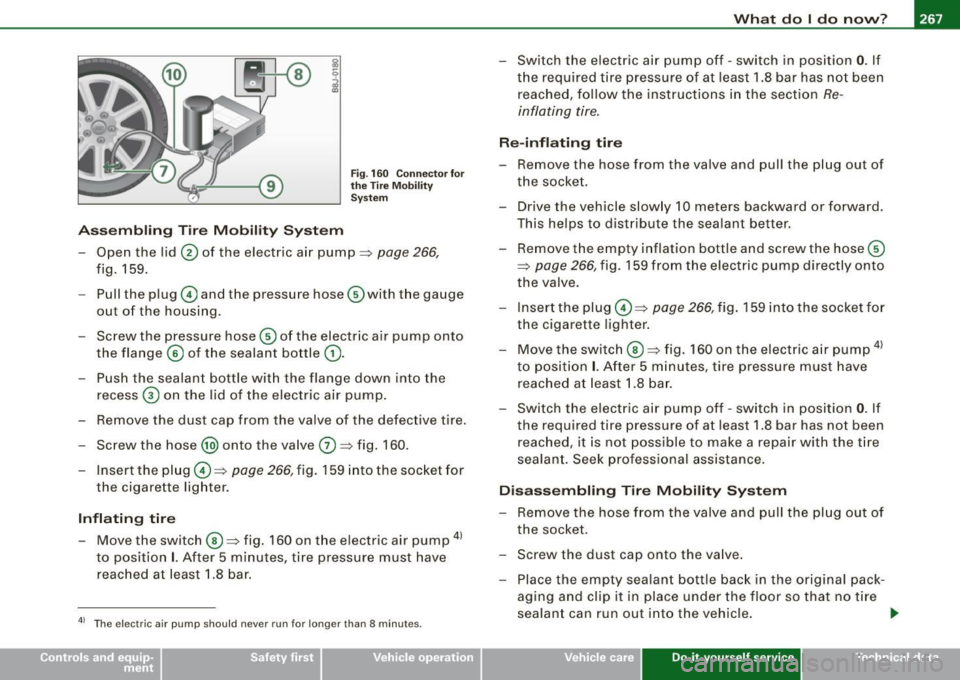
Open the lid 0 of the electric air pump:::;, page 266,
fig. 159.
- Pull the plug © and the pressure hose G)with the gauge
out of the housing.
- Screw the pressure hose© of the electric air pump onto
the flange © of the sealant bottle
G).
-Push the sealant bottle with the flange down into the
recess
0 on the lid of the electric air pump.
- Remove the dust cap from the valve of the defective tire.
- Screw the hose@) onto the valve
0:::;, fig. 160.
- Insert the plug©:::;,
page 266, fig. 159 into the socket for
the cigarette lighter.
Inflating tire
- Move the switch®:::;, fig. 160 on the electric air pump
4
l
to position I. After 5 minutes, tire pressure must have
reached at least 1.8 bar.
41 The electric a ir pump should never run for longer than 8 minutes .
-Switch the electric air pump off -switch in position 0. If
the required tire pressure of at least 1.8 bar has not been
reached, follow the instructions in the section
Re-
inflating tire.
Re-inflating tire
- Remove the hose from the valve and pull the plug out of
the socket.
- Drive the vehicle slowly 10 meters backward or forward.
This helps to distribute the sealant better.
- Remove the empty inflation bottle and screw the hose©
:::;, page 266, fig. 159 from the electric pump directly onto
the valve.
- Insert the plug ©:::;,
page 266, fig. 159 into the socket for
the cigarette lighter.
- Move the switch®:::;, fig. 160 on the electric air pump
4
l
to position I. After 5 minutes, tire pressure must have
reached at least 1.8 bar.
- Switch the electric air pump off -switch in position
0. If
the required tire pressure of at least 1.8 bar has not been
reached, it is not possible to make a repair with the tire
sealant. Seek professional assistance.
Disassembling Tire Mobility System
- Remove the hose from the valve and pull the plug out of
the socket.
- Screw the dust cap onto the valve.
- Place the empty sealant bottle back in the original pack-
aging and clip it in place under the floor so that no tire
sealant can run out into the vehicle. .,
Vehicle care Do-it-yourself service irechnical data
Page 270 of 316
11111.___W_ h_ a _ t_d_ o_ l _d _o_ n_ o_ w_ ? ______________________________________________ _
-Place the electric air pump in the luggage compartment
for the time being.
- Start driving right away so that the sealant is dist ributed
in the tire.
& WARNING
• Follow the manufacturer's safety instructions on the decal for
the air pump and the sealant bottle.
• If a tire pressure of 1.8 bar cannot be achieved after pumping
for 5 minutes, the tire is too severely damaged. Do not continue to
drive.
• Seek professional assistance if it is not possible to repair the
tire with the tire sealant.
[ i] Tips
• Do not operate the electric air pump for more than 8 minutes
without stopping, otherwise it can overheat. When the air pump has
cooled down, you can continue to use it.
• If sealant has escaped, allow it to dry, then you can peel it off. •
Applies to veh icles: with Tire Mob ili ty Sys tem
Final check
After driving for a short distance, tire pressure
must be checked
- After driving for about 10 minutes, stop and check the
tire pressure.
- If tire pressure is still at least 1.3 bar, inflate the tire to
specified pressure (see driveas side B-pillarl, drive to the
next repair shop and have the tire and the sealant bottle
replaced. -
If tire pressure is less than 1.3 bar, the tire is too severely
damaged. Do not continue to drive. Seek professional
assistance.
& WARNING
If tire pressure is less than 1.3 bar after driving for 10 minutes, the
tire is too severely damaged. Do not continue to drive. Seek profes
sional assistance.
[ i] Tips
After a tire repair, have the sealant bottle replaced at a dealership.
This restores full functionality to the Tire Mobility System. •
What should I be aware of when
changing a tire?
General information
The following sections will provide you with important information
on how to change a tire using the vehicle tool kit.
However, we recommend that you have a qualified service center
change the tire and perform all work associated with changing it. •
Page 271 of 316
_______________________________________________ W_ h_ a _ t_d_ o_ l _d _o_ n_ o_ w_ ? _ __.ffllll
Ap plies to vehic les: with decorative wheel covers
Decorative wheel covers
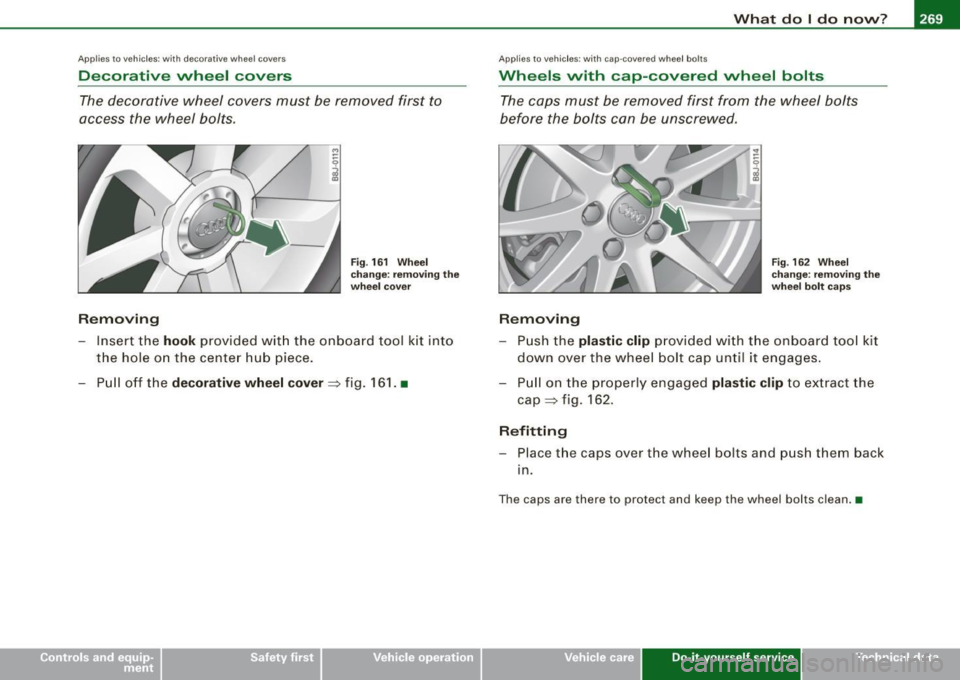
The decorative wheel covers must be removed first to
access the wheel bolts.
Removing
Fig . 161 Wheel
change : removing the
wheel cover
- Insert the hook provided with the on board tool kit into
the hole on the center hub piece.
- Pull off the
decorative wheel cover=> fig. 161. •
Applies to vehicles: with cap-covered wheel bolts
Wheels with cap-covered wheel bo lts
The caps must be removed first from the wheel bolts
before the bolts can be unscrewed.
Removing
Fig . 162 Wheel
change : removing the
wheel bolt caps
-Push the plastic clip provided with the on board tool kit
down over the wheel bolt cap until it engages.
- Pull on the properly engaged
plastic clip to extract the
cap=> fig. 162.
Refitting
-Place the caps over the wheel bo lts and push them back
1n.
The caps are there to protect and keep the wheel bolts clean.•
Vehicle care Do-it-yourself service irechnical data
Page 273 of 316
What do I do now? -
------------------
Fig. 165 Close-up:
proper positioning of
lifting jack
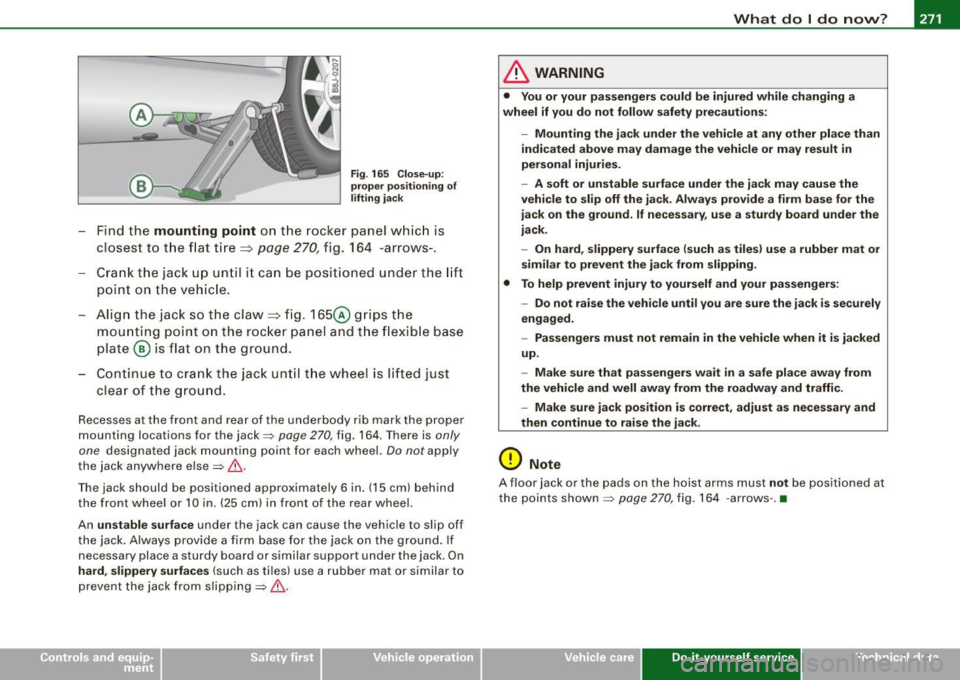
- Find the mounting point on the rocker panel which is
closest to the flat tire =>
page 270, fig. 164 -arrows-.
- Crank the jack up until it can be positioned under the lift
point on the vehicle.
- Align the jack so the claw=> fig. 165@ grips the
mounting point on the rocker panel and the flexible base
plate ® is flat on the ground.
- Continue to crank the jack until the wheel is lifted just
clear of the ground.
Recesses at the front and rear of the underbody rib mark the proper
mounting locations for the jack=>
page 270 , fig. 164. There is only
one
designated jack mounting point for each wheel. Do not apply
the jack anywhere else=>&.
The jack should be positioned approximately 6 in. (15 cm) behind
the front wheel or 10 in. (25 cm) in front of the rear wheel.
An
unstable surface under the jack can cause the vehicle to slip off
the jack. Always provide a firm base for the jack on the ground. If
necessary place a sturdy board or similar support under the jack. On
hard, slippery surfaces (such as tiles) use a rubber mat or similar to
prevent the jack from slipping=> &.
& WARNING
• You or your passengers could be injured while changing a
wheel if you do not follow safety precautions:
-Mounting the jack under the vehicle at any other place than
indicated above may damage the vehicle or may result in
personal injuries.
- A soft or unstable surface under the jack may cause the
vehicle to slip off the jack. Always provide a firm base for the
jack on the ground. If necessary, use a sturdy board under the
jack.
- On hard, slippery surface (such as tiles) use a rubber mat or
similar to prevent the jack from slipping.
• To help prevent injury to yourself and your passengers:
-Do not raise the vehicle until you are sure the jack is securely
engaged.
- Passengers must not remain in the vehicle when it is jacked
up.
- Make sure that passengers wait
in a safe place away from
the vehicle and well away from the roadway and traffic.
- Make sure jack position is correct, adjust as necessary and
then continue to raise the jack.
0 Note
A floor jack or the pads on the hoist arms must not be positioned at
the points shown
=> page 270 , fig. 164 -arrows -. •
Vehicle care Do-it-yourself service irechnical data
Page 275 of 316
What do I do now? -
----------------
•
• The whe el bo lts should be cl ean and easy to turn . C heck for dirt
an d corro sion on the mati ng s urfaces o f both th e wheel a nd the
hub. Remove a ll dirt fro m these surfaces before remountin g the
whee l.•
Notes on wheel change
Ple as e rea d th e informati on => pag e 246 , "New tir es an d r ep laci ng
tir es and whee ls", if you ar e goin g to us e a spar e tire which is
d ifferent from th e tir es on y our v ehic le .
After you ch ange a tire :
• Check the tire pressure on the spare immediately after
mounting.
• Have the wheel bolt tightening torque checked with a torque
wrench as soon as possible by your authorized Audi dealer or a qualified service station .
• With steel and alloy wheel rims, the wheel bolts are correctly
tightened at a torque of 90 ft lb (120 Nm l.
• If you notice while changing a tire that the wheel bolts are
corroded and difficult to turn , then they should be replaced before
you check the tightening torque.
• Replace the flat tire with a new one and have it installed on your
vehicle as soon as possible . Remount the wheel cover.
Until then , drive with extra care and at reduced speeds .
& WARNING
• If you are going to equip your vehicle with tires or rims which
differ from those which were factory installed , then be sure to read
the information
=> page 246, "New tires and replacing tires and
wheels ".
• Always store the tools securely in luggage compartment .
Otherwise, in an accident or sudden maneuver they could fly
forward, causing injury to passengers in the vehicle.
0 Note
D o not us e comme rc ia lly av ai labl e tire sea lants. Otherw ise, t he elec
trical components of the ti re pressure monitor ing system* will no
l o nger wor k properly a nd the se ns or fo r the tire pr essure moni
to ring system will have to be rep laced b y a qualified workshop. •
Tires with unidirectional tread design
T ires w ith unid ire ction al tread design must be m ounted
w ith their tread patte rn po inted t he r ight dire ction.
A un id irectiona l tir e ca n be iden tified by arrows on the sidewall ,
w hi ch point in th e dir ec tion of the r otation. You mus t follow th e
specified direction of rotati on. T his is necessa ry in o rder fo r these
t ire s to de ve lop their optimum ch arac ter ist ics rega rdin g grip, r oad
noise, wear, and h ydroplaning .•
Do-it -yourself service
Page 277 of 316
Fuses and bulbs -
------------------
The various electrical circuits are protected by fuses. The fuses are
clustered in a centralized unit. The unit is located behind the face
panel at the end of the instrument panel.
Two spare fuses and a sticker identifying the fuses are located on
the inside of the fuse box cover.
You are well advised to keep a supply of spare fuses in your vehicle.
Fuses with the proper ampere ratings are available at your autho
rized Audi dealer.
& WARNING
Never replace a fuse with one that has a higher amperage rating .
• A fuse with a too high amperage could damage the electrical
part and cause a fire.
0 Note
• On no account should fuses be repaired (e.g. patched up with tin
foil or wire) as this may cause serious damage elsewhere in the elec
trical circuit or cause fire.
• If a fuse blows repeatedly, do not keep replacing it. Instead, have
the cause for the repeated short circuit or overload tracked and
fixed. •
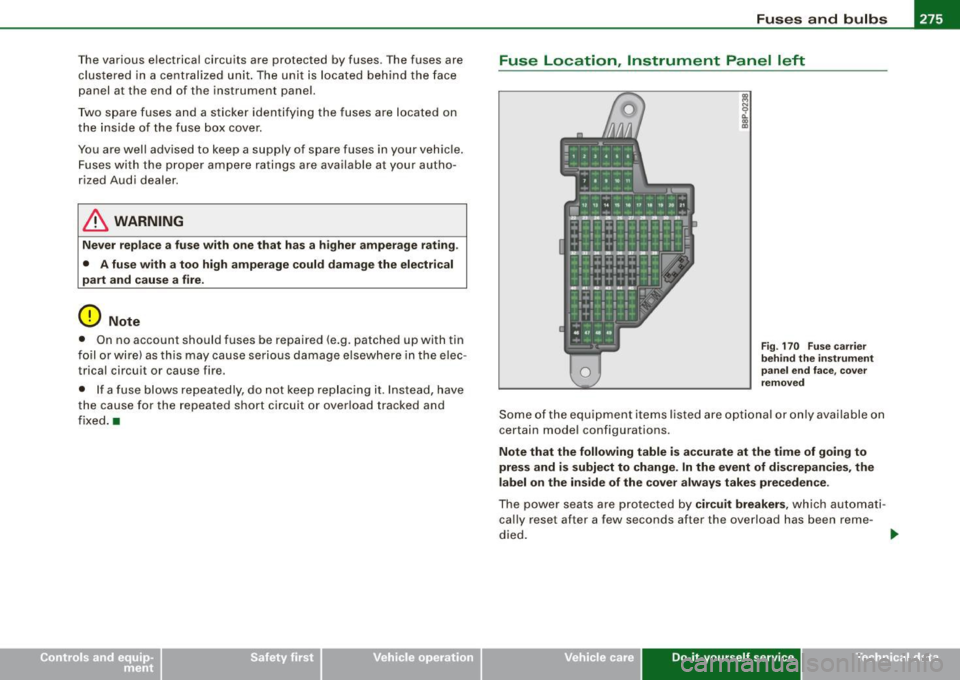
Fuse Location , Instrument Panel left
Fig . 170 Fuse carrier
behind the instrument
panelendface,cover
removed
Some of the equipment items listed are optional or only available on
certain model configurations.
Note that the following table is accurate at the time of going to
press and is subject to change. In the event of discrepancies, the
label on the inside of the cover always takes precedence.
The power seats are protected by circuit breakers, which automati
cally reset after a few seconds after the overload has been reme-
died. .,_
Vehicle care Do-it-yourself service irechnical data