service AUDI TT COUPE 2009 Repair Manual
[x] Cancel search | Manufacturer: AUDI, Model Year: 2009, Model line: TT COUPE, Model: AUDI TT COUPE 2009Pages: 316, PDF Size: 71.16 MB
Page 279 of 316

_______________________________________________ F_ u_ s_ e_s _ a_ n_d _ b_u_ l_ b _s_--J _
No. Equipm ent Amps
40 Not used
41 Not used
42 Not used
43 Not us ed
44 Not use d
45 Not used
Not used
47 SDARS tuner, cell phone package, TV tune r 5
48 VDA interface
5
49 Not us ed
Fuse location , left side of engine
compartment
"' ~ M 9 -, ., m
F ig . 17 1 Illus tration o f
fu se h old er on l eft s ide
of engin e compart-
m en t: fuses (wi thout
fu se cov er)
Some of the equipment items listed a re optiona l or on ly avai lable on
ce rtain model co nfigurations .
Not e th at the foll owing t able is acc urate at th e tim e of goin g to
pr es s and i s subject to chang e. In the even t of di scr epanc ies, the
lab el on the insi de of th e cove r alwa ys takes pre ced en ce .
•
No . Equipm ent
Fuse h old er (bl ack)
1 Not used
2 Not used
3 Not used
4 Not used
5
II Anti-theft warning system (sensor), anti-theft
warning system (ho rn)
6 Headlamp washer system
7 Electric fue
l pumps (supplyl/volume control
valve
8 Windshield wipers
9 Heated seats (driver and passenger)
10 Lumbar support (driver and passenger
)
1 1 Not used
12 Ventilation b
lower
Fus e holder (brown )
1
2
3
4
5
6
7 Fuel pump (6-cylinderl
02 sensors (6-cylinderl Mass airflow sensor (6 -cy linder)
02 sensors (6-cylin derl
Relay coil relay volum e con tro l valve 14-cylin-
der)
Secondary air pump valve (6 -cylinderl , 02 sen
so rs ( 4-cylinderl
Positioning valves pre-wired engine harness
Vehicle care Do-it-yourself service
Amps
5
30
15/10 30
25 1 0
40 15
10
5
10
5
1 0
10
-
irechnical data
Page 281 of 316
________________________________________________ E_m _ e_r..:: g ~ e_ n_c__, y:._ s_ i_ t ..:u ;..:a:.:. t.:.. i..: o :..; n..:..:: s __ ffllll
•
Emergency situations
General
This chapter is intended for trained emergency crews and working
pe rsonnel who have the necessary tools and equ ipment to perform
these operations. •
Starting by pushing or towing
(D Note
Vehicles with an automatic transmis sion cannot be started by
push ing or towing . •
Starting with jumper cables
If necess ary, the en gine can b e sta rted by co nnectin g it to
the battery of anothe r vehicle.
If th e engine should fail to start because of a discharged or weak
b at te ry, the batt ery ca n be co nnected t o the ba ttery of
another
vehicle, using a pair of jumper cables to start the engine .
Jumper cables
Use
only jumper cables of sufficiently large cross section to safe ly
c arry the s ta rt er cu rrent . Refer to the m anufac tu re r's sp ecifi cati ons.
Use only ju mper cables which have
insulated term ina l c lamps and
are proper ly marked for distinction:
plus (+l cable in mo st c ases co lor ed red
minus
(- 1 cable in most cas es color ed black .
& WARNING
Batteries contain electricity, acid , and gas. Any of the se can cause
very ser ious or fatal injury . Follow the instructions below for safe
handling of your vehicle 's battery .
• Always shield your eyes and avoid leaning over the battery
whenever possible .
• A discharged battery can already freeze at temperatures just
below 32 °F (0 °C l. Before connecting a jumper cable , the frozen
battery must be thawed completely , otherwise it could explode .
• Do not allow battery acid to conta ct eyes or skin. Flush any
contacted area with water immediately.
• Improper use of a booster battery to start a vehicle may cause
an explosion.
• Vehicle batteries generate e xplosive gases . Keep sparks , flame
and lighted c igarettes away from batteries.
• Do not try to jump st art any vehicle with a low acid level in the
battery.
• The voltage of the booster battery must also have a 12-Volt
rating. The capacity (Ah l of the booster battery should not be
lower than that of the discharged battery . Use of batteries of
different voltage or substantially different "Ah" rating may cause
an explosion and personal injury .
• Never charge a frozen battery. Gas trapped in the ice may cause
an explosion.
• Never charge or use a battery that has been frozen . The battery
c ase may have be weakened .
• Use of batter ies of different voltage or substantially different
c apacity (Ah l rating may cause an explosion and injury . The
capacity (Ahl of the booster batte ry should not be lower than that
of the discharged battery . _..
Do-it -yourself service
Page 283 of 316

________________________________________________ E _m_ e_r.:g :;,. e_ n_c ...: y:.- s_ i_ t _u _a_ t_ i_ o _ n_ s __ ffllll
•
7. Connect the other end of the black jumper cable to the
negative terminal (bolt head)
G) in the external starting
point @of your vehicle.
8. Route the jumper cables so that they cannot catch in any
rotating parts in the engine compartment.
Starting the engine
9. Start the engine of the vehicle providing assistance and
allow it to run at idle.
10. Now start the engine of the vehicle with the discharged
battery , wait for two to three minutes until the engine
"runs" smoothly.
11. If the engine does not start: Stop trying after 10 seconds
and then try again after about 30 seconds.
12. In the vehicle that has received start assistance, turn on
the heater blower and the rear window heating to elimi
nate any voltage peaks when disconnecting. Driving
lights must be switched off!
13. Disconnect the cable while the engine is running exactly
in
reverse order to that described in=> page 280,
"Connecting/disconnecting the jumper cable.". When
doing so, make sure that the cable cannot contact
rotating engine parts.
14. Close the cover on the posit ive terminal.
The battery is vented to the outside to prevent gases from entering
the vehicle interior. Make sure that the jumper clamps are well
connected with their
metal parts in full contact with the battery
terminals.
& WARNING
To avoid serious personal injury and damage to the vehicle, heed
all warnings and instructions of the jumper cable manufacturer.
If
in doubt, call for road service .
• Jumper cables must be long enough so that the vehicles do not
touch.
• When connecting jumper cables, make sure that they cannot
get caught in any moving parts in the engine compartment.
• Before you check anything in the engine compartment, always
read and heed all WARNINGS=>
page 209, "Engine compartment" .
0 Note
Improper hook-up of jumper cables can ruin the generator.
• Always connect POSITIVE(+) to POSITIVE (+l, and NEGATIVE(-) to
NEGATIVE( -) ground post of the battery manager control unit.
• Check that all screw plugs on the battery cells are screwed in
firmly. If not, tighten plugs prior to connecting clamp on negative
battery terminal.
• Please note that the procedure for connecting a jumper cable as
described above applies specifically to the case of your vehicle
being jump started. When you are giving a jump start to another
vehicle , do
not connect the negative(-) cable to the negative 1-1
terminal on the discharged battery ©-Instead, securely connect
the negative (-1 cable to either a solid metal component that is
firmly bolted to the engine block or to the engine block itself . If the
battery that is being charged does not vent to the outside, escaping
battery gas could ignite and explode! •
Do-it-yourself service
Page 285 of 316
______________________________________________ E!:,!2m~e:.!:r§g~e~n~c1y~s~it~u~a~ti~o~n~s:...__J-
When it is no longer needed, unscrew the towline eye and put it
back into the on-board toolkit. Make sure to have the towline eye
stored in the vehicle at all times.
When installing the grill for the air duct, be sure that the tabs on the gril l are first inserted into their guides on the vehicle. Then push the
grill into position.
& WARNING
If the towing loop is not screwed in as far as it will go, the thread
can pull out when the vehicle is towed -potential risk of an
accident. •
Rear towing loop
Do not install the rear towing loop until it is needed.
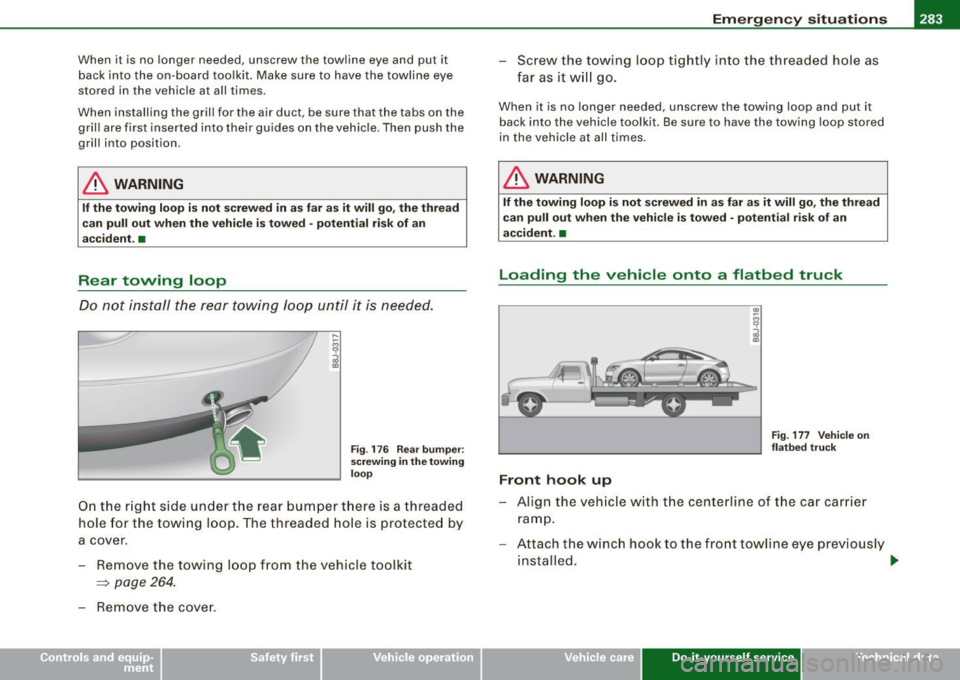
Fig. 176 Rear bumper :
screwing in the towing
l oop
On the r ight side under the rear bumper there is a threaded
hole for the towing loop . The threaded hole is protected by
a cover.
- Remove the towing loop from the vehicle toolkit
=::> page 264.
-Remove the cover. -
Screw the towing loop tightly into the threaded hole as
far as it will go.
When it is no longer needed, unscrew the towing loop and put it
back into the vehicle toolkit. Be sure to have the towing loop stored
in the vehicle at all times.
& WARNING
If the towing loop is not screwed in as far as it will go, the thread
ca n pull out when the vehicle is towed -potential risk of an
accident. •
Loading the vehicle onto a flatbed truck
Front hook up
Fig. 177 Vehicle on
flat bed t ruck
-Align the vehicle with the centerline of the car car rier
ramp .
- Attach the winch hook to the front towline eye previously
installed. ..,_
Vehicle care Do-it-yourself service irechnical data
Page 287 of 316

________________________________________________ E _m_ e_r.:g :;,. e_ n_c ...: y:.- s_ i_ t _u _a_ t_ i_ o _ n_ s __ ffllll
•
& WARNING
• To reduce the risk of serious injury and vehicle damage.
-Always lift the vehicle only at the special workshop hoist and
floor jack lift points illustrated=> page
284, fig. 178 and
=> page 284, fig. 179.
- Failure to lift the vehicle at these points could cause the
vehicle to tilt or fall from a lift if there is a change in vehicle
weight distribution and balance. This might happen, for
example, when heavy components such as the engine block or
transmission are removed.
• When removing heavy components like these, anchor vehicle
to hoist or add corresponding weights to maintain the center of
gravity. Otherwise, the vehicle might tilt or slip off the hoist,
causing serious personal injury.
0 Note
• Be aware of the following points before lifting the vehicle:
- The vehicle should never be lifted or jacked up from under
neath the engine oil pan, the transmission housing, the front or
rear axle or the body side members . This could lead to serious
damage.
- To avoid damage to the underbody or chassis frame, a rubber
pad must be inserted between the floor jack and the lift points.
- Before driving over a workshop hoist, check that the vehicle
weight does not exceed the permissible lifting capacity of the hoist .
- Before driving over a workshop hoist, ensure that there is
sufficient clearance between the hoist and low parts of the
vehicle. •
Do-it-yourself service
Page 291 of 316
_________________________________________________ G_ e_ n_ e_r _a _l_ i_n _f_o _ r_ m_ a_ t _i _o _ n __ lftlll
vehicle identification number of your vehicle (perforation) as well as
the Gross Vehicle Weight Rating (GVWR) and the Gross Axle Weight
Rating (GAWRl.
The high voltage warning label
is located on the lock carrier.
The spark ignition system complies with the Canadian
standard ICES-002. •
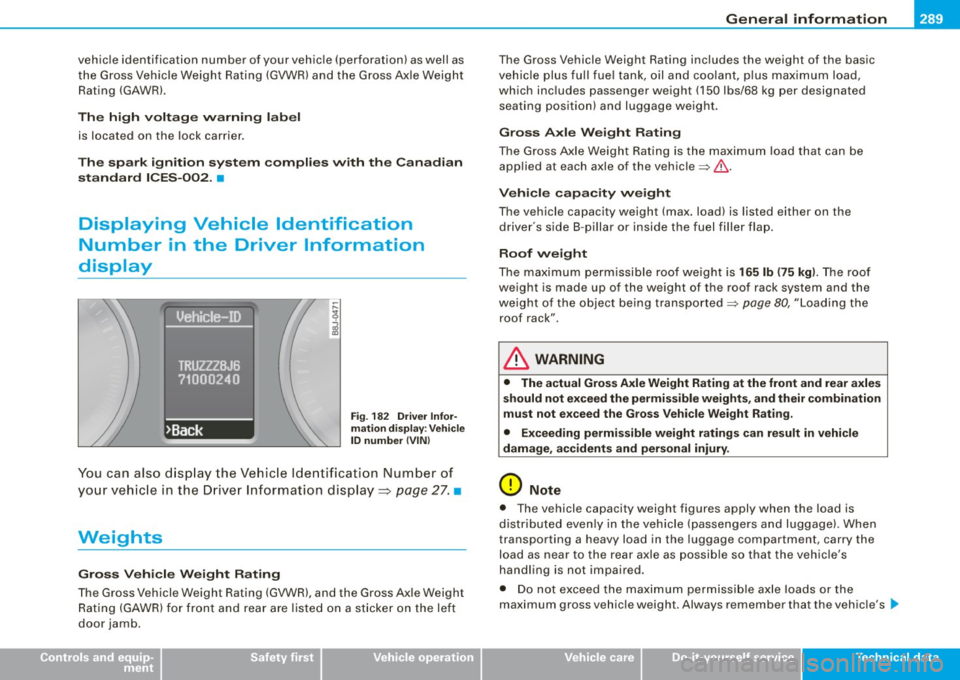
Displaying Vehicle Identification
Number in the Driver Information
display
Fig. 182 Driver Infor
mation display: Vehicle
ID number (VIN)
You can also display the Vehicle Identification Number of
your vehicle in the Driver Information display~ page
27. •
Weights
Gross Vehicle Weight Rating
The Gross Vehicle Weight Rating (GVWR), and the Gross Axle Weight
Rating (GAWR) for front and rear are listed on a sticker on the left
door jamb.
Controls and equip ment Safety first Vehicle operation
The
Gross Vehicle Weight Rating includes the weight of the basic
vehicle plus full fuel tank, oil and coolant, plus maximum load,
which includes passenger weight (150 lbs/68 kg per designated
seating position) and luggage weight.
Gross Axle Weight Rating
The Gross Axle Weight Rating is the maximum load that can be
applied at each axle of the vehicle~&.
Vehicle capacity weight
The vehicle capacity weight (max. load) is listed either on the
driver's side 8 -pillar or inside the fuel filler flap.
Roof weight
The maximum permissible roof weight is 165 lb (75 kg). The roof
weight is made up of the weight of the roof rack system and the
weight of the object being transported
~ page 80, "Loading the
roof rack".
& WARNING
• The actual Gross Axle Weight Rating at the front and rear axles
should not exceed the permissible weights, and their combination
must not exceed the Gross Vehicle Weight Rating.
• Exceeding permissible weight ratings can result in vehicle
damage, accidents and personal injury.
0 Note
• The vehicle capacity weight figures apply when the load is
distributed evenly in the vehicle (passengers and luggage). When
transporting a heavy load in the luggage compartment, carry the
load as near to the rear axle as possible so that the vehicle's
handling is not impaired.
• Do not exceed the maximum permissible axle loads or the
maximum gross vehicle weight. Always remember that the vehicle's .,_
Vehicle care Do-it-yourself service Tec hn ica l da ta
Page 293 of 316

_______________________________________________________ D_ a _ t_a __ llll
Data
A pplie s t o vehic les: w it h 2 .0 lit er 4-cy l. engi ne
200 hp, 2.0 liter 4-cyl. turbo engine
Engin e da ta
Maximum output SAE net
Maximum torque SAE net
No . of cylinders
Displacement
Stroke
Bore
Compression ratio
Fuel
Dim ension s (app rox.)
Length (with licence plate bracke t)
Width (across mirrors)
Height (unloaded)
Turning circle diameter (curb to curb)
Ca pac ities (a pprox.)
F u el t ank
-Total capacity
- Reserve (of total capacity)
Wind shi eld and he adli ght * was her fluid container
E ngine oil
with filter change
Controls and equip
ment Safety first
hp@rpm
lb-ft@ rpm
CID (cm
3
)
in (mm)
in (mm)
200@ 5100 -6000
207 @ 1800 -5000
4
121 (1984)
3.65 (92.8)
3 .25 (82.5)
10.3 : 1
Premium unleaded (91 AKI) Recommended for maximum engine performance. Fur
ther details =>
page 217 , "Gasoline"
in (mm)
in (mm)
in (mm)
ft. (ml
164 .5 (4178)
76.9 (1952) 53 .2 (1352)
34 .7 (10.60)
gal/litres
gal/litres
quarts/litres
quarts/l itres 14.5 / 55 .0
1 .9 / 7.0
4.3
I 4.0
4.8
I 4.5 •
Vehicle operation Vehicle care Do-it-yourself service Tec hn ica l da ta
Page 295 of 316
_______________________________________________ C _o_ n _ s_u _ m_ e_ r_l_n _f_o _ r_ m_ a_ t _i _o _ n __ _
Consumer Information
Warranty coverages
Yo ur A udi i s covere d by the f ollowi ng wa rrant ie s:
• New Vehicle Limited Warranty
• Limited Warranty Against Corrosion Perforation
• Emissions Control System Warranty
• Emissions Performance Warranty
• California Emissions Control Warranty (USA vehicles only)
• California Emissions Performance Warranty (USA vehicles only)
Detai led information regarding your warrant ies can be found in
your
Warr anty & M aintenan ce book let .•
Operating your vehicle outside the
U.S .A. or Canada
Government regulations in the United States and Canada require
t hat automobiles meet specific emission regulations and safety
standards . T herefore, vehicles built for the U.S .A . and Canada differ
from vehicles so ld in other countries .
If you plan to take your vehic le outside the continental limits of the
United States or Canada, there is the possibi lity that
• unleaded fue ls for vehicles w ith catalytic converter may not be
avai lable;
• fue l may have a considerably lower octane rat ing . Improper fuel
may cause engine damage;
• serv ice may be inadequate due to lack of proper service faci lities ,
tools or testing equipment;
• replacement parts may not be readily available .
Controls and equip
ment Safety first Vehicle operation
•
Navigation systems for vehicles built for the U.S.A . and Canada
wil l not necessarily work in Europe, and may not work in other coun
tries outs ide o f North America.
0 Note
Audi cannot be responsible fo r mechanica l damage that could
resu lt from inadequate fuel, service or parts availability. •
Audi Service Repair Manuals and
literature
Audi Official Factory Service Manuals are published as soon as
poss ible after model introduction . Serv ice manuals are ava ilab le
from :
Audi Technical Literature Ordering Center
Call toll -free :
Te l.:
1 (800) 544-8021
(from 8:00 AM to 8 :00 PM, EST, Monday through Friday)
or access their website
www .audi .dd sltd .com on the Internet to
order repair manuals and other Aud i literature .•
Maintenance
Gen era l
Your vehicle has been designed to he lp keep maintenance require
ments to a minimum . However, a certain amount of regular mainte
nance is sti ll necessary to assure your veh ic le's safety, economy and .,
Vehicle care Do-it-yourself service Tec hn ica l da ta
Page 296 of 316

___ C_ o_n_ s_ u_m _ e_ r_ ln_ f_ o _r _m _ a_ t_ i_o _n ______________________________________________ _
reliability. For detailed vehicle maintenance consult your Warranty &
Maintenance book let.
Und er di ffi cult ope rating cond ition s, for example at extremely low
outside temperatures, in very dusty regions, etc ., some service work
should be performed between the intervals specified. This app lies
particularly to:
• oil changes, and
• cleaning or replacing the air filter.
sion standards are maintained, thus minimizing adverse effects on
the environment. •
Important considerations for you and your
vehicle
The increasing use of electronics, sophisticated fuel injection and
emission control systems, and the general ly increasing technical
complexity of today's automobi les, have steadi ly reduced the scope
of maintenance and repa irs which can be carried out by vehicle
owners.
Al so, sa fety a nd e nvironment al concerns p lace very strict
limi ts on the na ture of repairs a nd adjustments to engine and trans
mission parts which an owner can perform.
Maintenance, adjustments and repairs usually require special tools,
testing dev ices and other equipment ava ilable to specially trained
workshop personnel in order to assure proper performance, reli
abil ity and safety of the vehicle and its many systems.
Improper maintenance, adjustments and repairs can impair the
ope ration and re liability of your vehic le and even void your vehic le
warranty. Therefore, proof of servicing in accordance with the main
tenance schedu le may be a condition for upholding a pos sible
warranty claim made within the warranty period. Above all, operational safety can be adversely affected, creating
unnecessary r isks for you and your passengers .
If in doubt about any servicing, have it done by your authorized Audi
dea ler or any other properly equipped and qualified workshop. We
strongly urge you to give your authorized Audi dealer the opportu
nity to perform all scheduled maintenance and necessary repairs.
Your dealer has the fac ilities, origina l parts and trained spec ial ists
to keep your vehicle running proper ly.
P e rforming limited maint enance your self
The following pages describe a lim ited number of procedures which
can be performed on your vehicle wi th ordinary too ls, should the
need arise and trained personnel be unavai lab le. Before performing
any of these procedures, a lways thoroughly read all of the appli
cable text and carefu lly follow the instructions given. Always rigor
ously observe the
WARNINGS provide d.
Before you che ck anything in th e eng ine compartment , always read
and heed all WARNINGS~
& and~ & in "Working in the engine
compartment" on
page 217.
& WARNING
• Serio us per sonal injur y may oc cur a s a re sult of improperly
performed maintenan ce , adjustment s or repair s.
• Alway s be e xtremely careful when working on the vehi cle .
Alway s follow commonly accepted s afety pra ctice s and general
c ommon sen se . Ne ver ri sk p ers onal injury .
• Do not attempt any of the maintenan ce , check s or repair s
de scr ibed on the follo wing page s if you are not full y familia r with
the se or other procedure s with respect t o the vehicle , or are uncer
tain ho w to pr oceed .
• Do not do any work without the proper tool s and equ ipment .
Ha ve the ne cessa ry work done by your authorized Audi deale r or
another properly equipped and qu alified work shop .
~
Page 297 of 316
__________________________________________________ C_o_ n _ s_u_ m_ e ___ r_l_ n _f_ o_ r _m...:....:.. a:.;..:. ti .... o:.. n ........ _lllll
& WARNING (continued)
• The engine compartment of any motor vehicle is a potentially
hazardous area. Never reach into the area around or touch the
radiator fan. It is temperature controlled and can switch on
suddenly -even when the engine is off and the ignition key has
been removed. The radiator fan switches on automatically when
the coolant reaches a certain temperature and will continue to run
until the coolant temperature drops .
• Always remove the ignition key before anyone gets under the
vehicle.
• Always support your vehicle with safety stands if it is neces
sary to work underneath the vehicle. The jack supplied with the
vehicle is not adequate for this purpose and could collapse
causing serious personal injury.
• If you must work underneath the vehicle with the wheels on
the ground, always make sure the vehicle is on level ground, that
the wheels are always securely blocked and that the engine
cannot be started .
• Always make sure the transmission selector lever (automatic
transmission) is in "P" (Park position) (automatic transmission) or
Neutral (manual transmission) and the hand brake is firmly
applied.
<£> For the sake of the environment
• Changing the engine settings will adversely affect emission
levels. This is detrimental to the environment and increases fuel
consumption .
• Always observe environmental regulations when disposing of
old engine oil, used brake fluid, dirty engine coolant, spent batteries
or worn out tires.
• Undeployed airbag modules and pretensioners might be classi
fied as Perchlorate Material -special handling may apply, see
www.dtsc.ca.gov/hazardouswaste/perchlorate . When the vehicle or
parts of the restraint system including airbag modules safety belts
Controls and equip ment Safety first Vehicle operation with pretensioners are scrapped, all applicable laws and regula
tions must be observed. Your authorized Audi dealer is familiar with
these requirements and we recommend that you have your dealer
perform this service for you. •
Additional accessories,
modifications and parts replacement
Additional accessories and parts
replacement
Always consult an authorized Audi dealer before
purchasing accessories.
Your vehicle incorporates the latest safety design features ensuring
a high standard of active and passive safety.
This safety could be compromised by non -approved changes to the
vehicle. For this reason, if parts have to be replaced, please observe
the following points when installing additional accessories:
Approved Audi accessories and genuine Audi parts are available
from authorized Audi dealers .
These dealers also have the necessary facilities, tools and trained specialists to install the parts and accessories properly .
& WARNING
Using the wrong spare parts or using non-approved accessories
can cause serious personal injury.
• Use only accessories expressly approved by Audi and genuine
Audi spare parts
• These parts and accessories have been specially designed to
be used on your vehicle.
• Never install accessories such as telephone cradles or
beverage holders on airbag covers or within the airbag deploy-
Vehicle care Do-it-yourself service Tec hn ica l da ta