wheel AUDI TT COUPE 2014 Workshop Manual
[x] Cancel search | Manufacturer: AUDI, Model Year: 2014, Model line: TT COUPE, Model: AUDI TT COUPE 2014Pages: 284, PDF Size: 34.42 MB
Page 246 of 284
Downloaded from www.Manualslib.com manuals search engine Mobility
- If the tyre is too badly damaged, you should
seek professional assistance.
(f!j} For the sake of the environment
A used can of sealing compound can be re
turned to your qualified workshop for dispos
al.
ij) Note
After repairing a tyre, remember to buy a new
tyre sealant can at a qualified workshop.
Changing a wheel
Preparations
Certain preparations must be made before you
change the wheel.
� Please refer to the important safety notes
¢page 241.
� Apply the parking brake.
� Manual
gearbox: Engage first gear.
� Automatic gearbox: Move the selector lever to
position P.
� Take out the tools ¢ page 242 and spare wheel
¢page 247.
A WARNING
If you have to change the tyre on a gradient,
block the wheel opposite the wheel being
changed by placing a stone or similar object
under it to prevent the vehicle from rolling
away.
Removing the hubcap/wheel bolt caps
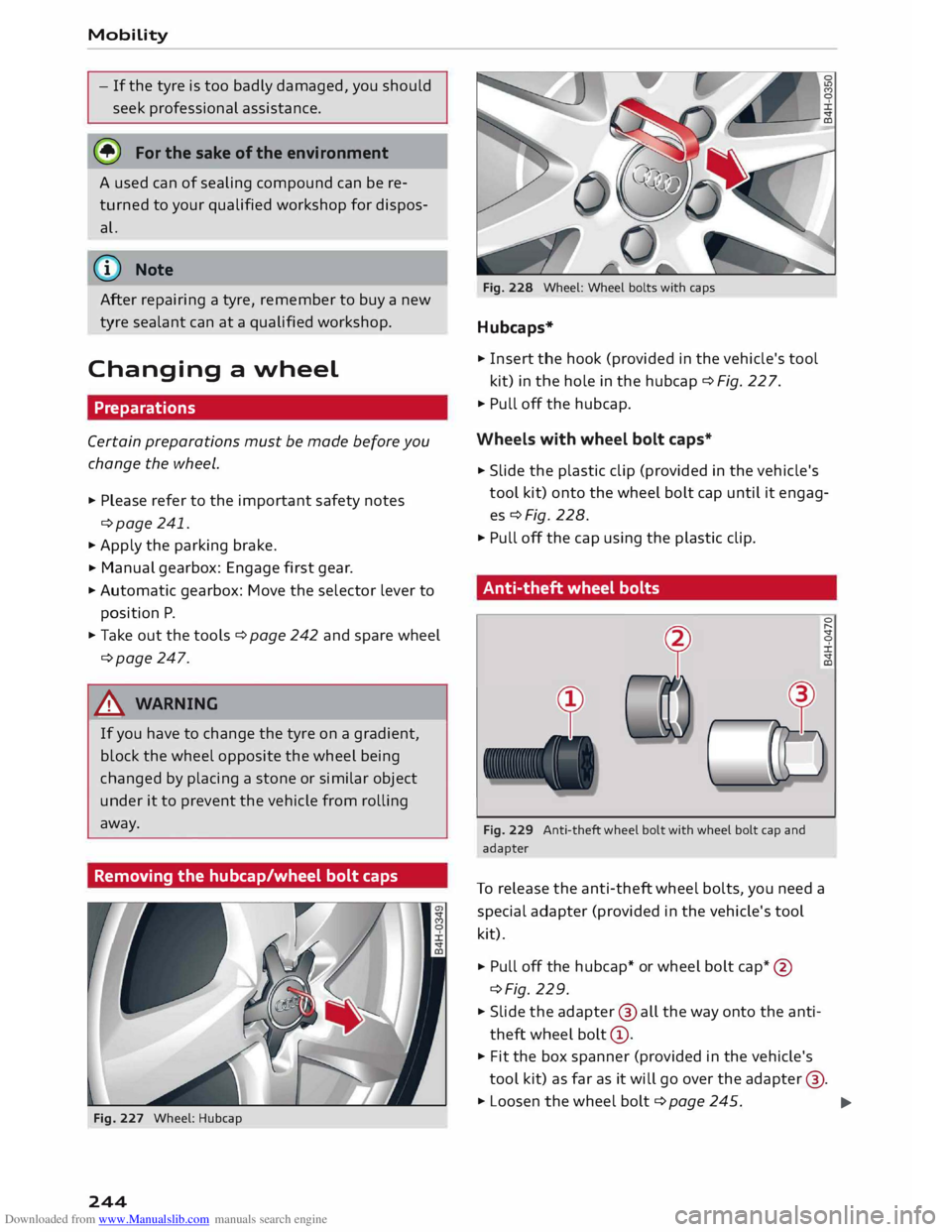
Fig. 227 Wheel: Hubcap
244 Fig.
228 Wheel: Wheel bolts with caps
Hubcaps*
� Insert the hook (provided in the vehicle's tool
kit) in the hole in the hubcap ¢ Fig. 22 7.
� Pull off the hubcap.
Wheels with wheel bolt caps*
� Slide
the plastic clip (provided in the vehicle's
tool kit) onto the wheel bolt cap until it engag
es¢ Fig. 228.
� Pull off the cap using the plastic clip.
Anti-theft wheel bolts
Fig. 229 Anti-theft wheel bolt with wheel bolt cap and
adapter
To release the anti-theft wheel bolts, you need a
special adapter (provided in the vehicle's tool
kit).
� Pull
off the hubcap* or wheel bolt cap*@
¢Fig. 229.
� Slide the adapter @ all the way onto the anti
theft wheel bolt@.
� Fit
the box spanner (provided in the vehicle's
tool kit) as far as it will go over the adapter @.
� Loosen the wheel bolt ¢page 245.
..,.
Page 247 of 284
Downloaded from www.Manualslib.com manuals search engine 0
N
co
,-j
\D L/'l
N
L/'l
,-j �
Note
Note the code number of the anti-theft wheel
bolt and keep it in a safe place -not in your
vehicle. If you need a replacement adapter,
give the code number to your Audi dealer.
Loosening the wheel bolts
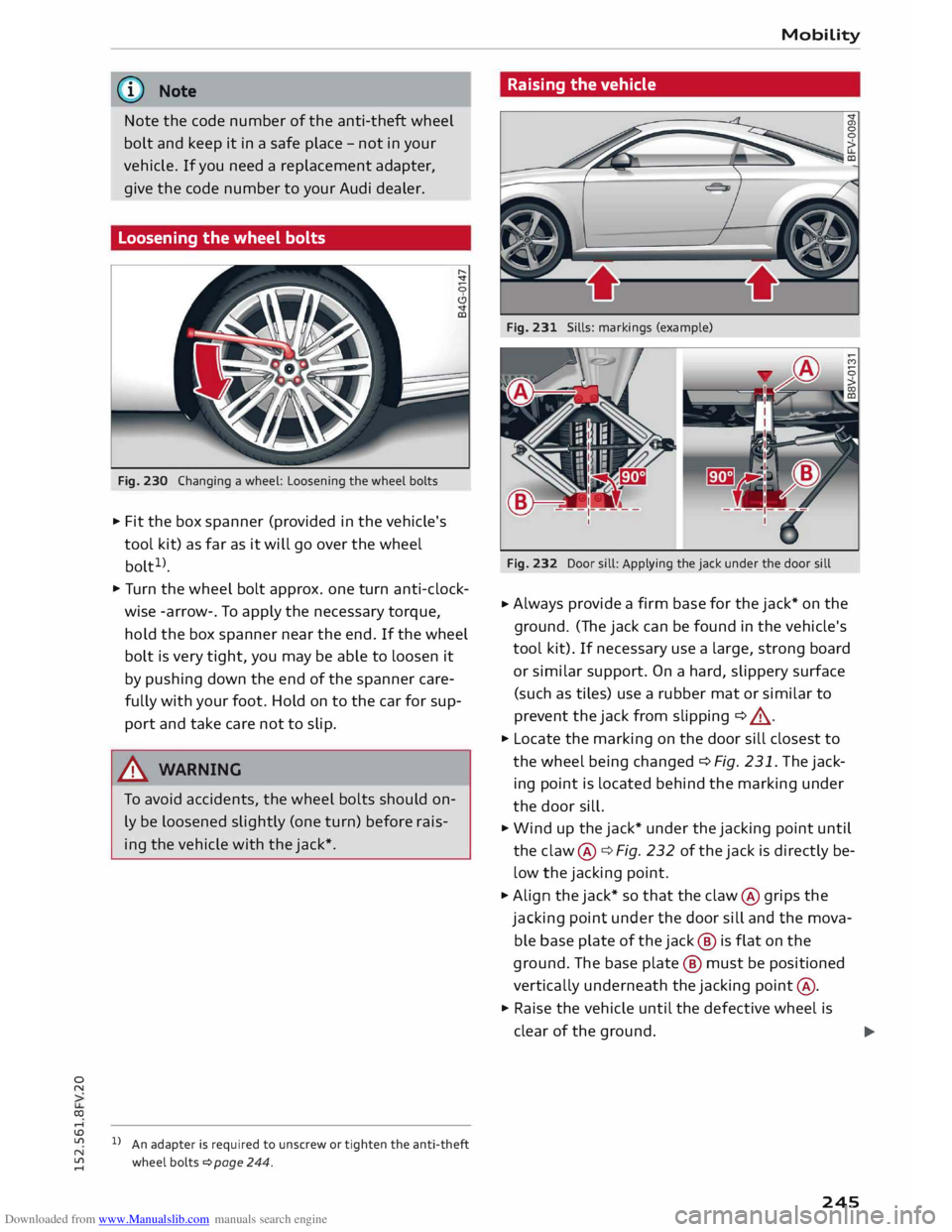
Fig. 230 Changing a wheel: Loosening the wheel bolts
.,. Fit the box spanner (provided in the vehicle's
tool kit) as far as it will go over the wheel
bolt 1
>.
.,. Turn the wheel bolt approx. one turn anti-clock
wise -arrow-. To apply the necessary torque,
hold the box spanner near the end. If the wheel
bolt is very tight, you may be able to loosen it
by pushing down the end of the spanner care
fully with your foot. Hold on to the car for sup
port and take care not to slip.
.&_ WARNING
To avoid accidents, the wheel bolts should on
ly be loosened slightly (one turn) before rais
ing the vehicle with the jack*.
l l
An adapter is required to unscrew or tighten the anti-theft
wheel bolts � page 244. Mobility
Raising the vehicle
Fig. 231 Sills: markings (example)
Fig. 232 Door sill: Applying the jack under the door sill
.,. Always
provide a firm base for the jack* on the
ground. (The jack can be found in the vehicle's
tool kit). If necessary use a large, strong board
or similar support. On a hard, slippery surface
(such as tiles) use a rubber mat or similar to
prevent the jack from slipping ¢ ,,&.
.,. Locate the marking on the door sill closest to
the wheel being changed ¢ Fig. 231. The jack
ing point is located behind the marking under
the door sill.
.,. Wind up the jack* under the jacking point until
the claw @¢ Fig. 232 of the jack is directly be
low the jacking point .
.,. Align the jack* so that the claw @ grips the
jacking point under the door sill and the mova
ble base plate of the jack @ is flat on the
ground. The base plate @ must be positioned
vertically underneath the jacking point@ .
.,. Raise the vehicle until the defective wheel is
clear of the ground.
.,.
245
Page 248 of 284

Downloaded from www.Manualslib.com manuals search engine Mobility
.&_ WARNING
- Make sure the jack* is stable. If the ground
underneath the jack* is slippery or soft, the
jack can slip or sink in -risk of injury!
- Use only the jack* supplied with your vehicle
to raise the vehicle. If you use a jack from a
different vehicle, your vehicle may slip off
the jack -risk of injury!
- Apply the jack* only at the jacking points Lo
cated behind the markings on the door sill
and align it properly. Otherwise there is a
risk of injury since the jack* can slip off sud
denly if it is not properly engaged.
- The height of the parked vehicle can change
as a result of variations in Loading.
- Never start the engine when the vehicle is
on the jack -risk of accident!
- If work has to be done under the vehicle, en
sure that it is safely supported on suitable
stands -risk of injury!
CD CAUTION
The vehicle must not be lifted up on its sills.
Only apply the jack* at the jacking points Loca
ted behind the markings on the door sill. Oth
erwise your vehicle could be damaged.
Taking off/ putting on the wheel
Fig. 233 Wheel: Hexagonal socket for turning wheel bolts
246 Fig.
234 Wheel: Mounting pin in wheel bolt hole nearest
to the top
Taking off the wheel
... Using the hexagonal socket in the screwdriver
handle {provided in the vehicle's tool kit), un
screw the top wheel bolt and place it on a clean
surface ¢ Fig. 233.
... Screw in the mounting pin (provided in the ve
hicle's tool kit) by hand in place of the wheel
bolt¢ Fig. 234.
.,. Then unscrew the other wheel bolts .
.,. Take off the wheel ¢(D
. The mounting pin
stays where it is.
Putting on the wheel
When putting on a tyre with directional tread
pattern, refer to ¢ page 247.
.,. Put on the wheel, using the mounting pin to
guide it into place ¢(D
.
.,. Screw in the wheel bolts and tighten them
lightly using the hexagonal socket .
... Then unscrew the mounting pin and tighten the
remaining wheel bolt lightly .
... Carefully lower the car with the jack* .
.,. Tighten the wheel bolts in diagonal sequence
with the box spanner.
The wheel bolts should be clean and turn easily.
Before putting on the wheel, inspect the condi
tion of the wheel and hub mounting surfaces.
These surfaces must be clean before mounting
the wheel.
.&_ WARNING
Do not use the hexagonal socket in the screw-
driver handle to tighten the wheel bolts. It is ..,.
Page 249 of 284
Downloaded from www.Manualslib.com manuals search engine 0
N
co
....
\D Lfl
N
Lfl
.... not
possible to tighten the bolts to the re
quired torque using the hexagonal socket -
risk of accident!
CD CAUTION
When removing/fitting the wheel the rim may
hit and damage the brake disc. For this rea
son, please take care and get a second person
to assist you.
Tyres with directional tread pattern
A directional tread pattern can be identified by
arrows on the sidewall that point in the direction
of rotation. Always note the direction of rotation
indicated when mounting the wheel. This is im
portant so that these tyres can give maximum
grip and avoid excessive noise, tread wear and
aquaplaning.
If you ever have a puncture and need to fit the
spare wheel* in the wrong direction, please drive
with extra care because the tyre will not give op
timum performance in this situation. Bear this in
mind particularly when driving on wet roads.
To benefit from the advantages of tyres with this
type of tread pattern, the defective tyre should
be replaced and refitted as soon as possible so
that all tyres again rotate in the correct direction.
After changing a wheel
.,. Fit the hubcap or wheel bolt caps back on, as
required.
.,. Put the tools and jack back in the luggage com
partment.
.,. If the replaced wheel will not fit into the spare
wheel well, stow it safely in the luggage com
partment ¢ page 201.
.,. Check
the tyre pressure of the fitted wheel as
soon as possible.
.,. Adjust the tyre pressures and store them via
the infotainment system.
.,. The wheel bolts should be tightened to 120
Nm. Have this checked as soon as possible with
a torque wrench. Until then, drive with caution.
.,. Have
the flat tyre replaced as quickly as possi
ble. Mobility
Spare wheel
General notes
Applies to vehicles: with compact temporary spare wheel
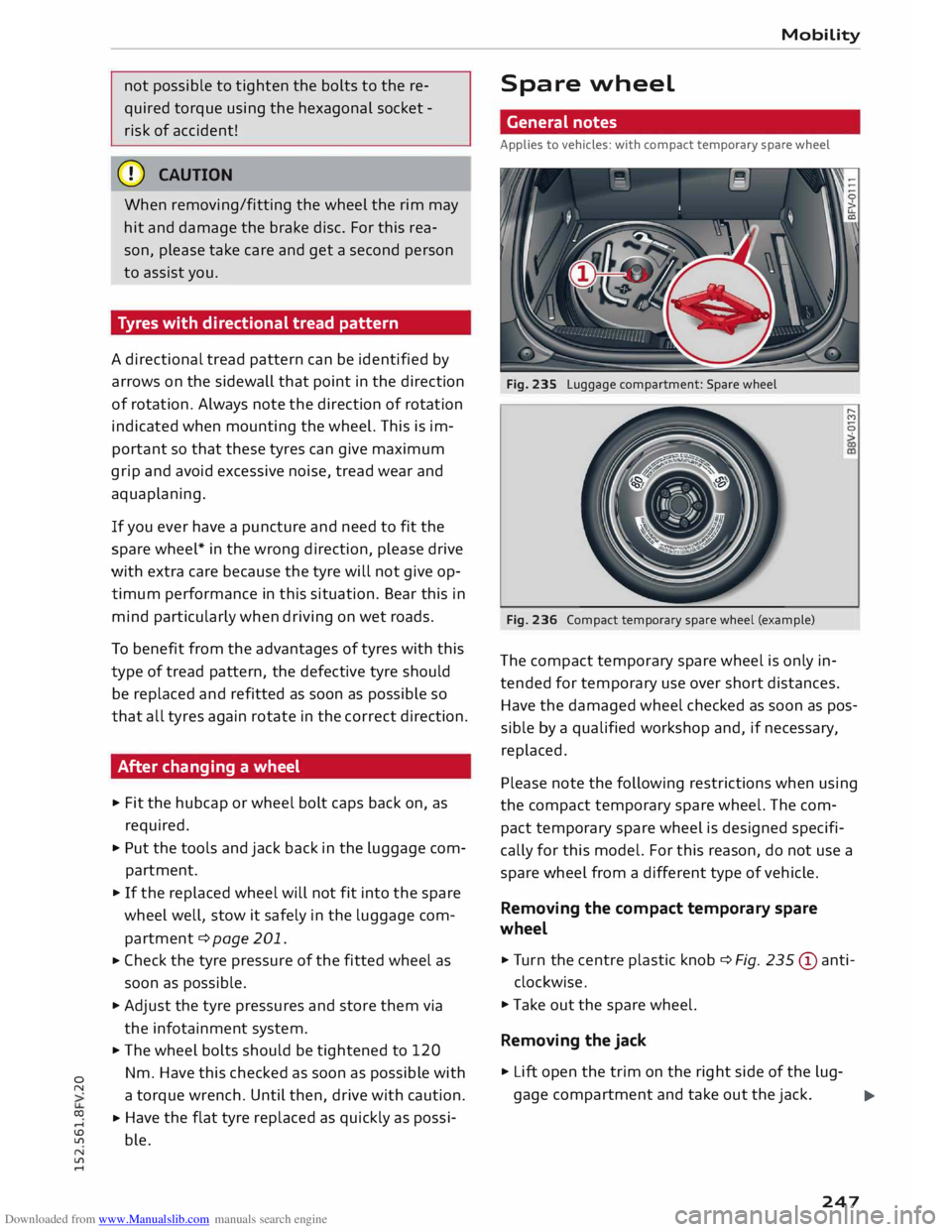
Fig. 235 Luggage compartment: Spare wheel
Fig. 236 Compact temporary spare wheel (example) ......
M
0
>
The compact temporary spare wheel is only in
tended for temporary use over short distances.
Have the damaged wheel checked as soon as pos
sible by a qualified workshop and, if necessary,
replaced.
Please note the following restrictions when using
the compact temporary spare wheel. The com
pact temporary spare wheel is designed specifi
cally for this model. For this reason, do not use a
spare wheel from a different type of vehicle .
Removing the compact temporary spare
wheel
.,. Tur n the centre plastic knob¢ Fig. 235 © anti-
clockwise.
.,. Take out the spare wheel.
Removing the jack
.,. Lift open the trim on the right side of the lug-
gage compartment and take out the jack.
..,..
247
Page 250 of 284
Downloaded from www.Manualslib.com manuals search engine Mobility
Snow chains
For technical reasons, snow chains must not be
used on the compact temporary spare wheel.
Sheu ld you have a puncture on one of the front
wheels when using snow chains, fit the compact
temporary spare wheel in place of one of the rear
wheels. You can then attach the snow chains to
the wheel taken from the rear and use this wheel
to replace the punctured front wheel.
A WARNING
- The tyre pressure must be checked as soon
as possible after fitting the spare wheel-an
incorrectly inflated tyre can increase the risk
of accident. You can find the tyre pressures
here ¢ page 233, Fig. 220.
- Do not drive faster than 80 km/h when the
compact temporary spare wheel is fitted -
higher speeds can cause an accident.
- Avoid heavy acceleration, hard braking and
fast cornering when the compact temporary
spare wheel is fitted -risk of accident!
- Never use two or more compact spare tyres
at the same time -risk of accident!
- No other type of tyre (normal summer or
winter tyres) may be fitted on the compact
temporary spare wheel.
]ump-starting Before starting the engine
If necessary, the engine can be started by con
necting it to the battery of another vehicle.
If the engine fails to start because of a dis
charged battery, the battery can be connected to
the battery of another vehicle to start the engine.
Suitable jump Leads are required.
Both batteries must be rated at 12 Volts. The ca
pacity (Ah) of the booster battery should not be
significantly lower than that of the discharged
battery.
Jump Leads
The jump Leads must be heavy enough to carry
the starter current. Refer to the details given by
the manufacturer.
248 Only
use jump leads with insulated battery
clamps.
Positive cable -usually red.
Negative cable -usually black.
A WARNING
- When it is discharged the battery can freeze
at temperatures around 0°
(. A frozen bat
tery must first be thawed out before con
necting the jump leads, as it could other
wise explode.
- Note the safety warnings referring to work
ing in the engine compartment ¢ page 220.
(© Note
- There must be no contact between the two
vehicles as otherwise current could flow as
soon as the positive terminals are connec
ted and the boosting battery could be dis
charged.
- The disch arged battery must be properly
connected to the vehicle's electrical system.
- Switch off the car telephone if necessary.
Details will be given in the manufacturer's
instructions for the car telephone.
Page 252 of 284
Downloaded from www.Manualslib.com manuals search engine Mobility
- Keep sparks, flame and lighted cigarettes
away from batteries: the gases given off can
cause an explosion.
- If jump-starting another vehicle, position
the jump Leads in such a way that they can
not come into contact with any moving
parts in the engine compartment of the oth
er vehicle.
CD CAUTION
Please note that the above method of con
necting the Leads is intended for jump-start
ing your vehicle. If jump-starting another ve
hicle, you should not connect the negative
lead (-) to the negative terminal of the dis
charged battery, but directly to the engine
block or a solid metal part bolted to the en
gin e block. If the battery of the other vehicle
does not have a gas vent, there is a risk that a
mixture of oxygen and hydrogen gas can accu
mulate and cause an explosion.
@ Note
- The battery is vented to the outside to pre
vent gases entering the vehicle's interior.
- Connect the battery clamps so they have
good metal-to-metal contact with the bat
tery terminals.
Tow-starting / towing
away
General notes
Some experience is required to tow or tow-start a
vehicle, especially when using a tow-rope. Both
drivers should be familiar with the technique re
quired for towing. Inexperienced drivers should
not attempt to tow-start or tow away another ve
hicle.
Do not pull too hard with the towing vehicle and
take care to avoid jerking the tow-rope. When
towing off-road, there is always a risk that the
anchorage points may be overloaded.
Tow-bar / tow-rope
It is easier and safer to tow the vehicle with a
tow-bar. You should only use a tow-rope if you do
250 not
have a tow-bar. It is advisable to use a tow
rope made of elastic synthetic fibre or similarly
elastic material.
Notes on towing vehicles
The vehicle can be towed with a tow-bar or tow
rope. When the engine is not running, the gear
box will not be adequately Lubricated if the fol
lowing speed/distance restrictions are not ob
served:
- The vehicle must not be towed faster than
SO km/h.
- The vehicle must not be towed further than
50km.
Additi onal notes on towing by breakdown
truck
If one of the axles has to be raised in order to tow
the vehicle, please refer to the following table to
determine the appropriate axle for your gearbox/
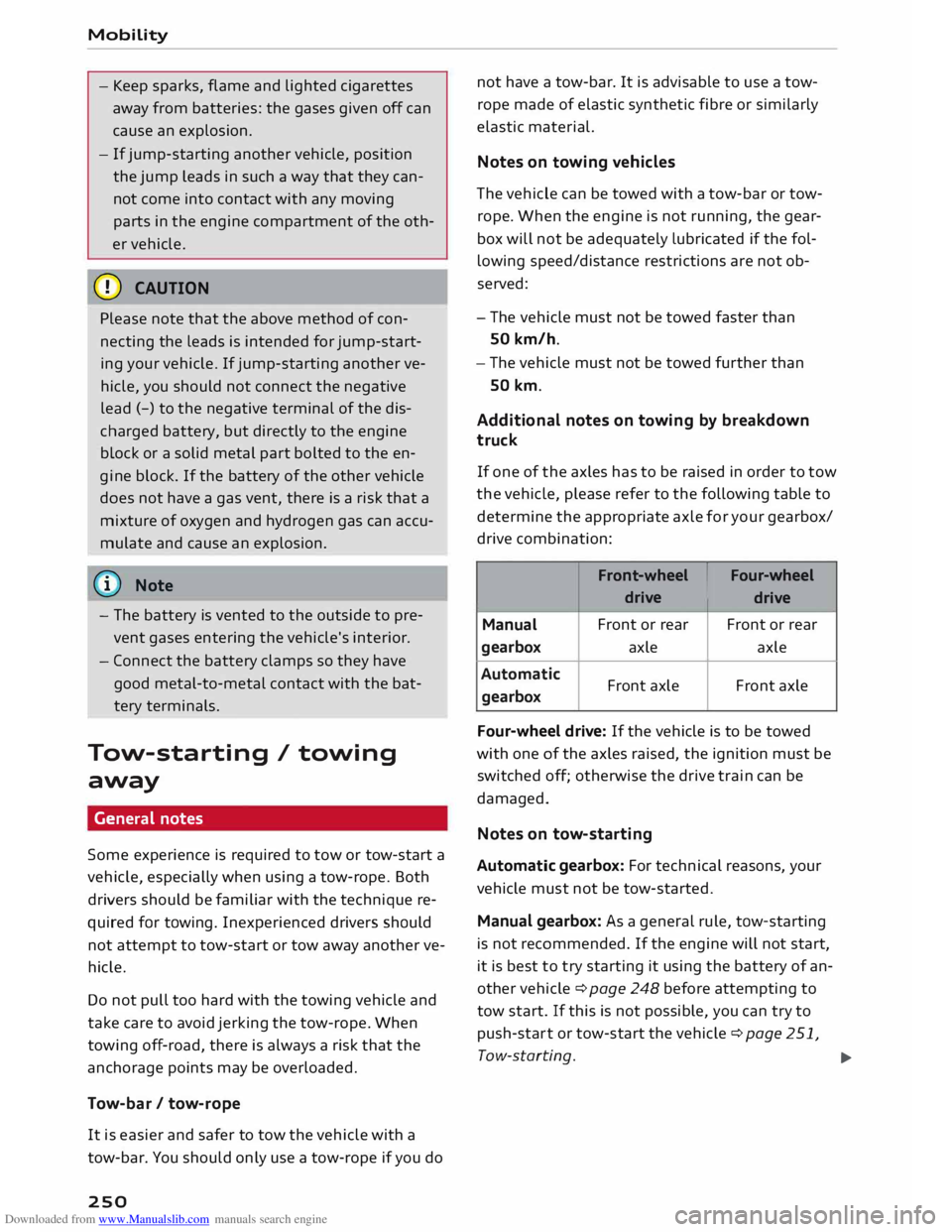
drive combination:
Front-wheel IFour-wheel
drive drive
Manual Front
or rear Front or rear
gearbox axle
axle
Automatic gearbox Front
axle Front axle
Four-wheel drive: If the vehicle is to be towed
with one of the axles raised, the ignition must be
switched off; otherwise the drive train can be
damaged.
Notes on tow-starting
Automatic gearbox: For technical reasons, your
vehicle must not be tow-started.
Manual gearbox: As a general rule, tow-starting
is not recommended. If the engine will not start,
it is best to try starting it using the battery of an
other vehicle ¢ page 248 before attempting to
tow start. If this is not possible, you can try to
push-star t or tow-start the vehicle ¢ page 251,
Tow-starting. ...,
Page 253 of 284
Downloaded from www.Manualslib.com manuals search engine 0
N
co
....
\D U'l ,&.
WARNING
There is a high risk of accidents when towing/
tow-starting, as the towed vehicle can easily
be driven into the towing vehicle.
CD CAUTION
- If it is not possible to tow the vehicle as de
scribed above (e.g. due to a gearbox failure
or if the vehicle has to be towed further
than 50 km), it must be transported on a
special car transporter or trailer.
- To wing a vehicle with the wrong axle raised
can cause serious damage to the gearbox.
@ Note
- Automatic gearbox: It is not possible to
move the selector lever out of position P if
the electrical power supply fails. Before the
vehicle can be recovered/manoeuvred you
must manually release the selector lever
¢page 78.
- Please observe the relevant regulations
when towing or tow-starting.
Towing away
Please observe the important safety warnings on
¢page 250.
Preparations
.. Attach the tow-rope or the tow-bar only to the
towing anchorages provided for this purpose
¢page 252, ¢page 252.
.. Please ensure that the tow-rope is not twisted
as it could otherwise become unscrewed from
the towline anchorage while the vehicle is being
towed.
.. The hazard warning lights of both vehicles
must normally be switched on ¢ page 40. How
ever, observe any regulations to the contrary.
Towing vehicle (front)
.. Ensure that the tow-rope is taut before you
drive off.
N
� l
l
Important: The battery must be adequately charged. Mobility
.. Engage the clutch very gently when starting to
move (manual gearbox) and press the accelera
tor slowly.
.. Avoid unnecessary braking and manoeuvres.
Vehicle being towed (rear)
.. Ensure
that the ignition is switched on, the
steering wheel is not locked, and that you can
operate the turn signals, horn or windscreen
wipers if
necessary ¢,& .
.. The
brake servo only works when the engine is
running. The power steering only works when
the ignition is on and the vehicle is moving 1
).
Otherwise you will need to press the brake ped
al significantly harder and apply more force to
move the steering wheel.
.. Please ensure that the steering wheel is un-
locked and that it moves freely.
.. Release
the parking brake ¢page 66.
.. Manual gearbox: Put the gear lever in neutral.
.. Automatic gearbox: Move the selector lever to
position N.
.. Ensure
that the tow-rope remains taut at all
times when towing.
,&. WARNING
If the vehicle has no electrical power, do NOT
use a tow-bar or tow-rope to tow the vehicle
@ Note
You can use the turn signals to indicate a
change of direction (or lane) even when the
hazard lights are on. The hazard lights will be
interrupted temporarily .
Tow-starting
Please observe the important safety warnings on
¢page 250.
Important: Your vehicle must be fitted with a
manual gearbox. If your vehicle has a petrol en
gine, it must not be towed further than SO me-
tres ¢(D.
.,.
251
Page 256 of 284
Downloaded from www.Manualslib.com manuals search engine Fuses
and bulbs
Fuses and bulbs
Fuses Fuses in vehic le interior
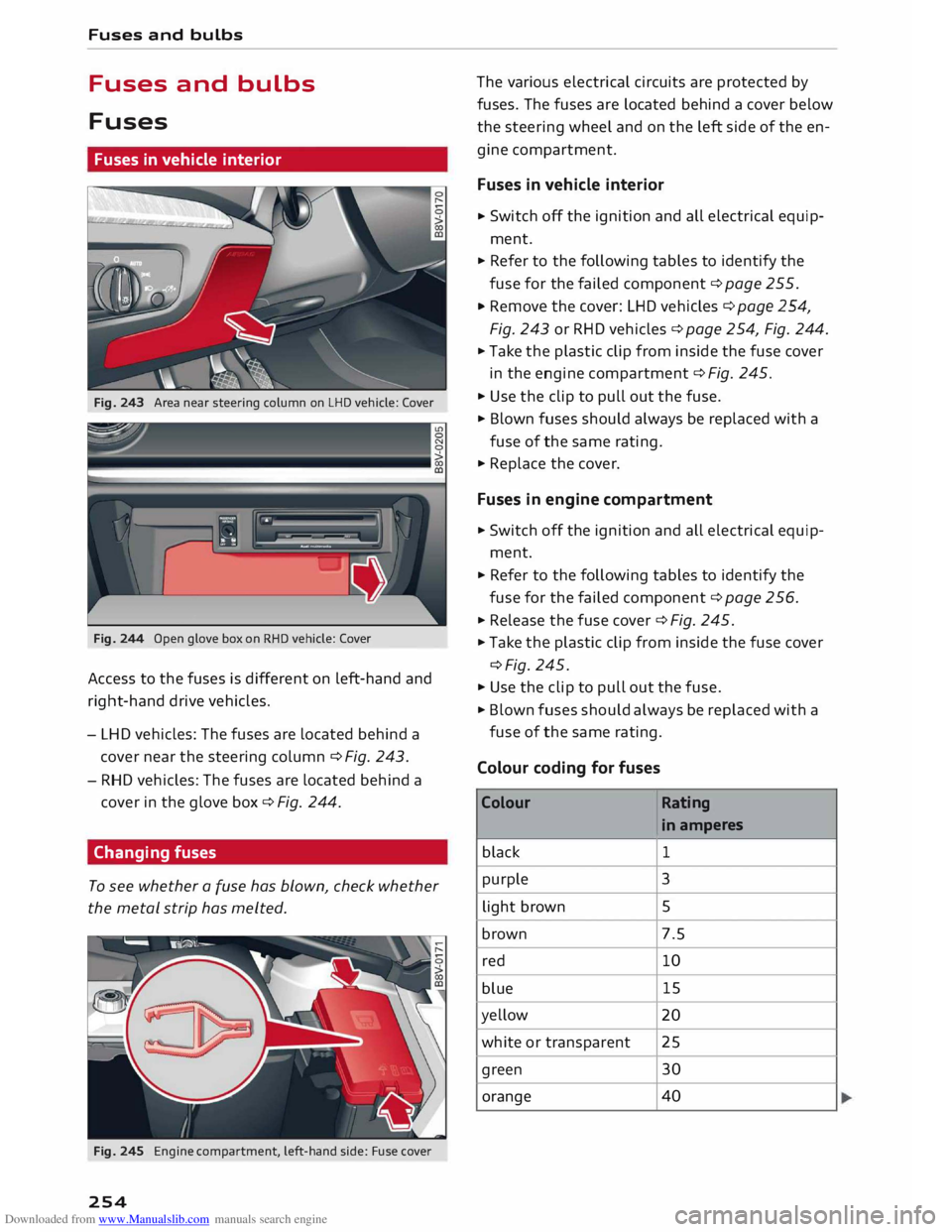
Fig. 243 Area near steering column on LHD vehicle: Cover
Fig. 244 Open glove box on RHO vehicle: Cover
Access to the fuses is different on left-hand and
right-hand drive vehicles.
- LHD vehicles: The fuses are located behind a
cover near the steering column ¢Fig. 243.
- RHD vehicles: The fuses are located behind a
cover in the glove box¢ Fig. 244.
Changing fuses
To see whether a fuse has blown, check whether
the metal strip has melted.
Fig. 245 Engine compartment, left-hand side: Fuse cover
254 The
various electrical circuits are protected by
fuses. The fuses are located behind a cover below
the steering wheel and on the left side of the en
gine compartment.
Fuses in vehicle interior
.. Switch
off the ignition and all electrical equip
ment .
.. Refer to the following tables to identify the
fuse for the failed component ¢ page 255 .
.. Remove the cover: LHD vehicles c:> page 254,
Fig. 243 or RHD vehicles ¢ page 254, Fig. 244 .
.. Take the plastic clip from inside the fuse cover
in the engine compartment ¢ Fig. 245 .
.. Use the clip to pull out the fuse.
.. Blown fuses should always be replaced with a
fuse of the same rating .
.. Replace the cover.
Fuses in engine compartment
.. Switch off the ignition and all electrical equip
ment .
.. Refer to the following tables to identify the
fuse for the failed component ¢ page 256 .
.. Release the fuse cover ¢ Fig. 245.
.. Take the plastic clip from inside the fuse cover
¢Fig. 245.
.. Use the clip to pull out the fuse.
.. Blown fuses should always be replaced with a
fuse of the same rating.
Colour coding for fuses
Colour Rating
in amperes
black 1
purple 3
light brown 5
brown 7.5
red 10
blue 15
yellow 20
white or transparent 25
green 30
orange 40
Page 259 of 284
Downloaded from www.Manualslib.com manuals search engine 0
N
co
....
\D L/'l
N
L/'l
.... Technical
data
Vehicle identification
data
XXXXX XX · X · XXXX XXX
/1\...l_ FAHRZG. -10£NT · NR.
� VBIICI.E -ll£NT. NO. xx
p /TYPE XXXXXXXX
XX X XXXXXXXX
XXX XXX
XX XXXXXXX XX X.X XX
XXX KW
XXX ('5\_J_
MOTO
RKB ./GETR.KB
.
xxxx XXX
XXX \::1/1
1 £NG.COO£/TRANS. COO£
(A\_J_ lAO(NR./INNENAUSST.
� PAINTNO
./WT
£R IO
R
xxxx / xxxx
XXX / xx
M
. ·
AUSST. / OPTIONS
EOA 7D5
2EH J02
3FC
FOA
TL6 3KA
lXW
7T6 CV7
3L4
15A 4UB
6XM 55G
1LB lAS
5MU 7X1
9G3 OG7 OYH
8EH UlA X9B
803 908 824
7KO 4X3 2K2
4KC 3YO 413
7GB 01A 5RW
1BA
OJF 027
D2D
5D2 4GO
@ f----- XX.
X XX.X XX.X XXXX
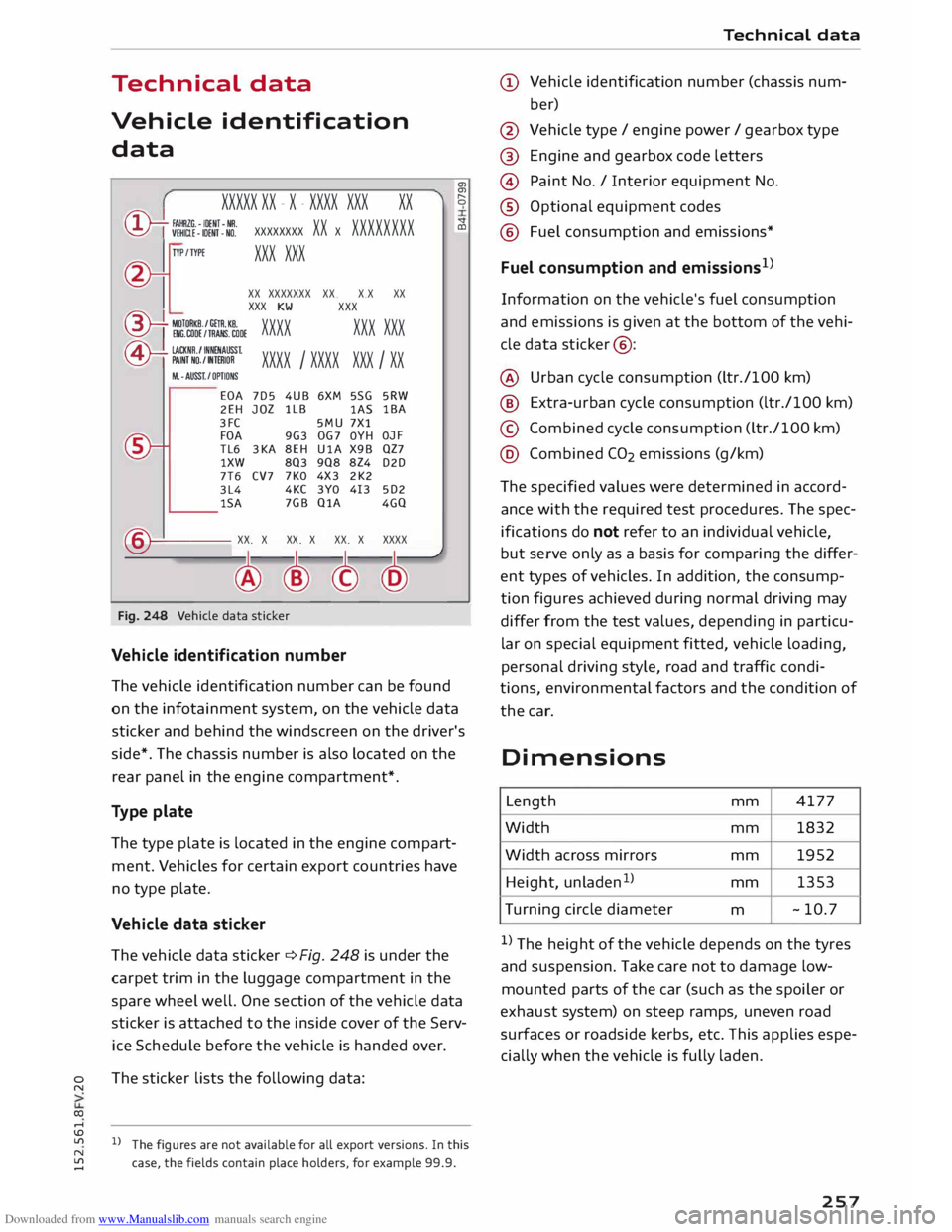
Fig. 248 Vehicle data sticker
Vehicle identification number a,
a,
.....
0
"
The vehicle identification number can be found
on the infotainment system, on the vehicle data
sticker and behind the windscreen on the driver's
side*. The chassis number is also located on the
rear panel in the engine compartment*.
Type plate
The type plate is located in the engine compart
ment. Vehicles for certain export countries have
no type plate.
Vehicle data sticker
The vehicle data sticker ¢ Fig. 248 is under the
carpet trim in the luggage compartment in the
spare wheel well. One section of the vehicle data
sticker is attached to the inside cover of the Serv
ice Schedule before the vehicle is handed over.
The sticker lists the following data:
l l
The figures are not available for all export versions. In this
case, the fields contain place holders, for example 99.9. Technical
data
(D Vehicle identification number (chassis num-
ber)
@ Vehicle type/ engine power/ gearbox type
@ Engine and gearbox code letters
© Paint No./ Interior equipment No.
® Optional equipment codes
® Fuel consumption and emissions*
Fuel consumption and emissions 1
>
Information on the vehicle's fuel consumption
and emissions is given at the bottom of the vehi
cle data sticker @:
@ Urban cycle consumption (ltr./100 km)
@ Extra-urban cycle consumption (ltr./100 km)
© Combined cycle consumption (ltr./100 km)
@ Combined CO2 emissions (g/km)
The specified values were determined in accord
ance with the required test procedures. The spec
ifications do not refer to an individual vehicle,
but serve only as a basis for comparing the differ
ent types of vehicles. In addition, the consump
tion figures achieved during normal driving may
differ from the test values, depending in particu
lar on special equipment fitted, vehicle loading,
personal driving style, road and traffic condi
tions, environmental factors and the condition of
the car.
Dimensions Length mm 4177
Width mm 1832
Width across mirrors mm 1952
Height, unladen 1
>
mm 1353
Turning circle diameter
m -10.
7
I) The height of the vehicle depends on the tyres
and suspension. Take care not to damage low
mounted parts of the car (such as the spoiler or
exhaust system) on steep ramps, uneven road
surfaces or roadside kerbs, etc. This applies espe
cially when the vehicle is fully laden.
257
Page 260 of 284
Downloaded from www.Manualslib.com manuals search engine Technical
data
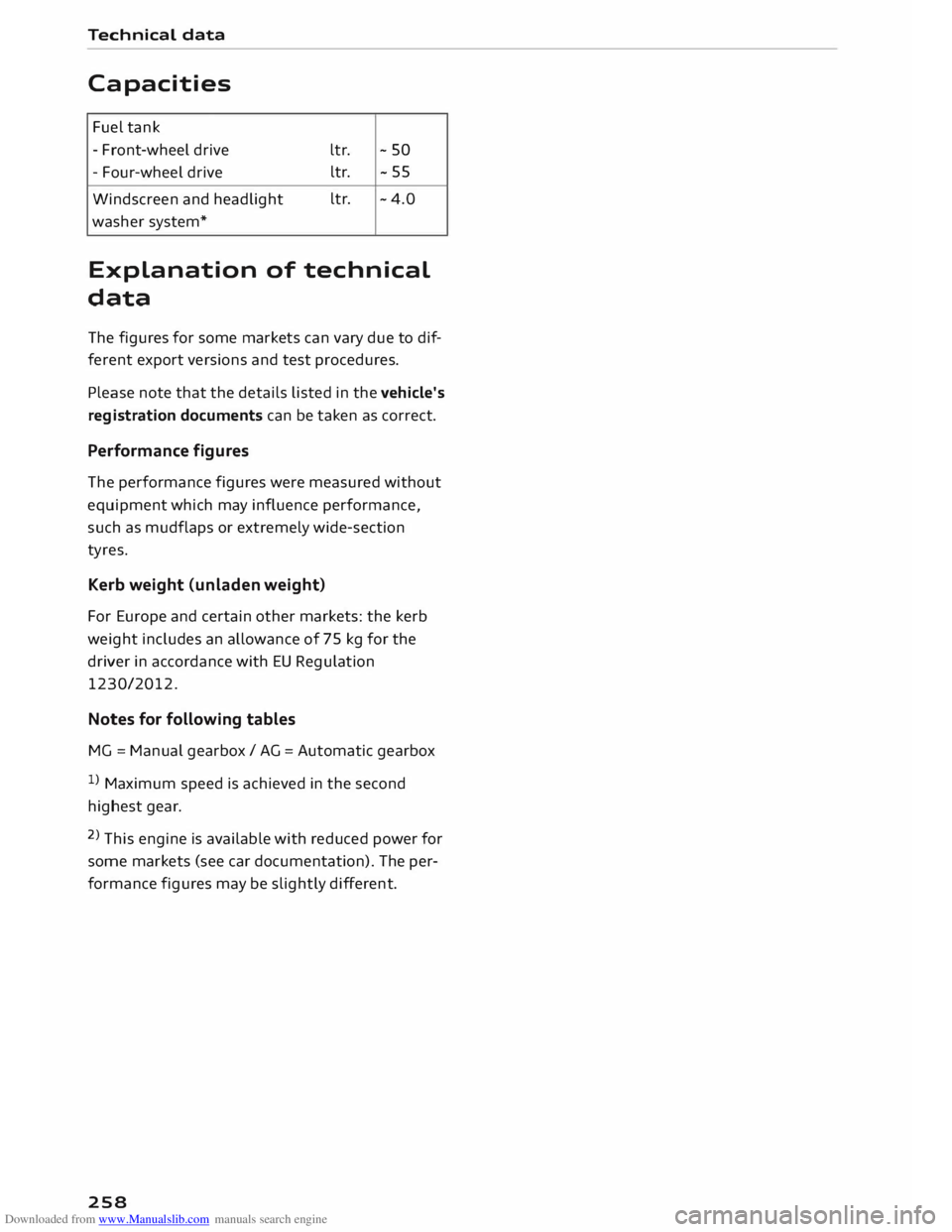
Capacities Fuel tank
- Front-wheel drive ltr. - so
- Four-wheel drive ltr. -
55
Windscreen and headlight ltr.
-4.0
washer system*
Explanation of technical
data
The figures for some markets can vary due to dif
ferent export versions and test procedures.
Please note that the
details
listed in the vehicle's
registration documents can be taken as correct.
Performance figures
The performance figures were measured without
equipment which may influence performance,
such as mudflaps or extremely wide-section
tyres.
Kerb weight (unladen weight)
For Europe and certain other markets: the kerb
weight includes an allowance of 75 kg for the
driver in accordance with EU Regulation
1230/2012.
Notes for following tables
MG = Manual gearbox I AG = Automatic gearbox
l) Maximum speed is achieved in the second
highest gear.
2 ) This engine is available with reduced power for
some markets (see car documentation). The per
formance figures may be slightly different.
258