wheel AUDI TT COUPE 2014 Service Manual
[x] Cancel search | Manufacturer: AUDI, Model Year: 2014, Model line: TT COUPE, Model: AUDI TT COUPE 2014Pages: 284, PDF Size: 34.42 MB
Page 214 of 284
Downloaded from www.Manualslib.com manuals search engine Airbag
system
Description of front airbags
The airbag system is not a substitute for the seat
belts.
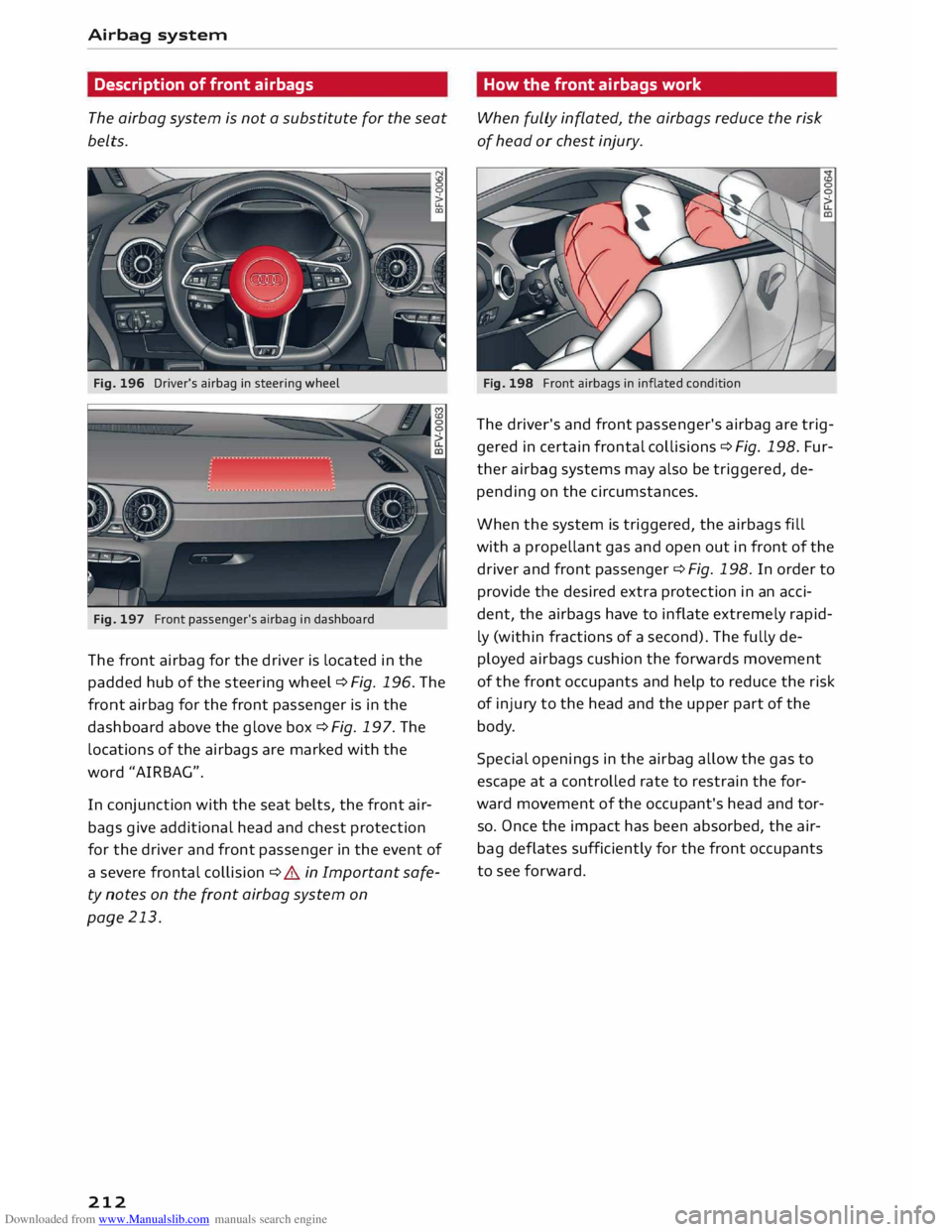
Fig. 196 Driver's airbag in steering wheel
Fig. 197 Front passenger's airbag in dashboard
The front airbag for the driver is located in the
padded hub of the steering wheel ¢Fig. 196. The
front airbag for the front passenger is in the
dashboard above the glove box ¢Fig. 197. The
locations of the airbags are marked with the
word "AIRBAG".
In conjunction with the seat belts, the front air
bags give additional head and chest protection
for the driver and front passenger in the event of
a severe frontal collision ¢ A in Important safe
ty notes on the front airbag system on
page 213.
212 How
the front airbags work
When fully inflated, the airbags reduce the risk
of head or chest injury.
Fig. 198 Front airbags in inflated condition
The driver's and front passenger's airbag are trig
gered in certain frontal collisions ¢Fig. 198. Fur
ther airbag systems may also be triggered, de
pending on the circumstances.
When the system is triggered, the airbags fill
with a prope llant gas and open out in front of the
driver and front passenger ¢ Fig. 198. In order to
provide the desired extra protection in an acci
dent, the airbags have to inflate extremely rapid
ly (within fractions of a second). The fully de
ployed airbags cushion the forwards movement
of the front occupants and help to reduce the risk
of injury to the head and the upper part of the
body.
Special openings in the airbag allow the gas to
escape at a controlled rate to restrain the for
ward movement of the occupant's head and tor
so. Once the impact has been absorbed, the air
bag deflates sufficiently for the front occupants
to see forward.
Page 215 of 284
Downloaded from www.Manualslib.com manuals search engine 0
N
co
....
\D U'l
N
U'l
.... Important
safety notes on the front airbag
system
There are a number of safety points concerning
the airbag system which you should remember.
This will help to reduce the risk of injury in an ac
cident.
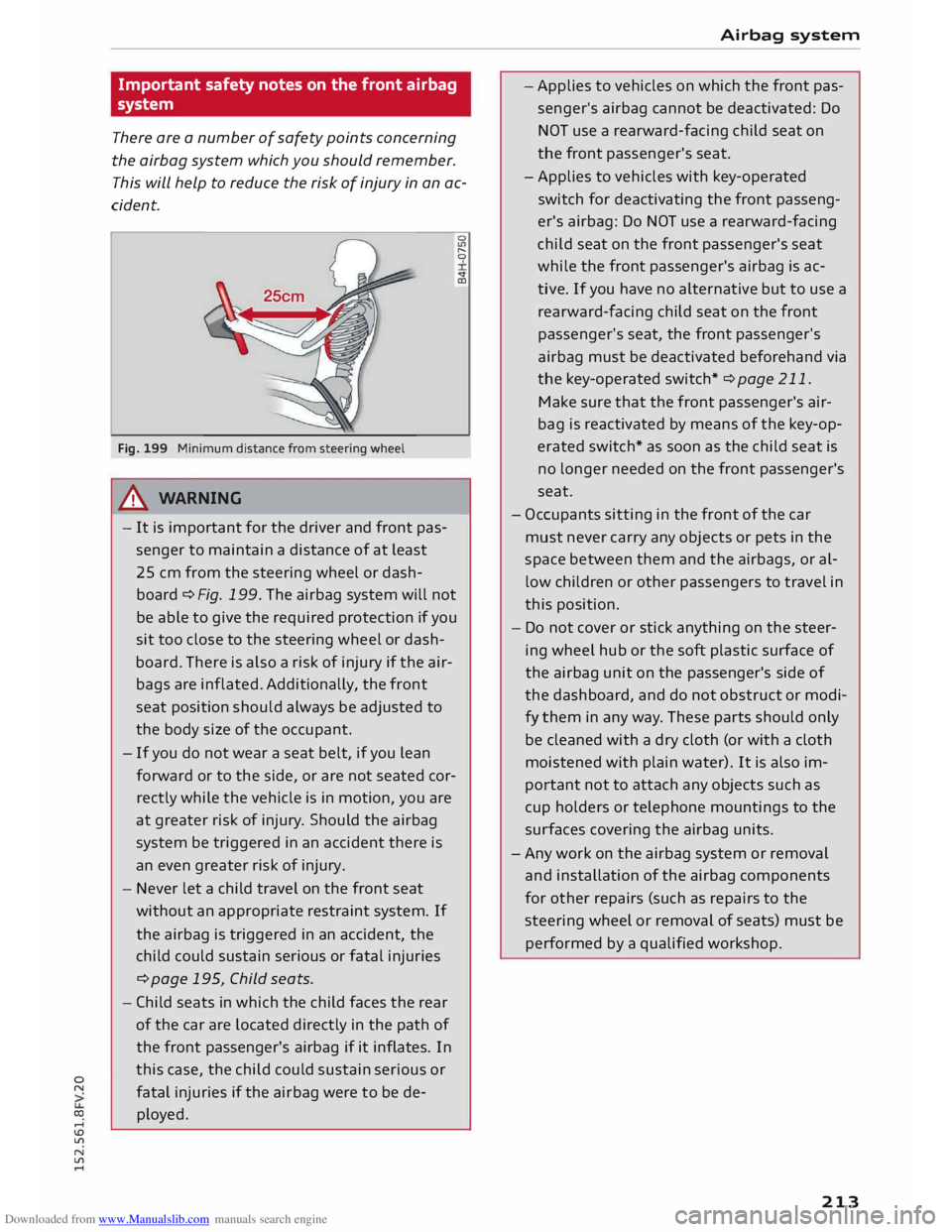
Fig. 199 Minimum distance from steering wheel
A WARNING
- It is important for the driver and front pas
senger to maintain a distance of at least
25 cm from the steering wheel or dash
board ¢Fig. 199. The airbag system will not
be able to give the required protection if you
sit too close to the steering wheel or dash
board. There is also a risk of injury if the air
bags are inflated. Additionally, the front
seat position should always be adjusted to
the body size of the occupant.
- If you do not wear a seat belt, if you lean
forward or to the side, or are not seated cor
rectly while the vehicle is in motion, you are
at greater risk of injury. Should the airbag
system be triggered in an accident there is
an even greater risk of injury.
- Never let a child travel on the front seat
without an appropriate restraint system. If
the airbag is triggered in an accident, the
child could sustain serious or fatal injuries
¢page 195, Child seats.
- Child seats in which the child faces the rear
of the car are located directly in the path of
the front passenger's airbag if it inflates. In
this case, the child could sustain serious or
fatal injuries if the airbag were to be de
ployed. 0
lt')
"
0
sf
CD
- Airbag
system
- Applies to vehicles on which the front pas
senger's airbag cannot be deactivated: Do
NOT use a rearward-facing child seat on
the front passenger's seat.
- Applies to vehicles with key-operated
switch for deactivating the front passeng
er's airbag: Do NOT use a rearward-facing
child seat on the front passenger's seat
while the front passenger's airbag is ac
tive. If you have no alternative but to use a
rear ward-facing child seat on the front
passenger's seat, the front passenger's
airbag must be deactivated beforehand via
the key-operated switch* ¢ page 211.
Make sure that the front passenger's air
bag is reactivated by means of the key-op
erated switch* as soon as the child seat is
no longer needed on the front passenger's
seat.
- Occupants sitting in the front of the car
must never carry any objects or pets in the
space between them and the airbags, or al
low children or other passengers to travel in
this position.
- Do not cover or stick anything on the steer
ing wheel hub or the soft plastic surface of
the airbag unit on the passenger's side of
the dashboard, and do not obstruct or modi
fy them in any way. These parts should only
be cleaned with a dry cloth (or with a cloth
moistened with plain water). It is also im
portant not to attach any objects such as
cup holders or telephone mountings to the
surfaces covering the airbag units.
- Any work on the airbag system or removal
and installation of the airbag components
for other repairs (such as repairs to the
steering wheel or removal of seats) must be
performed by a qualified workshop.
213
Page 233 of 284
Downloaded from www.Manualslib.com manuals search engine 0
N
co
....
\D L/'l
N
L/'l
.... Wheels
and tyres
Wheels General notes
... Inspect the tyres regularly for damage (cuts,
cracks or blisters, etc.). Remove any foreign
bodies embedded in the treads.
... If you have to drive over a kerb or similar obsta
cle, drive very slowly and as near as possible at
a right angle to the kerb.
... Damaged rims or tyres must be replaced imme
diately.
... Keep grease, oil and fuel off the tyres.
... Mark
the wheels before taking them off so that
they rotate in the same direction when refitted.
... When removed, the wheels should be stored
flat in a cool, dry and preferably dark place.
CD CAUTION
- Please note that summer and winter tyres
are optimised for the prevailing road condi
tions at different times of year. We recom
mend that you use winter tyres during the
winter months. At low temperatures, sum
mer tyres lose their elasticity and grip, and
braking performance also suffers as a re
sult. Cracks can form in the tread block on
summer tyres if they are used at very cold
temperatures, and this can cause perma
nent damage to the tyres. An increase in
rolling noise and tyre imbalance may result
from this damage.
- Machined, polished or chrome-plated rims
must not be used in winter conditions. The
process used to manufacture these types of
wheel rim does not provide adequate sur
face protection against corrosion, and the
rims can be permanently damaged by road
salt or similar.
New wheels or tyres
It is best to have all servicing of wheels and tyres
performed by a qualified workshop, since they
have the necessary special tools and replacement
parts and trained personnel. Wheels
and tyres
... New tyres do not yet give maximum grip. When
driving with new tyres, drive at moderate
speeds and be especially careful during the first
500 km.
... All four wheels must be fitted with tyres of the
same type, size (rolling circumference) and
preferably the same tread pattern.
... Tyres should be replaced in pairs and not indi
vidually (i.e. both front tyres or both rear tyres
together).
... We recommend the use of Audi Genuine Tyres.
If you wish to use other tyres, please note that
the actual size can differ from the nominal size
marked on the tyre ¢.&_
.
... If you wish to purchase a different combination
of rims and tyres than the ones fitted on the ve
hicle during production, it is advisable to con
sult a qualified workshop beforehand ¢.&_
.
On vehicles with four-wheel drive, all four wheels
must always be fitted with tyres of the same
type, make and tread pattern, as otherwise the
driveline can be damaged by variations in the
wheel speeds. For the same reason, only use a
spare wheel* which has the same rolling circum
ference as the normal road wheels.
If the spare wheel* is not the same type as the
tyres fitted on the car (for example if the car has
winter tyres or wide-section tyres) you should on
ly use the spare wheel* if a puncture occurs, and
then only for a short period of time. In this case,
please drive with extra care. Refit a normal road
wheel as soon as possible.
Manufacturing date
The manufacturing date is indicated on the tyre
sidewall (possibly only on the inner side of the
wheel):
DOT ... 2214 ...
means, for example, that the tyre was produced
in the 22nd week of 2014.
Audi Genuine Tyres
Audi Genuine Tyres with the marking "AO" or
"RO" are specially matched to your Audi. When
used properly, these tyres meet the highest
standards in safety and handling. Your specialist
retailer will be glad to provide more information . ..,..
231
Page 234 of 284

Downloaded from www.Manualslib.com manuals search engine Wheels
and tyres
& WARNING
- Use only tyre/rim combinations and match
ing wheel bolts approved by Audi. Otherwise
damage to the vehicle and an accident could
result.
- For technical reasons, it is not possible to
use wheels from other vehicles. In certain
cases, it is not even possible to use wheels
from another vehicle of the same model.
- It is very important to ensure that the tyres
you have chosen have adequate clearance.
When selecting replacement tyres, do not
rely entirely on the nominal tyre size marked
on the tyre; with some makes of tyre the ef
fective tyre size can differ significantly from
the nominal dimensions, even though the
tyres have the same size designation. Inade
quate tyre clearance can result in damage to
the tyres or the vehicle, causing a serious
safety risk.
- Avoid running the car on tyres that are more
than 6 years old. If you have no alternative,
you should drive slowly and with extra care
at all times.
- The use of run-flat tyres on your vehicle is
NOT authorised! Unauthorised use can cause
an accident or damage your vehicle.
- If wheel trims are fitted after the car is pur
chased, ensure that there is an adequate
flow of air for cooling the brakes -risk of ac
cident!
Tyre wear / damage
Fig. 219 Tyre tread: Tread wear indicators
l l
Please observe the applicable regulations in the country in
which you are travelling.
232 Tyre
wear
Inspect the tyres regularly for damage.
- The wear on under or over-inflated tyres is sig
nificantly higher.
- Fast cornering, heavy acceleration and hard
braking all increase tyre wear.
- If you notice excessive tyre wear, have the
wheel alignment checked by a qualified work
shop.
- Have your tyres rebalanced if steering wheel vi
brations indicate an imbalance. Otherwise, the
tyres and other parts of the vehicle may wear
faster.
Tread wear indicators
The original tyres on your vehicle have 1.6 mm
high tread wear indicators ¢ Fig. 219 running
across the tread at regular intervals. The letters
"TWI" or triangles on the sidewall indicate the
positions of the tread wear indicators.
The minimum tread depth 1
) is reached at the lat
est when the tread is worn down to the tread
wear indicators. Replace the tyres with new ones
¢ ,&..
Changing wheels round
Wheels should be changed round regularly to en
sure that the wear is equal on all tyres. Fit the
wheels from the rear axle on the front axle and
vice-versa. All the tyres will then last for about
the same time.
On tyres with a directional tread pattern, note
the direction of rotation indicated on the sidewall
¢page 247.
Concealed damage
Damage to tyres and rims is often not readily visi
ble. If you notice unusual vibrations or the car
pulling to one side, this may indicate that one of
the tyres is damaged. Reduce your speed imme
diately. Inspect the tyres for damage. If no exter
nal damage is visible, drive slowly and carefully
to the nearest qualified workshop and have the
car inspected.
Page 235 of 284
Downloaded from www.Manualslib.com manuals search engine 0
N
co
,-j
\D L/'l
N
L/'l
,-j A
WARNING
Insufficient tread depth or different tread
depths on different wheels reduce safety. This
is particularly evident in vehicle handling,
when there is a risk of aquaplaning in deep
puddles of water and when driving through
corners. Braking is also adversely affected -
risk of accident!
Tyre pressure
Audi V V
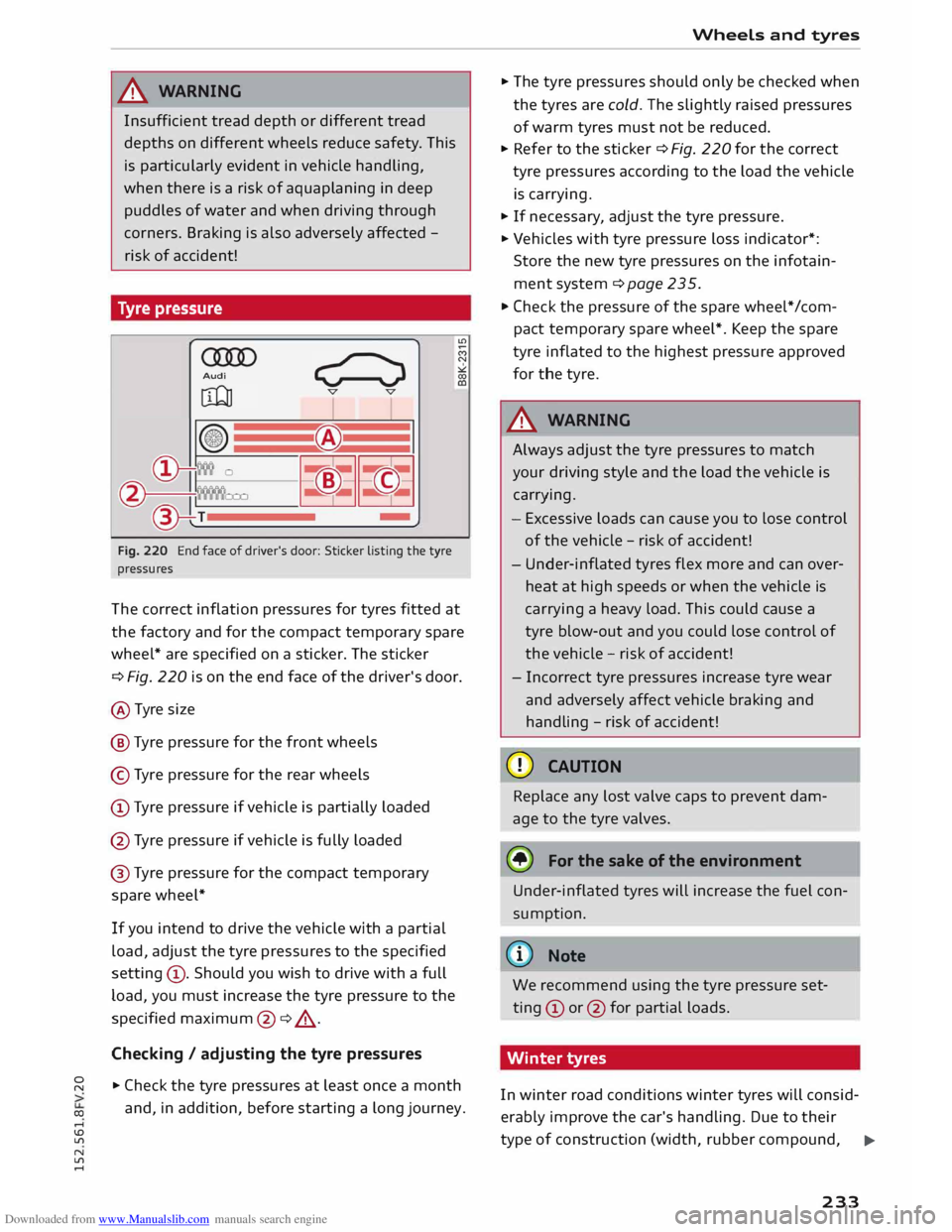
Fig. 220 End face of driver's door: Sticker listing the tyre
pressures
The correct inflation pressures for tyres fitted at
the factory and for the compact temporary spare
wheel* are specified on a sticker. The sticker
¢ Fig. 220 is on the end face of the driver's door.
@ Tyre size
@ Tyre pressure for the front wheels
© Tyre pressure for the rear wheels
(D Tyre pressure if vehicle is partially loaded
@ Tyre pressure if vehicle is fully loaded
@ Tyre pressure for the compact temporary
spare wheel*
If you intend to drive the vehicle with a partial
load, adjust the tyre pressures to the specified
setting (D. Should you wish to drive with a full
load, you must increase the tyre pressure to the
specified maximum @
¢.&,.
.
Checking / adjusting the tyre pressures
.. Check
the tyre pressures at least once a month
and, in addition, before starting a long journey. Wheels
and tyres
.. The tyre pressures should only be checked when
the tyres are cold. The slightly raised pressures
of warm tyres must not be reduced.
.. Refer to the sticker ¢ Fig. 220 for the correct
tyre pressures according to the load the vehicle
is carrying.
.. If necessary , adjust the tyre pressure.
.. Vehicles with tyre pressure loss indicator*:
Store the new tyre pressures on the infotain
ment system ¢ page 235 .
.. Check the pressure of the spare wheel* /com
pact temporary spare wheel*. Keep the spare
tyre inflated to the highest pressure approved
for the tyre.
A WARNING
Always adjust the tyre pressures to match
your driving style and the load the vehicle is
carrying.
- Excessive loads can cause you to lose control
of the vehicle -risk of accident!
- Under-inflated tyres flex more and can over
heat at high speeds or when the vehicle is
carrying a heavy load. This could cause a
tyre blow-out and you could lose control of
the vehicle -risk of accident!
- Incorrect tyre pressures increase tyre wear
and adversely affect vehicle braking and
handling -risk of accident!
CD CAUTION
Replace any lost valve caps to prevent dam
age to the tyre valves.
@ For the sake of the environment
Under-inflated tyres will increase the fuel con
sumption.
@ Note
We recommend using the tyre pressure set
ting (Dor@ for partial loads.
Winter tyres
In winter road conditions winter tyres will consid
erably improve the car's handling. Due to their
type of construction (width, rubber compound,
IJII>
233
Page 236 of 284
Downloaded from www.Manualslib.com manuals search engine Wheels
and tyres
tread pattern), summer tyres give less grip on ice
and snow.
... Winter tyres must be fitted on all four wheels.
... Only use winter tyres of the correct type ap-
proved for your vehicle.
... Please
note that the maximum permissible
speed for winter tyres may be lower than for
summer tyres¢.&_ . Your specialist retailer can
advise you of the maximum speed for your
tyres.
... After fitting the wheels you must always check
the tyre pressures ¢page 233.
Winter tyres lose their effectiveness when the
tread is worn down to a depth of 4 mm. The per
formance of winter tyres is also severely impaired
by ageing, even if the tread is still much deeper
than 4 mm.
.&_ WARNING
- Never exceed the maximum approved speed
for your tyres. This causes the tyres to over
heat and can even result in a blow-out -risk
of accident!
- Always adapt your driving style to the pre
vailing road and traffic conditions. Drive
carefully and reduce your speed on icy or
slippery roads. Even winter tyres lose their
grip on black ice.
@) For the sake of the environment
Summer tyres should be fitted again as soon
as possible; they give better handling on
roads which are free of snow and ice. They are
quieter, do not wear so quickly and reduce
fuel consumption.
(Qj) Note
All-weather tyres can also be used instead of
winter tyres. Please note that winter tyres
with the & symbol are required by law during
the winter season in some countries.
Snow chains
Snow chains will improve braking ability as well
as traction in winter conditions.
234 ...
Snow chains can be used on the front wheels
only. This also applies to vehicles with four
wheel drive* .
... Check that the snow chains are correctly seated
after driving for a few yards; follow the instruc
tions given by the manufacturer .
... Keep your speed below 50 km/h. Please ob-
serve the applicable local regulations.
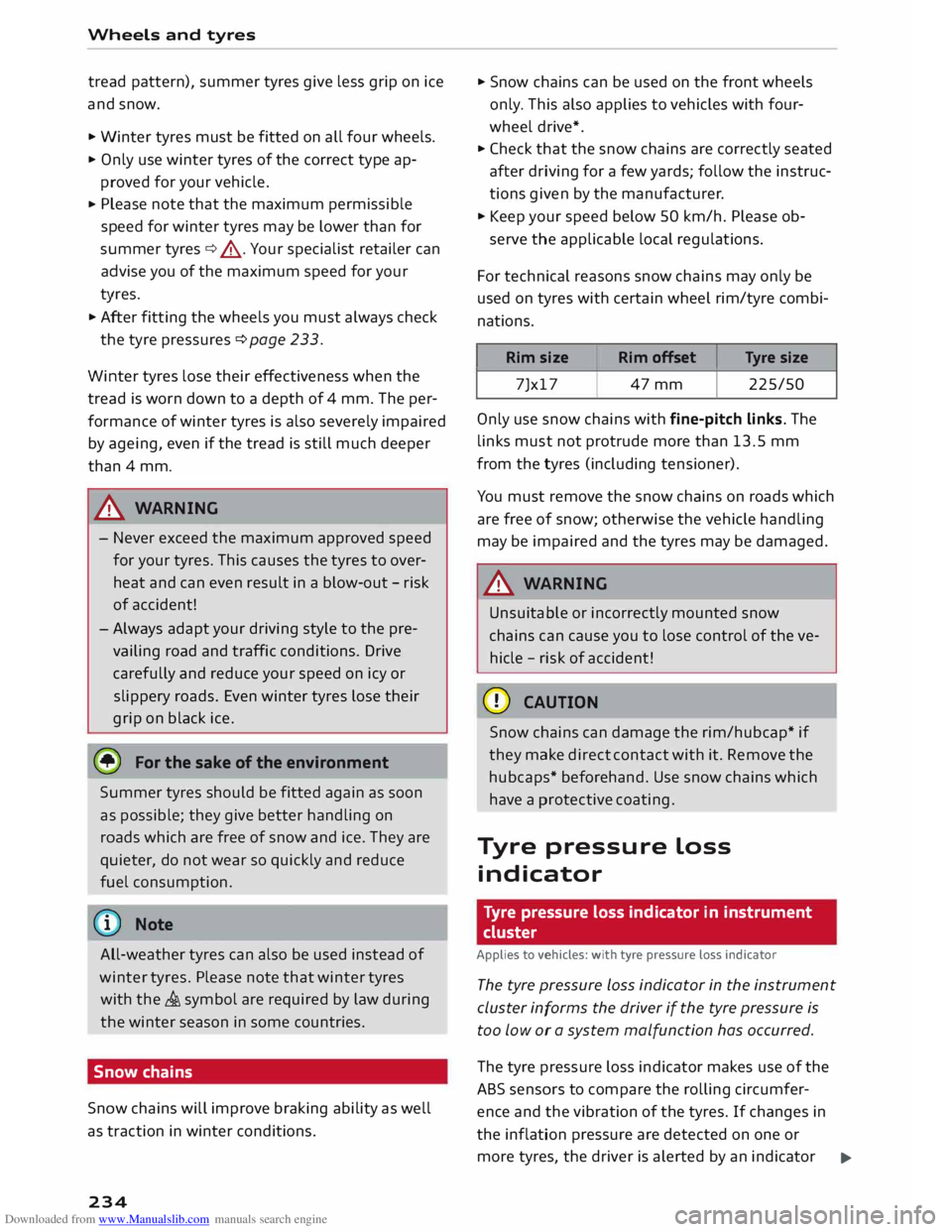
For technical reasons snow chains may only be
used on tyres with certain wheel rim/tyre combi
nations.
Rim size
Rim offset Tyre
size
7Jx17 47mm 225/50
Only use snow chains with fine-pitch links. The
links must not protrude more than 13.5 mm
from the tyres (including tensioner).
You must remove the snow chains on roads which
are free of snow; otherwise the vehicle handling
may be impaired and the tyres may be damaged.
.&_ WARNING
Unsuitable or incorrectly mounted snow
chains can cause you to lose control of the ve
hicle -risk of accident!
CD CAUTION
Snow chains can damage the rim/hubcap* if
they make direct contact with it. Remove the
hubcaps* beforehand. Use snow chains which
have a protective coating.
Tyre pressure Loss
indicator
Tyre pressure loss indicator in instrument
cluster
Applies to vehicles: with tyre pressure Loss indicator
The tyre pressure Loss indicator in the instrument
cluster informs the driver if the tyre pressure is
too low or a system malfunction has occurred.
The tyre pressure loss indicator makes use of the
ABS sensors to compare the rolling circumfer
ence and the vibration of the tyres. If changes in
the inflation pressure are detected on one or
more tyres, the driver is alerted by an indicator
..,.
Page 237 of 284
Downloaded from www.Manualslib.com manuals search engine 0
N
co
....
\D Lfl
N
Lfl
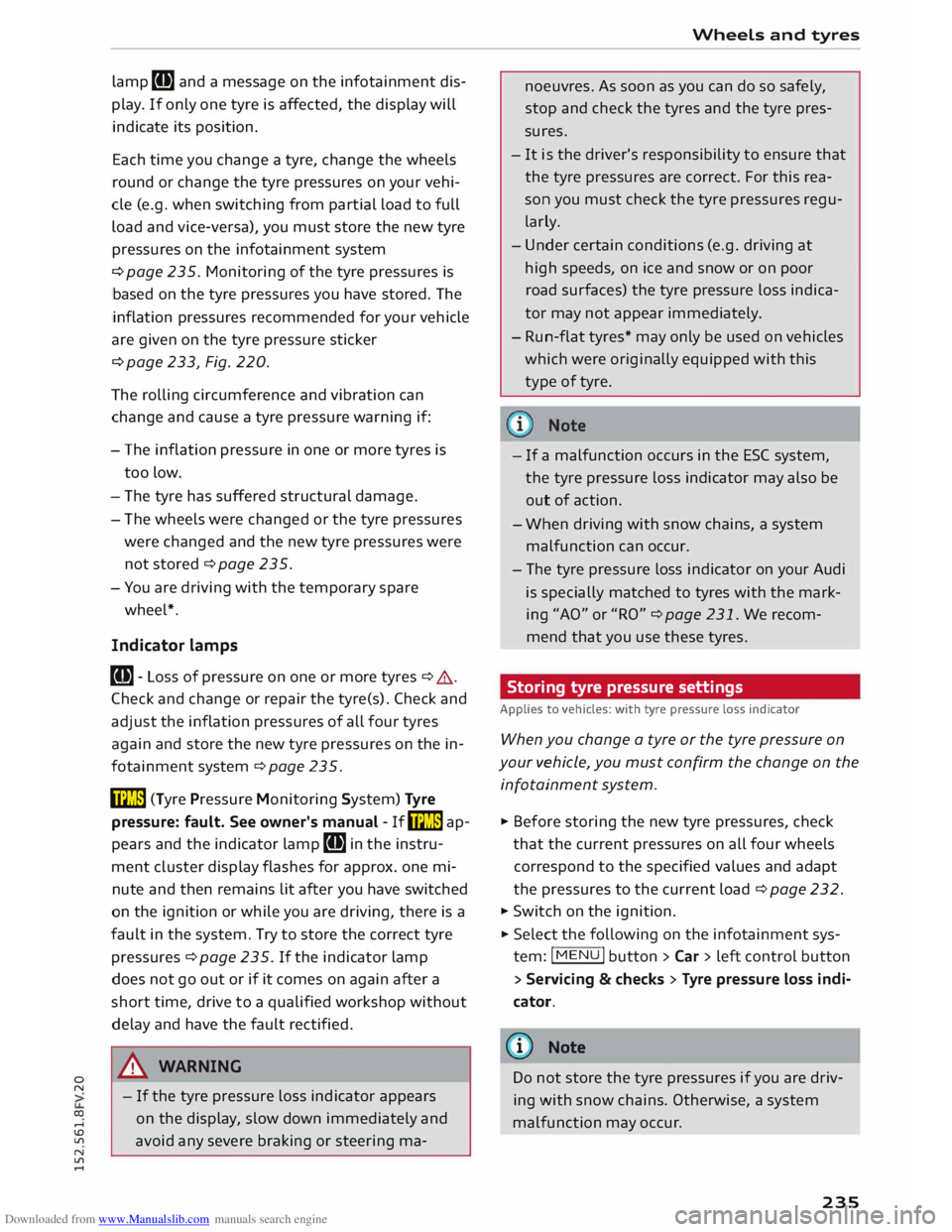
.... lamp
[Bl and a message on the infotainment dis
play. If only one tyre is affected, the display will
indicate its position.
Each time you change a tyre, change the wheels
round or change the tyre pressures on your vehi
cle (e.g. when switching from partial load to full
load and vice-versa), you must store the new tyre
pressures on the infotainment system
¢ page 235. Monitoring of the tyre pressures is
based on the tyre pressures you have stored. The
inflation pressures recommended for your vehicle
are given on the tyre pressure sticker
¢ page 233, Fig. 220.
The rolling circumference and vibration can
change and cause a tyre pressure warning if:
- The inflation pressure in one or more tyres is
too low.
- The tyre has suffered structural damage.
- The wheels were changed or the tyre pressures
were changed and the new tyre pressures were
not stored ¢ page 235.
- You are driving with the temporary spare
wheel*.
Indicator lamps
RI]- Loss of pressure on one or more tyres¢ A.
Check and change or repair the tyre(s). Check and
adjust the inflation pressures of all four tyres
again and store the new tyre pressures on the in
fotainment system¢ page 235.
ffim (Tyre Pressure Monitoring System) Tyre
pressure: fault. See owner's manual -If� ap
pears and the indicator lamp [Bl in the instru
ment cluster display flashes for approx. one mi
nute and then remains lit after you have switched
on the ignition or while you are driving, there is a
fault in the system. Try to store the correct tyre
pressures ¢ page 235. If the indicator lamp
does not go out or if it comes on again after a
short time, drive to a qualified workshop without
delay and have the fault rectified.
&_ WARNING
- If the tyre pressure loss indicator appears
on the display, slow down immediately and
avoid any severe braking or steering ma- Wheels
and tyres
noe uvres. As soon as you can do so safely,
stop and check the tyres and the tyre pres
sures.
- It is the driver's responsibility to ensure that
the tyre pressures are correct. For this rea
son you must check the tyre pressures regu
larly.
- Under certain conditions (e.g. driving at
high speeds, on ice and snow or on poor
road surfaces) the tyre pressure loss indica
tor may not appear immediately.
- Run-flat tyres* may only be used on vehicles
which were originally equipped with this
type of tyre.
- If a malfunction occurs in the ESC system,
the tyre pressure loss indicator may also be
out of action.
- When driving with snow chains, a system
malfunction can occur.
- The tyre pressure loss indicator on your Audi
is specially matched to tyres with the mark
ing "AO" or "RO" ¢ page 231. We recom
mend that you use these tyres.
Storing tyre pressure settings
Applies to vehicles: with tyre pressure loss indicator
When you change a tyre or the tyre pressure on
your vehicle, you must confirm the change on the
infotainment system.
� Before storing the new tyre pressures, check
that the current pressures on all four wheels
correspond to the specified values and adapt
the pressures to the current load ¢ page 232.
� Switch on the ignition.
� Select the
following on the infotainment sys
tem: I MENU I button >Car> left control button
> Servicing & checks > Tyre pressure loss indi
cator.
@ Note
Do not store the tyre pressures if you are driv
ing with snow chains. Otherwise, a system
malfunction may occur .
235
Page 239 of 284
Downloaded from www.Manualslib.com manuals search engine 0
N
co
....
\D L/'l
N
L/'l
.... vehicle
with the ignition switched on - risk
of accident!
- To avoid cutting yourself on sharp metal
parts, always wear suitable protection when
cleaning the underside of the car or inside
the wheel arches.
- After the car has been washed, the full brak
ing effect can be delayed by moisture (or in
winter by ice) on the discs and brake pads -
risk of accident! The brakes should be dried
by pressing the pedal to restore full braking
effect.
CD CAUTION
- Before washing the vehicle in an automatic
car wash, please make sure to retract the
exterior mirrors and, if necessary, retract
the automatic rear spoiler* to prevent dam
age. Always use the electrical power control
to fold the mirrors in/out on vehicles with
electrically retractable exterior mirrors*.
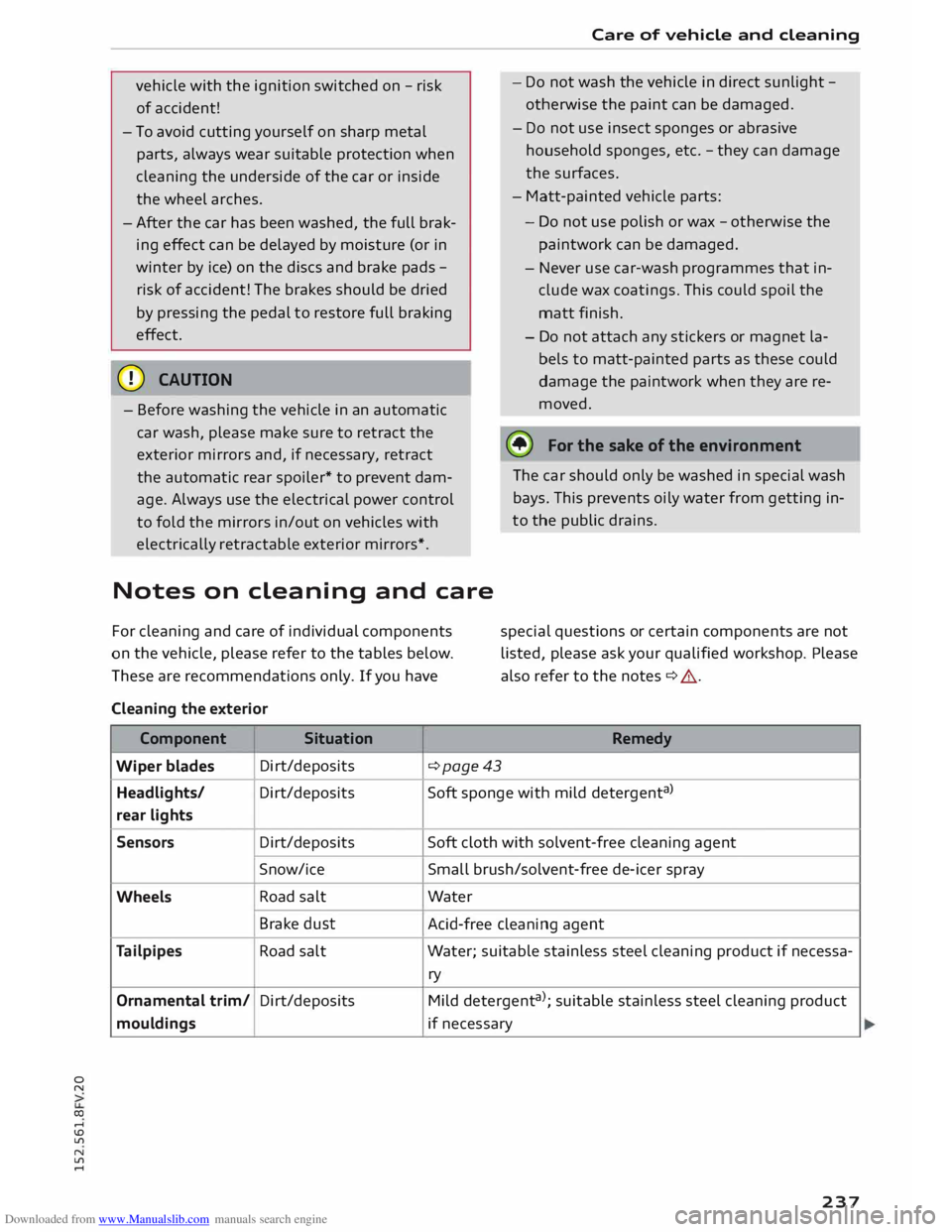
Notes on cleaning and care
For cleaning and care of individual components
on the vehicle, please refer to the tables below.
These are recommendations only. If you have
Cleaning the exterior
Component Situation Care
of vehicle and cleaning
- Do not wash the vehicle in direct sunlight -
otherwise the paint can be damaged.
- Do not use insect sponges or abrasive
household sponges, etc. -they can damage
the surfaces.
- Matt-painted vehicle parts:
- Do not use polish or wax -otherwise the
paintwork can be damaged.
- Never use car-wash programmes that in
clude wax coatings. This could spoil the
matt finish.
- Do not attach any stickers or magnet la
bels to matt-painted parts as these could
damage the paintwork when they are re
moved.
@ For
the sake of the environment
The car should only be washed in special wash
bays. This prevents oily water from getting in
to the public drains.
special questions or certain components are not
listed, please ask your qualified workshop. Please
also refer to the notes ¢ &. .
Remedy
Wiper blades Di
rt/deposits
¢page43
Headlights/ Di rt/deposits Soft
sponge with mild detergent a
>
rear lights
Sensors Dirt/deposits
Soft
cloth with solvent-free cleaning agent
Snow/ice Small brush/solvent-free de-icer spray
Wheels Road
salt Water
Brake dust
Acid-free cleaning agent
Tailpipes Road
salt Water; suitable stainless steel cleaning product if necessa-
ry
Ornamental trim/ Dirt/deposits
Mild detergent a
>
; suitable stainless steel cleaning product
mouldings if necessary
237
Page 241 of 284
Downloaded from www.Manualslib.com manuals search engine 0
N
co
....
\D Lfl
N
Lfl
.... Care
of vehicle and cleaning
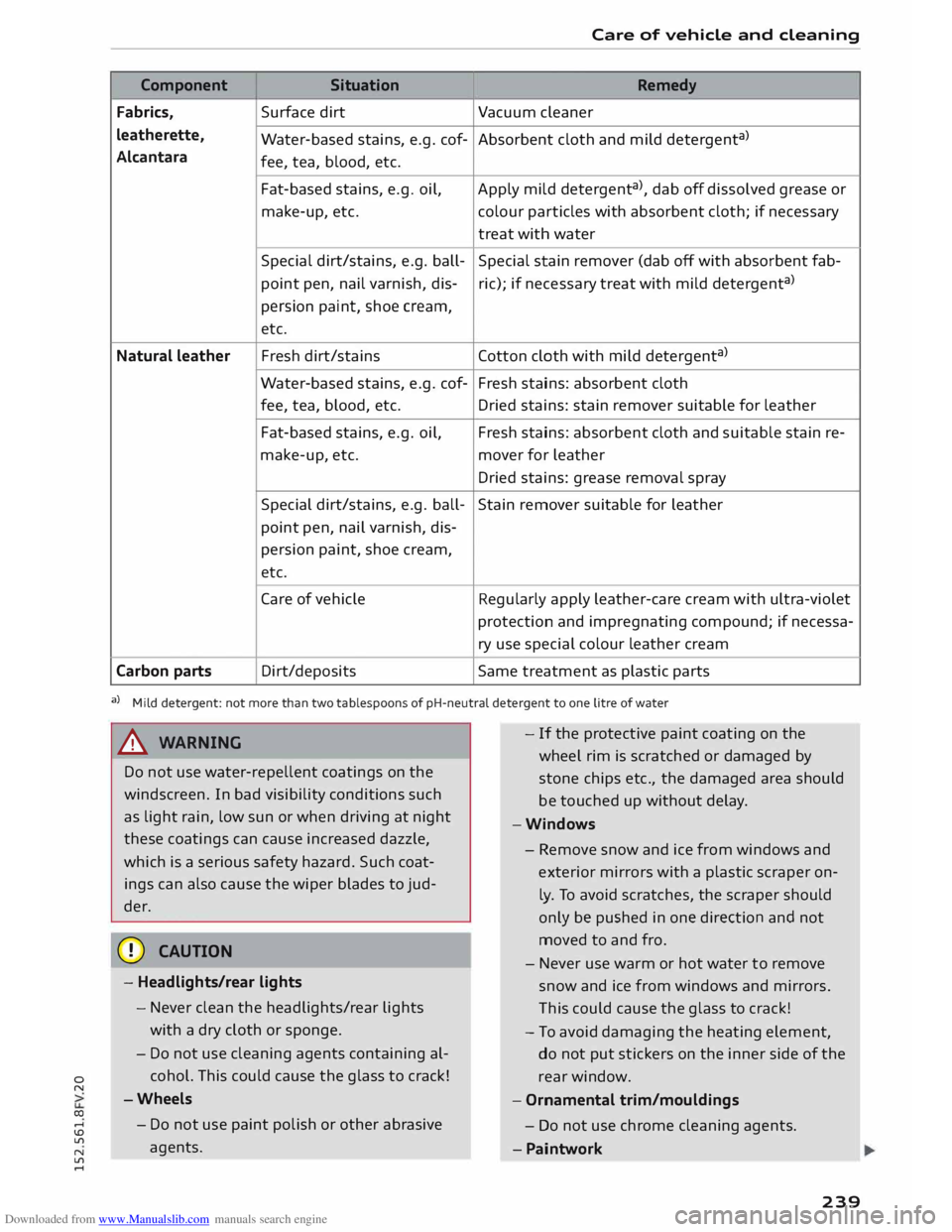
Component Situation
Remedy
Fabrics, Surface
dirt
Vacuum cleaner
leatherette, Water-based stains, e.g. cof- Absorbent cloth and mild detergent a
)
Alcantara fee, tea, blood, etc.
Fat-based stains, e.g. oil,
Apply mild detergent a
), dab off dissolved grease or
make-up, etc. colour
particles with absorbent cloth; if necessary
treat with water
Special dirt/stains, e.g. ball- Special stain remover (dab off with absorbent fab-
point pen, nail varnish, dis-ric);
if necessary treat with mild detergent a
)
persion paint, shoe cream,
etc.
Natural leather Fresh
dirt/stains Cotton cloth with mild detergent a
)
Water-based stains, e.g. cof- Fresh stains: absorbent cloth
fee, tea, blood, etc.
Dried stains: stain remover suitable for leather
Fat-based stains, e.g. oil, Fresh stains: absorbent cloth and suitable stain re-
make-up, etc. mover for leather
Dried stains: grease removal spray
Special dirt/stains, e.g. ball-
Stain remover suitable for leather
point pen, nail varnish, dis-
persion paint, shoe cream,
etc.
Care of vehicle Regularly apply leather-care cream with ultra-violet
protection and impregnating compound; if necessa-
ry use special colour leather cream
Carbon parts Dirt/deposits
Same treatment as plastic parts
a) Mild detergent: not more than two tablespoons of pH-neutral detergent to one litre of water
A WARNING
Do not use water-repellent coatings on the
windscreen. In bad visibility conditions such
as light rain, low sun or when driving at night
these coatings can cause increased dazzle,
which is a serious safety hazard. Such coat
ings can also cause the wiper blades to jud
der.
CD CAUTION
- Headlights/rear lights
- Never clean the headlights/rear lights
with a dry cloth or sponge.
- Do not use cleaning agents containing al
cohol. This could cause the glass to crack!
-Wheels
- Do not use paint polish or other abrasive
agents. -
If the protective paint coating on the
wheel rim is scratched or damaged by
stone chips etc., the damaged area should
be touched up without delay.
-Windows
- Remove snow and ice from windows and
exterior mirrors with a
plastic
scraper on
ly. To avoid scratches, the scraper should
only be pushed in one direction and not
moved to and fro.
- Never use warm or hot water to remove
snow and ice from windows and mirrors.
Th is could cause the glass to crack!
- To avoid damaging the heating element,
do not put stickers on the inner side of the
rear window.
- Ornamental trim/mouldings
- Do not use chrome cleaning agents .
- Paintwork
239
Page 244 of 284
Downloaded from www.Manualslib.com manuals search engine Mobility
Tool kit/tyre repair kit/compressor
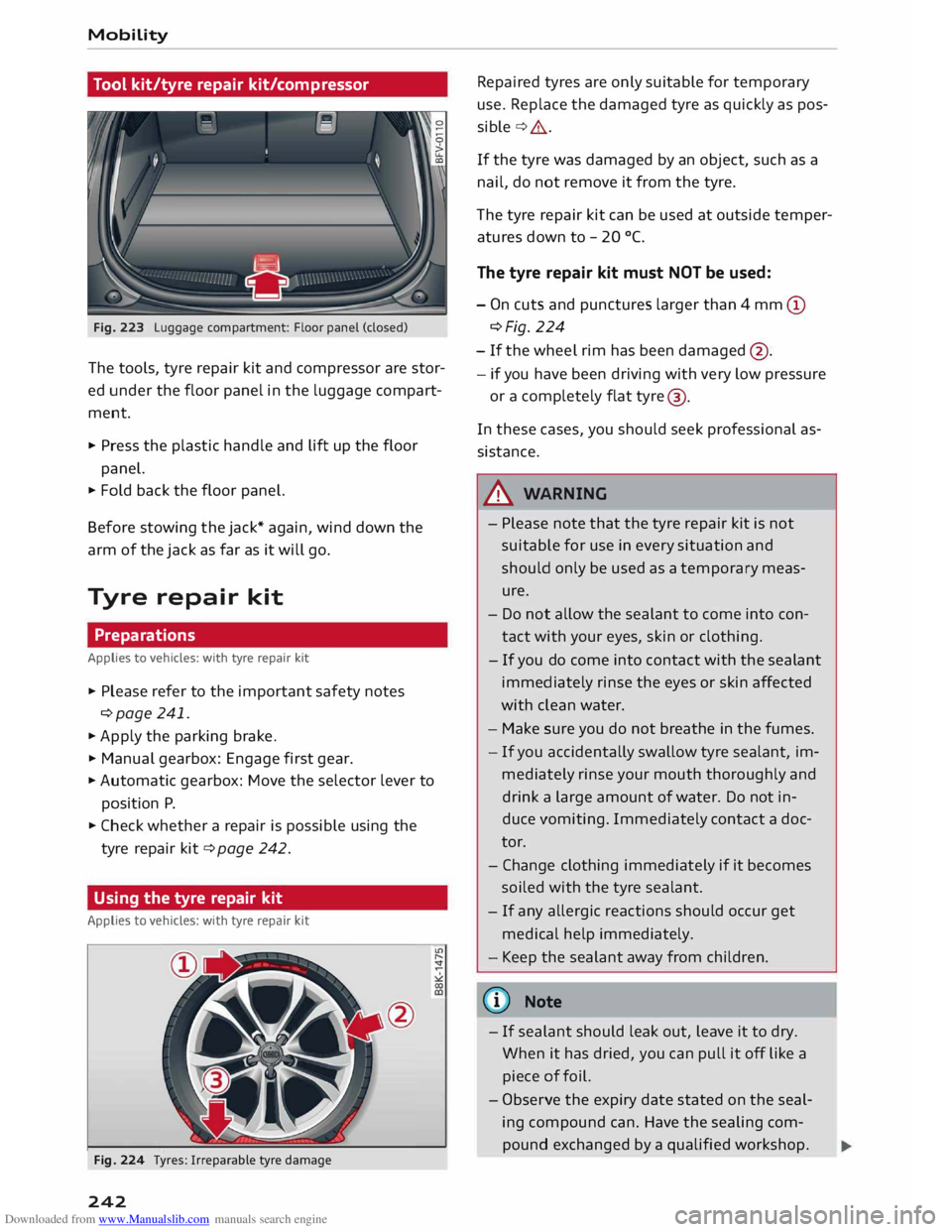
Fig. 223 Luggage compartment: Floor panel (closed)
The tools, tyre repair kit and compressor are stor
ed under the floor panel in the luggage compart
ment.
"' Press the plastic handle and Lift up the floor
panel.
"' Fold back the floor panel.
Before stowing the jack* again, wind down the
arm of the jack as far as it will go.
Tyre repair kit
Preparations
Applies to vehicles: with tyre repair kit
"' Please refer to the important safety notes
¢page 241.
"'Apply the parking brake.
"' Manual gearbox: Engage first gear.
"' Automatic gearbox: Move the selector lever to
position P.
"' Check whether a repair is possible using the
tyre repair kit¢ page 242.
Using the tyre repair kit
Applies to vehicles: with tyre repair kit
Fig. 224 Tyres: Irreparable tyre damage
242 Repaired
tyres are only suitable for temporary
use. Replace the damaged tyre as quickly as pos
sible ¢,&..
If the tyre was damaged by an object, such as a
nail, do not remove it from the tyre.
The tyre repair kit can be used at outside temper
atures down to - 20 °(.
The tyre repair kit must NOT be used:
- On cuts and punctures larger than 4 mm (D
¢Fig. 224
- If the wheel rim has been damaged @.
- if you have been driving with very low pressure
or a completely flat tyre@
.
In these cases, you should seek professional as
sistance.
A WARNING
- Pl ease note that the tyre repair kit is not
suitable for use in every situation and
should only be used as a temporary meas
ure.
- Do not allow the sealant to come into con
tact with your eyes, skin or clothing.
- If you do come into contact with the sealant
immediately rinse the eyes or skin affected
with clean water.
- Make sure you do not breathe in the fumes.
- If you accidentally swallow tyre sealant, im-
mediately rinse your mouth thoroughly and
drink a large amount of water. Do not in
duce vomiting. Immediately contact a doc
tor.
- Change clothing immediately if it becomes
soiled with the tyre sealant.
- If
any allergic reactions should occur get
medical help immediately.
- Keep the sealant away from children.
(©) Note
- If sealant should leak out, leave it to dry.
When it has dried, you can pull it off Like a
piece of foil.
- Observe the expiry date stated on the seal
ing compound can. Have the sealing com
pound exchanged by a qualified workshop.