seats AUDI TT COUPE 2017 Owner's Manual
[x] Cancel search | Manufacturer: AUDI, Model Year: 2017, Model line: TT COUPE, Model: AUDI TT COUPE 2017Pages: 322, PDF Size: 79.73 MB
Page 200 of 322
Airbag syste m
impact, veh icle speed, etc. The front airbags will
also not inflate in side or rear co llisions, or in
roll -overs.
A lwa ys re memb er: Airbags will deploy only once,
and only in certain kinds of coll isions. Your safety
be lts are always there to offer protection in those
situations in which airbags are not supposed to
deploy, or when they have already deployed ; for
example, when your vehicle strikes or is struck by
another vehicle after the first collision .
This is just one of the reasons why an airbag is a
supp lementary restraint and is not a substitute
for a safety belt. The a irbag system works most
effectively when used with the safety belts.
Therefore, always properly wear your safety belts
c::> page 189 .
A WARNING
Sitting too close to the steering whee l o r i n
strument panel will decrease the effective
ness of the airbags and will increase the risk
of persona l injury in a co llision.
- Never sit closer than 10 in (25 cm) to the
steering wheel or instr ument pane l.
- If you cannot si t mo re than 10 in (25 cm)
from the steering wheel, inves tigate wheth
er adaptive equipment may be avai lab le to
held yo u reach the pedals and increase your
seating distance from the steering wheel.
- If you are unrestrained, leaning forward, s it
ting sideways or out of position in any way,
your risk of injury is much higher.
- Yo u will also receive serious injuries and
could even be killed if you are up aga inst the
airbag or too close to it when it inflates -
even with an Advanced Airbag.
- To reduce the risk of injury when an airbag inflates, always wear safety belts properly
¢ page 193, Safety belts .
-Always make certain that chi ldren age 12 or
younger always ride in the rear seat. If chil dren are not properly restra ined, they may
be severely injured or k illed when an airbag
inflates .
- Never let children ride unrestrained or im prope rly rest ra in ed in the vehicle . Adjust the
front seats properly .
198
-
-Never ride with the back rest recl ined.
-Always sit as far as possible from the steer -
ing wheel or the instrument panel
¢ page 181.
-Always sit upright with your back against
the backrest of your seat.
- Never p lace your feet on the instrument
panel or on the seat . Always keep both feet
on the floor in front of the seat to help pre
vent serious injur ies to the legs and hips if
the airbag inflates.
- Never recl ine the front passenger's seat to
transport objects. Items can also move into
the area of the s ide a irbag or the front air
bag during brak ing or in a sudden maneu
ver. Objects near the airbags can become proje cti les and cause injury when an airbag
inflates.
A WARNING
A irbags that have deployed in a crash m ust be
replaced.
- Use o nly orig inal eq uipment airbags ap
p roved by A ud i and inst alled by a trained
technician who has the ne cessary tools and
diagnostic equipment to properly replace
any airbag in yo ur vehicle and assure system
effectiveness in a crash.
'
- Never permit salvaged or recycled airbags to
be installed in your vehicle .
Child restraints on the front seat - some
important things to know
.,. Be sure to read the important informat ion and
head the WARNINGS fo r important details
about c hildren and Advanced A irbags
c::> page 221 .
Even though your veh icle is equipped w ith an Ad
vanced Airbag Sys tem, make certa in that a ll chil
dre n, especia lly those 12 yea rs and younger, al
ways ride i n the b ack seat prope rly res trained fo r
their age and size. The airbag on the passenger
s ide makes the front seat a potentially dange rous
place for a child to r ide . The front seat is not the
safest place for a chi ld in a forward-fac ing chi ld ...,.
Page 201 of 322
co
co
.... N
" N .... 0
0
Vl c:o
seat. It can be a very dangerous place for an
infant or a child in a rearward-facing seat .
The Advanced Airbag System in your veh icle has
been certified to comply with the Requirements
of United States Federal Motor Vehicle Safety
Standard 208 as applicab le at the time your vehi
cle was manufactured.
The Standard req uires the front airbag on the
passenger side to be turned
off ("suppressed") if
a child up to about one year of age restrained in
one of the rear-facing or forward-facing infant re
stra ints listed in Federa l Motor Vehicle Safety
Standard 208 with which the Advanced Airbag
System in your vehicle was certified has been in
stalled on the front passenger seat. For a listing
of the ch ild restraints that were used to ce rtify
comp liance with the US Safety Standard
c>page 223.
The PASSENGER AIR BAG OFF~; light in the
h eadliner tells you when the front Advanced A ir
bag on the passenger side has been turned
off by
the elect ronic control unit.
E ach t ime you tur n on the ignit ion, the
PA SSEN
GER AIR BAG OFF ~; ON @ light will come on
for a few seconds and:
- PAS SENGER AIR BAG OFF~; will come on if
the front passenger seat is not occupied,
- PASSENGER AIR BAG OFF~; will come on if
the electr ical capacitance measured by the ca
pacit ive passenger detection system for the
front passenge r seat equa ls the comb ined ca
pacitan ce of an infant up to abou t one ye ar of
age and one of the rea rwa rd-facing or forward
f acing child restraints listed in Federa l Moto r
Vehicle Safety Standard 208 with which the Ad
vanced Airbag System in your vehicle was certi
fied. For a listing of the child restraints that
were used to cert ify your vehicle's compliance
with the U.S. Safety Standard
c> page 223.
-PASSENGER AIR BAG OFF~; will come on if
there is a small child or child restraint on the
front passenger seat,
- PASSENGER AIR BAG ON @will go off if the
front passenger seat is occupied by an adult as
reg istered by the capacitive passenger detec-
Airb ag sys tem
tion system c> page 209, Monitoring the Ad
vanced Airbag System.
T he PAS SENGER AIR BAG OFF~; ligh t comes on
whe n electrica l capacitan ce regis tered on the
front passenge r seat is equal to or less than the
combined capacitance of a typical 1 year -old in
fant and one of the rearward -facing or forward
facing child restraints listed in Federal Motor Ve hicle Safety Standard 208 w ith which the Ad
vanced Airbag System in your vehicle was ce rti
fied.
If the total e lectr ica l capacitance reg istered on
the front passenger seat is more than that of a
typ ical 1 year-old child but less than the weight
of a small adult, the front airbag on the passen
ger side can deploy (the
PASSENGER AIR BAG
OFF ~;
light does not come on).
If the
PASSENGER AIR BAG OFF~; light does
not come on, the fro nt airbag on the passenger
s ide has not been t urned
off by the electro nic
c ontro l unit and can deploy if the contro l uni t
senses an impac t that meets t he conditions stor
ed in its memory.
For example , the airbag may deplo y if:
- a small ch ild that is heav ier than a typical 1
year-o ld child is on the front passenger seat
(regardless of whethe r the child is in one of the
child safety seats listed
c> page 223), o r
- a child who has outgrown c hild restraints is on
the front passenge r seat.
If the front passenger airbag is turned off, the
PA SSENGER AIR BAG OFF~; light comes on i n
the headliner and stays on.
If the front passenger airbag deploys, the Feder
al Standard requires the airbag to meet the "low
risk" deployment criteria to reduce the risk of i n
jury through interact ion w ith the airbag. "Low
risk" deployment occurs in t hose crashes that
ta ke place at lowe r decele rations as defined in
t h e e lectronic co ntrol un it
c> page 209, PASS EN
GER A IR BAG OFF~; ON@ light.
Always remembe r, a ch ild seat or infant ca rr ier
insta lled on the front seat may be st ruck and
k nocked out of pos it io n by the rap idly inflat ing
passenge r's airbag in a fron tal coll is ion. The ..,_
199
Page 202 of 322
Airbag syste m
airbag cou ld g reatly reduce the effectiveness of
the child restraint and even serious ly injure the
child dur ing inflation.
F or this reason, and because the bac k seat is the
safest place for chi ldren -when properly restrain
ed according to their age and si ze -we strong ly
recommend that children a lways sit in the back
seat
¢ page 221 , Child safety.
A WARNING
A child in a rearward-facing chi ld seat instal
led on the front passenger seat will be ser i
ously injured and can be k illed if the front air
bag inflates -even with an Advanced Airbag
System.
- The inflating a irbag w ill hit the child seat or
infant carrier w ith great force and will
smash the ch ild seat and child against the
backrest, cente r arm rest, door or roof.
- Always install rear-facing child seats on the
rea r seat.
- If you must install a rearward fac ing ch ild
seat on the front passenger seat because of
exceptional circum$tances and the PASSEN
GER AIR BAG OFF,;;
light does not come
on and stay on, immediately install the rear
facing child seat in a rear seating position
and have the airbag system inspected by
your Audi dealer.
- Forward-facing chi ld seats installed on the
front passenge r's seat may interfere with
the deployment of the airbag and cause se rious persona l injury to the child .
A WARNING
If, in exceptional circumstances, you must in
stall a forward-facing chi ld restrain t on the
front passenger's seat :
- Always make sure the forward -facing seat
has been desig ned and ce rt ified by its man
ufact urer for use on a front seat with a pas
senger fron t and si de a irbag .
- Never put the forward-facing child restraint
up against or ve ry near the ins trumen t pan
el.
- Always move the front passenger seat to
the highest position in the up and down ad-
200
-
justment range and move it back to the
rearmost posit ion in the seat's fore and aft
adjustment range, as far away from the a ir
bag as poss ible, before installing the for
ward-facing chi ld restraint .
- Always make sure that the safety be lt upper
anchorage is behind the ch ild restraint and
not next to o r in front of the child rest raint
so that the safety be lt will be p roperly posi
tioned.
- Make sure that the
PASSENGER AIR BAG
OFF ,;;
light comes on and stays on all the
time wheneve r the ign it ion is swi tched on.
A WARNING
T o redu ce the ris k of serious injury, ma ke sure
that the
PASSENGER AIR BAG OFF,;; light
will be disp layed whenever a chi ld restraint is
installed on the front passenger seat and the
ignit ion is switched on.
- If the
PASSENGER AIR BAG OFF,;; light
does not stay on, perform the checks descri
bed
¢ page 209, Monitoring the Advanced
Airbag System .
-Take the child restra int off the front passen
ge r seat and install it prope rly at one of the
rear seat positions if the
PASSENGER AIR
BAG OFF~;
light does not stay on .
- Have the airbag system inspected by your
Aud i dea ler immediately.
-Always carefully follow instructions from child restraint manufacturers when instal
ling child restra ints.
A WARNING
If, in exceptional ci rcumstances, you must in
stall a forward or rearward-fac ing child re
stra int on the front passenger's seat:
- Improper installat ion of child restraints can
reduce the ir effectiveness or even prevent
them from provid ing any protect ion.
- An improperly installed child res tra int can
inte rfere with the airbag as it deploys and
serio usly injure or even kil l the child - even
w it h a n Advan ced Airb ag System .
Page 203 of 322
-Always carefully follow the manufacturer's
instructions provided w ith the child seat or
carrier.
- Always make sure that there is nothing on
the front passenger seat that will cause the
capacitive passenger detection system in
the seat to signal to the Airbag System that
the seat is occupied by a person when it is
not, or to signa l that it is occ upied by some
one who is heavier than the pe rson actua lly
s itting on the seat. The p resence of addi
tional objects could cause the passenger
fro nt airbag to be turned on when it shou ld
be off, or could cause the airbag to work in a
way that is different from the way it would
have worked without the object on the seat .
Front airbags
Description of front airbags
The airbag system can provide supplemental
protection to properly restrained front seat occu
pants.
F ig . 160 Locat ion of driver a irbag: in stee ring wheel
Fig . 1 61 Locat ion of front passenger's airbag: i n the in -
CD st rume nt panel CD ,-t N
" ~ Your veh icle is equipped with a n "Adva nced Air-
~ bag System" in compl iance wi th Un ited States
co
Airb ag sys tem
Federal Motor Vehicle Safety Standa rd
(FMVSS) 208, as well as Canada Motor Vehicle
Safety Standard (CMVSS) 208 as applicable at
the time your ve hicle was manufactured. The
safety belts for the front seats have "pretension
ers" that help to take slack out of the belt sys
tem . The pretens ioners are also activated by the
electronic control unit for the airbag system.
The front safety belts also have load limiters to
help reduce the fo rces applied to the body in a
crash.
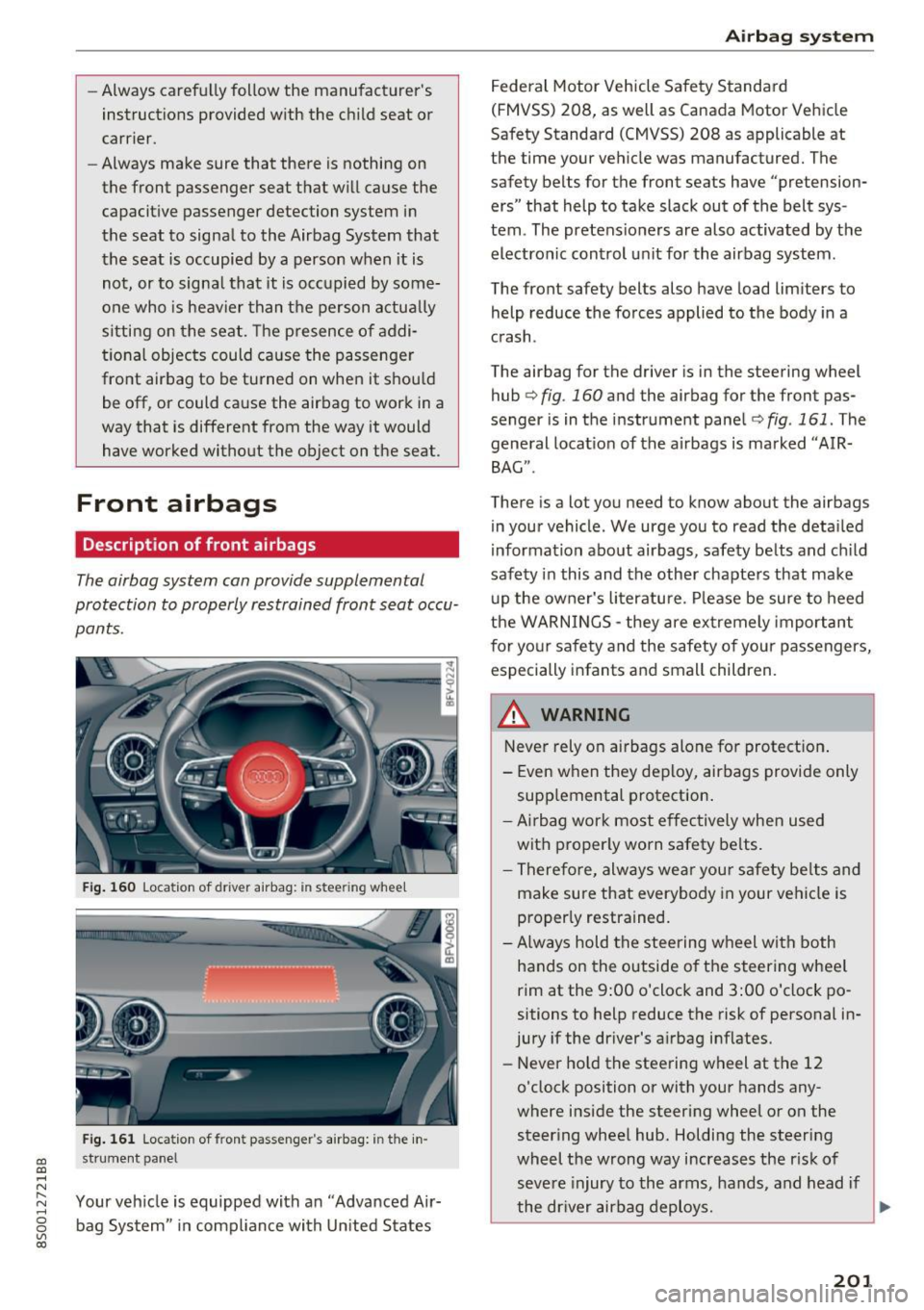
The airbag for the driver is in the steering wheel
hub ¢
fig. 160 and the airbag for the front pas
senger is in the instrument panel¢
fig . 161. The
general locat io n of the a irbags is marked "AIR
BAG" .
There is a lot you need to know about the airbags
in you r vehicle. We urge you to read the deta iled
information about airbags, safety be lts and c hild
safety in this and the other chapte rs that make
u p the ow ner's literature. Please be sure to heed
the WARNINGS - they are ex tremely important
for yo ur safety and the safety of your passengers,
especially infants and small children.
A WARNING
-
Never rely on airbags alone fo r protect ion .
- Even when they deploy, airbags provide only
supp lemental protection .
- Ai rbag work most effectively when used
with proper ly worn safety be lts.
- T herefo re, always we ar you r safe ty be lts and
make sure that everybody in your vehicle is
proper ly restrained.
- Always hold the stee ring w heel with both
hands on the outside o f the steering wheel
rim at the 9 :00 o'clock and 3:00 o'clock po
sitions to help reduce the risk of personal in
jury if the driver's a irbag inflates.
- Never ho ld the steering wheel at the 12
o'clock position or with your hands any
where inside the steering wheel o r on the
steer ing whee l hub. Holding the steering
wheel the wrong way increases the r is k of
seve re injury to the arms, hands, and head if
the dr iver airbag deploys.
~
201
Page 205 of 322
passenger side and very small adults on the driv
er side. The low risk deployment criteria are in
tended to help reduce the risk of injury through interaction with the front airbag that can occur,
for example, by being too close to the steer ing
wheel and instrument panel when the a irbag in
flates .
In addition, the system has been certified to
comply w ith the "suppression" requirements of
the Safety Standard, to turn off the front a irbag
for infants 12 months old and younger who are
restrained on the front passenger seat in child re
stra ints that a re listed in the Standa rd
q page 223, Child restraints and Advanced front
airbag system .
"Suppression" requ ires the front a irbag on the
passenger side to be turned off if:
- a ch ild up to about one year of age is restra ined
on the front passenger seat i n one of the rear
facing or forward-fac ing infant restra ints listed
in Federal Motor Vehicle Safety Standard 208
with wh ic h t he Advanced Airbag System in your
vehicle was certified . For a listing of the ch ild
restraints that were used to certify your vehi
cle's comp liance with the US Safety Standard
q page 223,
-When a person is detected on the front passen
ger seat that has an electrical capacitance that
is more than the tota l electrical capac itance of
a ch ild that is about 1 year old restra ined in one
of the rear-facing or forward-facing infant re
straints (listed in Federal Motor Veh icle Safety
Sta ndard 208 w ith wh ich the Advanced A irbag
System i n your ve hicle was certified), the front
airbag o n the passenge r side may o r may not
deploy.
The
PA SSENGER AIR BAG OFF~; light comes on
when the e lectron ic cont rol u nit detects a total
e lectrical capacitan ce on the front passenger seat
that requ ires the fron t ai rbag to be turned off. If
the
PASSENGER AIR BAG OFF~; light does not
come on, the front ai rbag on the passenger side
has not been turned off by the control unit and
~ can dep loy if the control unit senses an impact
;:::: that meets the conditions stored in its memory.
" N ...... 0
0
Vl c:o
Airb ag sys tem
If the total e lectr ica l capacitance reg istered on
the front passenger seat is more than that of a
typ ica l 1 year -o ld, but less than the weight of a
small adult, the front a irbag on the passenger
s ide may deploy (the
PASSEN GER AIR BA G OFF
~; light does not come on) .
For example, the airbag may deploy if :
-a small ch ild that is heav ier than a typica l 1
year -o ld child is on the front passenger seat
(regardless of whethe r the child is in one of the
child seats listed
¢ page 223),
- a child who has outgrown c hild restraints is on
the front passenge r seat .
If the front passenge r a irb ag is t urned off, the
PASSENGER AIR BAG OFF~; light in the head
liner wi ll come on and stay on .
If the front passenge r a irbag deploys, the Feder
al S tanda rd requi res the ai rbag to meet the "low
risk" deployment cri teria to he lp red uce the r isk
of inj ury through interaction with the airbag .
" Low risk" deployment occurs in those cras hes
that take p lace at lower decelerations as defined
in the electronic contro l unit
q page 209.
Always remember: Even tho ugh yo ur vehicle is
equipped with Advanced Airbags, the safest place
for children is properly restrained on the back
seat. Please be sure to read the important infor
mation in the sections that follow and be sure to
heed all of the WARNINGS .
A WARNING
To reduce the risk of injury when an airbag in
f lates, always wea r safety be lts prope rly.
- If you are u nrestra ined, leaning forward, si t
ting sideways or ou t of position in any way,
your r is k of injury is much highe r.
- You will a lso receive ser ious injuries and
could even be killed if yo u are up agains t the
a ir bag or too close to i t whe n it in flates -
even with an Advan ced Airb ag
Qpage 197.
203
Page 207 of 322

co
co
.... N
" N .... 0
0
Vl c:o
control unit "decides" whether to fire the front
airbags based on the information received from
the crash sensors. The control unit also "de
cides" whether the safety be lt pretensioners
shou ld be activated.
- An Advanced Airbag with gas generator for the
driver inside the steering wheel hub.
- An Advanced Airbag with gas generator inside
the instrument panel for the front passenger.
- A capacitive passenger detection system under
neath the front passenger seat cover. This sys
tem measures the electrical capacitance of the
person in the seat. The information registered
is sent continuously to the electronic control
unit to regulate deployment of the front Ad
vanced Airbag on the passenger side.
- An airbag monitoring system and indicator
light
El in the instrument cluster.
- A sensor in each front seat registers the dis
tance between the respective seat and the
steering wheel or instrument panel. The infor
mation registered is sent continuously to the
electronic control unit to regulate deployment
of the front Adv a need Airbags.
- The
PASSENGER AIR BAG OFF~; light comes
on and stays on in the headliner¢
page 209,
fig. 163 and tells you when the front Advanced
Airbag on the passenger side has been turned
off.
-A sensor in the safety belt latch for the driver
and for the front seat passenger that senses
whether that safety belt is latched or not and
transm its this information to the electronic
contro l unit.
A WARNING
Damage to the front passenger seat can pre
vent the front airbag from working properly.
- Improper repair or disassembly of the front
passenger and driver seat will prevent the
Advanced Airbag System from functioning properly.
- Repairs to the front passenger seat must be
performed by qualified and properly trained
workshop personnel.
- Never remove the front passenger or driver
seat from the vehicle.
Airbag system
-Never remove the upholstery from the front
passenger seat.
- Never disassemble or remove parts from the
seat or disconnect wires from it.
- Never carry sharp objects in your pockets or
put them on the seat. The capacitive pas
senger detection mat in the front passenger
seat will not function properly if it is punc
tured.
- Never carry things on your lap or carry ob
jects on the front passenger seat. Such ob
jects can influence the capacitance regis
tered by the capacitive passenger detection
system, so that incorrect information is pro
vided to the airbag control unit.
- Never store items under the front passenger
seat. Parts of the Advanced Airbag System
under the passenger seat could be dam
aged , preventing them and the airbag sys
tem from working properly.
- Never place seat covers or replacement up
holstery that have not been specifically ap
proved by Audi on the front seats.
- Seat covers can prevent the Advanced Air
bag System from recognizing child re
straints or occupants on the front passenger
seat and prevent the side airbag in the seat
backrest from deploying properly.
- If a seat heater has been retrofitted or oth
erwise added to the front passenger seat,
never install any child restraint system on
this seat.
- Never use cushions, pillows, blankets, or
similar items on the front passenger seat.
The additional layers prevent the capacitive
passenger detection system from accurately
measuring the capacitance of the child safe
ty seat and/or the person on the seat and
thus keep the Advanced Airbag System from
working properly.
- Never place or use any electrical device
(such as a laptop, CD player, electronic
games device, power inverter or seat heater
for child seats) on the front passenger seat
if the device is connected to the 12-volt
socket or the cigarette lighter socket. Such
devices can influence the capacitance regis
tered by the capacitive passenger detection
205
Page 209 of 322
More important things to know about front
airbags
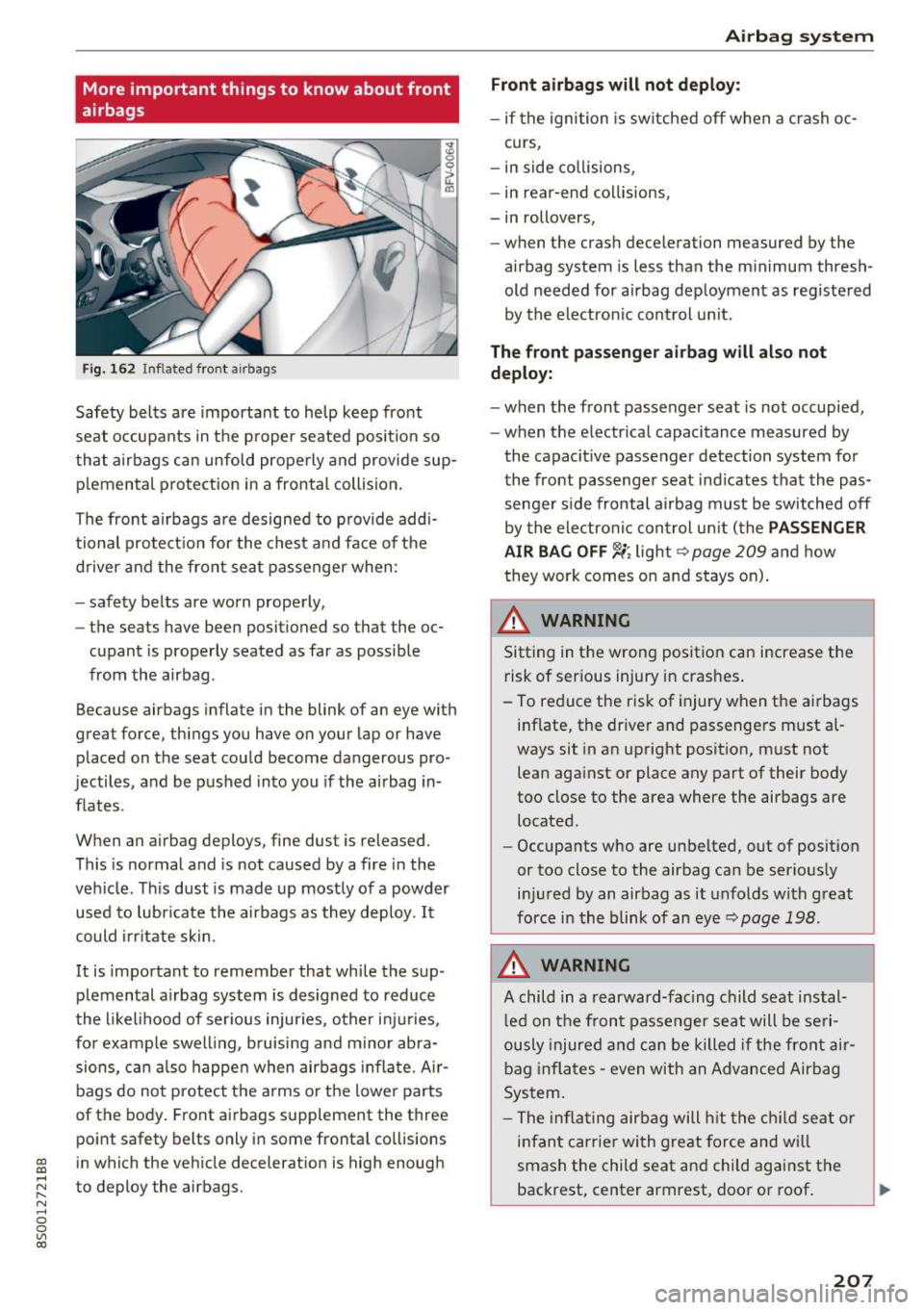
Fig. 162 Inflated front a irbags
Safety bel ts a re important to help keep front
seat occupants in the p roper seated position so
that airbags can unfold properly and provide sup
p lemental protection in a frontal collision.
The front airbags are designed to p rovide addi
tional protect ion for the chest a nd face of the
d river and the front seat passenger when:
- safety belts are worn properly,
- the seats have been positioned so that the oc-
cupant is properly seated as far as possible
from the airbag .
Because airbags inflate in the blink of an eye w ith
great force, things you have on your lap or have placed on the seat cou ld become dangerous pro
jectiles , and be pushed into you if the airbag in
flates .
When an a irbag deploys , fine dust is released.
This is normal and is not caused by a fire in the
veh icle. Th is dust is made up mostly of a powder
used to lubricate the airbags as they deploy . It
could irritate skin.
It is important to remember that while the sup
p lemental a irbag system is designed to reduce
the likel ihood of ser ious injuries, o ther inj uries,
for example swe lling, b ruising and mino r abra
sions, c an a lso happe n when airbags inflate. Ai r
bags do not protect the arms o r the lowe r parts
of the body . Front airbags supplement the three
point safety belts only in some frontal collisions
~ in which the vehicle decelerat ion is high enough ....
~ to deploy the airbags.
N .... 0
0
Ill co
Airb ag sys tem
Front a irbags will not deploy :
-if the ignition is sw itched off when a crash oc-
curs,
- in side co llisions,
- in rear-end col lisions,
- in rollovers,
- when the crash deceleration measured by the
ai rbag system is less than the m inimum thresh
old needed for airbag deployment as registered
by the electron ic con trol un it.
The front pa ssen ger airbag will als o not
deploy:
- when the fron t passenger seat is not occupied,
- when the e lectr ica l capacitance measured by
the capacit ive passenger detection system for
the front passenger seat ind icates that the pas
senger side frontal airbag must be switched off
by the ele ctro nic con trol un it ( the
PASSENGER
AIR BAG OFF
'-i; lights> page 209 and how
they work comes o n and stays on) .
A WARNING
Sitting in the wrong position can increase the
risk of ser ious injury in crashes .
- To reduce the risk of injury when the airbags in flate, the driver and passengers must al
ways sit in an upright posit ion, m ust not
lean aga inst or place any part of their body
too close to the area where the airbags are
located.
- Occupants who are unbelted, out of positio n
or too close to the airbag can be serio usly
i nju red by an airbag as it unfolds with great
force in the blink of an eye~
page 198.
A WARNING
-A child in a rearward-facing child seat ins tal
l ed on the front passenger seat will be se ri
ously injured a nd ca n be killed i f the front air
bag inflates -
even with an Advanced Airbag
System .
- The infla ting airbag will h it the chi ld s eat o r
infant carrier wi th great force and will
smash the child seat and child against the
backrest, center armrest, doo r or roof . .,..
207
Page 210 of 322

Airbag syste m
-Always install rear -facing child seats on the
rear seat.
- If you must install a rearward facing chi ld
seat on the front passenger seat because of
exceptional c ircumstances and the
PA SSEN
G ER AIR BAG OFF ~;
light does not come
on and stay on, immediately install the rear
facing child seat in a rear seating position and have the airbag system inspected by
you r Audi dealer.
_& WARNING
Objects between you and the a irbag w ill in
crease the risk of in jury in a crash by interfer
ing with the way the airbag unfo lds or by be
ing pushed into yo u as the airbag inflates.
-
- Never hold th ings in your hands or on your
lap when the vehicle is in use.
- Never transport items on or in the area of
the front passenger seat . Objects could
move into the area of the front airbags du r
ing brak ing or other sudden maneuver and
become dangerous projectiles that can
cause serious personal injury if the a irbags
inflate.
- Never place or attach accessor ies or other
objects (such as cup holders, te lephone
brackets, large, heavy or bulky objects) on
the doors, over or near the area marked "AIRBAG" on the steering wheel, instru
ment pane l, seat backrests or between
those areas and yourself. These objects could cause injury in a crash, espe cially
when the airbags inflate.
- Never recline the front passenge r's seat to
t ransport objects . Items can also move into
the area of the side airbag or the front air bag during braking or in a sudden maneu
ver. Objects near the airbags can become projectiles and cause injury, particularly
when the seat is reclined .
- Never place or transport objects on the
front passenger seat. Objects on the front passenge r seat could cause the capac itive
sensor in t he seat to signal to airbag system
that the seat is occupied by a person when it in fact is not, or that the person on the seat
208
is heavier than he or she actually is. The
change in electric capacitance because of
such objects can cause the passenger front
airbag to be t urned on when it should be
off, or can cause the airbag to work in a way
that is different from the way it would have
wo rked without objects on the seat.
- Always make sure that there is noth ing o n
the front passenge r seat that will cause the
capacitive passenge r de tection system in
the sea t to signal to the Airbag System tha t
the seat is occup ied by a person when it is
not , or to signal that it is occupied by some
one who is heavier than the person act ually
sitt ing on the seat. The presence of an ob
ject could cause the passenger front airbag
to be turned on when it should be off , or
could cause the airbag to work in a way that is diffe rent from the way it would have
wo rked without the object on the seat.
- Never til t the front passenger seat backrest
forward when the vehicle is mov ing . An in
flating airbag wi ll force t he bac krest back
ward and can injure rear seat occup ants .
_& WARNING
The fine dus t created when airbags deploy can
cause breathing prob lems for people with a
h istory of asthma or other breathing condi
tions.
- To reduce the r isk of breathing problems,
those with asthma o r other respiratory con
ditions sho uld get fresh ai r right away by
getting out of the vehicle or opening win
dows or doors.
- If you are in a co llision in which airbags de
ploy, wash your hands and face with m ild
soap and water before eating.
- Be carefu l not to get the dust into your eyes,
or into any cuts or scratches .
-If the residue shou ld get into your eyes,
flush them w ith water .
Page 212 of 322
Airbag syste m
front seat p assenge r's frontal Advanced Airbag.
Th e PAS SENGER AIR BAG OFF~; light:
-will come o n if the front pa ssenger seat is not
occupied;
- will come on if the e lectr ica l capacitance meas
u red by the c apac itive passenger detec tion sys
tem for the front passenger seat equals the
combined capacitance of an infant up to about
one year of age and one of the rearward-facing
or forward-facing child rest raints listed in Fed
eral Motor Vehicle Safety Standard 208 with
which the Advanced Ai rbag System in your veh i
cle was certif ied; Fo r a listing of the child re
straints that were used to cert ify your vehicle's
compliance with the U .S. Safety Standard
¢ page 223.
-will go out if the front passenger seat is occu
pied by an adult as reg istered by the capacitive
passenger detection system.
- T he
PAS SENG ER AIR BAG OFF~; light must
come on and s tay o n if the ignition is on and . ..
- a car bed has been insta lled on the front pas
senger seat, o r
-a rearward-fac ing ch ild restrai nt has been in
stalled on the front passenger seat , or
- a forward-facing child restra int has bee n in stal
led on the front passenger seat,
- and if the e lectrical capacitance registered on
the front passenger seat is equa l to or less than
the comb ined capac itance of a typical 1 year
o ld infant and one of the rearward-fac ing o r
fo rward -fa cing chi ld restrain ts lis ted in Federal
Motor Veh icle Safety Standard 208 with w hich
the Advanced Airbag System in yo ur vehicle was
certified .
I f the fron t passe nger seat is no t occ upied, the
front ai rbag w ill not dep loy, and the
PASSENGER
AIR BAG OFF~;
light wi ll stay on.
Never i nstall a rearward-facing child rest raint on
t he front passenge r sea t, the safes t place for a
chi ld in any kind of child restraint is at one o f the
seating positions on the rea r seat ¢
page 198,
Child restraints on the front seot -some impor
tant things to know
and ¢ page 221, Child safe
ty .
210
If the PASSENGER AIR BAG OFF~; light
com es on ...
If the PASSENGER AIR BAG OFF~; light comes
on when one of the condit ions listed above is
met, be sure to check the light regularly to make
certain t hat the
PASSENGER AIR BAG OFF~;
light stays on cont inuously whenever the ign ition
i s on . If the
PASSENGER AIR BAG OFF~; light
does not appear on and does not stay on all the
time, stop as soon as it is safe to do so a nd
- reactivate the system by tur ning the ignit ion
off for more than 4 seconds and then tur ning it
on again;
- remove and re install the ch ild restraint. Make
sure that the child restra int is prope rly insta l
led and that the safety belt for the front pas
senge r sea t has bee n corre ct ly rou ted th rough
t he child restraint as desc ribed in the ch ild re
straint man ufact urer's inst ruc tions;
- ma ke sure that the convert ible loc king retr ac
to r on the safety belt for the front passenge r
seat has been activated and that the safety belt has been pulled tight .
- ma ke sure that no e lectrica l device (s uch as a
laptop , CD p layer , e lectronic games device,
power inverte r or seat heater for chi ld seats) is
placed or used on the front passenger seat if
the device is connected to the 12-volt socket or
the c igarette lighter socket;
- make sure that no seat heater has been retro
fitted or otherw ise added to the front passen
ger seat;
- make sure that noth ing can interfere with the
safety belt buckles and that they are not ob
struc ted;
- make sure that there are no wet objects (such
as a wet towe l) and no water or other liquids on
the front passenger seat cushion .
If the PASSENGER AIR BAG OFF~; light still
does not come on ...
If the PASSENGER AIR BAG OFF~; light st ill
does not come on and does not stay on cont in u
ous ly (when the ign ition is switched o n),
- take the child restra int off the front passenger
seat and install it properly at one of the rear
ll-
Page 213 of 322
co
co
.... N
" N .... 0
0
Vl c:o
seat positions. Have the airbag system inspect
ed by your Audi dealer immediately.
- move the chi ld to a rear seat position and make
sure that the child is properly restrained in a
child restraint that is appropriate for its size
and age.
Th e PASSENGER AIR BAG OFF ~ ; light
s h ould NOT com e on ...
The PASS ENGER AI R BAG OFF ~ ; light should
NO T come on when the ignition is on and an
adult is sitting in a proper seating position on the
front passenger seat . If the
P ASS ENGER AIR
BAG OFF ~;
light comes on and stays on while
driving, under these circumstances, make sure
that :
- the adult on the front passenger seat is proper
ly seated on the center of the seat cushion with
his or he r back up aga inst the backrest and the
back rest is not reclined,
- the adult is not tak ing weight off the seat by
ho lding on to the passenger assist handle
above t he front passenger door or supporting
their weight on the a.rm rest,
- the safety belt is be ing properly worn and that
there is not a lot of slack in the safety belt web
bing,
- there are no aftermarket seat covers or cush
ions or other things (such as blankets) on the
front passenger seat that migh t ca use the ca
pacitive passenger detection system to miscal
cu late electrical capacitance .
Important safety instructions on
monitoring the Advanced Airbag System
A WARNING
-If the status of the Adv a need A irbag System
has changed while the vehicle is moving, the
PASSENGER AIR BAG OFF,;; ON @ light
blinks for about 5 seconds to catch the driv
er's attention .
If this happens, always stop
as soon as it is safe to do so and check the
steps described above .
- If the
PASSENGER AIR BAG OFF,;; light
does not go off when an adult who is not
very small is s itting on the front passenger
-
Airb ag sys tem
seat after taking the steps described above,
make sure the adu lt is properly seated and
restrained at one of the rear seating posi
tions . Have the a irbag system inspected by
your author ized Audi dealer before trans
port ing anyone on the front passenger seat.
A WARNING
f-
An a irbag system that is not functioning prop-
e rly cannot prov ide supplemental protect io n
i n a front al crash.
- I f the ai rbag ind icator light
~page 15
comes when the veh icle is being used, have
the system inspected immedia tely by your
authorized Audi dealer . It is possib le that
the airbag will inflate when it is not sup
posed to, or will not inflate when it should.
A WARNING
If the front airbag inflates, a ch ild without a
chi ld restraint, or in a rearward-facing child
safety seat, or in a forward-fac ing child re
stra int that has not been properly insta lled
will be seriously injured and can be killed.
- Even though your vehicle is equipped with
an Advanced A irbag System, make certain
that all children , espec ially 12 years and
younge r, always ride on the back seat p rop
erly rest rained for the ir age and s ize .
- Always install fo rwa rd or rear-facing child
seats on the rea r seat- even w ith an Ad
vanced Ai rbag System .
- I f you must install a rea rwa rd-facing child
seat on the front passenge r seat because of
except ional circumstances a nd the
PASSEN
GER AIR BAG OFF,;,
light does not appea r
and stay on, immediate ly install the rear
facing chi ld seat in a rear seating position
and have the airbag system inspected by
your Aud i dea ler.
- If, in exceptional circumstances, you must
install a forward-facing child restraint on
the front passenger seat, always move the seat into its rearmost position in the seat's
fore and aft ad justment range, as far away
from the a irbag as poss ible . The back rest
m ust be adjusted to an upr ight position .
211