seats AUDI TT COUPE 2017 Owner's Guide
[x] Cancel search | Manufacturer: AUDI, Model Year: 2017, Model line: TT COUPE, Model: AUDI TT COUPE 2017Pages: 322, PDF Size: 79.73 MB
Page 214 of 322
Airbag syste m
Make sure that the PASSENGER AIR BAG
OFF
11;; li ght comes on and stays on all t he
t ime whenever the ignition is switched on.
A WARNING
-
- If the PA SSEN GER AIR BAG OFF 11;; light
does not go out when an adult is si tting on
the front passe nger seat a fter ta king the
steps described above, make sure the adult is p roperly seated and restrained at one of
the rear seating positions.
- Have the airbag system inspected by your
Audi dealer befo re t ransporting anyone on
the front passenger seat.
@ Tips
If the capacitive passenger detection system
determines that the front passenger seat is
empty, the frontal airbag on the passenge r
side w ill be tu rned off, and the
PASSENGER
AIR BAG OFF
11;; light will stay on.
Repair , care and disposal of the airbags
Parts of the a irbag system are installed at many
different places on your Audi. Installing, remov ing, servic ing or repa iring a part in an area of the
ve hicle can damage a part of an airbag system
and prevent that system from working properly
i n a collision .
There are some important things you have to
know to make sure that the effectiveness of the
system w ill not be impaired and that discarded
components do not cause injury or pollute the
env ironment.
A WARNING
Improper care, serv icing and repai r proce
dures can increase the r is k of personal injury
and death by preventing an airbag from de
ploying when needed or dep loying an airbag
unexpectedly:
-
- Never cover, obstruct, or change the stee r
ing wheel horn pad or airbag cover or the in
strument pane l or modify them in any way.
212
- Never attach any objects s uch as c up ho lders
or telephone mountings to the surfaces cov
ering the a irbag un its.
- For cleaning the horn pad or instrument
panel, use only a soft, dry cloth or one mois
tened w ith plain water. Solvents or cleaners
could damage the airbag cover or change
the st iffness or strength of the material so
that the airbag canno t deploy and p rotect
properly.
- Never repair, adjust , or change any parts of
the airbag system.
- All work on the steering wheel, inst rument
panel, front seats or e lectr ica l system ( in
cluding the installation of a udio eq uipment,
cellular telephones and C B radios, etc.)
m ust be perfo rmed by a qualified techn ician
who has the training and specia l equipment
necessary.
- For any work on the airbag system, we strong ly recommend that you see your au
thorized A udi dealer or qualified workshop.
- Never modify the front b umper or parts of
the vehicle body.
- Always make sure that the side a irbag can
inflate w ithout interference:
- Never install seat covers or replacement
upholstery over the front seatbacks that
have not been specifically approved by
A udi.
- Never use additional seat c ushions that
cover the areas where the side airbags in
flate.
- Damage to the orig inal seat cove rs or to
the seam in the area of the s ide airbag
module mus t alway s be repaired immedi
ate ly by an autho riz ed Au di dealer.
- The a irbag system can deploy on ly once. Af
ter an airbag h as been deployed, i t m ust be
repla ced with new replacement parts de
signed and approved espec ia lly for your
Audi model version . Replacement of com
plete airbag systems or airbag components
must be perfo rmed by qua lified workshops
only. Make su re that any airbag service ac
tion is entered in your A udi Warranty
&
Ma intenance boo klet under AIRBAG RE-
PLAC EM EN T RECORD.
~
Page 221 of 322

CD
CD
.... N
" N ...... 0
0
Ill co
below the reference value programmed into the
control unit, the side curtain airbag will not be
tr iggered, even though the car may be bad ly
damaged as a result of the collision. It is not pos
sible to define an airbag triggering range that
will cover every possib le angle of impact, since
the circumstances will vary considerably between one co llision and another. Important factors in
clude, for example, the nature (hard or soft) of
the impacting object, the angle of impact, vehicle speed, etc.¢
page 219, How side curtain air
bags work.
Aside from their normal safety function, safety
be lts work to help keep the d river or fron t pas
senger in posit ion in the event of a co llision so
that the side curtain airbags can provide protec
tion.
The airbag system is not a s ubst itu te for yo ur
safety belt. Rather, it is part of the overa ll occu
pant restraint system in your vehicle. Always re
member that the airbag system can only help to
protect you if you are wearing your safety belt
and wear ing it properly . This is another reason
why you should always wear your safety belts,
not just because the law requires you to do so
¢ page 189, General notes.
It is important to remember that while the side
curtain airbag system is des igned to help reduce
the likelihood of serious injuries, other injuries,
for example, swelli ng, bruising, fr iction burns
and minor abrasions can also be associated with
these airbags upon deployment . Remember too,
these airbags will deploy only once and only in certa in kinds of acc idents - you r safety belts are
always there to offer protection.
The side curtain airbag system basically
consists of:
- T he elec tronic contro l module and external side
impact sensors
- T he side c urtain airbags above the front and
rea r side windows with ejection mitigation fea
tures
- T he airbag indicator light in the instrument
panel
The airbag system is monitored elec tronically to
make certain it is f unct ion ing properly at all
Airb ag sys tem
times. Each time you switch on the ignition, the
airbag system indicator light wi ll come on for a
few seconds (self d iagnostics).
Th e side curtain airbag is not activ ated:
- if the igni tion is sw itched off,
- in side co llisions when the accele ration meas-
ured by the sensor is too low,
- in rear-end co llisions.
A WARNING
- Safety belts an d the airbag system will only
p rovide protect ion when occup ants are in
the proper seat ing position ¢
page 44,
Seats and storage .
- If the airbag ind ic a tor light~ page 15
comes when the veh icle is being used, have
the system inspected immediately by your
authorized Audi dealer . It is possib le that
the airbag will inflate when it is not sup
posed to, or w ill not inf late when it should.
How side curtain airbags work
Side curtain airbags con work together with side
airbags to help reduce the risk of head and upper
torso injuries for occupants who ore properly re
strained.
Fig. 169 Illustration of princip le: Inflated s ide curta in air
bags on the left s ide
The side curtain airbags inflate between the oc
cupant and the windows on the side of the vehi-
cle that is struck in a side collision
¢fig . 169 .
When the system is triggered, the side curtain
airbag is filled with propellant gas and breaks
through a seam above the front and rear side
windows identified by the AIRBAG label. In order
liJ,
219
Page 223 of 322
co
co
.... N
" N .... 0
0
Vl c:o
Child safety
Important information
Introduction
The rear seat is generally the safest place in a
collision .
The physical principles of what happens when
your vehicle is in a crash apply also to children
c:> page 191, What happens to occupants not
wearing safety belts? .
But unlike adults and
teenagers, their muscles and bones are not fully
developed. In many respects children are at
greater r isk of serious injury in crashes than
adults .
Because children's bodies are not fu lly devel
oped, they requ ire restraint systems especially
des igned for their size, we ight, and body struc
ture. Many countr ies and all states of the United
States and provinces of Canada have laws requir
ing the use of approved child restraint systems
for infants and small children .
I n a frontal crash at a speed of 20- 3 5 mph
(30-56 km/h) the forces acting on a 13 lbs (6 kg)
infant will be more than 20 times the weight of
the child . This means the weight of the chi ld
would suddenly be more than 260 lbs (120 kg). Under these conditions, only an appropriate child
restraint properly used can reduce the risk of se
rious injury . Child restraints, l ike adult safety
belts, must be used properly to be effective .
Used imp roperly, they can increase the risk of se
rious injury in an accident.
All ch ildren, especially those 12 years and young
er must always ride in the back seat proper ly re
stra ined for their age and size. If you must install
a child restra int on the front passenger seat in
exceptional circumstances, be sure to read and
heed the important information and warnings
c:> page 198. Infants and other children who are
properly restrained in an appropriate child re
straint that is for their si ze and age can benefit
from the protection that supplemental side air
bags provide in some kinds of crashes.
For more information please see information
provided by the:
Ch ild safety
- National Highway Traffic Safety Administration
(NHTSA), currently at: http :/ /www.safe
rcar.gov (for the USA)
- Transport Canada Information Centre, current-
ly at: http://www.tc .gc.ca (for Canada)
Consult the chi ld safety seat manufacturer's in
structions in order to be sure the seat is right for
yo ur child's size
c:> page 225 , Important safety
instructions for using child safety seats .
Please
be sure to read and heed all of the important in
formation and WARNINGS about child safety,
Advanced Airbags, and the installation of child restra ints in this chapter .
There is a lot you need to know about the Ad
vanced Airbags in your vehicle and how they work
when infants and children in child restraints are on the front passenger seat . Because of the large
amount of important informat ion, we cannot re
peat it all he re . We urge you to read the detailed
information in this owner 's ma nual about airbags
and the Advanced Airbag System in your vehicle and the very important information about trans
porting children on the front passenger seat.
P lease be sure to heed the WARNINGS -they are
extremely important for your safety and the safe
ty of your passengers, especially infants and
small children .
A WARNING
-- Accident statistics have shown that children
are generally safer in the rear seat area than
in the front seat ing pos ition. Always restrain
any child age 12 and under in the rear.
- All vehicle occupants and especially children must be restrained prope rly whenever r iding
in a vehicle. An unrestra ined or improperly
rest rained child cou ld be inju red by striking
the interior or by being ejected from the ve hicle during a sudden maneuver or impact.
An unrestrained or improperly restrained
child is also at greater risk of injury or death
through contact w ith an inflating a irbag.
-A suitable ch ild restraint properly installed
and used at one of the rear seating positions
provides the h ighest degree of protection
for infants and small children in most acci
dent situat ions.
22 1
Page 224 of 322
Child safety
A WARNING
Children on the front seat of any car even with
Advanced Airbags can be seriously injured or
even killed when an airbag inflates. A child in
a rearward-facing child safety seat installed
on the front passenger seat will be seriously
injured and can be killed if the front airbag in
flates.
- The inflating airbag will hit the child safety
seat or infant carrier with great force and
will smash the child safety seat and child
against the backrest, center armrest, or
door.
- Always install rear-facing child safety seats
on the rear seat.
-If you must install a rearward facing child
safety seat on the front passenger seat in
exceptional circumstances and the
PASSEN
GER AIR BAG OFF~;
light does not come
on and stay on, immediately install the rear
facing child safety seat in a rear seating po
sition and have the airbag system inspected
immediately by your Audi dealer.
A WARNING
- Forward-facing child seats installed on the
front passenger seat may interfere with the deployment of the airbag and cause serious
personal injury to the child.
- If exceptional circumstances require the use
of a forward-facing child restraint on the
front passenger's seat, the child's safety and well-being require the following special
precautions to be taken:
- Always make sure that the forward-facing
seat has been designed and certified by its
manufacturer for use on a front passenger
seat with a front and side airbag.
-Always carefully follow the manufacturer's
instructions provided with the child seat
or infant carrier.
- Never install a child restraint without a
properly attached top tether strap if the
child restraint manufacturer's instructions
require the top tether strap to be used.
222
-Never put the forward-facing child re
straint up against or very near the instru
ment panel.
- Always move the front passenger seat to
the highest position in the up and down
adjustment range and move it back to the
rearmost position in the seat's fore and
aft adjustment range, as far away from
the airbag as possible, before installing
the forward-facing child restraint.
-Always make sure that the safety belt up
per anchorage is behind the child restraint
and not next to or in front of the child re
straint so that the safety belt will be prop
erly positioned.
- Always make sure that nothing prevents
the front passenger's seat from being
moved to the rearmost position in its fore
and aft adjustment range.
- Never place objects on the seat (such as a
laptop, CD player, electronic games de
vice, power inverter or seat heater for
child seats). These may influence the elec
trical capacitance measured by the capaci
tive passenger detection system and can
also fly around in an accident and cause
serious personal injury.
- Never place or use any electrical device
(such as a laptop, CD player, electronic
games device, power inverter or seat heat
er for child seats) on the front passenger
seat if the device is connected to the 12-
volt socket or the cigarette lighter socket.
-If a seat heater has been retrofitted or
otherwise added to the front passenger
seat, never install any child restraint sys
tem on this seat.
- Make sure that there are no wet objects
(such as a wet towel) and no water or oth
er liquids on the front passenger seat
cushion.
- Always make sure that the
PASSENGER
AIR BAG OFF~;
light comes on and stays
on all the time whenever the ignition is
switched on.
- If the PASSENGER AIR BAG OFF,;; light
does not come on and stay on, immediate- ly install the forward-facing child seat in a
~
Page 227 of 322
co
co
.... N
" N .... 0
0
Vl c:o
@ Tips
The chi ld seats listed in categories A to C have
been statically tested by Audi only for the Ad
vanced Airbag function .
Important safety instructions for using
child safety seats
Correct use of child safety seats substantially re
duces the risk of injury in an accident!
As the driver, you are responsible for the safety
of everybody in the vehicle, especially children:
~ Always use the right child safety seat for each
child and a lways use it properly~
page 22 7.
~ Always carefully follow the child safety seat
manufacturer's instructions on how to route
the safety belt properly through the child safe
ty seat .
~ When using the vehicle safety be lt to install a
child safety seat , you must first activate the
convertible locking retractor on the safety be lt
to prevent the child safety seat from moving
~ page 232.
~ Push the child safety seat down w ith your full
weight to get the safety be lt rea lly t ight so that
the seat cannot move forward and sideways more than 1 in (2 .5 cm).
~ Secure unused safety belts on the rear seat
~ page 227.
Always remember: Even though your vehicle is
equipped with an Advanced Airbag system, all
children, especially those 12 years and younger,
should always ride in the back seat properly re
stra ined for their age and size.
_&, WARNING
Not using a ch ild safety seat , using the w rong
child sa fety seat or imp roperly installing a
child restraint increases the risk of serious
personal injury and death.
- All vehicle occupants and especia lly children
must be restrained properly whenever riding
in a vehicle . An unrestrained or improperly
restrained child could be injured by striking
the interior or by being ejected from the ve hicle during a sudden maneuver or impact.
Ch ild safety
An unrestrained or improperly restrained
child is also at greater r isk of injury or death
through contact with an inf lating airbag.
- Commercially available child safety seats
are required to comply with U.S . Federal
Motor Vehicle Safety Standard (FMVSS) 213
(in Canada CMVSS 213) .
- When buying a child restra int, select one
that fits your chi ld and the vehicle.
- Only use child restraint systems that fully
contact the flat portion of the seat cush
ion . The child restraint must not tip or
lean to either side. Audi does not recom
mend using child safety seats that rest on
legs or tube-like frames. They do not pro
vide adequate contact with the seat.
- Always heed all lega l requirements per
ta ining to the insta llation and use of child
safety seats and carefully follow the in
structions provided by the manufacturer
of the seat you are using .
- Never allow children under 4 ft
9 in (57 in/
1.45 m) to wear a normal safety belt . H ow
eve r, the rear seat in the TT Coupe is de
signed to permit children who are between
4 ft 3 in (1.3 m) and 4
ft 9 in (57 in/1.45 m)
tall to use the available three-point lap and
shoulder safety belts.
- Never let more than one child occupy a chi ld
safety seat .
- Never let babies or o lder children ride in a
veh icle while sitting on the lap of another
passenger.
- Holding a child in your arms is never a sub
stitute for a child restraint system .
- The strongest person cou ld not ho ld the
ch ild with the forces that exist in an acci
dent . The child will strike the interior of
the vehicle and can also be struck by the passenger.
- The child and the passenger can also in
jure each other in an accident.
- Never install rear-fac ing child safety seats
or infant car riers on the front passenger
seat. A child w ill be seriously injured and
can be killed when the passenger a irbag in
flates -even with an Advanced Airbag Sys
tem .
225
Page 228 of 322
Child safety
-The inflating airbag will hit the child safety
seat or infant carrier with great force and
will smash the child safety seat and child
against the backrest, center armrest, door
or roof .
- Always install rear-facing child safety seats
or infant carriers on the rear seat .
- Make sure there is enough space in front of
the child in the child seat . If necessary, ad
just the angle and position of the seat in front of the child seat.
- Forward -facing child safety seats installed
on the front passenger's seat can interfere
with the airbag when it inflates and cause serious injury to the child . Always install for
ward-facing child safety seats on the rear
seat.
- If exceptional circumstances require the use
of a forward-facing child restraint on the
front passenger's seat, the child's safety and well-being require that the following
special precautions be taken:
- Make sure the forward-facing seat has
been designed and certified by its manu
facturer for use on a front seat with a pas senger front and side airbag .
- Always carefully follow the manufacturer's
instructions provided with the child safety
seat or carrier .
- Always move the front passenger seat into
the rearmost position of the passenger
seat's fore and aft adjustment range, and
as far away from the airbag as possible be
fore installing the child restraint.
- Always make sure that nothing prevents
the front passenger's seat from being
moved to the rearmost position in its fore
and aft adjustment range .
- Always make sure that the backrest is in
the upright position .
- Never place or use any electrical device
(such as a laptop, CD player, electronic
games device, power inverter or seat heat
er for child seats) on the front passenger
seat if the device is connected to the 12-
volt socket or the cigarette lighter socket.
- If a seat heater has been retrofitted or
otherwise added to the front passenger
226
seat, never install any child restraint sys
tem on this seat.
- Make sure that there are no wet objects
(such as a wet towel) and no water or oth
er liquids on the front passenger seat
cushion.
- Never place objects on the seat (such as a
laptop, CD player, electronic games de
vice, power inverter or seat heater for
child seats) . These may influence the elec
trical capacitance measured by the capaci
tive passenger detection system and can
also fly around in an accident and cause
serious personal injury.
- Always buckle the child safety seat firmly in
place even if a child is not sitting in it. A
loose child safety seat can fly around during
a sudden stop or in a collision .
-Always read and heed all WARNINGS when
ever using a child restrained in a vehicle is
being used
c::!;> page 189, Safety belts,
c::!;> page 197, Airbag system and
c::!;> page 221, Child safety .
A WARNING
To reduce the risk of serious injury, make sure
that the
PASSENGER AIR BAG OFF '-i; light
comes on and stays on whenever a child re
straint is installed on the front passenger seat
and the ignition is switched on.
-Take the child restraint off the front passen
ger seat and install it properly at one of the
rear seat positions if the
PASSENGER AIR
BAG OFF
'-i; light does not stay on .
- Have the airbag system inspected by your
authorized Audi dealer immediately.
Page 229 of 322
CD
CD
.... N
" N .... 0
0
Ill co
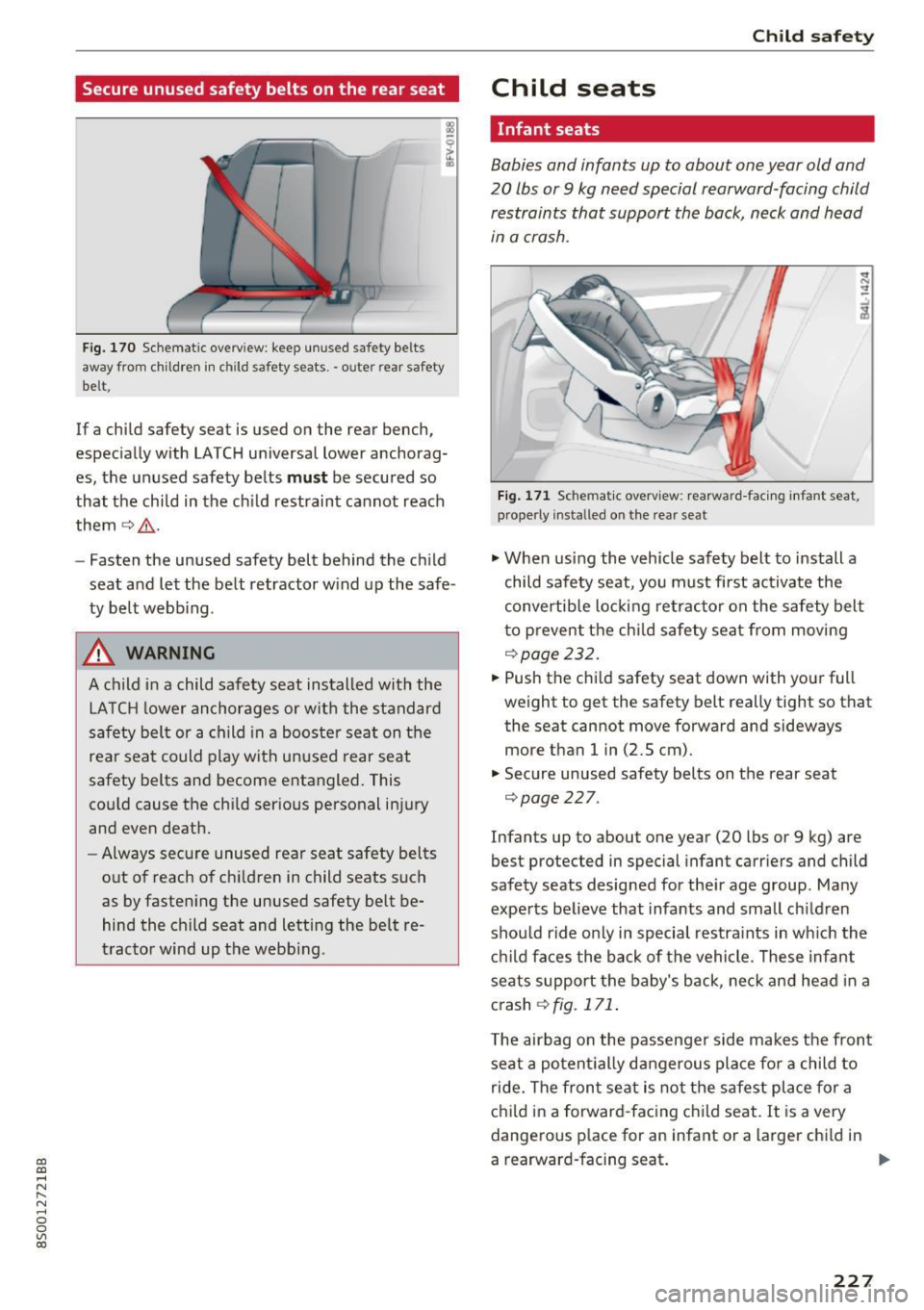
Secure unused safety belts on the rear seat
Fig. 170 Sche matic overview : keep unu sed sa fety belt s
away from c hildre n in c hild safety seats .· outer rear safety
belt,
If a child safety seat is used on the rear bench,
especially with LATCH universal lower anchorag
es, the unused safety belts
mu st be secured so
that the child in the ch ild restraint cannot reach
them 9&, .
- Fasten the unused safety belt behind the child
seat and let the be lt retractor w ind up the safe
ty be lt webbing.
.,&. WARNING
A child in a child safe ty seat ins talled with the
LA TC H l ower anchorages or w ith the standard
safety belt or a ch ild in a booste r seat on the
rear seat could play with u nused rear seat
safety belts and become entangled. This
co uld cause the chi ld serious personal in jury
and even death.
- Always secure unused rear seat safety belts
out of reach of chi ldren in child seats such
as by fastening the unused safety belt be
hind the child seat and letting the belt re·
tractor wind up the webb ing .
Ch ild sa fety
Child seats
Infant seats
Babies and infants up to about one year old and
20 lbs or
9 kg need special rearward -facing child
restraints that support the back , neck and head
in a crash .
Fig . 17 1 Schem atic overv ie w : rearward -fac ing in fan t seat,
p rope rly i nsta lled o n the rea r sea t
.,. When using the vehicle safety belt to install a
child safety seat, yo u must first activate the
convertib le loc king re tractor on the safety belt
to p revent the ch ild safety seat from moving
9 page232 .
.,. Push the ch ild safety seat down with your full
weight to g et the saf ety belt really tight so that
the seat cannot move forward and sideways
more than 1 in (2.5 cm) .
"' Secure unused safety belts on the rear seat
~ page 227.
Infants up to about one yea r (20 lbs or 9 kg) a re
best protected in special infant carr iers and child
safety seats designed for the ir age group. Many
expe rts believe that infants and small ch ild ren
shou ld ride o nly in special restra ints in wh ich the
ch ild fa ces the back of the vehicle. These infant
seats support the baby's back, neck and head in a
crash
~ fig. 171 .
The airbag on the passenge r side makes the front
sea t a potent ially dangerous place for a child to
ride. The fron t seat is not the safest place for a
c h ild in a forward -fac ing ch ild seat. It is a
very
dange rous p lace for an infant or a larger chi ld in
a rearward-fac ing seat . .,..
227
Page 230 of 322
Child safety
_& WARNING
Not using a child safety seat, using the wrong
child safety seat or improperly install ing a
child restra int increases the risk of serious
personal injury and death in a crash.
- Never install rear-facing child safety seats or infant carr iers on the front passenger
seat -
even with an Advanced Airbag System.
A chi ld will be seriously injured and can be
k illed when the inflating airbag hits the
child safety seat or infant carrier with great
force and smashes the child safety seat and
child against the backrest, center armrest,
door or roof
c::> page 198, Child restraints on
the front seat -some important things to
know.
- Always install rear-facing child safety seats
or infant carr iers on the rear seat.
- Never install a rear-facing child restraint in
the forward-facing direction. Such restraints
are designed for the spec ial needs of infants
and
very small children and cannot protect
them properly if the seat is forward-facing.
- If you must install a rearward fac ing ch ild
safety seat on the front passenger seat be
cause of exceptional circumstances and the
PAS SENGER AIR BAG OFF~; light does not
come on and stay on, immed iate ly install
the rear-facing child safety seat in a rear
seat ing position and have the airbag system
inspected by your Audi dealer.
- Never place or use any electrical device (such as a laptop, CD player, electronic
games device, power inverter or seat heater
for child seats) on the front passenger seat
if the device is connected to the 12-volt
socket or the cigarette lighter socket.
- If a seat heater has been retrofitted or oth
erwise added to the front passenger seat,
never install any ch ild restraint system on
th is seat.
- Make sure that there are no wet objects
(such as a wet towel) and no water or other
liquids on the front passenger seat cushion.
- Never place objects on the seat (such as a
laptop, CD player, electronic games dev ice,
power inverter or seat heater for child
228
seats). These may inf luence the electrical
capacitance measured by the capacitive pas
senger detect ion system and can also fly
around in an accident and cause serious per
sonal injury.
-Always read and heed all WARNINGS when
ever using a child restrained in a vehicle is
be ing used
c::> page 189, Safety belts,
c::>page 197, Airbag syste,n
and
c::>page 221, Important information.
Convertible child safety seats
Properly used convertible child safety seats can
help protect toddlers and children over age one who weigh between 20 and 40 lbs (9 and 18 kg)
in a crash.
Fig . 172 Schematic overview: installat ion of the attach
me nts applicable to a LATCH seat
Fig. 173 Schemat ic overv iew: installation of the seat using
the vehicle's safety belt system
.,. When using the vehicle safety belt to install a
child safety seat, you must first activate the
convertible locking retractor on the safety belt
to prevent the child safety seat from moving
c::>page 232 or install the seat using the LATCH
attachments.
.,. Push the child safety seat down wi th yo ur full
weight to get the safety belt rea lly tight so that
Iii>
Page 231 of 322
co
co
.... N
" N .... 0
0
Vl c:o
the seat cannot move forward or sideways more than 1 in (2.5 cm)
¢ page 232.
~ If the child safety seat is equ ipped with a tether
strap, attach it to the tether anchors
¢ page 238.
~ Secure unused safety belts on the rear seat
¢page 227 .
A toddler or child is usually too large for an in
fant restraint if it is more than one year old and
weighs more than 20 lbs (9 kg) .
T oddlers and children who are o lder than one
year up to about 4 years old and weigh more than 20 lbs (9 kg) up to 40 lbs (18 kg) must always be
properly restrained in a ch ild safety seat cert ified
for the ir s ize and weight ¢
fig. 172 and
¢ fig. 173 .
The airbag on the passenger side makes the front
seat a potentially dangerous place for a child to
ride . The front seat is not the safest place for a
chi ld in a fo rward-facing chi ld safety seat. It is a
ve ry dangero us p lace for an infant or a la rger
ch ild in a rearward -facing seat.
_.6 WARNING
-Not using a ch ild safety seat, using the wrong
child safety seat or improper ly installing a
child restraint increases the risk of serious
personal injury and death in a collis ion or oth
er emergency situation.
- Children on the front seat of any car, even
with Advanced Airbags, can be seriously in
jured or even killed when an a irbag inflates.
A ch ild in a rearward-facing child safety seat
installed on the front passenger seat will be
seriously injured and can be killed if the
front airbag inflates - even with an Ad
vanced Airbag System.
- T he inflating a irbag w ill hit the child safety
seat or infant carrier with great force and
will smash the ch ild safety seat and chi ld
against the backrest, center arm rest, door
or roof.
- Always install rear-facing child safety seats
on the rear seat.
- If you must install a rearward facing ch ild
safety seat on the front passenger seat be -
Child safety
cause of exceptional circumstances and the
PASS ENGER AIR BAG OFF~; light does not
come on and stay on, immediately install
the rear-facing child safety seat in a rear
seating position and have the a irbag system
inspected by your Audi dealer.
- The rear side of the ch ild safety seat should
be positioned as close as possible to the
backrest on the veh icle seat.
-Always read and heed all WARNINGS when eve r us ing a child restrained in a vehicle is
be ing used <>
page 189, Safety belts,
<> page 197, Airbag sys tem and
<> page 221, Important information.
_& WARNING
If exceptional c ircumstances req uire the use
of a forward -facing chi ld restraint on the
front passenger's seat, the child's safety and
well-being req uire that the following special
precautions be taken:
- Make sure the forward-fac ing seat has been
des igned and certified by its manufacturer
for use on a front seat with a passenger
front and side airbag.
-Always follow the manufacturer's instruc tions provided with the child safety seat or infant carrier .
- Always move the front passenger seat into
the rearmost pos ition of the passenger
seat's fore and aft adjustment range, and as
far away from the airbag as possible before installing the ch ild rest raint .
- Always make sure that nothing prevents the
front passenger's seat from being moved to
the rea rmost pos ition in its fore and aft ad
justment range.
- Always make sure the backrest is in an up
right position.
- Never p lace or use any electr ica l device
(such as a laptop, CD player, e lectron ic
games device, power inve rter or sea t hea ter
for child seats) on the front passenger seat
if the device is connected to the 12-volt
socket or the cigarette lighter socket. .,,.
229
Page 232 of 322
Child safety
-If a seat heater has been retrof itted or oth
erwise added to the front passenger seat,
never install any child restraint system on
this seat .
- Make sure that there are no wet objects
(such as a wet towe l) and no water or other
liquids on the front passenger seat cushion .
- Never place objects on the seat (such as a
laptop, CD player, electronic games device,
power inverter or seat heater for child
seats) . These may influence the e lectr ica l
capacitan ce measured by the capacitive pas
senger detection system and can also fly
around in an acc ident and ca use serio us pe r
sonal injury .
- Make s ure tha t the
PASSENGER AIR BAG
OFF ~;
light comes on and stays on a ll the
time whenever the ignition is switched on.
- If the PASSENGER AIR BAG OFF 1i; light
does not come on and stay on, immediate ly
insta ll the forward-facing child seat at a
seating position on the rear seat and have
the a irbag system inspected by your author
ized Audi dealer.
- Take the ch ild restraint off the front passen
ger seat and install it properly at one of the
rear seat positions if the
PASSEN GER AIR
BAG OFF ~;
light does not stay on whenever
the ignition is switched on .
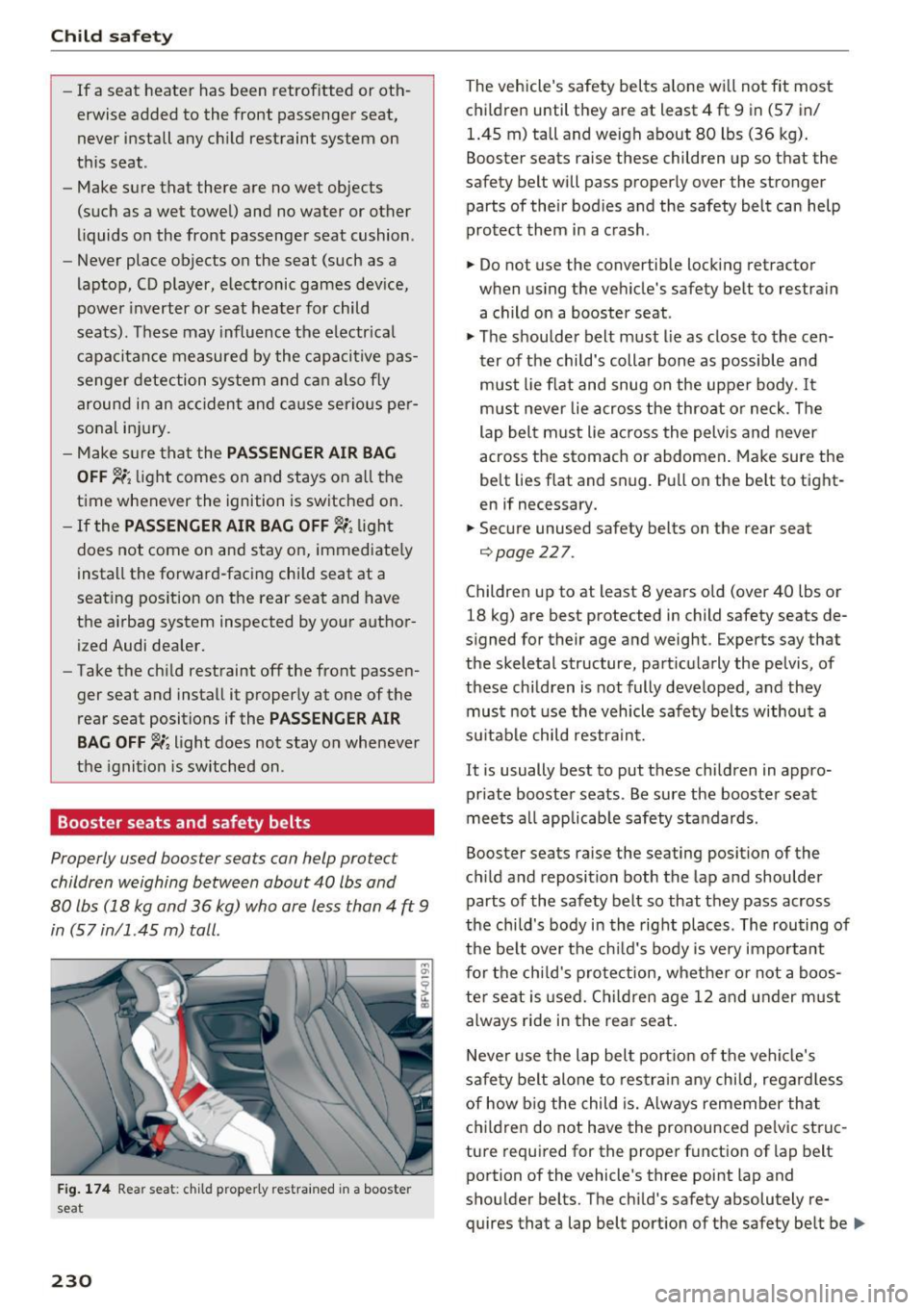
Booster seats and safety belts
Properly used booster sea ts can help protect
children weighing between about 40 lbs and
80 lbs (18 kg and 36 kg) who are less than 4 ft 9
in (57 in/1 .45 m) tall.
F ig . 17 4 Rea r seat: chi ld p roper ly restra ined in a booster
seat
230
The vehicle's safety belts alone wi ll not fit most
children until they are at least 4
ft 9 in (57 in/
1.45 m) tall and weigh about 80 lbs (36 kg) .
Booster seats raise these children up so that the
safety be lt will pass properly over the stronger
parts of their bodies and the safety belt can help
protect them in a crash.
.. Do not use the convertib le locking retractor
when us ing the ve hicle's safety belt to restra in
a child on a booster seat .
.., The shoulder belt must lie as close to the cen
ter of the child's collar bon e as possib le and
must l ie flat and snug on the uppe r body.
It
must never lie across the throat or neck. The
lap belt must lie ac ross the pelvis and never
across t he stomach or abdomen . Make sure the
belt lies flat and snug. Pu ll on the belt to tight
en if necessary.
.. Secure unused safety belts on the rear seat
¢page 227.
Children up to at least 8 years o ld (over 40 lbs or
18 kg) are best protected in child safety seats de
s igned for their age and weight. Experts say that
the skeletal structure, part icu larly the pelvis, of
these children is not fully developed, and they must not use the vehicle safety belts without a
su itab le child restra int.
It is usually best to put these children in appro
pr iate booster seats . Be sure the booster seat
meets a ll applicab le safety standards .
Booster seats raise the seating position of the
c hi ld and reposition both the lap and shoulder
parts of the safety belt so that they pass across
the chi ld's body in the right places . The rou ting of
the be lt over the ch ild's body is very important
fo r the child's protection, whet he r or not a boos
ter seat is used. C hildren age 12 and under m ust
a lways ride in the rear seat.
Never use the lap belt port ion of the vehicle's
safety belt alone to restra in any child, regard less
of how b ig the child is. A lways remember that
c hi ldre n do not have the pronounced pe lvic struc
ture requ ired for the proper function of lap belt
portion of the vehicle 's three point lap and
shou lder belts. The chi ld's safety absolutely re
quires that a lap belt port ion of the safety belt be ...,