light AUDI TT ROADSTER 2008 Owners Manual
[x] Cancel search | Manufacturer: AUDI, Model Year: 2008, Model line: TT ROADSTER, Model: AUDI TT ROADSTER 2008Pages: 316, PDF Size: 70.1 MB
Page 213 of 316
Cleaning and prote ction 1111 -------------------=-----------
•
Leath er care
- Every half year use a n app roved leather care product
(available from your Aud i dealer) to care for the leathe r.
- Ap ply the product very spar ingly .
- Wip e it off wit h a damp cloth .
If yo u have any questi ons a bout clean ing a nd caring fo r the leather
in your vehic le, it is best to contact your authorized Audi dea ler, who
wi ll be glad to help you and tell you about our full range of lea the r
care products, such as:
• Leath er cl eaning and care kit
• Cremes to care for co lored leather
• Spo t re move rs f or bal lp oin t pens, shoe polish , etc.
• Oil/gr eas e disso lving spray
• New and upcoming products.
& WARNING
Always read and heed all WARNING S and the information
=> page 200 .
0 Note
• Never use chemical so lvents (e.g . ligh ter flu id, turpentine),
waxes , shoe polish or simi lar p roduc ts on the leat her surfaces in
your Audi.
• To avoid damage, have stubborn stains removed by a commer
cia l cleaning specialist. •
Applies to veh ic les : w ith Alc a nt ara up holste ry
Cleaning Alcantara ® (synthetic suede)
Removing dust and dirt
- Moist en a cl oth, squeeze out e xcess water an d wip e down
t h e s eat su rfaces.
Removing stains
- Mo iste n a cloth w ith lukewa rm wa ter o r with d iluted
ethyl (rubbing) alcohol.
- Dab at the stain. S tart at the outside and work inwards.
O nce t he st ain is no l ong er visi ble , u se a so ft dry clo th o r
t issue to soak up th e mois ture .
Do n ot use lea ther cleaning products on A lcantara.
You may use a su itab le shampoo for remov ing dust and dirt.
Dust and grit in the por es and seams can scratch and damag e th e
s u rface . If the car is left stand ing in the sun for long peri ods, the
leather should be protected against direct sun light to prevent it
from fading. S light color var ia tions will develop in nor mal use and
are not an indication of materia l deterioration .
0 Note
• Never use chemical solvents (e .g. lighter fluid , turpentine),
waxes, shoe polish or similar products on Alcantara ® surfaces.
• To avoid damage , have stubborn stains removed by a commer
cia l cleaning specialist .
• Do no t use brushes, stiff sponges or similarly abrasive c leaning
ai ds. •
Vehicle care I t •
Page 214 of 316
-Cleaning and prot
ection
-~--------------
Safety belts
Only well-maintained safety belts work reliably when
needed.
H eavily soiled safety be lts may no t retract properly.
- Keep belts c lean.
- For clean ing, use a mild soa p an d wa ter so luti on. Let
belts dry thoroughly and away from d irect sunlight.
- D o not allo w inertia reel safe ty belts to retra ct before
they are com pletely dry .
- Check the condition of your safety belts
regularly .
& WARNING
Damaged safety belt s can break in a crash .
• Anything that might damage your safety belts could mean that
y ou and yo ur pas senger s would not be adequatel y prote cted in an
accident .
• Safety belt performance depend s on correct in stallation . Never
remove belt s from the vehicle to clean them.
• Do not u se chemi cal cleaning agents , blea ch or dyes . They h ave
c orrosive propertie s wh ich weaken the webbing.
• When cleaning your safety belts , in spect them for dam age . If
you discover damage, see your Audi dealer .
• Alway s read and heed all WARNINGS and the infor mation
=> page 200 . •
Engine compartment
Be es pecially caref ul when cle aning the engine compart
ment.
Alwa ys swit ch off the ignition before cle aning the engine => & .
Plenum pan el
Remove leaves from the plenum pane l in front of the w indshield
under the engine hood. This prevents the water drain holes from
becoming blocked, and it prevents debris from entering the vehicle
inter ior through the heating and ventilation ducts.
Corrosion protection
The engine compartment and transmission have been corrosion
pro tected at the factory.
Good anti -co rros io n treatment is very important, particularly in the
winter. If the vehicle is frequent ly driven on salt treated roads, the
enti re eng ine compartmen t and p lenum panel should be thor
oughly cleaned at the end of winter and retreated to prevent salt
damage . At the same time, the unde rside o f the vehicle shou ld be
washed as we ll.
I f the engine compartment is cleaned at any time with grease
removing solut ions
ll, or if you have the engine washed, the anti
corrosion treatment is almost a lways removed as well. It is therefore
essential to have a long-lasting corrosio n pro tec tion reapp lied to a ll
surfaces, seams, joints and components in the engine compart
ment .
& WARNING
Be awa re: Th e engine comp artment of any motor vehicle is a
potentially hazardou s area .
• Befo re working in the eng ine compartme nt, be sure to read the
i nformat ion =>
page 212 . .,.
11 Use on ly the correct cleaning so lutions. Never use gasol ine or diesel fuel.
Page 216 of 316
Fue l sup ply and fillin g your fu el tank
Fuel supply and filling your fuel tank
Gasoline
Fuel supply
Using the right fuel helps keep the environment clean and
prevents engine damage.
Fu el r eco mmend ati on
The fuel recommended for your vehicle is unleaded pr em ium grade
gasoline . See also =>
page 291, "Data". Audi recommends using TOP
TIER Detergent Gasoline with a minimum octane rating of 91 AKI (95
RON). For more information on TOP TIER Detergent Gasoline, please
go to the official website (www.toptiergas.coml.
The recommended gasoline octane rating for your engine can a lso
be found on a label located on the ins ide of the fuel filler flap. This
rating may be specified as AKI or RON .
Your vehicle may also be operated us ing un leaded regu lar gasoline
with a minimum octane rating of 87 AKl/91 RON. However, using 87
AKl/91 RON octane fuel will slight ly reduce engine performance .
Use u nlea d ed ga solin e only. Unleaded gasoline is available
throughout the USA, Canada, and in most European countries . We
recommend that you do not take your vehicle to areas or countries
where unleaded gasoline may not be available.
For more information on refueling your vehicle, see=>
page 215 .
O ctane ra tin g
Octane rating indicates a gasoline's abil ity to resist engine
damaging "knock" caused by premature ignition and detonation.
Therefore, buying the correct grade of gasoline is very important to help prevent possible engine damage and a loss of engine perfor
mance. Gasoline most commonly used in the United States and Canada has
the following octane ratings that can usual ly be found on the filler
pump:
• Premium Grade: 91 -96 AKI
• Regular Grade : 87 -90 AKI
Explanation of the abbreviations:
AKI = Anti Knock Index= (R +Ml/2 = (RON +MON)/2
RON= Research Octane Number
MON = M otor Octane Number .
0 Note
• Do not use any fuel with octane ratings lower than 87 AK I or 91
RON otherwise expensive engine damage will occur .
• Do
not use leaded gaso line! The use of leaded gasoline will
severely damage your vehic le's cata lytic converter and its abi lity to
contro l exhaust emissions. •
Blended gasoline
Use o f gaso line containin g alco ho l o r MTB E (met hy l
t e rt iary butyl e th er)
You may use unleaded gaso line blended with alcohol or MTBE
(common ly referred to as oxygenates) if the blended mixture meets
t he fo llowing criteria:
Bl end of g asoline m eth anol (wood alcoho l or methyl al coh ol)
• Anti-knock index must be 87 AKI or higher.
• Blend must contain no more than 3% methanol.
• Blend must contain more than 2% co-so lvents.
Page 221 of 316
_____________________________________________ C_h_ e_ c _ k_in -= g_a _ n_d _ f_il _li _n ..;::g =-- ____.ffllll
Checking and filling
Engine hood
Releasing the engine hood
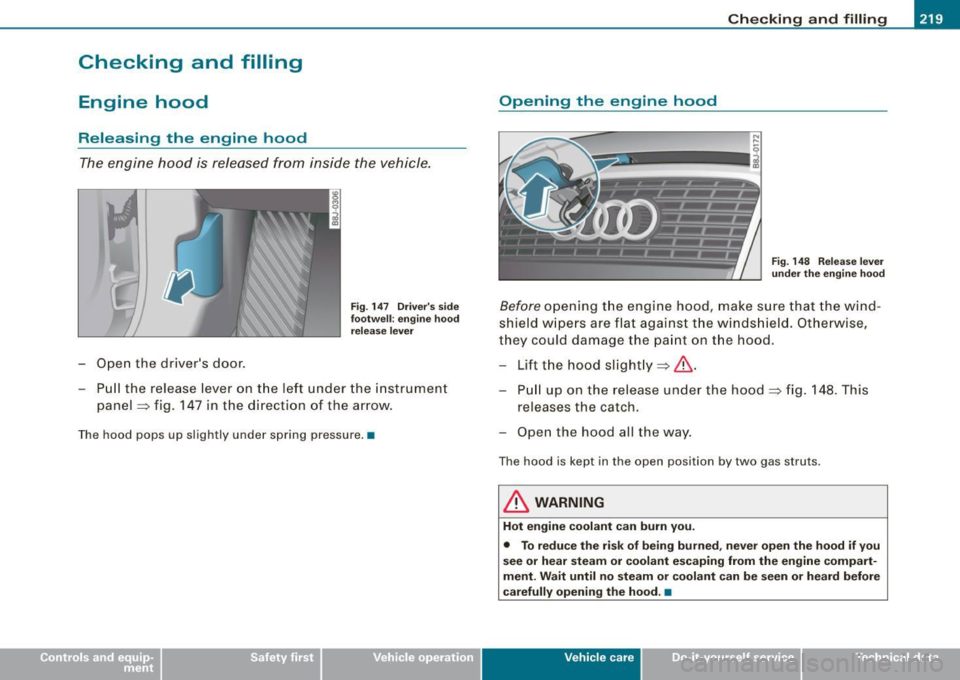
The engine hood is released from inside the vehicle.
- Open the driver's door .
Fig. 147 Driver's side
footwell: engine hood
release lever
- Pull the release lever on the left under the instrument
panel => fig. 147 in the direction of the arrow.
The hood pops up slightly under spring pressure. •
Opening the engine hood
Fig. 148 Release lever
under the engine hood
Before opening the engine hood, make sure that the wind
shield wipers are flat against the windshield. Otherwise,
they could damage the paint on the hood.
Lift the hood slightly =>& .
Pull up on the release under the hood=> fig. 148. This
releases the catch.
- Open the hood all the way.
The hood is kept in the open position by two gas struts.
& WARNING
Hot engine coolant can burn you.
• To reduce the risk of being burned, never open the hood if you
see or hear steam or coolant escaping from the engine compart
ment. Wait until no steam or coolant can be seen or heard before
carefully opening the hood. •
Vehicle care I I irechnical data
Page 224 of 316
-Checking and filling P'll:I ---=---------------
© Jump start points(+) under a cover, ( -) bolt head
© Windshield/headlight washer container ( O ) .. ... .. .
& WARNING
Before you check anything in the engine compartment, always
read and heed all WARNINGS
~ & in "Wo rking in the engine
compartment" on page
220. •
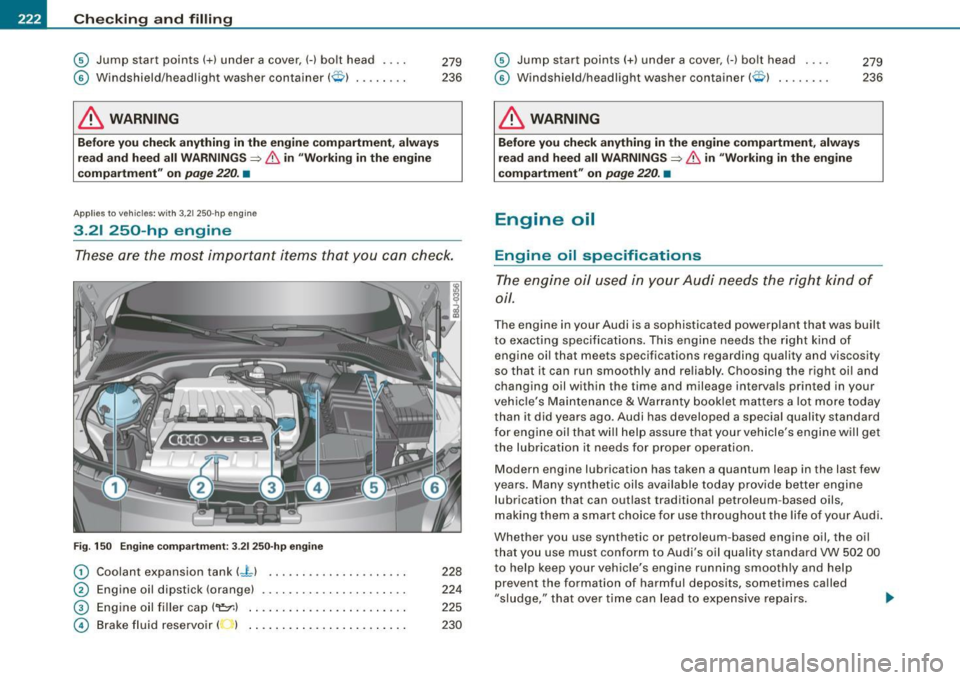
Applies to v ehi cles: with 3,2 1 250 -h p eng in e
3 .21 250 -hp engine
279
236
These are the most important it ems that you can check.
Fig . 150 Engine compartment: 3.21 250-hp engine
G) Coolant expansion tank (J -) ..... ... .. ..... .. ... .
0 Engine oil dipstick (orange) . ... .. ...... ........ . .
© Engine oil filler cap (
228
224
225
230
© Jump start points(+) under a cover,( -) bo lt head ... .
© Windshield/headlight washer container (O ) .. .... . .
& WARNING
Before you check anything in the engine compartment, always
read and heed all WARNINGS
~ & in "Working in the engine
compartment" on page
220. •
Engine oil
Engine oil specifications
279
236
The engine oil used in your Audi needs the right kind of
oil.
The engine in your Audi is a sophisticated powerp lant that was built
to exacting specifications. This engine needs the right kind of
engine oil that meets specifications regarding quality and viscosity
so that it can run smoo thly and re liably. Choosing the right oil and
changing oil wi thin the time and mileage interva ls printed in your
vehic le's Maintenance
& Warranty booklet matters a lot more today
than it did years ago. Audi has developed a special quality standard
for engine oil that will help assure that your vehicle's engine will get
the lubrica tion it needs for proper operation.
Modern engine lubrication has taken a quantum leap in the last few
years. Many synthetic oils available today provide better engine
lubrication that can outlast traditional petroleum -based oils,
making them a smart choice for use throughout the life of your Audi.
Whether you use synthe tic or petro leum-based engine oil, the oil
that you use must conform to Audi's oil quality standard VW 502 00
to help keep your vehicle's engine running smoothly and help prevent the formation of harmful deposits, sometimes called
"sludge,' ' that over time can lead to expensive repairs. •
Page 226 of 316
-L~C~ h~ e~c ~k ~in ~ g~a~ n~d ~ f ~i~ ll ~in ~ g~------------------------------------------
Engine oil consumption
The engine in your vehicle de pen ds on an ade quate
amount of oil to lubric ate and co ol all of its moving parts.
In order to provide effective lubrication and cooling of interna l
engine components, al l internal co mbustion engines consume a
certain amount of oil. Oil consumption varies from engine to engine
and may change sign ificant ly over the life of the engine . Typ ical ly,
engines with a specified break -in period (see=>
page 192) consume
more oil duri ng the brea k-in period than they consume afte r oil
consumption has stabi liz ed.
Unde r no rmal conditions, the rate of oil consumption depends on
the quality and viscosity of t he oil, the RPM ( revo lutions per m inute)
at which the engine is operated, the ambient temperature and road
co nd itions. Further factors are the amount of oi l dilut io n from water
condensation or fue l residue and the oxidation leve l of the oil. As
any e ng ine is subject to wear as mil eage builds up, the o il consump
tion may increase over time until replacement of worn components
may become necessary .
With all these var iables com ing into p lay, no standard rate of oil
consu mption can be es tab lished or speci fied. There is no a lternative
t o regular and frequent checking of the oi l leve l, see Note.
If the yellow engine oi l level warning symbol in the instrumen t
cluster _ lights up, y ou should check the oil level as soon as
possible
with the oil dipstick=> page 224. Top off the oil at your
ea rlies t conve nience =>
page 225.
ln. WARNING
Before you check anything in the engine compartment , alway s
re ad and heed all WARNINGS =>
& in "Working in the engine
c ompartment" on
page 220.
0 Note
D riving with an insufficient o il level is lik ely to cause seve re damage
to the engine .
[ i ] Tips
• The oil pressure warning display 't!:r. is not an indicator of the oil
level. Do not rely on it. Instead , check the oil level in your engine at
regular intervals , preferab ly ea ch time you refuel , and alw ays before
going on a long trip.
• I f you have the impression your engine consumes excessive
a m oun ts o f oi l, we recommend tha t you consu lt your Audi dealer to
have the cause of your concern properly diagnosed . Keep in mind
that the acc urate measure ment o f oil co nsum ptio n requires grea t
care and may take some time . Your Audi dea ler has instructions
about how to measu re oil consump tion accurately. •
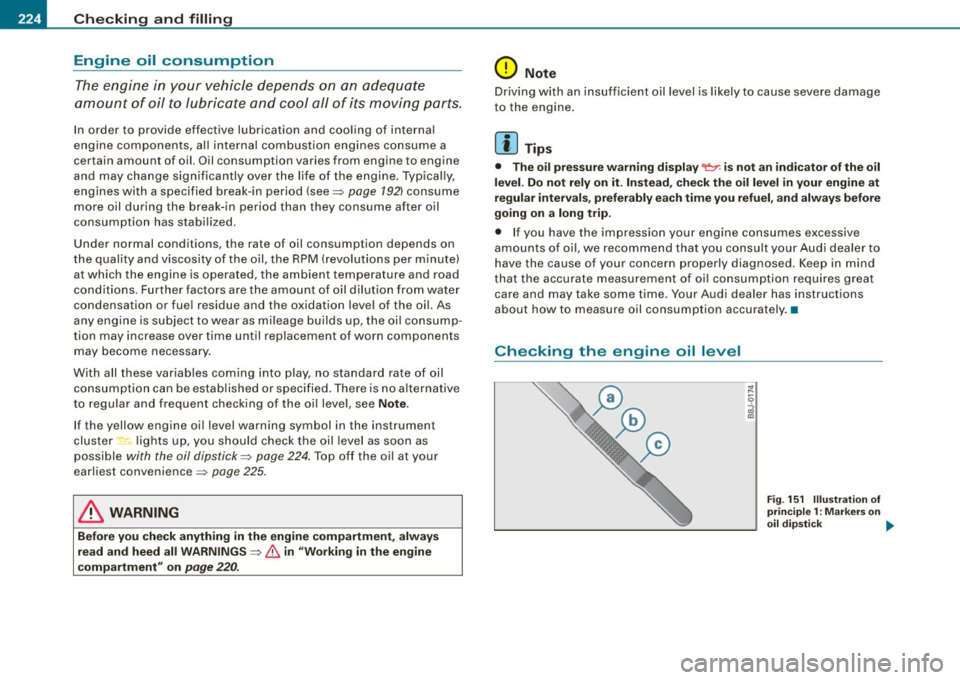
Checking the engine oil level
Fig . 151 Illust rat ion of
principle 1 : Marker s on
oil dip stic k
~
Page 230 of 316
___ C_h_ e_ c_k _in --== g'-- a_n _d_ f_il _li _n ..:::g:::..- ___________________________________________ _
function and performance of your cooling system and could result
in damage not covered by your New Vehicle Limi ted Warranty .•
Checking the engine coolant level
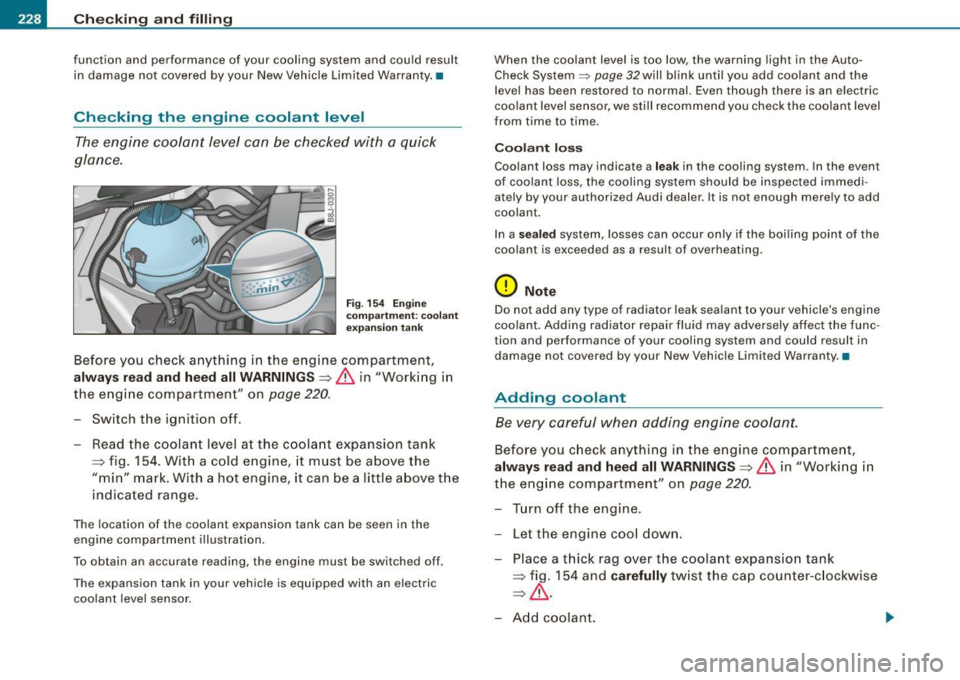
The engine coolant level can be checked with a quick
g lance .
Fig. 154 Engin e
co mpartment : coo lan t
e xpansio n tank
Before you check anything in the engine compartment,
always read and heed all WARNINGS =>
& in "Working in
the engi ne compa rtment" on
page 2 20.
- Switch t he ignition off.
- Rea d the coo lan t leve l at th e co ola nt e xpansion tank
=> fig . 154. Wit h a c old engine , it must be a b ove the
"min" mark . With a hot engine, it can be a little a bove t he
indicated range .
The location of the coo lant expansion tank can be seen in the
engine compartment i llustration.
To obtain an accurate reading, the engine must be switched off .
The expans io n tank in your vehicle is equipped with an electric
coo lant level sensor . When the coolant leve
l is too low , the warning light in the Auto
Check System ~
page 32will blink un til you add coolant and the
level has been restored to normal. Even though there is an electric
coo lant level sensor, we still recommend you check the coolant level
from time to time .
Coolant los s
Coolant loss may indicate a leak in the cooling system . In the event
of coo lant loss, the cooling system should be inspec ted i mmedi
a tely by your authorized Audi dealer . It is no t enough mere ly to add
coolant.
In a
sealed system, losses can occur only if the boi ling point of the
coolant is exceeded as a result of overheating.
0 Note
Do not add any type of radiator leak sea lant to your vehicle's engine
coo lant. A dding ra diator repair fluid may adversely affec t the func
tion and performance of your cooling system and could result in
damage not cove red by your New Veh icle Limi ted War ranty. •
Adding coolant
Be very careful when adding en gine coolant.
Before you c heck anything in the engine compartment,
always read and heed all WARNINGS =>
& in "Working in
the eng ine compa rtment" on
page 220 .
-Turn off the engine.
- Let the engine coo l dow n.
- Place a t hick rag
over th e coola nt expansio n tank
=> fig . 154 and carefully twist the cap cou nter -c lockwise
=> & .
- Add coolant .
Page 231 of 316
___________________________________________ C_ h_e _c_ k_ i_n _g _ a_n _d_ f_il _li _n _g __ ffllll
•
- Twist the cap on again tightly.
Replacement engine coolant must conform to exact specifications
=>
page 227, "Coolant ". If in an emergency coolant additive G12 + is
not avai lab le, do
not use a d ifferen t addit ive. Use p lain water
instead until you can get the correct additive and can restore the
correct ratio . This should be done as soon as possib le .
If you have lost a considerable amoun t of coolant, then you should
add cold antifreeze and cold water only when the engine is cold.
Always use
new engine coolan t when refilling .
Do not fi ll coolant above the "MAX" mark. Excess coo lant will be
forced out through the pressure relief va lve in the cap when t he
engine becomes hot.
& WARNING
• The cooling system is under pres sure a nd can g et very hot.
Reduce the ri sk of scald ing from ho t co olant b y following the se
s tep s.
- Turn off the engine and allow it to cool d own .
- Prote ct your fa ce , hand s and arm s from e scaping fluid and
st eam b y covering the cap with a l arge , thick rag .
- Turn the cap slo wly and very carefully in a count er-c lockw ise
dire ction while applying light , do wnward pres sure on th e top
o f the cap.
- To avoid b eing burned , do not spill antifre eze or coolant on
th e ex haus t syste m or hot e ngine parts . Under cert ain co nd i
tion s, the eth yle ne gly col in en gine co ola nt can cat ch fire .
• Antifr ee ze is poison ous. Alw ay s s tore antifr ee ze in its origi nal
c ontainer and well out of the re ach of children.
• If you dr ain th e coola nt , it mu st be caught and safe ly stored in
a proper contain er cle arly m ark ed "p oison ".
0 Note
• Coolant po llutes the env ironment and could cause an engine
fire . Excess coo lant wil l be forced out through the pressure relief
valve in the cap when the engine becomes ho t.
• I f, in an emergency, only water can be added, the correct ratio
between water and antifreeze=>
page 227must be restored as soon
as possib le .
<£> For the sake of the environment
Drained coolant should not be reused . Always dispose of used
coolant while observi ng all environmental regulations. •
Radiator fan
The radiator fan switches on automatically by itself.
The electric radiator fan is controlled by thermoswitches that switch
on and off depending on coolant and engine compartment temper
atures.
An auxiliary electric radiator fan * switches on and off depending on
coolant temperature and other vehic le operation conditions .
After you switch the eng ine o ff, the aux iliary fan can continue
running for up to 10 minutes -even with the ignition off. It can even
switch on again later by itself=>& , if
• the temperature of the engine coolant rises due to the heat
build -up from the engine in the engine compar tment, or
• the engine compartment heats up because the vehicle is parked
in intense sunlight.
& WARNING
• To reduc e the ri sk of per sonal in jur y nev er t ouch t he radiato r
f a n . .,_
Vehicle care
I t •
Page 232 of 316
___ C_h_ e_ c_k _in --== g'-- a_n _d_ f_il _li _n ..:::g:::..- ___________________________________________ _
& WARNING (continued)
• The auxiliary electric fan is temperature controlled and can
switch on suddenly even when the engine is not running.
• The auxiliary radiator fan switches on automatically when the
engine coolant reaches a certain temperature and will continue to
run until the coolant temperature drops. •
Brake fluid
Checking brake fluid level
The brake fluid level can be checked with a quick glance.
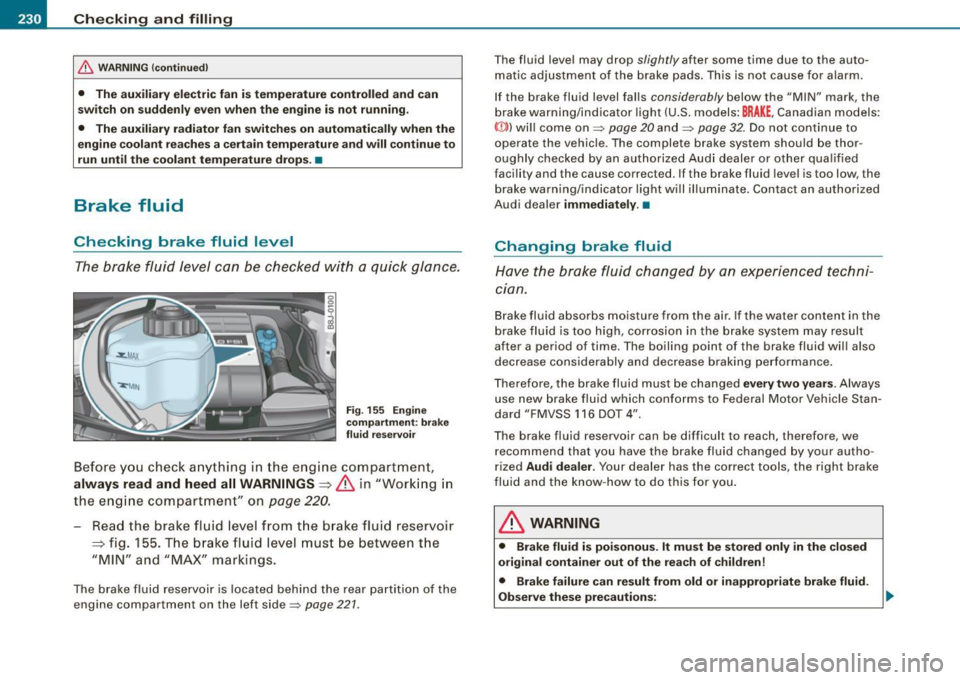
Fig. 155 Engine
compartment: brake
fluid reservoir
Before you check anything in the engine compartment,
always read and heed all WARNINGS =>
& in "Working in
the engine compartment" on
page 220.
- Read the brake fluid level from the brake fluid reservoir
~ fig. 155. The brake fluid level must be between the
"MIN" and "MAX" markings.
The brake fluid reservoir is located behind the rear partition of the
engine compartment on the left side~
page 221 .
The fluid level may drop slightly after some time due to the auto
matic adjustment of the brake pads. This is not cause for alarm.
If the brake fluid level falls
considerably below the "MIN" mark, the
brake warning/indicator light (U .S. models:
BRAKE , Canadian models:
ill) will come on~ page 20 and~ page 32. Do not continue to
operate the vehicle . The complete brake system should be thor
oughly checked by an authorized Audi dealer or other qualified
facility and the cause corrected. If the brake fluid level is too low, the
brake warning/indicator light will illuminate. Contact an authorized
Audi dealer
immediately .•
Changing brake fluid
Have the brake fluid changed by an experienced techni
cian.
Brake fluid absorbs moisture from the air. If the water content in the
brake fluid is too high, corrosion in the brake system may result
after a period of time. The boiling point of the brake fluid will als o
decrease considerably and decrease braking performance.
Therefore, the brake fluid must be changed
every two years. Always
use new brake fluid which conforms to Federal Motor Vehicle Stan
dard "FMVSS 116 DOT 4".
The brake fluid reservoir can be difficult to reach, therefore, we
recommend that you have the brake fluid changed by your autho
rized
Audi dealer . Your dealer has the correct tools, the right brake
fluid and the know -how to do this for you.
& WARNING
• Brake fluid is poisonous. It must be stored only in the closed
original container out of the reach of children!
• Brake failure can result from old or inappropriate brake fluid.
Observe these precautions : .,,_
Page 233 of 316
Checkin g and fillin g ---------------~-!':WIii
•
& WARN ING (co ntinued)
- Use only br ake flu id th at m eet s SAE spec ificati on J 1703 and
c onf orms to F ed eral Motor Vehi cle St and ard 11 6. Always ch ec k
w ith your a uthori zed A ud i de aler to m ake sure you are u sin g
the corre ct brake fluid . Th e co rrect typ e of br ake fluid i s also
indic ate d on the br ake fluid res ervo ir .
- The br ake fluid mu st be ne w. Heavy u se of the br ake s c an
c au se a vapor lo ck if the brake fluid i s left in the s yste m too
long. Thi s ca n seriou sly affe ct the eff iciency of the brake s as
w ell as your safety . This could resu lt in an a ccident .
0 Note
Brake fluid wi ll damage the paint of your vehicle.
t he special too ls required and the necessary expertise, we recom
mend that you have the brake f luid changed by your authorized Audi
dea ler .•
Battery
General information
Your vehicle is equipped with a specia l battery, an AGM battery. This
battery is located in the luggage compartment and must be
replaced with an origina l equipment battery. Under normal oper
ating conditions, the battery is
maintenan ce-free .
Have the battery checked when you take your vehicle in for service.
You a re we ll advised to replace a battery that is olde r th an 5 years .
Disc onn ectin g th e batt ery t erm inal s
Some vehic le functions (power window regulators, for e xample) are
lost if the battery terminals are disconnected. These functions have
to be relearned after the batte ry term inals are connected again. To
prevent this, the battery should only be disconnected from the
vehicle electrical system when abso lutely necessary for repairs.
V ehi cle s not dri ven for long period s
If you are going to le t your vehicle stand for a long t ime a nd not
drive it, you should remember there are electrica l components
which are still functioning and they will draw energy from the
battery and drain it, for examp le, the engine immob ilizer. To prevent
this, you can either charge the battery occasionally to keep it in
good working condition or you can d isconnect the negative cab le
on the battery.
W inter op era ti on
During the winter months, battery capacity tends to decrease as
temperatures drop. This is because more power is a lso consumed
while starting, and the headlights, rear window defogger, etc., are
used more often .
Avoid unnecessary power consumption, particularly in city traffic or
when trave ling on ly shor t distances . Let your au thorized Audi dea ler
check the capacity of the vehicle battery before winter sets in
=>
page 235 . A well charged battery will not on ly prevent start ing
p rob lems when the weather is cold , but wi ll a lso last longer .
Replacing battery
The new battery must h ave the same capacity, voltage (12 volts},
amperage, construction and p lug sea ling, as the origina l battery.
Specifications are l isted on the battery hous ing. Batteries specially
developed by Audi fulfill the ma intenance, output, and safety
requirements.
When installing the battery, make sure the ignition and all electrical consumers are switched off=>
0. .,_
Vehicle care I t •