light AUDI TT ROADSTER 2008 Owners Manual
[x] Cancel search | Manufacturer: AUDI, Model Year: 2008, Model line: TT ROADSTER, Model: AUDI TT ROADSTER 2008Pages: 316, PDF Size: 70.1 MB
Page 235 of 316
__________________________________________ C_ h _ e_c _k _in _ g =- a_ n __ df _i_ lli _n ___ g __ __
•
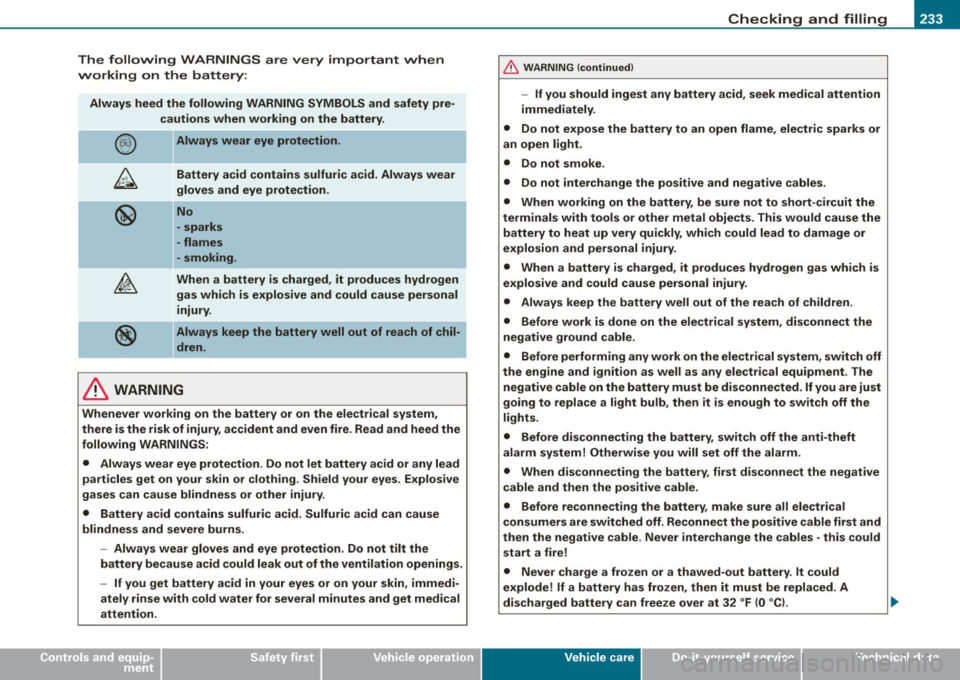
The following WARNINGS are very important when
working on the battery:
Always heed the following WARNING SYMBOLS and safety pre
cautions when working on the battery .
Always wear eye protection.
Battery acid contains sulfuric acid. Always wear
gloves and eye protection.
No
- sparks
- flames
- smoking.
When a battery is charged, it produces hydrogen
gas which is explosive and could cause personal
injury.
Always keep the battery well out of reach of chil
dren.
& WARNING
Whenever working on the battery or on the electrical system,
there is the risk of injury, accident and even fire. Read and heed the
following WARNINGS:
• Always wear eye protection. Do not let battery acid or any lead
particles get on your skin or clothing. Shield your eyes. Explosive
gases can cause blindness or other injury.
• Battery acid contains sulfuric acid. Sulfuric acid can cause
blindness and severe burns.
- Always wear gloves and eye protection. Do not tilt the
battery because acid could leak out of the ventilation openings.
- If you get battery acid in your eyes or on your skin, immedi
ately rinse with cold water for several minutes and get medical
attention.
& WARNING (continued)
-If you should ingest any battery acid, seek medical attention
immediately.
• Do not expose the battery to an open flame, electric sparks or
an open light.
• Do not smoke.
• Do not interchange the positive and negative cables .
• When working on the battery, be sure not to short -circuit the
terminals with tools or other metal objects. This would cause the battery to heat up very quickly, which could lead to damage or
explosion and personal injury.
• When a battery is charged, it produces hydrogen gas which is
explosive and could cause personal injury.
• Always keep the battery well out of the reach of children.
• Before work is done on the electrical system, disconnect the
negative ground cable.
• Before performing any work on the electrical system, switch off
the engine and ignition as well as any electrical equipment. The
negative cable on the battery must be disconnected.
If you are just
going to replace a light bulb, then it is enough to switch off the
lights.
• Before disconnecting the battery, switch off the anti-theft
alarm system! Otherwise you will set off the alarm.
• When disconnecting the battery, first disconnect the negative
cable and then the positive cable.
• Before reconnecting the battery, make sure all electrical
consumers are switched off. Reconnect the positive cable first and
then the negative cable . Never interchange the cables - this could
start a fire!
• Never charge a frozen or a thawed-out battery. It could
explode! If a battery has frozen, then it must be replaced. A
discharged battery can freeze over at 32 °F (0 °CI. .,,_
Vehicle care
I t •
Page 236 of 316
___ C_h_ e_ c_k _in --== g'-- a_n _d_ f_il _li _n ..:::g:::..- ___________________________________________ _
& WARNING (continued)
• Make sure the vent hose is always attached to the opening on
the side of the battery.
• Never use batteries which are damaged. Danger of explosion!
Always replace a damaged battery .
& WARNING
California Proposition 65 Warning :
• Battery posts, terminals and related accessories contain lead
and lead compounds, chemicals known to the State of California
to cause cancer and reproductive problems. Wash hands after
handling .
0 Note
• Do not disconnect the vehicle battery when the ignition is
switched on or when the engine is running, otherwise, you will
damage electronic components in the electrical system.
• When working on the engine, protect the battery housing from
ultraviolet (UV) rays by not parking the vehic le in direct sunlight.
• If your vehicle is going to stand for a long period of time without
being driven , protect the battery from "freezing", otherwise it will
be damaged and will then have to be replaced. •
Checking the battery acid level on magic eye
batteries*
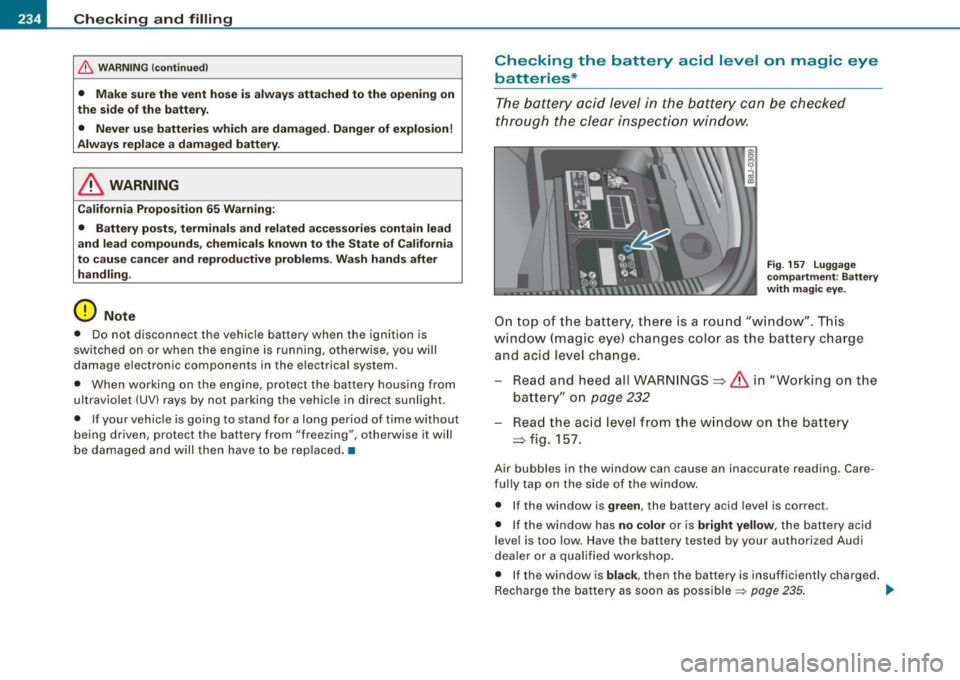
The battery acid level in the battery can be checked
through the clear inspection window.
I
Fig. 157 Luggage
compartment : Battery
with magic eye.
On top of the battery, there is a round "window". This
window (magic eye) changes color as the battery charge
and acid level change.
- Read and heed all WARNINGS=>
& in "Working on the
battery" on
page 232
- Read the acid level from the window on the battery
=> fig. 157.
Air bubbles in the window can cause an inaccurate reading. Care
fully tap on the side of the window.
• If the window is
green, the battery acid level is correct.
• If the window has
no color or is bright yellow, the battery acid
level is too low. Have the battery tested by your authorized Audi
dealer or a qualified workshop.
• If the window is
black , then the battery is insufficiently charged.
Recharge the battery as soon as possible =>
page 235. ...
Page 238 of 316
___ C_h_ e_ c_k _in --== g'-- a_n _d_ f_il _li _n ..:::g:::..- ___________________________________________ _
& WARNING (continued)
• To reduce the danger of explosion, never connect or disconnect
charger cables while the charger is operating.
• Fast charging a battery is dangerous and should only be
attempted by a competent technician with the proper equipment.
• Battery acid that may spill during charging should be washed
off with a solution of warm water and baking soda to neutralize
the acid.
0 Note
Never use a fast charger as a booster to start the engine. This will
seriously damage sensitive electronic components , such as control
units, relays, radio, etc., as well as the battery charger.
[ i ] Tips
The vehicle battery must not be charged with a standard small
charger that plugs into the cigarette lighter or outlet .•
Windshield /headlight washer
container
Using plain water is not adequate for filling the wind
shield washer system and the headlight washer system*.
Fig . 159 Fender, left:
Windshield washer
fluid reservoir
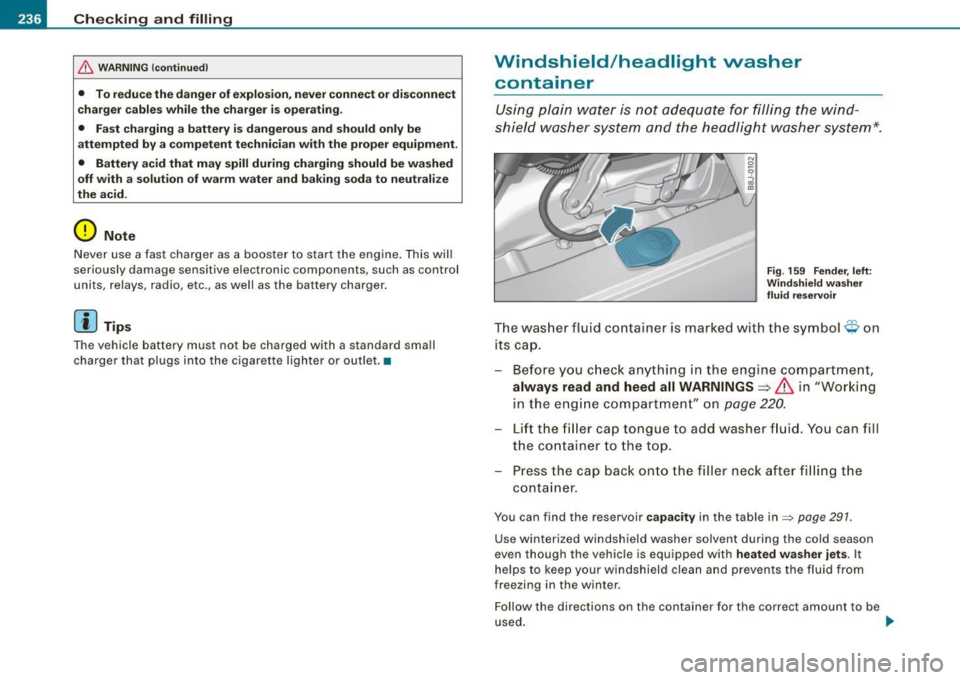
The washer fluid container is marked with the symbol e.;. on
its cap.
- Before you check anything in the engine compartment,
always read and heed all WARNINGS=> & in "Working
in the engine compartment" on
page 220.
-Lift the filler cap tongue to add washer fluid. You can fill
the container to the top.
- Press the cap back onto the filler neck after filling the
container .
You can find the reservoir capacity in the table in~ page 291.
Use winterized windshield washer solvent during the cold season
even though the vehicle is equipped with heated washer jets. It
helps to keep your windshield clean and prevents the fluid from
freezing in the winter.
Follow the directions on the container for the correct amount to be
used.
~
Page 245 of 316
__________________________________________________ T_ ir_e_ s_ a_ n_d _ w_ h_ e_ e_l_s __ __
•
ating the vehicle at ma ximum load , you must increase the t ire pre s
sures to those specified for maximum vehi cle load
~ & .
Bear in mind that the t ire pressure mo nitoring system can only
monitor the tire pressures you have stored . The system does not
reco gnize the load cond itio n of your vehicle.
T he effectiveness of the tire pressure monitoring system will be
impaire d if you stor e nor mal loa d pressures but then operate the
vehic le at its maximum load~&. See the
illustration~ page 242, fig. 160 for the location of the label
on driver's si de B -pillar (co lor of the ac tual label a nd exact loca tion
on the veh ic le will vary slightly).
N ote that the following tab le is accu rate at the time of going to
press and is subject to cha nge . In t he event o f discrepancies, the t ire
pressure label (on driver's side B -pillar) a lways takes precedence .
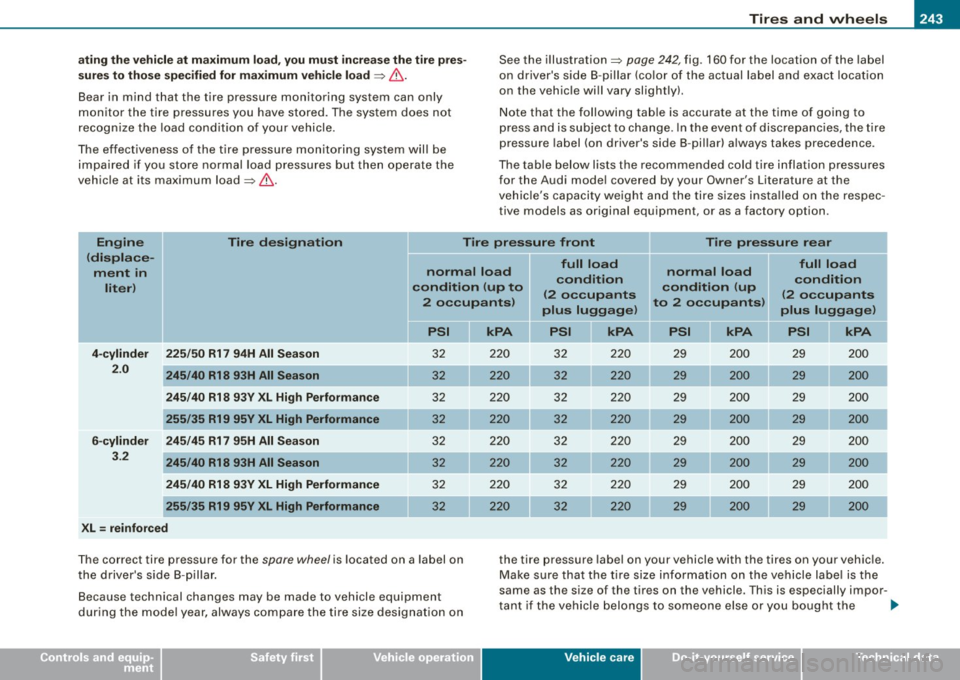
The table belo w lists t he r ecom mend ed cold tire i nflatio n pressures
for the Audi mode l covered by your Owner's Literature at the
vehic le' s capacity weigh t and the tire size s insta lled o n the respec
tive models as original equipment , or as a factory option .
Engine Tire designation
Tire pressure front II Tire pressure rear
(displace -
= " full load full load
ment in normal load
condition normal
load
condition
liter ) condition
(up to condition (up
( 2 oc cupants (2 occupants
2 o ccupants ) to 2 occupants)
plus luggage) plus luggage)
I
PSI II kPA PSI II kPA II PSI II kPA
PSI I[ kPA I
I
4-cylinder
225/50 R17 94H All Season 32 220 3 2 220 29 200 29 200
2.0
245/40 R18 93H All Season 32 220 32 220 29 200 29 200
245 /40 R18 93Y XL High Performance 32 220 32 220 29 200 29 200
255 /35 R19 95Y XL High Performance 32 220 32 220 29 200 29 200
6 -cylinder 245/45 R17 95H All Season 3 2 220 32 2 20 29 200 29 2 00
3.2
245/40 R18 93H All Season 32 220 32 220 29 200 29 200
245 /40 R18 93V XL High Performance 32 220 3 2 220 29 200 29 200
255/35 R19 95V XL High Performance 32 2 20 32 220 29 200 29 200
XL = reinforced
T he correct tire pressure for the spare wheel is located on a label on the tire p ressure label on your vehicle with the tires on your vehic le.
t he d river's s ide B -pilla r. Make sure that the tire s ize inf ormat ion on t he veh icle labe l is t he
Because technical changes may be made to vehicle equipment same as the si
ze of the tires on the vehicle. This is especially impor -
t ant if the ve hicle belongs to so meo ne else or you bought the
dur ing th e mode l year, always co mpare the tire size designa tion on
Vehicle care
I t •
.,
Page 247 of 316
________________________________________________ T_ i _r_e _s_ a_n_ d_ w_ h_ e_e _ l_s __ _
•
pressure for a trip - even one that you would not consider to be
"long." See=>
page 246, "Tires and vehicle load limits" for more
important information .
Always use an accurate tire pressure gauge when checking and adjus ting inflation pressures . Check all of the tires and be sure not
to forget the spare tire . If the pressure in any tire is too high when
the tire is "cold," let air out of the tire slowly with the edge of the tire gaug e and keep checking the pressur e until you reach the pressure
that is correct for the load (passengers and luggage) and kind of driving you plan to do.
I f the pressure in any tire is too low, note the difference between the
pressure in the cold tire and the pressure you need and add the air
that you need to reach the correct pressure for the vehicle load
(passengers and luggage) for the tires on your vehicle as listed on
the on your vehicle and in this manual and the kind of driving you
plan to do.
Ne ver e xceed the m aximum inflat ion pre ssure l isted on the tire
sid ewall for any rea son .
Remember that the veh ic le manufacturer, not the tire manufacturer ,
determin es the correct tire pressure for the tires on your vehicle .
It is important to check the tire pressure when the tires are cold .
• Read the required tire pressure from the tire pressure label
located on driver 's side 8 -pillar.
• T urn the va lve stem cap counter -clockwise to remove it from the
tire valve .
• Place the air pressure gauge on the valve .
• The tire pressures should only be checked and adjusted when
the tires are cold. The s lightly raised pressures of warm tir es mus t
not be reduced.
• Adjust the tire pressure to the load you are carrying .
• Reinstall the va lve stem cap on the valve .
When should I ch eck the tir e pr essu re?
The correct tire pressure is especially important a t high speeds . The
pressure should therefore be checked a t least once a month and
a lways before sta rting a journey.
Wh en sho uld I adjust the tire p re ss ure s?
Adjust the tire pressure to the load yo u are carrying . After changing
a wheel
o r replacing wheels you have to adjust the tire pressures on
a ll whee ls . In addition, you must then initia lize the new tire pres
sures in the tire pressure monitoring system=>
page 41.
& WARNING
Incorre ct t ir e pre ssures and /or underinfl ati on ca n lead sudden tire
failure , los s of contro l, colli sion , seriou s per sonal injury or even
death .
• Whe n the w arnin g sy mbol appear s in the instrument
cl uster , sto p and in spe ct the tire s.
• Inco rre ct tire pre ssure and /or underin flati on can cau se
in creased tire wear and can affe ct the ha ndling of the vehicle and
s topping ability.
• Incorre ct t ire pre ssures and /or underinfl atio n c an a ls o le ad to
s udden tire f ailure , including a blowout and sudden deflation ,
ca usi ng loss o f vehi cle co ntrol.
• The driv er i s re sp o nsible for the correct tire p re ss ure s for all
tire s on the vehicle . T he appl icable pre ssure v alu es are lo ca ted o n
a stic ker on th e driver 's side B -pillar.
• Onl y w hen all tire s on th e veh icle a re fi lled to the corre ct pre s
s ure , the tire pre ssure monitor ing sy ste m can work correctly .
• The u se of incorre ct t ire pr essure val ues can lead to accidents
or other d am age. The refo re it is esse ntial th at the dri ver ob serve
the spe cified tire pr essur e value s fo r the t ire s and the correc t pr es
s ures for the function of the tire pr essure monitoring sy stem.
• Always inflate t ires to the r ecom mended and corre ct tir e pr es -
su re bef ore dri ving off.
~
Vehicle care I t •
Page 261 of 316
________________________________________________ T_ i _r_e _s_ a_n_ d_ w_ h_ e_e _ l_s __ lfll
•
Handling characteristi cs change wh en dri ving with
low air pressure or with flat tires even with special run
flat tires
A low pressure or flat front tire affects vehicle hand lin g charac te ri s
t ics by pulling the vehic le slightly to the side where the tire is
mounted and reduces brak ing performance .
A low pressure or flat
rear tire also affec ts driving c haracteristics by
pul ling to the side where th e tire is mounted and also reduces
b raki ng per for mance . T he ef fec t o n ve hic le han dlin g is most n otice
able when driving around curves .
& WARNING
Changed vehicle handling characteristics when driv ing in the run
flat mode can cause lo ss of vehicle control , a crash and serious
personal injury .
• Driving on special run-flat tires in the run -flat mode will change
vehicle handling characterist ics during braki ng , when cornering
and under heavy acceleration .
• Never drive faster than the max imum rated speed of 50 mph
(80 km /h) when driving in the run -flat mode .
• Always adjust vehicle speed to traffic , road and weather condi
tions and drive slower than the maximum rated speed if nece ssary
weather and road conditions are taken into ac count .
• Always obey speed limits and other traffic laws .
0 Note
We always recommend driv ing with even more care when using
these special tires in the run -flat mode. A lways avoid sudden
m aneuvers. •
Applies to vehic les: with Run-f lat tires
Replacing run -flat tires and rims
Y our vehicle was especi ally des igned to use special run
fl at t ires.
You may use and c ombi ne o nly approved run -flat t ires a nd specia l
matching rims that have been designed for run -flat tires. Mounting
special run -fla t tires o n stan dard wheels w ill not work and wi ll not
provide the advantages fo the run -falt feature. Never us e special
run-flat tir es o n standard whee l rims.
After driving with a tire in the run -f lat mode, always have the vehicle
and affected tire(s) and rim(s) inspected by an a uthorized Audi
dea ler. T ires tha t have been driven i n the run -fla t mode mus t be
replaced.
& WARNING
Use of damaged run-flat tires and rims c an cause vehicle damage
that can lead to loss of vehicle control , a crash and serious
personal injury.
• Always have the vehi cle and affected tire (sl and rim(s )
inspe cted by an authorized Audi dealer after driving a tire in the
run -flat mode .
• Tires that have been driven in the run -flat mode must be
repla ced .•
Vehicle care
I t •
Page 267 of 316
_______________________________________________ W_ h_ a _ t_d_ o_ l _d _o_ n_ o_ w_ ? _ __.1111
- Remove the "max. 50 mph" (80 km/h) sticker from the
sealant bottle and affix it to the instrument cluster in the
driver's view.
& WARNING
• Turn the hazard flashers on and set up the warning triangle if
you have a flat tire in moving traffic . In this way you protect your
self and other road users.
• Make sure that all passengers are in a safe place, out of the
danger zone (for example, behind a guard rail).
0 Note
Particular care is necessary if you are making a tire repair on a steep
incline.
[ i] Tips
Obey all laws. •
Applies to vehicles: with T ire Mobil ity System
Making a tire repair
Tire repair consists of the following sections.
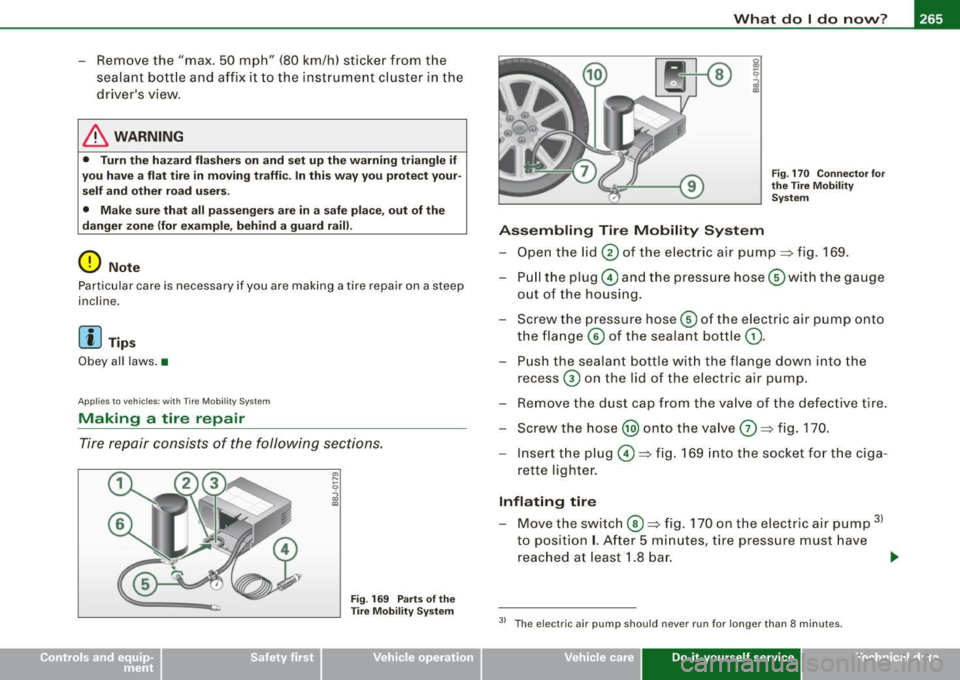
Fig. 169 Parts of the
Tire Mobility System Fig
. 170 Connector for
the Tire Mobility System
Assembling Tire Mobility System
- Open the lid 0 of the electric air pump~ fig. 169.
- Pull the plug© and the pressure hose G)with the gauge
out of the housing.
- Screw the pressure hose© of the electric air pump onto
the flange © of the sealant bottle
G).
- Push the sealant bottle with the flange down into the
recess
G) on the lid of the electric air pump.
- Remove the dust cap from the valve of the defective tire.
- Screw the hose @) onto the valve
G) ~ fig. 170.
- Insert the plug©~ fig. 169 into the socket for the ciga-
rette lighter.
Inflating tire
- Move the switch®~ fig. 170 on the electric air pump 31
to position I. After 5 minutes, tire pressure must have
reached at least 1.8 bar.
~
3> The e lectric air pump should never run for longer than 8 minutes.
Vehicle care Do-it-yourself service irechnical data
Page 268 of 316
11111.___W_ h_ a _ t_d_ o_ l _d _o_ n_ o_ w_ ? ______________________________________________ _
- Switch the electric air pump off - switch in position
0. If
the required tire pressure of at least 1.8 bar has not been
reached, follow the instructions in the section Re
inflating tire.
Re-inflating tire
-Remove the hose from the valve and pull the plug out of
the socket.
- Drive the vehicle slowly 10 meters backward or forward.
This helps to distribute the sealant better.
- Remove the empty inflation bottle and screw the hose
G)
=> page 265, fig. 169 from the electric pump directly onto
the valve.
- Insert the plug ©=>
page 265, fig. 169 into the socket for
the cigarette lighter.
- Move the switch
@ => page 265, fig. 170 on the electric
air pump
31 to position I. After 5 minutes, tire pressure
must have reached at least
1 .8 bar.
- Switch the electric air pump off - switch in position
0. If
the required tire pressure of at least 1.8 bar has not been reached, it is not possible to make a repair with the tire
sealant. Seek professional assistance.
Disassembling Tire Mobility System
- Remove the hose from the valve and pull the plug out of
the socket.
- Screw the dust cap onto the valve.
- Place the empty sealant bottle back in the original pack-
aging and cl ip it in place under the floor so that no tire
sealant can run out into t he vehicle. -
Place the electric air pump in the luggage compartment
for the time being.
- Start driving right away so that the sealant is distributed
in the tire.
& WARNING
• Follow the manufacturer's safety instructions on the decal for
the air pump and the sealant bottle.
• If a tire pressure of 1.8 bar cannot be achieved after pumping
for 5 minutes, the tire is too severely damaged. Do not continue to
drive.
• Seek professional assistance if it is not possible to repair the
tire with the tire sealant.
[ i] Tips
• Do not operate the electric air pump for more than 8 minutes
without stopping, otherwise it can overheat. When the air pump has
cooled down, you can continue to use it.
• If sealant has escaped, allow it to dry, then you can peel it off. •
Applies to vehic les : with Tire Mobil ity Sys tem
Final check
After driving for a short distance , tire pressure
must be checked
- After driving for about 10 minutes, stop and check the
tire pressure .
- If tir e pressure is still at least 1.3 bar, inflate the tire to
specified pressure (see driveas side B -pillarl, drive to the
next repair shop and have the tire and the sealant bottle
replaced.
~
Page 273 of 316
What do I do now? -
----------------
•
-Screw the threaded end of the alignment pin from the
tool kit hand-tight into the now vacant bolt hole
=:> page 270, fig. 177.
- Then completely unscrew the other wheel bolts as
described above.
- Take off the wheel leaving the alignment pin in the bolt
hole.
Putting on the wheel
- Lift the spare wheel and carefully slide it over the align
ment pin to guide it in place.
- Use the hexagonal socket in the screwdriver handle to
screw in and tighten all wheel bolts slightly.
- Unscrew the alignment pin and insert and tighten the
remaining wheel bolt slightly like the rest.
- Turn the jack handle counter -clockwise to lower the
vehicle until the jack is fully released.
- Use the wheel bolt wrench to tighten all wheel bolts
firmly =:> page 268. Tighten them crosswise, from one
bolt to the (approximately) opposite one, to keep the
wheel centered.
[ i J Tips
Never use the hexagonal socket in the handle of the screwdriver to
loosen or tighten the wheel bolts.
• Pull the reversible blade from the screwdriver before you use the
hexagonal socket in the handle to turn the wheel bolts.
• When mounting tires with
unidirectional tread design make sure
the tread pattern is pointed the right way~
page 272.
• The wheel bolts should be clean and easy to turn. Check for dirt
and corrosion on the mating surfaces of both the wheel and the
hub . Remove all dirt from these surfaces before remounting the
wheel. •
Notes on wheel change
Please read the information~ page 249, "New tires and replacing
tires and wheels", if you are going to use a spare tire which is
different from the tires on your vehicle.
After you change a tire:
• Check the tire pressure on the spare immediately after
mounting.
• Have the wheel bolt tightening torque checked with a torque
wrench as soon as possible by your authorized Audi dealer or a qualified service station .
• With steel and alloy wheel rims, the wheel bolts are correctly
tightened at a torque of 90 ft lb (120 Nml.
• If you notice while changing a tire that the wheel bolts are
corroded and difficult to turn, then they should be replaced before
you check the tightening torque.
• Replace the flat tire with a new one and have it installed on your
vehicle as soon as possible. Remount the wheel cover.
Until then, drive with extra care and at reduced speeds.
& WARNING
• If you are going to equip your vehicle with tires or rims which
differ from those which were factory installed, then be sure to read
the information
~ page 249, "New tires and replacing tires and
wheels".
• Always store the tools securely in luggage compartment.
Otherwise, in an accident or sudden maneuver they could fly
forward, causing injury to passengers in the vehicle.
Do-it-yourself service
Page 277 of 316
Fuses and bulbs -
----------------
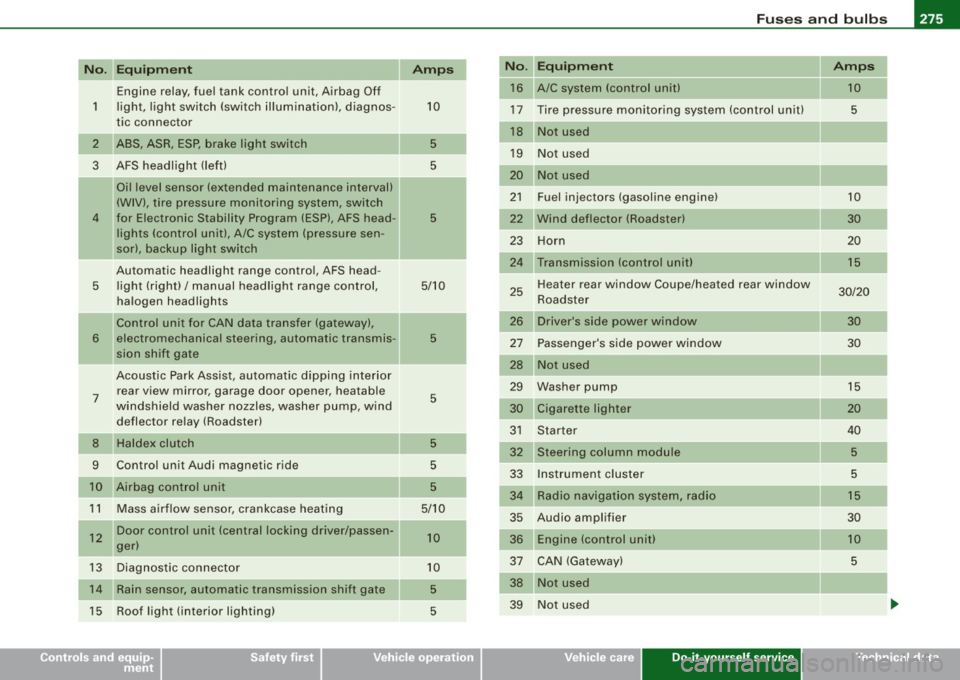
Equipment No. Equipment
Amps
Engine relay, fuel tank control unit, Airbag Off
16 A/C system (control unit) 10
1
light, light switch (switch illumination), diagnos-10
tic connector
17 Tire pressure monitoring system (control unit) 5
18
Not used
ABS, ASR, ESP, brake light switch
5 19
Not used
3 AFS headlight (left) 5
Not used
Oil level sensor (extended maintenance interval)
(WIV), tire pressure monitoring system, switch
21 Fuel injectors (gasoline engine) 10
4 for Electronic Stability Program (ESP), AFS head-5 Wind deflector (Roadster) 30
lights (control unit), A/C system (pressure sen -23 Horn 20 sorl, backup light switch
Automatic headlight range control, AFS head-
24 Transmission (control unit) 15
5
light (right)/ manual headlight range control, 5/10
25 Heater rear window Coupe/heated rear window 30/20
halogen headlights Roadster
Control unit for CAN data transfer (gateway),
26 Driver's side power window 30
6 electromechanical steering, automatic transmis-5
27 Passenger's side power window 30
sion shift gate
28 Not used
Acoustic Park Assist, automatic dipping interior
rear view mirror, garage door opener, heatable
29 Washer pump 15
7
windshield washer nozzles, washer pump, wind 5
30 Cigarette lighter 20
deflector relay (Roadster)
31 Starter 40
8
Haldex clutch 5 32 Steering column module 5
9
Control unit Audi magnetic ride 5 33
Instrument cluster 5
Airbag control unit 5 34 Radio navigation system, radio 15
1 1 Mass airflow sensor, crankcase heating 5/10
35
Audio amplifier 30
12 Door control unit (central locking driver/passen-10
36 Engine (control unit) 10 ger)
13 Diagnostic connector 10 37 CAN (Gateway) 5
Rain sensor, automatic transmission shift gate 5 38 Not used
15 Roof
light (interior lighting) 5 39 Not used
• Do-it
-yourself service