light AUDI TT ROADSTER 2008 Owners Manual
[x] Cancel search | Manufacturer: AUDI, Model Year: 2008, Model line: TT ROADSTER, Model: AUDI TT ROADSTER 2008Pages: 316, PDF Size: 70.1 MB
Page 173 of 316
Child Safety -
--------------------''---
& WARNING
To reduce the risk of serious injury, make sure that the PASSENGER
AIR BAG OFF light comes on and stays on whenever a child restraint is installed on the front passenger seat and the ignition
is switched on.
• Never install a rearward facing child safety seat on the front
passenger seat unless the PASSENGER AIR BAG OFF light comes
on and stays on. If the PASSENGER AIR BAG OFF light does not
come on and stay on the inflating airbag will hit the child safety
seat or infant carrier with great force and will smash the child
safety seat and child against the backrest, door or roof. Have the
airbag system inspected immediately by your Audi dealer.
[ i] Tips
The child seats listed in categories A to C have been tested by Audi
only for the Advanced Airbag function. •
Important safety instructions for
using child safety seats
Correct use of child safety seats substantially reduces the
risk of injury in an accident!
As the driver, you are responsible for the safety of every
body in the vehicle, especially children:
- Always use the right child safety seat for each child and
always use it properly ::::>
page 173.
-Always carefully follow the child safety seat manufac
turer's instructions on how to route the safety belt prop
erly through the child safety seat.
Controls and equip ment Safety first Vehicle operation
-
When using the vehicle safety belt to install a child safety
seat, you must first activate the convertible locking retractor on the safety belt to prevent the child safety
seat from moving ::::>
page 177.
-Push the child safety seat down with your full weight to
get the safety belt really tight so that the seat cannot
move forward or sideways more than one inch (2.5 cml.
Always remember: Even though your vehicle is equipped with an
Advanced Airbag system, a child should always ride in the seat
properly restrained for its age and size.
& WARNING
Not using a child safety seat, using the wrong child safety seat or
improperly installing a child restraint increases the risk of serious
personal injury and death.
• All vehicle occupants and especially children must always be
restrained properly whenever riding in a vehicle.
-An unrestrained or improperly restrained child can be injured
or killed by being thrown against the inside of the vehicle or by
being ejected from it during a sudden maneuver or impact.
- An unrestrained or improperly restrained child is at much
greater risk of injury or death by being struck by an inflating
airbag.
• Commercially available child safety seats are required to
comply with U.S. Federal Motor Vehicle Safety Standard (FMVSS)
213 (in Canada CMVSS 213).
- When buying a child restraint, select one that fits your child
and the vehicle.
- Only use child restraint systems that fully contact the flat
portion of the seat cushion. The child restraint must not tip or
lean to either side. Audi does not recommend using child safety
seats that rest on legs or tube-like frames. They do not provide
adequate contact with the seat. ..
Vehicle care Do-it-yourself service Technical data
Page 174 of 316
-Child Safety
---=-------------------
& WARNING
(continued )
-Always heed all legal requirements pertaining to the installa
tion and use of child safety seats and carefully follow the instructions provided by the manuf acturer of the seat you are
using.
• Never let more than one child occupy a child safety seat .
• Never let babies or older children ride in a vehicle while sitting
on the lap of another passenger.
-Holding a child in your arms is never a substitute for a child
restraint system.
- The strongest person could not hold the child with the forces
that exist in an accident . The child will strike the interior of the
vehi cle and can also be struck by the passenger.
- The child and the passenger can also injure each another in an accident .
• Never install a rearward facing child safety seat on the front
passenger seat unless the PASSENGER AIR BAG OFF light comes
on and stays on. If the PASSENGER AIR BAG OFF light does not
come on and stay on the inflating airbag will hit the child safety
seat or infant carrier with great force and will smash the child
safety seat and child against the backrest , door or roof . Have the
airbag system inspected immediately by your Audi dealer.
• Forward-facing child safety seats installed on the front
passenger's seat can interfere with the airbag when it inflates and
cause serious injury to the child .
• If exceptional circumstances require the use of a forward
facing child restraint on the front passenger's seat , the child's
safety and well-being require that the following special precau
tions be taken :
- Make sure the forward -facing seat has been designed and
certified by its manufacturer for use on a front seat with a
passenger front and side airbag.
- Always carefully follow the manufacturer's instruct ions
provided with the child safety seat or carrier.
& WARNING (continued)
- Always move the front passenger seat into the rearmost
position of the passenger seat's fore and aft adjustment range ,
and as far away from the airbag as possible before installing
the child restraint .
- Always make sure that nothing prevents the front
passenger's seat from being moved to the rea rmost position in
its fore and aft adjustment range .
- Always make sure that the backrest is in the upright posi
tion.
• Always buckle the child safety seat firmly in pla ce even if a
child is not sitting in it . A loose child safety seat can fly around
during a sudden stop or in a collision .
• Always read and heed all WARNINGS whenever using a child
restrained in a vehicle is being used=>
page 137 , "Safety belts ",
=>
page 146, "Airbag system" and=> page 168 , "Child Safety".
& WARNING
To reduce the risk of serious injury , make sure that the PASSENGER
AIR BAG OFF light comes on and stays on whenever a child
restraint is installed on the front passenger seat and the ignition
is switched on .
• Never install a rearward facing child safety seat on the front
passenger seat unless the PASSENGER AIR BAG OFF light comes
on and stays on . If the PASSENGER AIR BAG OFF light does not
come on and stay on the inflating airbag will hit the child safety
seat or infant carrier with great force and will smash the child
safety seat and child against the backrest, door or roof. Have the
airbag system inspected immediately by your Audi dealer. •
Page 175 of 316
Child safety seats
Infant seats
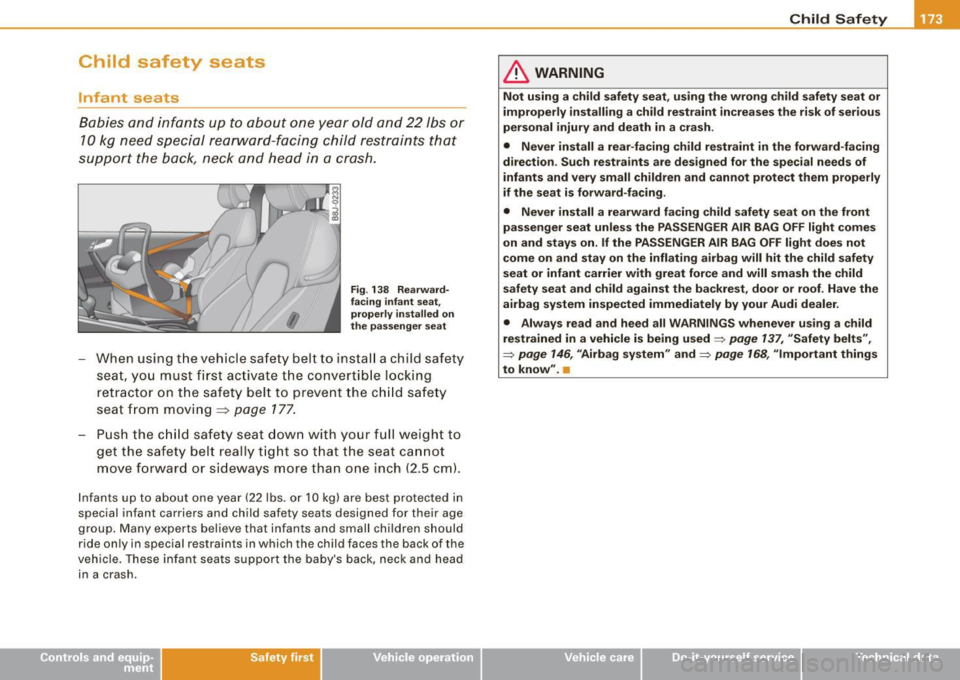
Babies and infants up to about one year old and 22 lbs or
10 kg need special rearward-facing child restraints that
support the back, neck and head in a crash.
Fig. 138 Rearward
facing infant seat,
properly installed on
the passenger seat
- When using the vehicle safety belt to install a child safety
seat, you must first activate the convertible locking
retractor on the safety belt to prevent the child safety
seat from moving ::::,
page 177.
-Push the child safety seat down with your full weight to
get the safety belt really tight so that the seat cannot
move forward or sideways more than one inch (2.5 cm).
Infants up to about one year (22 lbs. or 10 kg) are best protected in
special infant carriers and child safety seats designed for their age
group. Many experts believe that infants and small children should
ride only in special restraints in which the child faces the back of the
vehicle. These infant seats support the baby's back, neck and head
in a crash.
Safety first
Child Safety
& WARNING
Not using a child safety seat, using the wrong child safety seat or
improperly installing a child restraint increases the risk of serious
personal injury and death in a crash .
• Never install a rear-facing child restraint in the forward-facing
direction. Such restraints are designed for the special needs of
infants and very small children and cannot protect them properly
if the seat is forward-facing.
• Never install a rearward facing child safety seat on the front
passenger seat unless the PASSENGER AIR BAG OFF light comes
on and stays on. If the PASSENGER AIR BAG OFF light does not
come on and stay on the inflating airbag will hit the child safety
seat or infant carrier with great force and will smash the child
safety seat and child against the backrest, door or roof. Have the
airbag system inspected immediately by your Audi dealer.
• Always read and heed all WARNINGS whenever using a child
restrained in a vehicle is being used~
page 137, "Safety belts",
::::, page 146, "Airbag system" and::::, page 168, "Important things
to know". •
Vehicle care I I irechnical data
Page 176 of 316
___ C_h _i_ld _ S_a_ f_e _t .:..y ____________________________________________ _
Convertible child safety seats
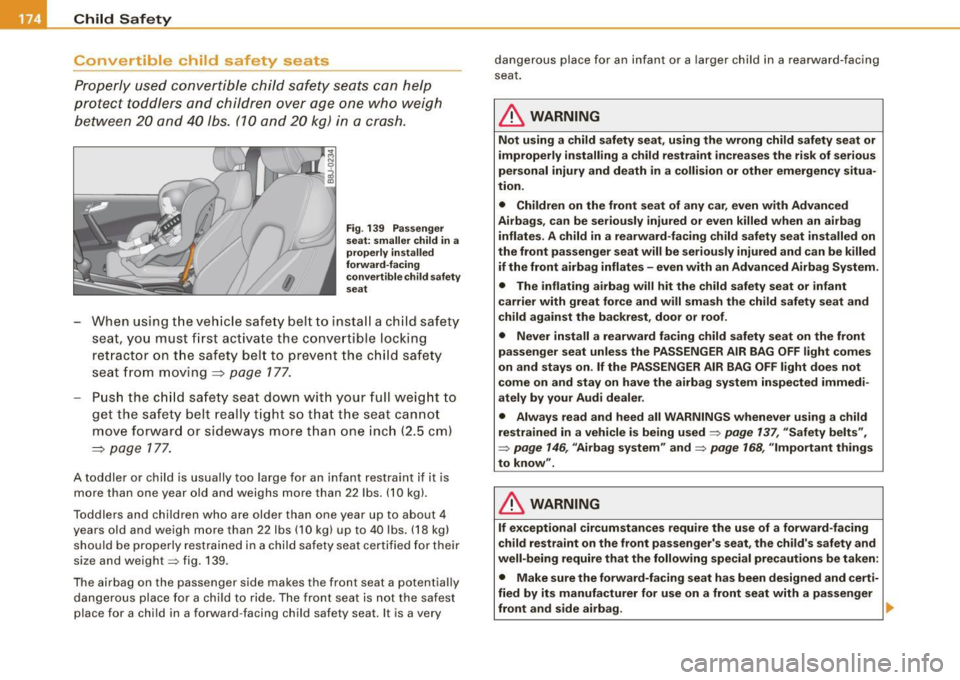
Properly used convertible child safety seats can help
protect toddlers and children over age one who weigh between 20 and 40 lbs. (10 and 20 kg) in a crash.
Fig. 139 Passenger
seat: smaller child in a
properly installed
forward-facing
convertible child safety
seat
When us ing the vehicle safety belt to install a child safety
seat, you must first activate the convert ible locking
retractor on the safety belt to prevent the child safety
seat from moving ~
page 177.
Push the child safety seat down with your full weight to
get the safety belt really tight so that the seat cannot move forward or sideways more than one inch (2.5 cm)
~ page 177.
A toddler or child is usually too large for an infant restraint if it is
more than one year old and weighs more than 22 lbs. (1 0 kg).
Toddlers and children who are older than one year up to about 4
years old and weigh more than 22 lbs (10 kg) up to 40 lbs. (18 kg) should be properly restrained in a child safety seat certified for their
size and weight=> fig. 139 .
The airbag on the passenger side makes the front seat a potentially dangerous place for a child to ride. The front seat is not the safest place for a child in a forward -facing child safety seat. It is a very dangerous place for an infant or a
larger child in a rearward-facing
seat.
& WARNING
Not using a child safety seat, using the wrong child safety seat or
improperly installing a child restraint increases the risk of serious
personal injury and death in a collision or other emergency situa
tion.
• Children on the front seat of any car, even with Advanced
Airbags, can be seriously injured or even killed when an airbag
inflates. A child in a rearward-facing child safety seat installed on
the front passenger seat will be seriously injured and can be killed
if the front airbag inflates -even with an Advanced Airbag System.
• The inflating airbag will hit the child safety seat or infant
carrier with great force and will smash the child safety seat and
child against the backrest, door or roof.
• Never install a rearward facing child safety seat on the front
passenger seat unless the PASSENGER AIR BAG OFF light comes
on and stays on. If the PASSENGER AIR BAG OFF light does not
come on and stay on have the airbag system inspected immedi
ately by your Audi dealer.
• Always read and heed all WARNINGS whenever using a child
restrained in a vehicle is being used=>
page 137, "Safety belts",
=>
page 146, "Airbag system" and=> page 168, "Important things
to know".
& WARNING
If exceptional circumstances require the use of a forward-facing
child restraint on the front passenger's seat, the child's safety and
well-being require that the following special precautions be taken:
• Make sure the forward-facing seat has been designed and certi
fied by its manufacturer for use on a front seat with a passenger
front and side airbag . .,
Page 177 of 316
& WARNING !continued)
• Always follow the manufacturer's instructions provided with
the child safety seat or carrier.
• Always move the front passenger seat into the rearmost posi
tion of the passenger seat's fore and aft adjustment range, and as
far away from the airbag as possible before installing the child
restraint.
• Always make sure that nothing prevents the front passenger's
seat from being moved to the rearmost position in its fore and aft
adjustment range.
• Always make sure the backrest is in an upright position.
• Make sure that the PASSENGER AIR BAG OFF light comes on
and stays on all the time whenever the ignition is switched on.
• If the light does not stay on, perform the checks~
page 157,
uMonitoring the Advanced Airbag System".
• If the PASSENGER AIR BAG OFF light does not come on and stay
on have the airbag system inspected immediately by your Audi
dealer. •
Safety first
Child Safety
Booster seats
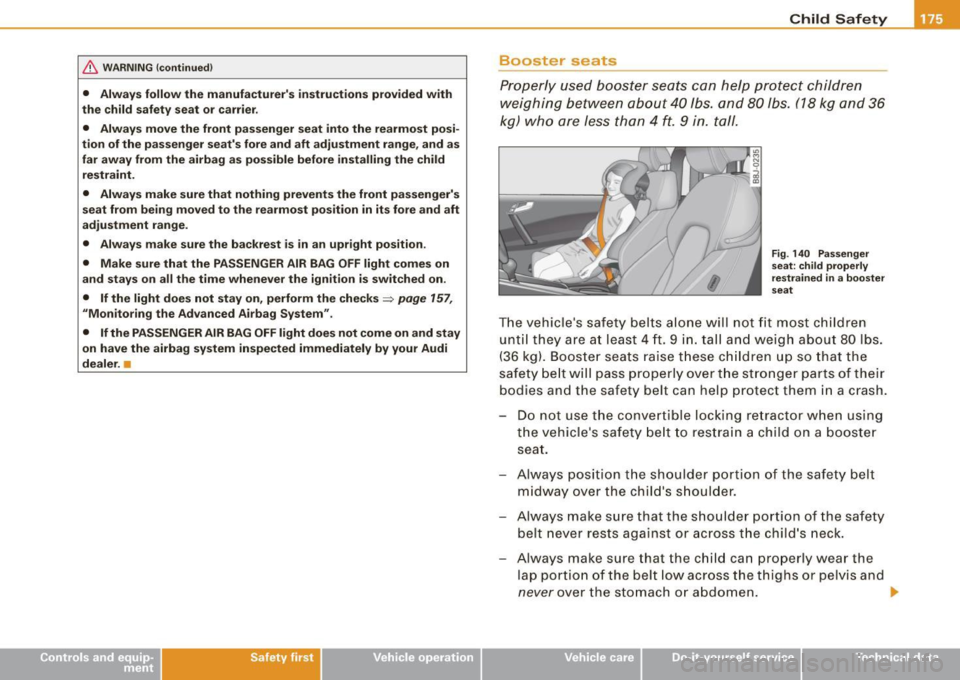
Properly used booster seats can help protect children
weighing between about 40 lbs. and 80 lbs. (18 kg and 36
kg) who are less than
4 ft. 9 in. tall.
II
Fig . 140 Passenger
seat: child properly
restrained
in a booster
seat
The vehicle 's safety belts alone will not fit most children
until they are at least
4 ft. 9 in. tall and weigh about 80 lbs.
(36 kg). Booster seats raise these children up so that the
safety belt will pass properly over the stronger parts of their bodies and the safety belt can help protect them in a crash .
- Do not use the convertible locking retractor when using
the vehic le 's safety belt to restrain a child on a booster
seat.
- Always posit ion the shoulder portion of the safety belt
midway over the child's shoulder.
- Always make sure that the shoulder port ion of the safety
belt never rests against or across the child's neck .
- Always make sure that the child can properly wear the
lap portion of the belt low across the thighs or pelvis and
never over the stomach or abdomen. •
Vehicle care I I irechnical data
Page 178 of 316
___ C_h_ i_ ld _ S_ a_ f_ e_ t_y ____________________________________________ _
Children up to about 40 lbs (18 kg) are best protected in child safety
seats designed for their age and weigh t. Experts say that t he skel
eta l structure, part icularly the pelv is, of these ch ildren is not fully
developed, and they s hou ld not use the vehicle sa fe ty be lts
::::>fig .140 .
Children who weigh more than 40 lbs . (1 8 kg) may generally use the
available three point combinat ion lap and shou lder belts when t hey
sit on an appropriate booster seat. Be sure the booster seat meets
all applicable safety sta ndards .
Booster seats raise the seating position of the ch ild and reposition
both the lap and s hou lder par ts of t he safety belt so tha t they pass
across the c hild's body in the right places. The routing o f the belt
over the child's body is very important for the child 's p rotection.
This app lies whenever a ch ild uses the vehicle's safety bel ts, even
when the child is big enough to use them without a booster seat.
In a crash, air bags must inflate with in a blink o f an eye and with
considerable force . In order to do its job, the airbag needs room to
inf late so tha t it wi ll b e there to pr otec t th e occ up ant as the occu
pant moves forward into the airbag .
A vehic le occupant including a child who is out of position and too
close to the airbag ge ts in the way of an inflati ng airbag. When an
occupant is too close , he or she will be struck vio lent ly and will
receive serious or p ossi bly eve n fatal injury.
In order for the airbag to offer protect ion , it is important that all
veh ic le occupan ts, especia lly any c hild ren, who mu st be in the fron t
seat in exceptional circumstances , be properly restrained and as far
away from the airbag as possible. By keeping room between the
child's or othe r occupant's body and the front of the passenger
compartment, the airbag can inflate fully and comp letely and
provid e supp lemental pro tec tion in cer tain fro ntal crashes.
& WARNING
Not using a booster seat , using the booster seat improperly , incor
rectly installing a booster seat or using the vehicle s afety belt
& WARNING (continued )
improperly in creases the r isk of serious personal injur y and death
in a collision or other emergency situation . To help reduce the risk
of ser ious p ersonal injury and /or death :
• Alway s make sure to position the shoulder portion of the three
point belt over the middle of child's shoulder .
• Never let the shoulder portion of the belt rest against or acro ss
the neck , face , chin , or throat of the child .
• Always make sure the lap belt portion of the three -point belt is
worn snug and passes as low as possible across the child's pelvis .
Never let the belt pass o ver the soft abdomen.
• Failure to properly route safety belts over a child's body will
cause severe injuries in an accident or other emergency situation
=> page 137 .
• Children on the front seat of any car , even with Advanced
Airbags, can be seriously injured or even killed when an airbag
inflates. A child in a rearward -facing child safety seat installed on
the front pa ssenger seat will be seriously injured and can be killed
if the front airb ag inflates .
• Never let a child stand or kneel on any seat , for example the
front seat .
• Never let a child ride in the cargo area of your vehicle .
• Alway s remembe r that a child leaning forward , sitting side
ways or out of po sition in any way during an accident can be
s truc k by a deploy ing airb ag. This will result in serious personal
injury or death .
• If you must install a rearward facing child safety seat on the
front passenger seat because of exceptional circumstances the PASSENGER AIR BAG OFF light must come on and stay on , when
ever the ignition is swit ched on .
• If the PASSENGER AIR BAG OFF light does not come on and st ay
on , perform the check s described =>
page 157, "Monitoring the
Advanced Airbag System ". .,_
Page 179 of 316
& WARNING !continued)
• If the PASSENGER AIR BAG OFF light does not come on and stay
on whenever the ignition is switched on the inflating airbag will
hit the child safety seat or infant carrier with great force and will
smash the child safety seat and child against the backrest, door or
roof. Have the airbag system inspected immediately by your Audi
dealer.
• Always read and heed all WARNINGS whenever using a child
restrained in a vehicle is being used=>
page 137, "Safety belts",
=>
page 146, "Airbag system" and=> page 168, "Important things
to know". •
Safety belts and older children
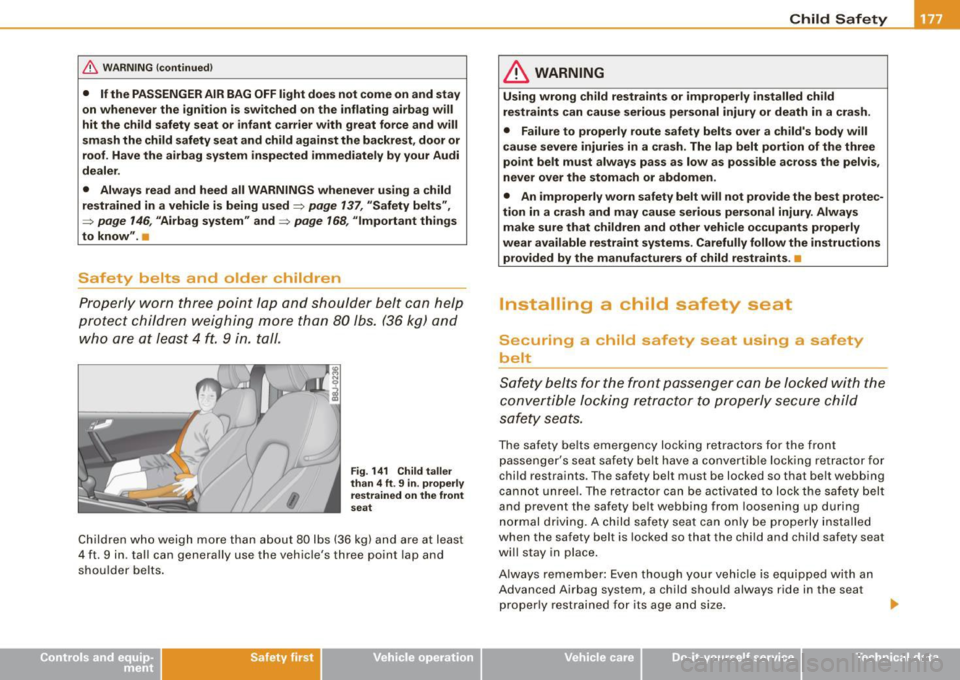
Properly worn three point lap and shoulder belt can help
protect children weighing more than 80 lbs. (36 kg) and
who are at least 4 ft. 9 in. tall.
I
Fig. 141 Child taller
than 4 ft. 9 in. properly
restrained on the front
seat
Children who weigh more than about 80 lbs (36 kg) and are at least
4 ft . 9 in . tall can generally use the vehicle's three point lap and
shoulder belts.
Safety first
Child Safety
& WARNING
Using wrong child restraints or improperly installed child
restraints can cause serious personal injury or death in a crash.
• Failure to properly route safety belts over a child's body will
cause severe injuries in a crash. The lap belt portion of the three
point belt must always pass as low as possible across the pelvis,
never over the stomach or abdomen.
• An improperly worn safety belt will not provide the best protec
tion in a crash and may cause serious personal injury. Always
make sure that children and other vehicle occupants properly
wear available restraint systems. Carefully follow the instructions provided by the manufacturers of child restraints. •
Installing a child safety seat
Securing a child safety seat using a safety
belt
Safety belts for the front passenger can be locked with the
convertible locking retractor to properly secure child
safety seats.
The safety belts emergency locking retractors for the front
passenger's seat safety belt have a convertible locking retractor for
child restraints. The safety belt must be locked so that belt webbing
cannot unreel. The retractor can be activated to lock the safety belt
and prevent the safety belt webbing from loosening up during
normal driving. A child safety seat can only be properly installed
when the safety belt is locked so that the child and child safety seat
will stay in place.
Always remember: Even though your vehicle is equipped with an
Advanced Airbag system, a child should always ride in the seat properly restrained for its age and size. .,_
Vehicle care
I I irechnical data
Page 180 of 316
___ C_ h_ il_d _S_ a_f _e _ty ~----------------------------------------------
& WARNING
Improperly installed child safety seats increase the risk of serious
personal injury and death in a collision.
• Always make sure that the safety belt retractor is locked when
installing a child safety seat. An unlocked safety belt retractor
cannot hold the child safety seat in place during normal driving or
in a crash.
• Always buckle the child safety seat firmly in place even if a
child is not sitting in it. A loose child safety seat can fly around
during a sudden stop or in a collision
• The inflating airbag will hit the child safety seat or infant
carrier with great force and will smash the child safety seat and
child against the backrest, door or roof.
• Forward-facing child safety seats or infant carriers installed on
the front passenger's seat may interfere with the deployment of
the airbag and cause serious injury to the child .
• Always read and heed all WARNINGS whenever using a child
restrained in a vehicle is being used=>
page 168. Special precau
tions apply when installing a child safety seat on the front passenger seat=>
page 147, "Child restraints on the front seat -
some important things to know" .
& WARNING
Always take special precautions if you must install a forward or
rearward-facing child restraint on the front passenger's seat in
exceptional situations :
• Whenever a forward or rearward-facing child restraint is
installed on the front passenger seat , the PASSENGER AIR BAG
OFF light must come on and stay on whenever the ignition is
switched on.
• If the PASSENGER AIR BAG OFF light does not come on and stay
on , perform the checks described=>
page 157, ''Monitoring the
Advanced Airbag System".
& WARNING (continued)
• If the PASSENGER AIR BAG OFF light does not come on and stay
on whenever the ignition is switched on the inflating airbag will
hit the child safety seat or infant carrier with great force and will
smash the child safety seat and child against the backrest , door or
roof . Have the airbag system inspected immediately by your Audi
dealer.
• Improper installation of child restraints can reduce their effec
tiveness or even prevent them from providing any protection .
• An improperly installed child restraint can interfere with the
airbag as it deploys and seriously injure or even kill the child.
• Always carefully follow the manufacturer's instructions
provided with the child safety seat or carrier .
• Never place additional items on the seat that can increase the
total weight registered by the weight -sensing mat and can cause
injury in a crash .
in. WARNING
Forward-facing child restraints:
• Always make sure the forward-facing seat has been designed
and certified by its manufacturer for use on a front seat with a
passenger front and side airbag .
• Never put the forward-facing child restraint up , against or very
near the instrument panel.
• Always move the passenger seat into its rearmost position in
the seat's fore and aft adjustment range, as far away from the
airbag as possible before installing the forward -facing child
restraint. The backrest must be adjusted to an upright position.
• Make sure that the PASSENGER AIR BAG OFF light comes on
and stays on all the time whenever the ignition is switched on.
~
Page 181 of 316
_______________________________________________ C_h _ i_ld _ S_ a_ f_ e_ t..,:c y __ __
& WARNING
Rearward-facing child restraints:
• A child in a rearward-facing child safety seat installed on the
front passenger seat will be seriously injured and can be killed if
the front airbag inflates -even with an Advanced Airbag System.
• The inflating airbag will hit the child safety seat or infant
carrier with great force and will smash the child safety seat and
child against the backrest, door or roof.
• Always be especially careful if you must install a rearward
facing child safety seat on the front passenger seat in exceptional
circumstances.
• Make sure that the PASSENGER AIR BAG OFF light comes on
and stays on all the time whenever the ignition is switched on.
• Never install a rearward facing child safety seat on the front
passenger seat unless the PASSENGER AIR BAG OFF light comes
on and stays on. If the PASSENGER AIR BAG OFF light does not
come on and stay on have the airbag system inspected immedi
ately by your Audi dealer. •
Activating the convertible locking retractor
Use the convertible locking retractor to secure a child
restraint.
Always heed the child safety seat manufacturer's instruc
tions when installing a child restraint in your vehicle . To
activate the convertible locking retractor:
- Place the child restraint on a seat .
- Slowly pull the belt
all the way out.
- Route it around or through the child restraint belt path
~& -
Controls and equip
ment Safety first
Vehicle operation
-Push the child safety seat down with your full weight to
get the safety belt really tight.
- Insert the belt tongue into the buckle for that seating
position .
- Guide the safety belt back into the retractor unt il the belt
lies flat and snug on the child safety seat.
- You should hear a "clicking" noise as the belt winds back
into the inertia reel. Test the convertible locking retractor
by pul ling on the belt. You should no longer be able to
pull the belt out of the retractor. The convertible locking
retractor is now activated .
- Make sure that the red release button is facing away from
the child restraint so that it can be unbuckled quickly.
- Pull on the belt to make sure the safety belt is properly
tight and fastened so that the seat cannot move forward
or sideways more than one inch (2.5 cm).
& WARNING
Using the wrong child restraint or an improperly installed child
restraint can cause serious personal injury or death in a crash.
• Always make sure that the safety belt retractor is locked when
installing a child safety seat. An unlocked safety belt retractor
cannot hold the child safety seat in place during normal driving or
in a crash.
• Always buckle the child safety seat firmly in place even if a
child is not sitting in it. A loose child safety seat can fly around
during a sudden stop or in a crash.
• Always make sure the seat backrest to which the child restraint
is installed is in an upright position. Otherwise, the seat back with
the child safety seat attached to it could fly forward in the event of
an accident or other emergency situation. ..,
Vehicle care Do-it-yourself service Technical data
Page 188 of 316
___ ln_ t _e_ ll-'"ig ...,_ e_ n_t _t_ e_ c_ h _ n_o _ l_o _,.g= y,_ __________________________________________ _
Electronic differential lock (EOL)
The electronic differential lock monitors the rotational
speed of the drive wheels.
General notes
The electronic differential lock (EDU helps the car to start moving,
accelerate and climb a gradient on surfaces providing poor or
almost no grip. Without EDL, this would be difficult, if not impos
sible.
How the system works
Th e EDL operates automatically. It monitors the rotational speed of
the drive wheels on an axle with the help of the ABS sensors
=> page 189. If a noticeable difference in rotational speed between
the drive wheels on one axle is detected (e.g. on slippery ground
on
one side),
the spinning wheel is braked, thereby transferring power
to the other drive wheel or wheels (all-wheel drivel. This is done up
to a speed of about 60 mph (100 km/hl. Noises from the brake
system signal that wheel spin is being controlled.
Driving off
When driving off, always be sure to keep road conditions in mind as
you accelerate . If one drive wheel spins because it is on a surface
with less grip, gradually increase the pressure on the accelerator
pedal until the car starts to move. The wheel less able to transfer
power spins.
Overheating of brakes
To prevent the disc brake of the braked wheel from overheating if
subjected
to excessive loads, the EDL cuts out temporarily . The
vehicle remains operational and behaves in the same way as a
vehicle without EDL.
As soon as the brake has cooled down, EDL switches on again auto
matically.
& WARNING
• When accelerating on slippery surfaces, such as on ice or snow,
always be careful when depressing the accelerator pedal. Even
with the EDL working, the drive wheels can spin and reduce your ability to control your car. -Risk of crash!
• The increased safety afforded by EDL does not mean that you
can take safety risks. Always adapt your driving style to the road
conditions and traffic situation.
[ i] Tips
If a fault occurs in the ABS, the EDL is also not functioning . This is
indicated by the ABS warning light=>
page 20. •
Anti-Slip Regulation System (ASR)
The Anti-Slip Regulation System prevents the driven
wheels from spinning when the car is accelerating.
General notes
The Anti-Slip Regulation System (ASR) is integrated in the electronic
stabilization program (ESP). When the vehicle starts up and acceler
ates , the wheels are prevented from spinning by adjusting the
engine power to match the amount of grip available from the road
surface .
How the system works
ASR performs automatically, i.e. without the driver's intervention .
With the aid of the ABS sensors =>
page 189, ASR monitors the
speed of the driven wheels. If the wheels start to spin, the engine
torque is reduced automatically until the tires find enough grip to
lock onto the road surface . The system is active across the entire
speed range.
The ASR works in conjunction with the ABS. If a malfunction should
occur in the ABS, the ASR will also be out of action .
~