light AUDI TT ROADSTER 2008 Owners Manual
[x] Cancel search | Manufacturer: AUDI, Model Year: 2008, Model line: TT ROADSTER, Model: AUDI TT ROADSTER 2008Pages: 316, PDF Size: 70.1 MB
Page 189 of 316
Activating
The ESP is automatically activated when the engine is started and it
performs a self-test. You can activate a deactivated ASR if required
by pressing the=>
page 184, fig. 142 button. When it is activated,
the message
ESP/ASR on appears briefly in the display. Vehicles
with front -wheel drive a deactivated ASR automatically re -activates
itself at a speed of 40 mph (70 km/h).
Deactivating
You can deactivate the ASR if required by pressing the button (for
less than 3 seconds)=>
page 184, fig. 142. With the ASR deactivated,
the ESP check light comes on, see=>
page 18. The message ASR off
appears in the display as well. On vehicles with front -wheel drive:
deactivation is possible only up to 30 mph (50 km/h) for safety
reasons. Vehicles with all -wheel drive : the ASR can be deactivated
at any speed.
The ASR should normally be activated all the time. Only in certain exceptional situations when some slip is desirable does it make
sense to deactivate the ASR. Examples:
• when driving with tire chains
• when driving in deep snow or on loose ground and
• when rocking the vehicle loose after it has become stuck.
When the abnormal situation is over, you should activate the ASR
again.
& WARNING
The increased safety afforded by ASR does not mean that you can
take safety risks. Always adapt your driving style to the road
conditions and traffic situation.
[ i J Tips
To ensure that the ASR works properly, all four wheels must be fitted
with identical tires. Any differences in rolling radius of the tires can
Intelligent technology
cause the system to reduce engine power when this is not desired.
See also ::::>
page 249, "New tires and replacing tires and wheels".
Rear spoiler
The rear spoiler improves vehicle handling and enhances
driver control.
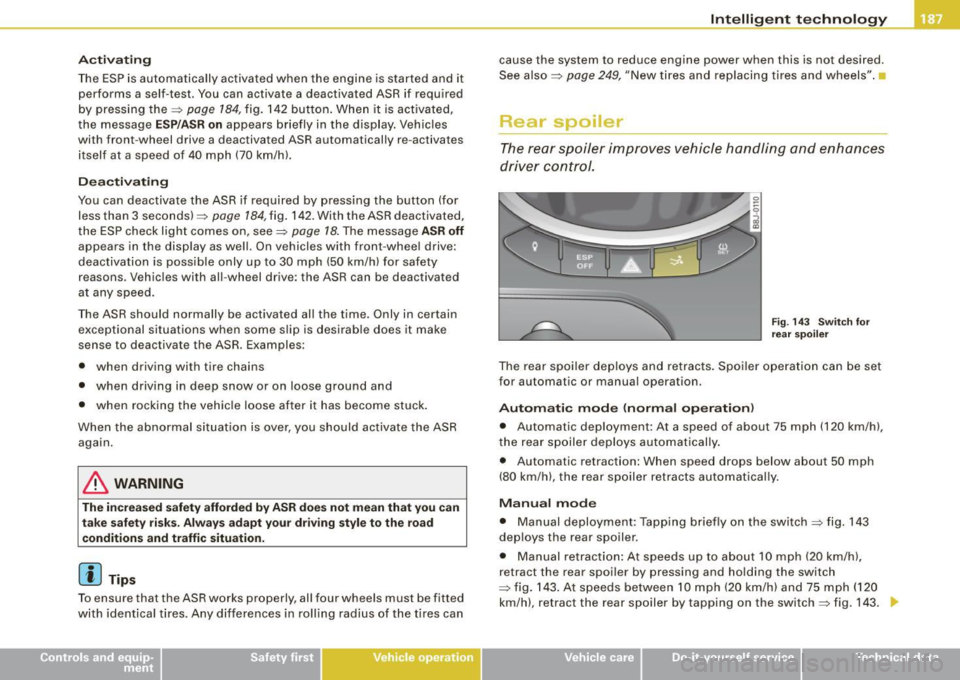
Fig. 143 Switch for
rear spoiler
The rear spoiler deploys and retracts. Spoiler operation can be set
for automatic or manual operation .
Automatic mode (normal operation)
• Automatic deployment : At a speed of about 75 mph (120 km/h),
the rear spoiler deploys automatically.
• Automatic retraction: When speed drops below about 50 mph
(80 km/h), the rear spoiler retracts automatically.
Manual mode
• Manual deployment: Tapping briefly on the switch ::::> fig. 143
deploys the rear spoiler .
• Manual retraction: At speeds up to about 10 mph (20 km/h),
retract the rear spoiler by pressing and holding the switch
::::> fig. 143. At speeds between 10 mph (20 km/h) and 75 mph (120
km/h), retract the rear spoiler by tapping on the switch=> fig. 143 .
Vehicle care I I irechnical data
Page 190 of 316
-Intelligent t echnology
--- =---- ----"-!...!-------------------------------
After 15 cycles (deploy and retract), manual operation is suspended
fo r up t o 2.5 minutes . Above 75 mph (120 km/h), operation swi tches
to automatic mode .
& WARNING
Driving at higher speeds witho ut the re ar spoiler deployed can
impair handling characteri stics, making the vehicle harder to
c ontrol.
• Always make sure that the spoiler i s deployed when driving at
speeds over 85 mph (140 k m/h). If the rear spoiler warning /ind i
c ator light in the in strument clu ster come s on , the rear spoiler
may not have deployed .
• Never drive at speed s higher than 85 mph (140 km /h ) if the
spoiler is not deployed . Have the spoiler inspe cted as soon as
po ssible by an authorized Audi dealer or qualified workshop.
• Always obey speed limits and other traff ic law s.
& WARNING
Improper operation of the rear spoiler can cause crushing injuries.
• Always make su re that nobody , especially children , is in the
way when the rear spoiler is deployed or retracted.
0 Note
Never push the vehicle or a pply force to the rear spoi ler -it cou ld be
damaged .
[ i ] Tips
Clean the spoi ler compartment every 2 to 3 months . The spoiler
compa rtment must always be free of ice, snow, leaves or other
debris. •
Braking
General "nformation
What aff ects braking effi cie ncy?
Operating condition s and driving habits
The brakes on today's automob iles a re sti ll sub ject to wea r,
depending large ly o n operati ng co nditions and driving habits~&.
On vehicles which are driven mostly in stop -and -go city traffic or
whic h are driven hard, the brake pa ds shou ld be checked by your
authorized Audi dea ler more often than specified in the
Mainte
nance
& Warranty booklet.
On steep slopes, you should use the braking effect of the en gine.
Th is way, you prevent u nneces sary wea r on the brake syste m. If you
must use your brakes, do not ho ld the brakes down continuous ly.
P ump the brakes at interva ls.
Moisture or road salt
U nde r certain co nditi ons, for example, when driving th rough water
or v ery heavy rain, or eve n after washing your vehicle, the braking
effec t can be red uced d ue to mo isture (o r in freezing c onditions ice)
o n the brake pads . A few cautious brake appl ica tions should dry off
the brake pads or remove any ice coat ings.
T he effe ctiveness of the brakes can be reduced when the ve hicle is
driven on a sa lt -covered road and the brakes are not used. Li kewise,
you clean off accu mulated sa lt co atin g fr om bra ke discs a nd pads
with a few cautious applications of the brake~&.
Corrosion
There may be a tendency for dirt to build up on the brake pads and
corr osi on to for m on the d iscs if the ca r is no t driven regu lar ly or
only for short trips with litt le use of the brakes .
I f the b ra kes a re not used frequently, or if co rros ion ha s formed on
the d iscs, it is adv isable to clean off the pads a nd discs by braking
firm ly a few times from a moderately high speed~& . .,_
Page 196 of 316
___ D_ r_ iv _i_ n-' g"'""'- a_ n_d_ e_ n _ v_i_r _ o _n_ m_ e_ n_t _____________________________________________ _
- Lack of proper maintenance as well as improper use of the
vehicle will impair the function of the emission con trol system
and could lead to damage.
exhaust gas can have a su lfur -like exhaust gas smell under some
operating states . This depends on the su lfur content of the fuel
being used. Using a different brand of fuel may he lp, or filling the
tank with lead-free super grade gasoline. •
Avoid damaging the vehicle
When you are driving on poor roads, or over curbs, steep ramps,
etc., make certain that low-lying parts such as spoilers and exhaust
system parts do not bottom out and get damaged.
This is especially true for vehicles with low-slung chassis (sports
chassis) and fully loaded vehicles. •
Operate your vehicle economically
and minimize pollution
General
Your personal style of driving will determine the economy
of your vehicle, as well as exhaust and noise levels.
Fuel economy, environmental impact, and wear on your engine,
brakes and t ires largely depend on three factors:
• your personal driving style
• operating condit ions
• technical limitations If
you anticipate what you need to do next and drive economically,
you can easily cut your fuel consumption by 10-15 percent . This
section will give you some tips on how you can he lp the environ
ment and your pocketbook .
[ i ] Tips
The consumption estimates as published by ENVIRONMENTAL
PROTECTION AGENCY (EPA) and Transport Canada may not corre
spond to your actua l consumption on the road, which will vary
depend ing upon vehicle load and speed, road and weather condi
tions, trip length, etc. •
Drive smoothly and keep a lookout ahead
Vehicles use the most fuel when they are accelerating.
Avoid unnecessary accelerating and braking.
Vehicles use the most fue l when they are accelerating . If you antici
pate what is going to happen next, you will need to brake less and,
thus, accelerate less. Let the vehicle coast whenever possible -for
example when you see that the next traffic light is red. •
Avoid full throttle
Driving at moderate speeds saves fuel and improves your
mileage.
- Try and keep well below your car's maximum speed.
Acce lerating gently reduces fuel consumption, engine wear, and
does not disturb the environment.
Fuel consumption, exhaust emissions and engine noise increase
disproportionately at high speeds. If you drive at approximately
three quarters of top speed, fuel consumption wil l be reduced by
9J,,
Page 197 of 316
one half. Never drive faster than the posted speed limit and weather
conditi ons permit. •
Reducing unnecessary Idling
Even when your car is just idling it burns up fuel.
- Shut the eng ine off when you are not driving the vehicle .
- Do not warm up the vehicle by letting the eng ine run at
idle.
I t makes sense to shut off the engine in traffic jams, when waiting
for trains to pass at railroad crossings, or at traffic lights that have long waits on red. Turning the engine off for just 30 -40 seconds
saves more fue l than is burned s tarting the engine again .
It takes a long time for the engine to warm up fully when it is
running at idle . However, wear and noxious emissions a re especial ly
high when the engine is warming up . So you should drive away as
soon as you start the engine and avoid running at high RPMs whi le
the engine is stil l warming up .
0 Note
Do not leave engine idling unattended after starting . If warning
lights should come on to indicate improper operation, they would
go unheeded. Extended idl ing also produces heat, wh ich cou ld
result in overheating or other damage to the vehicle or other
property .•
Regular maintenance
A badly tuned en gine unnecessarily wastes a lot of fuel.
- Have your v ehicl e serv ice d at reg ular intervals.
Controls and equip
ment Safety first Vehicle operation
Dri
ving and environm ent
By having your vehicle regularly serviced by an Audi dea ler helps to
ensure that i t runs properly and economically . The conditio n of your
vehic le not only affects its safety and abi lity to hold its va lue, it also
affects
fuel consumption .
Check your oil each time you fill your tank.
The amount of oil used is related to engine load and speed .
I t is normal for the oi l consumption of a new eng ine to reach its
lowest va lue after a certain mi leage has been driven.
You must drive your vehicle about 3,000 miles (5,000 kilometres) be fore you can proper ly assess o il consumpt ion.
This also applies to fuel consumption and engine output .
0 Note
• Have your vehicle maintained properly and in accordance with
t he service recommendations in your Main tenance
& Warranty
booklet. Lack of proper ma intenance as well as improper use of the
vehicle wi ll impair the function of the emission control system and
cou ld lead to da mage.
• Do not alter or remove any component of the Emission Contro l
System unless approved by the manufacturer .
• Do no t al te r or remove any device, such as heat shields,
switches, ignition wires, valves, which are designed to protect your
veh ic le' s Emission Control System and o ther i mportant vehicle
components. •
Fewer short trips
Fu el consu mption will alwa ys be relatively high on shor t
trips.
- Try to avo id driving short dista nce s wi th a cold engine.
Vehicle care Do-it-yourself service Technical data
Page 203 of 316
_____________________________________________ C_ l_ e _a_ n_ in_ g_a _ n_d_ p_ r_ o_ t _e_ c_t _io _ n __ _
•
High temperatures, as from exposure to intense sunlight, intens ify
the corrosive effect particularly when humidity is high as well.
Under ce rtain circumstances ,
weekly washing may be necessary .
Under other conditions, a monthly washing and waxing may be
adequate.
After the winter, the
underside of the vehicle should be thoroughly
washed preferably in a professional car wash .
& WARNING
Always read and heed all WARNINGS and the information
=>
page 200 . •
Automatic car wash
The vehicle can be washed in almost any modern auto
matic car wash.
The vehicle paint is so durable that the vehicle can normally be
washed without problems in an automatic car wash . However , the
effect on the paint depends to a large extent on the design of the
facility, the filtering of the wash water, the type of wash and care
material, etc. If the paint has a dull appearance after going through
the car wash or is scratched, bring this to the attention of the oper
ator immediately . If necessary, use a different car wash .
The power top does not require specia l precautions before passing
through a car wash.
However, the car must not be treated with hot
wax after the wash cycle!
The wax could adversely affect the power
top and even damage the fabric over a period of time.
The power top do es not have to be washed every time you use a car
wash . The power top can be spared if the car wash facility is
equipped with manually adjustable roof brushes or rollers.
Before going through a car wash, be sure to take the usua l precau
tions such as closing the windows. Remove antenna if applicable . If
you have installed additional accessories on the vehicle -such as
spoilers, etc. -it is best to ask the car wash operator if these should
be removed.
& WARNING
Always read and heed all WARNINGS and the information
=> page 200. •
Washing the vehicle by hand
A lot of water is needed when washing a vehicle by hand.
-Before you start washing, make sure you have read and
understood the WARNINGS ::}
& in "General informa
tion" on
page 200.
-First soak all dried dirt until it is soft, then rinse it off.
- As you clean your vehicle, start with the roof and work
your way down to the bottom, using a sponge, a sponge
glove or a clean brush.
- Rinse the sponge or the sponge glove often, flushing it
clean each time.
- Use special car shampoo only for very persistent dirt .
- Rinse the car thoroughly with water.
- Use a chamois leather to gently wipe the exterior dry.
Use a separate sponge for cleaning the wheels, door si lls and other
regions exposed to road dirt. In this way, you will not scratch the
paint with coarse particles imbedded in the sponge the next time
you wash the car . .,,
Vehicle care I t •
Page 204 of 316
___ C_ le_ a _ n_i_n ~g _ a_ n_ d __ p_r _o _t _e _c_ t_ i_o _n ___________________________________________ _
& WARNING
• Do not cl ean th e under side o f the ch ass is, fender s, whe el
c over s, or other hard to r ea ch part s without protecting your h and s
a nd a rms. Yo u may cut you rse lf on sh ar p-edged m eta l p art s.
• Alway s read and h eed all WARNINGS and other informat ion
~ p age 2 00 .
0 Note
• Never try to remove dirt, mud or dust if the surface of the vehicle
is dry . Never use a dry cloth or sponge, s ince this cou ld scratch your
vehic le's paint or w indows .
• Never wash your car in br ight sunl ight. Drops of wa ter act as
magnifying lenses and may damage your paint .
• When you wash your car in the winter : if you rinse your vehicle
with a hose, be careful not to aim the stream of water directly at
locks, or at door or ha tch openings - they can freeze shut.
• Never use sponges designed to remove insects, or any kitchen
scouring sponges or simila r products. They can damage your paint
finish .
• Never use a dry cloth or sponge to c lean the head lights. Only use
wet cloths or sponges to prevent scratches . It is best to use soapy
water.
c£> For the sake of the environment
In the interest of the environment, the vehicle shou ld on ly be
washed in special wash bays. •
Washing your vehicle with a power washer
Cleaning the exterior of your car with a high-pressure
power washer is safe as long as you observe a few simple rules .
-Before us ing the powe r washer, make sure you have read
and understood the WARNINGS~
& in "General infor
mation" o n
page 200.
Always follow the operating instructions for the power
washer.
Make sure that the jet o n th e sp ray hose produces a "fan
shaped sp ray".
Do
not hold the spray n ozzle too close to soft ma terials .
Never u se a power washer to clean the power top itself .
When cleaning the vehicle with a power washer
always follow the
operating instructions. This applies particula rly to the
operating
pre ssure
and the spraying di stanc e. Maintain a sufficient distance
to soft materia ls such as rubber hoses and sound/vibration dead
ening materia ls (particularly on the underside of the engine hood).
Do not use a jet which sprays water in a
di re ct stre am or one that
has a
rotating jet.
Water temperature shou ld not exceed 140 °F (60 °Cl.
in. WARNING
Never wash tires with a jet that sp rays water in a dire ct stream .
Thi s could cause invisib le damage to the tire s and weaken them ,
even if the spra y is fr om a re lative ly lo ng d istanc e and f or a s ho rt
tim e. Damaged and we akened tire s can f ail and cau se ac cident s
a nd pers ona l i njur y. .,,_
Page 205 of 316
_____________________________________________ C_ l_ e _a_ n_ in_ g_a _ n_d_ p_ r_ o_ t _e_ c_t _io _ n __ lftlll
•
0 Note
• Never use a power washer to clean the powe r top itself .
• To avoid damaging your vehicle, always make sure that there is
sufficien t distance between the spray head and soft materials like
rubber hoses, plastic parts and sound -deadening materials. Never
aim the spray head at the same point for a long time. This also
applies to cleaning headlights and painted bumpers. Remember:
the closer the nozzle is to the surface of the material, the greater the stress on the material. •
Folding top care
The folding top requires special care.
Keeping your top looking great and making certain that it lasts a
long time depend to a great extent on proper use and care. Remove
bird droppings as soon as possible, since the corrosive chemicals in
them will cause the rubber impregnation in your top to swell and
possibly allow the fabric to leak .
W ith normal soiling, all you need to do is clear the top with a soft
brush and clear water . Always brush in the direction of the fabric
from front to rear.
If the top is very dirty and has spotted areas clean it with a brush
using a convertible top cleaner. Always brush in the direction of the
fabric from front to rear . Rinse with plenty of clear water, and allow
the top to air-dry.
Chamois are not suitable for drying the top.
Never use gasoline, spot remover, benzene, paint thinner or
solvents to remove spots. We recommend that you only use
cleaners especially formulated for use on convertible tops, and that
you follow the produce use directions carefully . Authori zed Audi
deals can provide detailed information.
& WARNING
Always read and heed all WARNINGS and the information on
:=> page 200.
0 Note
Never use a high -pressure power washer to clean the folding top. •
Applies to ve hicles: w ith win d def le cto r
Wind deflector
Clear the wind deflector with water or, if it is heavily soiled, a chem
ically neutral cleaning solution.
& WARNING
Always read and heed all WARNINGS and the information on
=> page 200. •
Waxing
Wax protects the vehicle's paint.
-Use a manually applied car wax occasionally to protect
the paint.
A good wax coating protects the vehicle paint to a large extent
against the environmental factors listed under ~ page 200,
"Washing" and even against slight scratches.
You can use a liquid car wax to protect your paint as soon as one
week after your vehicle has been delivered.
Even if you regularly use a waxing process in automatic car washes ,
we recommend that you manually apply a coat of wax to give the .,_
Vehicle care
I t •
Page 206 of 316
___ C_ le_ a _ n_i_n ~g _ a_ n_ d __ p_r _o _t _e _c_ t_ i_o _n ___________________________________________ _
paint extra protection, particularly if water no longer beads on the
clean paint .
Protect p lastic body parts with car wax in the same way as the
vehic le body .
During wa rm weather dead insects tend to collect on the fron t
bumper and on the forward area of the hood. They are much easier
t o remove from paint that is waxed
often .
& WARNING
Alway s read and heed all WARNING S and other information
~ page 200 .
0 Note
Do not use car wax on
• matte or anodized metal trim
• rubbe r or rubber -like trim .•
Polishing
P olishing restores the gloss to the paint.
Polish your veh icle on ly if t he pa in t has lost its shine and the g loss
cannot be brought back with wax.
If the polish used does not contain preservative compounds, the
paint mus t be wax ed afterwards ~
page 203, "Waxing".
& WARNING
Always read and heed all WARNINGS and the information
~ page 200 .
0 Note
Do not treat matte anodized metal trim, p lastic or rubber parts with
polish or wa x.•
Trim strips
Met al trim nee ds s peci al care .
For environmental reasons, Audi fabricates the bright trim strips
and tr im pieces from pure chromium -free a luminum.
D irt and marks on the trim strips should be removed with a
pH
balanced
clean ing agen t (do n ot use a chrome cleaner) . Audi
dea lers carry cleaning products which have been tested for use on
you r vehic le and are not harmful to the env ironment.
To avoid corrosion on the exterior trim s trips, only a pH -ba lanced
solution should be used for the windshield washer .
& WARNING
Always read and heed all WARNINGS and other inform ation
~ page200 .•
Plastic and vinyl
Plas tics needs spe cial care.
Use a clean, damp cloth or sponge to remove dust and light surface
dirt. For other soil, use a lukewarm all -purpose cleaning so lution or
a mild sadd le soap for vinyl tr im . Re move water spots and soap
traces with a clean, damp cloth or sponge. Use a clean, soft c loth to
r ub dry .
Grease, tar or oil stains can be removed with a clean cloth or sponge
soaked wi th all-purp ose cleaner o r wi th a solven t designe d espe -
cia lly to c lean vinyl. .,.
Page 209 of 316
Cleaning and prote ction BIii
------------------------------------=-----=-------
•
Ap plies to vehi cles : w it h C ast a llo y wh eels
Cast (light) alloy wheels
Cast (light) alloy wheels require special care.
-Wash the wheels w ith a sponge or hose brush eve ry
ot her week .
- For de ep cleaning afterwar ds, use only a dedicated
acid
free cast alloy wheel cleaner .
- Ru b a c oat of
liquid wax on to t he rims every t hree mon th.
B e sure t o reach and treat all parts of the rim .
To preserve the decora tive appearance of the cas t alloy whee ls,
some special care is necessary . In addition to road dirt and sa lt ,
b rake dust is also co rro sive . If left o n fo r to o long, brake dust can
cause pitting .
Use only special
ac id -free cleaners formulated for alloy rims . Safe
products are available at your Audi dea ler . Never leave the cleaner
on the r ims longer than specified on the label. If not rins ed off
promp tly, the acid contained in some cleaners can a ttack the
threads on the wheel bolts .
Never use abrasive or me tal po lishing cleaning agents . If the protec
tive coat ing has been chipped, e .g . by kicked up road dirt. touch it
up as soon as possib le .
& WARNING
• Moi sture and ice on brakes may affect braking efficiency
=> page 188 , "General information ". Te st the b rake s c arefully ea ch
time you wash the vehicle.
• Alway s read a nd heed all WARNINGS and other informat ion
=> page 200 . •
Body cavity sealing
T he body c avity sealing d oes not need t o be checke d.
A ll body cavities which could be aff ected by corrosion hav e been
given thor ough protecti on a t the facto ry.
This sealing does not require any inspection or add itional treat
ment . If any wax shou ld seep out of the cavity when the ambient
tempera ture is high , it can be removed wi th a p las tic sc raper and a
suitable solvent.
& WARNING
Solvent s can be dangerous.
• Benz ine is flammable and to xic . If you use benz ine for removing
the wax , keep sparks , flame and lighted cigarettes away . Never
dump benz ine on the ground , into open streams or down sewage
drains .
• Be sure to observe all safety and environmental regulat ions .
Follow all instru ctions on the container.
• Always read and heed all WARNINGS and the information
=> page 200 . •
Chassis
Have the undercoa ting checked for damag e from time to
time .
The lowe r body shell of your Audi is a lso thoroughly protected
against corros ion.
Any damage to the undercoating caused by road ha za rds sh ould be
repaired promp tly .
& WARNING
Too much unde rcoat ing in the wrong pla ces can cause a fire .
Vehicle care
I t •
Page 212 of 316
___ C_ le_ a _ n_i_n ~g _ a_ n_ d __ p_r _o _t _e _c_ t_ i_o _n ___________________________________________ _
clothing materials can discolor leather seats (especially if such
clothing is damp and was not dyed correctly). Dust and dirt particles
in pores, folds, and seams can have an abrasive effect and can
damage the leather surface as well as weaken seams.
The leather should be cleaned regularly as needed. After having
been used for a relatively long time, your leather seats will acquire
a rich aged finish. This is a characteristic of natural leather and a
sign of true quality.
In order to maintain the value of this natural product over the life of
your vehicle, you should follow the recommendations below:
0 Note
• To keep your leather from bleaching out, do not allow it to be
exposed to bright sunlight for long periods of time. If you have to
leave the vehicle parked outside for long periods, cover the leather
to protect it from direct exposure to sunlight.
• Sharp objects on clothing, such as zippers, rivets or sharp pieces
on belts can leave permanent scratches or scrape marks on the
surface of the leather.
[ i J Tips
• After each time you clean the leather and at regular intervals, use
a leather preservative creme that contains UV -blockers and that
works into the leather. This creme will nourish and moisturize the leather, helping it to breathe and stay supple. It also helps to build
up a protective coating on the surface.
• Clean the leather every 2 -3 months, and clean any areas that get
soiled.
• Remove fresh marks made by ballpoint pens, ink, lipstick, shoe
polish, etc. as soon as possible.
• Preserve the color of the leather as needed by using a special
colored leather care creme to touch up areas of uneven color. •
Applies to vehicles: w ith natu ral leather
Cleaning and caring for leather upholstery
and trim
Natural leather requires special care and attention.
Normal cleaning
-Clean soiled areas with a slightly moistened cotton or
woolen cloth.
More stubborn dirt
- More stubborn dirt can be removed using a cloth satu
rated with a mild soap solution (2 tablespoons mild
liquid soap).
- Never allow the soap solution to saturate the leather, and
make certain that no water soaks into the seams.
Wipe off the soap solution with a soft, dry cloth.
Cleaning spots
-Remove fresh water-based spots (such as coffee, tea,
juices, blood) with an absorbent cloth or paper towel.
- Remove fresh
grease or oil-based spots (such as butter,
mayonnaise, chocolate) with an absorbent cloth or paper
towel, or use the cleaner from the leather care kit if the
spot has not yet penetrated into the surface of the
leather.
- Use an oil/grease dissolving spray, if
oil/grease spots
have dried on.
- Remove specific kinds of spots (ballpoint pen, felt
marker, fingernail polish, water-based paint, shoe polish,
etc.) with a spot remover specifically formulated for leather. ..,_