fuel cap AUDI TT ROADSTER 2008 User Guide
[x] Cancel search | Manufacturer: AUDI, Model Year: 2008, Model line: TT ROADSTER, Model: AUDI TT ROADSTER 2008Pages: 316, PDF Size: 70.1 MB
Page 227 of 316
Checking and filling -
------------- --------=----" =---------
M ....
9
i
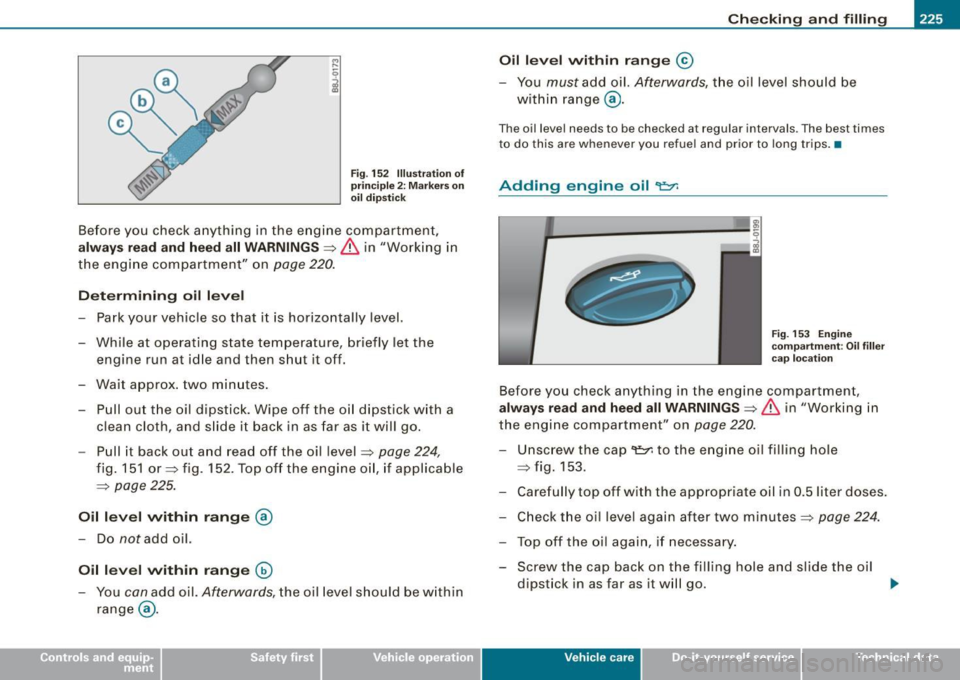
Fig. 152 Illustration of
principle 2: Markers on
oil dipstick
Before you check anything in the engine compartment,
always read and heed all WARNINGS~ & in "Working in
the engine compartment" on
page 220.
Determining oil level
- Park your vehicle so that it is horizontally level.
- Wh ile at operating state temperature, briefly let the
engine run at idle and then shut it off .
- Wait approx. two minutes.
- Pull out the oil dipstick. Wipe off the oil dipstick with a
clean cloth, and slide it back in as far as it will go.
Pull it back out and read off the oil level
~ page 224,
fig. 151 or~ fig. 152. Top off the engine oil, if applicable
~ page 225.
Oil level within range @
- Do not add oil.
Oil level within range @
- You can add oil. Afterwards, the oil level should be within
range @.
Oil level within range ©
-You must add oil. Afterwards, the oil level should be
within range@.
The oil level needs to be checked at regular intervals . The best times
to do this are whenever you refuel and prior to long trips. •
Adding engin e oil ~
Fig . 153 Engine
compartment : Oil filler
cap location
Before you check anything in the engine compartment,
always read and heed all WARNINGS~ & in "Working in
the engine compartment " on
page 220.
- Unscrew the cap "l=:7': to the engine oil filling hole
~ fig. 153.
- Carefully top off with the appropriate oil in 0.5 liter doses.
- Check the oil level again after two minutes ~
page 224.
-Top off the oil again, if necessary.
- Screw the cap back on the filling hole and slide the oil dipstick in as far as it will go . .,_
Vehicle care I I irechnical data
Page 248 of 316
-~_T_ ir_e_ s_ a_ n_d _ w_ h_ e_e _l_s _________________________________________________ _
& WARN ING (continued )
• Driving with underinflated tires bend more , letting them get
too hot re sulting in t read separation , sudden t ire failure and loss
of control.
• Excessive speed and /overloading can cau se heat bu ild-up ,
sudden tire failure and lo ss of control.
• If the tire pressure is too low or too high , the tires will wear
prematurely and the vehicle will not handle well .
• If the tire is not flat and you do not have to change a wheel
immediately, drive at reduced speed to the nearest service station
to che ck the tire pres sure and add air as required .
0 Note
Driving without valve stem caps can cause damage to the tire
va lves. To prevent this, always ma ke sure that fact ory insta lled valve
stem caps on all whee ls are securely mounted on the valve .
<£> For the sake of the environment
Underinflated tires will also increase the fue l consumption. •
Tires and vehicle load limits
There are limits to the amount of load or weight that any vehicle and
any tire can carry. A vehicle that is overloaded will not handle well
and is more difficu lt to stop. Overload ing can not only lead to loss
of vehicle contro l, but can a lso damage important parts of the
veh ic le an d ca n lead to sudden t ire fa ilu re , inc lud ing a bl owout a nd
sudden deflation that can cause the vehicle to crash.
Yo ur saf ety a nd that of you r passenge rs also de pends on making
sure that load limits are not exceeded . Vehicle load includes every
body and eve ryt hing in and on the vehic le . Th ese load limi ts are technica
lly referred to as the vehicle's
Gross Vehicle We ight Rating
("GVWR").
Th e "GVWR" includes the weight of the basic vehicle, all factory
insta lled accessories, a ful l tank of fuel, oil, coolant and other f luids
p lus max imum load. The ma ximu m load inc ludes the numbe r of
passengers that the vehicle is intended to carry ("seating capacity")
w it h an assu med we ight o f 150 lbs (68 kg) for eac h pass enger at a
designated seating position and the total weight of any luggage in
t he vehicle.
T he
Gross Axle Weight Rating ("GAWR"l is the maximum load that
can be a pplied a t eac h of the vehic le's two a xles .
T he Gross Veh icle Weigh t Rat ing a nd the Gross A xle We igh t R ating
are listed on the safety comp liance stic ker label located on the
dr iver's s ide B -p illar . You r Aud i has 2 sea ting pos it io n s. Eac h seating
posit ion has a safety belt=>
page 137, "Safety belts".
T he fact that the re is a n up per lim it to yo ur vehicle's G ross Veh ic le
We ig ht Rating means that the to tal we ight o f what ev e r is be ing
ca rried in the ve hicle is lim ited. The mo re pas se ngers in the vehic le
or passe ngers w ho ar e heav ier t han th e sta ndard weights assumed
mean that less weight can be carried as luggage.
T he ti re p ress ure labe l on yo ur Aud i al so list s the maxi mum
combined weight of a ll of the occupants and luggage or other cargo
th at the vehicle can car ry. F or the lo ca tio n of t he label =>
page 242,
fig . 160.
& WARNING
Overloading a vehicle can cause loss of vehicle control , a crash or
other accident, serious personal injury , and even death .
• Carrying more weight than your vehicle was des igned to carry
will prevent the vehicle from handling properly and increase the risk of the loss of vehi cle control .
• The brakes on a vehicle that has been overloaded may not be
able to stop the vehicle within a safe distance. .,_
Page 259 of 316
________________________________________________ T_ i _r_e _s_ a_n_ d_ w_ h_ e_e _ l_s __ !II
•
• After any impact, immediately inspect your tires or have them
inspected by the nearest authorized Audi dealer. Replace a
damaged tire as soon as possible .
• Inspect your tires every 2,000 miles (3,000 km) for damage and
wear . Damage is not always easy to see. Damage can lead to loss of
air and underinflation, which could eventua lly cause tire fai lure . If
you believe that a tire may have been damaged, replace the tire as
soon as possible .
• These tires may wear more quickly than others.
• Please a lso remember that, whi le these tires deliver responsive
handling, they may ride less comfortably and make more noise than
other choices.
R edu ced p erform an ce in w in te r/ c o ld sea son
co nditi ons
All tires are designed for certain purposes. The low aspect ratio,
ultra high performance tires originally installed on your vehicle are
intended for maximum dry and wet road performance and hand ling.
They are not suitable for cold, snowy or icy weather conditions . If
you drive under those circumstances, you should equip your vehicle
with al l- season or winter tires, which offer better traction under
those conditions . We suggest you use the recommended snow or
a ll- season tires specified for your vehicle, or their equivalent .
Refer to=>
page 254 for more detai led in formation regarding winter
tires. •
Run-flat tires
Applies to vehi cles : w ith R un-f lat tires
Introduction
Run-flat tires help keep you moving if a tire goes flat.
Reinforced s idewalls give the ti res run -flat capability if tire pressure
is lost . We recommend that run-flat tires only be mounted on vehicles that
we
re origina lly equipped with these special tires at the fac tory and
have a Tire Pressure Monitoring System .
Run-flat t ires can be ident ified by the letter s "RSC" on the tire side
wall.
If you do change the tires on your vehic le from normal to run -flat
tires, you must buy the special rims required for run-flat tires, and
the Tire Pressure Monitoring System must be reprogrammed by an
authorized Audi dea ler or other qualified workshop.
Wh at do run-fl at tir es do?
These special t ires have run-flat capabi lities that he lp keep you
moving if a tire loses pressure and goes flat. Under favorable condi
t ions tires can be driven
at least 30 miles (50 km ), but you must not
drive
f as ter t han 50 mph (80 km/h i=> page 258 , "Driving with run
flat t ires".
The Tire Pressure Moni toring System constantly checks the air pres
sure in the tires. If the run -flat system is active (shown in the center
display), you must inspect the affected tire or tires and then decide
whether to continue driving . Be sure to follow these tips
=>
page 258, "Driving with run-flat tires" .
When it is not po ssibl e to continue driving , even with
run -fl at tire s?
• If the Electronic Stabilization Program (ES P) is not working or
keeps coming on.
• If the Tire Pressure Monitoring System does not work.
• If the tire has been severely damaged, in a crash , for example .
The tread can separate from a damaged tire as the wheel turns, and
hit parts of the vehicle , such as the fue l tank filler neck, fuel lines or
brake lines.
• Do not continue driving if severe vibration occurs or if the tire
starts to smoke because the tire is running hot.
• Do not continue driving if damage to the tire, such as cracks in
the s idewall, appears .
~
Vehicle care I t •
Page 291 of 316
_________________________________________________ G_ e_ n_ e_r _a _l_ i_n _f_o _ r_ m_ a_ t _i _o _ n __ lftlll
vehicle identification number of your vehicle (perforation) as well as
the Gross Vehicle Weight Rating (GVWR) and the Gross Axle Weight
Rating (GAWRl.
The high voltage warning label
is located on the lock carrier.
The spark ignition system meets all requirements of the Canadian
Interference-Causing Equipment Regulations. •
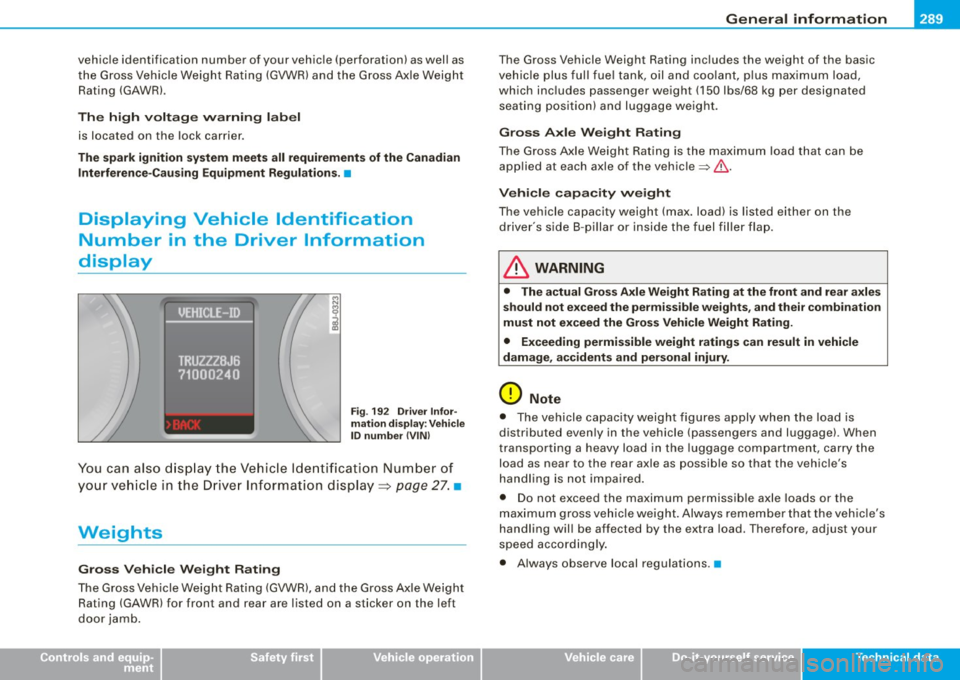
Displaying Vehicle Identification
Number in the Driver Information
display
Fig . 192 Driver Infor
mation display: Vehicle
ID number (VIN)
You can also display the Vehicle Identification Number of
your vehicle in the Driver Information display=:>
page 27. •
Weights
Gross Vehicle Weight Rating
The Gross Vehicle Weight Rating (GVWR), and the Gross Axle Weight
Rating (GAWR) for front and rear are listed on a sticker on the left
door jamb.
Controls and equip ment Safety first Vehicle operation
The
Gross Vehicle Weight Rating includes the weight of the basic
vehicle plus full fuel tank, oil and coolant, plus maximum load,
which includes passenger weight (150 lbs/68 kg per designated
seating position) and luggage weight.
Gross Axle Weight Rating
The Gross Axle Weight Rating is the maximum load that can be
applied at each axle of the vehicle~&.
Vehicle capacity weight
The vehicle capacity weight (max. load) is listed either on the
driver's side 8 -pillar or inside the fuel filler flap.
& WARNING
• The actual Gross Axle Weight Rating at the front and rear axles
should not exceed the permissible weights, and their combination
must not exceed the Gross Vehicle Weight Rating.
• Exceeding permissible weight ratings can result in vehicle
damage, accidents and personal injury.
0 Note
• The vehicle capacity weight figures apply when the load is
distributed evenly in the vehicle (passengers and luggage). When
transporting a heavy load in the luggage compartment, carry the
load as near to the rear axle as possible so that the vehicle's
handling is not impaired.
• Do not exceed the maximum permissible axle loads or the
maximum gross vehicle weight. Always remember that the vehicle's
handling will be affected by the extra load. Therefore, adjust your
speed accordingly.
• Always observe local regulations. •
Vehicle care Do-it-yourself service Tec hn ica l da ta
Page 293 of 316
_______________________________________________________ D_ a _ t_a __ llll
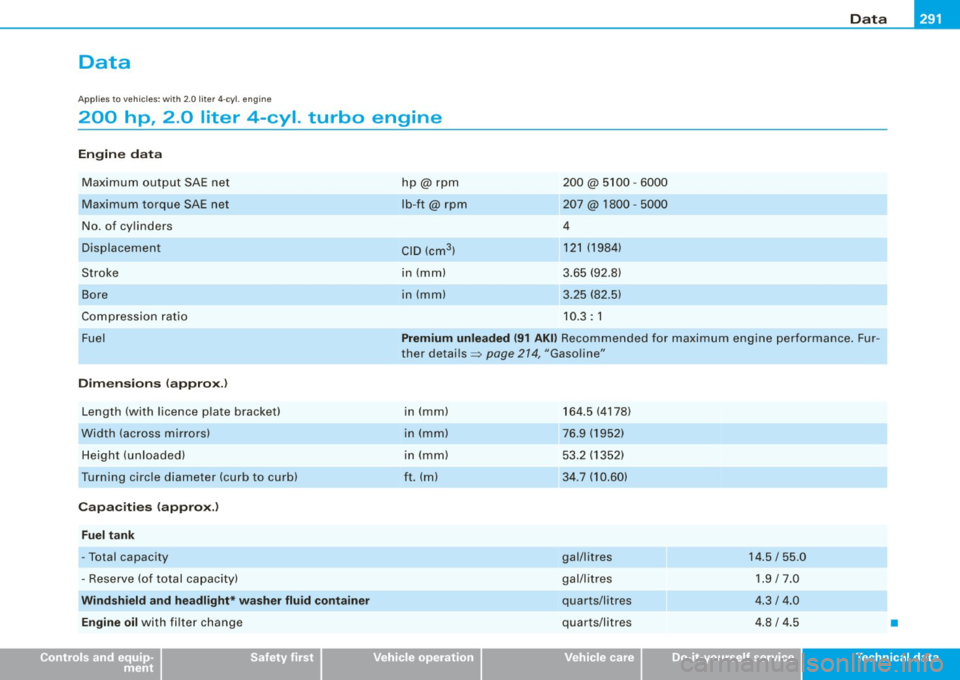
Data
A pplie s t o vehic les: w it h 2 .0 lit er 4-cy l. engi ne
200 hp, 2.0 liter 4-cyl. turbo engine
Engin e da ta
Maximum output SAE net
Maximum torque SAE net
No . of cylinders
Displacement
Stroke
Bore
Compression ratio
Fuel
Dim ension s (app rox.)
Length (with licence plate bracke t)
Width (across mirrors)
Height (unloaded)
Turning circle diameter (curb to curb)
Ca pac ities (a pprox.)
F u el t ank
-Total capacity
- Reserve (of total capacity)
Wind shi eld and he adli ght * was her fluid container
E ngine oil
with filter change
Controls and equip
ment Safety first
hp@rpm
lb-ft@ rpm
CID (cm
3
)
in (mm)
in (mm)
200@ 5100 -6000
207 @ 1800 -5000
4
121 (1984)
3.65 (92.8)
3 .25 (82.5)
10.3 : 1
Premium unleaded (91 AKI) Recommended for maximum engine performance. Fur
ther details =>
page 274, "Gasoline"
in (mm)
in (mm)
in (mm)
ft. (ml
164 .5 (4178)
76.9 (1952) 53 .2 (1352)
34 .7 (10.60)
gal/litres
gal/litres
quarts/litres
quarts/l itres 14.5 / 55 .0
1 .9 / 7.0
4.3
I 4.0
4.8
I 4.5 •
Vehicle operation Vehicle care Do-it-yourself service Tec hn ica l da ta
Page 294 of 316
___ D_ a_ ta ______________________________________________________ _
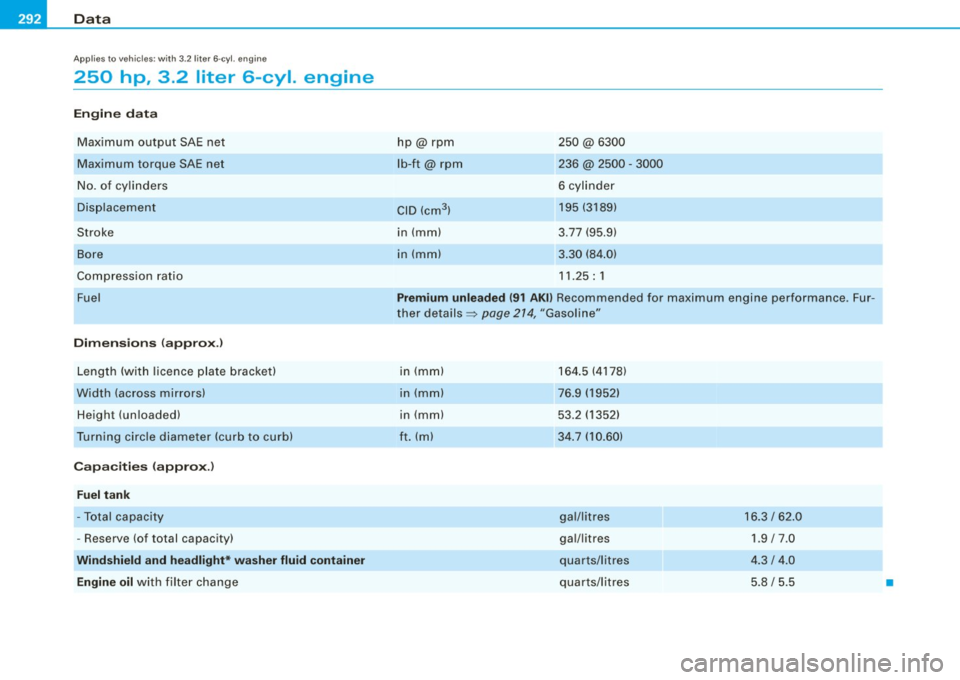
Applies to vehicles : wit h 3.2 liter 6-c yl. en gine
250 hp, 3 .2 liter 6-cyl. engine
Engine data
Max imum output SAE net
Maximum torque SAE net
No . of cy linders
Di spl acement
Stroke
Bo re
Comp ress ion ratio
Fuel
Dimensions (appro x.>
Length (with licence plate brac ket)
Width (across mirrors) Height (un loaded)
Tur ning c ircle diameter (curb to curb)
Capacities {approx .>
Fuel tank
-To tal capacity
- Reserve (of total capacity)
Windshield and headlight* washer fluid container
Engine oil
with filter change hp@ rpm
lb-ft@ rpm
CID (cm
3
)
in (mm)
in (m m)
250@6300
236 @ 2500 -3000
6 cylinder
195 (3189)
3 .77 (95 .9)
3 .30 (84 .0)
11 .25 : 1
Premium unleaded {91 AKll Recommended for maximum engine performance . Fur
t her deta ils =:>
page 214 , "Gasoli ne"
in (m m)
in (m m)
in (mm)
ft . (ml
16 4.5 ( 41 78)
76.9 (1952)
53 .2 ( 1352)
3 4. 7 (10 .60)
gal/litres
gal/ lit res
quarts/litres
quarts/l it re s 16.3 / 62 .0
1 .9 / 7 .0
4.3
I 4 .0
5.8 / 5.5
•
Page 305 of 316
______________________________________________ A_ l_,_ p _h_ a_ b_e _t_i c_ a _ l _in _ d_e _ x __ lllll
Dimensions ... .. ...... . .... .. .. .... 290 Electronic differential lock (EDU
Dipstick Reading the dipstick properly
Direct Shift Gearbox 224
Emergency release . . . . . . . . . . . . . . . 120
Distance ........ .... ....... ...... ... 40
Driver information system . .... .... ... . 22
Digital speedometer ... .. .... ...... 24
Fuel filler cap ...... ..... .... .... .. 24
Menu button ..................... 28
Menu display ..................... 27
Open door or rear lid warning . ......
24
Outside temperature display .. .... .. 23
Parking brake warning ............. 30
red symbols .. ............. ....... 31
Setting ...... .... ... .... ..... .. .. 28
Sound system disp lay ............ .. 23
Text messages . .... .... .... .... ... 30
Driver seat See Seating position . ............. 130
Driving Run -flat tires . .... .... ....... .... . 258
Dr iving messages ... ..... .. ... .... ... 30
Driving safely . . . . . . . . . . . . . . . . . . . . . . . 128
Driving time ... .... ... ..... .... .... .. 39
Duplicate key .... .... ...... ....... ... 47
Dust filter . ....... .... .... ........ ... 99
E
Electro -mechanical power assist ... 21, 190 How the system works
............ 186
Warning/indicator lights ............ 20
Electronic immobilizer ...... ... .. .. 14, 49
Electronic power cont ro l
EPC warning/indicator light ..... .... 17
Electronic Stability Program .......... 184
Electronic stabilization program (ESP! Warning/indicator lights ........ .... 18
Emergency flasher Warning/ind icator lights .. .... ...... 19
Emergency flashers .................. 75
Emergency locking . ... .... .... ... .. .. 54
Emergency operation Folding top ....................... 64
Rear lid .. .... ....... .... .... .... . 56
Emergency release for selector lever ... 120
Emergency starting ........ ... .... ... 278
Emergency towing .. ............. .. . 281
Engine Cecking and filling locations ... ... . 222
Checking and filling locations ...... 221
Coolant ... .. .... .... ..... .. ... .. 227
Hood . ..... .. ... ... .. .... ..... .. 219
Starting ..................... 106, 107
Starting with jumper cables ........ 278
Stopping .... .... ...... ...... ... . 107
Engine compartment .... ...... ...... 221
Safety instructions ................ 220
Working in the engine compartment 220
Engine coolant sys tem ..... .... ...... 227
Adding coolant .... .... ..... ... ... 228
Checking the engine coolant leve l .. . 228 Radiator fan
... .. .. .. .... .... .... 229
Temperature gauge ................ 13
Engine cooling system Malfunction ... .. .... .... .... ..... 32
Engine data .. ............... .... ... 291
Engine hood Closing .. ... ........ .... ... ..... 220
How to release the hood ... ... ... .. 219
Engine oil . ...... .... .... ... .... .... 222
Adding .... ....... .... ... .... .... 225
Additives .. .... .... ... .... .... ... 225
Changing . .... .... .... ..... ..... . 226
Checking the engine oi l leve l ... .... 224
Indications and conditions requiring extra checking .... .... .... .... .... ... 224
Oil consumption . ...... ..... .. .... 224
Oil grades . ....... .... .... ....... 222
Pressure malfunction .............. 33
Recommended oil check intervals ... 224
Specification and viscosity ......... 222
Engine oi l leve l .. .... .... ... .... .... . 35
Engine oil sensor defective .... ...... .. 35
Environment Break-in period ..... .. ... .... .... . 192
Catalytic converter .......... ... .. . 193
Disposing of your vehic le battery .. . 231
Driving at high speeds . ...... .... . 194
Dr iving to minim ize pollution and noise .
194
Fuel .. .... .... .... ... .... .... ... 216
Fuel economy ......... ........ ... 194
Leakage from your vehicle . .... .... 220
Letting the vehicle stand and warm up ..
195
Controls and equip ment Safety first Vehicle operation
Vehicle care Do-it-yourself service Technical data
Page 306 of 316
__ _!:_A~l'.!:p~ h~ a~ b~e~ t~ic ~a..'.... l ~in~d~e ~x~ --------------------------------------------
Proper disposal of drained brake fluid ...
230
Proper disposal of drained engine
coolant . ............ .... ...... . 228
Proper disposa l of drained engine oil
225,226
Recycling used engine oil ..... .... 225
Un leaded fuel .... ............... 214
What should I do with an old battery?
231
EPC
See Electronic power control . . . . . . . . 17
ESP
See Electronic Stability Program .... 184
Event Da ta Recorder (EDR) . . . . . . . . . . . 184
Expansion tank 228
F
Fan 100
Radiator . . . . . . . . . . . . . . . . . . . . . . . . 229
Flat tire Changing ....................... 267
Floor mats . . . . . . . . . . . . . . . . . . . . . . . . . 134
Fog lights, front ..................... 73
Folding master key with remote contro l . 47
Fo lding top .. ..... .. .... .... ........ 60
Automatic folding top . . . . . . . . . . . . . 62
Care and cleaning ...... ........ .. 203
Emergency operation . . . . . . . . . . . . . . 64
General . .... ... .. .... .... ...... .. 60
manual folding top ........... ..... 61
Warning/indictor lights .. ........ .. 18
Wind deflector . . . . . . . . . . . . . . . . . . . . 64 Foot pedals
. . . . . . . . . . . . . . . . . . . . . . . . 134
For the sake of the env ironment
Gasoline fumes and the environment 2 16
Letting your engine warm up . ..... 107
Reducing engine noise by early
upshifting .................. .... 12
Refueling ... .. .... .... .... ...... 216
Saving fuel by early upshifting ...... 12
Front airbags Description ..... ..... ...... ...... 150
How they work . . . . . . . . . . . . . . . . . . . 155
Front seats . . . . . . . . . . . . . . . . . . . . . . . . . . 87
Adjusting ......... .... .... ...... 131
Adjusting the manual seats .. .... ... 89
Child restraints in the front seat .... 147
Fronta l col lisions and the laws of physics ...
138
Fuel Additives .. ....... .... .......... 214
Blended gasoline ................. 214
Consumption .. ............. ...... 39
Fi ller neck . .... ........ ... ....... 215
Fuel gauge . . . . . . . . . . . . . . . . . . . . . . . 14
Gasoline ........... ... .... .... .. 214
Gasoline additives .... .... ... .. ... 215
Octane rating ... .. .... .... .... ... 214
Recommendation . . . . . . . . . . . . . . . . 214
Refuelling ..... ........ .... ... ... 216
Reserve .. .... ....... ...... .... ... 14
Tank capacity . .... ... .... ..... ... 291
Unlocking the fuel filler flap by hand 218
Fuel fi ller cap ......... .... .... ... .... 24
Fuel supply too low ........ ....... ... 35 Fuse
arrangement .... ... .. .. . .... .. . 274
G
Garage door opener ... .......... .... 121
Gas discharge lamps ...... ... .... ... 277
Gauges Engine coolant temperature ........ 13
Fuel gauge .... .... ....... .... .... 14
Tachometer ........... ...... .... . 12
Gearshift lever
6 -speed manual transmission ... ... 113
Generator Warning/indicator lights ............ 19
G lossary of tire and loading terminology ...
239
G love compartment ...... .... .... .... 96
Gross Vehicle Weight Rating (GVWR) ... 289
H
Head restraints ........ ... ........ .. 132
Adjusting .. ........... .... .... .. 132
Headlight Defective . . . . . . . . . . . . . . . . . . . . . . . . . 36
Headlight range control
defective .......... .... ....... .... 35
Headlights .... ....... .... ... .... .... 69
adaptive light ...... ........ .... ... 72
Front fog lights ... .... .... .... .... 73
Switching off ... .... ...... .... .... 69
Switching on ...... .... ....... .... 69
Washer system . . . . . . . . . . . . . . . . . . . 79
Page 312 of 316
__ _!:_A~l'.!:p~ h~ a~ b~e~ t~ic ~a..'.... l ~in~d~e ~x~ --------------------------------------------
Trip computer
Fuel consumption ................. 39
Mi leage .. ........ ........ .... ... 39
Trip odometer .. ...... .... ........ ... 14
What does it mean when dEF appears in the trip odometer display? ... ... .. 14
Trunk lid .... ........ ............. .. 55
Trunk escape handle ... .. .... .... 262
Turn signals ................. ....... 76
Warning/indicator lights ........... 19
u
Undercoating 207
Unfastening safety belts ...... ...... . 143
Unidirectional tires .................. 238
Uniform tire quality grading . ......... 253
Universal Radio- Frequency Remote Control (Homelink®) . . . . . . . . . . . . . . . . . . . 121
Un locking
Power locking switch . . . . . . . . . . . . . . 53
Rear lid/trunk lid ...... .... ...... .. 55
Remote control key ..... .. .... .... . 51
Using the key ... .. .... .... ...... .. 53
V
Vanity mirror ...... .. .... ........ .... 77
Vehic le electrical system .. ........ .... 19
Vehicle Identification Number (VIN) .... 288
Vehic le jack . . . . . . . . . . . . . . . . . . . . . . . . 269
Vehicle literature ............. ........ 5
Vehic le tool kit . . . . . . . . . . . . . . . . . . . . . 262 Vehicle-care products
...... ........ . 200 Power top cleaning ..... .. .... ... . 203
Venti lation ... ............ .... .... ... 98 with a power washer
....... .... ... 202
Waxing .......... .... .... ....... ... 203
w Wear indicator ..... ... ... .... ....... 248
Warning light
Tire pressure monitoring system 37
Warning lights ...................... 16 Weatherstrips
.... ....... .... .... ... 206
Weights ....... .. .... .... ...... .... 289
What happens if you wearyoursafety belt too loose? ..... .. .... .............. 142
Warning/Indicator light
Rear spoi ler ... ... .... ........ .... 18 What happens to unbelted occupants? .
139
What impairs driving safety? ... .... ... 129
Warning/indicator ligh1ts ... .. · · · · · · · · · 12 What should I do after changing a wheel? ..
Airbag system . . . . . . . . . . . . . . . . . . . . 19 245
Anti -lock brake system (ABS) · · · · · · · · 20 What shou ld I do after replacing whe els?
Brake system . . . . . . . . . . . . . . . . . . . . . 20 245
Cruise control . . . . . . . . . . . . . . . . . . . . 19
Electronic power control ........... 17
El ec tronic stabilization program (ESP) 18
Folding top ...... ... .. ... ... .. .... 18
Generator . . . . . . . . . . . . . . . . . . . . . . . . 19
High beam . . . . . . . . . . . . . . . . . . . . . . . 18
Malfunction Indicator Lamp (MIU .... 18
Parking brake . . . . . . . . . . . . . . . . . . . . . 20
Safety be lt . . . . . . . . . . . . . . . . . . . . . . . 19
Tire pressure monitoring system .... 17
Turn signals .. ....... ...... ....... 19
Warranty coverages .. ........ .... ... 293
Washer reservoir ..... .... ... ..... ... 236
Washing ........ ....... ...... .... .. 200
Automatic car wash ........... ... 201
by hand ......... ......... ... ... 201
Folding top cleaning ...... ... .. ... 203
General information ......... ..... 200 Wheel bolts
Torque ......................... 256
Wheels .............. ....... .... ... 238
Cast alloy .................... ... 207
Checking tire pressure ............ 244
Co ld tire inflation pressure ....... . 242
General notes .......... .......... 238
Glossary of tire and loading terminology .
239
New tires and whee ls .. ... .. ...... 249
Tires and vehicle load limits ... .... 246
Wheels/Tires Steel wheels ... .... .... ...... .... 206
When must the airbag system be inspected?
157
When should I adjust the tire pressures? 245
When should I check the tire pressures? 245