stop start AUDI TT ROADSTER 2008 Owner's Manual
[x] Cancel search | Manufacturer: AUDI, Model Year: 2008, Model line: TT ROADSTER, Model: AUDI TT ROADSTER 2008Pages: 316, PDF Size: 70.1 MB
Page 222 of 316
-~_C_ h_e _c _ k_ i_n ...:::g::;...._ a_n_ d_ f_ i_ll _in -'g:::;.._ ___________________________________________ _
Closing the engine hood
- Pull the hood down until the pressure from the struts is
reduced.
- Let the hood
drop down and latch in place. Do not try to
push it shut;
it may fail to engage~& .
& WARNING
A hood that is not completely latched could fly up and block your
view while driving.
• When you close the engine hood, check it to make sure the
safety catch has properly engaged. The hood should be flush with
the surrounding vehicle body parts.
• If you notice while driving that the hood is not secured prop
erly, stop at once and close it. •
Working in the engine compartment
Be especially careful whenever you work in the engine
compartment!
Whenever you must perform any work in the engine compartment,
for example checking and filling the different fluids, there is a risk of injury, burns and accidents. To prevent personal injury always
observe the following WARNINGS. The engine compartment of any
vehicle is a hazardous area!
=> &
& WARNING
To help avoid injury, before you check anything under the hood :
• Switch off the engine.
• Remove the ignition key.
• Apply the parking brake.
& WARNING (continued)
• Move selector lever of automatic transmission to "P" {Park);
put manual transmission in Neutral.
• Always let the engine cool down. Hot components will burn
skin on contact.
• To reduce the risk of being burned, never open the hood if you
see or hear steam or coolant escaping from the engine compart
ment. Wait until no steam or coolant can be seen or heard before
carefully opening the hood .
• Keep children away from the engine compartment.
• Never spill fluids on hot engine components. They can cause a
fire.
• Never touch the radiator fan. The auxiliary electric fan is
temperature controlled and can switch on suddenly.
• Never open the coolant reservoir cap when the engine is still
warm. The coolant system is pressurized and hot coolant could
spray out.
• Protect your face, hands and arm from steam or hot engine
coolant by placing a thick rag over the cap when you open the
coolant reservoir.
• If work on the fuel system or the electrical system is necessary:
- Always disconnect the battery .
- Never smoke or work near heaters or open flames. Fluids in
the engine compartment could start a fire.
- Keep an approved fire extinguisher immediately available.
• To avoid electrical shock and personal injury while the engine
is running or being started, never touch :
- Ignition cables
- Other components of the high voltage electronic ignition
system.
• If you must perform a check or repair with the engine running: .,_
Page 268 of 316
11111.___W_ h_ a _ t_d_ o_ l _d _o_ n_ o_ w_ ? ______________________________________________ _
- Switch the electric air pump off - switch in position
0. If
the required tire pressure of at least 1.8 bar has not been
reached, follow the instructions in the section Re
inflating tire.
Re-inflating tire
-Remove the hose from the valve and pull the plug out of
the socket.
- Drive the vehicle slowly 10 meters backward or forward.
This helps to distribute the sealant better.
- Remove the empty inflation bottle and screw the hose
G)
=> page 265, fig. 169 from the electric pump directly onto
the valve.
- Insert the plug ©=>
page 265, fig. 169 into the socket for
the cigarette lighter.
- Move the switch
@ => page 265, fig. 170 on the electric
air pump
31 to position I. After 5 minutes, tire pressure
must have reached at least
1 .8 bar.
- Switch the electric air pump off - switch in position
0. If
the required tire pressure of at least 1.8 bar has not been reached, it is not possible to make a repair with the tire
sealant. Seek professional assistance.
Disassembling Tire Mobility System
- Remove the hose from the valve and pull the plug out of
the socket.
- Screw the dust cap onto the valve.
- Place the empty sealant bottle back in the original pack-
aging and cl ip it in place under the floor so that no tire
sealant can run out into t he vehicle. -
Place the electric air pump in the luggage compartment
for the time being.
- Start driving right away so that the sealant is distributed
in the tire.
& WARNING
• Follow the manufacturer's safety instructions on the decal for
the air pump and the sealant bottle.
• If a tire pressure of 1.8 bar cannot be achieved after pumping
for 5 minutes, the tire is too severely damaged. Do not continue to
drive.
• Seek professional assistance if it is not possible to repair the
tire with the tire sealant.
[ i] Tips
• Do not operate the electric air pump for more than 8 minutes
without stopping, otherwise it can overheat. When the air pump has
cooled down, you can continue to use it.
• If sealant has escaped, allow it to dry, then you can peel it off. •
Applies to vehic les : with Tire Mobil ity Sys tem
Final check
After driving for a short distance , tire pressure
must be checked
- After driving for about 10 minutes, stop and check the
tire pressure .
- If tir e pressure is still at least 1.3 bar, inflate the tire to
specified pressure (see driveas side B -pillarl, drive to the
next repair shop and have the tire and the sealant bottle
replaced.
~
Page 282 of 316
llll1.--___;E::. m :..:..:. e .::..:..r_,.g ~e:..: n:..:..: c:.!y ;__: s:... i..:.t ..:.u :...a ..:.t:... i..::o ..:.n..:.. s::.... ______________________________________________ _
6. Connect one end of the black jumper cable to the nega
tive term inal
0 of t he booster bat tery @.
7. Connect the other end of the balck jumper cable to the negative terminal (bolt head)
G) in the external starting
point @ of your ve hic le.
8. Route the jumper cables so tha t they cannot catch in any
rotating parts in the engine compartment.
Starting the engin e
9. Start the engine of the vehicle providing assistance and
allow it to run at id le.
10 . Now start t he engine o f the ve hicle wit h the disc harged
battery, wa it for two to three minutes until t he engine
"runs" smoothly.
11 . If the engi ne does not start : Stop tryi ng after 10 seconds
and t hen try ag ain after abo ut 30 secon ds.
12. In the vehicle that has received start assistance, turn on
the heate r blower and the rear window heating to elimi
nate any voltage pea ks when disconnecting. Driving
lights must be switched off!
1 3. Disconnect the cable while the engine is running exactly
in
reverse order to that described in=> page 279,
"Connecting/d isconnecting the jumper cable .". When
doing so, make sure t hat the cable cannot contact
rotating engine parts.
14 . Close the cover on the pos itive terminal.
The battery is vented to the outside to prevent gases from entering
the vehic le interior. Make sure that the jumper clamps are well
connected with their
metal parts in full contact with the battery
termina ls .
& WARNING
To a vo id se riou s pe rso nal in jur y a nd d am age t o the vehi cle, heed
all wa rnings and in stru ction s of th e jumper cable manuf acturer. If
i n doubt , call for r oad ser vic e.
• Jumper c able s mu st be long enough so that the vehicle s do not
t o uch .
• When connecting jumper cable s, make sur e th at they cannot
g et ca ught in any mo ving p arts in the eng ine comp artment .
• Bef ore you che ck anyth ing in the engin e comp artment , alway s
r ea d and heed all WARNING S=:,
page 21 2, "Engine c omp artment ".
0 Note
Improper hook -up of jumper cables can ruin the generator .
• Always connect POS ITIVE ( +l to POSITIVE(+), and NEGAT IVE( -) to
NEGAT IVE( -) ground post of the battery manager control unit .
• Check that al l screw plugs on the battery cells are screwed in
firm ly . I f not, tighten plugs prior to connecting clamp on negative
battery terminal.
• Please note that the procedure for connect ing a jumper cable as
described above applies specifical ly to the case of your vehicle
being jump started. When you are giving a jump start to another
vehicle, do
not connect the negative(-) cable to the negative 1- l
terminal on the discharged battery@. Instead, securely connect
the negative( -) cable to either a sol id metal component that is
firm ly bolted to the engine block or to the engine block itself . If the
battery that is being charged does not vent to the outside, escaping
battery gas could ignite and explode! •
Page 305 of 316
______________________________________________ A_ l_,_ p _h_ a_ b_e _t_i c_ a _ l _in _ d_e _ x __ lllll
Dimensions ... .. ...... . .... .. .. .... 290 Electronic differential lock (EDU
Dipstick Reading the dipstick properly
Direct Shift Gearbox 224
Emergency release . . . . . . . . . . . . . . . 120
Distance ........ .... ....... ...... ... 40
Driver information system . .... .... ... . 22
Digital speedometer ... .. .... ...... 24
Fuel filler cap ...... ..... .... .... .. 24
Menu button ..................... 28
Menu display ..................... 27
Open door or rear lid warning . ......
24
Outside temperature display .. .... .. 23
Parking brake warning ............. 30
red symbols .. ............. ....... 31
Setting ...... .... ... .... ..... .. .. 28
Sound system disp lay ............ .. 23
Text messages . .... .... .... .... ... 30
Driver seat See Seating position . ............. 130
Driving Run -flat tires . .... .... ....... .... . 258
Dr iving messages ... ..... .. ... .... ... 30
Driving safely . . . . . . . . . . . . . . . . . . . . . . . 128
Driving time ... .... ... ..... .... .... .. 39
Duplicate key .... .... ...... ....... ... 47
Dust filter . ....... .... .... ........ ... 99
E
Electro -mechanical power assist ... 21, 190 How the system works
............ 186
Warning/indicator lights ............ 20
Electronic immobilizer ...... ... .. .. 14, 49
Electronic power cont ro l
EPC warning/indicator light ..... .... 17
Electronic Stability Program .......... 184
Electronic stabilization program (ESP! Warning/indicator lights ........ .... 18
Emergency flasher Warning/ind icator lights .. .... ...... 19
Emergency flashers .................. 75
Emergency locking . ... .... .... ... .. .. 54
Emergency operation Folding top ....................... 64
Rear lid .. .... ....... .... .... .... . 56
Emergency release for selector lever ... 120
Emergency starting ........ ... .... ... 278
Emergency towing .. ............. .. . 281
Engine Cecking and filling locations ... ... . 222
Checking and filling locations ...... 221
Coolant ... .. .... .... ..... .. ... .. 227
Hood . ..... .. ... ... .. .... ..... .. 219
Starting ..................... 106, 107
Starting with jumper cables ........ 278
Stopping .... .... ...... ...... ... . 107
Engine compartment .... ...... ...... 221
Safety instructions ................ 220
Working in the engine compartment 220
Engine coolant sys tem ..... .... ...... 227
Adding coolant .... .... ..... ... ... 228
Checking the engine coolant leve l .. . 228 Radiator fan
... .. .. .. .... .... .... 229
Temperature gauge ................ 13
Engine cooling system Malfunction ... .. .... .... .... ..... 32
Engine data .. ............... .... ... 291
Engine hood Closing .. ... ........ .... ... ..... 220
How to release the hood ... ... ... .. 219
Engine oil . ...... .... .... ... .... .... 222
Adding .... ....... .... ... .... .... 225
Additives .. .... .... ... .... .... ... 225
Changing . .... .... .... ..... ..... . 226
Checking the engine oi l leve l ... .... 224
Indications and conditions requiring extra checking .... .... .... .... .... ... 224
Oil consumption . ...... ..... .. .... 224
Oil grades . ....... .... .... ....... 222
Pressure malfunction .............. 33
Recommended oil check intervals ... 224
Specification and viscosity ......... 222
Engine oi l leve l .. .... .... ... .... .... . 35
Engine oil sensor defective .... ...... .. 35
Environment Break-in period ..... .. ... .... .... . 192
Catalytic converter .......... ... .. . 193
Disposing of your vehic le battery .. . 231
Driving at high speeds . ...... .... . 194
Dr iving to minim ize pollution and noise .
194
Fuel .. .... .... .... ... .... .... ... 216
Fuel economy ......... ........ ... 194
Leakage from your vehicle . .... .... 220
Letting the vehicle stand and warm up ..
195
Controls and equip ment Safety first Vehicle operation
Vehicle care Do-it-yourself service Technical data
Page 311 of 316
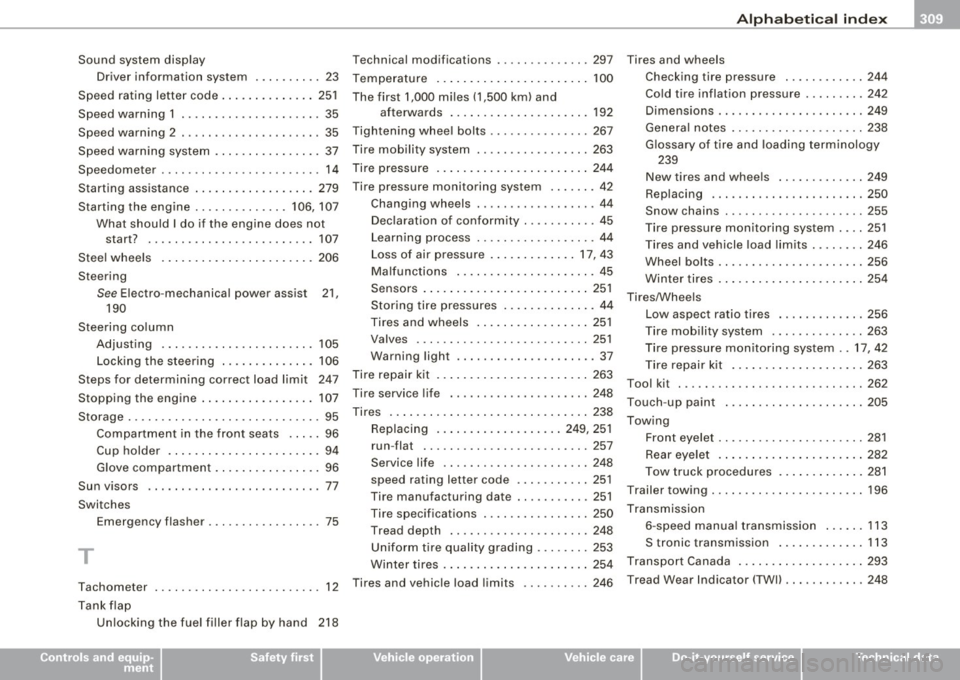
______________________________________________ A_ l_,_ p _h_ a_ b_e _t_ic _ a _ l _in _ d_e _ x __ lll
Sound system display
Driver info rma tion system .... .... .. 23
Speed rating letter code ........... ... 251
Speed warning 1 . .... ...... ... .. .... . 35
Sp eed warning 2 . .... .... ... ... ... .. . 35
Speed warning system ... .... .. .. .... . 37
Speedometer . . . . . . . . . . . . . . . . . . . . . . . . 14
Starting assistance ...... .... ...... .. 279
Starting the engine .. .... .... ... . 106, 107
What should I do if the engine does not
star t? ........ .... .... ... .. ... . 10 7
Stee l wheels .... ....... .... .. . ..... 206
Steering
See Electro-mechanical power assist 21,
190
Steering co lumn
Adjusting .... ... .... .... ...... .. 105
Locking the steering ... .. .... .... . 106
Steps fo r determining co rrect load limit 247
Stopping the engine ...... ....... .... 107
Storage . .... .... .... .... ... .... .... . 95
Compartment in the front seats . .... 96
Cup holder ... .... .... ......... ... 94
Glove compartment ...... .... .... .. 96
Sun visors .. .. .. ..... ... ..... .. ..... 77
Switches Emergency flasher ..... .. .... .... .. 75
T
Tachometer ... .. .... .... ... .... .... . 12
Tank flap
Un locking the fuel filler flap by hand 218
Controls and equip
ment Safety first
Technical
modifications ..... .... ..... 297 Tires and wheels
Tempera ture ............ ... .... .... 100 Checking tire pressure .
.... ...... . 244
The firs t 1,000 miles ( 1,500 kml and Co
ld tire inflation pressure . ... ... .. 242
afterwards ... .. .. .. .... .... .... 192 Dimensions
.. ... .... ... .. .... .... 249
Tightening whee l bolts ... .... .... .... 267 General
notes ...... ... .... ...... . 238
Tire mobility system .... ....... .... .. 263
Tire pressure .... .. ...... .... ....... 244 G
lossary of tire and loading terminology
239
New tires and wh eels . ....... .... . 249
Tire pressure monitor ing system ...... . 42
Changing wheels ........... .... ... 44
Declaration of conform ity . .... .... .. 45
Learning process . ..... ... .... .... . 44
Loss of air pressure ........... .. 17, 43
Malfunctions ... .. .... .... .... ... . 45
Sensors ........... ... .... ....... 251
Storing tire pressures ............. . 44
Tires and wheels ...... .... .... ... 251
Valves ....... .... .... .... .... ... 25 1
Warning light ..... .. .... .... .... .. 37
Tire repair kit ... ... ...... .... .... ... 263
Tire service life ........ .... ... .... .. 248
Tires .... .. . ... ... ................. 238
Replacing .... .... .... .... ... 249, 251
run -flat .. .... ... .... .... .... .... 257
S ervice lif e ..... .... ... .. .... .... 248
speed ra ting let ter code ..... .. ... . 251
Tire manufacturing date . .... ...... 251 Replacing
..... .. .... .... ..... .. . 250
Snow chains ...... .... .. . .. .. .... 255
Ti re pressure monitoring system .... 251
Tires and vehicle load limits ... .... . 246
Wheel bo lts ... .... .... ... .... .... 256
Winter tires ... .... .... ....... .. .. 254
Ti res/Wheels
Low aspect ratio tires . .... ...... .. 256
Tire mob ility system ..... .. .... ... 263
Tire pressure mon itoring system .. 17, 42
Tire repair kit ................ .... 263
Tool kit ..... .... ... .. .... .. .... .... 262
Touch -up paint ... .. .... .... .... .... 205
Towing Front eyelet ... ... ..... ... .... .... 281
Rear eyelet ... .... .... .... ....... 282
Tow truck procedures .. ...... .... . 281
Trailer towing .......... .. ...... .... . 196
Tire specifica tions . ...... ... .... .. 250 Transmission
Tread depth ..... .... ...... .. .... 248 6
-speed manua l transmission ...... 113
Uniform tire quality grading ... ..... 253 S tronic transm
ission ............. 113
Winter tires .... .... ... .... ....... 254 Transport Canada
........ .. .. ....... 293
Tires and vehicle load limits ... ....... 246 Tread
Wear Indicator (TWI) ... .... .... . 248
Vehicle operation Vehicle care Do-it-yourself service Technical data