warning AUDI TT ROADSTER 2011 Owners Manual
[x] Cancel search | Manufacturer: AUDI, Model Year: 2011, Model line: TT ROADSTER, Model: AUDI TT ROADSTER 2011Pages: 260, PDF Size: 64.11 MB
Page 129 of 260
routed around the child restraint as descri
bed in the chi ld restraint manufacturer's
instruct ions;
- make sure that the convertible locking fea
ture on the safety belt for the front passen ger seat has been activated and that the
safety belt has been pulled tight. The belt must not be loose or have loops of slack so
that the sensor below the safety belt latch
on the seat can do its job
~ page 144 .
-make sure that th ings that may increase the
weight of the ch ild and child safety seat are
not being transpo rted on the front passen
ger seat;
- make sure that the safety belt tension sen
sor is not b locked. Shake the safety belt
latch on the front passenge r sea t back and
forth;
- If a st rap or tether is being used to tie the
child safety seat to the front passenger
seat, ma ke s ure that i t is not so tight tha t it
ca uses the weight -sensing mat to meas ure
more weight than is actually on the seat .
If the PASSENGER AIR BAG OFF light still
d oes not come o n
and does not stay on con
tinuously (when the ignition is switched on),
- ta ke the ch ild restraint off the front passen-
ger seat and insta ll it p roperly at one of the
rear seat pos itions. Have the a irb ag system
inspected by your A udi dealer immediately.
- move the chi ld to a rea r seat posi tion and
make su re that the ch ild is p roperly res train
ed in a child restraint that is appropriate for
its size and age .
The
PASSENGER AIR BAG OFF light shou ld
NO T come on when the ign ition is on and an
ad ult is sitting in a proper seating position on
the front passenger seat.
If the PASSENGER
AIR B AG O FF
light comes on and stays on or
flashes for about 5 seconds while dr iv ing, un
der these circumstances, make sure that:
- the ad ult on the front passenger seat is
properly seated on the center of the seat
c u shi on with h is or her back up against the
backrest and the backrest is not reclined
A irbag system 127
~ page 99, Proper occupant seating posi
tions,
- the adult is not tak ing we ight off the seat by
holding on to the passenger assist handle
above the front passenger door or support
ing their weight on the armrest,
- the safety be lt is being properly worn and
that there is not a lot of s lack in the safety
be lt webbing,
- accessory seat covers or cushions or other
things that may cause an incorrect reading
or impression on the weight-sensing mat
under the upho lstery of the seat have been
removed from the front passenger seat,
- a safety belt extender has not been left in
the safety belt latch for the front passenger
seat .
In add ition to the
PA SSEN GER AIR BAG O FF
light in the center of the instrument panel,
the message
PASS ENGE R AIR BAG O FF or
PASSENGER AIR BAG ON w ill briefly appear
i n the instrument cluster d isp lay . This is to in
form the dr iver of the current front passenge r
a irbag sta tus.
Important safety instructions on
monitoring the Advanced Airbag System
A WARNING
An ai rbag system that is not functioning
p roperly cannot provide supplemental pro
tection in a frontal crash.
- If the airbag ind icator light comes on, it
means that there may be something
wrong wi th the Advanced Airbag Sys tem.
It is poss ible that the ai rbag w ill inflate
when it is not supposed to, or will not in
f late when it sho uld .
- Have the airbag system inspected imme
diate ly by yo ur Audi dealer.
A WARNING
If the front airbag inflates, a child without
a child restraint, in a rearward -facing child
safety seat or in a forward-facing child re
straint that has not been proper ly installed
-
will be ser ious ly injured and can be killed. ~
•
•
Page 130 of 260
128 Airbag system
-Even though your vehicle is equipped
with an Advanced Airbag System, make
certain that all children, especially 12
years and younger, always ride on the
back seat properly restrained for their
age and size.
- If you must install a rearward-facing
child safety seat on the front passenger
seat because of exceptional circumstan
ces and the
PASSENGER AIR BAG OFF
light does not appear and stay on, imme
diately install the rear-facing child safety
seat in a rear seating position and have the airbag system inspected by your Audi
dealer.
- A tight tether or other strap on a rear
ward-facing child restraint attached to
the front passenger seat can put too
much pressure on the weight-sensing
mat in the seat and register more weight
than is actually on the seat. The heavier
weight registered can make the system
work as though an adult were on the seat
and deploy the Advanced Airbag when it
must be suppressed causing serious or
even fatal injury to the child.
- If, in exceptional circumstances, you
must install a forward-facing child re
straint on the front passenger seat, al
ways move the seat into its rearmost po
sition in the seat's fore and aft adjust
ment range, as far away from the airbag
as possible. The backrest must be adjust
ed to an upright position . Make sure that
the
PASSENGER AIR BAG OFF light
comes on and stays on all the time when
ever the ignition is switched on.
A WARNING
- If the PASSENGER AIR BAG OFF light
does not go out when an adult is sitting
on the front passenger seat after taking
the steps described above, have the air
bag system inspected by your Audi deal
er before transporting anyone on the
front passenger seat.
-
(!) Tips
If the weight-sensing mat in the front pas
senger seat detects an empty seat, the
front airbag on the passenger side will be
turned
off, and PASSENGER AIR BAG OFF
will stay on.
Repair , care and disposal of the airbags
Parts of the airbag system are installed at
many different places on your Audi. Installing,
removing, servicing or repairing a part in an
area of the vehicle can damage a part of an
airbag system and prevent that system from
working properly in a collision.
There are some important things you have to
know to make sure that the effectiveness of
the system will not be impaired and that dis
carded components do not cause injury or pol
lute the environment.
A WARNING
-Improper care, servicing and repair proce-
dures can increase the risk of personal in
jury and death by preventing an airbag from deploying when needed or deploying
an airbag unexpectedly:
- Never cover, obstruct, or change the
steering wheel horn pad or airbag cover
or the instrument panel or modify them
in any way.
- Never attach any objects such as cup
holders or telephone mountings to the
surfaces covering the airbag units.
- For cleaning the horn pad or instrument
panel, use only a soft, dry cloth or one
moistened with plain water. Solvents or
cleaners could damage the airbag cover
or change the stiffness or strength of the material so that the airbag cannot de
ploy and protect properly.
- Never repair, adjust, or change any parts
of the airbag system.
- All work on the steering wheel, instru
ment panel, front seats or electrical sys-
tem (including the installation of audio
II),
Page 132 of 260
130 Airbag system
& WARNING
Cha nging the vehicle's suspension includ
ing use of unapproved tire -r im combina
tions can change Advanced Airbag per
formance and increase the risk of serious pers onal in jury in a crash.
- Never install suspens ion components
t h at do not have the same performance
c harac teristics as the components origi
n ally inst alled on you r vehicle.
- Never use ti re- rim combinat io ns that
h ave not been approved by A udi.
& WARNING
-
Ite ms stored be tween the s afety bel t
buckle and the center console can cause
the senso rs in the buckle to send the
w rong informat ion to the elect ronic con
trol mod ule and prevent the Advanced A ir
bag System from work ing proper ly.
- Always make sure that noth ing can inter
fere w ith the sa fety belt buckles and that
they a re not obstructed.
@) For the sake of the environment
Unde ployed airbag modu les and preten
sioners might be classified as Perchlorate Material -specia l hand ling may apply, see
www.dtsc.ca.gov/haza rdouswaste/per chlorate . Whe n the vehicle or parts of the
restraint system including airbag modules
safety belts w ith pretens ioners ar e scrap
pe d, all appli cable laws and regulat io ns
m ust be observed. Yo ur authoriz e d Au di
dea le r i s f amiliar wit h these requ ireme nts
an d we recommend th at you have your
dea le r p erfo rm this service for you.
Knee airbags
Description of knee a irbags
The airbag system can provide supplemental
protection to properly restrained front seat occupants .
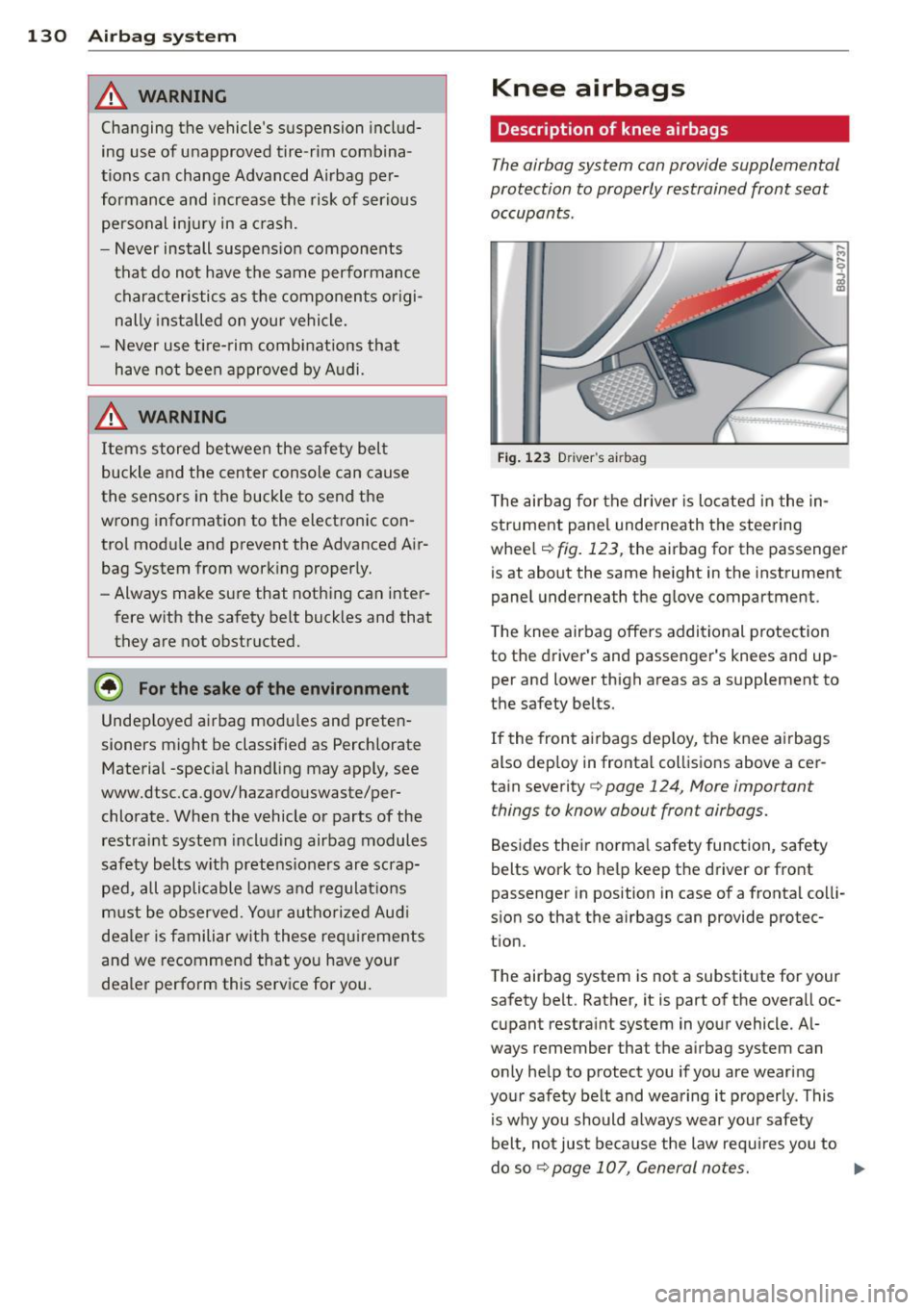
Fig . 1 23 Driv er's ai rbag
T he airbag for the driver is lo ca ted in the in
str ument pane l unde rneath t he stee ring
whee l
I:!) fig. 123, the airbag for the passenger
is at about the same height in the instrument
pane l underneath t he glove compartment .
T he knee airbag offe rs addi tional protection
to the d river 's and passenger's knees and up
per and lower thigh areas as a s upplement to
the safety belts.
If the fron t ai rbags dep loy, the knee a irbags
also dep loy in frontal collisions above acer
ta in seve rity
¢ page 124, More important
things to know about front airbags.
Besides the ir norma l safety func tion, safety
belts work to he lp keep the d river or front
passenger in position in case o f a fronta l co lli
s ion so that the a irbags can provide protec
t ion.
T he airbag system is not a substit ute for your
safety belt. Rather, it is part of the overa ll oc
cupant restra int system in yo ur vehicle. A l
ways remember that the a irbag system can
only help to protect you if you are wearing
you r safety belt and wearing it p roperly . This
i s why you should always wear your safety
belt , no t jus t be ca use the law requ ires you to
do so
¢ page 107, General no te s . ..,.
Page 133 of 260
The safety belt buckle for the driver and front
seat passenger have switches that tell the air
bag control mod ule if the safety belt is being
used or not. If the safety belt is being used,
the knee airbag will deploy at a slightly higher
rate of deceleration than if the belt is not be
i ng used. Therefo re, i n a pa rtic ular collision, it
is poss ible that an airbag will not deploy at a
seating position whe re the safety belt is being
used but will inflate at the position whe re the
safety be lt is not being used .
R emembe r too, airbags will deploy only once
and on ly in ce rtain kinds of accidents -your
safety be lts are a lways there to offer pro te c
t ion in those acc idents in which airbags are
not supposed to deploy or when they have a l
ready deployed, fo r example when your vehi
cle strikes or is struck by another after the
f irst coll is ion.
This is just one o f th e reasons why an ai rbag is
not a substitute for the safety belt . The airbag
system works most effective ly when used with
the safety belts. Therefore, always wear your
safety belts correctly .
It is important to remember that while the
supp lemental airbag system is designed to re
duce the likelihood of serio us inj uries, other
in juries, for example, swel ling, bruising, and
minor abrasions can also be associated with
a ir bags .
The knee airbag sy stem ba sically consist s
of:
- The electronic control modu le
- Two inflatable airbags (airbag and gas gen-
erator), one for the driver and one for the
front passenger
- The airbag indicator light in the instrument
panel
The knee airbag sy stem will not deploy :
-when the ignition is turned off
- in fron t-end col lisions w hen the dece lerat ion
measured by the control unit is too low
- in s ide collisions
- i n rear-end colli sions
- in ro llovers
A irbag system 131
- in the event of a system mal function (warn
ing/indicator light illuminated)
r=>poge 16.
A WARNING
-Safety belts and the airbag system can
only provide pr otection w hen occupants
are in the proper seating position
r=>poge 124.
-If the ai rbag ind icator light comes when
the vehicle is be ing used, have the sys
tem inspected immediate ly by yo ur au
thori zed A udi deal er. The airbag may not
wo rk p roperly when the vehicle a ccele ra
tion in a side col lision i s high enough to
dep loy the airbag. See also
c=:> page 16.
How knee airbags work
The risk of injury to the leg area is reduced by
fully deployed knee airbags.
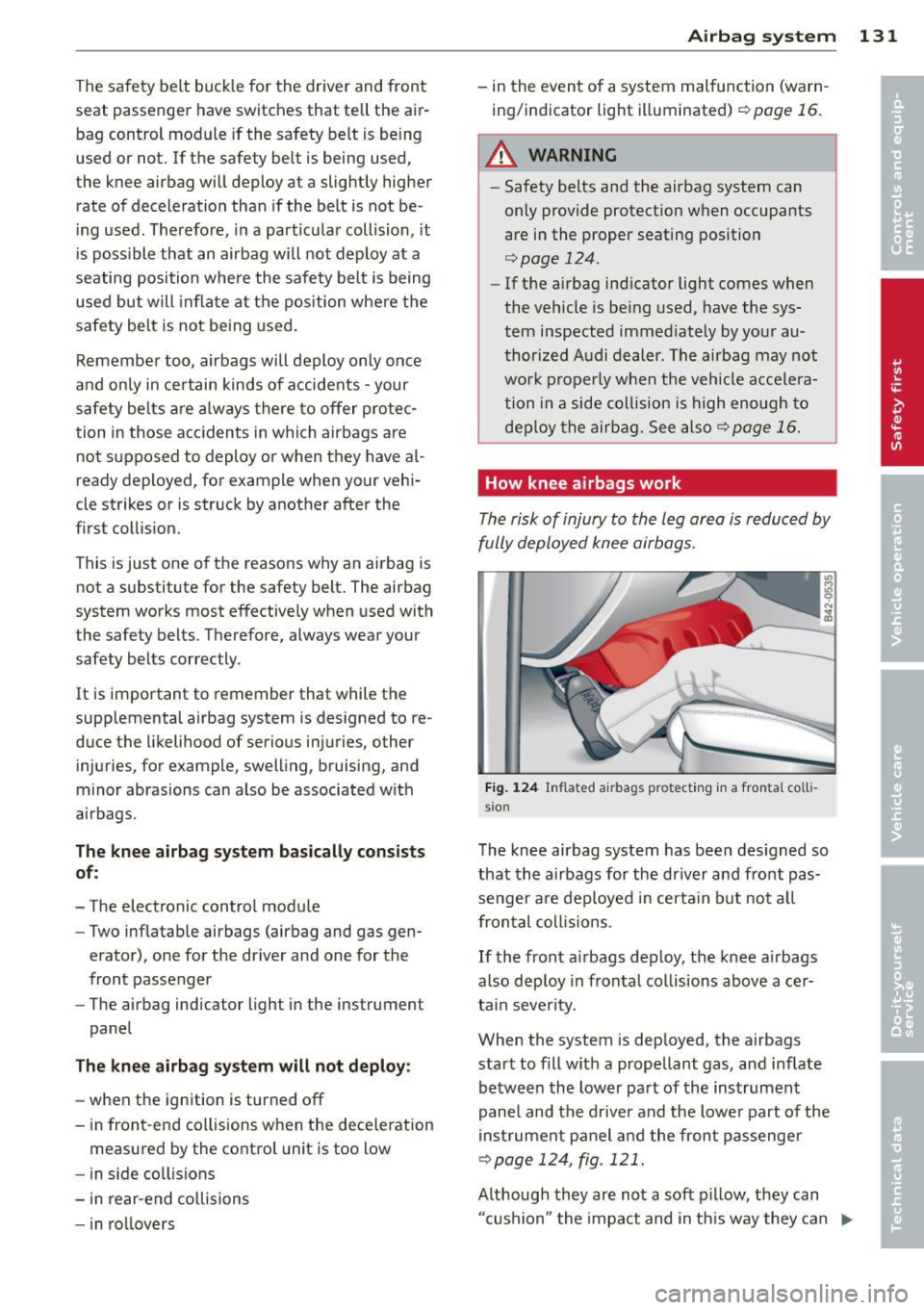
Fig. 1 24 In flated a irbags protec ting in a fronta l coll i
sio n
The knee airbag system has been designed so
that the a irbags for the driver and front pas
senger are dep loyed in certa in but not a ll
fron tal coll is io ns.
If the front a irbags dep loy, the knee a irbags
also dep loy in fronta l co llisions above ace r
ta in seve rity .
When the system is dep loyed, the a irbags
start to fill w ith a propellant gas, and inflate
betwee n the lower pa rt of the instrument
panel and the driver and the lowe r part of the
in strume nt pa nel and the fron t passenger
r=> page 124 , fig . 12 1.
Although they are not a soft p illow , they can
"c ushion" the impact and in th is way they can
Ill>
Page 134 of 260
132 Airbag system
help to reduce the risk of injury to the lower
extremit ies.
All this takes place instantaneously, so fast
that many people don 't even realize that the
airbags have deployed. The airbags also in
flate with a great deal of force and it is impor
tant for occupant safety that nothing should be in their way when they deploy.
Fully inflated airbags in combination with
properly worn safety belts slow down and lim
it the occupant's forward movement and help
to reduce the risk.
Important safety instructions on the
knee airbag system
Airbags are only supplemen tal res traints. Al
ways wear safety belts correctly and ride in a
proper seating position.
The re is a lot tha t you and your passengers
must know and do to help the safety belts and
airbags to provide supplemental protection .
A WARNING
An inflating knee airbag can cause serious
injury. Wearing safety belts incorrectly and
improper seating positions increase the
risk of serious personal injury and death
whenever a vehicle is being used .
- The airbag system cannot protect you
properly if you are seated too close to
any of the airbag locations. When adjust
ing their seat positions, it is important
that both the driver and the front pas
senger keep their upper bodies and
knees at the following minimum safe
distances:
- 10 inches (25 cm) between the chest
and the steering wheel/instrument
panel.
- 4 inches (10 cm) between the knees
and the lower part of the instrument
panel.
- The risk of personal injury increases if
you lean forward or to the side, or if the seat is improperly positioned and you are
not wearing your safety belt. The risk in- creases even more should the airbag de
ploy
.
- Always make sure that the knee airbag
can inflate without interference. Objects
between yourself and the airbag can in
crease the risk of injury in an accident by
interfering with the way the airbag de
ploys or by being pushed into you as the
airbag deploys.
- No persons (children) or animals
should ride in the footwell in front of
the passenger seat.
If the airbag de
ploys, this can result in serious or fatal
injuries.
- No objects of any kind should be car
ried in the footwell area in front of the
driver 's or passenger's seat . Bulky ob
jects (shopping bags, for example) can
hamper or prevent proper deployment
of the airbag . Small objects can be
thrown through the vehicle if the air
bag deploys and injure you or your pas
sengers.
- Make sure there are no cracks, deep
scratches or other damage in the area of
the instrument panel where the knee air
bags are located.
- If children are incorrectly seated, their
risk of injury increases in the case of an
accident
c:> page 136, Child Safety.
Side airbags
Description of side airbags
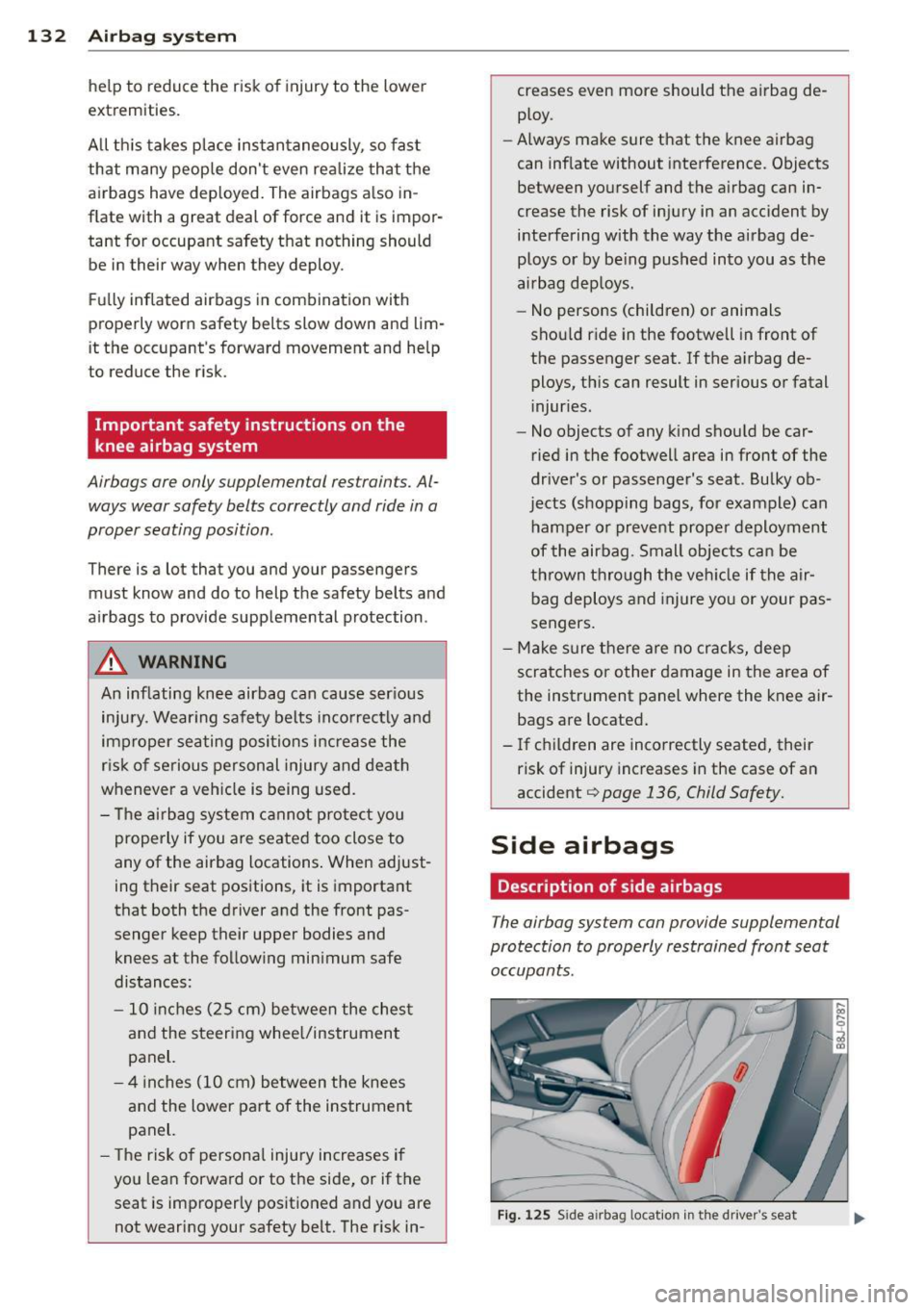
T he airbag system can provide supplemen tal
protection to properly restrained front seat
occupants.
Fig. 12S S ide a irba g locatio n in the d river's seat
Page 135 of 260
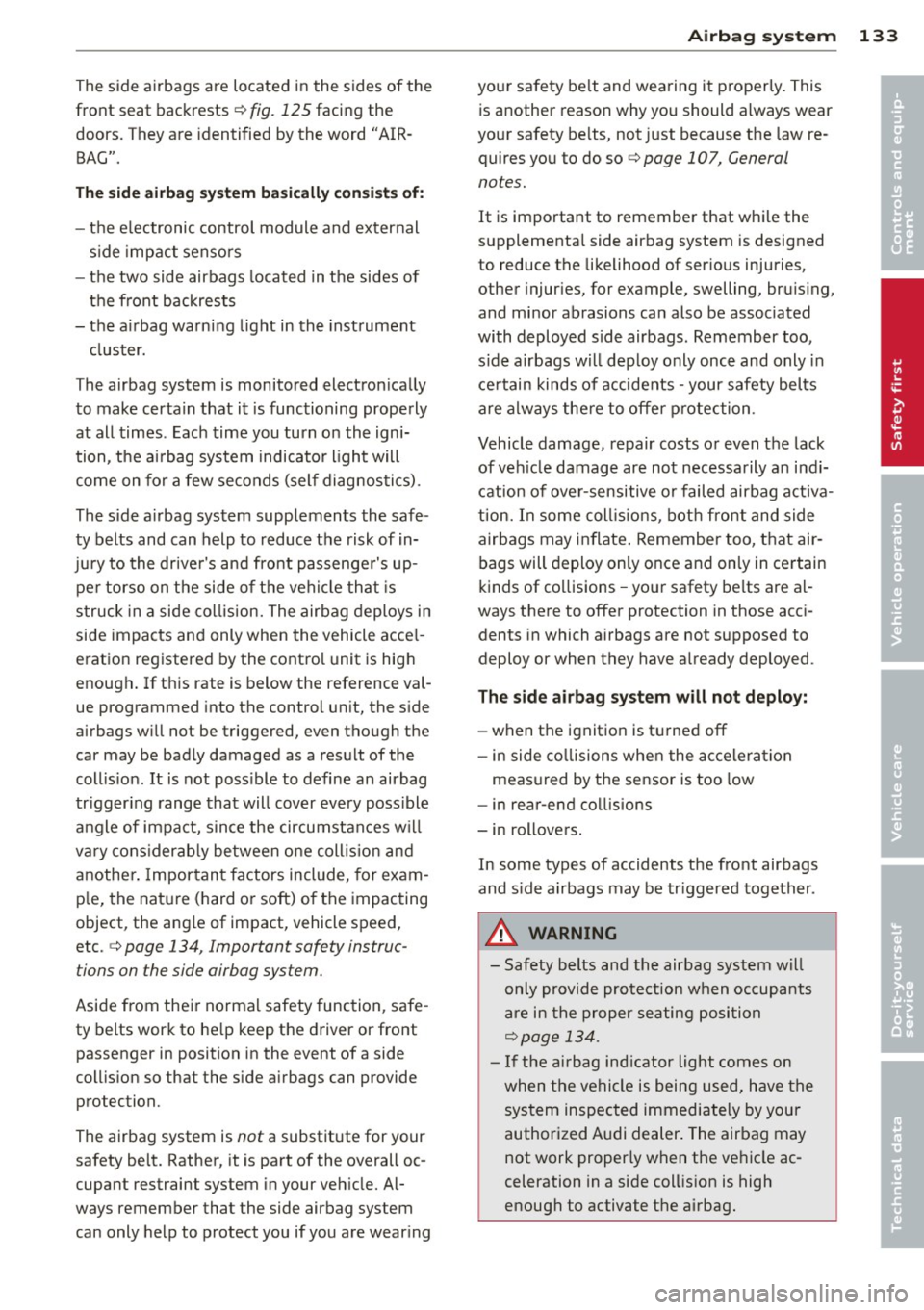
The side airbags are located in the sides of the
fro nt seat backrests ¢
fig. 125 facing the
doors. They are identified by the word "AIR
BAG".
The side airbag system basically consists of:
-the e lectronic control module and external
s ide impact senso rs
- the two side airbags located in the sides of
the front backrests
- the a irbag warning light in the instrument
cluster.
The airbag system is monitored electron ically
to make certain that it is functioning properly
at all times . Each time you turn on the igni
tion, t he a irbag system indicator light will
come on for a few seconds (self diagnos tics) .
The s ide a irbag system supplements the safe
ty belts and can help to reduce the risk of in
jury to the driver's and front passenge r's up
per torso on the side of the vehicle that is
struck in a side collision. The airbag deploys in
side impacts and only when the vehicle acce l
eration registered by the control unit is hig h
enough. If this rate is below the reference val
ue programmed into the control un it, the side
airbags w ill not be triggered, even though the
car may be badly damaged as a result of the
coll is ion . It is not poss ible to define an airbag
triggering range that will cover every possible
angle of impact, since the circumstances w ill
va ry considerably between one collis ion and
another. Important factors include, for exam
ple, the nature (hard or soft) of the impacting
object, the angle of impact, vehicle speed,
etc.
c> page 134, Important safety instruc
tions on the side airbag system.
Aside from their normal safety function, safe
ty belts work to he lp keep the driver or front
passenger in posit ion in the event of a side
coll is ion so that the side a irbags can provide
protection.
The airbag system is
not a substitute for your
safety belt. Rather, it is part of the overall oc
cupant restraint system in your veh icle. Al
ways remember that the side airbag system
can only help to protect you if you are wear ing
Airbag system 133
your safety be lt and wearing it properly. This
is another reason why you should always wear
your safety be lts, not just because the law re
quires you to do soc;,
page 107, General
notes.
It is important to remember that wh ile the
supplementa l side airbag system is designed
to reduce the likelihood of ser ious injuries,
other injur ies, for example, swelling, bru is ing,
and minor abrasions can also be associated
with deployed s ide airbags. Remember too,
s ide airbags wi ll dep loy only once and only in
certain kinds of accidents -your safety belts
a re always there to offer protection.
Vehicle damage, repair costs or even the lack
of veh icle damage are not necessarily an indi
cation of over-sensitive or failed airbag activa
tion. In some collision s, both front and side
airbags may inflate. Remember too, that air
bags will deploy only once and only in certain
kinds of collisions -your safety belts are al
ways there to offer protection in those acci
dents in which airbags are not supposed to
deploy or when they have already deployed .
The side airbag system will not deploy:
-when the ignition is turned off
- in side collisions when the acceleration
meas ured by the sensor is too low
- in rea r-end co llision s
- in rollove rs.
In some types of accidents the front airbags
and s ide a irbags may be triggered together .
A WARNING
-Safety belts and the airbag system will
only provide protection when occupants
are in th e proper seating position
c;,page 134.
- If the airbag indicator light comes on
when the vehicle is being used, have the
system inspected immediately by your
authorized Audi dealer. The airbag may
not work properly when the vehicle ac
celeration in a side coll is ion is high
enough to activate the a irbag. •
•
Page 136 of 260
134 Airbag system
How supplemental side airbags work
Side airbags deploy instantly and con help reduce the risk of upper torso injuries for occu
pants who ore properly restrained.
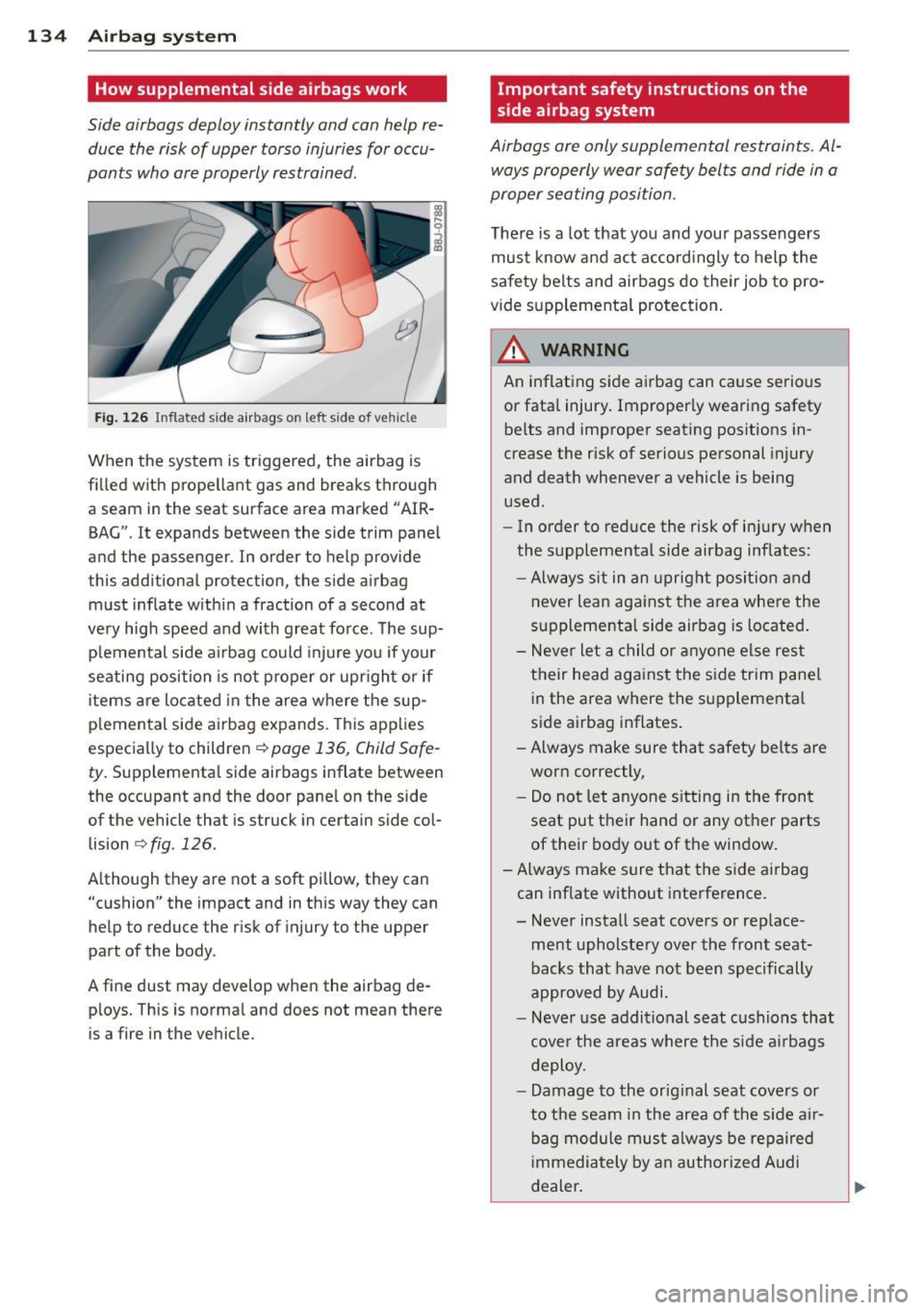
Fig. 126 Inflated s ide airbags on left side of vehicle
When the system is triggered, the airbag is
filled with propellant gas and breaks through
a seam in the seat surface area marked "AIR
BAG". It expands between the side trim panel
and the passenger . In order to help provide
this additional protection, the side airbag
must inflate within a fraction of a second at
very high speed and with great force. The sup plemental side airbag could injure you if your
seating position is not proper or upright or if
items are located in the area where the sup
plemental side airbag expands. This applies
especially to children
Q page 136, Child Safe
ty.
Supplemental side airbags inflate between
the occupant and the door panel on the side
of the vehicle that is struck in certain s ide col
lision
Q fig. 126.
Although they are not a soft pillow, they can
"cushion" the impact and in this way they can
help to reduce the risk of injury to the upper
part of the body.
A fine dust may develop when the airbag de
ploys. This is normal and does not mean there
is a fire in the vehicle. Important safety instructions on the
side airbag system
Airbags ore only
supplemental restraints. Al
ways properly wear safety belts and ride in a
proper seating position.
There is a lot that you and your passengers
must know and act accordingly to help the
safety belts and airbags do their job to pro
vide supplementa l protection .
A WARNING
An inflating side airbag can cause serious
or fatal injury. Improperly wearing safety
belts and improper seating positions in
crease the risk of serious personal injury
and death whenever a vehicle is being
used.
- In order to reduce the risk of injury when
the supplemental side airbag inflates:
- Always sit in an upright position and
never lean against the area where the
supplemental side airbag is located.
- Never let a child or anyone else rest
their head against the side trim panel
in the area where the supplemental
side airbag inflates.
-Always make sure that safety belts are worn correctly,
- Do not let anyone sitting in the front
seat put their hand or any other parts
of their body out of the window.
- Always make sure that the side airbag
can inflate without interference.
- Never install seat covers or replace ment upholstery over the front seat
backs that have not been specifically
approved by Audi.
- Never use additional seat cushions that
cover the areas where the side airbags
deploy.
- Damage to the original seat covers or
to the seam in the area of the side air
bag module must always be repaired
immediately by an authorized Audi
dealer.
Page 138 of 260
136 Child Safety
Child Safety
Important things to
know
Introduction
The physical princip les of what happens when
your vehicle is in a crash app ly also to children
c:> page 108, What happens to occupants not
wearing safety belts? .
But unlike adults and
teenagers, their muscles and bones are not
fully developed . In many respects children are
at greater risk of serious injury in crashes than
adults.
Because children's bodies are not fully devel
oped, they require restraint systems especial
ly designed for the ir s ize, weight, and body
structure . Many countries and all states of the
United States and provinces of Canada have
l aws requ iring the use of approved ch ild re
straint systems for infants and small children.
In a frontal crash at a speed of 20-35 mph
(30-56 km/ h) the fo rces acting on a 13-pound
(6 kg) infant w ill be more than 20 times the
weight of the child. This means the weight of
the child would suddenly be more than 260 pounds (120 kg) . Under these conditions,
only an appropriate ch ild restraint properly
used can reduce the risk of serious injury.
Child restra ints, like adult safety belts, must
be used properly to be effective. Used improp
erly, they can increase the risk of ser ious in
ju ry in an accident.
Consult the child safety seat manufacturer's instructions in order to be sure the seat is
right for your ch ild's s ize
c:> page 139, Impor
tant safety instructions for using child safety
seats.
Please be sure to read and heed all of
the important information and WARN INGS
about child safety, Advanced Airbags, and the installation of child restraints in this chapter.
There is a lot you need to know about the Ad
vanced Airbags in your vehicle and how they
work when infants and children in chi ld re
straints are on the front passenger seat. Be
cause of the large amount of important infor- mation, we cannot repeat it all here
. We urge
you to read the detailed information in this owner's manua l about airbags and the Ad
vanced Airbag System in your vehicle and the
very important information about transport
ing children on the front passenger seat.
Please be sure to heed the WARNINGS - they
are extremely importa nt for your safety and
the safety of you r passengers, especially in
fants and small chi ldren.
A WARNING
-
A ll vehicle occupants and especially chi l
dren must be restrained properly whenev
e r riding in a vehicle. An unrestrained or
improperly restrained child could be in
jured by str ik ing the interior or by being
ejected from the veh icle dur ing a sudden
maneuver or impact. An unrestra ined or
i mproperly restra ined child is also at great
er risk of injury or death through contact
with an inflat ing airbag.
_& WARNING
Children on the front seat of any car even
with Advanced Airbags c an be ser ious ly in
ju red or even ki lled when an airbag in
f lates. A child in a rearward-fac ing child
safety seat insta lled on the front passen
ger seat will be ser iously injured and can
be killed if the front airbag inflates.
- The inflating airbag will h it the ch ild
safety seat or infant carrier with great
force and will smash the child safety seat
and child aga inst the backrest, door or
roof.
- Never install a rearward facing child
safety seat on the front passenger seat
un less the
PASSENGER AIR BAG OFF
light comes on and stays on. If the PAS
SENGER AIR BAG OF F
light does not
come on and stay on, have the airbag
system inspected immediately by you r
Audi deale r.
.
Page 139 of 260

A WARNING ,~
If, in exceptional circumstances, you must
install a forward-facing child restraint on
the front passenger's seat:
- Always make sure the forward-facing
seat has been designed and certified by
its manufacturer for use on a front seat
with a passenger front and side airbag.
-Always follow the manufacturer's in
structions provided with the child safety
seat or carrier.
- Always move the passenger seat into its
rearmost position in the seat's fore and
aft adjustment range, as far away from
the airbag as possible before installing
the child restraint. The backrest must be
adjusted to an upright position.
- Always make sure that the
PASSENGER
AIR BAG OFF light comes on and stays
on all the time whenever the ignition is
switched on.
Advanced front airbag system and children
Your vehicle is equipped with an "Advanced
Airbag System" in compliance with United
States Federal Motor Vehicle Safety Standard
(FMVSS) 208 as applicable at the time your
vehicle was manufactured.
The Advanced Airbag system in your vehicle
has been certified to meet the "low-risk" re
quirements for 3- and 6-year old children on
the passenger side and small adults on the
driver side. The low risk deployment criteria
are intended to reduce the risk of injury
through interaction with the airbag that can
occur, for example, by being too close to the
steering wheel and instrument panel when
the airbag inflates. In addition, the system has been certified to comply with the "sup
pression" requirements of the Safety Stand
ard, to turn
off the front airbag for infants up
to 12 months who are restrained on the front
passenger seat in child restraints that are list
ed in the Standard.
Child Safety 137
Even though your vehicle is equipped with an
Advanced Airbag system, a child should al
ways ride in theseat properly restrained for its
age and si ze . The airbag on the passenger side
makes the front seat a potentially dangerous
place for a child to ride . The front seat is not
the safest place for a child in a forward-facing
child safety seat . It can be a very dangerous
place for an infant or a larger child in a rear
ward-facing seat.
Advanced Airbags and the weight
sensing mat in the front seat
The Advanced Airbag System in your vehicle detects the presence of an infant or child in a
child restraint on the front passenger seat us
ing the weight -sensing mat in the seat cush
ion and the sensor below the safety belt latch
on the front passenger seat that measures the
tension on the safety belt.
The weight -sensing mat measures total
weight of the child and the child safety seat
and a child blanket on the front passenger
seat. The weight on the front passenger seat
is related to the design of the child restraint
and its "footprint", the size and shape of the
bottom of the child restraint as it sits on the
seat. The weight of a child restraint and its
"footprint" vary for different kinds of child re
straints and for the different models of the
same kind of child restraint offered by child
restraint manufacturers .
The weight ranges for the individual types,
makes and models of child restraints that the
NHTSA has specified in the Safety Standard
together with the weight ranges of typical in
fants and typical 1 year-old child have been
stored in the control unit of the Advanced Air
bag System. When a child restraint is being
used on the front passenger seat with a typi
cal 1 year-old child, the Advanced Airbag Sys
tem compares the weight measured by the
weight sensing mat with the information stor
ed in the electronic control unit.
The electronic control unit also registers the
tension on the front passenger safety belt. ..,. •
•
Page 141 of 260
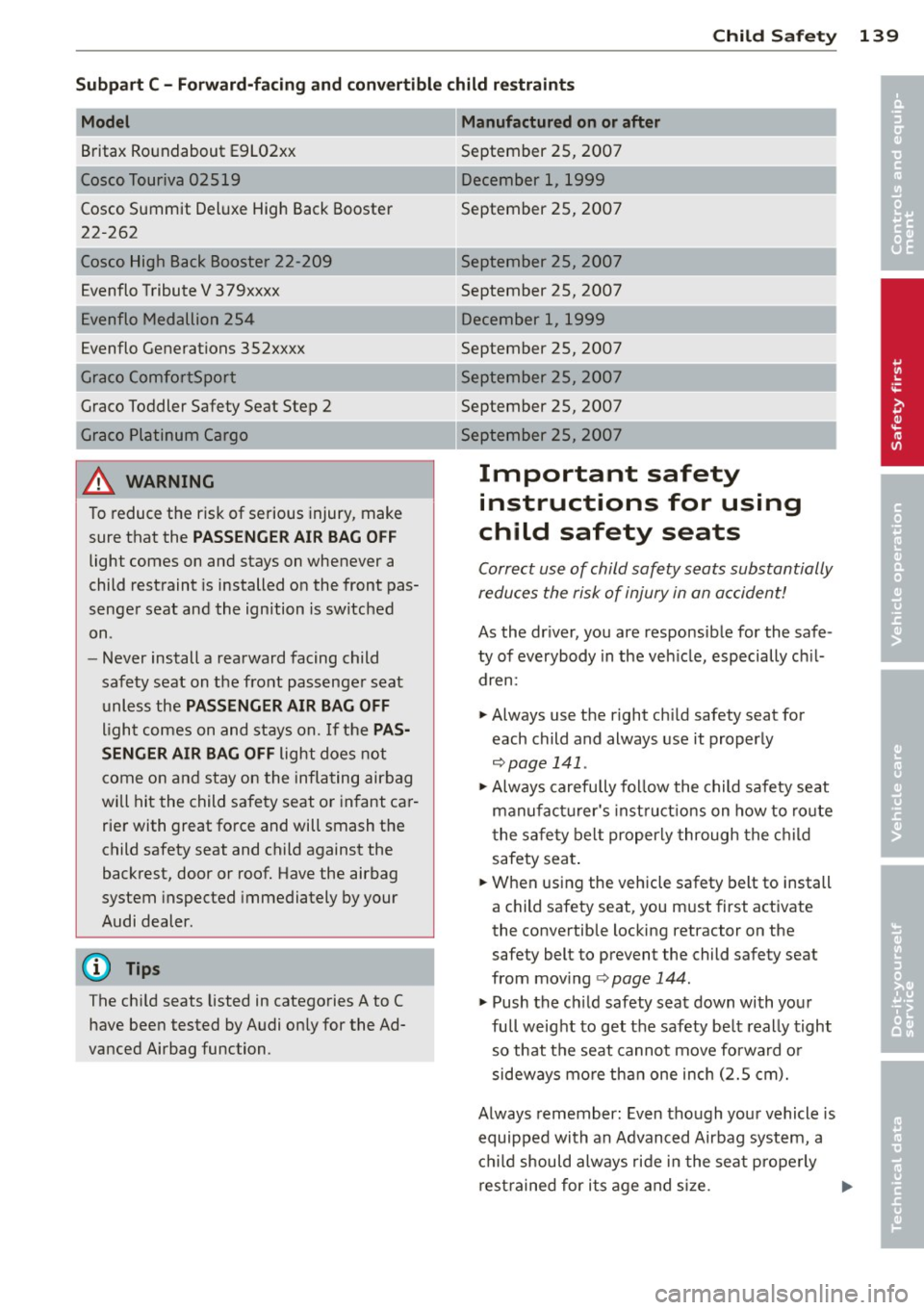
Child Safet y 139
Subp art C -Forward-f acing and conv ert ibl e child r estraints
Model
BritaxRoundaboutE9L02xx
Cosco Touriva 02519
Cosco Summit Deluxe High Back Booster
22-262
Cosco High Back Booster 22-209
M anufactured on or after
September 25, 2007
December 1, 1999
September 25, 2007
September 25, 2007
September 25, 2007
Evenflo Tribute V 379xxxx
E venflo Medallion 254
-------·-
Evenflo Generations 352xxxx
Grace ComfortSport
----~-,
December 1, 1999
September 25, 2007
September 25, 2007
September 25, 2007
Grace Toddler Safety Seat Step 2
Grace Platinum Cargo
--------
& WARNING
To reduce the risk of serious injury, make
sure that the
PA SSENGER AIR BAG O FF
light comes on and stays on whenever a
child restraint is installed on the front pas
senger seat and the ignition is switched
on .
- Never install a rearward facing child
safety seat on the front passenge r seat
unless the
PASSENGER AIR BAG OFF
light comes on and stays on. If the PA S
SENGER AIR BAG OFF
light does not
come on and stay on the infla ting airbag
will hit the child safety seat or in fant car
rie r with great force and will smash the
child safety seat and child against the
backrest, door or roof. Have the airbag
system inspected immediately by your
Audi dealer .
@ Tips
The child seats listed in categories A to C
have been tested by A udi on ly for the Ad
vanced Airbag function. September 25, 2007
Important safety
instructions for using
child safety seats
Correct use of child safety seats substantially
reduces the risk of injury in an accident!
As the dr iver, you are responsible for the safe
ty of everybody in the vehicle, especially chi l
dren:
"' Always use the right ch ild safety seat for
each child and always use it properly
c:::;, page 141 .
"'Always carefully follow the child safety seat
manufac turer's inst ruct ions on how to ro ute
t he sa fe ty belt proper ly through the c hild
safety seat .
"' When using the vehicle safety belt to install
a child safety seat, you m ust first activate
the convertible locking retractor on the
safety belt to prevent the child safety seat
from mov ing
c:::;, page 144.
"' Push the ch ild safety seat down with your
full weight to get the safety be lt really tight
so that the seat cannot move fo rwa rd o r
sideways mo re tha n one inch ( 2.5 cm).
Always remember : Even tho ugh you r vehicle is
equipped with an Advanced Airbag system, a
c h ild should always ride in the seat properly
rest rained for its age and s ize.
•
•