ESP AUDI TT ROADSTER 2011 Owner's Manual
[x] Cancel search | Manufacturer: AUDI, Model Year: 2011, Model line: TT ROADSTER, Model: AUDI TT ROADSTER 2011Pages: 260, PDF Size: 64.11 MB
Page 85 of 260
(D Note
Only after the vehi cle has come to com
plete stop, should you f irm ly set the park
ing brake and either move the selector lev
er into "P".
Parking
To prevent a parked vehicle from rolling
away, there are a few things you should do.
When you park your vehicle, do the following:
.,. Stop the vehicle using the brake pedal.
... Set the parking b ra ke firmly .
... Switch
off the engine.
... Move the selector lever into the P position
¢ A .
... Remove the ign it ion key from the ignit ion
lock.
What else you should do when pa rking
your vehicle on an incline or decline
Turn the steering wheel so that if the vehicle
should start to roll, it will roll into the curb.
If you are parking on a decl ine (the front of
your vehicle facing downhill), turn the front
wheels to the right so that they point
toward
the curb.
If you are parking on an incline (the font of
your vehicle facing uph ill), turn the front
wheels to the left so that they po int
away
from the curb.
A WARNING
Th is is how you can reduce the risk of in
jury when leaving your veh icle.
- Never park the vehicle where it can come
in contact with d ry grass, sp illed fuel or
any othe r flammable mater ials .
- Never allow anyone -especially small
children -to remain in the vehicle whe n
it is locked . Locked doors ma ke it more
difficult for rescuers to access the pas
senge r compartmen t in the event of an
eme rgency. Danger to life!
- Never leave c hildren unsupervised in the
vehicle. Children co uld re lease the par k-
-
On th e ro ad 83
ing brake or move the gearsh ift leve r out
of gear. The vehicle could start to ro ll
away and cause an acc ident.
- No matter what the season is, the tem
perature in a parked ve hicle can reach
dangerous leve ls.
Acoustic parking
system
' Rear acoustic park assist
Applies to vehicles: with 4-channel acoust ic park assist
Acoustic park assist gives a warning about
obstacles behind the vehicle .
Description
The rea r acoustic pa rk ass ist (4-channel
a coustic park ass ist) de termines the dista nce
of the vehicle from an obstacle using ult ra
son ic sensors. The sensors are in the rear
bumper. The volume and the pitch of the
c hi mes can be adjusted throug h the men u dis
play¢
page 21.
T he range at wh ich the sensors start to meas
u re is
about :
To the side
Activation
2 feet (0.60 m)
5 feet (1.60 m)
T he park ing ass ist is activated when
rever se
g ear
is engaged. A br ief tone confirms th at
the sys tem is activated .
Backing up
Distance warning whe n backing up sta rts
whe n an obstacle is detected in the range of
t he pa rk ass ist system. As the distance de
c reases, the t ime inte rva l between the audible
tones becomes shorte r.
When the distance is less than 1 foot (0.30
m), the tone becomes continuous. At this
po in t you sho uld s top bac king up .
Please note that low objects already signalled
by a war ning ca n disappear from the system's
de te ction range and will not continue to be
s ignalled . .,._
Page 86 of 260
84 On the road
Potenti al malfunction s
If a warn ing buzzer sounds for a few seconds
when the ignition is switched on, there is a
system malf unction with the acoustic park as
sist. If the malfunction persists until the igni
tion is switched off, there will be no acoustic
warning at the next attempt to activate the
system. Have the problem corrected.
There is no confirmation tone when reverse
gear is engaged if there is a system malfunc
tion.
For the parking assist to operate, the sensors
must be kept clean and free of ice .
A WARNING
-Sensors have blind spots in which objects
cannot be detected. Pay special attention
to sma ll children and animals. They can
not always be detected by the sensors -
danger of an accident!
- The parking assist cannot replace the dr iver's attention. The d river alone is re
sponsible for parking and s imilar driving
maneuvers. A lways watc h where you a re
dr iv ing.
(D Note
Low obstacles al ready signalled by a warn
ing can disappear from the system's det ec
t ion range as they are approached and will
no t continue to be sign alled. Objects such
as barrier cha ins, trailer draw ba rs, thin
pa inted vertical poles, or fences may not
be detected by the system -risk of dam
age .
For the parking ass ist to operate, the sen
sors must be kept clea n and free of snow
and ice.
Cruise control
Switching the system on
The cruise control system makes it possible to
drive at a constant speed starting at 20 mph
(30kmlh).
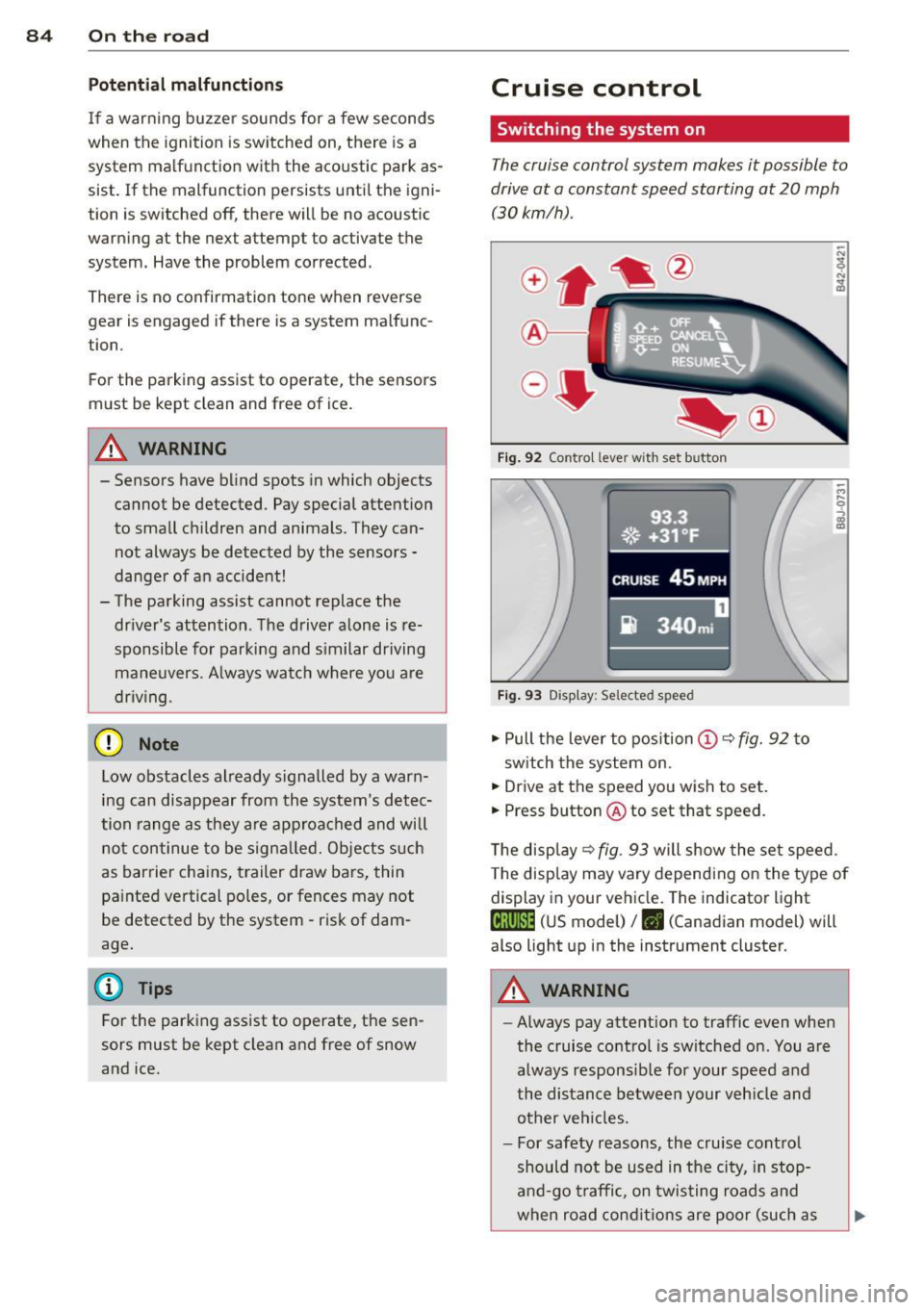
®-
Fig . 9 2 Contro l lever wit h set button
93.3
. ®' ~.+31, ~F; ,
II .~~ .. . • , -,.::.._-.--~.I-~-
CRUISE 45 MPH
iR 340m i
Fig. 9 3 Display: Selected speed
.,. Pull the lever to position (D c::> fig. 92 to
sw itch the system on.
.,. Drive at the speed you wish to set.
.,. Press button @ to set that speed.
T he disp lay
c::> fig . 93 will show the se t speed.
T he disp lay may vary depend ing on the type of
display in your ve hicle. The indicator light
te;(Q~i~ (US model) /. (Canadian model) will
also light up in the instrument cluster.
A WARNING
--Always pay attention to traffic even whe n
the cruise contro l is switched on. You are
always respons ib le for your speed and
the distance between your veh icle and
other ve hicles.
- For safety reasons, the cru ise cont ro l
should not be used in the city, in stop
an d-go t raffic, on twis ting road s and
when road cond itio ns are poor (such as
Page 88 of 260
86 On the road
Audi magnetic ride
Applies to vehicles: wit h magnet ic ride
Damping can be adjusted to the driver's pref
erence and it adapts automatically to the cur
rent driving situation.
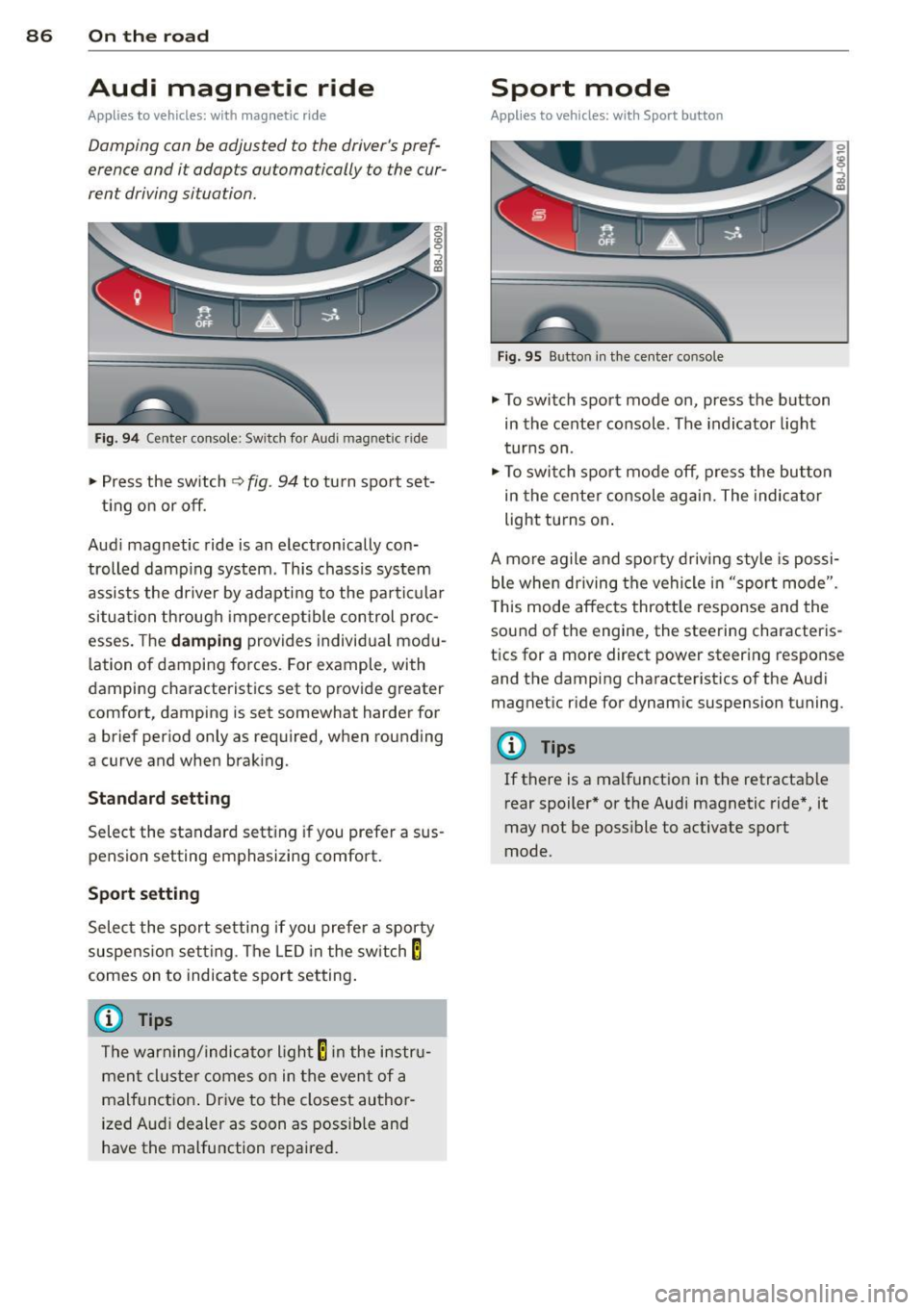
Fig. 94 Cente r console: Switch for Audi magnetic r ide
" Press the sw itch r=) fig. 94 to tu rn spo rt set-
t ing o n or off.
Aud i magnetic ride is an electron ically con
trolled damp ing system . Th is chassis system
assists the driver by adapti ng to the par ticular
situatio n th rough imper cep tible con trol p roc
esses. The
damping provides individual mod u
l ation of damping forces. For example, with
dampi ng characterist ics set to p rovide greater
comfort, damping is set somewhat harder for
a brief period only as required, when rounding
a curve and when braking.
Standard setting
Select the standard sett ing if you prefer a sus
pension setting emphasizing comfort.
Sport setting
Select the sport setti ng if you prefe r a sporty
suspe nsio n setting . The LED in the sw itch
E
comes on to indicate spo rt setting .
@ Tips
The warning/indicator light E in the instru
men t clus ter comes on in the even t of a
malf unction . Drive to the closest au thor
ized Audi dealer as soon as possible and
have the malfunction repaired.
Sport mode
Applies to veh icles: w ith Sport bu tton
Fig . 95 Button in t he ce nter console
.,. To switch sport mode on, press the button
in the center console. The indicator light
t ur ns on .
" To swit ch spor t mode off, press the but ton
in the center console again. The indicator
light turns on .
A mo re agile and spo rty d riv ing style is possi
ble when driving the vehicle in "sport mode".
T his mode affec ts thrott le response and the
sound of the engine, the steering characteris
t ics for a more direct power steering response
and the damping characteristics of the Audi
magnetic ride for dynam ic suspension tu ning.
(D Tips
If there is a malfunction in the retractable
rear spoiler* or the Aud i magnetic ride *, it
may not be poss ible to activate sport
mode.
Page 93 of 260
If you have selected a lower gear than the cur
rent one, the transmission w ill only shift down
when the engine cannot be overspeeded .
If kick-down is actuated, the transmission
shifts into a lower gear independent ly of
speed and engine rpm .
Steering wheel with Tiptronic ® controls
The selector paddl es allow the driver to keep
both hands on the steering wheel when shift
ing gears.
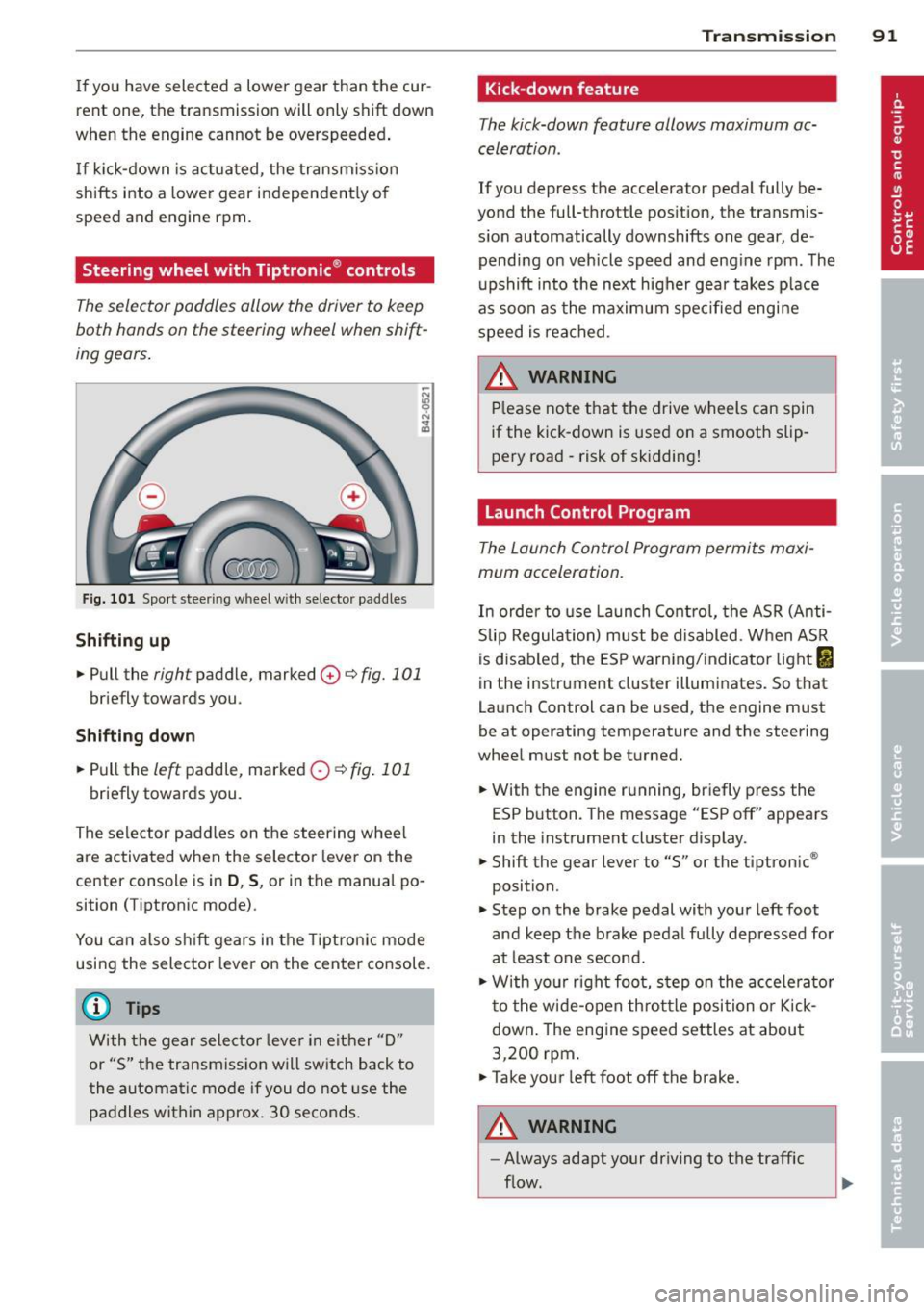
Fig. 101 Sport steer ing wheel w ith selector paddle s
Shifting up
.. Pull the right paddle, marked 0 ¢ fig. 101
briefly towards you .
Shifting down
.. Pull the left paddle, marked 0 ¢fig. 101
briefly towards you.
The selector paddles on the steering wheel
are activated when the selector lever on the
center console is in
D , S, or in the manual po
sition (Tiptronic mode) .
You can also shift gears in the Tiptronic mode
using the selector lever on the center console.
@ Tips
With the gear selector lever in either "D"
or "S" the transmission will switch back to
the automatic mode if you do not use the
paddles within approx. 30 seconds.
Transmission 91
Kick-down feature
The kick-down feature allows maximum ac
celeration .
If you depress the accelerator pedal fully be
yond the full-throttle position, the transmis
s ion automatically downshifts one gear, de
pending on vehicle speed and engine rpm. The
upshift into the next higher gear takes place
as soon as the maximum specified engine
speed is reached.
_&. WARNING
Please note that the drive wheels can spin
if the kick-down is used on a smooth slip
pery road -risk of sk idding!
Launch Control Program
The Launch Control Program permits maxi
mum acceleration.
In order to use Launch Control, the ASR (Anti
Slip Regulation) must be disabled. When ASR
is disabled, the ESP warning/indicator light
I
in the instrument cluster illuminates. So that
Launch Control can be used, the engine must
be at operating temperature and the steering
wheel must not be turned .
.. With the engine running, briefly press the
ESP button. The message "ESP off" appears
in the instrument cluster display.
.. Shift the gear lever to "S" or the tiptronic ®
position.
.. Step on the brake pedal with your left foot
and keep the brake pedal fully depressed for
at least one second.
.. W ith your right foot, step on the accelerator
to the wide-open throttle position or Kick
down. The engine speed settles at about
3,200 rpm.
.. Take your left foot off the brake.
&_ WARNING
-
-Always adapt your driving to the traffic
flow.
Page 94 of 260
92 Transmission
-Only use Launch Control when road and
traffic conditions allow it and other driv
ers will not be endangered or annoyed by
your driving and the acceleration of the
vehicle.
- Make sure that ESP remains enabled.
With the ESP disabled, the vehicle could
brake away, particularly on a slick and
slippery road -risk of skidding!
- Once acceleration is finished, switch ASR
on again by briefly pushing the ESP but
ton.
Back -up program
In the event of a system malfunction, there is
an back-up program .
In the event of system malfunction, the auto
matic transmission switches to the fail-safe
mode . All of the selector lever position dis
plays for the automatic transmission are high
lighted with a light background in the instru
ment cluster display . In some cases you can
not use reverse gear any more.
If the transmission switches to fail-safe
mode, you should take the vehicle to an au
thorized Audi dealership as soon as possible
to have the condition corrected.
Clutch is overheating
• Clutch is overheating! Please stop vehi
cle!
If the symbols are illuminated, the clutch is
overheating and could be damaged if you con
tinue to drive . Stop the vehicle and allow the
transmission to cool with the selector lever in
the
P position while the engine runs at idle. If
the warning does not turn off, do not continue
driving. See your authorized Audi dealer or
qualified repair facility for assistance. Other
wise serious transmission damage could re
sult. Once the indicator light has turned off,
drive to your authorized Audi dealer or quali
fied repair facility immediately to have the
malfunction corrected.
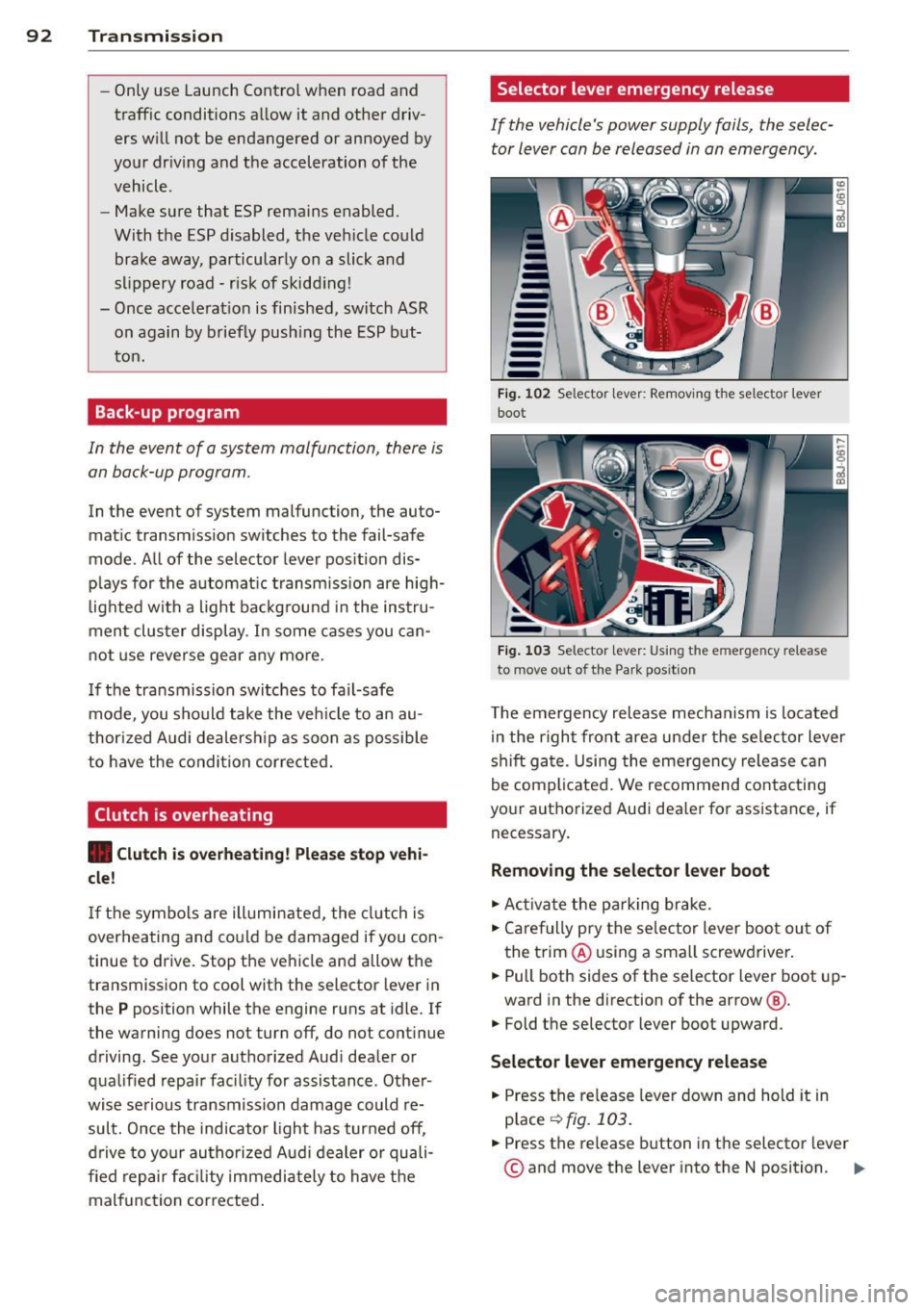
Selector lever emergency release
If the vehicle 's power supply fails, the selec
tor lever can be released in an emergency.
-
-
-
-
-
-
---Fig. 102 Selector lever: Removing t he selector lever
boot
Fig. 103 Selector lever: Using the e merge ncy release
to move o ut of the Park pos it ion
The emergency release mechanism is located
in the right front area under the selector lever
shift gate. Using the emergency release can
be complicated. We recommend contacting
your authorized Audi dealer for assistance, if necessary .
Removing the selector lever boot
.. Activate the parking brake.
.. Carefully pry the selector lever boot out of
the trim @ using a small screwdriver .
.. Pull both sides of the selector lever boot up-
ward in the direction of the arrow @.
.. Fold the selector lever boot upward.
Selector lever emergency release
.. Press the release lever down and hold it in
place
~ fig . 103 .
.. Press the release button in the selector lever
© and move the lever into the N position. Iii>
Page 101 of 260
.. Fasten your safety belt and wear it properly.
Also instruct your passengers to fasten the ir
safety belts proper ly ¢
page 107 .
What impairs driving safety?
Safe driving is directly related to the condi
tion of the vehicle, the driver as well as the
driver's ability to concentrate on the road
without being distrac ted.
The driver is responsible for the safety of the
veh icle and a ll of its occupants . If your ability
to drive is impaired, safety risks for everybody
in the vehicle increase and you also become a
hazard to everyone else on the road ¢
,&..
Therefore:
.,. Do not let yourself be distracted by passen
gers or by us ing a cellular telephone .
.. NEVER dr ive when your driv ing ability is im
paired (by medicat ions, alcohol, drugs, etc.) .
.. Observe all traffic laws, ru les of the road
and speed limits and plain common sense .
.. ALWAYS adj ust yo ur speed to road, traff ic
and weather condit ions .
.. Take frequent breaks on long trips . Do not
drive for more than two hours at a stretch .
.. Do NOT drive when you are tired , under
pressure or when you are stressed.
A WARNING
Impaired driving safety increases the risk
of serious personal injury and death when
ever a veh icle is being used .
Drivin g Sa fely 99
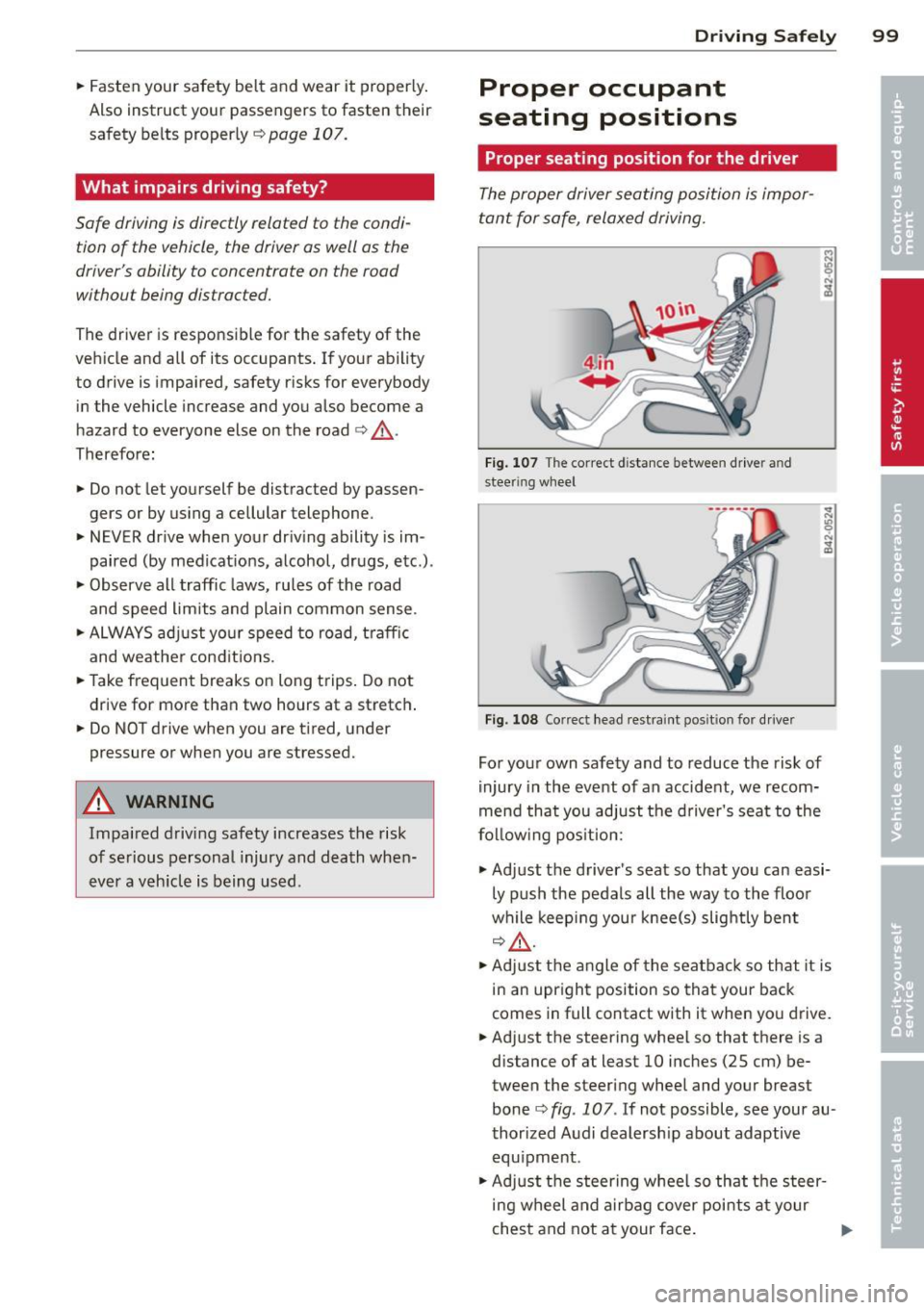
Proper occupant
seating positions
Proper seating position for the driver
The proper driver seating position is impor
tant for safe, relaxed driving.
Fig . 107 The correct d istance betwee n drive r an d
stee ring wheel
Fig . 1 08 Co rrec t head rest raint pos it ion fo r dr ive r
For your own safety and to reduce the risk of
injury in the event of an accident, we recom
mend that you adjust the driver's seat to the
fol low ing position:
.,. Adjust the driver 's seat so that you can easi
ly push the pedals all the way to the floor
while keeping your knee(s) slightly bent
<=> ,& .
.. Adjust the angle of the seatbac k so that it is
in an upright position so that your back
comes in full contact with it when yo u drive .
.. Adjust the steering wheel so that there is a
distance of at least 10 inches (25 cm) be
tween the steering wheel and your breast
bone
c:> fig . 107 . If not possible, see your au
thorized Audi dealersh ip about adaptive
equ ipment .
.. Adjust t he steer ing wheel so that the steer
ing wheel and a irbag cover poi nts at your
chest and not at your face .
Page 104 of 260
102 Driving Safel y
must adjust the driver headrest for any
r eason, first stop the vehicle safe ly be
fore attempting to adjust the head re straint.
- Children must always be properly re
strained in a ch ild restraint that is appro
pr iate for their age and s ize <=>
page 136.
Examples of improper seating positions
The occupant restraint system can only re
duce the risk of injury if vehicle occupants are
properly seated .
Improper seating posit ions can ca use serio us
inj ury or death. Safety belts can only work
when they are properly positioned on the body . Imprope r seat ing pos itions reduce the
effectiveness of safety be lts and will even in
crease the risk of i njury and death by moving
the safety bel t to critical a rea s of the body .
I mpro per sea ting posit io ns also i ncrease the
ris k of serious injury and dea th when an air
bag de ploys and strikes an occupant who is
not in the prope r seat ing pos ition. A drive r is
respons ible for the safety of a ll vehicle occu
pants and especially for c hildren. Therefore:
• Never allow anyone to ass ume an inco rrect
seat ing position when the ve hicle is being
used <=>.&, .
The fo llowing bullets list only some sample
positions that wi ll increase the risk of ser ious
in ju ry and deat h. Our hope is that these exam
p les w ill make you more awa re of seating po
sitions that are dangero us.
The refore, whenever the vehicle is
moving :
- never stand up in t he vehicle
- never stand on the seats
- never knee l on the seats
- n ever ride w ith the seatbac k reclined
- n ever lie dow n on t he rear seat
- never lean up aga inst the inst rument pa nel
- never sit o n the edge of the seat
- never sit s ideways
- never lean out the w indow -
neve r put your feet o ut the window
- neve r pu t your feet on t he instr ument pane l
- neve r rest your feet on the seat cus hion or
back of the seat
- neve r ride in the footwell
- neve r ride in the ca rgo area
.&_ WARNING
---Im proper sea ting posit ions increase the
r isk of ser ious persona l inju ry and death
whenever a vehicle is being used.
- Always ma ke sur e that all vehi cle occ u
pa nts stay in a proper seating position
a nd ar e prop erly rest rained whenever the
veh icle is being used.
Driver and passenger
side footwell
Important safety instructions
.&_ WARNING ~
A lways make sure that the knee airbag can
i nflate witho ut interference. Objects be
tween yourself and the a irbag can increase
the r isk of injury in a n accident by interfer
i ng with the way the airbag deploys or by
b eing pushed into you as the airbag de
pl oys.
- No persons (children) or animals shou ld
rid e in t he footwell in front of the pas
s enger seat. If the ai rbag dep loys, this
c an result in ser ious or fatal in juries.
- No ob jec ts of any kin d should be carried
in the footwell area in fr ont of the driv
er 's or p assenge r's se at. B ulky objects
(shopping bags, for example) can ham
pe r o r prevent proper deployment of the
airbag . Small ob jects can be thrown
through the vehicle if the airbag deploys
and inj ure you or your passenge rs.
-
Page 106 of 260
104 Driving Safely
• Distribute the load evenly in the luggage
compartment.
• Always place and properly secure heavy
items in the luggage compartment as far
forward as possible.
A WARNING
Improperly stored luggage or other items
can fly through the vehicle causing serious
personal injury in the event of hard brak
ing or an accident. To help reduce the risk
of serious personal injury:
- Always put objects, for example, luggage
or other heavy items in the luggage com
partment.
- Always secure objects in the luggage
compartment using the tie-down eyelets
and suitable straps.
A WARNING
Heavy loads will influence the way your ve
hicle handles. To help reduce the risk of a
loss of control leading to serious personal
injury:
-Always keep in mind when transporting
heavy objects, that a change in the cen
ter of gravity can also cause changes in
vehicle handling:
- Always distribute the load as evenly as
possible.
- Place heavy objects as far forward in
the luggage compartment as possible.
- Never exceed the Gross Axle Weight Rat
ing or the Gross Vehicle Weight Rating
specified on the safety compliance stick
er on the left door jamb. Exceeding per
missible weight standards can cause the
vehicle to slide and handle differently.
- Please observe information on safe driv ing
~ page 98.
A WARNING
To help prevent poisonous exhaust gas
from being drawn into the vehicle, always keep the rear lid closed while driving.
- Never transport objects larger than
-
those fitting completely into the luggage area because the rear lid cannot be fully
closed.
- If you absolutely must drive with the rear
lid open, observe the following notes to
reduce the risk of poisoning:
- Close all windows,
- Close the convertible top,
- Open all air outlets in the instrument
panel,
- Switch off the air recirculation,
- Set the fresh air fan to the highest
speed.
A WARNING
-Always make sure that the doors, all win-
dows, the convertible top and the rear lid
are securely closed and locked to reduce
the risk of injury when the vehicle is not
being used.
- After closing the rear lid, always make
sure that it is properly closed and locked.
- Never leave your vehicle unattended es pecially with the rear lid left open . A
child could crawl into the vehicle through
the luggage compartment and close the
rear lid becoming trapped and unable to
get out. Being trapped in a vehicle can
lead to serious personal injury.
- Never let children play in or around the
vehicle.
- Never let passengers ride in the luggage
compartment. Vehicle occupants must
always be properly restrained in one of
the vehicle's seating positions.
@ Tips
- Air circulation helps to reduce window
fogging. Stale air escapes to the outside
through vents in the trim panel, on the
left side of the luggage compartment.
Be sure to keep these slots free and
open.
- The tire pressure must correspond to the
load. The tire pressure is shown on the
tire pressure label. The tire pressure la bel is located on the driver's side B-pillar .
The tire pressure label lists the ..,
Page 109 of 260
Safety belts
General notes
Always wear safety belts!
Wearing safety belts correctly saves lives!
This chapte r exp lains why safety be lts a re nec
essary, how they work and how to adjust and
wear them correctly.
~ Read a ll the informat ion that fo llows and
heed all of the inst ruct ions and WARNINGS.
A WARNING
Not wearing safety belts or wearing them
imp roperly increases the risk of ser ious
personal in jury and death .
- Safety belts are the sing le most effective
means availab le to red uce the r isk of se
rious injury and death in a utomob ile acci
dents . For your prot ecti on and that of
yo ur passenge rs, always co rrec tly wear
sa fe ty bel ts when the ve hicle is mov ing.
- P re g nant women, injured, or physically
impa ired perso ns must also use safe ty
belts. L ike a ll vehicle occup ants, they are
more like ly to be ser ious ly injure d if they
do not wea r safety be lts . The best way to
protect a fet us is to protect the mother -
thro ughout the entire pregnancy.
Number of seats
Your Audi TT Roadster has two seating posi
tions. Each seat ing pos ition has a safety be lt.
A WARNING
Not wearing safety belts or wearing them
improper ly increases the risk of ser ious
personal in jury and death.
- Never st rap more than one person, in
clu ding small ch ild ren, into any belt. It is
especially dangerous to place a safety
belt over a child s itting on yo ur lap.
- Never let mo re people ride in the ve hicle
t h an t he re a re safety be lts ava ilable.
Sa fety belts 107
- Be s ure everyone riding in the vehicle is
properly restrained w ith a separate sa fe
ty belt or child restra int.
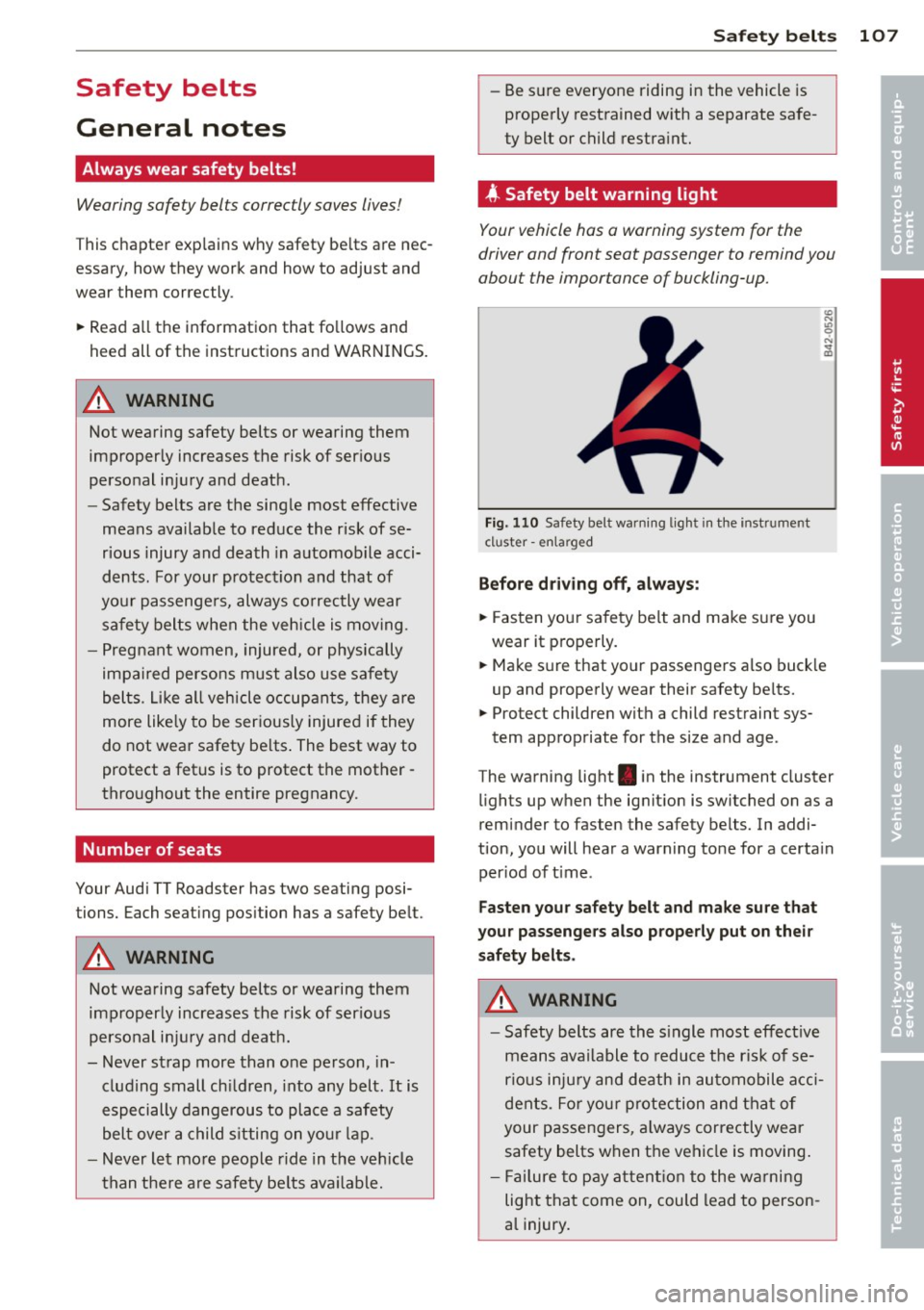
4 Safety belt warning light
Your vehicle has a warning system for the
driver and front seat passenger to remind you
about the importance of buckling-up.
Fi g. 1 10 Safety be lt warn ing lig ht in the instr ume nt
cl uster -enla rged
Befor e driv ing off, always :
~ Fasten your sa fe ty belt and make su re you
wear it p roperly.
~ Make s ure that yo ur passenge rs a lso buck le
up and properly wear their safety be lts.
~ Protect childre n with a child rest raint sys-
tem appropriate for the size and age .
The wa rning light . in the instrument cluster
li ghts up w hen the ig nit ion is switched on as a
remi nder to fasten the safety belts. In addi
tion , you will hear a warning tone for a certa in
per iod of t ime .
Fasten your safety belt and make sure that
your passengers also properly put on their saf ety belts .
A WARNING
-Safety belts are the s ingle most effect ive
means ava ilable to reduce t he risk of se
rio us i nju ry and de ath in au tomobile a cci
dents . Fo r yo ur pro tection and tha t of
your passen gers, a lways correctly wear
safety belts when t he ve hicl e is moving .
- Fail ure to p ay att ent io n t o the wa rni ng
lig ht that come on , could lead to person
a l injury . •
•
Page 114 of 260
112 Safet y belt s
Pregnant women must also be properly
restrained
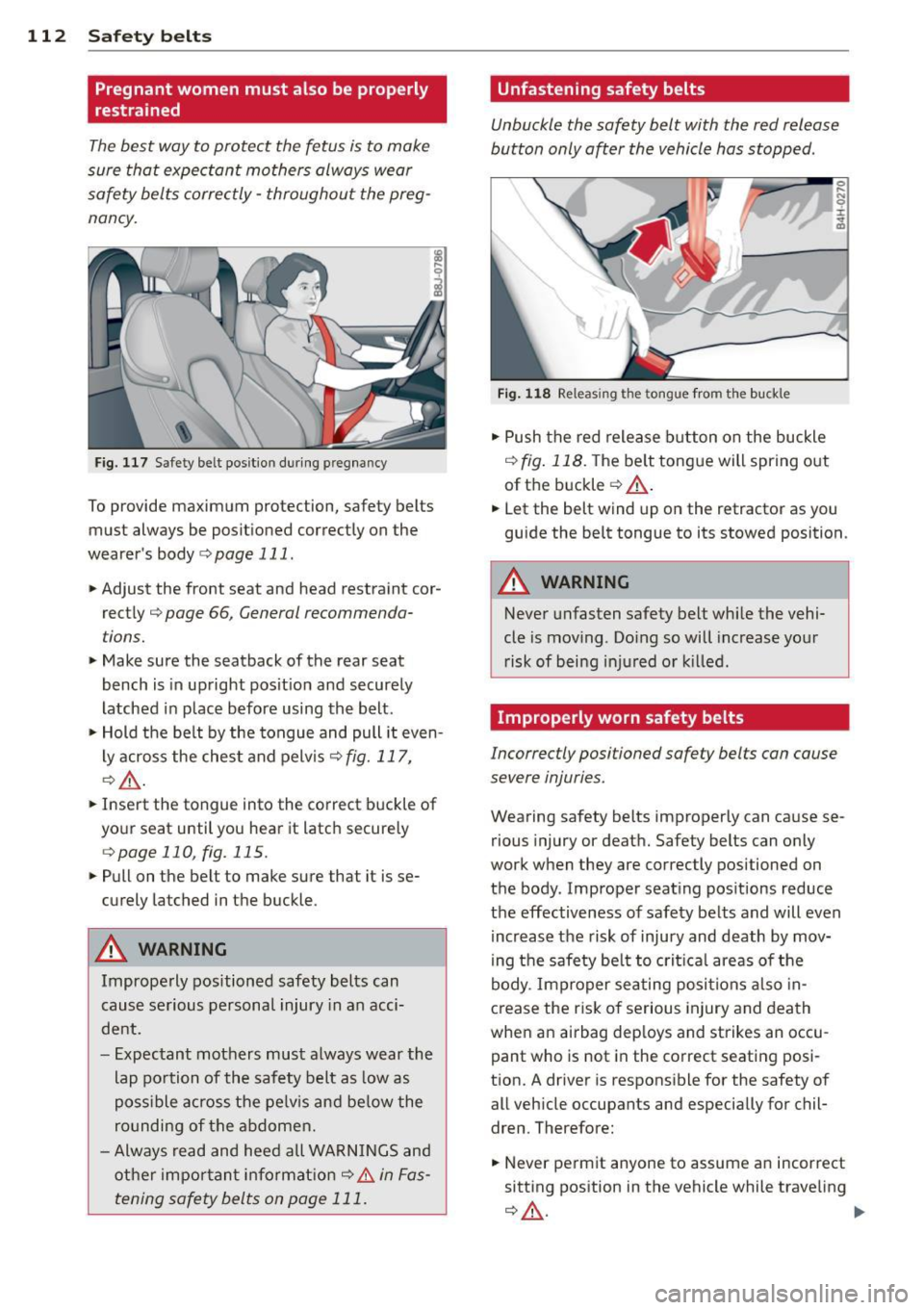
The best way to protect the fetus is to make
sure that expectant mothers always wear
safety belts correctly -throughout the preg
nancy.
Fig. 117 S afety be lt pos it io n during p regnancy
To provide maximum protection, safety belts
must always be positioned correctly on the
wearer's body
c> page 111 .
• Adjust the front seat and head restraint cor
rectly
c> page 66, General recommenda
tions.
• Make sure the seatback of the rear seat
bench is in upright posit ion and securely
latched in p lace before using the belt .
• Hold the belt by the tongue and pull it even
ly across the ches t and pelvis
c> fig. 117,
c> ,& .
• Insert the tongue into the correct buckle of
yo ur seat until you hear it latch securely
c> poge 110 , fig. 115.
•Pullon the belt to make sure that it is se
curely latched in the buckle .
A WARNING
Improperly positioned safety belts can
cause se rious personal injury in an acci
dent.
-
- Expectant mothers must always wear the
lap po rtion of the safety belt as low as
poss ible ac ross the pe lv is and be low the
rounding of the abdomen.
- Always read and heed all WARN INGS and
ot her impo rtan t info rmat ion
c> .&. in Fas
tening safety belts on page
111.
Unfastening safety belts
Unbuckle the safety belt with the red release
button only o~er the vehicle has stopped .
,,
}_
Fig . 1 18 Releas ing the tongue from the buc kle
• Push the red release b utton on the buckle
c> fig. 118. T he be lt tongue will spring out
of t he b uckle
c> ,& .
N 0 ;c
a1i
• Let the belt wind up on the retractor as you
guide the belt tongue to its stowed position .
A WARNING
-
Never unfasten safety belt while the vehi-
cle is mov ing . Do ing so will increase your
risk of being i njured or k illed.
Improperly worn safety belts
Incorrectly positioned safety belts con cause
severe injuries.
Wearing safety belts improper ly can ca use se
rious injury or deat h. Safety belts can only
work when they are correctly positioned on
the body . Improper seat ing positions reduce
the effectiveness of safety be lts and will even
increase the risk of injury and death by mov
ing the safety be lt to crit ica l areas of the
body . Imp roper seati ng posi tions a lso in
crease the risk of serious injury and death
whe n an airbag dep loys and strikes an occu
pant who is not in the correct seating posi
t ion. A driver is respons ible for the safety of
all veh icle occupants and especially for chil
dren. Therefore:
• Never pe rmit anyone to assume an incorrect
sitting position in the vehicle while traveling
c> ,& . ~