ESP AUDI TT ROADSTER 2011 Repair Manual
[x] Cancel search | Manufacturer: AUDI, Model Year: 2011, Model line: TT ROADSTER, Model: AUDI TT ROADSTER 2011Pages: 260, PDF Size: 64.11 MB
Page 197 of 260
-Never mount used tires on yo ur vehicle if
you are not sure of their "previous histo
ry." Old used tires may have been dam
aged even though the damage cannot be
seen that can lead to sudden tire failure
and loss of vehicle control.
Glossary of tire and loading terminology
Accessory weight
means the comb ined weight (in excess of
those standard items wh ich may be rep laced)
of automa tic tra nsmission, power steering,
power br akes, power w indows, power sea ts,
radio, and heater, to the ex tent that these
items are avai lab le as factory -installed eq uip
ment (whether installed or not).
Aspect ratio
means the rat io of the height to the w idt h of
the tire in percent . Numbers of 55 o r lower in
d icate a low sidewall fo r improve d steer ing re
sponse and better overall handling on dry
pavement.
Bead
means the pa rt of the t ire t hat is made o f
s teel wires, wrapped o r reinforce d by ply cor ds
and that is shaped to fit the r im.
Bead separation
means a b reakdown of the bond between
com ponents in the bead .
Cord
means the strands forming the plies in the
tire .
Cold tire infl ation pres sure
means the tire pressure recommended by the
vehicle manufacturer for a t ire of a designated
size that has not been dr iven for more than a
couple of miles (kilometers) at low speeds in
the three hour period before the tire pressure
i s measu red or adjusted.
Tire s an d wheel s 195
-If you notice un usua l vibration or if the
veh icle pulls to one side when driv ing, a l
ways stop as soon as it is safe to do so and check the wheels and tires for dam
age.
Curb weight
mea ns the we ight of a motor ve hicle w it h
standard equipment in cl ud ing t he maximum
capacity of fuel, o il, and coolant, ai r cond i
tion ing and addi tional weig ht o f optiona l
equipment .
Extra load tire
means a t ire designed to operate at higher
loads and at highe r inflat ion p ressu res tha n
th e co rresponding standard tire. Extr a load
tir es my be i dent ified as "X L", "xl", " EXTRA
L O AD", or "RF" on t he sidewall.
Gross Axle Weight Rating ("GAWR ")
mea ns the load-carry ing capac ity of a s ingle
axle system, measured at the tire-ground in
te rfaces .
Gross Vehicle Weight Rating ( "GVWR ")
mea ns the maximum total loaded we ight of
t h e ve hicle.
Groove
means the space between two adjacent tread
ribs.
Load rating (code )
means the maximum load tha t a t ire is rate d
to ca rry for a given inflation press ure. Yo u
may not find this information on all tires be
ca use it is not required by law.
Maximum load rating
me ans the loa d ra ting f or a t ire a t the maxi
mum pe rm issi ble inflat ion pressure for that
ti re . •
•
...
Page 198 of 260
196 Tires and wheels
Maximum loaded vehicle weight
means the sum of:
(a) Curb weight
(b) Accessory weight
(c) Vehicle capacity we ight, and
(d) Production options weight
Maximum (permissible) inflation pressure
means the maximum cold inflation pressu re
to which a tire may be inflated. Also called
"maximum inflation p ressure."
Normal occupant weight
means 150 lbs. (68 kilograms) times the
number of occupants seated in the vehicle up
to the total seating capacity of your vehicle.
Occupant distribution means distribution of occupants in a vehicle .
Outer diameter means the overa ll diameter of an inf lated new
tire.
Overall width
means the linear distance between the exteri
ors of the sidewalls of an inflated tire, includ
ing e levations due to labeling, decorations, or
protective bands or ribs.
Ply
means a laye r of rubber-coated parallel cords.
Production options weight
means the comb ined we ight of those installed
regular production options weighing over 5
lbs . (2 .3 kg) in excess of those standard items
which they replace, not previously considered
in curb weight or accessory weight, including
heavy duty brakes, r ide leve lers, heavy duty
battery, and special trim.
Radial ply tire
means a pneumatic tir e in which the p ly cords
that extend to the beads are laid at substan
tially 90 degrees to the centerline of the
tread . Recommended inflation pressure
see
~
page 195, Cold tire inflation pressure.
Reinforced tire
means a t ire designed to operate at higher
loads and at higher inflation p ressures than
the corresponding standard tire. Reinforced
ti res my be ident ified as "XL" "xl" "E XTRA
, ,
LOAD", or "RF" on the sidewall.
Rim
means a metal support for a tire or a t ire and
tube assembly upon which the tire beads are seated.
Rim diameter
means nominal d iameter of the bead seat. If
you change your wheel s ize, you w ill have to
purchase new tires to match the new r im di
ameter .
Rim size designation
means rim diameter and width.
Rim width
means nominal distance between rim flanges .
Sidewall
means that portion of a tire between the
tread and bead.
Speed rating (letter code)
means the speed at which a tire is designed to
be driven for extended periods of time. The
r atings range from 93 mph (150 km/h) to
186 mph (298 km/h)
~ page 206 . You may
not find this information on all tires because
it is not requ ired by law.
T he speed rating letter code, where applica
ble, is molded on the tire sidewall and indi
cates the maximum perm iss ibl e road speeds
~ A in Winter tires on page 209 .
Tire pressure monitoring system
means a system that detects when one or
more of a veh icle's tires are underinflated and
i lluminates a low tire pressure warning tell-
tale. ..,_
Page 200 of 260
198 Tires and whe els
Cold tire inflation pressure
Tire pressure affects the overall handling, performance and safety of a vehicle .
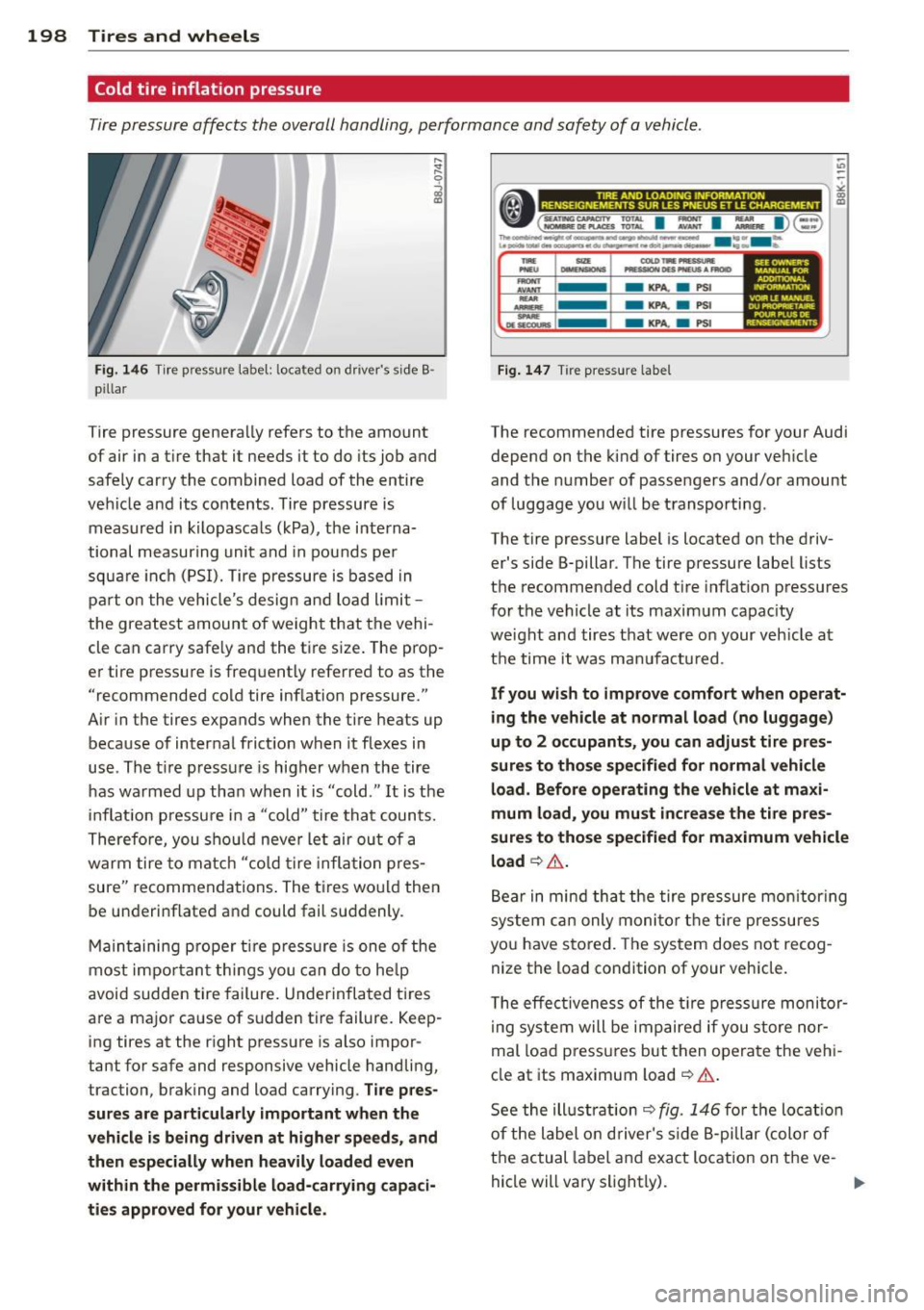
Fig. 14 6 Tire p ress ure labe l: loca ted on dr iver 's side B ·
p ill ar
Tire pressure generally refers to the amount
of air in a t ire that it needs it to do its job and
safely carry the combined load of the entire
vehicle and its contents . Tire pressure is
measured in kilopasca ls (kPa), the interna·
tional measuring unit and in pounds per
squa re inch (PSI). Tire pressure is based in
part o n the vehicle's design and load limit
the greatest amount of weight that the vehi·
cle can carry safe ly and the t ire size. The prop·
er tire pressure is freq uently referred to as the
"recommended cold tire inflation pressure."
A ir in the tires expands when the tire heats up
because of internal frict ion when it flexes in
use . The t ire p ressure is higher when the tire
has warmed up than when it is "cold ." It is the
i n flat ion pressure in a "cold " tire that counts.
Therefore, you shou ld neve r let air ou t of a
warm tire to match " co ld tir e infla tion p res
sure" recommendations . The tires wo uld then
be underinflated and could fail su ddenly .
M aintaining p roper t ire press ure is one o f the
most impo rtan t things you can do to he lp
avoid sudden tire failure. Underinflated ti res
are a major cause of s udden tire failure. Keep
ing tires at the right pressure is also impor
tant for safe and responsive vehicle handling,
traction, braking and load carrying .
Tir e pres
s ur es are part icularly important wh en th e
vehicl e is being driven at higher speed s, and
then es pecially wh en heav ily loaded even
w ithin th e permis sible load -carrying capa ci
tie s approv ed for y our vehi cle.
,;
•(=~: I : I :,.. I)@ ~
The~-----~---w-o- ....... -e.....i -·· - u ........ -.-..,.0, ... -....,.,...tot~---....... ._.,. -..
....
-..... ...........
- KPA. a PSI
- KPA.
a PSI
- KPA.
a PSI
Fig . 14 7 Tir e pressure labe l
SEE OWNER'S MANUAl FOR
A DOMlONAL
T10N VOl!ILEMANU£1. DU _,...,
POUR P\.US DE
REHSEKiloiEMENTS
The recommended tire pressures for your Audi
depend on the kind of tires on your veh icle
and the number of passengers and/or amount
of luggage you w ill be transporting .
The tire pressure label is located on the driv
er's side B-pillar . The tire pressure label lists
the recommended cold t ire inflat io n pressures
for the vehicle at its maxim um capac ity
we ight and tires that were on your veh icle at
the time it was manufa ctu red .
If you wish to impro ve comfort when operat
ing the v ehicle at normal lo ad (no luggag e)
up to 2 occupant s, you can adju st ti re pr es
sures to tho se spe cified f or normal vehi cle
load. Before oper ating th e vehicl e at maxi
mum load, yo u must increase the tire pr es
sure s to tho se spe cified f or ma ximum vehicle
load ~.&. .
Bear in mind that the tire pressure mon itor ing
system c an only moni to r the tire pressu res
you have stored. The sys tem does not recog
nize the load condition of your veh icle.
T he effec tiveness of the t ire press ure monitor
i ng system will be impaire d if you store nor
mal load pressures but then operate the vehi
cle at its maximum load
~ .&. .
See the ill ustration ~ fig. 146 fo r the locat io n
of the label on d river 's s ide B-pillar (colo r of
the actual label and exact location on the ve-
hicle will vary slight ly) .
IJi,,
Page 201 of 260
Tires and wheels 199
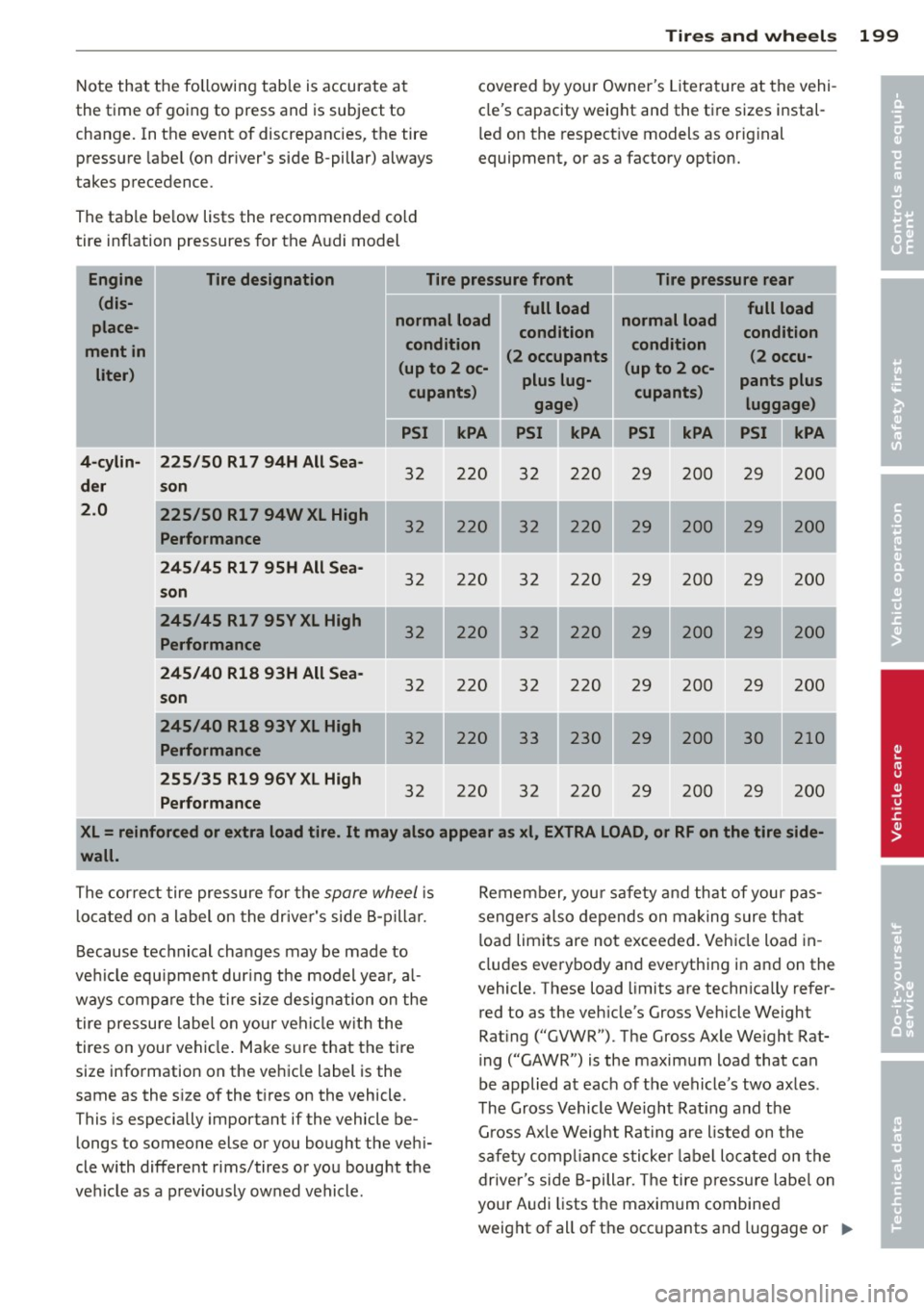
Note that the following tab le is accurate at
the time of going to press and is subject to
change. In the event of discrepanc ies, the tire
pressure label (on dr iver's side B-pillar) always
takes precedence .
The table be low lists the recommended cold
tire inf lation pressures for the Audi model covered
by your Owner 's Literature at the vehi
cle's capacity weight and the tire sizes instal
l ed on the respective models as orig inal
equipment, or as a factory option.
Engine II Tire designation Tire pressure front Tire pressure rear l
(dis-
full load full load
place- normal load
condition normal load
condition
ment in condition
(2 occupants condition
(2 occu-
liter) (up
to 2 oc-
plus lug- (up
to 2 oc-
pants plus
cupants) gage) cupants)
luggage)
PSI
ll kPA PSI kPA
PSI JI kPA PSI Jl kPA
-
4-cylin-
der
2.0 225/50
Rl 7 94H All Sea-
son
225/50 R17 94W XL High
Performance
245/45 Rl 7 95H All Sea-
son
245/45 R17 95YXL High
Performance
245/40 R18 93H All Sea
son
245/40 R18 93V XL High
Performance
255/35 Rl9 96V XL High
Performance
32 220
32 220
32 220
32 220
32 220
32 220
32 220 32
220 29 200 29 200
32 220 29 200 29 200
32 220 29 200 29 200
•
32 220 29 200 29 200
I
32 220 29 200 29 200
•
33 II 230 29
200 30 210 I
32 220 29 200 29 200
XL= reinforced or extra load tire. It may also appear as xl, EXTRA LOAD, or RF on the tire side
wall.
The correct tire pressure for the spore wheel is
l ocated on a label on the drive r's side B-pillar.
Because technical changes may be made to
ve hicl e equ ipment dur ing the model year, a l
ways compa re the tire size designation on the
tire pressure label on your vehi cle w ith t he
tires on your vehicle . Make sur e that the tire
size information on the vehicle label is the
same as the size of the tires on the vehicle.
This is especially important if the vehicle be
longs to someone else or you bought the veh i
cle with different rims/tires or you bought the
vehicle as a previously owned vehicle. Remember, you
r safety and that of your pas
sengers also depends on making sure that
load limits are not exceeded. Vehicle load in
cludes everybody and everything in and on the
vehicle. These load limits are technically refer
red to as the veh icle's Gross Vehicle Weight
Rat ing ("GVWR"). The Gross Axle We ight Rat
ing ("GAWR") is the maximum load that can
be applied at each of the vehicle's two axles .
The Gross Vehicle Weight Rating and the
Gross Axle Weight Rating are listed on the
safety comp liance sticker label lo cated on the
driver's side B-pillar. The tire pressure label on
your A udi lists the maximum combined
weight of all of the occ upants and luggage or
Ill>
•
•
Page 203 of 260
Never exceed the m aximum inflati on pres
s u re li sted on the ti re sidew all for any rea
son.
Remembe r that the vehicle manufacturer, not
the t ire manufacturer, determines the co rrect
tire pressure for the tires on your vehicle.
It is importan t to check the tire pressure when
t he t ires are cold .
- Read the requ ired ti re pressure from the tire
pressure label located on d river's s ide B-pi l
l ar .
- T urn the valve stem cap counter-clockwise
to remove it from the tire valve .
- Place the air pressure gauge on the valve .
- The tire pressures should only be checked
and adjusted when the tires are cold . The
s li ght ly raised p ressures of warm tires must
not be reduced.
- Adjust the t ire pressure to the load you a re
ca rrying.
- Re install the valve stem cap on the valve .
When should I ch eck the ti re pres sur e?
The correct tire pressure is especially impor
tant at high speeds. The pressure should
therefore be checked at least once a month
and a lways before start ing a journey .
When should I ad just th e tir e pre ss ures?
Ad just the tire pressure to the load you are
carrying . After changing a wheel
or replacing
wheels you have to adjust the tire pressures
on all wheels. In addition, you must then in it i
alize the new tire pressures in the tire pres
sure mon itor ing system
q page 212 .
A WARNING
Incorrect tire pressures and/or unde rinfla
tion can lead sudden tire failure, loss of cont ro l, col lision, ser ious persona l inju ry
or even death.
- When the warning symbo l
[D] appears in
the instrument cl uster, stop and inspect
the tires.
- Incor rect tire pressure and/or underinfla
tion can cause increased tire wear and
Tire s an d wheel s 201
can affect the handling of the vehicle and
stopping ability .
- Incorrect tire pressures and/or underin
flation can a lso lead to sudden t ire fail
ure, including a blowout and sudden de
flation, caus ing loss of veh icle control.
- The driver is responsible for the correct
tire pressures for all tires on the veh icle.
The applicable pressure values are locat ed on a sticker on the dr iver's s ide B-pil
lar .
- On ly when all tires on the vehicle are fil
led to the correct pressure, the t ire p res
sure mon itor ing system can work cor
rectly.
- The use of incorrect tire p ressu re va lues
can lead to acc idents or other damage.
Therefore it is essential that the drive r
observe the spec ified t ire p ress ure val ues
for the t ires and the correct pressures for
the function of the tire press ure monito r
ing system.
-A lways inflate tires to the recommended
and correct tire pressure before dr iv ing
off.
- Driving with underinf lated tires bend
mo re, letting them get too hot resulting
in tread separation, sudden tire failure
and loss of control.
- Excessive speed and/over loading can
cause heat b uild-up, sudden tire failure
and loss of control.
- If the tire pressure is too low or too high,
the t ires will wear prematurely and the
veh icle w ill not handle well.
- If the tire is not flat and you do not have
to change a wheel immediately, drive at
reduced speed to the nearest service sta
tion to check the t ire p ressu re and add
a ir as requ ired.
(D Note
Driving w it h out valve stem caps can cause
damage to the tire valves. To prevent this,
always make sure that factory installed
valve stem caps on all whee ls are secu rely
mounted o n the valve. .,.
•
•
Page 206 of 260
204 Tires and wheels
c::>fig . 148 running across the tread. Depend
ing on the make, there will be six to eight of
them evenly placed around the tire. Marks on
the tire sidewall (for example "TWI" or other
symbols) indicate the positions of the tread
wear ind icators . Worn tires must be replaced .
Different figures may apply in other countries
c::> ,& .
Tire pressure
Incorrect tire pressure causes premature wear
and can cause sudden tire blow-out . For this
reason, tire pressure must be checked at least
once a month
c::> page 200.
Driving style
Driving fast around curves, heavy acceleration
and hard braking increase tire wear.
Rotating tires for more even wear
For a ll four tires on your vehicle to have the
same service life, we recommend that the
front and rear tires are rotated according to
the tire manufacturer's suggested tire rota
tion intervals. Please remember the follow
ing:
- Tire rotation interva ls may differ from the
vehicle serv ice intervals outlined in your
Warranty
& Maintenance Booklet.
- The longer one tire is used in one location
on the vehicle, the more it wears at certain
points; therefore, we recommend that you
follow the tire manufacture r's suggested
t ir e rotation intervals .
- Vehicles with front-wheel drive experience
more tread wear on the front wheels com
pared to all-wheel drive (quatt ro ® ).
- Please rotate t ires as shown
c::> fig . 149.
-Extra care must be taken when rotating di-
rect ion-specific tires
c::> page 226.
Wheel balancing
The whee ls on new vehicles are balanced.
However, various situations during everyday
driving can cause them to become unbal
anced, resulting in vibrations you can usually
feel through the steering wheel. Unbalanced
wheels must be rebalanced to
avoid excessive wear on steering, suspension
and t ires . A whee l must also be reba lanced
when a new tire is installed.
Incorrect wheel alignment
Incorrect wheel alignment can cause exces
sive tire wear, impairing the safety of the vehi
cle. If tires show excessive wear, have the
whee l alignment checked by an authorized
Audi dealer or qualified workshop.
All Wheel Drive
Vehicles with quattro ® must a lways have tires
of the same size, construction and tread type .
For details see c::>page
154.
A WARNING
-Sudden tire fai lure can lead to loss of con-
trol, a crash and serious personal injury!
- Never drive a vehicle when the tread on
any tire is worn down to the wear indica
tors.
- Worn tires are a safety hazard, they do not grip well on wet roads and increase
your r isk of "hydroplaning" and loss of
control.
- Always keep chemicals that can cause
tire damage, such as grease, oil, gasoline
and brake fluid away from tires.
- Tires age even if they are not being used
and can fail suddenly, especially at high
speeds. Tires that are more than 6 years
old can only be used in an emergency
and then w ith special care and at lower
speeds.
- Never mount used tires on your vehicle if
you are not sure of their "previous histo
ry." O ld used tires may have been dam
aged even though the damage cannot be
seen that can lead to sudden tire fai lure
and loss of vehicle control.
Page 209 of 260
general, the greater the number of plies, the more weight a tire can support . Tire manufac
turers also must indicate the materials in the
tire, wh ich include steel, nylon, polyester, and
others .
Ma ximum Load R ating
This number indicates the maximum load in
kilograms and pounds that can be carried by
the tire.
Tire qualit y gr ad ing for treadw ear,
tract ion , an d temp erature resis ta nce
Tread wear , traction and temperature grades
c::> pag e208.
M aximum Permis sibl e Inflation Pr essur e
This n umbe r is the greatest amount of air
pressure that should ever be put in the tire
under normal driving conditions .
& WARNING
- Using incorrect or unmatched tires and/
or whee ls or improper tire and whee l
combinations can lead to loss of contro l,
collision and serious personal injury.
- Always use tires, rims and wheel bo lts
that meet the specifications of orig inal
factory-installed tires or other combina
t ions that have been spec ifically ap
proved by the vehicle manufacturer .
- Tires age even if they are not be ing used
and can fail suddenly, especially at high
speeds . T ires that are more than 6 years
o ld can only be used in an emergency
and then with special care and at lower
speeds.
- Never mount used ti res on you r vehicle if
yo u are not s ure of their "previous histo
ry ." Old used tires may have been dam
aged even though the damage cannot be
seen that can lead to sudden tire failure
and loss of vehicle control.
- All four wheels must be fitted with radia l
t ires of the same type, size (roll ing cir
cumference) and the same tread pattern .
Driv ing with different tires reduces veh i-
Tire s an d wheel s 207
cle handling and can lead to a loss of
contro l.
- If the spare tire is not the same as the
tires that are mounted on the vehicle -
for examp le w ith winter t ires -only use
the spare t i re for a short period of time
and drive with extra care . Refit the nor
mal road wheel as soon as safely poss i
ble .
- Never drive faster than the max imum
speed for which the tires on your vehicle
are rated because tires that are dr iven
faster than their rated speed can fa il
suddenly.
- Ove rloading tires cause heat build-up,
sudden tire fa ilure, including a blowout
and sudden deflation and loss of contro l.
- Temperature grades apply to tires tha t
are properly infla ted and not over or un
derinf lated .
- For technical reasons it is not always
possible to use whee ls from other vehi
cles -in some cases not even wheels
from the same ve hicle mode l.
-If you install wheel trim discs on the ve
hicle wheels, make sure that the air flow
to the brakes is not b locked. Reduced air
f low to the brakes can them to overheat,
increas ing stopping d istances and caus
ing a co llision .
- Run flat tires may only be used on vehi
cles that were equ ipped w ith them at the
factory. The veh icle must have a chassis
des igned for run flat ti res and a factory
installed t ire p ressure monito ring sys
tem that indicates a loss of ti re p ressu re.
I nco rrec t use of run fl at tires can lead to
veh icle damage o r accidents. Check with
an authorized Audi dealer or tire special ist to see if your vehicle can be equipped
with run flat tires. If run flat tires are used, they must be installed on all four
wheels. Mixing tire types is not permit-
ted .
Ill>
•
•
Page 210 of 260
208 Tires and wheels
-For technical reasons, it is not generally
possible to use the whee l rims from oth
er vehicles. This can hold true for wheels
of the same vehicle type.
- If the spare tire is different from the
tires that you have mounted on your ve hicle (for example winter tires or wide
profile tires), then use the spare t ire for a
short period of time only and drive with
extra care. Replace the flat tire with the
tire match ing the others on your vehicle
as soon as possible.
- Never drive without the valve stem cap.
The valves could get damaged.
@ For the sake of the environment
Dispose of old tires in accordance with the
local requ irements.
Uniform tire quality grading
- T read wear
- Traction AA A B (
- Temperature ABC
Quality grades can be found where applicable
on the tire side wall between tread shoulder
and maximum sect ion width ¢
page 205,
fig . 150 .
For example: Tread wear 200, Traction AA,
Temperature A.
All passenger car tires must conform to Feder
al Safety Requirements in addition to these
grades.
Tread wear
The tread wear grade is a comparative rating
based on the wear rate of the tire when tested
under controlled conditions on a specified
government test course.
F or example, a tire graded 150 would wear
one and one half (11/2) times as well on the
government course as a tire graded 100.
The relat ive performance of tires depends
upon the actua l conditions of their use, how -ever, and may depart significantly from the
norm due to variations in driving habits, serv
ice practices and differences in road character
istics and climate.
Traction
The traction grades, from highest
to lowest,
are AA, A, Band
C. Those grades represent the
tire's ability to stop on wet pavement as measured under contro lled conditions on
specified government test surfaces of asphalt and concrete. A tire marked C may have poor
traction performance ¢
,&.
Temperature
The temperature grades are A (the highest),
B, and C, representing the tire's resistance to
the generation of heat and its ability to dissi pate heat when tested under controlled condi
t ions on a specified indoor labo ratory test
wheel.
Sustained h igh temperature can cause the
material of the tire to degenerate and reduce
tire life, and excessive temperature can lead
to sudden tire failure ¢ ,&.
The grade C corresponds to a level of perform
ance which all passenger car tires must meet
under the Federal Motor Vehicle Safety Stand
ard No. 109. Grades Band A represent h igher
levels of performance on the laboratory test
whee l than the minimum required by law.
A WARNING
The traction grade assigned to this tire is
based on straight -ahead braking traction
tests, and does not include acceleration,
cornering, hydroplaning or peak traction
characterist ics .
A WARNING i- -
The temperature grade for this tire is es-
tablished for a tire that is properly inflated
and not overloaded . Excess ive speed, un
derinflation, or excessive loading, either
separately or in combinat ion, can cause
heat buildup and possible tire failure.
Page 213 of 260
can be damaged and the wheel can be
come loose.
@ Note
The specified torque fo r the wheel bo lts is
90 ft lb (120 Nm) with a tolerance of± 7,4
ft lb(± 10 Nm). Torque wheel bo lts diago
nally. After chang ing a wheel, the torque
must be checked as soon as possib le wit h a
torque wrench -preferab ly by an author
ized Aud i dealer or qualified workshop .
Low aspect ratio tires
Your Audi is factory-equipped with low aspect
ratio t ires. These t ires have been thorough ly
tes ted and been selected spec ifica lly for your
model for the ir superb pe rformance, road feel
and handling under a variety of driving condi
tions . Ask your a uthorized Audi dea le r for
more deta ils.
The low aspect ratio of these tires is indicated
by a numeral of
55 or le ss in the tire's size
designation. The numeral represents the ratio
of the tire's sidewall height in relat ion to its
tread width expressed in percentage . Conven
tional tires have a height/width ratio of 60 or more .
The perfo rmance of low -aspect -rat io ti res i s
part icularl y sensit ive to improp er i nflation
pr essu re. It i s th erefore importan t that low
aspect r atio tire s are infla ted to th e specifi ed
pr ess ure and that the inflation pressure is
regu lar ly che cked and maintained. Tir e pr es·
s ur es sh ould b e chec ked at l ea st once a
month and alw ay s before a lon g trip
<=> page 200, Checking tire pressure.
What you can do to avoid tire and rim
damag e
Low aspec t ratio t ires can be damaged more
easi ly by impact with potho les, cu rbs, gu llies
or ridges on the road, part icu larly if the tire is
underinflated .
I n o rder to m inimize the occu rrence o f impact
damage to the t ires of your vehicle, we recom -
Tires an d wheel s 211
mend that you observe the following preca u
tions:
- Always ma inta in re commended inflation
pressures . Check your tire pressu re eve ry
2,000 miles (3,000 km) and add air if neces
sary.
- Drive caref ully on roads with potholes, deep
gullies or ridges. The impact from driving
through or over such obstacles can damage
your tires. Impact with a curb may also cause damage to your tires .
- After any impact, immediate ly inspect your
tires or have them inspected by the nearest
au thor ized Audi dealer. Replace a damaged
tire as soon as possible .
- Inspect your tires every 2,000 m iles (3,000
km) for damage and wear. Damage is no t al
ways easy to see . Damage can lead to loss of
air and under inflat ion, which could eventu
ally cause tire failure .
If you believe that a
tire may have been damaged, rep lace the
tire as soon as possib le .
- These tires may wear more quickly tha n oth
ers.
- Please also remember that, while these tires
de live r responsive handling, they may ride
less comfo rtably and make more noise than
other choices .
Reduced performanc e in winter /cold
season conditions
A ll ti res are designed for certa in p urposes.
T he low aspect ratio, ult ra h igh performance
tires originally installed on your vehicle are in
tended for maxim um dry and wet road per
formance and handling. They are not suitable
for cold , snowy or icy weather condi tions. If
you drive under those circumstances, you
should equ ip your vehicle w ith all-season or
winter tires, which offer bette r traction under
those conditions. We suggest you use the rec
ommended snow o r all-season t ires specified
f o r yo ur vehicle , or thei r equivalent .
Refer to
<=> page 209 fo r more detailed infor
mation regard ing winter tires .
•
•
Page 214 of 260

212 Tires and wheels
Tire pressure
monitoring system
General notes
Appl ies to vehicles: with tire pressure monitoring system
Each tire, including the spare (if provided),
should be checked monthly when cold and in
f lated to the inflation pressure recommended
by the vehicle manufacturer on the vehicle
placard or tire inflation pressure label. (If your
vehicle has t ires of a different size than the
size indicated on the vehicle placard or tire in
flation pressure label, you should determine
the proper tire inflation pressure for those
tires.)
As an added safety feature, your vehicle has
been equipped with a tire pressure monitoring
system (TPMS) that illuminates a low tire
pressure telltale when one or more of your
tires is significantly under-inflated. According
ly, when the low tire pressure telltale illumi
nates, you should stop and check your tires as
soon as possible, and inflate them to the proper pressure. Driving on a significantly un
der-inflated tire causes the tire to overheat
and can lead to tire failure. Under-inflation al
so reduces fuel efficiency and tire tread life,
and may affect the vehicle's handling and
stopping ability.
Please note that the TPMS is not a substitute
for proper tire maintenance, and it is the driv
er's responsib ility to ma inta in correct tire
pressure , even if under-inflation has not
reached the level to trigger illumination of the
TPMS low tire pressure telltale.
Your veh icle has also been equ ipped with a
TPMS malfunction indicato r to indicate when
the system is not operating properly. The
TPMS malfunction indicato r is combined with
the low tire pressure telltale. When the sys
tem detects a malfunction, the telltale will
f lash for approximately one minute and then
remain continuously illuminated. This se
quence will continue upon subsequent vehicle
start-ups as long as the ma lfunction exists. When the
malfunction indicator is illuminat
ed, the system may not be ab le to detect or
s ignal low tire pressure as intended. TPMS
malfunctions may occur for a variety of rea
sons, including the installation of replace
ment or alternate tires or wheels on the vehi
cle that prevent the TPMS from functioning
properly. Always check the TPMS malfunction
telltale after replacing one or more tires or
wheels on your vehicle to ens ure that the re
placement or alternate ti res and wheels allow
the TPMS to continue to function properly.
Tire pressure indicator appears
Applies to veh icles : w ith tire pressure monitoring system
The tire pressure indicator in the instrument
cluster informs you if the tire pressure is too
low or if there is a system malfunction.
Fig. 151 Display : underinflatio n warning
Fig. 152 Display: System malfunction
Using the ABS sensors, the tire pressure moni
toring system compares the tire tread circum
ference and vibration characteristics of the in dividual tires. If the pressure decreases in one
or more t ires, this is indicated in the instru
ment cluster with a warning symbol
g and a
message
r=:> fig. 151. Th e driver message in the
display goes out after 5 seconds. The driver
message can be displayed again by pressing
11--