lights AUDI TT ROADSTER 2011 Owner's Manual
[x] Cancel search | Manufacturer: AUDI, Model Year: 2011, Model line: TT ROADSTER, Model: AUDI TT ROADSTER 2011Pages: 260, PDF Size: 64.11 MB
Page 61 of 260

automatic dimming of the o uts ide m ir
r or s will likewise be di sabled .
-Check to make sure there are no objects
preventing light from reaching the inside
mirror.
- Do not attach any sticke rs to the wind
shield in front of the two light sensors,
as this would interfere with both the au
tomatic operation of the headlights and
the automatic dimming of the inside mir ror(s).
Outside mirrors
The outside mirrors ore electrically adjusted.
Fig. 67 Forward section of drive r's armrest: power mir
ror contro ls
Adju sting th e outside mirror s
• Turn the adjusting knob to posit ion ©
Q fig. 67 to adjust the o utside mirror on the
driver's side .
• Turn the adjusting knob to position ® to ad
just the outside mirror on the passenger
side.
• Press the knob in the appropriate direction
to move the mirror surface so that you have
a good view to the rear.
Heated mirro rs
• Turn the knob to posit ion @.
Depending on the outside temperature, the
mirror surfaces are heated until the ignition is
switched off -even if the knob is no longer in
position @. You are well-advised to fold the
outs ide mirrors in when maneuvering in tight
spaces or when leaving the car parked close to
other veh icles.
Clear vi sion 59
(D Note
- Curved ( i.e. convex) mirror s urfaces in
crease yo ur field of view. Remember that
vehicles or other objects will appear
smaller and farther away than when
seen in a flat m irror . If you use this mir
ror to estimate distances of following ve
hicles when chang ing lanes, you could
es timate incorrectly and cause an ac ci
dent.
- If the mirror housing is moved uninten
tionally (for examp le, w hile pa rking your
vehicle), then yo u must first fold the m ir
ror elect rically . Do not rea djust the mir
ror housing man ually . You cou ld damage
the motor which controls the mirror .
(D Tips
If there sho uld be a ma lf u nction in the
e lectrica l system, yo u can sti ll adjust the
outside m irrors by pressing the edge of
the m irror.
Automatic dimming for outside mirrors
Applies to vehicles: wit h automatic dimm ing for outside
mirro rs
The outs ide mirrors are dimmed together with
the automatic dimming of the inside mirror .
When the ignition is sw itched on, the mirrors
darken automatically depending on the light
striking them (e .g. headlights from the rear) .
When the interior lighting is switched on and
when reverse gear is engaged, the mirrors are
switched back to the ir original br ightness (not
dimmed) .
A WARNING
Broken glass of automat ic dimming mirror
can cause electrolyte flu id leakage. El ec
trolyte f lu id can ir rit a te skin, eyes, a nd res
p ira to ry system.
- Repeated or prolonged exposu re to e lec
trolyte can cause irritation to the respira
tory sys tem, espe cially among people
wit h asthma or other resp irato ry co ndi -
tions . Get fresh air immediately by
~
Page 63 of 260

come back a while later and drive off, the rain
sensor will reactivate itself after the vehicle
speed has exceeded 4 mph (6 km/h).
The rain sensor* is only activated with the
wiper lever set to position(!). When it starts
to rain, the rain sensor will automatically acti
vate the intermittent wiping mode.
To reduce the sensitivity of the sensor, move
switch @ down. To increase the sensitivity,
move the switch up. The higher you adjust the
sensitivity, the faster the sensor will react
when it senses moisture on the windshield. The pauses between wiper turns depend not
only on the sensitivity setting, but on the ve
hicle speed as well.
During brief stops, e.g . at a red light, wiper
motion will automatically be reduced to the
next lower speed . Wipers already turning at
low speed. change to intermittent wiping.
When the ignition is turned on, the washer
jets are heated .
A WARNING
-Wiper blades are crucial for safe driving!
Only when they are in good condition are
they able to clear the windows properly
to provide uncompromising visibility.
Worn or damaged wiper blades are a
safety hazard ¢
page 63, Replacing
windshield wiper blades!
- The light/rain sensor* is only designed to
assist and support the driver.
It remains
entirely the driver's responsibility to
monitor outside weather conditions and
to manually activate the wipers as soon
as rain or drizzle reduces visibility
through the windshield.
- The windshield must not be treated with
water-repellent materials. They can in
crease glare under poor visibility condi
tions such as wetness, darkness, or when
the sun is low on the horizon. In addi
tion, they can cause the windshield wip
ers to chatter.
Clear vision 61
@ Note
In freezing or near freezing conditions:
- Always check that the wiper blades are
not frozen to the glass before you turn
the wipers on. Loosen a wiper blade
which is frozen in place before operating
the wipers to prevent damage to the
wiper blade or the wiper motor.
- Do not use the wipers to clear a frosted
window. Using the wipers as a conven ient ice scraper will destroy the wiper
blades .
- Before you take your vehicle to an auto
matic car wash, make sure you have the
windshield wiper system switched off (lever in position
0), otherwise the wind
shield wiper system could get damaged
in the car wash if it should suddenly
come on.
@ Tips
-The windshield wipers are switched off
when the ignition is turned off. Activate
the windshield wipers after the ignition
is switched back on by moving the wind
shield wiper lever to any position.
- Worn or dirty windshield wiper blades
cause smearing, which can affect the op
eration of the light/rain sensor*. Check
the condition of your windshield wiper
blades regularly.
-The rain sensor is part of the interval
wiping system. Turning off the ignition
will also deactivate the rain sensor. To re
activate the sensor, switch off the inter
val wiping function, then switch it back
on again.
-Applies to vehicles with light/rain sen
sor: When the wipers are switched on
manually and in rain conditions, the au
tomatic headlights* turn on¢
page 53,
Switching the headlights on and off
or
off during the day when the wipers are
no longer operating. The automatic
headlights* function is available in this
case only when the light switch is in the
"AUTO" position¢
page 53, fig. 57.
Page 64 of 260
62 Clear vis ion
- Make sure the washer fl uid reservoir in
the engine compartment is topped
off
before going on a long trip . Look up
c:> page 192 for checking and fi lling the
washer container.
- The w ipers only operate w ith the hood
completely closed.
Headlight washer system
App lies to vehicles: with hea dlig ht washer system
The headlight washer system cleans the
headlights.
.. Operate the winds hield wiper/washer sys
tem
c:> page 60, fig. 68 ® with the head
li ghts turned on by holding the lever for lon
ger than one second.
The washer jets extend forward o ut of the
front bumper driven by water pressure to
spray the front headlights with water.
You shou ld inspect the headlights regularly
(for example when refue ling) and clean
off
any solid dirt or insects from the lenses .
To ensure the system works properly in winter,
keep the washer jets free of snow and remove
any ice using a de-icing spray.
Service position
It is only possible to change wiper blades if
you move the wiper arms to the service posi
tion
I n o rder to use the windsh ie ld w ipers, the
front lid must be comp letely closed
Moving wiper blades to the service
position
.. When there is a ris k of frost, ma ke s ure that
the wiper b lades are not frozen to the wind
shield .
.. Switch the ignition on .
.. Move the wiper lever to pos ition
0
c:> page 60, fig. 68 .
.. Press the I Reset I button until the Display
type menu appears in the Driver Informa
t ion System display . ..
Using the rocker switch and the
I R ese t I but
ton, se lect the Set > Wipe rs > Front > Se rv
ice po sition on function . The w indshield
w iper arms move to the service posit ion.
Mo ving wip er blades to pa rk position
.. Make certain that the w iper arms are ly ing
against the windshield .
.. Switch the ignition on and move the wipe r
lever from pos ition O
to 4 c:> page 60,
fig. 68.
The w iper arms will move back to
the park position.
@ Note
Never drive your veh icle when the wind
sh ield wiper arms are in the service posi
tion and pulled away from the winds hield.
When you d rive faster than 4 mph (6 km/
h), the wiper a rms automatically return to
the pa rk position and cou ld cause paint
d amage to the front l id!
@ Tips
= Yo u can also tur n on the se rvice posit ion,
for example, if yo u want to p rotect the
w indshield from icing by us ing a cover.
- The service posit ion moves to
off a uto
matically whe n you ope ra te the w ind
shield wiper lever, o r speed exceeds
4 mph (6 km/h) .
Page 83 of 260
You should always lock the steering whenever
you leave your vehicle . This makes a vehicle
theft even more difficu lt ¢ & .
Ignition ke y safe ty lock
After switching off the ignition, the ig nit ion
key can only be removed from the ign ition
l ock when the selector lever is in the "P"
(Park) position . After you have removed the
key, the selector lever is locked and cannot be
moved.
Ignition on @
If it is difficult to turn the key after you have
inse rted it into the ignition lock, turn the
steering whee l back and forth. This will take
the load
off the steering lock mechan ism and
you will be able to turn the key freely and start the engine.
Starting the engin e@
In this position the engine starts . While the
engine is starting, the power supply to the headlights and other e lectr ica l consumers is
tempo rarily interrupted to conserve battery
power . After the engine has started, release
the key and it will return to posit io n @ .
Before the starter can be operated again the
key must be turned back to position@. The
non-r epeat lock prevents you from damag ing
the sta rter when the engine is runn ing .
A WARNING
-Never remove the key from the ign ition
lock whi le the vehicle is moving. The
steering wheel will lock causing loss of
control.
- If you have to leave your ve hicle -even
f or just a m in ute -always remove the ig
ni tion key and take it with you. This is es
pecially important if yo u a re going to
leave chi ldren behind in the vehicle. The
children cou ld start the engine or use
other vehicle controls. Unsupervised use
of vehicle controls (for example, power
windows) can cause serious personal in
jur ies .
-
On th e ro ad 81
(D Tips
If the vehicle battery has been disconnect
ed and then reconnected, then yo u must
l eave the key in posit ion @ for about 5
seconds before you can start the engine.
Starting and stopping
the engine
' Starting the engine
The engine can only be started with an origi
nal Audi key .
.,. Se t the par king brake.
.,. Move the selector lever in P or
N q ,& .
.,. Tu rn the ignition key to position ®
~ page 80, fig. 90 -do not depress the gas
peda l when starting the engine!
.,. Let go of the key as soon as the engine
starts.
A cold engine may at first be loud after it has
been started. This is due to the hydraulic
valves bu ild ing up the oil pressure. Th is nor
mal and no need for concern .
If the engine does not start immediately, stop
trying after 10 seconds and then try to restart
the engine about 30 seconds later.
A WARNING
-Never start or let the eng ine run in a con-
fined o r enclosed area . Exhaust fumes
from the engine contain carbon monoxide,
a colorless and odo rless gas. Ca rbon mon
oxide can be f atal if inhaled.
- Never leave the engine id ling unattend
ed. An una ttended veh icle with a runn ing
engine poses a danger o f personal injury
or theft .
(D Note
-Avo id high engine speeds, fast accelera
tion or heavy engine loads while the en
gine is still cold. This could damage the
engine.
- The engine cannot be started by pushing
or towing the vehicle . .,..
Page 89 of 260
Transmission S tronic transmission
Introduction
Your vehicle is equipped with a S tronic trans miss ion, also called a double-clutch system/
transmission.
Power is transferred between the engine and
the transm ission by means of two i ndepend
ent clutches. They replace the to rque convert
e r of conventional automat ic transm iss ions
and a llow the vehicle to acce lerate without a
noticeable break in the power flow .
W it h the aid
of tiptroni c, the gears can op
tionally be sh ifted
manually¢ page 90.
Selector lever positions
All the selector lever positions are explained
in this section.
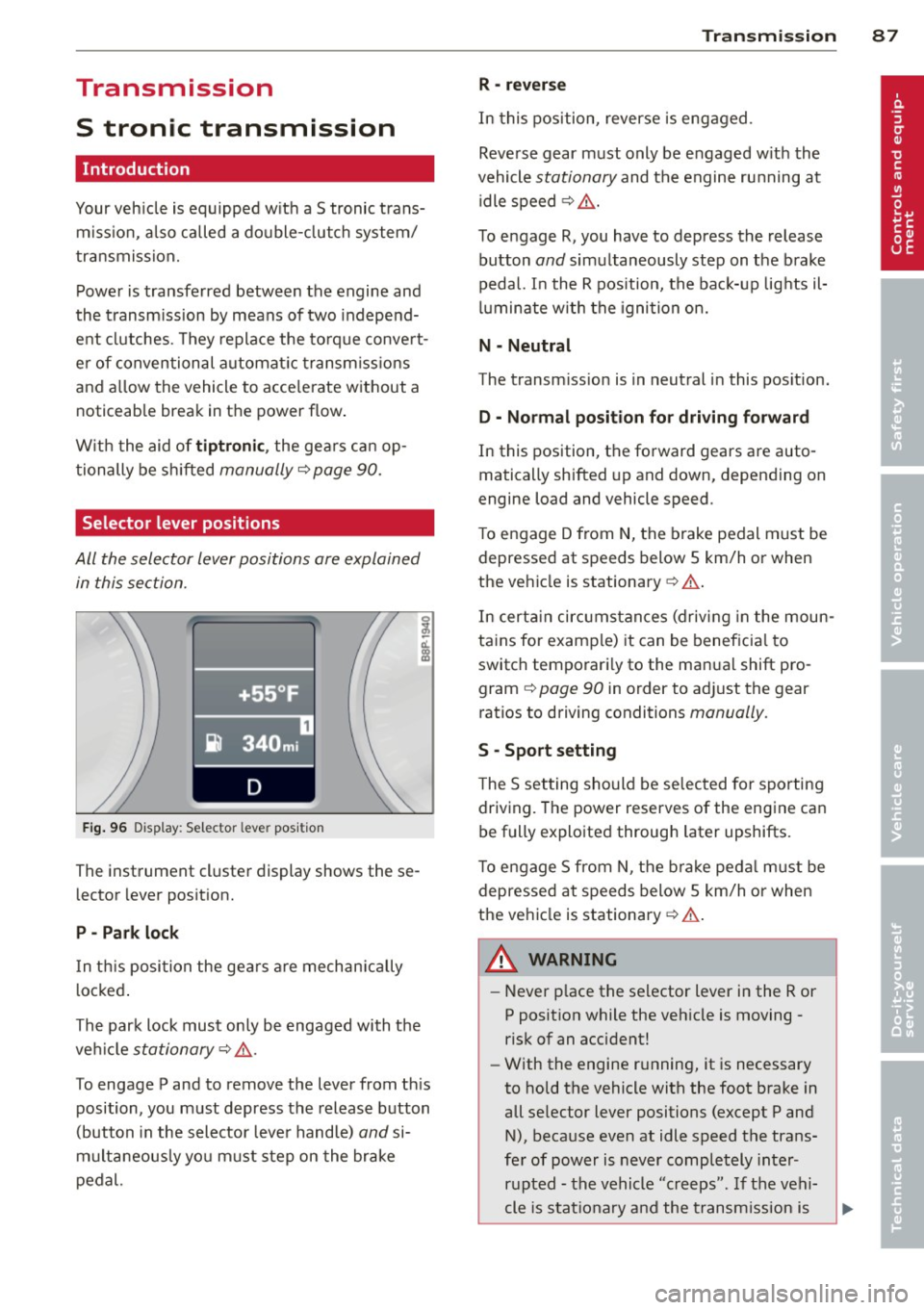
F ig . 96 Display: Selector lever position
The instrument cluster display shows these
l ector lever position.
P -Park lock
In th is posi tion the gea rs are mechan ically
l ocked .
The park lock must on ly be engaged with the
ve hicl e
stationary¢ /1..
To engage P and to remove the lever from th is
position, you must depress the release button
(button in the selector lever handle)
and si
multaneously yo u must step on the brake
pedal.
Tran sm iss ion 87
R -re ver se
In this position, reverse is eng aged.
Reverse gear must only be engaged w ith the
vehicle
stationary and the engine ru nning at
idle speed ¢
/1..
To engage R, you have to depress the release
button
and simultaneously step on the brake
pedal. I n the R pos ition, the bac k-up lights il
luminate w ith the ignition on.
N -Neutral
The transm iss ion is in neutral in this pos ition.
D -Normal po sition fo r dri ving forward
In this position, the forward gears are auto
matically shifted up and down, depending on
engine load and vehicle speed.
T o engage D from
N, the brake pedal must be
depressed at speeds below S km/h or when
the vehicle is stationary¢&. .
In certa in circ umstances (driving in the moun
tains for examp le) it can be beneficia l to
switch temporari ly to the man ual shift pro
gram ¢
page 90 in order to adjust the gear
ratios to driving conditions
manually .
S -Sport s etting
T he S set ting should be se lected for sporting
driving. The power reserves of the engine ca n
be fully explo ited through later upshifts.
T o e ngage S from N, the b ra ke peda l must be
depressed at speeds below 5 km/h or when
the ve hicle is stationary ¢&. .
A WARNING
-Never p lace the selector lever i n the R or
P posit ion while the veh icle is moving -
risk of an accident!
- With the engine r unning, it is necessary
to hold the vehicle with the foot brake in
all se lector lever positions (except P and
N), because even at idle speed the trans
fe r of power is never completely inter
r u pted -the vehicle "creeps". If t he vehi
cle is stat ionary and the t ransm ission is
Page 100 of 260
98 Driving Safel y
Driving Safely
General notes
Safe driving habits
Please remember -safety first!
This chapter contains important information,
tips, instructions and warnings that you need
to read and observe for your own safety, the
safety of your passengers and others . We have
summarized here what you need to know
about safety belts, a irbags, ch ild restra ints as
well as child safety. Your safety is for us
priori
ty number 1.
Always observe the info rmat ion
and warn ings in th is sect ion -fo r yo ur own
safety as well as for that of your passengers.
The information in this se ction app lies to all
model ve rsions of your veh icle . Some of the
feat ures desc ribed in this sec tions may be
standa rd equipment on some models, or may
be optional equipment on others . If you are
not sure, ask your authorized Aud i dealer.
A WARNING
- Make certain that you follow the instruc
t ions and heed the WARNINGS in this
Manual. It is in your interest and in the
interest of your passengers .
- Always keep the complete Owner's Liter
ature in your Audi when you lend or sell
yo ur vehicle so that this important info r
mation will a lways be ava ilable to the
dr iver and passenge rs.
- Always keep the Owner's literature handy
so that you can find i t eas ily if yo u have
ques tions.
Safety equipment
The safety features are part of the occupant
restraint system and work together to help
reduce the risk of injury in a wide variety of
accident situations.
Your safety and the safety of your passenge rs
should not be left to chance. Advances in
technology have made a varie ty o f fea tures
avai la bl e to he lp re duce the risk of injury in an accident
. The following is a lis ting o f just a
few of the safety features in your Audi:
- sophis tic ated s afety be lts fo r drive r and a ll
passenger sea ting pos it ions,
- safety belt pre-tensione rs,
- fro nt airbags,
- knee airbags for the front seats,
- side airbags in the front seats,
- LATCH anchorages for child restraints,
- ad justab le steering column .
T hese ind iv idual safety features can wor k to
ge ther as a sys tem to he lp p rotec t you and
you r passengers in a wide range of accidents.
These features cannot wo rk as a system if
they are not always p roper ly adjusted and
properly used!
Safet y is everybody's re sponsibilit y!
Important things to do before driving
Safety is everybody's job! Vehicle and occu
pant safety always depends on the informed and careful driver.
For yo ur safe ty and the safety of you r passen
gers,
befor e driving alwa ys:
"' Make s ure that all lights and signa ls are op
erati ng correctly .
"' Ma ke su re t hat the t ire p ressu re is co rrec t.
"' Mak e su re that all windows are clean and a f
ford good vis ibility to the outs ide.
"' Sec ure all luggage and other items caref ully
I:!) page 7 3.
"'Make sure that nothing can interfere with
the pedals.
"' Adjust front seat, head restraint and mirrors
correctly for your height .
"' Inst ruct passe ngers to adjust the head re
st raints accord ing to the ir height .
"' Ma ke sur e to use the r igh t chi ld restraint
correc tly to protect c hild ren
¢ page 136,
Child Safety .
"'Sit properly in your seat and make sure that
your passengers do the same
I:!) page 66,
General recommendations. .,_
Page 162 of 260
160 Driving and en vi ro nment
Reducing unnecessary idling
Even when your car is just idling it burns up
fuel .
.,. Shut the engine off when you are not dr iving
the vehicle.
.,. Do not warm up the vehicle by letting the
engine run at idle .
It makes sense to shut
off the engine in traffic
jams, when waiting for trains to pass at ra il
road crossings, or at traff ic l ights that have
l ong wa its on red . Turning the engine
off fo r
just 30-40 seconds saves more fue l than is
burned starting the eng ine again .
It takes a long time for the engine to warm up
fu lly when it is running at idle . However , wear
and nox ious em issions are especially high
when the engine is warming up. So you should
drive away as soon as you start the engine and
avoid running at high RPMs whi le the engine
is sti ll warming up.
(D Note
Do not leave engine idling unattended af
ter starting . If warning lights should come
on to indicate imp roper operation, they
wou ld go unheeded. Extended idling also
produces heat, which cou ld result in over
heating or other damage to the vehicle or
other property .
Regular maintenance
A badly tuned engine unnecessarily wastes a
lot of fuel .
... Have your vehicle serv iced at regular inter-
vals.
By having your vehicle regularly serviced by an
Audi dea ler helps to ensure that it runs prop
erly and economica lly. The cond it ion of yo ur
vehicle not only affects its safety and ability to
hold its value, it also affects fuel consump
tion .
Check you r oil ea ch time you fill you r tank. T
he amount o f oi l used is re lated to engine
load and speed.
It i s normal fo r the oil consump tion of a new
engine to reach its lowest value after a certa in
mileage has been d riven.
You must drive your veh icle about 3,000 m iles
(S,000 kilometres) before yo u can properly
assess oil consumpt ion.
T his also app lies to fue l consumption and en
gine o utput.
(D Note
- Have your veh icle ma inta ined properly
and in acco rdance with the service rec
ommendations in your Wa rranty
& Main
t enance boo klet . Lack of p roper ma inte
nance as well as improper use of the ve
hicle will impair the function of the
emission contro l system and cou ld lead
to damage.
- Do not alter or remove any component of
the Emission Control System unless ap
proved
by the manufacturer.
- Do not alter or remove any device, such
as heat sh ie lds, switches, ign it ion w ires,
valves, which are designed to protect
your vehicle's Emission Control System and other important vehicle compo
nents.
Fewer short trips
Fuel consumption will always be relatively
high on short trips .
.,. Try to avoid driv ing short distances w ith a
cold engine .
T he engine and cata lytic converter have to
reach their opt imal operat ing temperature to
reduce fuel consumption and nox ious emis
s ions effectively .
- Ju st after starting, a cold engine in a mid
size car burns the fue l at a poor rate of 6-8
m iles per gallon (30-40 l/l00km). Half a
m ile down the road , the mileage improves
to 12 MPG (20 l/100 km). It w ill take the
ll>
Page 166 of 260
164 Cleaning and protection
regular basis, fo r example when
refuelling your vehicle.
- Never use a dry cloth or sponge to clean
the headlights . Only use wet cloths or
sponges to prevent scratches. It is best
to use soapy water.
@J For the sake of the environment
In the interest of the env ironment, the ve
hicle sho uld only be washed in special
wash bays.
Washing your vehicle with a power
washer
Cleaning the exterior of your car with a high
pressure power washer is safe as long as you observe a few simple rules .
.. Before us ing the power washer, make sure
you have read and understood the WARN INGS
c> & in General information on
page 162.
.. Always fo llow the operating instructions for
the power washer .
.. Make sure that the jet on the spray hose pro
duces a "fan shaped spray".
.. Do
not hold the spray nozzle too close to
soft materia ls.
N eve r u se a pow er w asher to clean the power
top itse lf.
When clea ning t he vehicle w it h a powe r wash
e r
always fo llow the operating instructions.
This applies particularly to the
o pera tin g
p re ssu re
and the s p ra yi ng dist ance. Maintain
a sufficient distance to soft materials such as
rubber hoses and so und/vibration deadening
materia ls (part icularly on the underside of the
engine hood). Do not use a jet wh ich sprays
water in a
dire ct st ream or one that has a ro
tat ing
jet .
Water temperature shou ld not exceed 140 °F
(60
°() .
A WARNING
Never wash tires w ith a jet that sprays wa
ter in a d irect stream. This could cause in- visible damage to the tires and weaken
them, even
if the spray is from a relative ly
long distance and for a short time. Dam
aged and weakened tires can fail and cause
accidents and personal inju ry.
(D Note
- Never use a power washer to clean the
power top itself.
- To avoid damaging your veh icle, always
make sure that there is sufficient dis
tance between the spray head and soft
materials like rubber hoses, plast ic parts
and sound-deadening materials. Never
aim the spray head at the same point for
a long time. This also app lies to cleaning
head lights and pa inted b umpe rs. Re
member: the closer the nozz le is to the
surface of the material, the greate r the
stress on the materia l.
Convertible top care
The convertible top requires special care.
Keeping you r top looking great and mak ing
certain tha t it lasts a long time depend to a
great extent on proper use and care . Remove
bird droppings as soon as possible, since the
corrosive chemicals in them will cause the
rubber impregnation in your top to swell and
poss ibly allow the fabric to leak .
With
normal soiling, all you need to do is
clea r the top with a soft br ush and clear wa
ter. A lways brush in the direction of the fabric
from front to rear.
If the top is very dirty and has spotted areas
clean it with a brush using a convertible top
cleaner . Always brush in the direction of the
fabric from front to rear. R inse with plenty of
clear water, and allow the top to air-dry.
Chamois are not suitable for drying the top.
Never use gaso line, spot remover, benzene,
paint thinner or solvents to remove spots . We
recommend that you on ly use cleaners espe
cia lly formulated for use on convertib le tops,
and that you fo llow the produce use directions ...
Page 184 of 260
182 Checking and filling
Deterge nt additives in the o il wi ll make fresh
oil look dark after the engine has been run
n ing for a short time . This is norma l and is not
a reason to change the oil more often than recommended.
D am ag e o r m alfun ction s due to lack of
m ainten ance
It is essent ial that yo u change your oil at the
recommended intervals using only engine oil
that complies with Audi oi l standard
VW 502 00. Yo ur Limited New Veh icle War
ranty does not cover damage or malfunctions
due to failure to follow recommended mainte
nance and use requ irements as set forth in
the Audi Owner's Manual and Warranty& Maintenance book let . Your dea ler will have to
deny warranty coverage un less you p resen t to
the dea ler proof in the form of Servi ce or Re
pa ir Orde rs that all schedu led maintenance
was performed in a timely manner.
Engine oil consumption
The engine in your vehicle depends on an ade
quate amount of oil to lubricate and cool all
of its moving ports.
I n o rder to prov ide effective lubr ication and
cooling of internal engine components, a ll in
ternal comb ustion engines consume a certain
amount of oil. Oi l consumption varies from
engine to engine and may change significantly
over the life of the eng ine . Typically, eng ines
with a specif ied break-in period (see
c::;, page 157) consume more oil during the
break-in per iod than they consume after oil
consumption has stabilized .
Under normal conditions, the rate of oil con
sumpt io n depends on the quality and viscosity
of the oil, the RPM (revolutions per m inute) at
which the engine is operated, the ambient
temperature and road cond it io ns. Furthe r fac
tors are the amo unt of o il d ilution from wate r
condensation or fuel residue and the ox ida
tion level of the oi l. As any engine is s ubject to
wear as mileage bui lds up, the oil consump
tion may increase over t ime until replacement
of worn components may become necessary. Wi
th a ll these variab les coming into p lay, no
standard rate of oil consumption can be es
tab lished or spec ified. There is no alte rnative
to regular and frequent check ing of the o il lev
el, see
Note .
If the yellow engine oil leve l warning symbo l
in the instr ument cluster
m lights up, yo u
sho uld check the oil leve l as soon as possib le
with the oil dipstick c::;, page 183. Top off the
o il at your earliest conve nience
c::;, page 183 .
A WARNING
-Before you chec k anything in the engine
compartment, a lways read and heed a ll
WAR NIN GS
c::;, .& in Working in the engine
comportment on page 178.
CI) Note
D riving with an insufficient o il level is like
l y to cause sever e damage to the engine.
(D Tips
- The oil pressure warn ing display. is
not an indicator of the oil level. Do not
re ly on it . Instead, check the oil level in
your engine at r egular interval s, pr ef
erably e ach time you refu el, and always
before going on a long trip.
- If you have the impressio n yo ur engine
cons umes ex cessive amoun ts of oil, we
recommend that you consult your Aud i
dealer to have the cause of your concern
properly diagnosed. Keep in mind that
the accurate meas urement of o il con
sumption requ ires great care and may
take some t ime . Your Audi dea ler has in
struct ions about how to measure oil con
sumption acc urately.
Page 191 of 260
still functioning and they will draw energy
from the battery and drain it, for example, the
engine immobilizer . To prevent this, you can
e ither charge the battery occasionally to keep
it in good working condi tion or you can d is
connect the negat ive cable on the battery .
Winter ope ration
During the winter months, battery capacity
tends to decrease as temperatures drop . This
is because more power is also consumed while
start ing, and the headlights, rear window de
fogger, etc ., are used more often .
Avoid unnecessary power consumption, par
ticularly in c ity traffic or when traveling on ly
short distances. Let your authori zed Audi
dealer check the capacity of the vehicle bat
tery before winter sets in
¢ page 192. A well
charged battery w ill not only prevent starting
p rob lems when the weathe r is cold, but will
a lso last longer .
Replacing b attery
The new battery m ust have the same capaci
ty, voltage (12 volts), amperage, construction
a n d p lug sealing, as the origina l batte ry. Spec
ifications are listed on the batte ry housing.
Batteries specially developed by A udi f ulfill
the ma intenance, output, and safety require
ments.
When insta lling the bat tery , make sure the ig
n ition and all e lectr ica l cons umers are sw itch
ed
off ¢ (j) .
We recommend that you use ma intenance
free or
cy cle-re sis tant /le ak -proof batteries
according to the standards TL 825 06 (from
December 1997) and VW 7 SO 73 (from Au
gust 200 1).
Replacing the battery should be ca rried by a
qua lified workshop. Please follow the instruc
tions on the battery cover.
(D Note
- All work on t he battery requires techni
ca l knowledge. Please contact an A udi
dealership or anothe r authorized facili ty
Checkin g and fillin g 189
for questions abo ut the batte ry - danger
of acid burns and exp losion hazard!
- T he battery must not be opened! Do not
try to change the battery's liquid level,
otherwise detonating gas will escape
from the battery - explosion hazard!
- The AGM battery in the luggage com
partment cannot leak, because the elec
tro lyte for this battery is absorbed into a
special glass mat. This leak-proof battery
must not be replace with a convent iona l
battery.
- Make sure the ventilation hose on the
side of the battery is connected, other
w ise fumes or battery ac id can leak out.
- Battery holder and terminals always
have to be secured correctly.
- Before all work on the battery follow the
warnings below ¢.&. in Working on the
battery on page 190.
@) For the sake of the environment
Because of the prob lem of proper disposal
of a battery, we recommend your author
ized Audi dealer change the battery for
you. Batteries contain sulfur ic acid and
l ead and must always be disposed of prop
erly in compl iance with a ll environmental
regulat ions. Disposing of vehi cle batter ies
improperly is very dangerous to the envi
ronment. Make sure that the removed bat
tery cannot overbalance, otherwise sulfu ric acid might escape!
(D Tips
If your vehicle is left standing for several
weeks at extremely low temperatures, the
vehicle battery shou ld be removed and
stored where it w ill not freeze. This will
prevent it from be ing damaged and having
to be replaced . •
•