brake light AUDI TT ROADSTER 2011 Owner's Guide
[x] Cancel search | Manufacturer: AUDI, Model Year: 2011, Model line: TT ROADSTER, Model: AUDI TT ROADSTER 2011Pages: 260, PDF Size: 64.11 MB
Page 169 of 260
Never dry windows with the same chamois
that you use to dry painted surfaces . Wax resi
due on the chamois can impair vision through
the windows.
_& WARNING
- The windshield must not be treated with
water-repellent materials. They can in
crease glare under poor visibility condi
tions such as wetness, darkness, or when
the sun is low on the horizon. In addi
tion, they can cause the windshield wip
ers to chatter.
- Always read and heed all WARNINGS and
other information <=;>
page 162.
([) Note
-Never use warm or hot water to remove
snow and ice from windows and mirrors.
This could cause the glass to crack.
- To prevent damage to the wires of the
rear defogger, do not place any adhesive
stickers on the inside of the rear window
over the wires.
- To help prevent dirt from scratching the
window, always scrape in a forward di
rection -pushing the scraper away from
you -never back and forth.
Weatherstrips
Complete car care includes the weatherstrips
as well.
.,. Apply a suitable rubber conditioner to the
weatherstrips from time to time.
To be able seal properly, the weatherstrips
around the hood, doors, rear lid, etc. must re main pliable . Spray the weatherstrips with sil
icone or coat them with talcum powder or
glycerine to retain the flexibility of the rubber
and to protect them against freezing in the
winter .
_& WARNING
Always read and heed all WARNINGS and
the information
¢page 162.
Cleaning and protection 167
(D Tips
Keep silicone sprays off the windshield to
avoid wiper smear in rain.
Steel wheels
App lies to vehicles : wit h stee l w hee ls
The wheels also have to be cleaned.
.,. Always include the hub caps and wheel rims
when washing your vehicle to remove road
dirt, salt sprays and brake dust.
If necessary, use a commercial wheel cleaner
to remove accumulated brake dust.
The wheel rims are easier to keep clean if they
are regularly coated with liquid wax.
Paint scratches should be touched up as soon
as possible to prevent corrosion
¢ page 166,
Touch-up paint .
_& WARNING
-Moisture and ice on brakes may affect
braking efficiency-
¢page 151, General
information. Test the brakes carefully af
ter each vehicle wash.
-Always read and heed all WARNINGS and
the information¢
page 162.
Cast (light) alloy wheels
Applies to vehicles : wi th Cas t alloy w hee ls
-
Cast (light) alloy wheels require special care .
.,. Wash the wheels with a sponge or hose
brush every other week .
.,. For deep cleaning afterwards, use only a
dedicated
acid-free cast alloy wheel cleaner .
.,. Rub a coat of
liquid wax onto the rims every
three month. Be sure to reach and treat all
parts of the rim.
To preserve the decorative appearance of the
cast alloy wheels, some special care is neces
sary. In addition to road dirt and salt, brake
dust is also corrosive. If left on for too long,
brake dust can cause pitting. .,..
•
•
Page 170 of 260
168 Cleaning and protection
Use only special acid -free cleaners form ulated
for a lloy rims. Safe products are available at
your Aud i dealer. Never leave the cleaner on
the r ims longer than spec ified on the label. If
not rinsed
off promp tly, the acid conta ined in
some cleaners can attack the threads on the
wheel bolts .
Never use abras ive or metal polishing clean
ing agents. If the protective coating has been
chipped, e .g . by k icked up road dirt, touch it
up as soon as poss ible.
A WARNING
- Moisture and ice on brakes may affect
braking efficiency ¢
page 151, General
information.
Test the brakes c aref ully
each t ime you wash the veh icle.
- Always read and heed all WARNI NGS and
other informa tion ¢
page 162.
Body cavity sealing
-
The body cavity sealing does not need to be
checked.
A ll body cavities wh ich could be affected by
corrosion have been give n thorough protec
tion at the facto ry.
T his sea ling does not require any inspection or
addit io nal treatment. If any wax should seep
out of the cav ity when the ambient tempera
ture is high, it can be removed w it h a plastic
scrape r and a su itab le so lven t.
A WARNING
So lvents can be dange rous.
- B enzine is flammable and t oxic.
If you
use benzine for removing the wax, keep
spar ks, flame and lighted c igaret tes
away. Never dump benzine on t he
ground, into open streams or down sew
age drains.
- Be sure to observe all safety and env iron
menta l regulations . Follow all instruc
t ions on the container.
- Always read and heed all WAR NIN GS and
the in format ion
¢page 162.
Chassis
Have the undercoating checked for damage
from time to time.
The lower body shell of your Aud i is also thor
oughly protected against cor ros io n.
Any damage to the unde rcoating ca used by
road ha zards should be repaired prompt ly.
A WARNING ....__
Too much undercoating in the wrong p la
ces can cause a fire.
- Do not app ly additional undercoating or
r u stp roof ing on or near the exhaust
manifold, exhaust pipes, catalytic con
ver ter or heat shields. While driving, the
substance used fo r undercoating could
overhea t and cause a fire.
- Always read and heed all WAR NINGS and
o ther info rmation
¢ page 162.
Exhaust tail pipes
Road salt and o ther co rrosive materials w ill
damage the mate ria l in the e xhaus t tail pipes
i f they are not cleaned regular ly . Do not clean
the tail pipes with w hee l cleaner, pa int polish,
c h rome polish or other ab rasive cleane rs .
Clean the tail pipes with car care products
t h at are suitable for sta inless steel.
Your a uthorized Audi dea ler can prov ide clean
ing products that have been tested and ap
proved for your vehicle .
Care of interior
Radio-/Navigation* display
.. Clea n the dis play wi th a soft clean clo th and
a n LC D cleaner.
T he disp lay can be cleaned with a profess io
nally ava ilab le " LCD clea ner". The clot h should
be s ligh tly d ampened wit h the cleaning flui d
to clean the disp lay. .,..
Page 182 of 260
18 0 Che cking and filling
Engine compartment
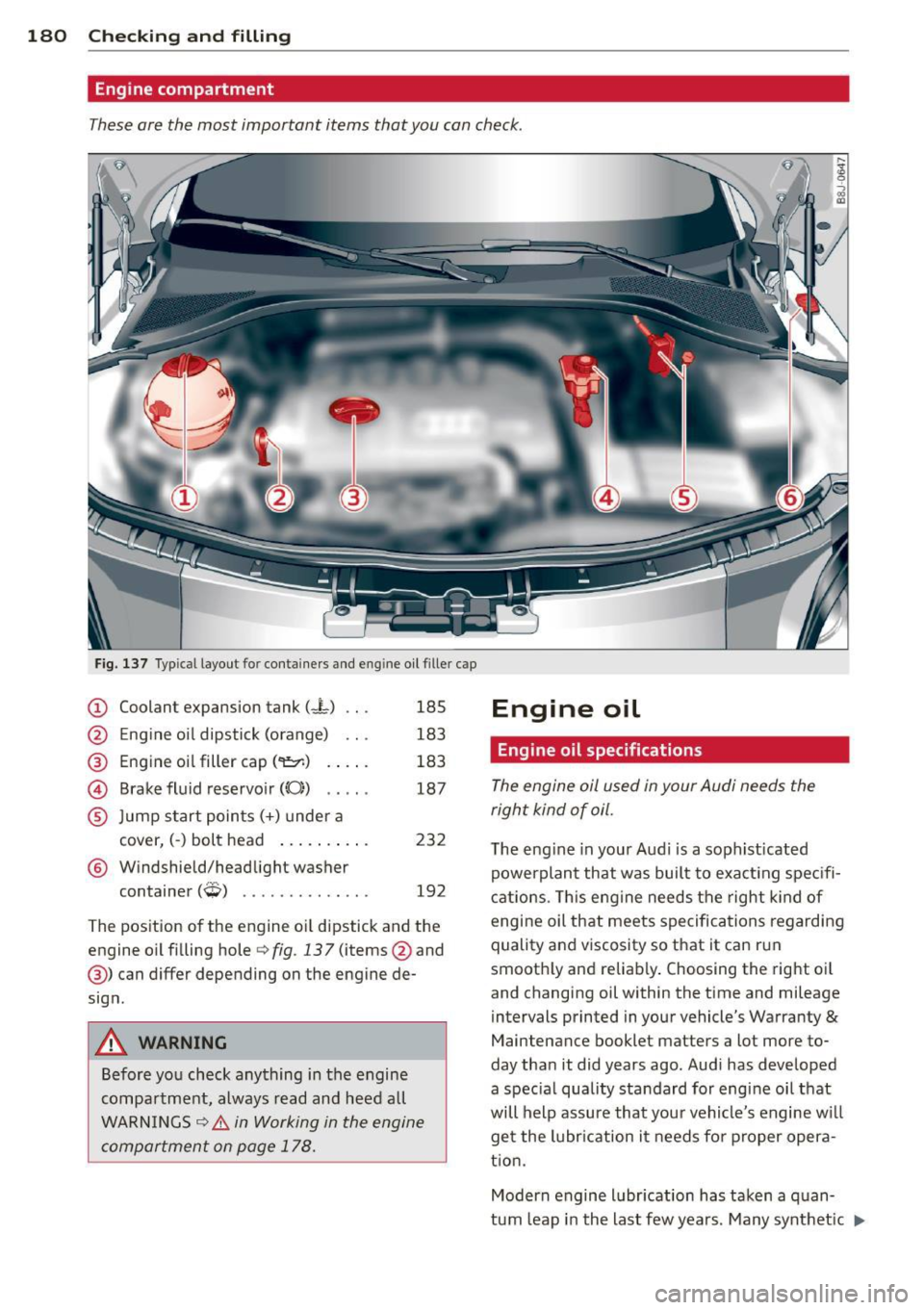
These are the most important items that you can check .
•
Fig. 137 Typ ica l layout fo r containers and eng ine oil filler cap
(D Coolant expansion tank (-L) 185
@ Eng ine o il dipstick (o range) 183
@ Engine oi l filler cap ('1:::r.) . . . . . 183
@ Brake fluid reservoir((();) . . . . . 187
® Jump start points(+) under a
cover,(-) bolt head . . . . . . . . . . 232
® Windshield/headlight washer
t . (
;;p, ) con ainer ,-!,, •••.•••. •.• •• . 192
The position of the engine o il dipstick and the
engine o il filling hole
r::> fig . 137 (items @and
@) can differ depending on the engine de
sign .
A WARNING
Before you check anything in the engine
compartment, always read and heed all
WARN INGS
c::> .& in Working in the engine
compartment on page 178.
Engine oil
Engine oil specifications
The engine oil used in your Audi needs the
right kind of oil.
T he eng ine in your Aud i is a soph ist icated
powerplant that was built to exact ing spec ifi
cat ions . T his engine needs the right kind of
engine oil that meets specifications regarding
quality and viscosity so that it can run
smooth ly and reliab ly . Choosing the right o il
and changing oil within the time and mileage
intervals printed in your vehicle's Warranty
&
Maintenance booklet matters a lot more to
day than it did years ago . Audi has developed
a spec ia l quality standard for engine oil that
will help assure that you r vehicle's engine w ill
get the lubr ication i t needs fo r proper opera
t io n.
Modern engine lubr ication has taken a quan
tum leap in the last few years. Many synthet ic
1J.
Page 189 of 260
-To avoid being burned, do not sp ill an
tifreeze or coolant on the exhaust sys tem or hot engine parts. Under certa in
conditions, the ethylene glyco l in en
g ine coolant can catc h fire.
- Antifreeze is poisonous. Always store an
t ifreeze in its or iginal co ntaine r and well
o ut of the reach of children.
- If you drain the coolant, it must be
caught and safely stored in a proper con
tainer clearly ma rked "poison".
(D Note
- Coolant pollutes the env ironment and
could cause a n engine fire. Excess cool
ant wi ll be forced out through the pres
su re re lief va lve in the cap when the en
gine becomes hot.
- If, in an emergency, only water can be
added, the cor rect ratio be tw een wate r
and antifreeze
¢page 185 must be re
store d as soon as possib le.
@ For the sake of the environment
Drained coolant s hould no t be reused. Al
ways dispose of use d coolan t w hile obse rv
ing all envir onmental reg ulations.
Radiator fan
The radiator fan switches on automatically by
i tself
The electric radiator fan is contro lled by ther
moswitches that switch on and off depend ing
on coolant and eng ine compa rtment tempera
tures.
An aux iliary electr ic radiator fa n* switches on
and off depen ding on coolant t emperature
and other ve hicl e operation conditions.
After you switch t he engine off, the a uxiliary
fan ca n cont inue runn ing fo r up to 10 minutes
- even with the ignition off .
It can even sw itch
on agai n later by i tself
c::> &., , if
- the temperature of the eng ine coolant rises
due to the heat bui ld-up from the eng ine in
t h e engine compartment, o r
Checking and fillin g 187
- the engine compartment heats up because
the vehicle is parke d in intense sunlight.
A WARNING
-To reduce the risk of persona l in ju ry nev
er touch the radiator fan .
- The a uxiliary electric fan is tempe rat ure
contro lled and can switch on suddenly
even when the engine is not running.
- The a uxiliary radiator fan sw itches on a u
tomatically when the engine coo lant
reaches a certa in temperature and w ill
continu e to run until the coo lant temper
ature drops.
Brake fluid
Checking brake fluid level
T he brake fluid level can be checked wi th a
qui ck gl ance.
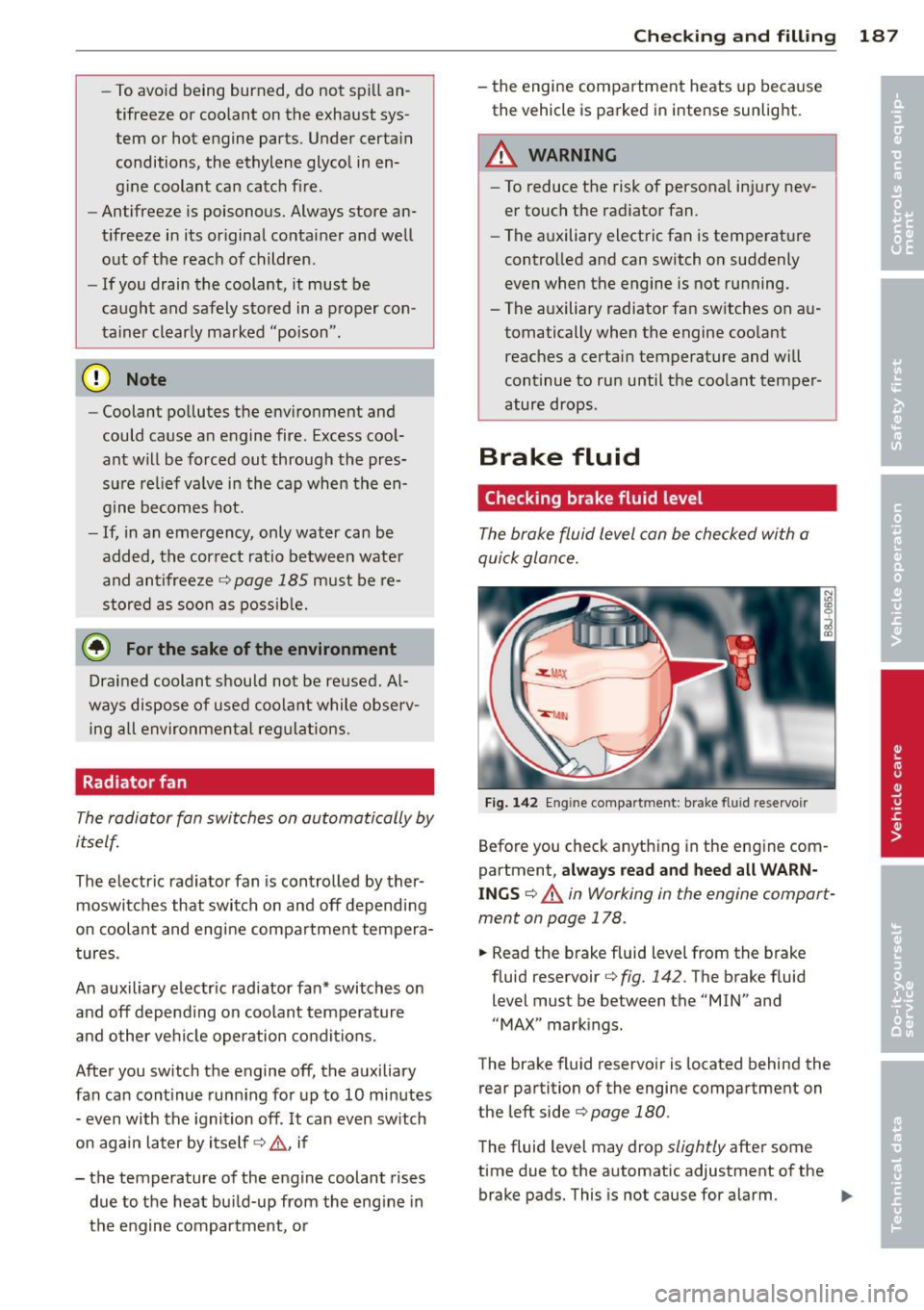
Fi g. 142 Engin e compart ment : brake flu id reservoir
Before you check anyth ing in the eng ine com
partment,
alw ays read and heed all WARN
INGS c::> A in Working in the engine compart
ment on page 178 .
.,. Read the brake fluid level from the brake
fluid reservoir
c::> fig. 142. The brake fluid
level must be between the "MIN" and
"MAX" markings.
The brake fluid reservoir is located behind the
rear partition of the engine compartment on
the left side
c::> page 180.
The fluid level may drop slightly after some
time due to the automatic adjustment of the
brake pads. This is not cause for alarm.
IJ1'-
Page 190 of 260
188 Checking and filling
If the brake fluid level falls considerably be
l ow the "MIN" mark, the brake warning/indi
cator light (U .S . mode ls: . , Canadian
models: .) will come on
¢ page 16 and
¢ page 30. Do not continue to operate the ve
h icle . The complete brake system shou ld be
thoroughly checked by an authorized A ud i
dea ler o r othe r qualified facility and t he cause
corrected. If the bra ke fluid level is too low,
the bra ke warning/ind ic a tor ligh t will illum i
nate . Contact an authorized Aud i dea ler
im
mediatel y.
Changing brake fluid
Hove the broke fluid changed by on experi
enced technician.
B rake fl uid abso rbs mois ture from the a ir. If
the water content in the b ra ke fluid i s too
h igh, corros ion in the brake sys tem may result
after a period of t ime . The boi ling point o f the
b rake fluid wi ll also decrease considerab ly and
decrease braking per formance.
T herefore, the brake flu id mus t be changed
every two year s. Always use new b rake fluid
which conforms to Fede ral Motor Vehicle
Standard "FMVSS 116 DOT 4".
T he brake flu id rese rvoi r can be difficul t to
reach, therefo re, we recommend that yo u
have the brake f luid changed by yo ur autho r
ized
Audi dealer . Your dealer has the correct
too ls, the right b rake f luid and the know-how
to do this for you.
A WARNING
- B rake fluid is poiso nous . It mus t be stor
ed only in th e closed orig inal con tainer
o ut of the reac h of children!
- Brake fa ilure can result from old o r inap
propriate b ra ke fluid. Observe these pre
c aut ions:
- Use o nly brake fluid t hat meets SAE
specif ication
J 1703 and confo rms to
Federal Motor Vehicle Standard 116.
Always check with your a uthorized Audi
dealer to make s ure you are using the
correct brake fl uid. T he correct type of brake flu
id is also ind icate d on the
brake f lu id rese rvoir.
- The brake fl uid must be new . Heavy use
of the brakes can cause a vapo r lock if
the brake fluid is left in the system too
long . This can se riously affect the effi
c iency of t he brakes as well as your
safe ty. This co uld resu lt in a n accide nt.
([) Note
Brake fluid will damage the paint of your
vehicle.
@ For the sake of the environment
Because o f the prob lem of prope r disposal
of brake fluid as well as t he spec ial too ls
required and the necessary expertise, we
recomme nd t hat yo u have th e brake flu id
cha nged by yo ur autho rize d Au di dea le r.
Battery
General information
Your ve hicl e is equipped with a specia l bat
tery, an
ACM battery. This battery is located
in t he luggage compartment and must be re
placed with an origina l equipment battery.
U nder normal opera ting condit ions, the bat
te ry is
maintenance-fr ee .
Have the battery checked when you take your
vehicle in for se rv ice . You a re well advised to
replace a battery that is o lde r th an 5 years .
Disconnecting the battery terminals
Some vehicle functions (power window reg u
lators, for example) are lost if the battery te r
mina ls are disconnected. T hese functions have
to be relearned after the battery termina ls are
connected aga in . T o prevent t his, t he battery
shou ld only b e disconne cted from the ve hicle
ele ct ric al sy stem w hen abso lutely ne cessary
f o r rep air s.
Vehicles not driven for long periods
If you are go ing to let your vehicle stand for a
long time a nd not drive it, you should remem
ber there are elect rical components which a re
Ill-
Page 222 of 260
220 What do I do now?
Preliminary steps
Applies to vehicles: with T ire Mobility System
Some preliminary steps are necessary for tire
repair .
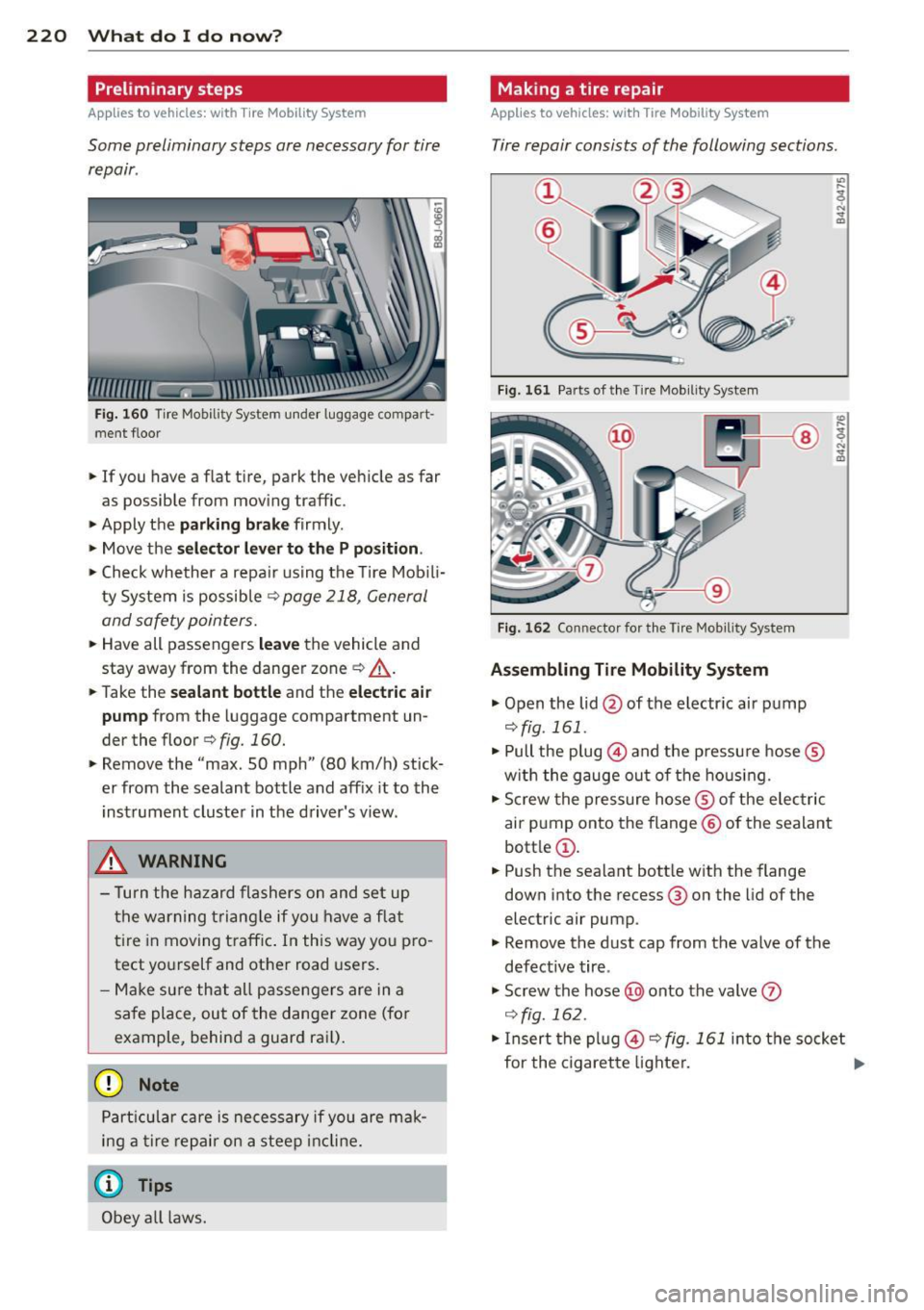
Fig. 160 Tire Mobili ty System under luggage co mpart
men t floor
• If you have a flat tire, park the vehicle as far
as possible from mov ing traffic .
• Apply the
park ing brake firmly .
• Move the
selector lever to the P position .
• Check whether a repa ir using the Tire Mobili
ty System is possible
¢ page 218, General
and safety pointers.
• Have all passengers leave the vehicle and
stay away from the danger zone ¢
_A.
• Take the sealant bottle and the electric air
pump
from the luggage compartment un
der the floor
c> fig. 160.
• Remove the "max. 50 mph" (80 km/h) stick
er from the sealant bottle and aff ix it to the
instrument cluster in the driver's view .
..&, WARNING
- Turn the hazard flashers on and set up
the warning triangle if you have a flat
tire in moving t raff ic. In this way you pro
tect yo u rs elf and other road users .
- Make sure that all passengers are in a
safe place, out of the danger zone (for
example, behind a guard rail).
(D Note
Particular care is necessary if you are mak
ing a tir e repair on a steep incline.
@ Tips
Obey all laws.
Making a tire repair
Applies to vehicles: with Tire Mob ility System
Tire repair consists of the following sections .
Fig. 161 Parts of the Tire Mob ility System
Fig . 1 62 Con nector for the Tire Mob ility System
Assembling Tire Mobility System
• Open the lid @of the electr ic air pump
c>fig . 161 .
• Pull the plug@) and the pressu re hose ®
w ith the gauge out of the housing.
• Screw the pressure hose® of the electric
air pump onto the flange@ of the sealant
bott le @ .
• Push the sealant bott le with the flange
down into the recess @ on the lid of the
electric air pump.
• Remove the dust cap from the valve of the
defective tire .
• Screw the hose @) onto the valve
• In sert the plug @ c> fig. 161 into the socket
for the cigarette lighter. .,.
Page 227 of 260

~ Use the hexagonal socket in the screwdriver
handle to screw in and tighten all wheel
bo lts
slightly .
~ Unscrew the alignment pin and insert and
t ighten the remaining wheel bolt s light ly
like the rest.
~ T urn the jack handle counter-clockw ise to
l ower the vehicle unti l the jack is fully re
leased .
~ Use the whee l bolt w rench to t ighten al l
whee l bolts firmly <=>
page 222 . Tighten
them
crosswise, from one bolt to the (ap
proximate ly) opposite one, to keep the
whee l cente red.
Q;) Note
When removing or installing the wheel,
the rim could hit the brake rotor and dam
age the rotor. Work carefully and have a
second person help you.
(D} Tips
Never use the hexagonal socket in the han
dle of the screwdriver to loosen or t ighten
the wheel bolts .
- Pull the reversib le b lade from the screw
driver before yo u use the hexagonal
socket in the handle to t urn the whee l
bo lts .
- When mounting tires with
unid irectional
tread design
make su re the tread pat
te rn is poi nted the r ight way
<=> page 226.
- The wheel bolts should be clea n and easy
to tu rn . Check for d irt and corrosion on
the mat ing s urfaces of both the wheel
and the hub. Rem ove a ll dirt from these
su rfaces before rem ounting the wheel.
Notes on wheel change
Please read the information <=> page 205 , New
tires and replacing tires and wheels ,
if you are
going to use a spare t ire which is different
from the tires on your ve hicle.
Afte r you change a tire :
What do I do now? 225
-Check the tire pre ssure on the spare imme
diately after mounting.
- Have the whe el bolt tightening torque
checked with a torque wrench as soon a s
possible by your authorized Audi dealer or
a qualified service station.
- With steel and alloy wheel rim s, the wheel
bolt s are cor rectly tightened at a torque of
90 ft lb (120 Nm ).
- If you noti ce while changing a tire that the
wheel bolts are corroded and difficult to
turn , then they should be replaced before
you check the tightening to rque.
- Replace the flat tire w ith a new one and
have it installed on your vehicle as soon as
possible. Remount the whee l co ver.
Until then , dr ive with extra care and at re
duced speeds.
A WARNING
- If you are going to equ ip your vehicle
w it h tires o r rims which differ from those
which were factory installed, then be
sure to rea d the information
¢ page 205,
New tire s and replacing tires and
wheels.
- Always sto re the too ls secu rely in lug
gage com partmen t. Othe rwise , in a n ac
cident or s udden m aneuver they cou ld fly
forwa rd, causing inj ury to passengers in
the vehicle.
(D Note
D o not use comme rcially ava ilab le tire
se alants . Ot herwise, t he e lectr ic al c ompo
nen ts of the tire pressu re monitoring sys
tem will no lo nger work p roperly and the
sensor fo r the tire pressure mon itor ing
system will have to be rep laced by a quali
fied workshop. •
•
Page 230 of 260
228 Fuses and bulbs
Fuse Location, Instrument Panel left
0
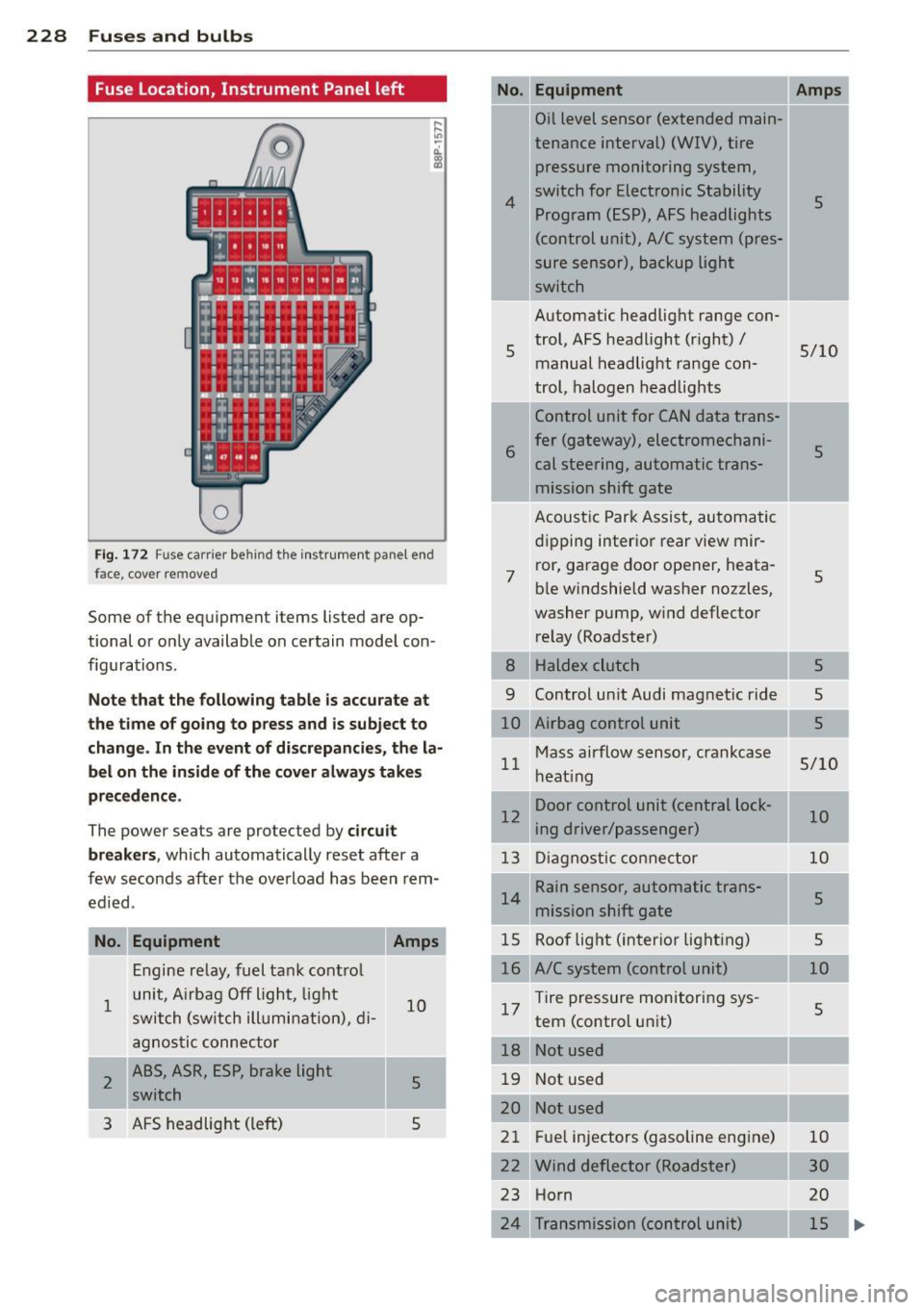
Fig. 172 Fuse ca rrier be hind the inst rum ent pan el end
fa ce, cover rem oved
Some of the equipment i tems lis ted are op
tional or only available on certain model con
figurations.
Note that the following table is accurate at
the time of going to press and is subject to
change. In the event of discrepancies, the la
bel on the inside of the cover always takes
precedence.
The power seats are protected by circuit
breakers,
which automatically reset after a
few seconds after the overload has been rem
edied .
No. Equipment
1
I 2
Engine relay, fuel tank control
unit , Airbag Off light, light
switch (switch illumination), di-
agnostic connector
ABS, ASR, ESP, brake light switch
3 AFS headlight (left)
Amps
10
5
s
No.
4
5
6
7
Equipment
Oil level sensor (extended main-
tenance interval)
(WIV), tire
pressure monitoring system,
switch for Electronic Stability Program (ESP), AFS headlights
(control unit), A/C system (pres-
sure sensor), backup light
switch
Automatic headlight range con
trol, AFS headlight (right)/
manual headlight range con
trol, halogen headlights
Control unit for CAN data trans
fer (gateway), electromechani
cal steering, automatic trans mission shift gate
Acoustic Park Assist, automatic
dipping interior rear
view mir-
ror, garage door opener, heata
ble windshield washer nozzles,
washer pump, wind deflector
relay (Roadster)
--r-
Amps
5
5/10
5
5
8 Haldex clutch 5
9 Control unit Audi magnetic ride 5
10 Airbag control unit 5
Mass airflow sensor, crankcase
11 5/10
heating
Door control unit (central lock-
12 10
ing driver/passenger)
--
13 Diagnostic connector 10
Rain sensor, automatic trans-
14 5
mission shift gate
15 Roof light (interior lighting) 5
16 A/C system (control unit) 10
17 Tire pressure monitoring sys-
5
tern (control unit)
l
I
18 Notused -
19 Not used
20 Not used
21 Fuel injectors (gasoline engine)
Wind deflector (Roadster)
Horn
24 Transmission (control unit) 10
30
20
15
..,.
Page 232 of 260
230 Fuses and bulbs
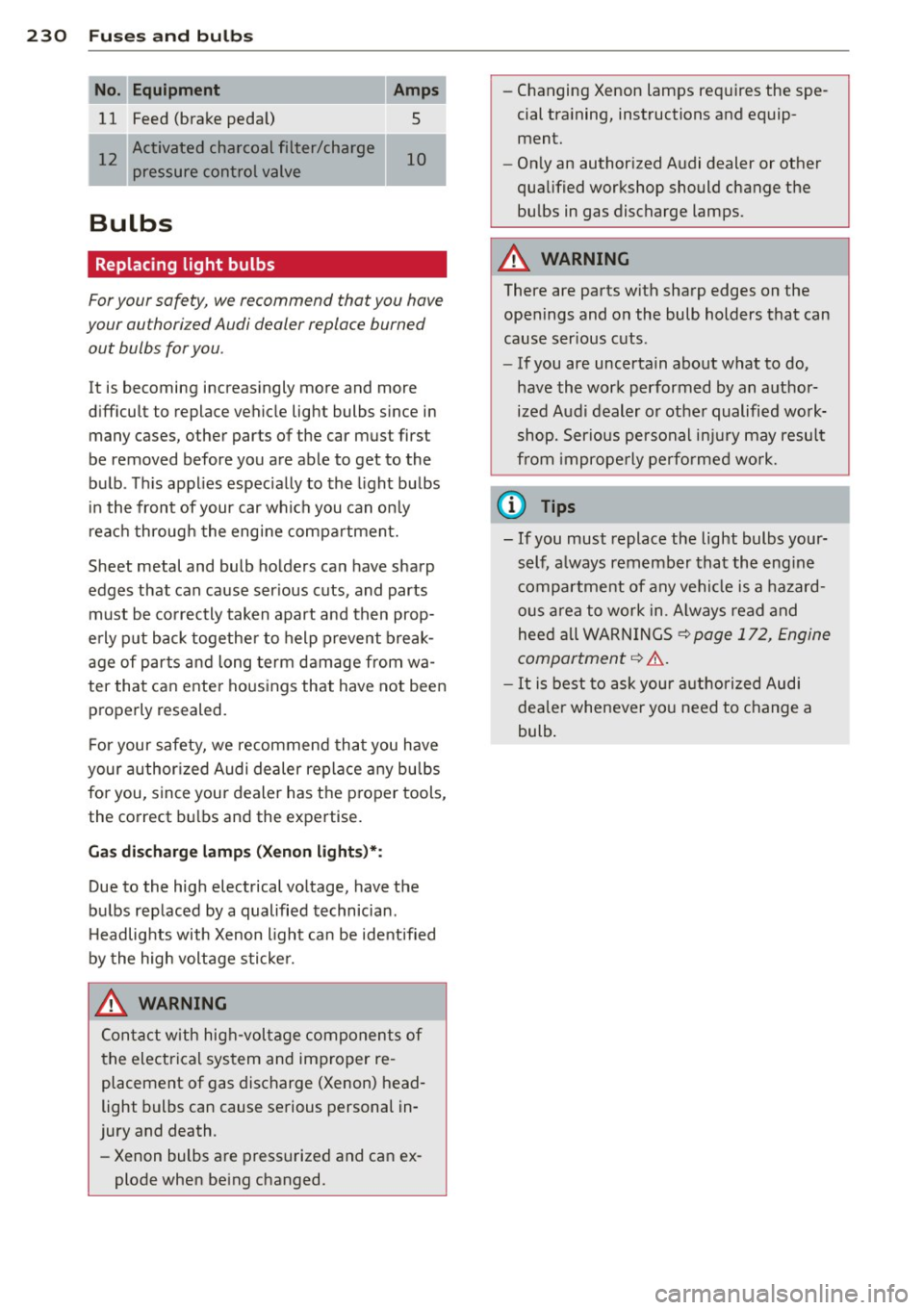
No. Equipment Amps
11 Feed (brake pedal) 5
-
12 Activated cha
rcoal filter/charge I pressure control valve 10
Bulbs
Replacing light bulbs
For your safety, we recommend that you have
your authorized Audi dealer replace burned
out bulbs for you .
It is becoming increasingly more and more
difficult to replace vehicle light bulbs since in
many cases, other parts of the car must first
be removed before you are able to get to the
bulb . This applies especially to the light bulbs
in the front of your car which you can only
reach through the engine compartment.
Sheet metal and bulb holders can have sharp
edges that can cause ser ious cuts, and parts
must be correctly taken apart and then prop
e rly put back together to help prevent break
age of parts and long term damage from wa
ter that can enter housings that have not been
properly resealed.
For your safety, we recommend that you have
your authorized Audi dealer replace any bulbs
for you, since your dealer has the proper tools,
the correct bulbs and the expertise.
Gas discha rge lamps (Xenon lights}*:
Due to the high electrical voltage, have the
bulbs replaced by a qualified technician.
H eadlights with Xenon light can be identified
by the high voltage sticker.
A WARNING
Contact with high-voltage components of
the electrical system and improper re
placement of gas discharge (Xenon) head
light bulbs can cause serious personal in
jury and death.
- Xenon bulbs are pressurized and can ex
plode when being changed. -
Changing Xenon lamps requires the spe
cial tra ining, instructions and equip
ment.
- Only an authorized Audi dealer or other
qualified workshop should change the
bulbs in gas discharge lamps.
A WARNING
=
There are parts with sharp edges on the
openings and on the bulb holders that can
cause ser ious cuts.
- If you are uncertain about what to do,
have the work performed by an author
ized Audi dealer or other qualified work
shop. Serious personal injury may result
from improperly performed work.
@ Tips
- If you must replace the light bulbs your
self, a lways remember that the engine
compartment of any vehicle is a hazard
ous area to work in. A lways read and
heed all WARNINGS
c:::> page 172, Engine
compartment
c::> &. .
-It is best to ask your authorized Audi
dealer whenever yo u need to change a
bulb .
-
Page 234 of 260
232 Emergency situations
@ Tips
The discharged battery must be properly
connected to the vehicle's electrical sys
tem.
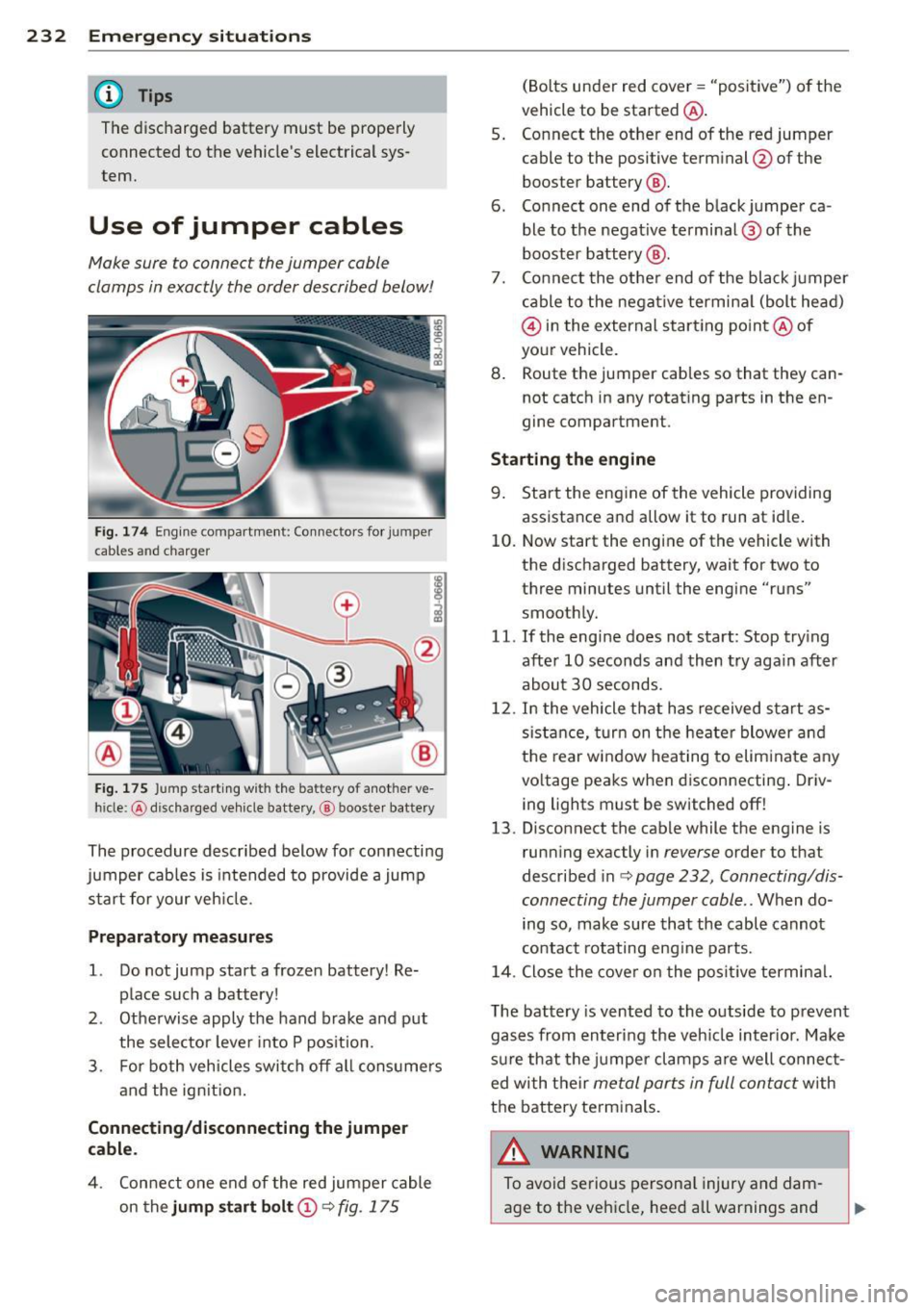
Use of jumper cables
Make sure to connect the jumper coble
clomps in exactly the order described below!
Fig. 174 Engine compart ment: Co nnectors for jumper
cables and charger
Fig. 175 Jump starting with the battery of another ve
hicle: @discharged veh icle battery, ® booste r battery
The procedure described below for connecting
jumper cables is intended to provide a jump
start for your veh icle.
Preparatory measures
1. Do not jump start a froze n battery! Re
place such a battery!
2 . Otherwise apply the hand brake and put
the selector lever into P position.
3. For both vehicles switch off all consumers
and the ign ition.
Connecting/disconnecting the jumper
cable .
4. Connect one end of the red jumper cable
on the
jump start bolt (D 9 fig. 175
(Bolts under red cover = "positive") of the
vehicle to be started @.
5. Connect the other end of the red jumper
cable to the positive terminal @of the
booster battery @.
6. Connect one end of the black jumper ca
ble to the negat ive terminal @of the
booster battery @.
7. Connect the other end of the black jumper
cable to the negative terminal (bolt head)
@ in the external start ing point @ of
your vehicle.
8. Route the jumper cables so that they can
not catch in any rotat ing parts in the en
gine compartment.
Starting the engine
9. Start the engine of the vehicle providing
assistance and allow it to run at id le .
10. Now start the engine of the vehicle with
the discharged battery, wait for two to
three minutes until the engine "runs"
smoothly.
11. If the eng ine does not start: Stop try ing
after 10 seconds and then try again after
about 30 seconds.
12. In the vehicle that has received start as
sistance, turn on the heater blower and
the rear window heating to elim inate any
vo ltage peaks when disconnecting . Driv
ing lights must be switched off!
13 . Disconnect the cable while the engine is
running exactly in
reverse order to that
described inc:>
page 232, Connecting/dis
connecting the jumper coble ..
When do
ing so, make sure that the cable cannot
contact rotating eng ine parts.
14. Close the cover on the posi tive terminal.
The battery is vented to the outside to prevent
gases from entering the vehicle inter ior. Make
sure that the jumper clamps are well connect
ed with their
metal parts in full contact with
the battery terminals.
A WARNING ~
To avoid serious personal injury and dam-
age to the vehicle, heed all warnings and