engine AUDI TT ROADSTER 2011 Manual PDF
[x] Cancel search | Manufacturer: AUDI, Model Year: 2011, Model line: TT ROADSTER, Model: AUDI TT ROADSTER 2011Pages: 260, PDF Size: 64.11 MB
Page 187 of 260
wooded areas, into open streams or
down sewage drains.
- Recycle used engine oil by taking it to a
used engine oil collection facility in your
area, or contact a service station.
Engine cooling system
Coolant
T he engine coolan t performs two functions: it
keeps the engine from overheating and it pro
tects the engine from freezing in the winter .
The cooling system is sealed and generally re
quires little attention .
T he cooling system has been filled at the fac
tory with a permanent coolant which does not
need to be changed . The coolan t consis ts of a
mixture of water and the manufacturer 's gly
col-basedcoolant additive G12 ++ antifreeze
with anticorrosion additives (50% for USA
models; 60% for Canad ian models). This mix
ture both assures the necessary frost protec
tion and protects metal components in the
engine 's cooling system from corrosion and
scaling. It also raises th e boiling point of the
c oolant.
Do not reduce the concentration of the coo l
ant in the summer by adding plain water .
The
proportion of coolant additive must be at
least 50% but not more than 60%
to main
tain antifree ze protection and cooling efficien
cy . If the coolant frost protection is too low,
the coolant could freeze and damage the veh i
cle heating and eng ine cooling system .
For year-round driving, an tifree ze is added at
the factory for temperatures down to:
- -31 ° F ( - 3 5 °C) USA
- -40 °F ( -40 °C) Canada.
You can mix the G12 ++ coolant addit ive with
other additives (G12+ or G12) . Always check
with your authorized Audi dealer.
& WARNING
Before you check anything in the engine
compartment, always read and heed all
-
Checkin g and fillin g 185
WARNINGS c:::> .& in Working in the engine
compartment on page 178.
(D Note
- Before winter sets in, have the coolant
checked to see if the coolant additive in
your vehicle is sufficient to meet the cli
mate conditions. This is especially impor
tant if you live in a region where the win
ter is extreme ly cold . If necessary, in
crease the proportion of coo lant add itive
to 60% .
- Whe n adding coolant additive to your
cooling system, remember :
- We recommend using only coo lant ad
ditive G12++ (check the labe l) for your
vehicle . This coolant additive is avai la
ble at authorized Audi dealers. Other
types of ant ifreeze can significantly re
duce corrosion protection . The result
ing corrosion can cause a loss of cool
ant and ser ious eng ine damage.
- Do not add any type of rad iator leak seal
ant to yo ur vehicle's engine coolant .
Add ing radiator repair fluid may adverse
ly affect the function and performance of
your cooling system and could resu lt in
damage not covered by your New Vehicle
Limited Warranty .
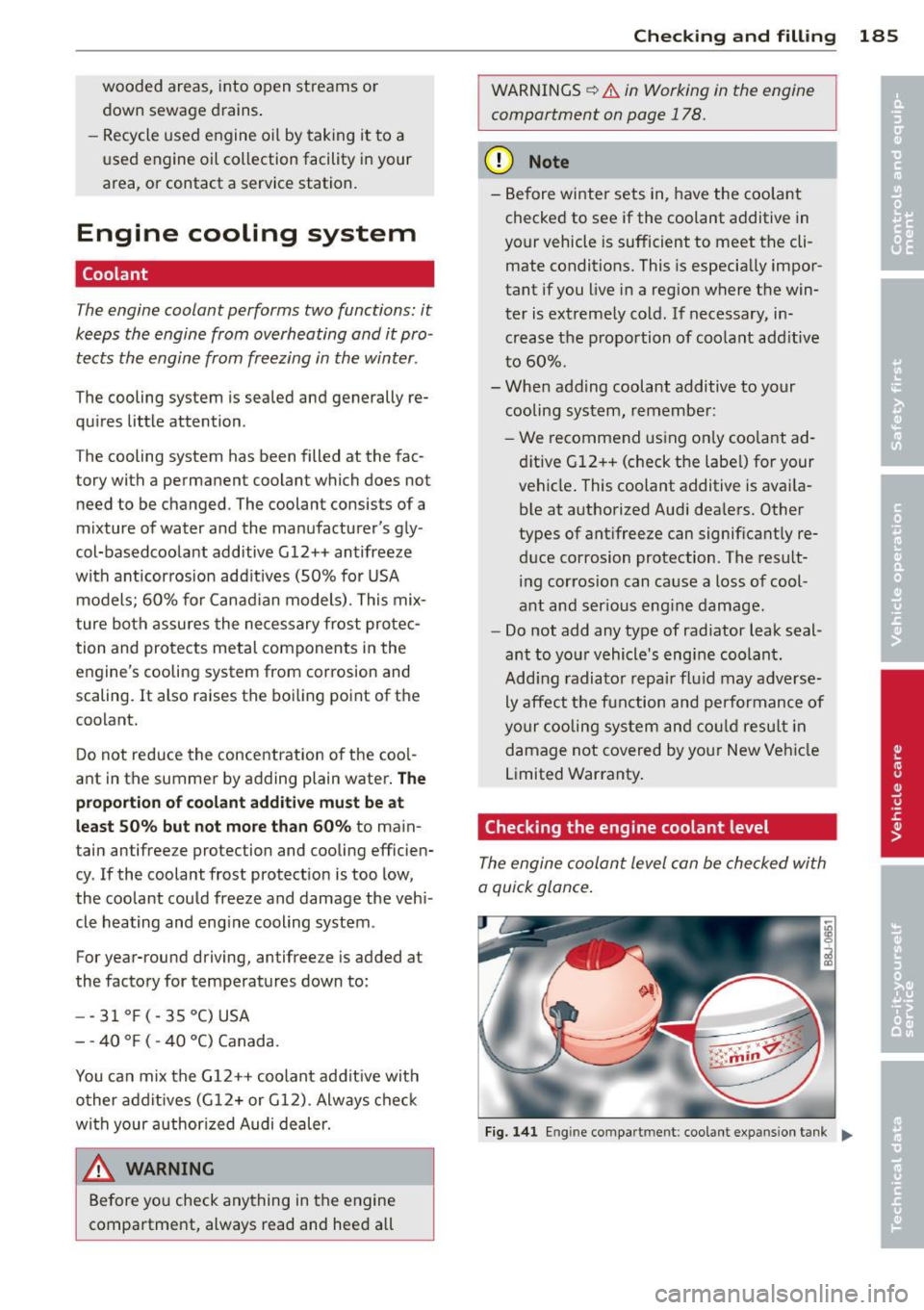
Checking the engine coolant level
The engine coolant level can be checked with
a quick glance.
Fig. 141 E ng ine compart men t: coo lant ex pansion t ank Ill>
Page 188 of 260

186 Checking and filling
Before you check anything in the engine com
partment,
alwa ys r ea d and heed all WARN
INGS ¢ A in Working in the engine
comportment on page 178.
• Switch the ignition off .
• Read the coo lant level at the coolant expan
s ion tank ¢
fig. 141 . With a co ld engine, it
must be above the "min" mark. W ith a hot
engine, it can be a little above the indicated
range.
The location of the coolant expansion tank
can be seen in the engine compartment illus
tration .
To obtain an accurate reading , the engine
must be switched
off.
The expansion tank in you r vehicle is equipped
with an e lectric coolant level sensor .
When the coolant level is too low, the warning light in the Auto- Check System ¢
page 31 will
blink until you add coo lant and the level has
been restored to no rma l. Even though there is
an electric coolant level sen sor, we still rec
ommend you check the coolant leve l from
time to time.
Coolant loss
Coolant loss may indicate a leak in the cooling
system . In the event of coolant loss, the cool
ing system should be inspected immediately
by your authorized A udi dealer. It is not
enough merely to add coolant .
In a
sealed system, losses can occur only if
the boiling point of the coolant is exceeded as
a result of overheating.
@ Note
Do not add any type of ra diator leak seal
ant to yo ur vehicle's eng ine coolant. Add
ing radiator repair f luid may adversely af
fect the function and performance of your
cooling system and could result in damage
not covered by your New Vehicle Limited
Warranty.
Adding coolant
Be very careful when adding engine coolant.
Before you check anyth ing in the engine com
partment,
always read and heed all WARN
INGS ¢ A in Working in the engine comport
ment on page 178 .
•Turnoff the engine.
• Let the eng ine cool down.
• Place a thick rag ove r the coolant expansion
tank
¢ page 185, fig . 141 and carefully
tw ist the cap counter-clockwise ¢&_ .
• Add coolant.
• Twis t the cap o n aga in
tightly.
Replacement engine coolant must conform to
exact spec ificat ions
¢ page 185, Coolant.
E ven in a n emerge ncy, if coo lant addi -
t ive G1 2++, G12+ or G12 is not ava ilable , do
not use a d ifferen t addit ive. Use plain water
instead unti l you can get the cor rect additive
and can restore the correct ratio . This sho uld
be done as soon as possible .
If you have los t a considerab le amo unt o f
coolant , then you sho uld add cold ant ifreeze
and co ld wate r on ly w hen the engine is cold.
Always use
new engine coo la nt whe n refilling .
Do not fill coola nt above the "MAX" mark. Ex
cess coo la nt wi ll be fo rced o ut through the
pressure relief valve in t he cap w hen the en
gine becomes hot.
,&. WARNING ~ -
- T he cooling system is under pressure and
can get very hot. Reduce the risk of
scalding from hot coolant by followi ng
these steps.
- T urn
off the engine and allow it to coo l
down.
- Protect you r face, hands and a rms from
esca ping fluid and steam by covering
the cap w ith a large, t hick rag.
- T urn the cap slowly a nd ve ry carefully
in a counter-clo ckwise direction while
applying light, downward pres sure on
the top o f the cap.
Page 189 of 260
-To avoid being burned, do not sp ill an
tifreeze or coolant on the exhaust sys tem or hot engine parts. Under certa in
conditions, the ethylene glyco l in en
g ine coolant can catc h fire.
- Antifreeze is poisonous. Always store an
t ifreeze in its or iginal co ntaine r and well
o ut of the reach of children.
- If you drain the coolant, it must be
caught and safely stored in a proper con
tainer clearly ma rked "poison".
(D Note
- Coolant pollutes the env ironment and
could cause a n engine fire. Excess cool
ant wi ll be forced out through the pres
su re re lief va lve in the cap when the en
gine becomes hot.
- If, in an emergency, only water can be
added, the cor rect ratio be tw een wate r
and antifreeze
¢page 185 must be re
store d as soon as possib le.
@ For the sake of the environment
Drained coolant s hould no t be reused. Al
ways dispose of use d coolan t w hile obse rv
ing all envir onmental reg ulations.
Radiator fan
The radiator fan switches on automatically by
i tself
The electric radiator fan is contro lled by ther
moswitches that switch on and off depend ing
on coolant and eng ine compa rtment tempera
tures.
An aux iliary electr ic radiator fa n* switches on
and off depen ding on coolant t emperature
and other ve hicl e operation conditions.
After you switch t he engine off, the a uxiliary
fan ca n cont inue runn ing fo r up to 10 minutes
- even with the ignition off .
It can even sw itch
on agai n later by i tself
c::> &., , if
- the temperature of the eng ine coolant rises
due to the heat bui ld-up from the eng ine in
t h e engine compartment, o r
Checking and fillin g 187
- the engine compartment heats up because
the vehicle is parke d in intense sunlight.
A WARNING
-To reduce the risk of persona l in ju ry nev
er touch the radiator fan .
- The a uxiliary electric fan is tempe rat ure
contro lled and can switch on suddenly
even when the engine is not running.
- The a uxiliary radiator fan sw itches on a u
tomatically when the engine coo lant
reaches a certa in temperature and w ill
continu e to run until the coo lant temper
ature drops.
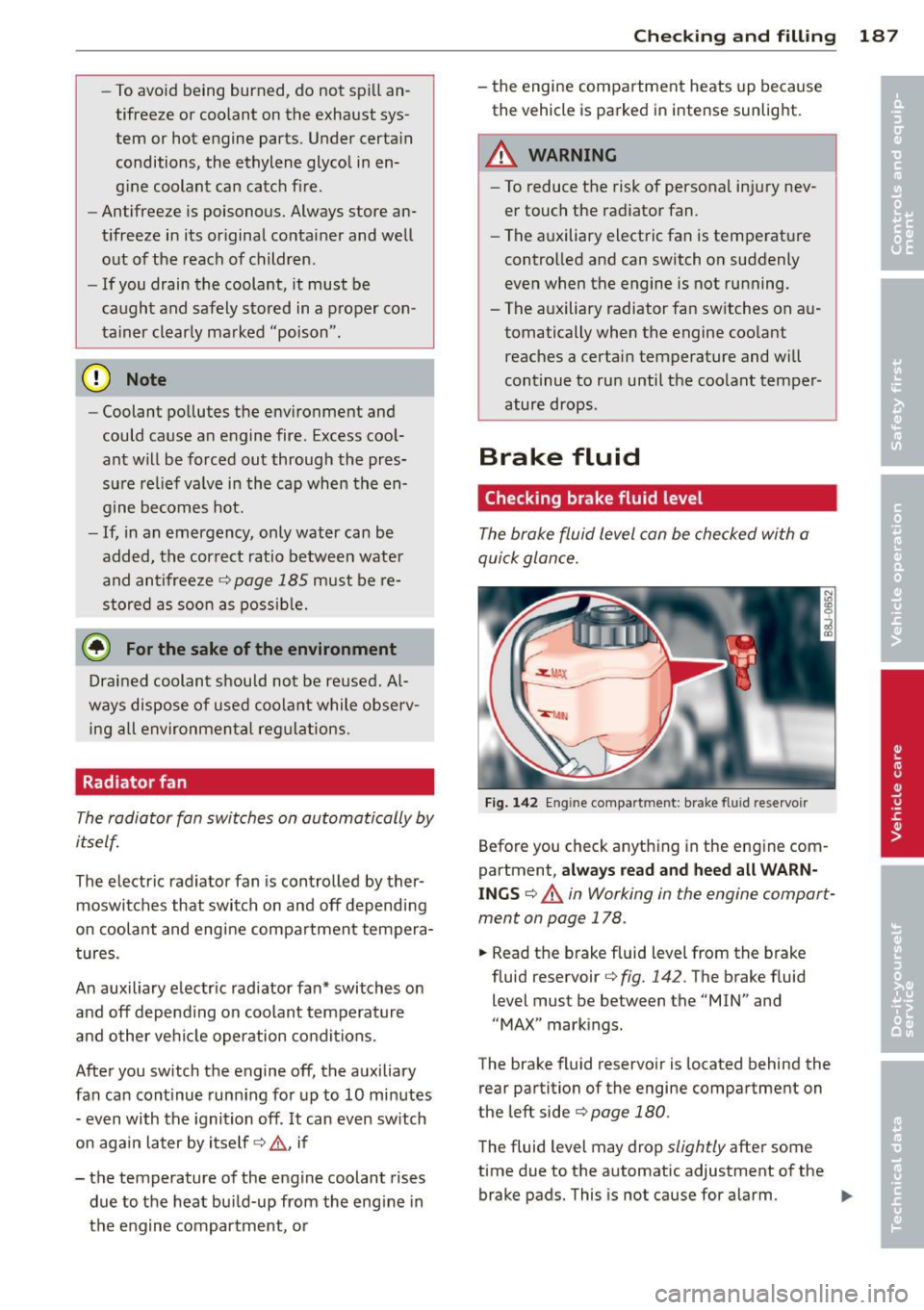
Brake fluid
Checking brake fluid level
T he brake fluid level can be checked wi th a
qui ck gl ance.
Fi g. 142 Engin e compart ment : brake flu id reservoir
Before you check anyth ing in the eng ine com
partment,
alw ays read and heed all WARN
INGS c::> A in Working in the engine compart
ment on page 178 .
.,. Read the brake fluid level from the brake
fluid reservoir
c::> fig. 142. The brake fluid
level must be between the "MIN" and
"MAX" markings.
The brake fluid reservoir is located behind the
rear partition of the engine compartment on
the left side
c::> page 180.
The fluid level may drop slightly after some
time due to the automatic adjustment of the
brake pads. This is not cause for alarm.
IJ1'-
Page 191 of 260
still functioning and they will draw energy
from the battery and drain it, for example, the
engine immobilizer . To prevent this, you can
e ither charge the battery occasionally to keep
it in good working condi tion or you can d is
connect the negat ive cable on the battery .
Winter ope ration
During the winter months, battery capacity
tends to decrease as temperatures drop . This
is because more power is also consumed while
start ing, and the headlights, rear window de
fogger, etc ., are used more often .
Avoid unnecessary power consumption, par
ticularly in c ity traffic or when traveling on ly
short distances. Let your authori zed Audi
dealer check the capacity of the vehicle bat
tery before winter sets in
¢ page 192. A well
charged battery w ill not only prevent starting
p rob lems when the weathe r is cold, but will
a lso last longer .
Replacing b attery
The new battery m ust have the same capaci
ty, voltage (12 volts), amperage, construction
a n d p lug sealing, as the origina l batte ry. Spec
ifications are listed on the batte ry housing.
Batteries specially developed by A udi f ulfill
the ma intenance, output, and safety require
ments.
When insta lling the bat tery , make sure the ig
n ition and all e lectr ica l cons umers are sw itch
ed
off ¢ (j) .
We recommend that you use ma intenance
free or
cy cle-re sis tant /le ak -proof batteries
according to the standards TL 825 06 (from
December 1997) and VW 7 SO 73 (from Au
gust 200 1).
Replacing the battery should be ca rried by a
qua lified workshop. Please follow the instruc
tions on the battery cover.
(D Note
- All work on t he battery requires techni
ca l knowledge. Please contact an A udi
dealership or anothe r authorized facili ty
Checkin g and fillin g 189
for questions abo ut the batte ry - danger
of acid burns and exp losion hazard!
- T he battery must not be opened! Do not
try to change the battery's liquid level,
otherwise detonating gas will escape
from the battery - explosion hazard!
- The AGM battery in the luggage com
partment cannot leak, because the elec
tro lyte for this battery is absorbed into a
special glass mat. This leak-proof battery
must not be replace with a convent iona l
battery.
- Make sure the ventilation hose on the
side of the battery is connected, other
w ise fumes or battery ac id can leak out.
- Battery holder and terminals always
have to be secured correctly.
- Before all work on the battery follow the
warnings below ¢.&. in Working on the
battery on page 190.
@) For the sake of the environment
Because of the prob lem of proper disposal
of a battery, we recommend your author
ized Audi dealer change the battery for
you. Batteries contain sulfur ic acid and
l ead and must always be disposed of prop
erly in compl iance with a ll environmental
regulat ions. Disposing of vehi cle batter ies
improperly is very dangerous to the envi
ronment. Make sure that the removed bat
tery cannot overbalance, otherwise sulfu ric acid might escape!
(D Tips
If your vehicle is left standing for several
weeks at extremely low temperatures, the
vehicle battery shou ld be removed and
stored where it w ill not freeze. This will
prevent it from be ing damaged and having
to be replaced . •
•
Page 192 of 260
190 Checking and filling
Working on the battery
Be especially careful when working on or near
the battery!
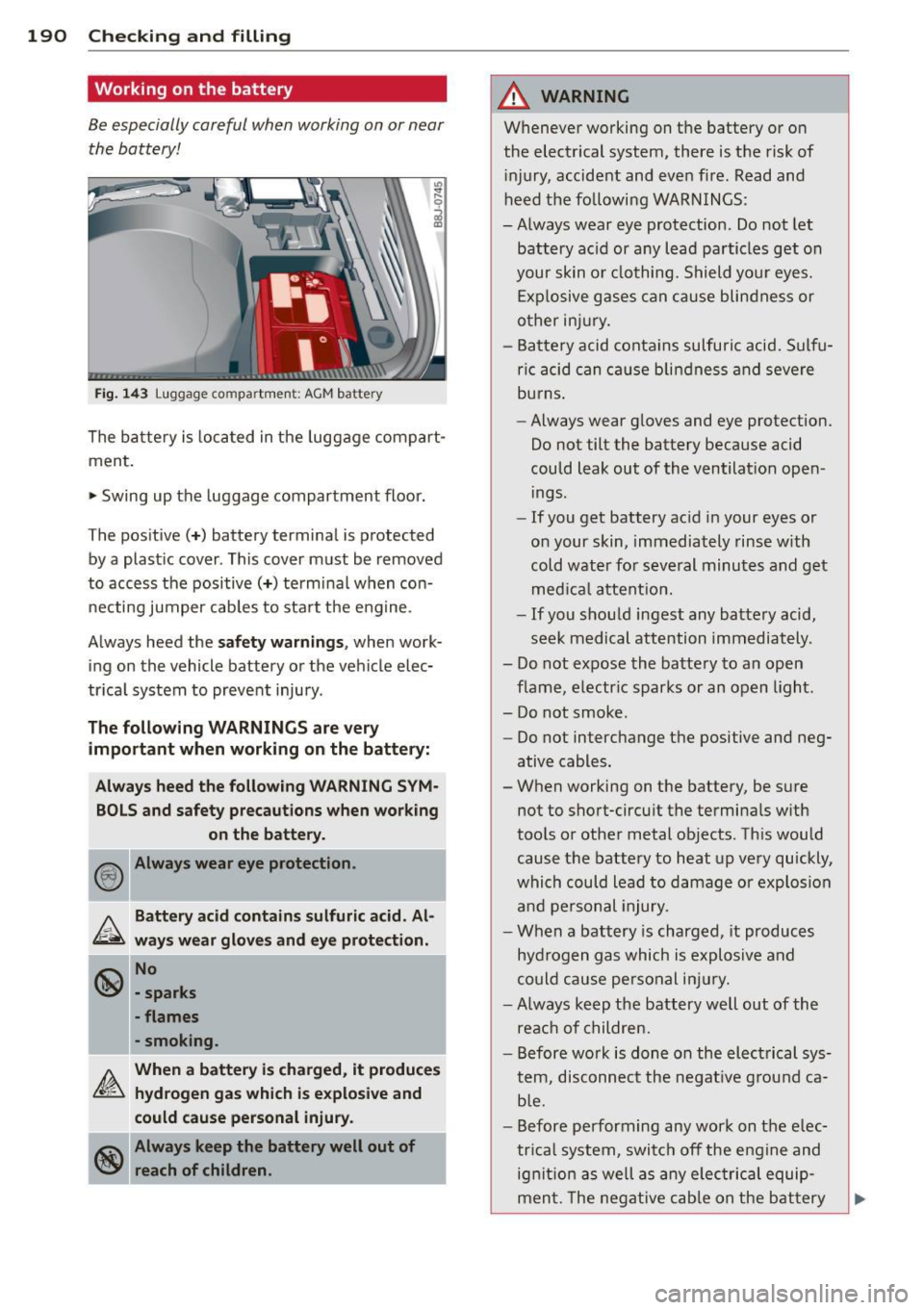
Fig . 14 3 Luggage compartment: AGM battery
The battery is loca ted in the luggage compart
ment.
~ Swing up the luggage compartment floor.
The positive( +) battery terminal is p rotected
by a plast ic cover . This cover must be removed
to access the positive( +) termina l when con
necting jumper cables to start the eng ine .
Always heed the
safe ty war nings, when work
ing on the vehicle battery or the vehicle elec
tr ica l system to prevent injury .
The following WARN INGS are ver y
import ant when w orking on the battery:
Alw ays heed t he follow ing W ARNING SYM ·
BOLS a nd safety precautions wh en working
on th e bat tery.
® Always wear eye protection .
I).. Battery acid contain s sulfuric acid. Al
~ ways wear gl oves a nd e ye prot ecti on.
I/£ No
\l:!S' -spar ks
• flames
- smoking.
When a batter y is ch arged , it pr odu ce s
h y d rogen g as which i s ex plosi ve and
could cau se personal injury.
----Always keep the battery well out of
re ach of children .
®
.&_ WARNING
Whenever working on the battery or on
the elect rical system, there is the risk of
i njury, accident and even fire. Read and
heed the fo llowing WARNINGS:
-Always wear eye protection. Do not let battery ac id or any lead particles get on
your skin o r clothing. Shield your eyes.
E xp losive gases can cause blindness or
o ther inju ry.
- Ba ttery acid conta ins sulfuric acid. Sulfu
ric acid can ca use blindness and severe
burns .
- Always wear gloves and eye protection.
Do not tilt the battery because acid
could leak out of the ventilat ion open
ings .
- If you get battery acid in your eyes or
on your skin, immediately rinse w ith
cold water for several minutes and get
medica l attent ion.
- If you shou ld ingest any battery acid,
seek medical attention immediately.
- Do not expose the battery to an open flame, e lectr ic sparks or an open light .
- Do not smoke.
- Do not interchange the positive and neg-
ative cables.
- When working on the battery, be sure
not to short-circuit the terminals with
tools or other metal objects . Th is would
cause the battery to heat up very quickly,
which could lead to damage or explosion and personal injury.
- When a battery is charged, it produces
hydrogen gas which is explos ive and
could cause pe rsonal in ju ry.
- Always keep the battery well out of the
reac h of children.
- Before work is done on the electrical sys
tem, disconnect the negat ive g round ca
b le.
- Before performing any work on the e lec
tr ica l system, switch off the engine and
ignit ion as well as any elec trical equip
ment. The negative cable on the bat tery
Page 193 of 260
must be disconnected. If you are just go
ing to replace a light bulb, then it is
enough to switch off the lights.
- Before disconnecting the battery, switch
off the anti-theft alarm system! Other
wise you will set off the alarm.
- When disconnecting the battery, first
disconnect the negative cable and then
the positive cable.
- Before reconnecting the battery, make
sure all electrical consumers are switch
ed off. Reconnect the positive cable first
and then the negative cable. Never inter
change the cables -this could start a fire!
- Never charge a frozen or a thawed-out battery. It could explode! If a battery has
frozen, then it must be replaced. A dis
charged battery can freeze over at 32 °F
(0 oc).
-Make sure the vent hose is always attach
ed to the opening on the side of the bat
tery.
- Never use batteries which are damaged.
Danger of explosion! Always replace a
damaged battery.
A WARNING
California Proposition 65 Warning:
- Battery posts, terminals and related ac
cessories contain lead and lead com
pounds, chemicals known to the State of
California to cause cancer and reproduc
tive problems. Wash hands after han
dling.
CD Note
- Do not disconnect the vehicle battery
when the ignition is switched on or when
the engine is running, otherwise, you will
damage electronic components in the
electrical system.
- If your vehicle is going to stand for a
long period of time without being driven,
protect the battery from "freezing", oth
erwise it will be damaged and will then have to be replaced.
Checking and filling 191
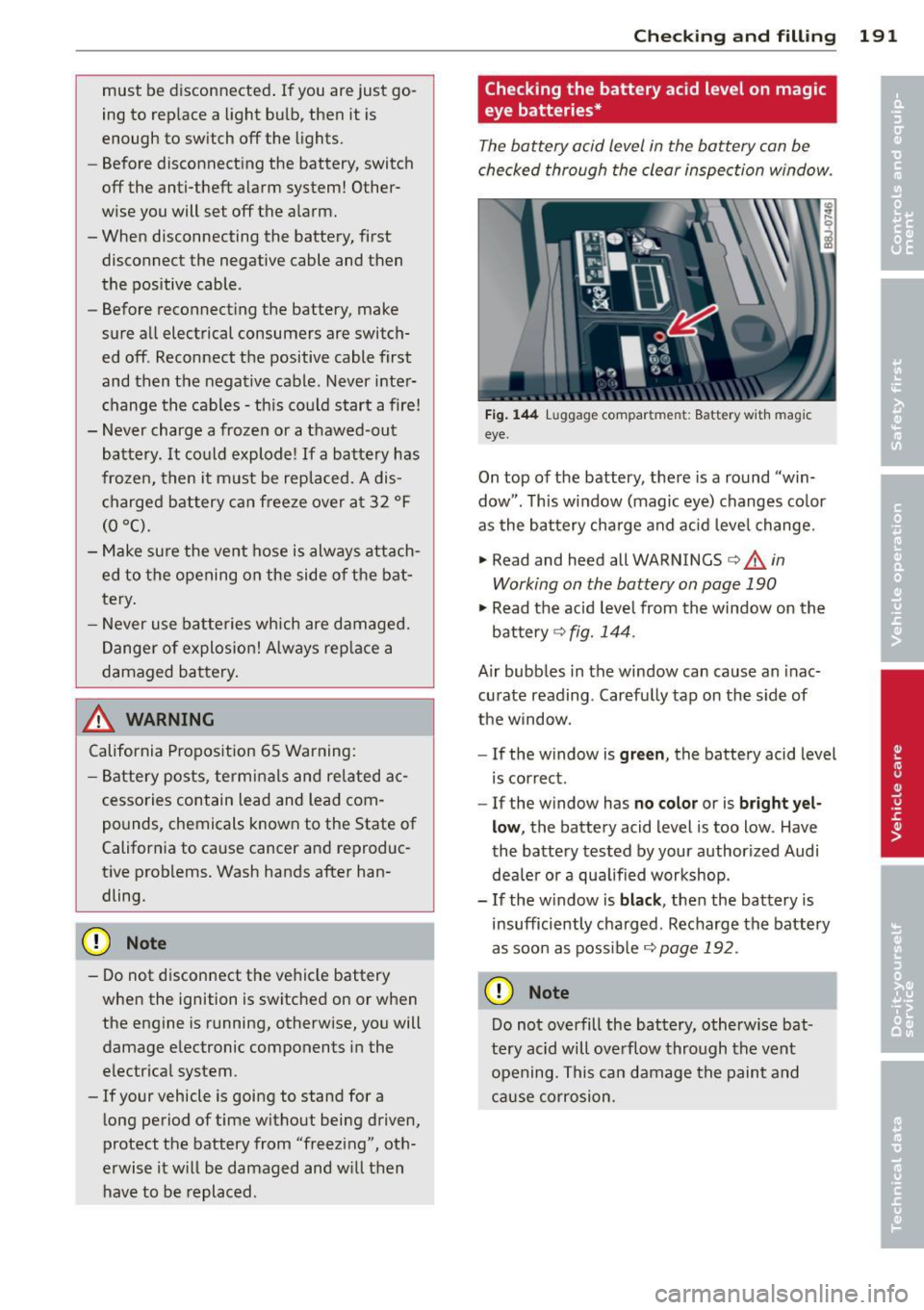
Checking the battery acid level on magic
eye batteries*
The battery acid level in the battery can be
checked through the clear inspection window .
Fig. 144 Luggage compartment: Battery With magic
eye.
On top of the battery, there is a round "win
dow". This window (magic eye) changes color
as the battery charge and acid level change.
.. Read and heed all WARNINGS
c::> &_ in
Working on the battery on page 190
.. Read the acid level from the window on the
battery
c:> fig. 144.
Air bubbles in the window can cause an inac
curate reading . Carefully tap on the side of
the window.
- If the window is
green, the battery acid level
is correct.
- If the window has no color or is bright yel
low ,
the battery acid level is too low . Have
the battery tested by your authorized Audi
dealer or a qualified workshop.
- If the window is
black , then the battery is
insufficiently charged . Recharge the battery
as soon as possible
r:::, page 192 .
CD Note
Do not overfill the battery, otherwise bat
tery acid will overflow through the vent
opening. This can damage the paint and
cause corrosion .
Page 194 of 260
192 Checking and filling
Charging of battery
Starting the engine requires a well charged battery.
,. Always read and heed all W ARNIN GS be
low
c> A and c> A in Working on the bat
tery on page 190.
,. Switch off the ignitio n and all electrical con
s u mers.
,. Make sure the area is well vent ilated when
yo u charge the battery.
,. Connect charger cables.
ALWAY S co nnect
ch arg er ca ble s PO SITIV E
G) to POSITIVE
G) ; NE GATI VE Q to NEGATI VE Q .
,. Switch on the charger.
,. Make sure the charging rate is not over
6 amps.
,. Turn off the charger¢.&_.
,. Disconnect the charger cables .
,. Connect both battery cables to the battery if
necessary-
first plus, then m inus.
It is not necessary to remove the battery from
the luggage compartment, and it is also not
necessa ry to disconnect the cables.
Normally, a battery should be charged at no
more than 10 percent of its rated capacity.
For example, a charging current of 4.5 amps
wou ld be used on a battery rated at 45 Ah.
Rated capacity of the battery in your veh icle is
listed on the battery housing .
The battery caps should
not be opened when
charging a battery.
&,. WARNING
-
Charging a battery can be dangerous.
- Never charge a frozen battery . It may ex
plode because of gas trapped in the ice.
Allow a frozen battery to thaw out first.
- Do not reuse batteries which were fro
zen. The battery housing may have
c racked and weakened whe n the battery
froze.
- Charge the battery in a we ll ventilated
area . Keep away from open f lame o r elec
t ric al spa rk . Do not smoke. Hydrogen gas
gene rate d by the b attery is exp losive. -
To reduce the danger of explosion, never
connect or d isconnect charger cab les
while the charger is operating .
- Fast charging a battery is dangerous and
should only be attempted by a compe
tent tech nician with the proper equip
ment .
- Battery acid that may spill during charg
ing should be washed off with a solution
of wa rm water and bak ing soda to neu
tralize th e ac id .
(D Note
Never use a fast charger as a booster to
start the eng ine . Th is w ill seriously dam
age sensit ive electronic components, such
as cont ro l units, re lays, radio, etc., as well
as the battery charger.
{1) Tips
The vehicle batte ry must not be charged
with a standa rd small charger that p lugs
i nto the cigarette lig hter or outlet.
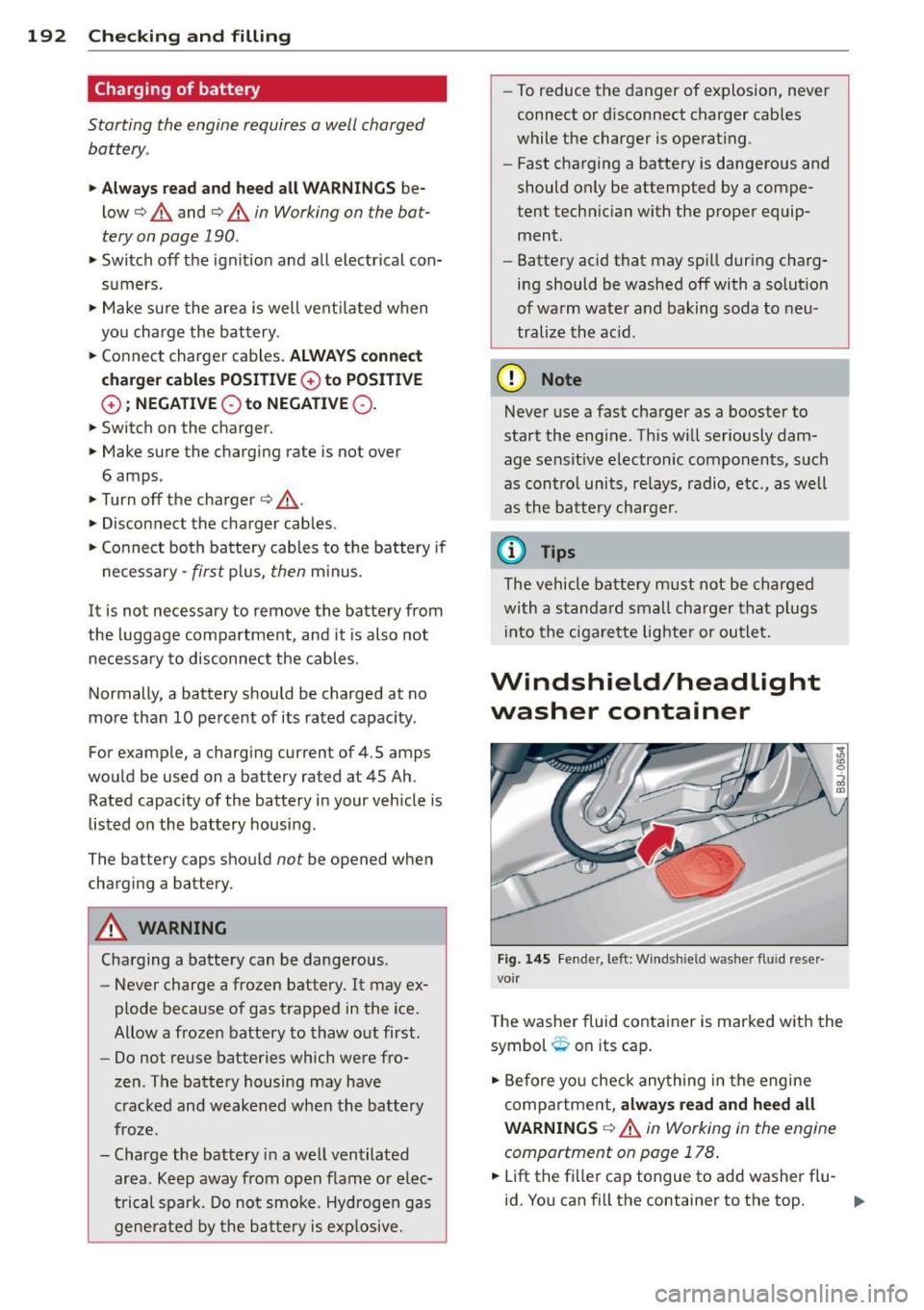
Windshield/head Light
washer container
Fig . 14 5 Fender, left: Windshie ld washer fluid reser·
vo ir
T he washer fluid container is marked with the
symbol
O on its cap.
,. Before you check any thing in the engine
compa rtme nt,
a lwa ys read and heed all
WARNINGS ¢
A in Working in the engine
compartment on page 178 .
,. Lift the filler cap tongue to add washer flu-
id. You can fill the container to the top.
111>
Page 195 of 260

~ Press the cap back onto the filler neck after
filling the container .
You can find the reservoir
c ap acit y in the tab le
in
c::> page 239.
C lean water should be used when filling up. If
possible, use soft wate r to prevent scal ing on
the w asher jets. Always add a glass cleaner
solution (with frost protection in the winter) .
(D Note
Do not mix engine coolant antifreeze or
any other add itives to fi ll up the wind
shie ld washer reservoir.
Checkin g and fillin g 193
•
•
Page 201 of 260
Tires and wheels 199
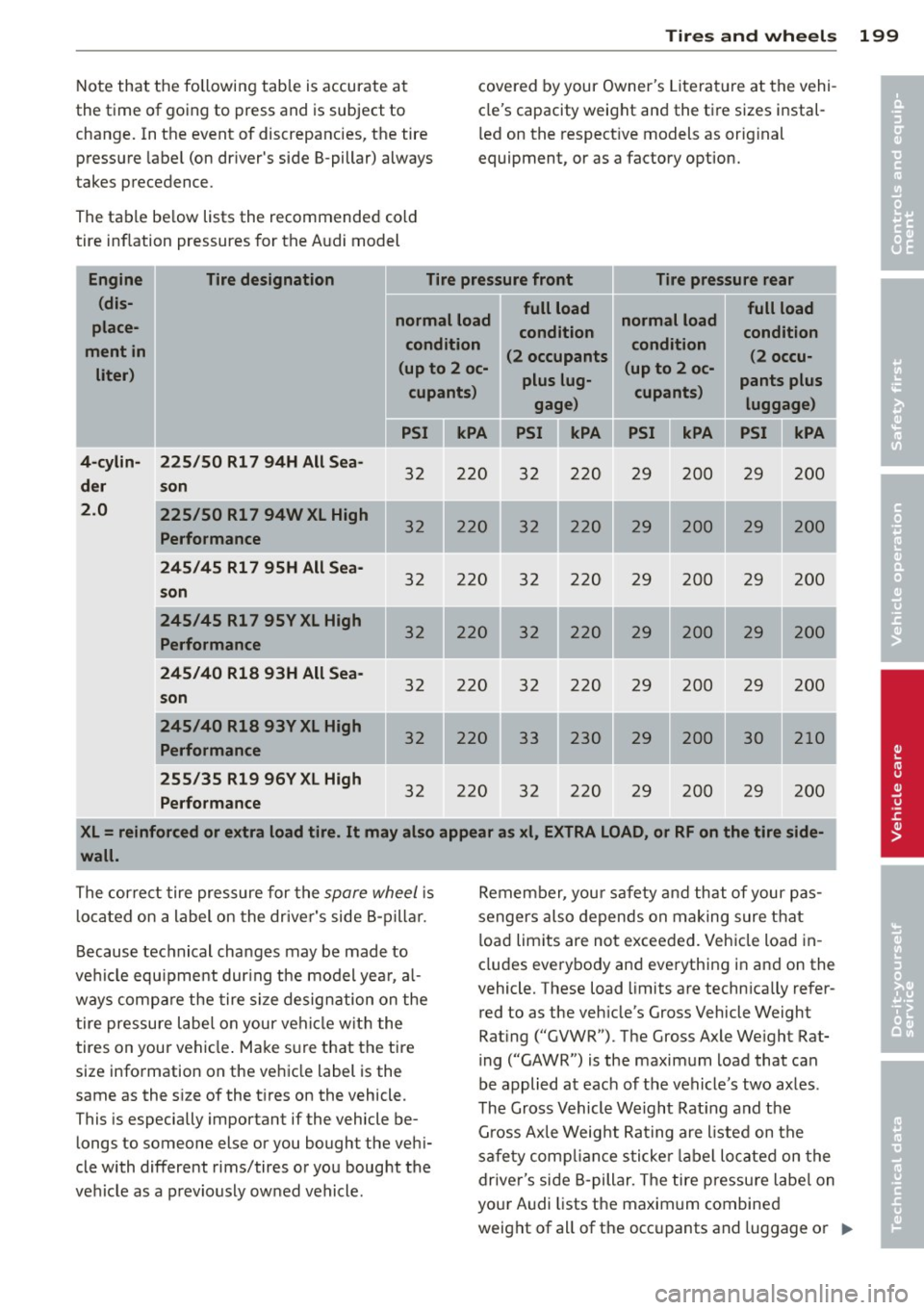
Note that the following tab le is accurate at
the time of going to press and is subject to
change. In the event of discrepanc ies, the tire
pressure label (on dr iver's side B-pillar) always
takes precedence .
The table be low lists the recommended cold
tire inf lation pressures for the Audi model covered
by your Owner 's Literature at the vehi
cle's capacity weight and the tire sizes instal
l ed on the respective models as orig inal
equipment, or as a factory option.
Engine II Tire designation Tire pressure front Tire pressure rear l
(dis-
full load full load
place- normal load
condition normal load
condition
ment in condition
(2 occupants condition
(2 occu-
liter) (up
to 2 oc-
plus lug- (up
to 2 oc-
pants plus
cupants) gage) cupants)
luggage)
PSI
ll kPA PSI kPA
PSI JI kPA PSI Jl kPA
-
4-cylin-
der
2.0 225/50
Rl 7 94H All Sea-
son
225/50 R17 94W XL High
Performance
245/45 Rl 7 95H All Sea-
son
245/45 R17 95YXL High
Performance
245/40 R18 93H All Sea
son
245/40 R18 93V XL High
Performance
255/35 Rl9 96V XL High
Performance
32 220
32 220
32 220
32 220
32 220
32 220
32 220 32
220 29 200 29 200
32 220 29 200 29 200
32 220 29 200 29 200
•
32 220 29 200 29 200
I
32 220 29 200 29 200
•
33 II 230 29
200 30 210 I
32 220 29 200 29 200
XL= reinforced or extra load tire. It may also appear as xl, EXTRA LOAD, or RF on the tire side
wall.
The correct tire pressure for the spore wheel is
l ocated on a label on the drive r's side B-pillar.
Because technical changes may be made to
ve hicl e equ ipment dur ing the model year, a l
ways compa re the tire size designation on the
tire pressure label on your vehi cle w ith t he
tires on your vehicle . Make sur e that the tire
size information on the vehicle label is the
same as the size of the tires on the vehicle.
This is especially important if the vehicle be
longs to someone else or you bought the veh i
cle with different rims/tires or you bought the
vehicle as a previously owned vehicle. Remember, you
r safety and that of your pas
sengers also depends on making sure that
load limits are not exceeded. Vehicle load in
cludes everybody and everything in and on the
vehicle. These load limits are technically refer
red to as the veh icle's Gross Vehicle Weight
Rat ing ("GVWR"). The Gross Axle We ight Rat
ing ("GAWR") is the maximum load that can
be applied at each of the vehicle's two axles .
The Gross Vehicle Weight Rating and the
Gross Axle Weight Rating are listed on the
safety comp liance sticker label lo cated on the
driver's side B-pillar. The tire pressure label on
your A udi lists the maximum combined
weight of all of the occ upants and luggage or
Ill>
•
•
Page 229 of 260
Fuses and bulbs
Electrical fuses
Replacing fuses
Fuses that have blown will have metal strips
that have burned through.
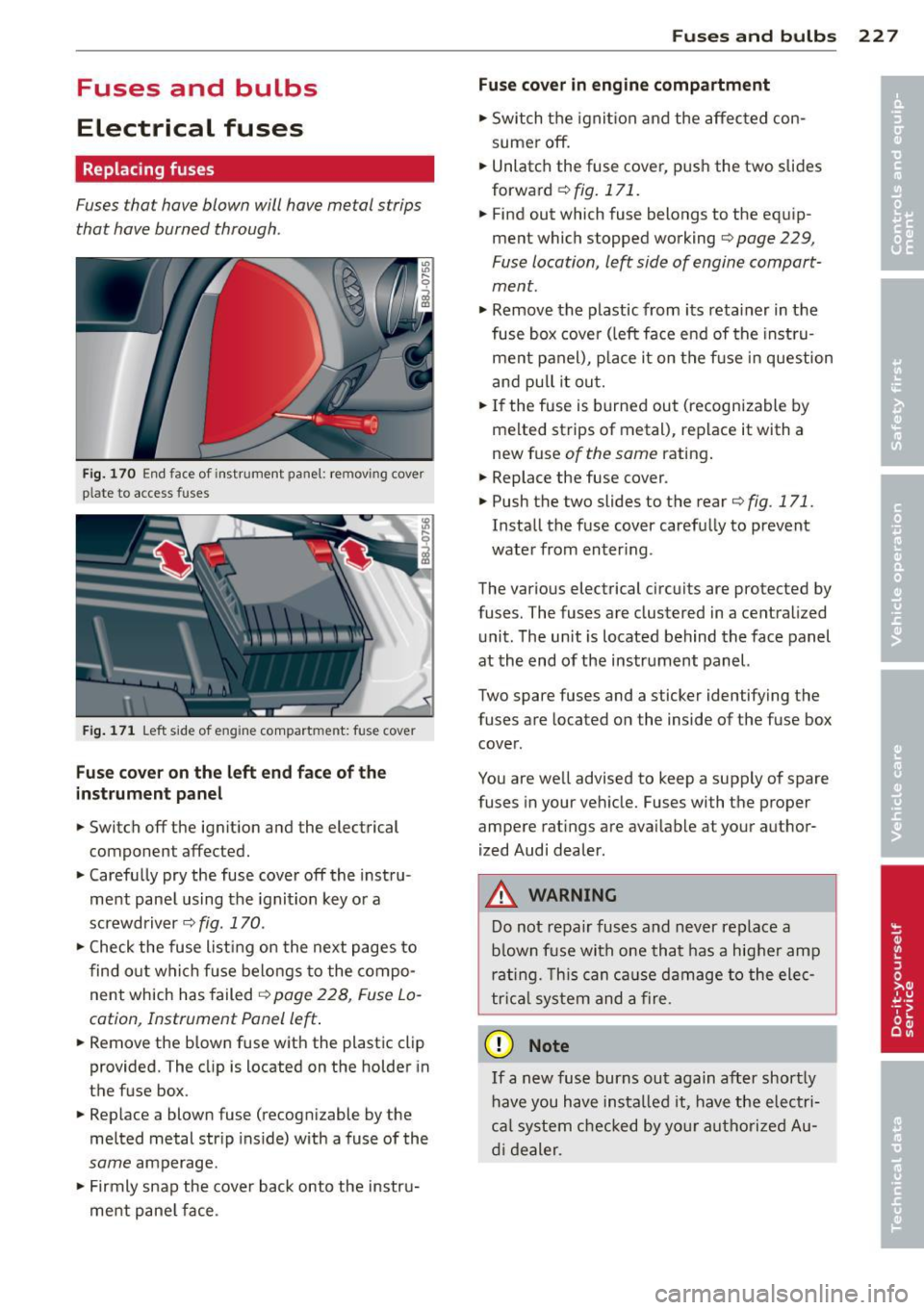
Fig. 170 End face of instrument panel: removing cover
p late to access fuses
Fig. 171 Left side of eng ine compart ment: fuse cove r
Fuse cover on the left end face of the
instrument panel
.. Switch off the ignition and the electrical
component affected .
.. Carefully pry the fuse cover off the instru
ment panel using the ignition key or a
screwdriver ~
fig. 170.
.. Check the fuse list ing on the next pages to
find o ut which f use belongs to the compo
nent which has failed ¢
page 228, Fuse Lo
cation, Instrument Panel left .
.. Remove the blown fuse with the plastic clip
provided. The clip is located on the holder in
the fuse box.
.. Replace a blown fuse (recognizable by the
melted metal str ip inside) with a fuse of the
same amperage .
.. Firmly snap the cover back onto the instru
ment pane l face .
Fuse s and bulbs 22 7
Fuse cover in engine compartment
.. Switch the ignit ion and the affected con
sumer off .
.. Unlatch the fuse cover, p ush the two slides
forward
~ fig. 171.
.. Find out which fuse belongs to the equip
ment which stopped working
~ page 229,
Fuse location, le~ side of engine compart
ment.
.. Remove the plastic from its retainer in the
fuse box cove r (left face end of the instru
ment panel), place it on the f use in question
and pull it out .
.. If the fuse is burned out (recognizable by
melted strips of metal), replace it with a
new fuse
of the same rating.
.. Replace the fuse cover .
.. Push the two slides to the rear¢
fig. 171.
Install the fuse cover carefully to prevent
water from enter ing .
The various electrical circuits are protected by
fuses. The fuses are clustered in a centralized unit. The unit is located behind the face panel
at the end of the instrument panel.
Two spare fuses and a sticker identifying the
fuses are located on the inside of the fuse box
cover.
You are well advised to keep a supply of spare
fuses in your vehicle. Fuses with the proper ampere ratings are available at your author
ized Audi dealer .
A WARNING
Do not repair fuses and never replace a
blown fuse with one that has a higher amp
rating. Th is can cause damage to the elec
trical system and a fire .
(D Note
If a new fuse burns out again after short ly
have you have installed it, have the electri
cal system checked by your authorized Au
di dealer .