ESP AUDI TT ROADSTER 2014 Owner's Manual
[x] Cancel search | Manufacturer: AUDI, Model Year: 2014, Model line: TT ROADSTER, Model: AUDI TT ROADSTER 2014Pages: 244, PDF Size: 60.87 MB
Page 82 of 244
80 On the road
Audi magnetic ride
Applies to vehicles: with magnetic ride
Damping can be adjusted to the driver's pref
erence and it adapts automatically to the cur
rent driving situation.
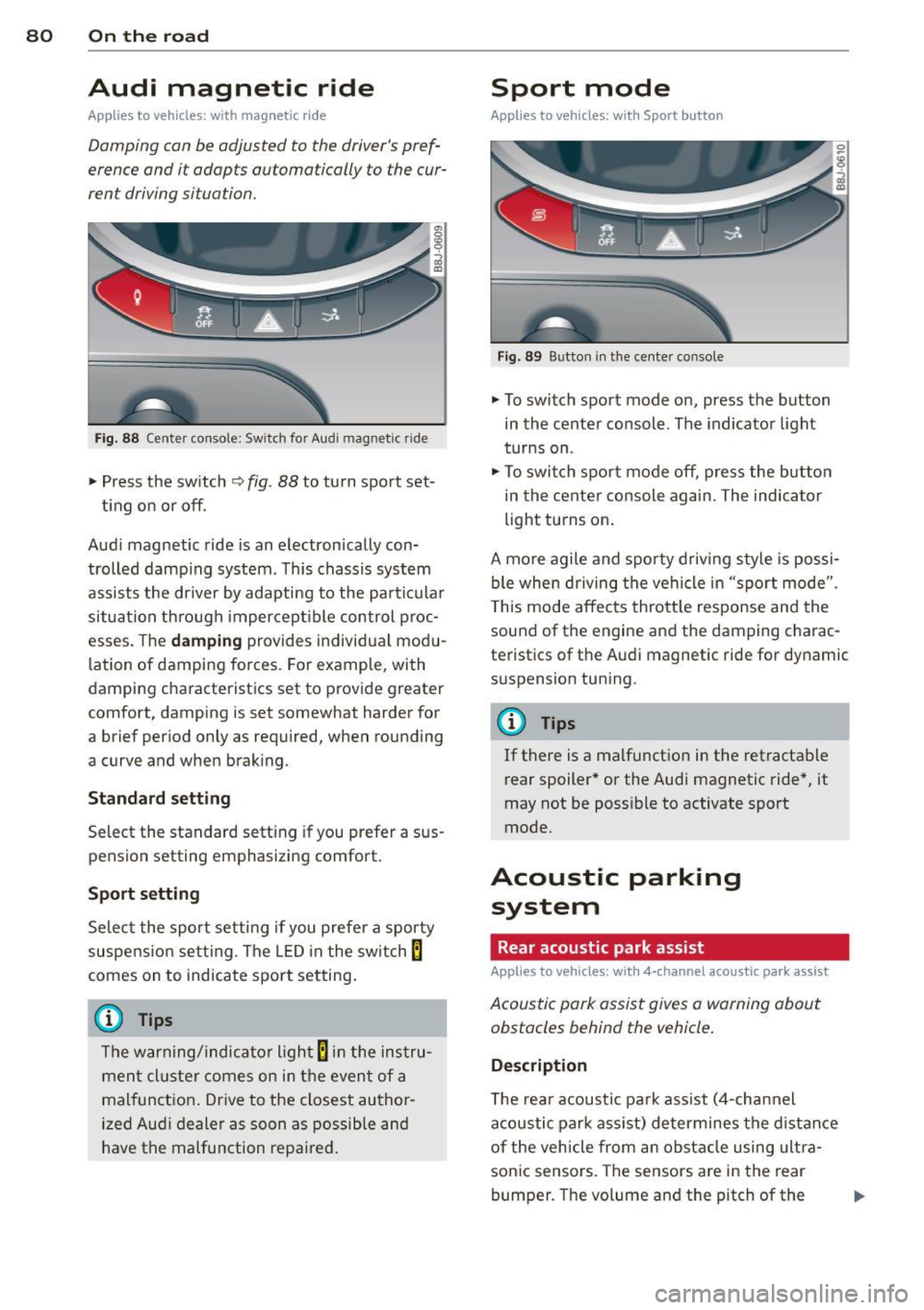
Fig. 88 Center console: Switch for Audi magnetic r ide
.,. Press the sw itch ~ fig. 88 to turn sport set-
ting on or off.
Aud i magnetic ride is an electronically con
trolled damping system. This chassis system
assists the driver by adapting to the particular
situation through imperceptible control proc
esses. The
damping provides individual modu
lation of damping forces. For example, with
damping characteristics set to provide greater
comfort, damping is set somewhat harder for
a brief period only as required, when rounding
a curve and when braking.
Standard setting
Select the standard setting if you prefer a sus
pension setting emphasizing comfort.
Sport setting
Select the sport setting if you prefer a sporty
suspe nsion setting . The LED in the switch
8
comes on to indicate sport setting.
@ Tips
The warning/indicator light 8 in the instru
ment cluster comes on in the event of a
malfunction .
Drive to the closest author
ized Audi dealer as soon as possible and
have the malfunction repaired.
Sport mode
Applies to vehicles: with Sport button
Fig. 89 Button in the center console
.,. To switch sport mode on, press the button
in the center console. The indicator light
turns on .
.,. To switch sport mode off, press the button
in the center console again. The indicator
light turns on .
A more agile and sporty driving style is possi
ble when driving the vehicle in "sport mode".
T his mode affects throttle response and the
sound of the engine and the damping charac
teristics of the Audi magnetic ride for dynamic
suspension tuning .
@ Tips
If there is a malfunction in the retractable
rear spoiler* or the Audi magnetic ride*, it
may not be poss ible to activate sport
mode.
Acoustic parking system
Rear acoustic park assist
Applies to vehicles: with 4-channel acoustic park assist
Acoustic park assist gives a warning about
obstacles behind the vehicle.
Description
T he rear acoustic park ass ist (4-channel
acoustic park assist) determines the distance
of the vehicle from an obstacle using ultra
son ic sensors. The sensors are in the rear
bumper. The volume and the pitch of the
Page 95 of 244
.. Fasten your safety belt and wear it properly.
Also instruct your passengers to fasten their
safety belts properly ¢
page 101.
What impairs driving safety?
Safe driving is directly related to the condi
tion of the vehicle, the driver as well as the
driver's ability to concentrate on the road
without being distracted.
The driver is responsible for the safety of the
veh icle and a ll of its occupants . If your ability
to drive is impaired, safety risks for everybody
in the vehicle increase and you also become a
hazard to everyone else on the road ¢
,&..
Therefore:
.,. Do not let yourself be distracted by passen
gers or by us ing a cellular telephone.
.. NEVER drive when your driv ing ability is im
paired (by medicat ions, alcohol, drugs, etc.) .
.. Observe all traffic laws, ru les of the road
and speed limits and plain common sense.
.. ALWAYS adjust your speed to road, traffic
and weather conditions.
.. Take frequent breaks on long trips. Do not
drive for more than two hours at a stretch .
.. Do NOT drive when you are tired, under
pressure or when you are stressed.
A WARNING
Impaired driving safety increases the risk
of serious personal injury and death when
ever a vehicle is being used.
Drivin g Sa fely 93
Proper occupant
seating positions
Proper seating position for the driver
The proper driver seating position is impor
tant for safe, relaxed driving.
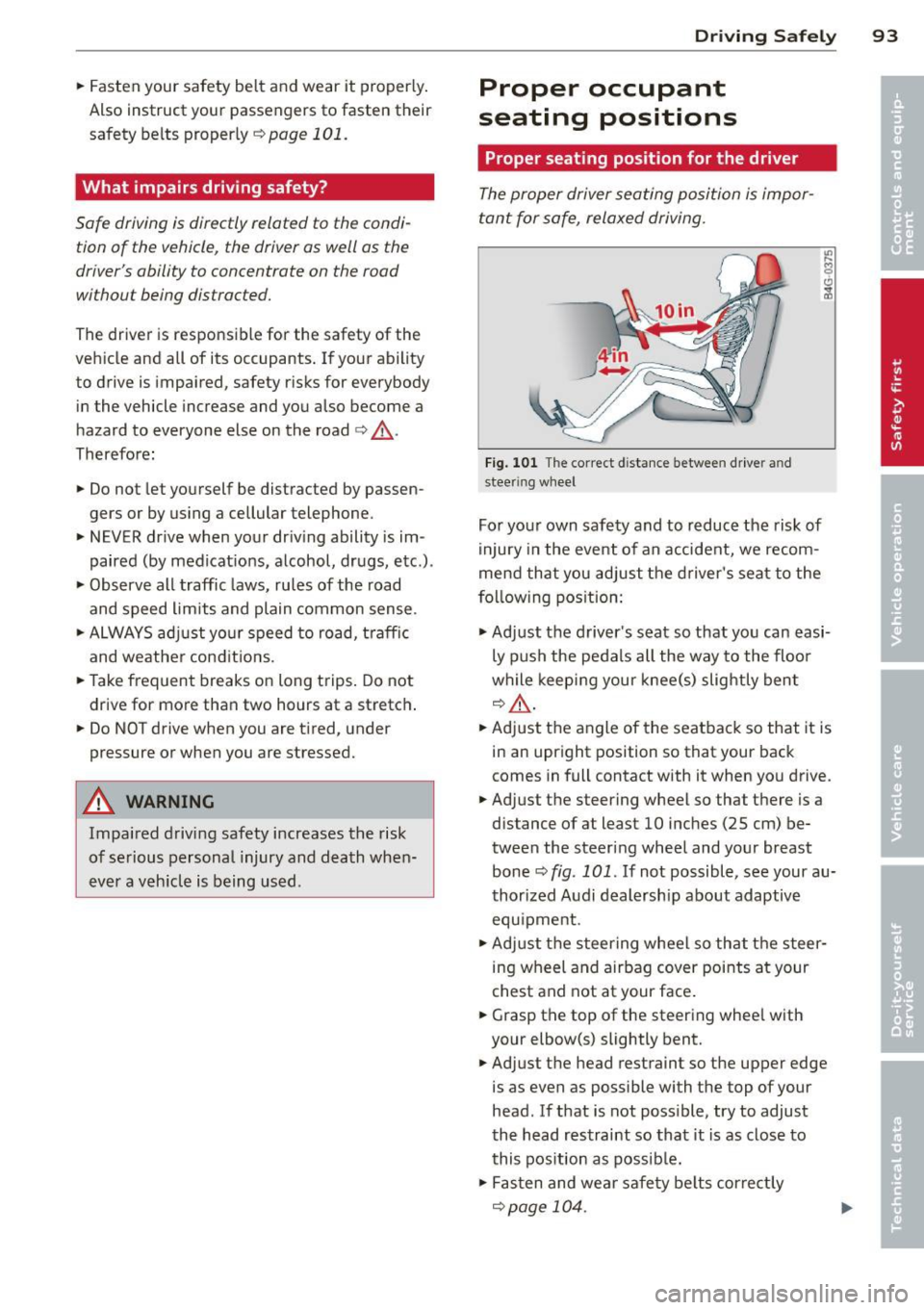
Fig. 101 The correct d istance between driver an d
steer ing wheel
For your own safety and to reduce the risk of
injury in the event of an accident, we recom
mend that you adjust the driver's seat to the
f o ll ow ing pos ition:
.,. Adjust the driver's seat so that you can easi
ly push the pedals all the way to the floo r
while keeping your knee(s) slightly bent
q&_ ,
.. Adjust the angle of the seatback so that it is
in an upright position so that your back
comes in full contact with it when you drive.
.. Adjust the steering wheel so that there is a
distance of at least 10 inches (25 cm) be
tween the steering wheel and your breast
bone¢
fig. 101. If not possible, see your au
thorized Audi dealership about adaptive
equ ipment .
.. Adjust the steering wheel so that the steer
ing wheel and airbag cover points at your
chest and not at your face .
.. Grasp the top of the steering whee l with
your elbow(s) slightly bent .
.. Adjust the head restraint so the upper edge
is as even as possible with the top of your
head . If that is not poss ible, try to adjust
the head restraint so that it is as close to
this pos ition as possib le .
.. Fasten and wear safety belts correctly
qpage 104.
Page 98 of 244
96 Driving Safely
-Never attempt to adjust head restraint
while driving. If you have driven off and
must adjust the driver headrest for any
reason, first stop the vehicle safely be
fore attempting to adjust the head re straint.
- Children must always be properly re
strained in a child restraint that is appro
priate for their age and size
Q page 130.
Examples of improper seating positions
The occupant restraint system can only re
duce the risk of injury if vehicle occupants are
properly seated.
Improper seating positions can cause serious
injury or death. Safety belts can only work
when they are properly positioned on the body. Improper seating positions reduce the
effectiveness of safety belts and will even in
crease the risk of injury and death by moving
the safety belt to critical areas of the body.
Improper seating positions also increase the
risk of serious injury and death when an air
bag deploys and strikes an occupant who is
not in the proper seat ing position. A driver is
responsible for the safety of all vehicle occu
pants and especially for children . Therefore:
.. Never allow anyone to ass ume an incorrect
seat ing position when the vehicle is being
used
Q A .
The following bullets list only some sample
positions that will increase the risk of serious
injury and death. Our hope is that these exam
ples will make you more aware of seating po
sitions that are dangerous .
Therefore, whenever the vehicle is
moving :
-never stand up in the vehicle
- never stand on the seats
- never kneel on the seats
- never ride with the seatback reclined
- never lie down on the rear seat
- never lean up against the instrument panel
- never sit on the edge of the seat
- never sit sideways -
never lean out the window
- never put your feet out the window
- never put your feet on the instrument panel
- never rest your feet on the seat cushion or
back of the seat
- never ride in the footwell
- never ride in the cargo area
A WARNING ..___
Improper seating positions increase the
risk of serious personal injury and death
whenever a vehicle is being used.
- Always make sure that all vehicle occu
pants stay in a proper seating position
and are properly restrained whenever the
vehicle is being used.
Driver and passenger
side footwell
Important safety instructions
A WARNING
-
~ -
Always make sure that the knee airbag can
inflate without interference. Objects be
tween yourself and the airbag can increase
the risk of injury in an accident by interfer
ing with the way the airbag deploys or by
being pushed into you as the airbag de
ploys.
- No persons (children) or animals should
ride in the footwell in front of the pas
senger seat. If the airbag deploys, this
can result in ser ious or fatal injuries.
- No objects of any kind should be carried
in the footwell area in front of the driv
er's or passenger's seat. Bulky objects
(shopping bags, for example) can ham
per or prevent proper deployment of the
airbag. Small objects can be thrown
through the vehicle if the airbag deploys
and injure you or your passengers.
Page 100 of 244
98 Driving Safely
• Distribute the load evenly in the luggage
compartment.
• Always place and properly secure heavy
items in the luggage compartment as far
forward as possible.
A WARNING
Improperly stored luggage or other items
can fly through the vehicle causing serious
personal injury in the event of hard brak
ing or an accident. To help reduce the risk
of serious personal injury:
- Always put objects, for example, luggage
or other heavy items in the luggage com
partment.
- Always secure objects in the luggage
compartment using the tie-down eyelets
and suitable straps.
A WARNING
Heavy loads will influence the way your ve
hicle handles. To help reduce the risk of a
loss of control leading to serious personal
injury:
-Always keep in mind when transporting
heavy objects, that a change in the cen
ter of gravity can also cause changes in
vehicle handling:
- Always distribute the load as evenly as
possible.
- Place heavy objects as far forward in
the luggage compartment as possible.
- Never exceed the Gross Axle Weight Rat
ing or the Gross Vehicle Weight Rating
specified on the safety compliance stick
er on the left door jamb. Exceeding per
missible weight standards can cause the
vehicle to slide and handle differently.
- Please observe information on safe driv
ing
!:? page 92 .
A WARNING
To help prevent poisonous exhaust gas
from being drawn into the vehicle, always
keep the rear lid closed while driving.
- Never transport objects larger than
-
those fitting completely into the luggage area because the rear lid cannot be fully
closed.
- If you absolutely must drive with the rear
lid open, observe the following notes to
reduce the risk of poisoning:
- Close all windows,
- Close the convertible top,
- Open all air outlets in the instrument
panel,
- Switch off the air recirculation,
- Set the fresh air fan to the highest
speed.
A WARNING
-Always make sure that the doors, all win-
dows, the convertible top and the rear lid
are securely closed and locked to reduce
the risk of injury when the vehicle is not
being used.
- After closing the rear lid, always make
sure that it is properly closed and locked.
- Never leave your vehicle unattended es pecially with the rear lid left open . A
child could crawl into the vehicle through
the luggage compartment and close the
rear lid becoming trapped and unable to
get out. Being trapped in a vehicle can
lead to serious personal injury.
- Never let children play in or around the
vehicle.
- Never let passengers ride in the luggage
compartment. Vehicle occupants must
always be properly restrained in one of
the vehicle's seating positions.
@ Tips
- Air circulation helps to reduce window
fogging. Stale air escapes to the outside
through vents in the trim panel , on the
left side of the luggage compartment.
Be sure to keep these slots free and
open.
- The tire pressure must correspond to the
load. The tire pressure is shown on the
tire pressure label. The tire pressure la bel is located on the driver's side B-pillar .
The tire pressure label lists the ..,
Page 103 of 244
Safety belts
General notes
Always wear safety belts!
Wearing safety belts correctly saves lives!
This chapte r exp lains why safety be lts a re nec
essary, how they work and how to adjust and
wear them correctly.
~ Read a ll the informat ion that fo llows and
heed all of the inst ruct ions and WARNINGS.
A WARNING
Not wearing safety belts or wearing them
improperly increases the risk of ser ious
personal in jury and death .
- Safety belts are the sing le most effective
means availab le to red uce the r isk of se
rious injury and death in a utomob ile acci
de nts . For your prot ecti on and that of
yo ur passenge rs, always co rrec tly wear
sa fe ty bel ts when the ve hicle is mov ing.
- P re g nant women, injured, or physically
imp aired perso ns must also use safe ty
belts. L ike a ll vehicle occup ants, they are
more like ly to be ser ious ly injure d if they
do not wea r safety be lts . The best way to
protect a fet us is to protect the mother -
thro ughout the entire pregnancy.
Number of seats
Your Audi TT Roadster has two seating posi
tions. Each seat ing pos ition has a safety be lt.
A WARNING
Not wearing safety belts or wearing them
im proper ly increases the risk of ser ious
personal in jury and death.
- Never st rap more than one person, in
clu ding small ch ild ren, into any belt. It is
especially dangerous to place a safety
belt over a child s itting on yo ur lap.
- Never let mo re people ride in the ve hicle
t h an t he re a re safety be lts ava ilable.
Sa fety belts 1 O 1
- Be s ure everyone riding in the vehicle is
properly restrained w ith a separate sa fe
ty belt or child restra int.
4 Safety belt warning light
Your vehicle has a warning system for the
driver and front seat passenger to remind you
about the importance of buckling-up.
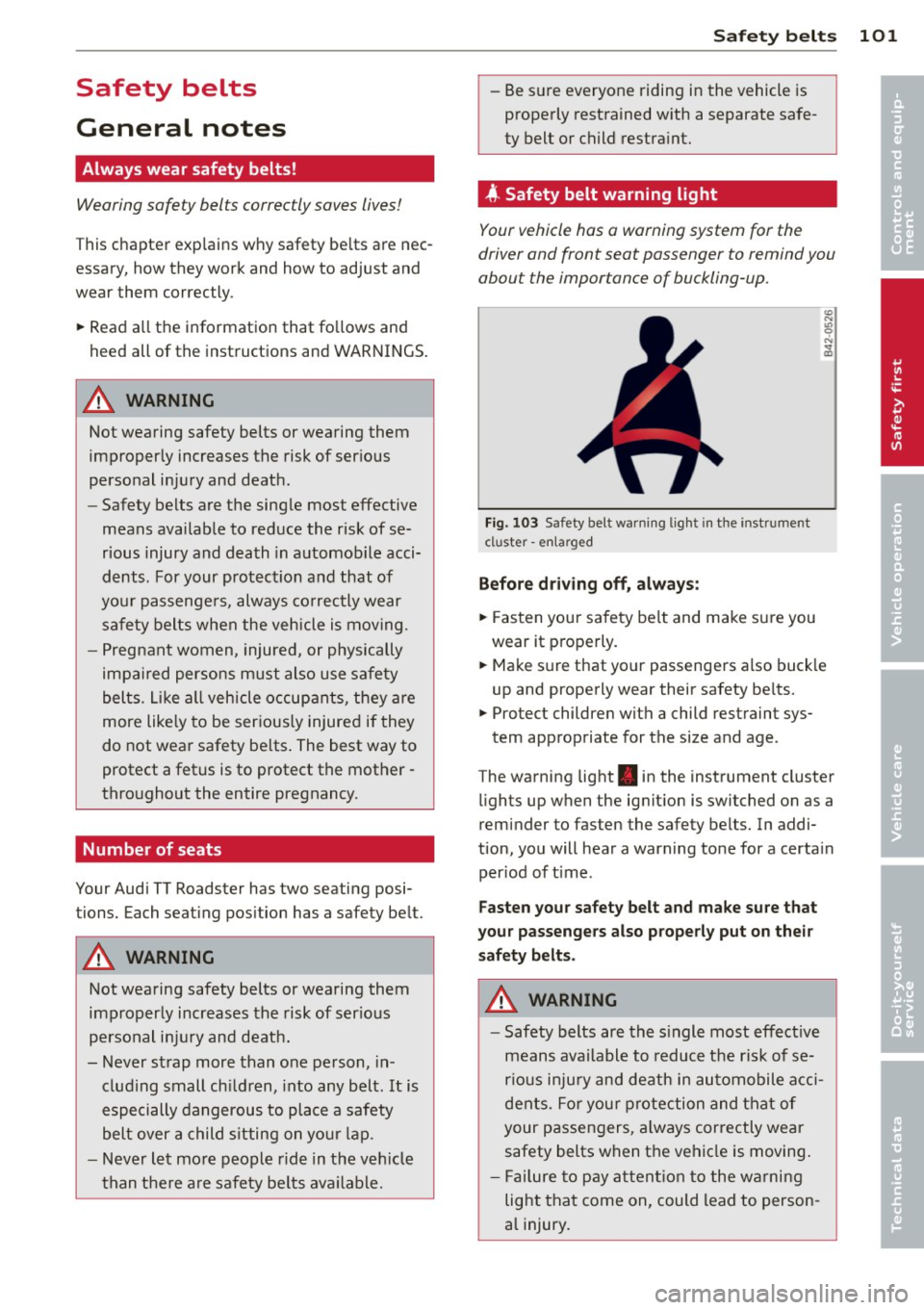
Fi g. 1 03 Safety be lt warn ing lig ht in the instr ume nt
cl uster -enla rged
Befor e driv ing off, always :
~ Fasten your sa fe ty belt and make su re you
wear it p roperly.
~ Make s ure that yo ur passenge rs a lso buck le
up and properly wear their safety be lts.
~ Protect childre n with a child rest raint sys-
tem appropriate for the s ize and age .
The wa rning light . in the instrument cluster
li ghts up w hen the ig nit ion is switched on as a
reminder to fasten the safety belts. In addi
tion , you will hear a warning tone for a certa in
per iod of t ime .
Fasten your safety belt and make sure that
your passengers also properly put on their saf ety belts .
A WARNING
-Safety belts are the s ingle most effect ive
means ava ilable to reduce t he risk of se
rio us inju ry and death in au tomobile a cci
de nts. Fo r yo ur pro tection and tha t of
your passen gers, a lways correctly wear
safety belts when t he ve hicl e is moving .
- Fail ure to p ay att ention t o the wa rni ng
light that come on, could lead to person
a l injury . •
•
Page 108 of 244
106 Safet y belt s
Pregnant women must also be properly
restrained
The best way to protect the fetus is to make
sure that expectant mothers always wear
safety belts correctly -throughout the preg
nancy.
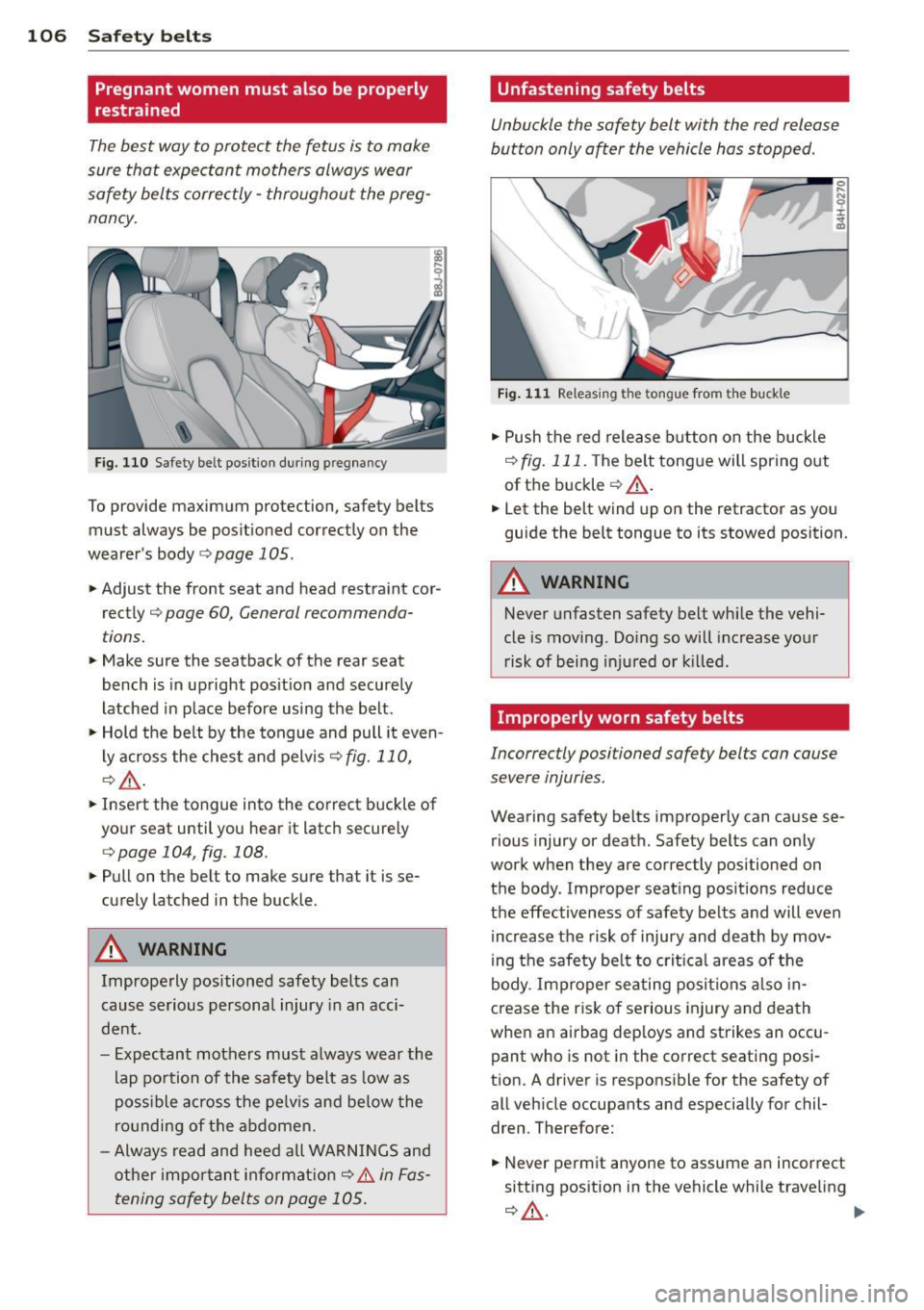
Fig . 1 10 S afety be lt pos it io n dur ing p regnancy
To provide maximum prote ction , safety belts
must always be po sitioned correctly on the
wearer's body
c> page 105 .
• Adjust the front seat and head restraint cor
rect ly
c> page 60, General recommenda
tions.
• Make sure the seatback of the rear seat
bench is in up right posit io n and securely
latched in p lace before using the b elt .
• Hold the be lt by the tongue and pull it even
l y across the ches t and pelvis
c> fig. 110,
c>,& .
• Inse rt the tongue into the correct buckle of
yo ur seat until you hear it latc h securely
c> page 104 , fig . 108.
•Pullon the belt to make sure that it is se
curely latched in t he buckle .
A WARNING
Imprope rly positioned safety belts can
cause se rious personal injury in an acci
de nt.
-
- E xpec tant mothers mus t always wear the
lap po rtion of the safety b elt as low as
poss ible ac ross the pe lv is and be low the
ro unding of the a bdome n.
- Always read and heed all WARN INGS and
ot her impo rtan t info rma tion
c> .&. in Fas
tening safety belts on page 105.
Unfastening safety belts
Unbuckle the safety belt with the red release
button only a~er the vehicle has stopped .
,,
}_
Fig . 11 1 Rele asing the ton gu e from the buc kle
• Push the red release b utton on the buckle
c> fig . 111. T he be lt tongue will spring out
of t he b uckle
c> ,& .
N 0 ;c
a1i
• Let the belt wind up on the retractor as you
guide the belt tongue to its stowed position .
A WARNING
-
Never unfasten safety belt whi le the vehi-
cle is mov ing . Do ing so will increase yo ur
r isk of being i njured o r kill ed .
Improperly worn safety belts
Incorrectly positioned safety belts can cause
severe injuries.
Wearing safety belts improper ly can ca use se
rious injury or deat h. Safety belts can o nly
work when they are correc tly positioned on
the body . Improper seat ing positions reduce
the effectiveness of safety be lts and will even
increase the risk of inju ry and death by mov
ing the safety be lt to crit ical areas o f the
body . Imp roper seati ng po siti ons also in
c rease the risk of serious injury and death
whe n an a irbag dep loys and strikes an occu
pant who is not in the co rrect seating posi
t ion. A driver is respons ible for the safety of
all veh icle occupants and especially for chil
dren . There fore:
• Never pe rm it anyone to assume an incorrect
sitt ing position in the vehicle while trave ling
c> ,& . ~
Page 111 of 244
Airbag system Important things to know
Importance of wearing safety belts and
sitting properly
Airbags are only supplemental restraints. For
airbags to do their job, occupants must al
ways properly wear their safety belts and be
in a proper seating position.
For your safety and the safety of your passen
gers, before driving off, always:
"" Adjust the driver's seat and steering wheel
properly¢
page 93,
"" Adjust the front passenger's seat properly
¢page 61,
""Wear safety be lts properly ¢ page 103,
""Always properly use the proper child re-
straint to protect children
r::::> page 130.
In a collision airbags must inflate within the
blink of an eye and with considerable force.
The supplemental airbags can cause injuries if
the driver or the front seat passenger are not
seated properly . Therefore in order to help the
airbag to do its job, it is impo rtant, both as a
d river and as a passenger to s it properly at all
times.
By keeping room between your body and the
steer ing whee l and the front of the passenger
compartment, the airbag can inflate fully and
comp lete ly and provide supplemental protec
tion in certain frontal collisions
r::::> page 93,
Proper occupant seating positions.
F or details
on the operation of the seat adjustment con
trols ¢
page 61 and ¢ page 62.
It's especially important that children a re
properly restrained
r::::> page 130.
There is a lot that the driver and the passen
ger can and must do to help the individua l
safety features installed in your Aud i work to
gether as a system.
Proper seating pos ition is important so that
the front airbag on the driver side can do its
job. If you have a physical impairment or con-
Airbag system 109
dition that prevents you from sitting properly
on the driver seat with the safety belt properly
fastened and reach ing the pedals, or if you
have concerns with regard to the function or
operation of the Advanced Airbag System,
please contact your authorized Audi dealer or
qualified workshop, or call Audi Customer Re
lations at 1-800-822-2834 for poss ible modi
fications to your vehicle.
When the airbag system dep loys, a gas gener
ator will fill the a irbags, break open the pad
ded covers, and inflate between the steer ing
whee l and the driver and between the instru
ment panel and the front passenger. The air
bags will deflate immediately after deploy
ment so that the front occupants can see
through the windshield again without inter
ruption.
A ll of th is takes place in the blink of an eye, so
fast that many people don't even realize that
the airbags have deployed. The airbags a lso
inflate with a great dea l of force and nothing
should be in their way when they deploy.
Front airbags in combination with properly
worn safety belts slow down and lim it the oc
cupant's forward movement. Together they
help to prevent the driver and passenger from
hitt ing parts of the inside the vehicle while re
ducing the forces acting on the occupant dur
ing the crash . In this way they help to reduce
the risk of injury to the head and upper body
in the crash. Airbags do not protect the arms
or the lower parts of the body.
Both front airbags will not inflate in all fronta l
collisions . The triggering of the airbag system
depends on the vehicle dece leration rate
caused by the co llision and registered by the
electronic control unit. If th is rate is below
the reference value programmed into the con
trol unit, the airbags will not be triggered,
even though the car may be badly damaged as
a result of the collision . Vehicle damage, re
pair costs or even the lack of veh icle damage
is not necessarily an indication of whether an
airbag shou ld inf late or not .
It is not possible to define a range of vehicle
speeds that will cover every possible kind and ..,. •
•
Page 115 of 244
Front airbags
Description of front airbags
The airbag system can provide supplemental
protection to properly restrained front seat
occupants .
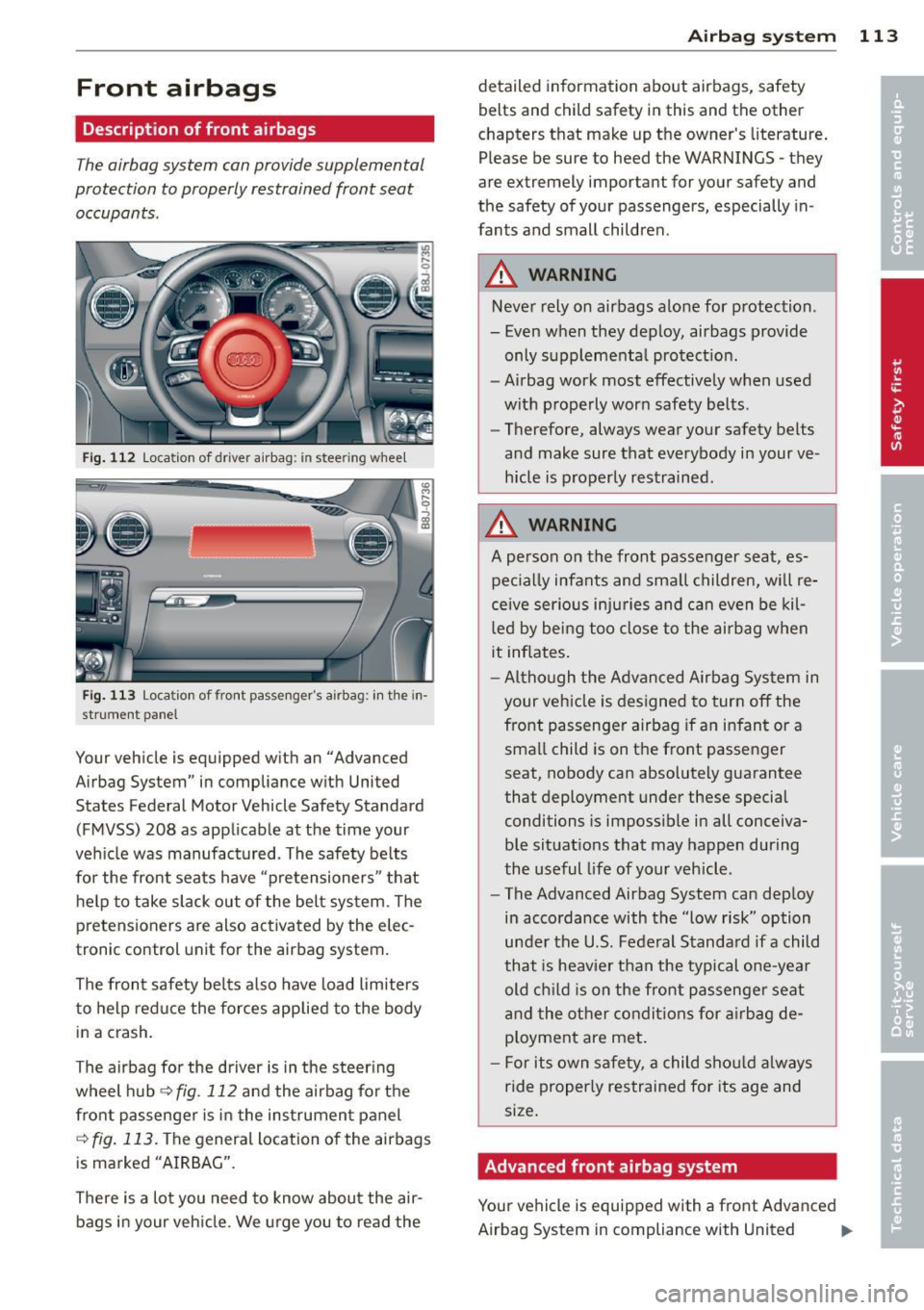
Fig. 112 Location of dri ver airbag: in steering whee l
Fig. 113 Location of front passe nger's ai rb ag : in the in
strument panel
Your vehicle is equipped with an "Advanced
Airbag System" in compliance with United
States Federal Motor Vehicle Safety Standard
(FMVSS) 208 as applicable at the time your
vehicle was manufactured . The safety belts
for the front seats have "pretensioners" that
help to take slack out of the belt system. The
pretensioners are also activated by the elec
tronic control unit for the airbag system.
The front safety belts also have load limiters
to help reduce the forces applied to the body
in a crash .
The airbag for the driver is in the steering
wheel hub¢
fig. 112 and the airbag for the
front passenger is in the instrument panel
¢fig. 113. The general location of the airbags
is marked "AIRBAG".
There is a lot you need to know about the air
bags in your vehicle. We urge you to read the
Airbag system 113
detailed information about airbags, safety
belts and child safety in this and the other
chapters that make up the owner's literature .
Please be sure to heed the WARNINGS - they
are extremely important for your safety and
the safety of your passengers, especially in
fants and small children.
A WARNING ,.;;
Never rely on airbags alone for protection .
- Even when they deploy, airbags provide
only supplementa l protection.
- Airbag work most effectively when used
with properly worn safety belts.
- Therefore, always wear your safety belts
and make sure that everybody in your ve
hicle is properly restrained.
A WARNING
A person on the front passenger seat, es
pecially infants and small children, will re
ceive serious injuries and can even be kil
led by being too close to the airbag when
it inflates .
- Although the Advanced Airbag System in
your vehicle is designed to turn off the
front passenger airbag if an infant or a
small child is on the front passenger
seat, nobody can absolutely guarantee
that deployment under these special
conditions is impossible in all conceiva
ble situations that may happen during
the useful life of your vehicle .
- The Advanced Airbag System can deploy
in accordance with the "low risk" option
under the U.S. Federal Standard if a child
that is heavier than the typical one-year
old child is on the front passenger seat
and the other condit ions for airbag de
ployment are met.
- For its own safety, a child should always
ride properly restrained for its age and
size.
Advanced front airbag system
-
Your vehicle is equipped with a front Advanced
Airbag System in compliance with United
Ill>
Page 121 of 244
-The inflating airba g will hit the child
safety seat or infant carrier wit h great
f o rce and w ill smash t he ch ild safety seat
and child aga inst the backrest, center
arm rest, d oor or roof.
- Never install a r earward facing child
sa fety seat on the front pass eng er s eat
unless the
PASSENGER AIR BAG OFF
light c omes on and stays on. If the PAS
S ENGER AIR BAG OFF
ligh t does no t
come on and stay on, the inflating airbag
will hit the child safety seat or infant car
rier with great force and will smash the
child safety seat and child against the
backrest, door or roof. Have the airbag
system inspected immediately by your
authorized Audi dealer .
A WARNING
Objects between you and the a irbag will
increase the risk of injury in a crash by in
terfering with the way the airbag unfolds
or by being pushed into you as the a irbag
inflates.
- Never hold th ings in your hands or on
your lap when the vehicle is in use .
- Never transport items on or in the area
of the front passenge r seat. Objects
cou ld move into the area of the front air
bags dur ing braking or other s udden ma
neuver and become dangerous projec
ti les that can cause serious personal in
jury if the airbags inflate.
- Never place o r attach accessories or oth
er objects (such as cup ho lders, tele
phone brackets, large, heavy or b ulky ob
jects) on the doors, over or near the area
marked "AIRBAG" on the steering wheel,
instrument panel, seat backrests or be
tween those a reas and yourself. These
objects could cause injury in a crash, es
pecially when the airbags inflate.
- Never recline the front passenger's seat
to transport objects. Items can also
move in to the area of the side airbag or
the front airbag dur ing braking or in a
sudden maneuver . Objects near the air -
-
Airbag system 119
bags can become projectiles and cause
inju ry, partic ularly when the seat is re
clined.
A WARNING
The fine dust created when airbags deploy
can cause breathing prob lems for people
with a history of asthma or other breath
ing cond itions.
- To reduce the risk of breath ing problems,
those with asthma o r other respiratory
conditions shou ld get fresh air r ight
away by getting o ut of the veh icle or
open ing windows or doors.
- If you are in a collision in which airbags
deploy, was h your hands and fa ce with
mild soap and wate r before ea ting.
- Be ca reful not to get the dust into your
eyes, o r into any cuts or sc ratches .
- If the resid ue should get into your eyes,
f lush them w ith wate r.
Monitoring the
Advanced Airbag System
t!~ Airbag monitoring indicator light
Two separate indicators monitor the function
of the Advan ced Airbag System: the airbag
monitoring indi cator light and the
PASSEN
GER AIR BAG OFF
light.
T he Advanced A irbag System (including the
electron ic co ntro l unit, sensor circu its and sys
tem wir ing) is monitored con tinuously to
make sure that it is functioning properly
whenever the ignition is on. Each time you
turn on the ignition, the a irbag mon itoring in
dicator light
I will come on for a few seconds
(self diagnostics).
The sy stem mu st be in spected when th e
indicator light
I :
- does not come on when the ignition is
sw itched on,
- does not go out a few seconds after you
have switched on t he ignition, or
•
•
Page 123 of 244
described in the child restraint manufactur
er 's instructions;
- make sure that the convertible locking fea
ture on the safety be lt for the front passen
ger seat has been activated and that the
safety belt has been pulled tight. The belt
must not be loose or have loops of slack so
that the sensor below the safety belt latch
on the seat can do its job<=>
page 138 .
-make sure that th ings that may increase the
weight of the child and child safety seat are
not being transported on the front passen
ger seat;
- make sure that the safety belt tension sen
sor is not blocked . Shake the safety belt
latch on the front passenger seat back and
forth;
- If a strap or tether is being used to tie the
ch ild safety seat to the front passenger
seat, make sure t hat it is not so tight that it
ca uses the we ight-sensing mat to meas ure
more weight than is actua lly on the seat .
If the PASSENGER AIR BAG OFF light still
d oes no t com e on and does not stay on con
tinuously (when the igni tion is sw itched on),
- take the ch ild restraint off the front passen·
ger seat and have the airbag system inspect
ed by your Aud i dealer immediately .
The
PASSENGER AIR BAG OFF light should
NO T come on when the ign ition is on and a n
adu lt is sitt ing in a p roper seat ing pos ition on
the front passenger seat.
If the PASSENGER
AIR BAG OFF
li gh t comes on and stays on or
flashes for about 5 seconds while driving, un
de r these circ umstances, make s ure that:
- the ad ult o n the front passenger seat is
properly seated on the center of the seat
cus hion with his or her back up against the
backrest and the backrest is not reclined
<=> page 93, Proper occupant seating posi
tions,
- the ad ult is not taking weight off the seat by
ho lding on to the passenger assist handle
above the front passenger door,
A irbag system 12 1
- the safety belt is being properly wo rn and
that there is not a lot of s lack in the safety
be lt webb ing,
- accessory seat covers or cushions or other
things that may cause an incorrect reading
or impression on the weight-sensing mat
under the upho lstery of the seat have been
removed from the front passenger seat,
- a safety belt extender has not been left in the safety belt latch for the front passenger
seat .
In addition to the
PASSEN GER A IR BAG O FF
light in the center of the instrument panel,
the message
PASSENGER AIR BAG OFF or
PAS SENG ER AIR BAG ON will briefly appear
i n the instrument cluster d isplay. This is to in
fo rm the dr iver of the current front passenger
airbag status.
Important safety instructions on
monitoring the Advanced Airbag System
A WARNING
-
An airbag system that is not functioning
p roperly cannot provide supplemental pro
tection in a frontal c rash.
- If the airbag ind icator light comes on, it
means that there may be something
wrong with the Advanced Airbag Sys tem.
It is poss ible that the ai rbag w ill inflate
when it is not supposed to, or will not in
f late when it sho uld .
- Have the airbag system inspe cted imme
diate ly by your Audi dealer.
A WARNING
If the front airbag inflates, a child withou t
a child restraint, in a rea rward-facing child
safety seat or in a forwa rd-facing child re
straint that has not been properly installed
will be ser ious ly injured and can be killed.
- Even tho ugh your vehicle is equipped
with an Advanced A irbag System, make
certain that all children, espec ially 12
yea rs and younger, always ride properly
restrained fo r their age and size. •
•