engine oil AUDI TT ROADSTER 2014 Owner's Manual
[x] Cancel search | Manufacturer: AUDI, Model Year: 2014, Model line: TT ROADSTER, Model: AUDI TT ROADSTER 2014Pages: 244, PDF Size: 60.87 MB
Page 171 of 244
Detergent additives in the oil will make fresh
oil look dark after the engine has been run
n ing for a short time . This is norma l and is not
a reason to change the o il more often than
recommended.
D amage o r m alfu nctions due to lac k of
m ainten ance
It is essen tial that yo u change your oil at the
recommended inte rva ls using only engine oil
that complies with A udi oil standard
VW 502 00 . Your Lim ited New Vehicle War
ranty does not cover damage or malfunctions
due to failure to follow recommended mainte nance and use requ ireme nts as set forth in
the Audi Owner 's Manual and Warranty
&
Maintenance book let . Your dea ler will have to
deny warranty coverage u nless you p resent to
the dea ler proof in the form of Serv ice or Re
pa ir Orde rs that all scheduled maintenance
was performed in a timely manner.
Engine oil consumption
The engine in your vehicle depends on an ade
quate amount of oil to lubricate and cool all
of its moving ports.
I n o rder to prov ide effective l ubr ication and
cooling of internal engine components, a ll in
ternal comb ustion engines consume a certain
amo unt of oi l. Oi l cons umption varies from
engine to engine and may change significantly
over the life of the eng ine . Typ ically, eng ines
with a specified break-in per iod (see
¢ page 150) consume more o il during the
break-in per iod than they consume after oil
consumption has stab ilized .
Under normal conditions, the rate of oil con
sumpt io n depends on the quality and viscosity
of the oil, the RPM (revolutions per m inute) at
which the engine is ope rated, the ambient
temperature and road condi tions. Furt her fac
tors are the amo unt of oil d ilution from wate r
condensation or fuel residue and the oxida
tion level of the oi l. As any engine is subject to
wear as mileage bui lds up, the oil consump
tion may increase over time until rep lacement
of worn components may become necessary.
Checkin g and fillin g 169
With a ll these variab les coming into p lay, no
standard rate of oil consumption can be es
tab lished or spec ified . There is no alte rnative
to regular and frequent check ing of the o il lev
el, see
Note .
If the yellow engine oil leve l warning symbo l
in the instrument cluster
Ill li ghts up, you
sho uld check the oil leve l as soon as possib le
with the oil dipstick¢ page 170. Top off the
o il at your earliest convenience ¢
page 170 .
A WARNING
Before you check anything i n the engine
compartment, always read and heed a ll
WAR NINGS ¢
& in Working in the engine
compor tment on page 165.
(D Note
D riving w it h an insufficient o il level is like
l y to cause severe damage to the engine.
© Tips
- The oil pr essur e warn ing display. is
not an indicator of th e oil level. Do not
rely on it . Instead, che ck the oil level in
your engine at regu lar int ervals, pr ef
erably e ach time you r efuel, and always
before going on a long trip .
-If you have the impression yo ur engi ne
cons umes excess ive amoun ts of oil, we
recommend that you consu lt your Aud i
dea ler to have the cause of your concern
properly d iagnosed. Keep in mind that
the accurate meas urement of o il con
sumption requires great care and may
take some t ime . Your Audi dea ler has in
st ruct ions about how to measure oil con
sumption acc urately.
-
•
•
Page 172 of 244
1 70 Checking and filling
Checking the engine oil level
Fig. 131 Illustrat ion of p rinciple 1: Markers on o il dip
stick
F ig. 132 Illustration of princip le 2: Markers on oil dip·
stick
Before you check anything in the engine com
partment,
always read and heed all WARN·
INGS ¢ .&. in Working in the engine compart
ment on page 165.
Determining oil level
• Park your vehicle on a level surface.
• While at operating state temperature, brief
ly let the engine run at id le and then shut it
off .
• Wait approx . two minutes.
•Pu llout the oil dipstick. Wipe off the oil dip
stick with a clean cloth, and slide it back in
as far as it will go .
• Pull it back out and read off the oil level
<=?fig . 131 or ¢fig. 132 . Top off the engine
oi l, if applicable ¢
page 170.
Oil level within range~
• Do not add oil.
Oil level within range@
• You can add oil. Afterwards, the oil level
shou ld be within range~-
Oil level within range 0
• Yo u must add oil. Afterwards, the oil level
should be within range~-
T he oil leve l needs to be checked at regular in
tervals . Th e best times to do this are whenev
er you refuel and prior to long trips.
Depending on the way the vehicle is dr iven
and the operating conditions, oil consumption
can be up to 1/2 quart per 600 miles (0.5 liter
per 1,000 km). Consumption may be higher
within the first 3,000 miles (5,000 km) .
Adding engine oil "1::7-
0 N ,;;
><
"' IXl
Fig. 133 En g ine compartment: cove r on t he eng ine o il
fille r neck
Before you check anything in the engine com
partment,
always read and heed all WARN
INGS ¢.&. in Working in the engine comport·
ment on page 165 .
• Shut the engine off.
• Unscrew the cap
't::7-to the engine oil filling
hole
¢ page 167, fig . 130.
• Carefully top off with 0.5 quarts (0.5 liters)
of the appropriate oil
r::.>page 167.
• Check the oil level again after two minutes
¢ page 170, Checking the engine oil level.
• Top off the oil again, if necessary.
• Scr ew the cap back on the filling hole and
slide the oil dipstick in as far as it will go.
A WARNING
-While topping off, the oil must not come
in contact with hot engine parts -fire
hazard!
~
Page 173 of 244
-The oil fille r cap must be properly se
cured to preve nt oil from being sprayed
on the hot engine and exhaust system
when the eng ine is running -fire hazard!
- If your skin has come in contact w ith the
engine oil, you must subsequent ly
cleanse it thoroughly.
@ Note
- The oil leve l must not be above range 0
- danger of converter or eng ine damage!
Contact an authorized Audi dealer to
draw
off oil, if necessary.
- Audi does not recommend the use of o il
add itives . They may damage the engine
and adversely affect your New Vehicle
Warranty .
@ For the sake of the environment
-Un der no circ umstances ca n the o il come
i n contact with the sewage network o r
t h e soil.
- Observe and fo llow lega l regu lations
whe n disposing of empty oil con tainers.
Changing the engine oil
We recommend that have your oil changed by
an authorized Audi dealer or a qualified serv
ice station .
Before you check anything in the engine com
partment,
always read and heed all WARN
INGS
~ .& in Working in the engine compart
ment on page 165.
The engine oil must be changed according to
the intervals specified in you r Warra nty
&
Ma intenance boo klet . This is very important
because the l ubr icating prope rties of oil di
m ini sh gradua lly dur ing no rma l veh icle use.
Unde r some ci rcumstances the engine o il
should b e changed more frequently . Change
oil more often if you drive most ly short dis
tances, ope rate the vehicle in dusty areas or
u nder predomin antly stop -and-go t ra ffi c con
d itions, or have your ve hicle w here tempera-
Checkin g and fillin g 171
tu res remain below freezing for extended pe
riods .
Dete rgent additives in the oil will make fres h
o il look dar k after the engine has been run
ning for a sho rt time. This is normal an d is not
a reaso n to cha nge the oil more often t han
recommended.
Bec ause of t he prob lem o f proper disposal,
along with the specia l tools and necessa ry ex
pertise req uired, we st ro ngly recommend that
you have your oil changed by an a uthorized
Audi dealer or a qualified service station.
If you choose to change your oil yourself ,
please note the following important info rma
tion:
_& WARNING
To reduce the risk of pe rsonal inj ury if you
must change the eng ine oil in your vehicle
yourself:
- Wear eye protect io n.
- To reduce t he risk of burns from hot en-
gine oil , let the engine c oo l down to the
touch.
- When removing the o il dra in p lug with
your fingers, stay as far away as possible.
Always keep you r forearm parallel to the
grou nd to help p revent hot o il from run
ning down you r arm.
- Dra in the oil into a container designed
for this purpose, one la rg e enough to
hold at l east the tota l am ou nt of oil in
your engine.
- Engine oil is poisonous. Keep it well o ut
of the rea ch of childre n.
- Con tinuous contact wit h used eng ine o il
is harmful to yo ur ski n. A lways protect
your skin by washi ng oil
off th oroughly
w it h soap and w ater.
(D Note
N eve r mix oil additives wi th you r engine
oil. Th ese additives can damage your en
g ine and adversely affect your Au di Li m it
e d N ew Vehicle Warr anty.
•
•
Page 174 of 244
172 Checking and filling
@ For the sake of the environment
- Before changing your oil , first make sure
you know where you can properly dispose
of the used o il.
- Always dispose of used engine oil proper
l y. Do not dump it on garden soi l, wood
ed areas, into open streams or down
sewage dra ins.
- Recycle used engine oil by taking it to a
used engine o il collection facility in your
area, or contact a service station .
Engine cooling system
Coolant
The engine coolant performs two functions: it
keeps the engine from overheating and it pro tects the engine from freezing in the winter.
The cooling system is sea led and generally re
q uir es little attention .
The cooling system has been filled at the fac
tory with a pe rmanent coolant which does not
need to be c hanged. The coolant consists of a
mixture of spec ia lly condi tioned water and the
manuf acturer 's glyco l-b asedcoolan t addi -
tive G l3 antifreeze with ant icorros ion addi
tives (50% for USA models ; 60% for Canadian
mod els). This mixture both assures the nec es
sary frost protection and p rotects metal com
ponents in the engine's cooling system from
corrosion and scaling . It a lso raises the boil
ing point of the coo lant .
Do not red uce the concentration o f the coo l
ant in the summer by adding plain water.
The
proportion of coolant add itive must be at
l e a st 50 % but not more than 60 %
to main
tain antifreez e protection and cooling efficien
cy . If the coolant frost prote ct ion is too low,
the coo lant cou ld free ze and damage the veh i
cle hea ting and eng ine cooling system.
For yea r-round d riving, antifreeze is added at
the fac to ry for temperatures down to:
-- 31°F( -35°C)USA
- -40 °F ( -40 °C) Canada. If
you must add coolant, use a mixture o f wa
ter and coolant additive . Mixing the coo lant
additive with distilled water is recommended.
A WARNING
-
Before you c heck anything in the engine
compartment, always read and heed a ll
WAR NINGS
c::, & in Working in the engine
compartment on page 165.
(D Note
- Before winter sets in, have the coo lant
checked to see if the coolant additive in
your vehicle is sufficient to meet the cli m ate conditions . This is especia lly impor
tan t if you live in a reg io n wher e the win
t er is ex treme ly col d. If ne cessa ry, i n
crease the proportion of coo lant add itive
t o 60%.
- Whe n adding coolant additive to yo ur
c oolin g sys tem, remembe r:
- We recommend using on ly coolant ad
d itive Gl2++ or Gl3 for your vehicle .
This coolant additive is avai lab le at au
thor ized Audi dealers . Other types of
ant ifre eze can s ignificant ly reduce cor
rosion prote ctio n. T he resulti ng cor ro
sion can ca use a lo ss o f coolan t and se
rio us en gine d amage.
- Do not add any ty pe of rad iator leak seal
a n t t o y our vehicle 's engine coolant.
Add ing radiator rep air fl uid may adverse
ly affect the function and performance of
yo ur cooling system and co uld resu lt in
damage not covered by yo ur New Vehicle
Limited Warranty.
-
Page 175 of 244
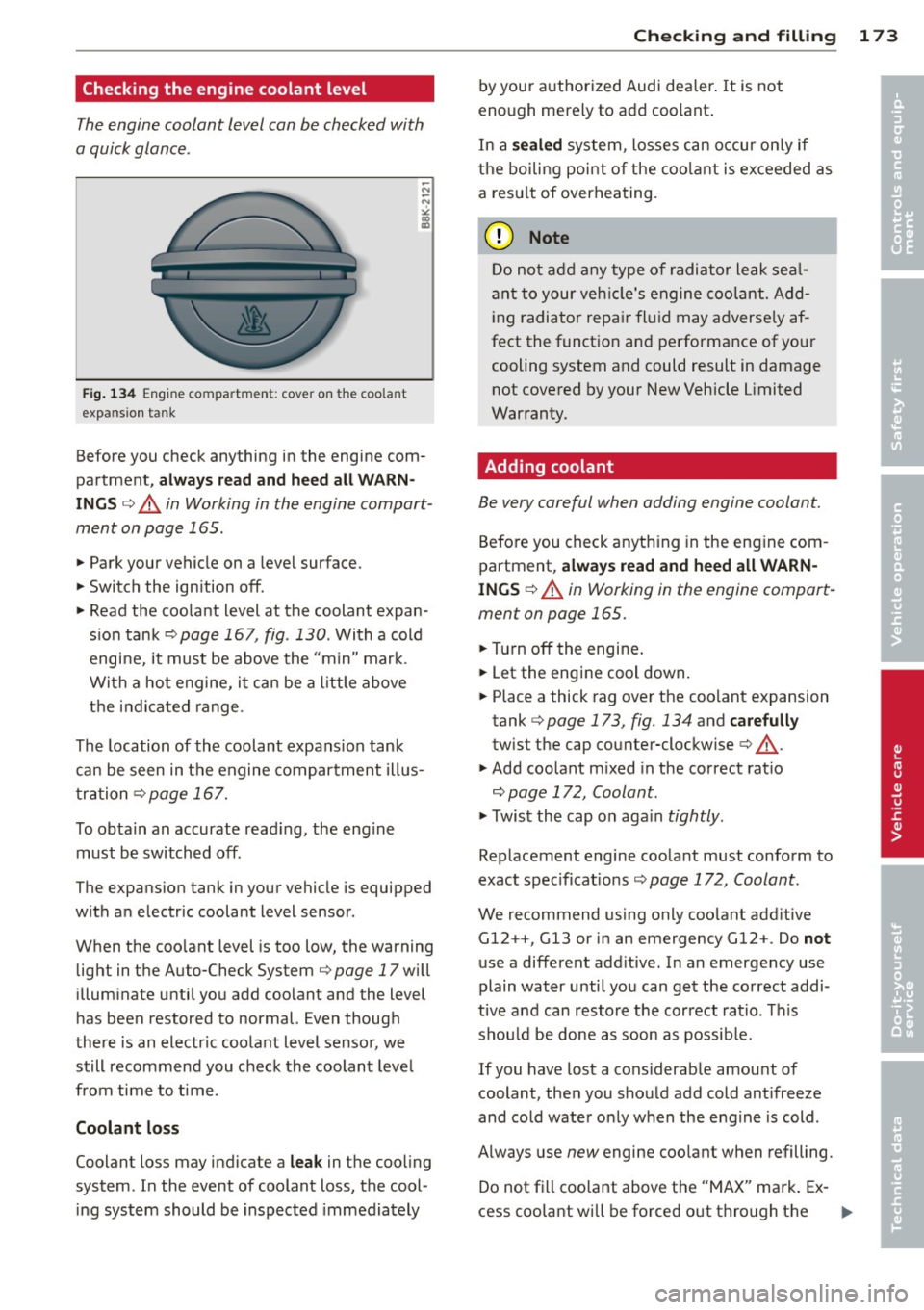
Checking the engine coolant level
The engine coolant level can be checked with
a quick glance .
Fig. 134 Eng ine compartme nt: cover o n the coolant
expansion tank
Before you check anything in the engine com
partment,
a lway s read and he ed all WARN
INGS ¢ A in Working in the engine compart
ment on page 165.
.,. Park your vehicle on a level surface.
.,. Switch the ignition
off .
.,. Read the coola nt level at the coolant expan
s ion tank
¢ page 167, fig . 130. With a cold
engine, it must be above the "min" mark.
With a hot engine, it can be a l ittle above
the indica ted range.
The location of the coolant expans ion tank
can be seen in the engine compar tment illus
tration
¢page 167.
To obtain an accurate read ing, the eng ine
must be switched
off.
The expans ion tank in your vehicle is equipped
with a n electric coolant level sensor.
When the coo lant level is too low, the warning
light in the Auto-Check System¢
page 17 will
illum inate until you add coolant and the level
has been restored to normal. Even though
there is an electric coolant level sensor, we
still recommend you check the coolant leve l
from time to time.
Coolant loss
Coolant loss may indicate a leak in the cool ing
system. In the event of coolant loss, the cool
i ng system should be inspected immediately
Checkin g and fillin g 173
by your authorized Audi dea ler . It is not
enough merely to add coo lant .
In a
s ealed system, losses can o ccu r on ly if
the boiling point o f the coo lant is exceeded as
a res ult of overheating.
(D Note
Do not ad d any type of radiator leak sea l
ant to your veh icle's engine coo lant. Add
ing radiator repa ir flui d may adverse ly af
fect the function and performance of yo ur
cooling system and could result in damage
not covered by your New Vehicle Limited
War ranty.
Adding coolant
Be very careful when adding engine coolant.
Before you check anyth ing in the engine com
partment,
alway s read and heed alt WARN
INGS ¢ A in Working in the engine compart
ment on page 165.
... Tu rn off the engine .
.,. Let the engine cool down.
.,. Place a thick rag ove r the coolant expansion
tank ¢
page 173, fig. 134 and carefully
twist the cap counter-clockwise ¢_& .
.,. Add coo lant m ixed in the correct rat io
¢ page 172, Coolant .
.,. Twist the cap on aga in tightly.
Rep lacement engine coo lant must conform to
exact specificat ions¢
page 172, Coolant.
We recommend using only coolant add itive
Gl2 ++, Gl3 or in an emergency Gl2+. Do not
use a different additive. In an emergency use
plain water until you can get the correct addi
tive and can resto re the correct ratio . Th is
shou ld be done as soon as possib le.
If you have lost a cons iderab le amount of
coolant, then you should add cold ant ifreeze
and co ld wate r on ly when the engine is cold.
Always use
new engine coolant when refilling.
Do not fill coolant above the "MAX" mark. Ex-
cess coolant will be fo rced o ut through the ..,_
•
•
Page 216 of 244
214 Fuses and bulbs
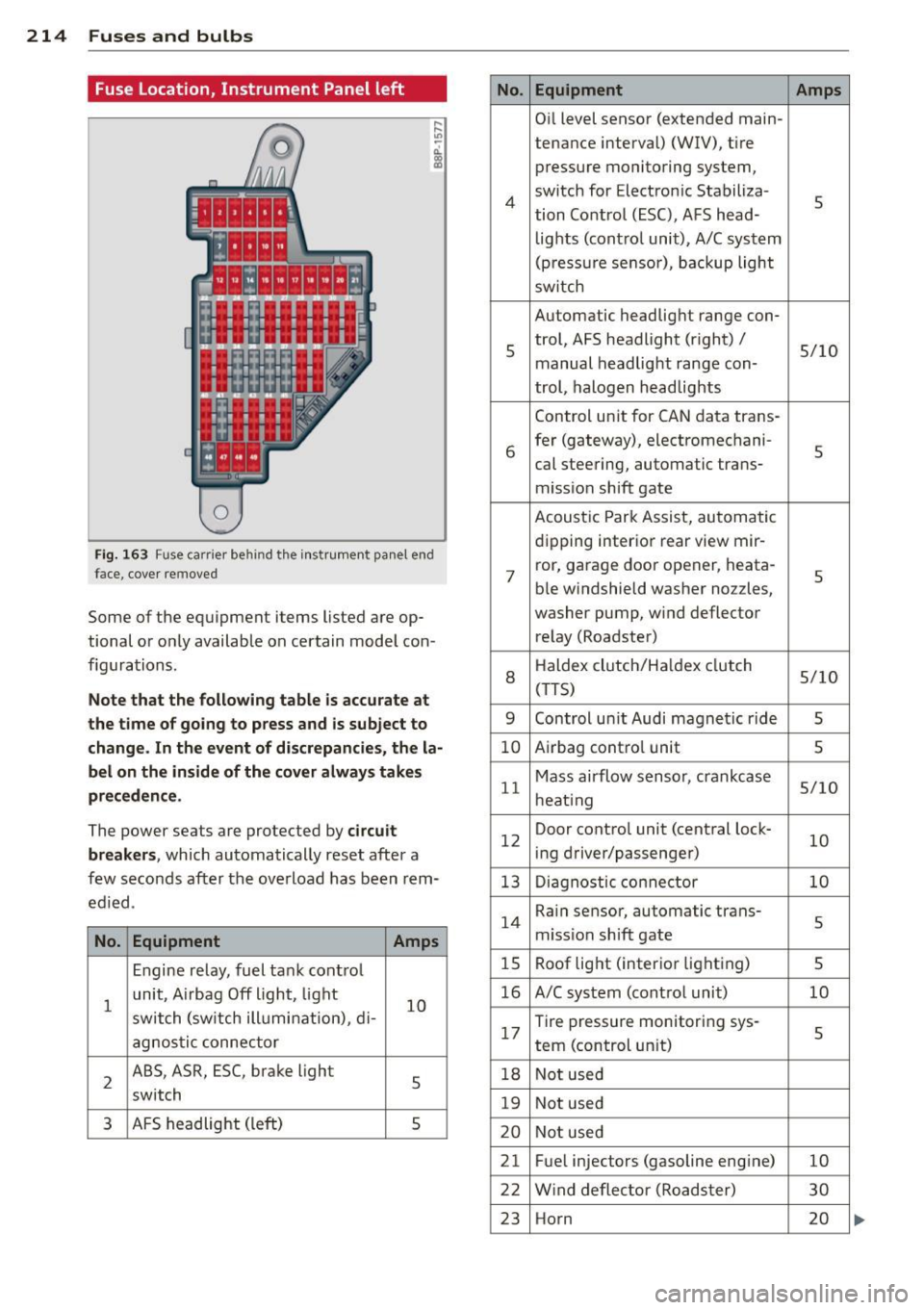
Fuse Location, Instrument Panel left
0
Fi g. 163 Fuse carrier behind the instrument panel end
face, cove r removed
Some of the equipment items listed are op
tional or only available on certain model con
figurations .
Note that the following table is accurate at
the time of going to press and is subject to
change. In the event of discrepancies, the la
bel on the inside of the cover always takes
preceden ce .
The power seats are protected by circuit
breaker s,
which automatically reset after a
few seconds after the overload has been rem
ed ied.
No . Equipment Amps
Engine relay, fuel tank control
1
unit, A irbag Off light, light
10 switch (sw itch illumination), d i-
agnos tic connector
2
ABS, ASR, ESC, brake light
5 switch
3 AFS headlight (left) s
No.
4
5
6
7
8
9
10
11
12
13
14
15
16
17
18
19
20
21
22
23
Equipment Amps
Oil level sensor (extended main-
tena nce interval) (WIV), tire
pressure monitoring system,
switch for Electronic Stabiliza-
s tion Control (ESC), AFS head-
lights (control unit), A/C system
(pressure sensor), backup light
sw itch
Automatic headlight range con-
trol, AFS headlight (right) /
5/10
manual headlight range con-
trol, halogen headlights
Control unit for CAN data trans-
fer (gateway), electromechani-
s cal steering, automatic trans-
mission shift gate
Acoustic Park Assist, automatic
dipping interior rear view mir- ror, garage door opener, heata-
s ble windshield washer nozzles,
washer pump, wind deflector
relay (Roadster)
H aldex clutch/Ha ldex clutch
5/10 (T TS)
Control un it Audi magnetic ride
s
Airbag contro l unit s
Mass airflow sensor, crankcase 5/10
heating
Door control unit (central lock-
10 ing driver/passenger)
Diagnostic connector
10
Rain sensor, automatic trans-
s miss ion shift gate
Roof light (interior lighting)
5
A/C system (control unit) 10
Tire pressure monitoring sys-
5 tern (control un it)
Not used
Not used
Not used
Fuel injectors (gasoline engine)
10
Wind deflector (Roadster) 30
Horn 20
Page 217 of 244
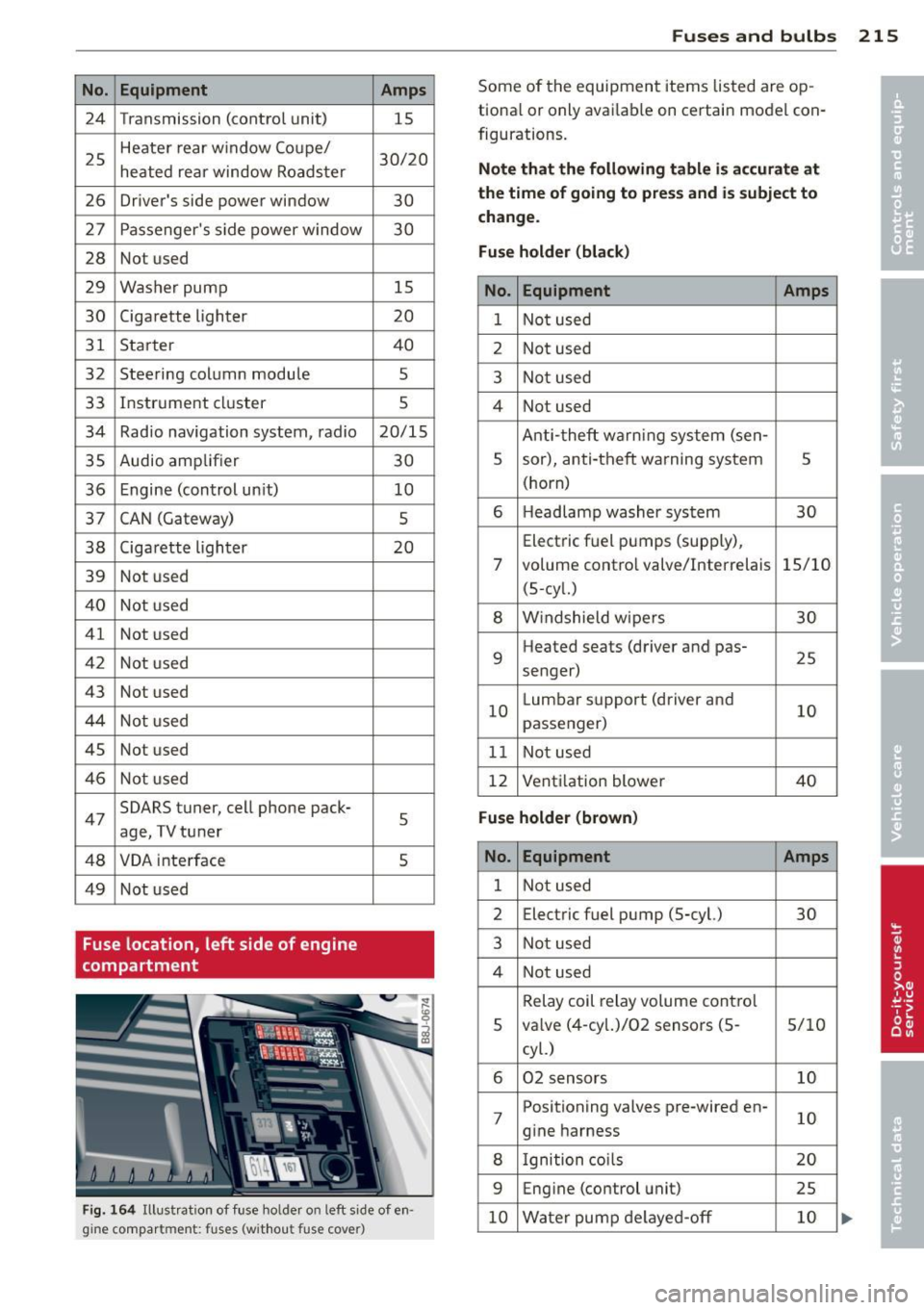
No. Equipment 24 Transmission (control unit)
25 Heater rear window Coupe/
heated rear window Roadster
26 Driver's side power window
27 Passenger's s ide power window
28 Not used
29 Washer pump
30 Cigarette lighter
31 Starter
32 Steering column module
33 Instrument cluster
34 Radio navigation system, radio
35 Audio amplifier
36 Engine (control un it)
37 CAN (Gateway)
38 Cigarette lighter
39 Not used
40 Not used
41 Not used
42 Not used
43 Not used
44 Not used
45 Not used
46 Not used
47 SOARS
tuner, cell phone pack-
age, TV tuner
48 VOA inte rface
49 Not used
Fuse location, left side of engine
compartment Amps
15
30/20
30
30
15
20
40
5
5
20/15
30 10
5
20
5
5
Fig. 164 Illustrat ion of fuse ho lder on left side of en
gine compart ment: fuses (without fuse cover)
Fuse s and bulb s 215
Some of the equipment items listed are op
tiona l or only avai lab le on certain model con
figurations.
Note th at the foll owing t abl e is ac cur ate at
the time of going t o pre ss and i s subject to
ch ang e.
Fus e holder (bla ck )
No. Equipment Amps
1 Not used
2 Not used
3 Not used
4 Not used
Anti-theft warning system (sen-
5 sor), anti-theft warning system
5
(horn)
6 H
eadlamp washer system
30
Electric f uel pumps (supp ly),
7 volume contro l valve/Interrelais 15/10
(5-cy l.)
8 W indshield w ipers 30
9 Heated
seats (driver and pas-
25
senger)
10 L
umbar support (driver and
10
passenger)
11 Not used
12 Vent
ilation blower
40
Fu se holder (brown )
No. Equipment Amps
1 Not used
2 Electric
fuel pump (5-cyl.)
30
3 Not used
4 Not used
Relay coil relay volume cont ro l
5 va
lve (4-cy l.)/02 sensors (5 -
5/10
cyl.)
6 02 sensors 10
7 Positioning valves pre-wired en-
10
g ine harness
8 Ignition coi ls 20
9 Eng
ine (control unit)
25
10 Water pump de layed-off 10
Page 224 of 244
222 Emergency situations
Lifting vehicle
Lifting with workshop hoist and with
floor jack
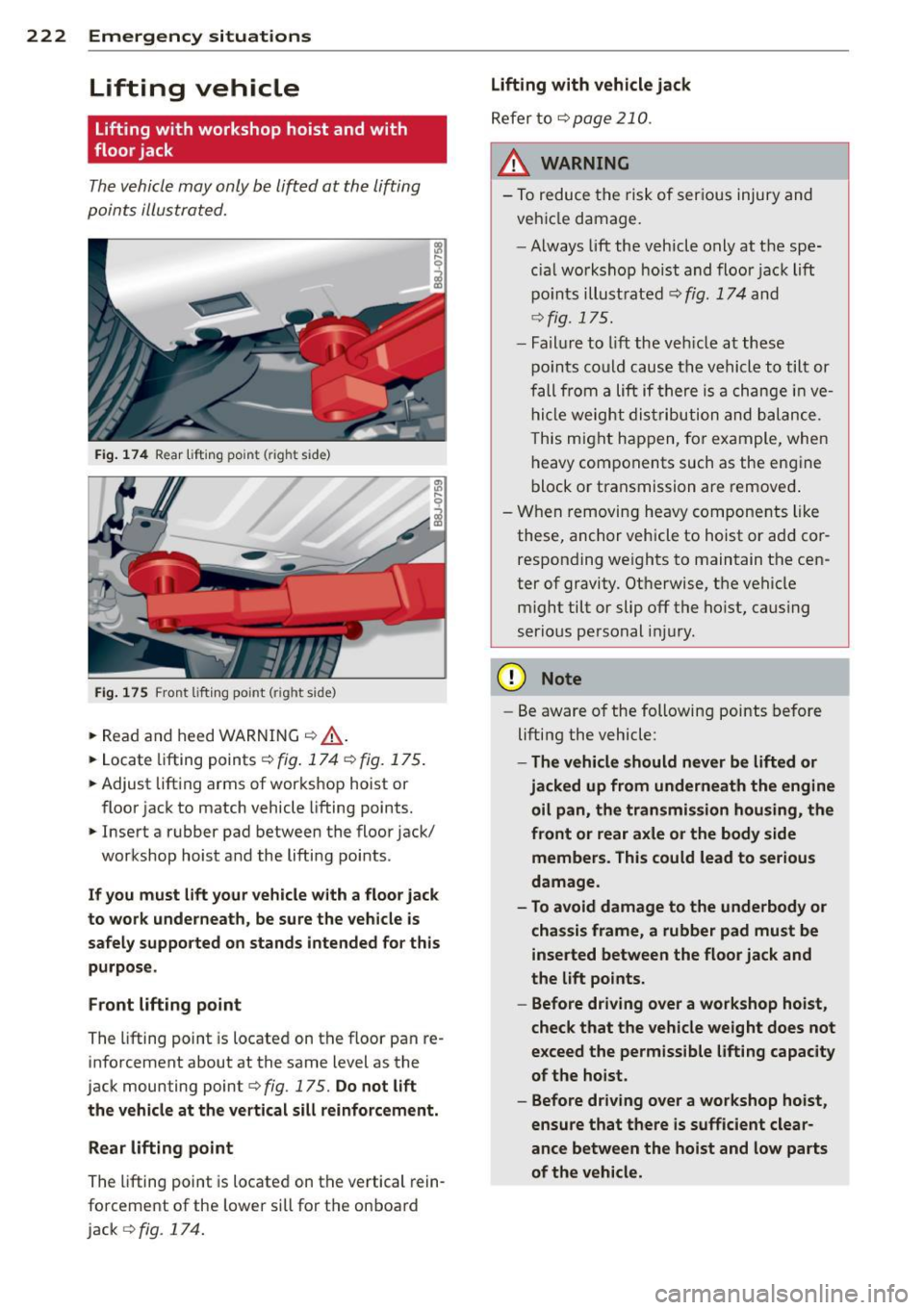
The vehicle may only be lif ted at the lifting
points illustra ted.
F ig. 174 Rear lift in g poin t (ri gh t side)
Fi g. 1 75 Fro nt lift in g po int (r ig ht s ide)
• Read and heed WARNI NG ¢,& .
• Locate lifting points
r=> fig . 174 r=> fig . 1 75 .
• Adjust lift ing arms of wor ks h op hoist or
floor jack to match vehicle lifting points.
• In se rt a rubber pad between the floor jack/
workshop hoist and the lifti ng po ints.
If you must lift your vehicle with a floor jack
to work underneath, be sure the vehicle is safely supported on stands intended for this
purpose.
Front lifting point
The lifting point is locate d on t he floor pan re
info rcement about at the same level as the
jac k mounting point
r=> fig. 175. Do not lift
the vehicle at the vertical sill reinforcement.
Rear lifting point
The lifting point is locate d on t he vertical rein
forceme nt of the lower s ill for t he on boa rd
j ac k
t:!>fig . 174.
Lifting with vehicle jack
Refer to r=>page 210.
/n.. WARNING
-To re duce the risk of ser ious injury and
ve hicl e damage .
- Always lift th e ve hicle o nly at t he spe
c ia l works hop hoist and floor jac k lift
p o ints illust rated
t:!> fig . 17 4 and
r=> fig. 175.
- Fa il u re to lift th e veh icle at th ese
p oi nts co ul d cau se the vehicle to tilt or
f a ll from a li ft if th ere is a ch an ge in ve
h icl e weig ht distr ib utio n an d ba lan ce.
T his mi ght happ en, for ex ample, when
h eavy com ponent s such as the engine
b lock o r tra nsmissi on are remove d.
- Wh en removin g heavy c ompone nts like
these , anch or vehicle to hoist or ad d co r
respon ding we ights to maintain t he cen
ter of gravity. Ot herwise , th e ve hicle
might tilt or slip off the ho ist, causing
serio us pe rsonal injury.
(D Note
-Be aware o f the followin g points bef ore
liftin g the vehicle:
- The vehicle should never be lifted or
jacked up from underneath the engine
oil pan, the transmission housing, the
front or rear axle or the body side members. This could lead to seriou s
damage.
- To avoid damage to the underbody or
chassis frame, a rubber pad must be inserted between the floor jack and
the lift points.
- Before driving over a workshop hoist,
check that the vehicle weight does not
exceed the permissible lifting capacity
of the hoist .
- Before driving over a workshop hoist,
ensure that there is sufficient clear
ance between the hoist and low parts
of the vehicle.
-
Page 227 of 244
Technical Dat a 225
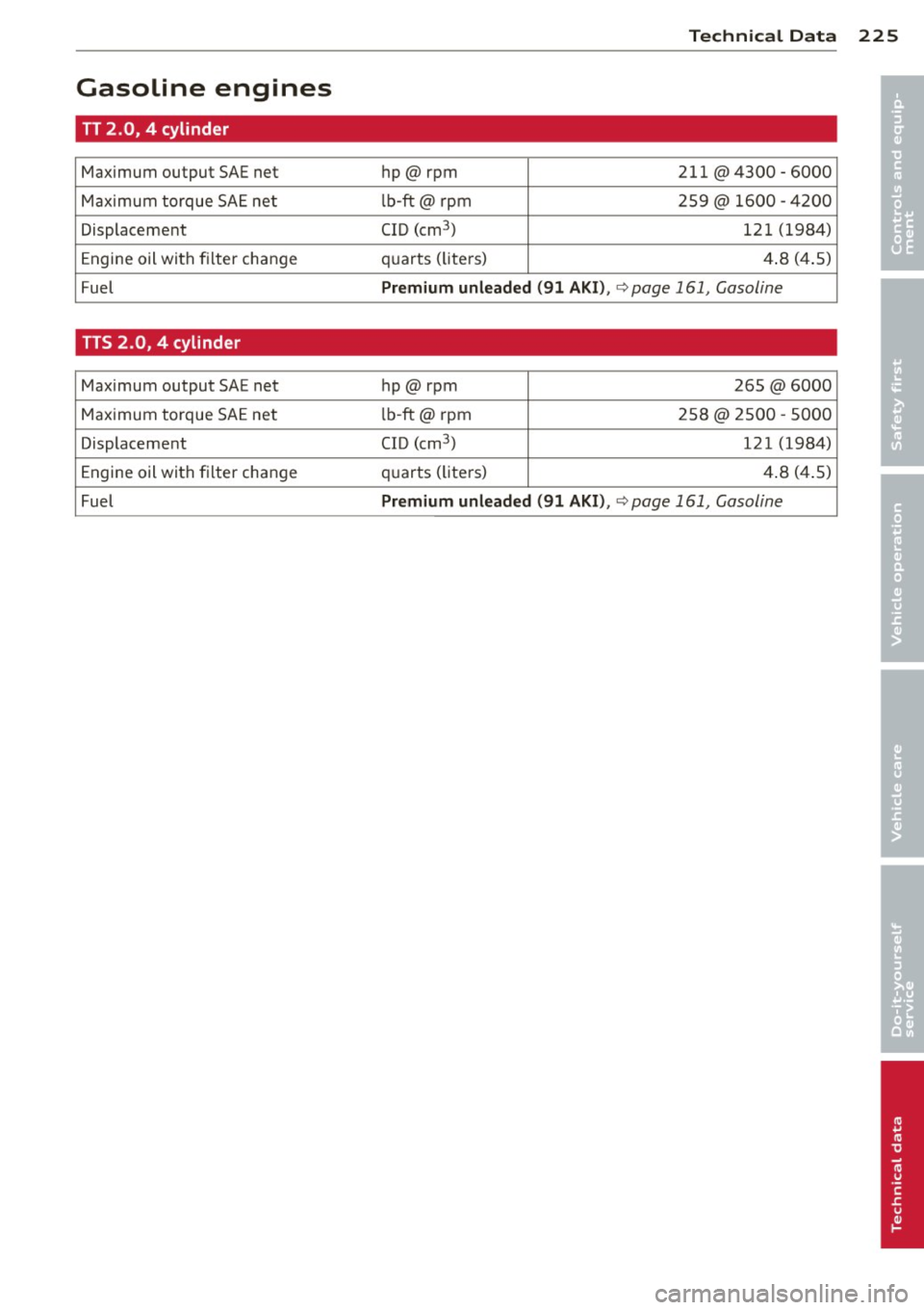
Gasoline engines
•
TT 2.0, 4 cylinder •
Maximum output SAE net hp@rpm 211 @4300 - 6000
Maximum torque SAE net lb-ft@ rpm 259@ 1600 - 4200
Displacement CID (cm
3
) 121 (1984)
Engine oil with f ilter change q
uarts (liters) 4.8 (4 .5)
Fuel
Prem ium unleaded (91 AKI) , ¢page 161, Gasoline
TTS 2.0, 4 cylinder
Maximum output SAE net hp@rpm 265 @6000
Maximum torque SAE net l
b -ft@ rpm 258@ 2500 -5000
Displacement CID (cm
3
) 121 (1984)
Engine oil with filter change q
uarts (li ters) 4.8 (4 .5)
Fuel
Premium unleaded (91 AKI) , ¢page 161, Gasoline
Page 228 of 244
226 Consumer Information
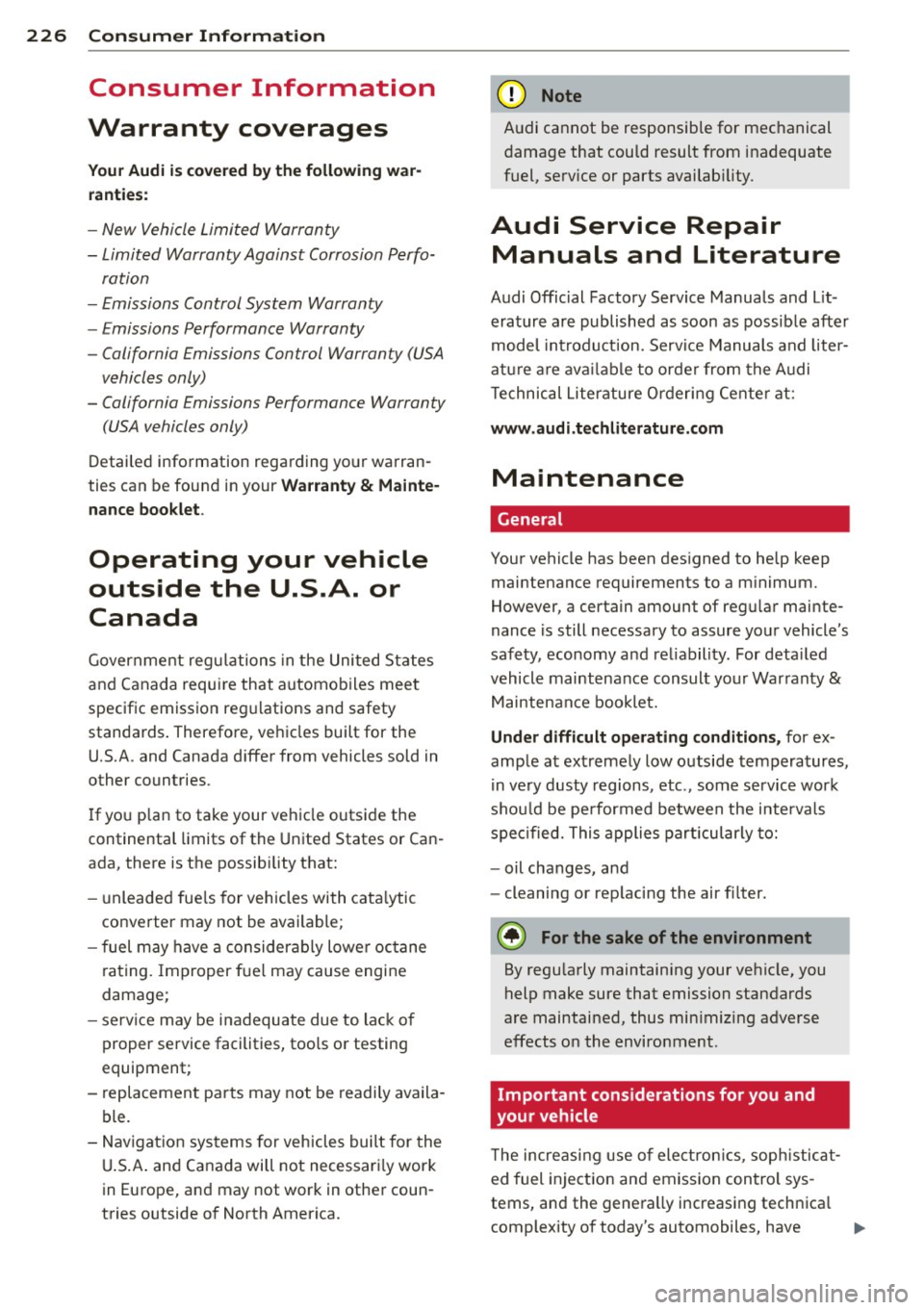
Consumer Information
Warranty coverages
You r Audi is covered by the following war
ranties:
- New Vehicle Limited Warranty
- Limited Warranty Against Corrosion Perfo-
ration
- Emissions Control System Warranty
- Emissions Performance Warranty
- California Emissions Control Warranty (USA
vehicles only)
- California Emissions Performance Warranty
(USA vehicles only)
Detailed information regarding your warran
ties can be found in your
Warranty & Mainte
nance booklet .
Operating your vehicle
outside the U.S.A. or
Canada
Government regu lations in the United States
and Canada require that automobiles meet
specific emission regulations and safety
standards. Therefore, veh icles built for the
U.S.A . and Canada differ from vehicles sold in
other countries .
If you p lan to take your vehicle outside the
continental limits of the United States or Can
ada, there is the possibility that:
- unleaded fuels for vehicles with cata lytic
converter may not be available;
- fuel may have a considerably lowe r octane
rating. Improper fuel may cause engine
damage ;
- service may be inadequate due to lack of
proper service facilities, tools or testing
equipment ;
- replacement pa rts may not be readily availa
ble.
- Navigation systems for vehicles built for the
U.S.A. and Canada will not necessar ily work
in Europe, and may not work in other coun
tries outside of North America.
(D Note
Audi cannot be responsible for mechanical
damage that could result from inadequate
fuel, service or parts availability.
Audi Service Repair Manuals and Literature
Audi Official Factory Service Manuals and Lit
erature are published as soon as possible after
model introduction. Service Manuals and liter
ature are available to order from the Audi
T echnical Literature Ordering Center at:
www.audi.techliterature.com
Maintenance
General
Your vehicle has been designed to help keep
maintenance requirements to a minimum.
However, a certain amount of regular mainte
nance is still necessary to assure your vehicle's
s afety, economy and rel iability. For detailed
vehicle maintenance consult your Warranty &
Maintenance booklet.
Under difficult operating conditions, for ex
ample at extremely low outside temperatures,
i n very dusty regions , etc., some service work
should be performed between the intervals
specified. This applies particularly to:
- oil changes, and
- cleaning or replacing the air filter.
@ For the sake of the environment
By regu larly maintaining your vehicle, you
help make sure that emission standards
are maintained, thus minimizing adverse
effects on the environment .
' Important considerations for you and
your vehicle
T he increasing use of electron ics , soph isticat
ed fuel injection and emission control sys
tems, and the generally increasing technica l
complexity of today's automobiles, have
liJJ,