weight AUDI TT ROADSTER 2016 User Guide
[x] Cancel search | Manufacturer: AUDI, Model Year: 2016, Model line: TT ROADSTER, Model: AUDI TT ROADSTER 2016Pages: 306, PDF Size: 31.82 MB
Page 228 of 306
Downloaded from www.Manualslib.com manuals search engine Safe
driving
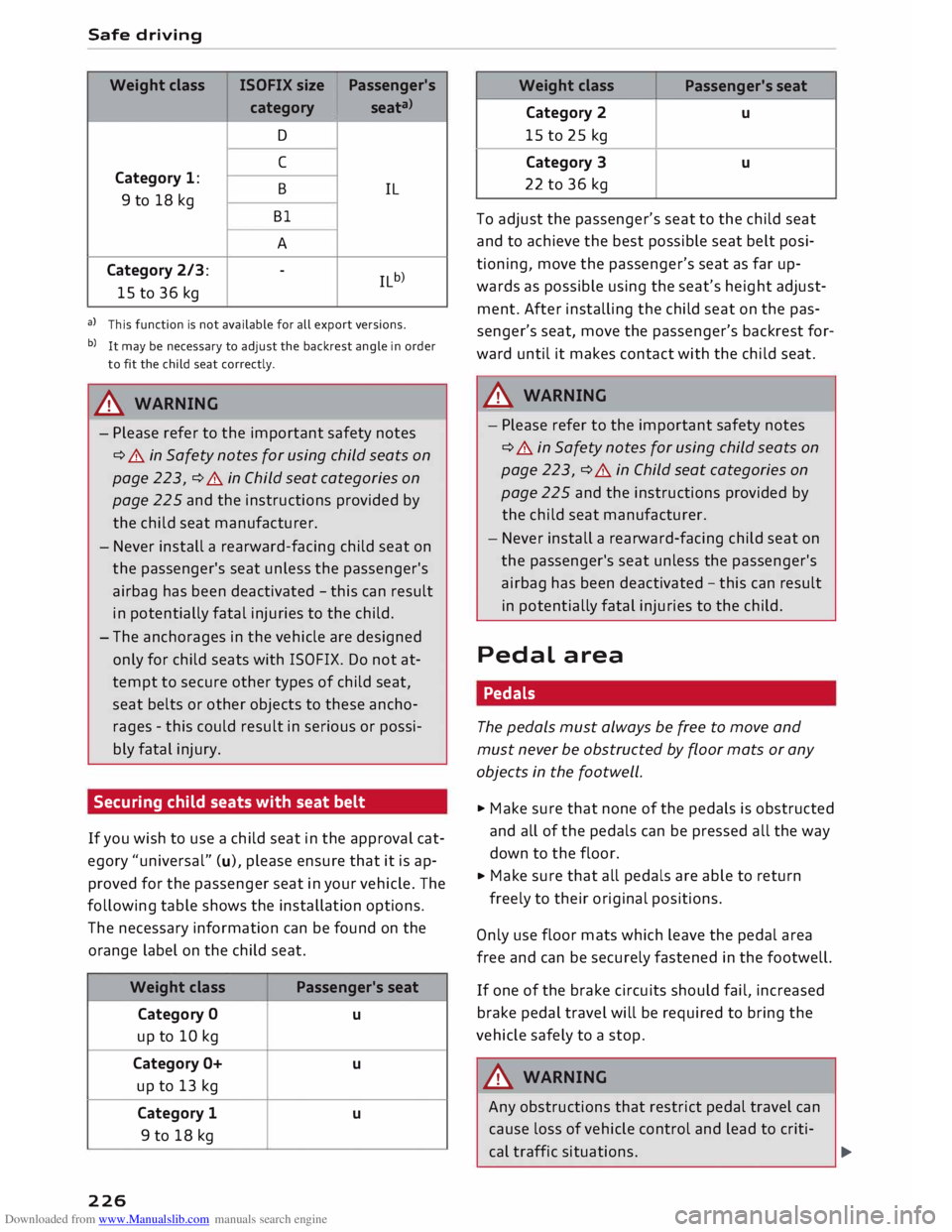
Weight class ISOFIX size Passenger's
category seata
>
D C
Category 1:
B IL
9 to 18 kg
Bl
A
Category 2/3: -
15 to 36 kg IL
b)
al This function is not available for all export versions.
bl It may be necessary to adjust the backrest angle in order
to fit the child seat correctly.
A WARNING
- Please refer to the important safety notes
¢ A in Safety notes for using child seats on
page 223, � A in Child seat categories on
page 225 and the instructions provided by
the child seat manufacturer.
- Never install a rearward-facing child seat on
the passenger's seat unless the passenger's
airbag has been deactivated -this can result
in potentially fatal injuries to the child.
- The anchorages in the vehicle are designed
only for child seats with ISO FIX. Do not at
tempt to secure other types of child seat,
seat belts or other objects to these ancho
rages -this could result in serious or possi
bly fatal injury.
Securing child seats with seat belt
If you wish to use a child seat in the approval cat
egory "universal" (u), please ensure that it is ap
proved for the passenger seat in your vehicle. The
following table shows the installation options.
The necessary information can be found on the
orange label on the child seat.
Weight class
Passenger's seat
Category 0
u
up to 10 kg
Category O+ u
up to 13 kg
Category 1
u
9 to 18 kg
226 Weight
class
Passenger's seat
Category 2
u
15 to 25 kg
Category 3
u
22 to 36 kg
To adjust the passenger's seat to the child seat
and to achieve the best possible seat belt posi
tioning, move the passenger's seat as far up
wards as possible using the seat's height adjust
ment. After installing the child seat on the pas
senger's seat, move the passenger's backrest for
ward until it makes contact with the child seat.
A WARNING
- Please refer to the important safety notes
¢ A in Safety notes for using child seats on
page 223, ¢ A in Child seat categories on
page 225 and the instructions provided by
the child seat manufacturer.
- Never install a rearward-facing child seat on
the passenger's seat unless the passenger's
airbag has been deactivated -this can result
in potentially fatal injuries to the child.
Pedal area
Pedals
The pedals must always be free to move and
must never be obstructed by floor mats or any
objects in the footwell.
.,. Make sure that none of the pedals is obstructed
and all of the pedals can be pressed all the way
down to the floor.
... Make sure that all pedals are able to return
freely to their original positions.
Only use floor mats which leave the pedal area
free and can be securely fastened in the footwell.
If one of the brake circuits should fail, increased
brake pedal travel will be required to bring the
vehicle safely to a stop.
A WARNING
Any obstructions that restrict pedal travel can
cause loss of vehicle control and lead to criti-
cal traffic situations.
�
Page 229 of 306
Downloaded from www.Manualslib.com manuals search engine 0
N
,.....
N
......
0
,.....
Vl
CX) -
Never place objects in the driver's footwell.
Such objects could move under the pedals
and interfere with their proper function. In
the event of sudden braking or a change of
direction, you would not be able to use the
pedals. This could result in a loss of control
and possibly cause an accident.
Floor mats on the driver's side
Use only floor mats which can be securely fas
tened in the footwell and do not obstruct the
pedals.
... Make sure that floor mats are securely fastened
and cannot interfere with the pedals ¢,&. .
Use only floor mats that leave the pedal area un
obstructed and are firmly secured to prevent
them from slipping. You can obtain suitable floor
mats from your dealer or a specialist retailer.
A WARNING
Any obstructions that restrict pedal travel can
cause loss of vehicle control and increase the
risk of serious personal injury.
- Always make sure that floor mats are prop
erly secured.
- Never lay or install additional floor mats or
other floor coverings over the existing floor
mats; this would restrict the pedal area and
possibly obstruct the pedals, which could
cause an accident.
Stowing luggage safely
Luggage compartment
All luggage and other objects must be safely se
cured in the luggage compartment. To maintain
safe handling on the road, please observe the fol
lowing points:
.,.. Distribute the load evenly in the luggage com
partment.
.,.. Place heavy items as far forward as possible in
the Luggage compartment and secure them
properly. Safe
driving
... Secure the load with the luggage net* or with
non-elastic straps secured to the fastening
rings* ¢ page 228.
A WARNING
- Loose items in the luggage compartment
are a safety hazard: they can move suddenly
and impair the handling of the vehicle as a
result of the change in weight distribution.
- In an accident or a sudden manoeuvre, loose
objects in the passenger compartment can
be flung forward -risk of injury! Always
stow objects safely in the luggage compart
ment and secure them on the fastening
rings*. Use suitable securing straps, particu
larly when transporting heavy objects.
- Always stow objects in the luggage com
partment.
- Transporting heavy objects may affect the
vehicle's handling by shifting the centre of
gravity -this could cause an accident. Take
extra care when driving and adjust your
speed accordingly.
- Never exceed the maximum axle loads or
the maximum gross weight for the vehicle
¢ page 287. Exceeding the permitted axle
loads or gross weight limit can affect the ve
hicle's handling characteristics, and increase
the risk of accidents, personal injuries or
damage to the vehicle.
- Never leave your vehicle unattended when
the boot lid is open. Children could climb in
to the boot and close the boot lid from the
inside. In this case the child would be un
able to get out of the
vehicle
without help.
This could have fatal consequences.
- Never allow children to play in or around the
vehicle. Always close and lock the boot lid
and all the doors when you leave the vehi
cle.
- Never let passengers ride in the luggage
compartment. All occupants must be prop
erly restrained by the seat belts at all times
¢page 230. .,._
227
Page 230 of 306
Downloaded from www.Manualslib.com manuals search engine Safe
driving
� Note
- The tyre pressure must be adjusted accord
ing to the Load the vehicle is carrying
¢page 256.
-Air circulation in the vehicle helps reduce
fogging of the windows. Used air escapes
through ventilation slots in the rear of the
vehicle. Make sure that these ventilation
slots are not obstructed.
- Suitable belts for securing Loads to the fas
tening rings* are commercially available.
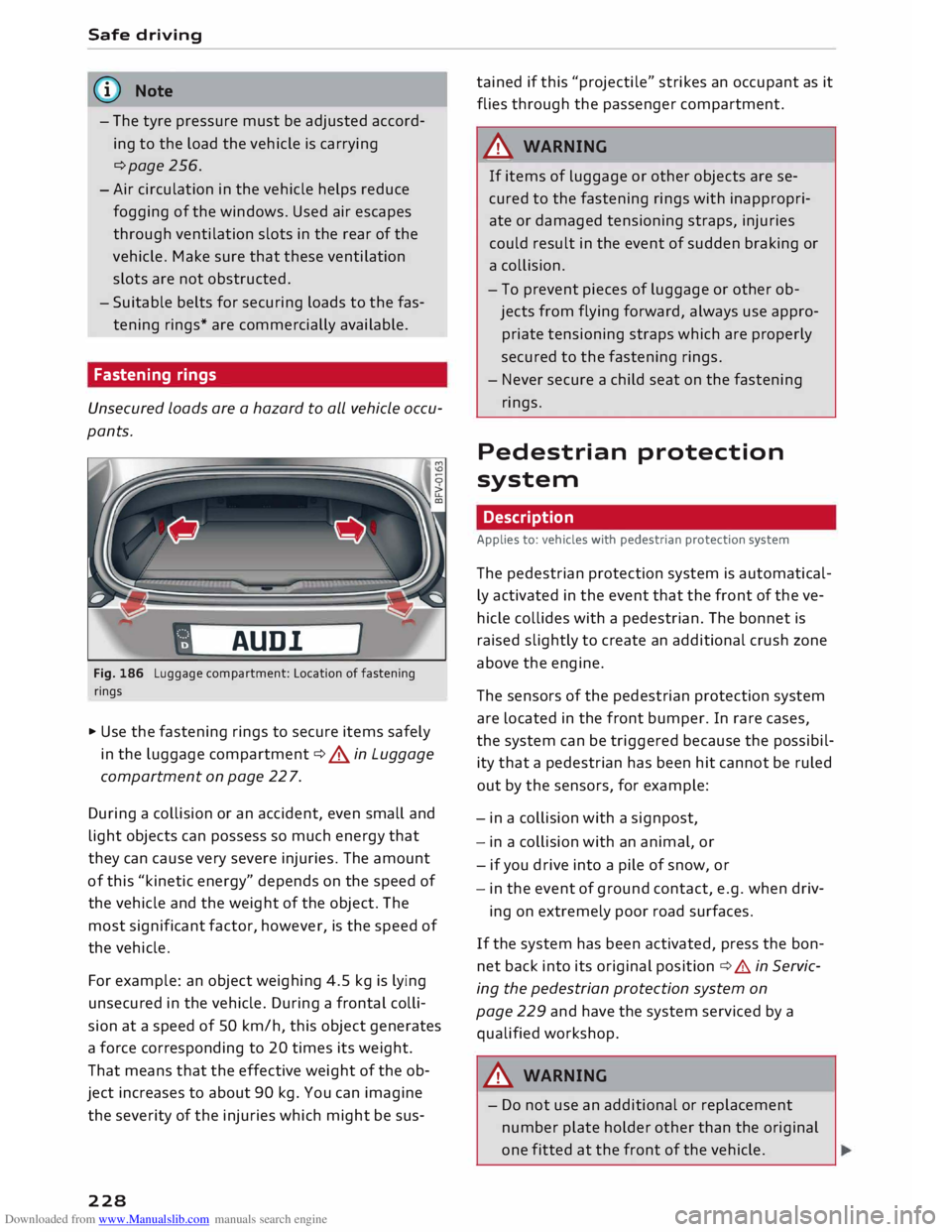
Fastening rings
Unsecured Loads are a hazard to all vehicle occu
pants.
AUDI
Fig. 186 Luggage compartment: Location of fastening
rings
� Use the fastening rings to secure items safely
in the Luggage compartment ¢.&. in Luggage
compartment on page 22 7.
During a collision or an accident, even small and
Light objects can possess so much energy that
they can cause very severe injuries. The amount
of this "kinetic energy" depends on the speed of
the vehicle and the weight of the object. The
most significant factor, however, is the speed of
the vehicle.
For example: an object weighing 4.5 kg is Lying
unsecured in the vehicle. During a frontal colli
sion at a speed of 50 km/h, this object generates
a force corresponding to 20 times its weight.
That means that the effective weight of the ob
ject increases to about 90 kg. You can imagine
the severity of the injuries which might be sus-
228 tained
if this "projectile" strikes an occupant as it
flies through the passenger compartment.
A WARNING
If items of Luggage or other objects are se
cured to the fastening rings with inappropri
ate or damaged tensioning straps, injuries
could result in the event of sudden braking or
a collision.
- To prevent pieces of Luggage or other ob
jects from flying forward, always use appro
priate tensioning straps which are properly
secured to the fastening rings.
- Never secure a child seat on the fastening
rings.
Pedestrian protection
system
Description
Applies to: vehicles with pedestrian protection system
The pedestrian protection system is automatical
ly activated in the event that the front of the ve
hicle collides with a pedestrian. The bonnet is
raised slightly to create an additional crush zone
above the engine.
The sensors of the pedestrian protection system
are Located in the front bumper. In rare cases,
the system can be triggered because the possibil
ity that a pedestrian has been hit cannot be ruled
out by the sensors, for example:
- in a collision with a signpost,
- in a collision with an animal, or
- if you drive into a pile of snow, or
- in the event of ground contact, e.g. when driv-
ing on extremely poor road surfaces.
If the system has been activated, press the bon
net back into its original position ¢.&. in Servic
ing the pedestrian protection system on
page 229 and have the system serviced by a
qualified workshop.
A WARNING
- Do not use an additional or replacement
number plate holder other than the original
one fitted at the front of the vehicle.
Page 232 of 306
Downloaded from www.Manualslib.com manuals search engine Seat
belts
Seat belts
Why is it so important to
use seat belts?
Seat belts provide effective protection
The common belief that passengers can brace
their weight with their hands in a minor collision
is false.
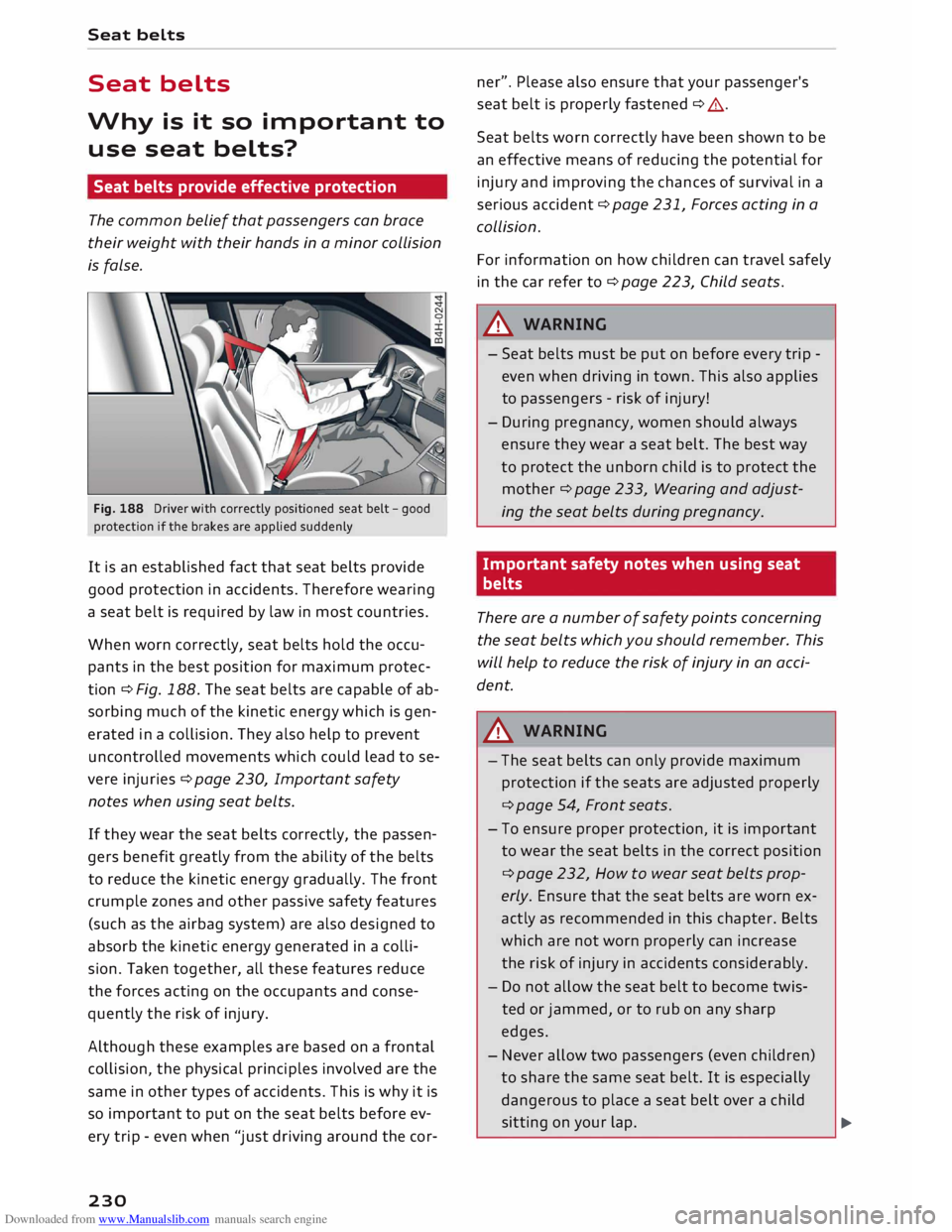
Fig. 188 Driver with correctly positioned seat belt -good
protection if the brakes are applied suddenly
It is an established fact that seat belts provide
good protection in accidents. Therefore wearing
a seat belt is required by law in most countries.
When worn correctly, seat belts hold the occu
pants in the best position for maximum protec
tion ¢ Fig. 188. The seat belts are capable of ab
sorbing much of the kinetic energy which is gen
erated in a collision. They also help to prevent
uncontrolled movements which could lead to se
vere injuries ¢ page 230, Important safety
notes when using seat belts.
If they wear the seat belts correctly, the passen
gers benefit greatly from the ability of the belts
to reduce the kinetic energy gradually. The front
crumple zones and other passive safety features
(such as the airbag system) are also designed to
absorb the kinetic energy generated in a colli
sion. Taken together, all these features reduce
the forces acting on the occupants and conse
quently the risk of injury.
Although these examples are based on a frontal
collision, the physical principles involved are the
same in other types of accidents. This is why it is
so important to put on the seat belts before ev
ery trip -even when "just driving around the cor-
230 ner".
Please also ensure that your passenger's
seat belt is properly fastened ¢ A.
Seat belts worn correctly have been shown to be
an effective means of reducing the potential for
injury and improving the chances of survival in a
serious accident ¢ page 231, Forces acting in a
collision.
For information on how children can travel safely
in the car refer to¢ page 223, Child seats.
_& WARNING
- Seat belts must be put on before every trip -
even when driving in town. This also applies
to passengers -risk of injury!
- During pregnancy, women should always
ensure they wear a seat belt. The best way
to protect the unborn child is to protect the
mother ¢ page 233, Wearing and adjust
ing the seat belts during pregnancy.
Important safety notes when using seat
belts
There are a number of safety points concerning
the seat belts which you should remember. This
will help to reduce the risk of injury in an acci
dent.
_& WARNING
- The seat belts can only provide maximum
protection if the seats are adjusted properly
¢ page 54, Front seats.
- To ensure proper protection, it is important
to wear the seat belts in the correct position
¢ page 232, How to wear seat belts prop
erly. Ensure that the seat belts are worn ex
actly as recommended in this chapter. Belts
which are not worn properly can increase
the risk of injury in accidents considerably.
- Do not allow the seat belt to become twis
ted or jammed, or to rub on any sharp
edges.
- Never allow two passengers (even children)
to share the same seat belt. It is especially
dangerous to place a seat belt over a child
sitting on your lap.
..,.
Page 233 of 306
Downloaded from www.Manualslib.com manuals search engine 0
N
,.....
N
......
0
,.....
Vl
CX) -
Do not wear the belt over hard or fragile ob
jects (such as glasses or pens, etc.) because
this can cause injuries.
- Loose, bulky clothing (such as an overcoat
over a jacket) impairs the proper fit and
function of the belts.
- The belts must be kept clean, otherwise the
retractors may not work properly
¢ tab. Cleaning the interior on page 265.
- The slot in the seat belt buckle must not be
blocked with paper or other objects, as this
can prevent the latch plate from engaging
properly.
- The latch plate of the belt must always be
engaged in the correct buckle for that seat,
otherwise the belt will not be fully effective.
- Check the condition of the seat belts at reg
ular intervals. If you notice that the belt
webbing, fittings, retractor mechanism or
buckle of any of the belts is damaged, the
belt must be replaced by a qualified work
shop.
- The seat belts must not be removed or
modified in any way. Do not attempt to re
pair a damaged belt yourself.
- Seat belts which have been worn in an acci
dent and stretched must be replaced by a
qualified workshop. The belt anchorages
should also be checked. Forces
acting in a
collision Seat
belts
The physical principles involved in a frontal
impact
Very large forces are generated during a colli
sion; these forces have to be absorbed.
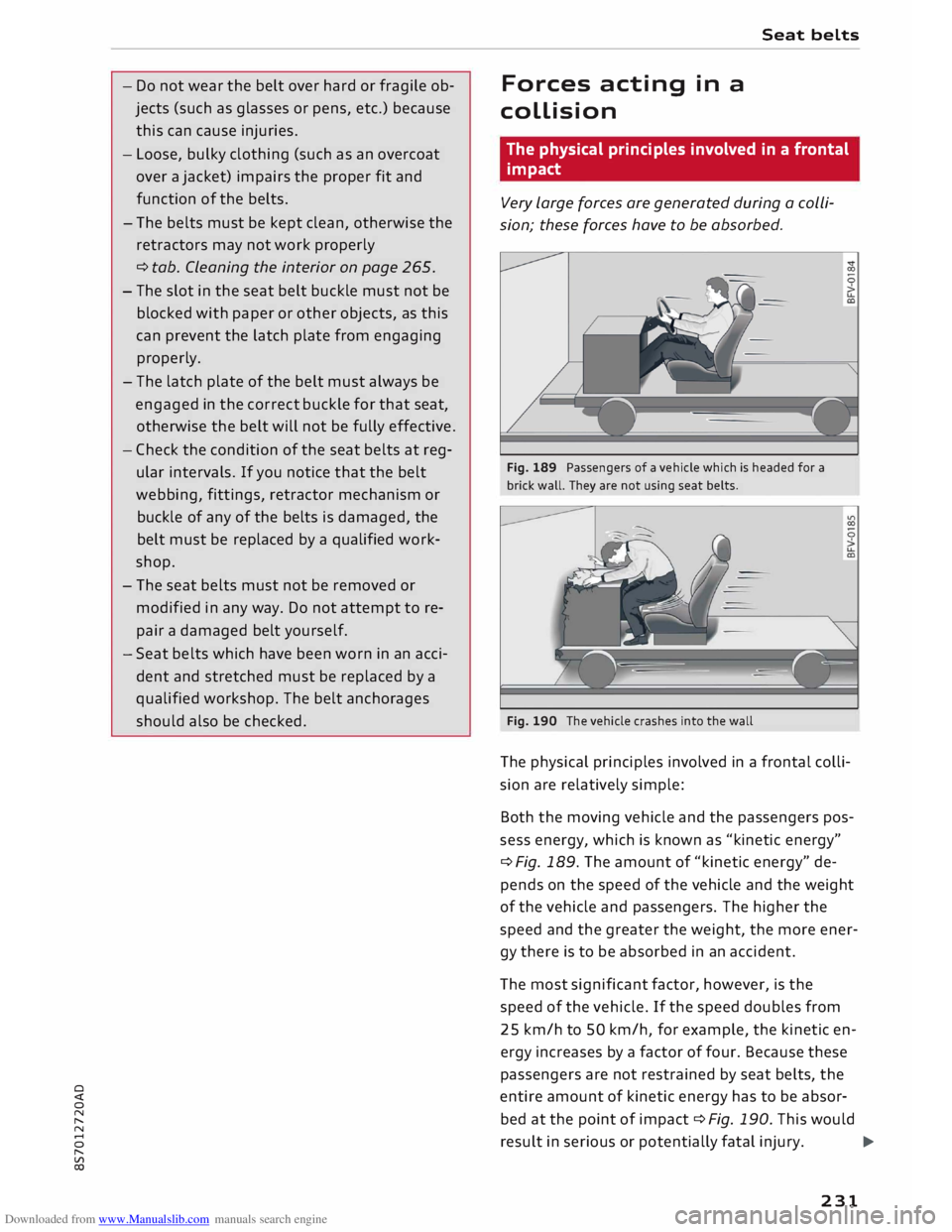
Fig. 189 Passengers of a vehicle which is headed for a
brick wall. They are not using seat belts.
Fig. 190 The vehicle crashes into the wall
The physical principles involved in a frontal colli
sion are relatively simple:
Both the moving vehicle and the passengers pos
sess energy, which is known as "kinetic energy"
¢ Fig. 189. The amount of "kinetic energy" de
pends on the speed of the vehicle and the weight
of the vehicle and passengers. The higher the
speed and the greater the weight, the more ener
gy there is to be absorbed in an accident.
The most significant factor, however, is the
speed of the vehicle. If the speed doubles from
25 km/h to 50 km/h, for example, the kinetic en
ergy increases by a factor of four. Because these
passengers are not restrained by seat belts, the
entire amount of kinetic energy has to be absor
bed at the point of impact ¢ Fig. 190. This would
result in serious or potentially fatal injury.
..,.
231
Page 234 of 306
Downloaded from www.Manualslib.com manuals search engine Seat
belts
Even at urban speeds of 30 km/h to 50 km/h, the
forces acting on the occupants in a collision can
reach the equivalent of 1 ton (1,000 kg) or more.
At greater speed these forces are even higher.
Again: if the speed doubles, the forces increase
by a factor of four.
Passengers who do not wear seat belts are not
"attached" to the vehicle. In a frontal collision
they will continue to move forward at the speed
their car was travelling just before the impact.
What happens to passengers not wearing
seat belts?
Passengers not wearing seat belts risk fatal inju
ries in the event of an accident.
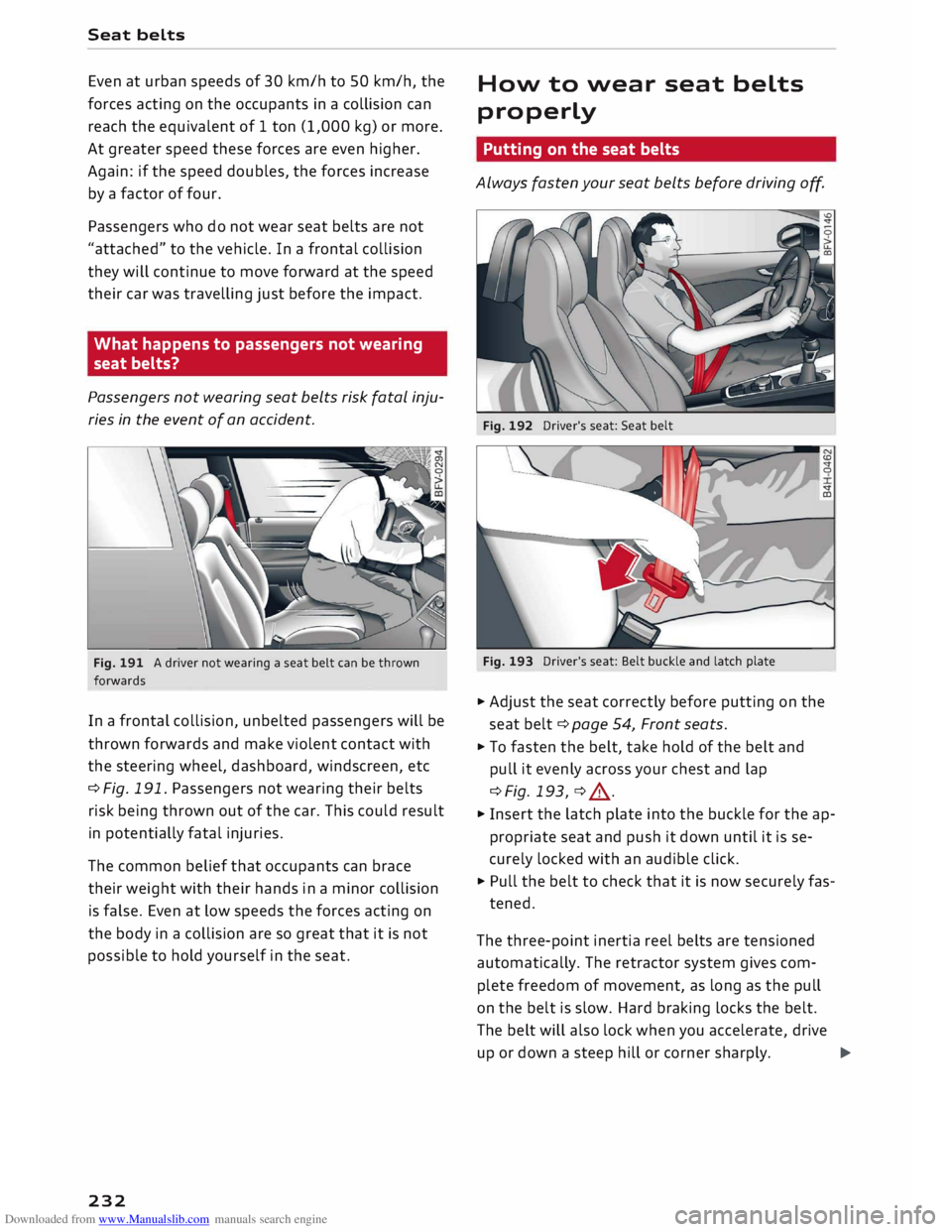
Fig. 191 A driver not wearing a seat belt can be thrown
forwards
In a frontal collision, unbelted passengers will be
thrown forwards and make violent contact with
the steering wheel, dashboard, windscreen, etc
¢ Fig. 191. Passengers not wearing their belts
risk being thrown out of the car. This could result
in potentially fatal injuries.
The common belief that occupants can brace
their weight with their hands in a minor collision
is false. Even at Low speeds the forces acting on
the body in a collision are so great that it is not
possible to hold yourself in the seat.
232 How
to wear seat belts
properly
Putting on the seat belts
Always fasten your seat belts before driving o
ff.
Fig. 192 Driver's seat: Seat belt
Fig. 193 Driver's seat: Belt buckle and latch plate
0
<:t
co
.. Adjust the seat correctly before putting on the
seat belt¢ page 54, Front seats.
.. To fasten the belt, take hold of the belt and
pull it evenly across your chest and lap
¢Fig. 193, ¢ ,A .
.. Insert the latch plate into the buckle for the ap
propriate seat and push it down until it is se
curely locked with an audible click.
.. Pull the belt to check that it is now securely fas-
tened.
The three-point inertia reel belts are tensioned
automatically. The retractor system gives com
plete freedom of movement, as long as the pull
on the belt is slow. Hard braking Locks the belt.
The belt will also lock when you accelerate, drive
up or down a steep hill or corner sharply.
..,.
Page 262 of 306
Downloaded from www.Manualslib.com manuals search engine Wheels
Tyre pressure
monitoring system
General notes
Applies to: vehicles with tyre pressure monitoring system
The tyre pressure monitoring system keeps a
check on the tyre pressures of the four road
wheels while you are driving.
The system uses sensors to measure tempera
tures and pressures in the tyres. The sensors
transmit the data to the control unit by radio.
The tyre pressure monitoring system displays the
current pressures and temperatures of the tyres
on the infotainment system while the vehicle is
moving ¢ page 260. In addition, it compares the
current tyre pressures with the stored tyre pres
sures and warns you if it detects a discrepancy
¢page 261.
The system cannot check if the stored tyre pres
sures correspond to the recommended tyre pres
sures for your vehicle. You must store the new
tyre pressures ¢ page 261:
- after every adjustment to the tyre pressures,
e.g. after changing the laden weight of your ve
hicle,
- after changing a wheel, or
- when using wheels with new wheel sensors.
.&_ WARNING
- The tyre pressure monitoring system helps
the driver to monitor the tyre pressures.
However, it is always the driver's responsi
bility to ensure that the tyres are at the cor
rect pressure.
- Never re-adjust the tyre inflation pressure
when the tyre is hot. This can cause serious
damage to the tyre or even a blow-out,
which could result in an accident.
- Under-inflated tyres flex more than they
should. This causes them to overheat. This
can cause tread separation and tyre blow
out, which could result in an accident.
- The tyre pressure monitoring system cannot
warn you of tyre damage or defects that
could lead, for example, to a tyre blow-out.
Perform a regular visual check of your tyres.
260 (I))
Note
- The sensors and valves do not have to be de
tached or changed round when fitting new
tyres. Only the valve core needs to be re
placed, and if necessary the valve and the
electronic components in the wheel. Please
contact a qualified workshop if you have any
questions.
-After using the tyre repair kit, the tyre pres
sure monitoring system may malfunction.
Have the sensors renewed by a qualified
workshop.
Displaying tyre pressures and temperatures
Applies to: vehicles with tyre pressure monitoring system
Important: The vehicle must be moving.
.. Select the following on the infotainment sys
tem: !MENU! button> Servicing & checks >
Tyre pressure loss indicator > Display tyre
pressures.
The current tyre pressures are displayed in green,
yellow or red on the infotainment system:
- Green: The tyre pressure is roughly the same as
the reference value.
- Yellow: The tyre pressure is too low compared
with the reference value.
- Red: The tyre pressure is much too low com-
pared with the reference value.
The reference value is the last stored tyre pres
sure value ¢ page 261.
Bear in mind that the tyre inflation pressure is al
so influenced by the temperature of the tyre. The
tyre heats up while the vehicle is being driven
and the tyre pressure will rise accordingly.
.&_ WARNING
Please observe the important safety informa-
tion and notes ¢ page 260.
�
Page 290 of 306
Downloaded from www.Manualslib.com manuals search engine Technical
data
� Note
In cases where technical data are not listed,
the figures were not available at time of pub
lication.
Dimensions
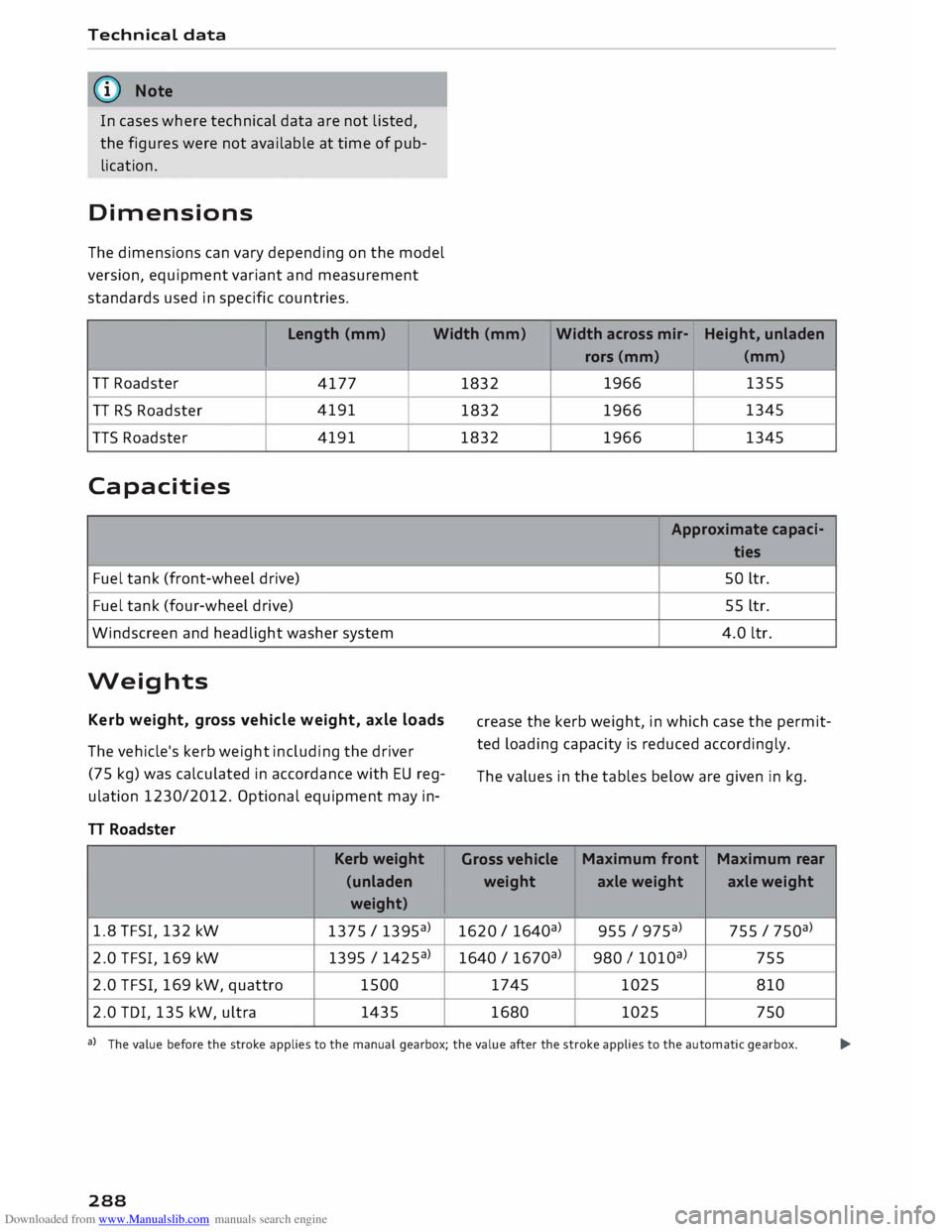
The dimensions can vary depending on the model
version, equipment variant and measurement
standards used in specific countries.
Length (mm)
Width (mm) Width
across mir-Height,
unladen
TT Roadster
4177
TT RS Roadster 4191
TTS Roadster
4191
Capacities
Fuel tank (front-wheel drive)
Fuel tank (four-wheel drive)
Windscreen and headlight washer system
Weights Kerb weight, gross vehicle weight, axle loads
The vehicle's kerb weight including the driver
(75 kg) was calculated in accordance with EU reg
ulation 1230/2012. Optional equipment may in-
TT Roadster
Kerb weight
(unladen weight)
1.8 TFSI, 132 kW
1375 / 1395a)
2.0 TFSI, 169 kW
1395 / 1425a)
2.0 TFSI, 169 kW, quattro 1500
2.0 TOI, 135 kW, ultra 1435 rors
(mm) (mm)
1832 1966
1355
1832 1966 1345
1832 1966
1345
Approximate capaci-
ties
SO ltr.
55 ltr.
4.0 ltr.
crease the kerb weight, in which case the permit
ted loading capacity is reduced accordingly.
The values in the tables below are given in kg.
Gross vehicle Maximum
front
Maximum rear
weight axle weight axle weight
1620 / 164oa) 955
/ 975a) 755
/ 750a)
1640 / 167oa) 980
I 101oa>
755
1745 1025
810
1680 1025
750
a) The value before the stroke applies to the manual gearbox; the value after the stroke applies to the automatic gearbox.
�
288
Page 291 of 306
Downloaded from www.Manualslib.com manuals search engine 0
N
,.....
N
......
0
,.....
Vl
CX) Technical
data
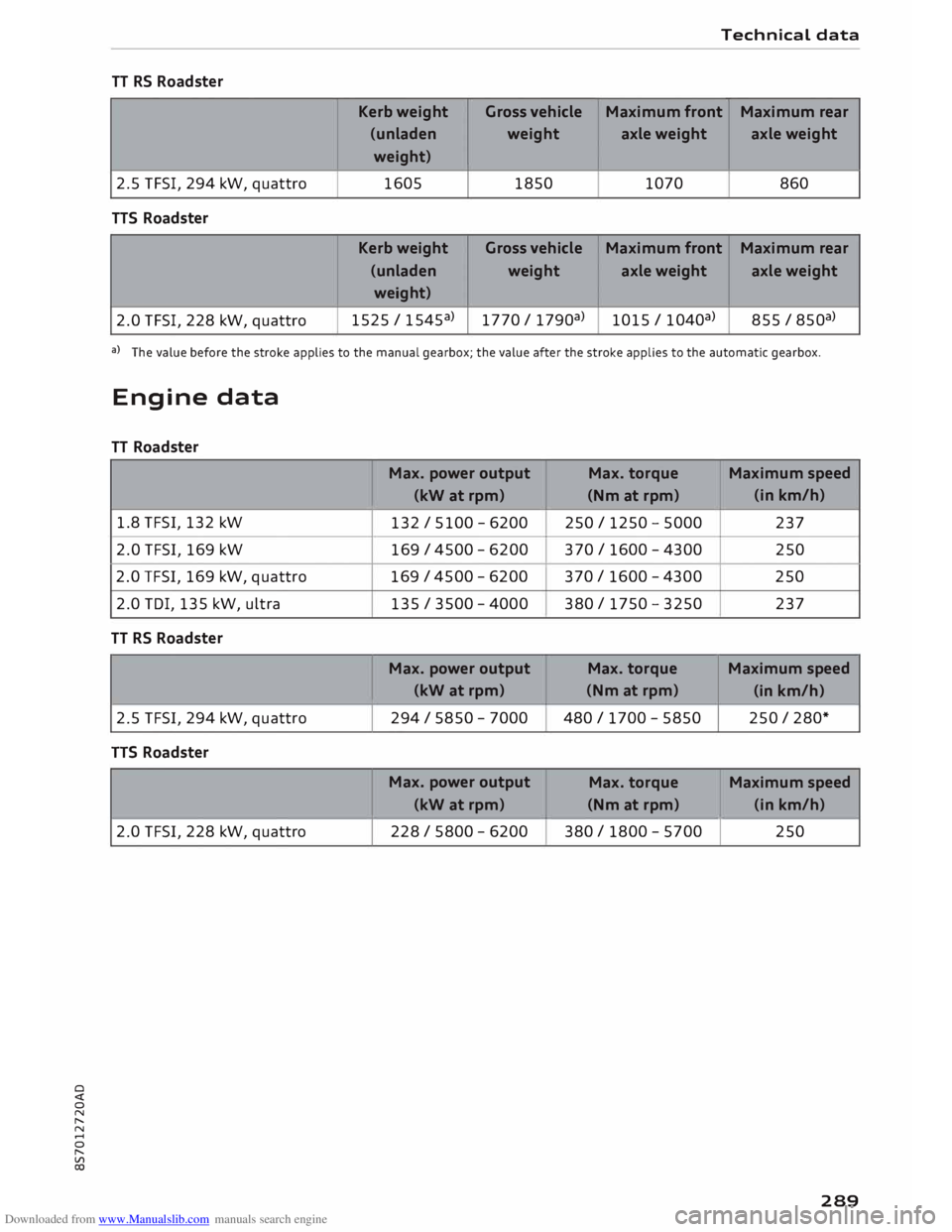
TT RS Roadster
Kerb weight
Gross vehicle Maximum front
Maximum rear
(unladen weight axle
weight axle weight
weight)
2.5 TFSI, 294 kW, quattro 1605 1850
1070
860
TTS Roadster
Kerb weight Gross
vehicle Maximum
front
Maximum rear
(unladen weight axle weight axle weight
weight)
2.0 TFSI, 228 kW, quattro 1525
/ 1545a)
1770 / 179oa) 1015
/ 1040a)
855 / 85oa)
a) The value before the stroke applies to the manual gearbox; the value after the stroke applies to the automatic gearbox.
Engine data
TT Roadster
Max. power output Max.
torque
Maximum speed
(kW at rpm) (Nm at rpm) (in
km/h)
1.8 TFSI, 132 kW
132 / 5100 -6200
250 / 1250 -5000 237
2.0 TFSI, 169 kW
169 / 4500 -6200
370 I 1600 -4300 250
2.0 TFSI, 169 kW, quattro 169
/ 4500 -6200
370 I 1600 -4300 250
2.0 TOI, 135 kW, ultra 135
/ 3500 -4000
380 I 1750 -3250 237
TT RS Roadster
Max. power output
Max. torque Maximum
speed
(kW at rpm) (Nm at rpm)
(in km/h)
2.5 TFSI, 294 kW, quattro
294 / 5850 -7000 480
/ 1700 -5850
250 / 280*
TTS Roadster
Max. power output
Max. torque
Maximum speed
(kW at rpm) (Nm at rpm) (in
km/h)
2.0 TFSI, 228 kW, quattro
228 / 5800 -6200 380
I 1800 -5700
I 250
289
Page 303 of 306
Downloaded from www.Manualslib.com manuals search engine 0
N
,.....
N
....
0
,.....
Vl
CX) Switching
character sets (MMI touch) . . . . .
124
Switching off engine . . . . . . . . . . . . . . . . . . . . 69
Switching on ignition . . . . . . . . . . . . . . . . . . .
68
Symbols ............................ 130
Navigation ......................... 178
Traffic . . . . . . . . . . . . . . . . . . . . . . . . . 182, 183
see also Warning lamps . . . . . . . . . . . . . . . 11
System settings (MMI) . . . . . . . . . . . . . . . . .
212
System update (MMI) . . . . . . . . . . . . . . . . . .
216
System volume 217
T
Tailgate see Boot lid . . . . . . . . . . . . . . . . . . . . . . . . . . 33
Technical data . . . . . . . . . . . . . . . . . . . . . . . .
287
Telephone . . . . . . . . . . . . . . . . . . . . . . . . . . .
141
Audi phone box . . . . . . . . . . . . . . . . . . . . .
146
Connecting . . . . . . . . . . . . . . . . . . . . . . . . .
142
Dialling a number . . . . . . . . . . . . . . . . . . .
147
Options during a call . . . . . . . . . . . . . . . . .
148
Settings . . . . . . . . . . . . . . . . . . . . . . . . . . .
155
SIM card . . . . . . . . . . . . . . . . . . . . . . . . . . .
144
Telephone mode . . . . . . . . . . . . . . . . . . . . . .
155
Temperature display
Coolant . . . . . . . . . . . . . . . . . . . . . . . . . . . . .
10
Outside temperature . . . . . . . . . . . . . . . . . .
20
Temperature setting (air conditioner) . . . 61, 62
Tethering . . . . . . . . . . . . . . . . . . . . . . . . . . .
161
Text messages . . . . . . . . . . . . . . . . . . . 136, 150
Tightening torque (wheel bolts) . . . . . . . . .
275
Time ............................... 212
tiptronic (automatic gearbox) . . . . . . . . . . . . 81
TMC/TMCpro see Traffic information . . . . . . . . . . . . . . .
182
Tools . . . . . . . . . . . . . . . . . . . . . . . . . . . . . . .
270
Torque Engine . . . . . . . . . . . . . . . . . . . . . . . . . . . . .
289
Torque (wheel bolts) . . . . . . . . . . . . . . . . . .
275
Touch pad
see MMI touch 124
Tow-away protection . . . . . . . . . . . . . . . . . . . 32
Tow-starting
Towing 278
Trailer weights . . . . . . . . . . . . . . . . . . . . . . 288
Towing away . . . . . . . . . . . . . . . . . . . . . . . . . 278 Index
TPMS Tyre pressure monitoring system . . . . . . .
260
Warning lamp . . . . . . . . . . . . . . . . . . . . . .
262
TPMS (tyre pressure loss indicator) . . . . . . . 258
Traction control system . . . . . . . . . . . . . . . . 113
Traffic announcements
see Traffic programme (TP) . . . . . . . . . . . .
186
Traffic avoidance . . . . . . . . . . . . . . . . . . . . .
176
Traffic information . . . . . . . . . . . . . . . . 182, 183
Traffic programme (TP) . . . . . . . . . . . . . . . .
186
Traffic reports . . . . . . . . . . . . . . . . . . . . . . . . 179
Traffic sign recognition
see Camera-based traffic sign recognition . 90
Treble (sound) . . . . . . . . . . . . . . . . . . . . . . . 217
Trip recorder, resetting . . . . . . . . . . . . . . . . .
24
Turn signals . . . . . . . . . . . . . . . . . . . . . . . . . .
45
Type plate . . . . . . . . . . . . . . . . . . . . . . . . . . . 287
Tyres ........................... 254, 270
Changing . . . . . . . . . . . . . . . . . . . . . . . . . . 272
Directional tread . . . . . . . . . . . . . . . . . . . . 275
Four-wheel drive . . . . . . . . . . . . . . . . . . . .
116
Inflation pressure . . . . . . . . . . . . . . . . . . .
256
Low-profile tyres . . . . . . . . . . . . . . . . . . . .
2 58
Repair kit . . . . . . . . . . . . . . . . . . . . . . . . . . 270
Service life
255
Tyre pressure loss indicator. . . . . . . . . . . . 258
Tyre pressure monitoring system . . . . . . . 260
Wear indicator . . . . . . . . . . . . . . . . . . . . . .
255
u
Unlocking/locking By remote control . . . . . . . . . . . . . . . . . . . . 29
With the central locking switch . . . . . . . . .
31
With the convenience key . . . . . . . . . . . . . . 30
With the key . . . . . . . . . . . . . . . . . . . . . . . . . 32
USB charging socket . . . . . . . . . . . . . . . . . . . 199
USB stick
see Audi music interface . . . . . . . . . . 197,
198
V Vehicle Raising . . . . . . . . . . . . . . . . . . . . . . . . . . . . 274
Taking out of service . . . . . . . . . . . . . . . . .
268
Vehicle battery
see Battery . . . . . . . . . . . . . . . . . . . . . . . . .
250
301