catalytic converter AUDI TT ROADSTER 2016 Owners Manual
[x] Cancel search | Manufacturer: AUDI, Model Year: 2016, Model line: TT ROADSTER, Model: AUDI TT ROADSTER 2016Pages: 306, PDF Size: 31.82 MB
Page 13 of 306
Downloaded from www.Manualslib.com manuals search engine 0
N
,.....
N
......
0
,.....
Vl
CX) Instruments
and warning/indicator lamps
The tank capacity of your vehicle is given in the
Technical data section ¢ page 288.
CD CAUTION
Never run the tank completely dry. If there is
an irregular fuel supply, misfiring can occur.
Unburnt fuel can then enter the exhaust sys
tem. This can lead to overheating and dam
age to the catalytic converter.
Warning and indicator
Lamps
Description
The warning and indicator lamps light up or flash
in the instrument cluster. Their purpose is to in
dicate functions or faults.
Some of the warning and indicator lamps may be
accompanied by a driver message and a warning
tone. The warning/indicator lamps and driver
messages on the display can be masked by fur
ther displays. To display a warning or message
again, use the controls on the multi-function
steering wheel to select the display tab for warn
ing/indicator lamps and messages ¢ page 20.
If several malfunctions have occurred, you can
use the thumbwheel to scroll through them on
the display.
Some of the warning lamps may be displayed in
different colours.
Overview
When you switch on the ignition, some of the
warning and indicator lamps light up briefly to
show that the associated systems are working
properly. These systems are marked with a../ in
the following tables. If one of these warning/in
dicator lamps does not light up, there is a fault in
the associated system.
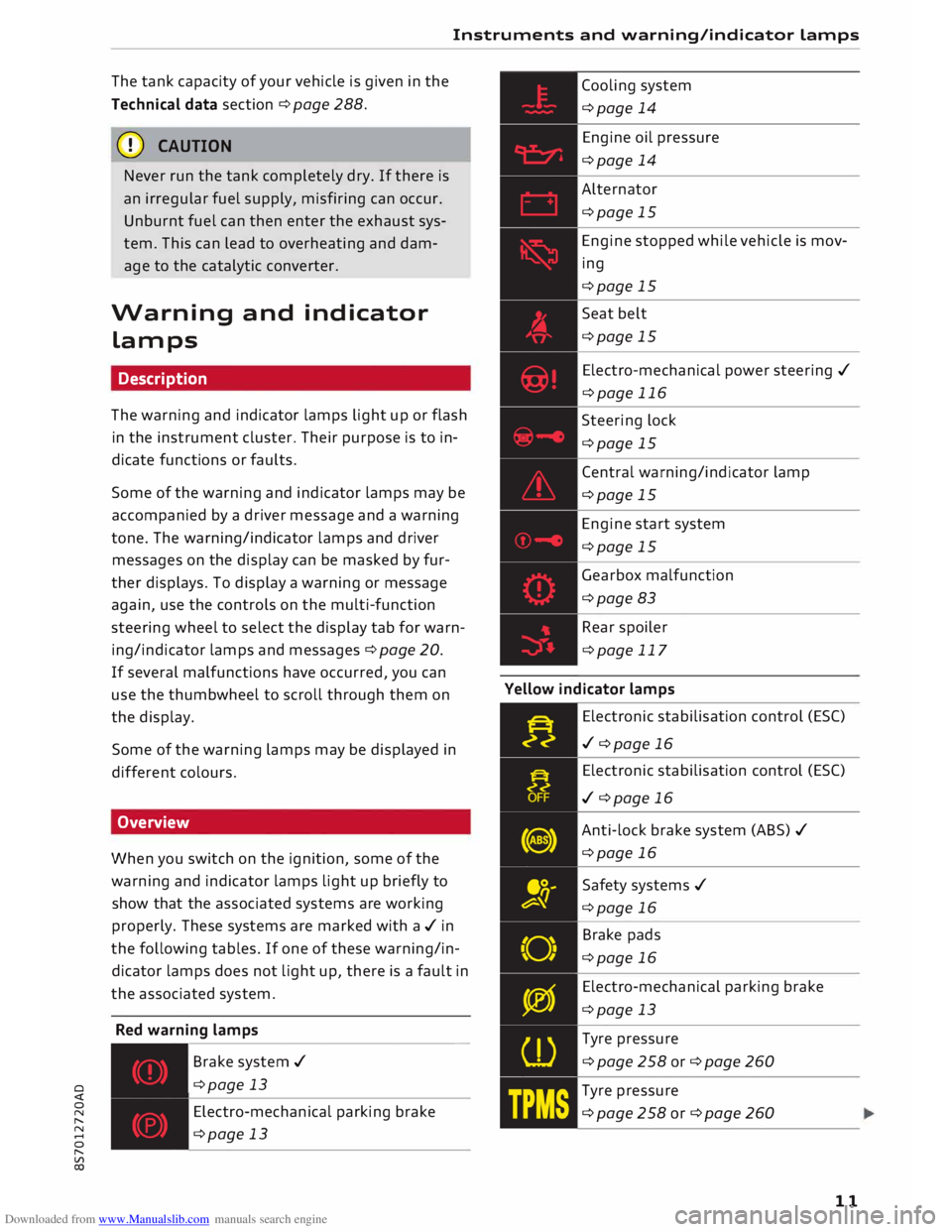
Red warning lamps
---------------
Br a k e system ../
¢page 13
Electro-mechanical parking brake
¢page 13 Cooling
system
¢page 14
Engine oil pressure
¢page 14
Alternator
¢page 15
Engine stopped while vehicle is mov
ing
¢page 15
Seat belt
¢page 15
Electro-mechanical power steering ../
¢page 116
Steering lock
¢page 15
Central warning/indicator lamp
¢page 15
Engine start system
¢page 15
Gearbox malfunction
¢page 83
Rear spoiler
¢page 117
Yellow indicator lamps
Electronic stabilisation control (ES()
../ ¢page 16
Electronic stabilisation control (ES()
../ ¢page 16
Anti-lock brake system (ABS) ../
¢page 16
Safety systems ../
¢page 16
Brake pads
¢page 16
Electro-mechanical parking brake
¢page 13
Tyre pressure
¢page258or¢page260
Tyre pressure
¢page258or¢page260
11
Page 243 of 306
Downloaded from www.Manualslib.com manuals search engine 0
N
,.....
N
......
0
,.....
Vl
CX) Checking
and topping up
fluids
Fuel Petrol grade
Applies to: vehicles with petrol engine
The correct grade of petrol is Listed inside the
fuel tank flap.
The vehicle is equipped with a catalytic converter
and must only be run on unleaded petrol. Petrol
must be sulphur-free and must comply with the
EN 228 standard. You can fuel your vehicle with
fuels containing a maximum of 10% ethanol
(ElO). The petrol grades have different octane
ratings (RON).
The following headings relate to the sticker on
the inside of your vehicle's tank flap:
Unleaded fuel only RON/ROZ 95 Super,
Premium or min. RON/ROZ 91 Normal
The use of premium petrol (95 RON) is recom
mended. If that type of fuel is not available, reg
ular petrol (RON 91) can be used with a slight
loss of power.
Unleaded fuel only, min. RON/ROZ 95
Super, Premium
Premium petrol (at least 95 RON) must be used.
If premium petrol is not available, the engine can
be run on regular petrol with 91 RON as an emer
gency measure. In this case only use moderate
engine speeds and a light throttle. Fill up with
premium or Super Plus petrol as soon as possi
ble.
Unleaded fuel only RON/ROZ 98 Super Plus
or min. RON/ROZ 95 Super, Premium
The use of Super Plus petrol (98 RON) is recom
mended. If that type of fuel is not available, pre
mium petrol (RON 95) can be used with a slight
loss of power.
If premium petrol is not available, the engine can
be run on regular petrol with 91 RON as an emer
gency measure. In this case only use moderate
engine speeds and a light throttle. Fill up with Checking
and topping up fluids
premium or Super Plus petrol as soon as possi
ble.
CD CAUTION
- Do NOT fuel your vehicle with high-ethanol
fuel blends (e.g. ESQ or E85). This will dam
age the fuel system.
- Just one tank of leaded fuel or fuel with
metallic additives will permanently impair
the efficiency of the catalytic converter.
- You should use only petrol additives which
have been approved by Audi. Additives with
so-called octane boosters or antiknock addi
tives can contain metallic additives that
cause significant damage to the engine and
the catalytic converter. Do not use such ad
ditives.
- Metal-based fuels, which can be identified
from the marking on the fuel dispenser,
must not be used. LRP fuel (lead replace
ment petrol) also contains high concentra
tions of metallic additive. Risk of engine
damage!
- High engine speed and full throttle can
damage the engine when using petrol with
an octane rating lower than the correct
grade for the engine.
((D Note
- You can use higher octane fuel than your en
gine requires.
- In countries where sulphur-free fuel is not
available, you may use low-sulphur fuel in
stead.
Diesel fuel
Applies to: vehicles
with
diesel engine
Please note the information on the inside of the
fuel tank flap.
The use of sulphur-free diesel complying with
the EN 590 standard is recommended.
Diesel can thicken at very low temperatures,
which can result in problems starting the engine
or prevent the engine from running smoothly.
For this reason, filling stations in some countries
offer winter-grade diesel fuel during the cold 1)11,,
241
Page 245 of 306
Downloaded from www.Manualslib.com manuals search engine 0
N
,.....
N
......
0
,.....
Vl
CX) the
canister during filling. This helps
prevent an electrostatic charge building
up.
- Make sure you never spill fuel in the vehi
cle or in the luggage compartment. Fuel
vapour is explosive -danger to life!
CD CAUTION
- If any fuel is spilt onto the vehicle, it should
be removed immediately as it could other
wise damage the paintwork.
- Never run the tank completely dry. If there
is an irregular fuel supply, misfiring can oc
cur. As a result unburnt fuel can enter the
exhaust system and cause damage to the
catalytic converter(s).
- When filling the fuel tank after having run it
completely dry on a vehicle with a diesel en
gine the ignition must be switched on for at
least 30 seconds without starting the en
gine. When you then start the engine it may
take longer than normal (up to one minute)
for the engine to start firing. This is because
air needs to be bled from the fuel system
while starting.
@) For the sake of the environment
Do not try to put in more fuel after the auto
matic filler nozzle has switched off; this may
cause the fuel to overflow if it becomes warm.
@ Note
Should the fuel tank flap become frozen stuck
during inclement weather, press the middle
of the flap with the palm of the hand and try
again.
(ill) Note
- To prevent the tank from being filled with
the incorrect type of fuel, only suitable filler
nozzles can be inserted in the fuel filler on
your vehicle.
- If the filler nozzle is old, damaged or too
small, it may not be able to open the pro
tection mechanism on the fuel tank. In this
case, try turning the filler nozzle before in
serting it in the fuel filler neck, use a differ- Checking
and topping up fluids
ent filling pump or seek professional assis
tance.
- The protection mechanism will not open if
you try to add fuel from a spare fuel canis
ter. If you need to fill the tank from a spare
fuel canister, you must use the special fun
nel stowed in the luggage compartment
¢page 243, Fig. 209.
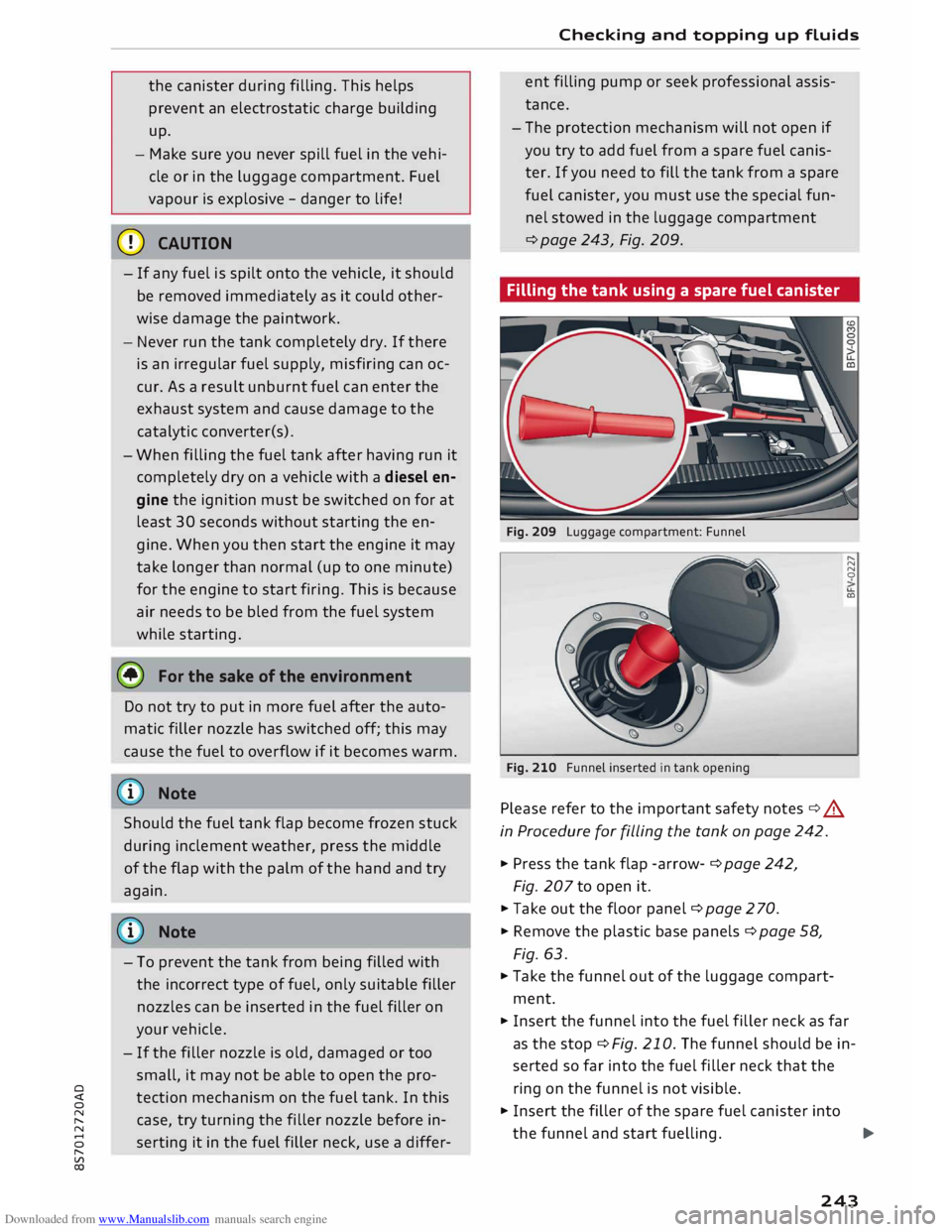
Filling the tank using a spare fuel canister
Fig. 209 Luggage compartment: Funnel
Fig. 210 Funnel inserted in tank opening
Please refer to the important safety notes¢.&.
in Procedure for filling the tank on page 242.
""' Press the tank flap -arrow- ¢ page 242,
Fig. 207 to open it.
.., Take out the floor panel¢ page 2 70.
""' Remove the plastic base panels ¢ page 58,
Fig. 63.
.., Take the funnel out of the luggage compart
ment. .....
N
N
0
I.L
a,
""' Insert the funnel into the fuel filler neck as far
as the stop ¢Fig. 210. The funnel should be in
serted so far into the fuel filler neck that the
ring on the funnel is not visible.
.., Insert the filler of the spare fuel canister into
the funnel and start fuelling.
...,.
243
Page 246 of 306
Downloaded from www.Manualslib.com manuals search engine Checking
and topping up fluids
... After fuelling, remove the funnel and close the
fuel tank flap so that it locks in place.
CD CAUTION
Remove any fuel spills from the paintwork im
mediately.
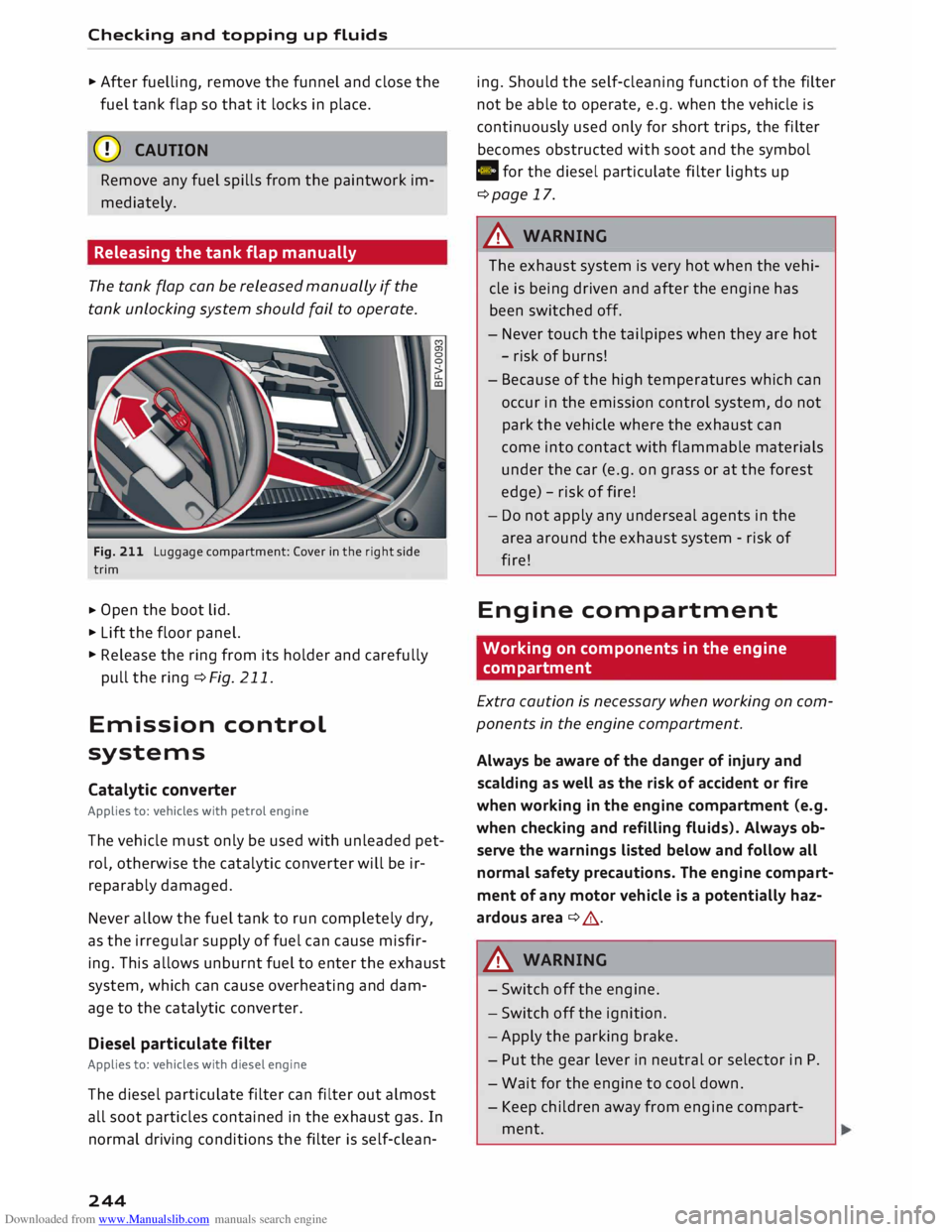
Releasing the tank flap manually
The tank flap can be released manually if the
tank unlocking system should fail to operate.
Fig. 211 Luggage compartment: Cover in the right side
trim
... Open
the boot lid .
... Lift the floor panel.
... Release the ring from its holder and carefully
pull the ring ¢Fig. 211.
Emission control
systems
Catalytic converter
Applies to: vehicles with petrol engine
The vehicle must only be used with unleaded pet
rol, otherwise the catalytic converter will be ir
reparably damaged.
Never allow the fuel tank to run completely dry,
as the irregular supply of fuel can cause misfir
ing. This allows unburnt fuel to enter the exhaust
system, which can cause overheating and dam
age to the catalytic converter.
Diesel particulate filter
Applies to: vehicles with diesel engine
The diesel particulate filter can filter out almost
all soot particles contained in the exhaust gas. In
normal driving conditions the filter is self-clean-
244 ing.
Should the self-cleaning function of the filter
not be able to operate, e.g. when the vehicle is
continuously used only for short trips, the filter
becomes obstructed with soot and the symbol
C for the diesel particulate filter lights up
¢page 17.
A WARNING
The exhaust system is very hot when the vehi
cle is being driven and after the engine has
been switched off.
- Never touch the tailpipes when they are hot
- risk of burns!
- Because of the high temperatures which can
occur in the emission control system, do not
park the vehicle where the exhaust can
come into contact with flammable materials
under the car (e.g. on grass or at the forest
edge) -risk of fire!
- Do not apply any underseal agents in the
area around the exhaust system -risk of
fire!
Engine compartment
Working on components in the engine
compartment
Extra caution is necessary when working on com
ponents in the engine compartment.
Always be aware of the danger of injury and
scalding as well as the risk of accident or fire
when working in the engine compartment (e.g.
when checking and refilling fluids). Always ob
serve the warnings listed below and follow all
normal safety precautions. The engine compart
ment of any motor vehicle is a potentially haz
ardous area ¢ A .
A WARNING
- Switch off the engine.
- Switch off the ignition.
- Apply the parking brake.
- Put the gear lever in neutral or selector in P.
- Wait for the engine to cool down.
- Keep children away from engine compart-
ment.
Page 250 of 306
Downloaded from www.Manualslib.com manuals search engine Checking
and topping up fluids
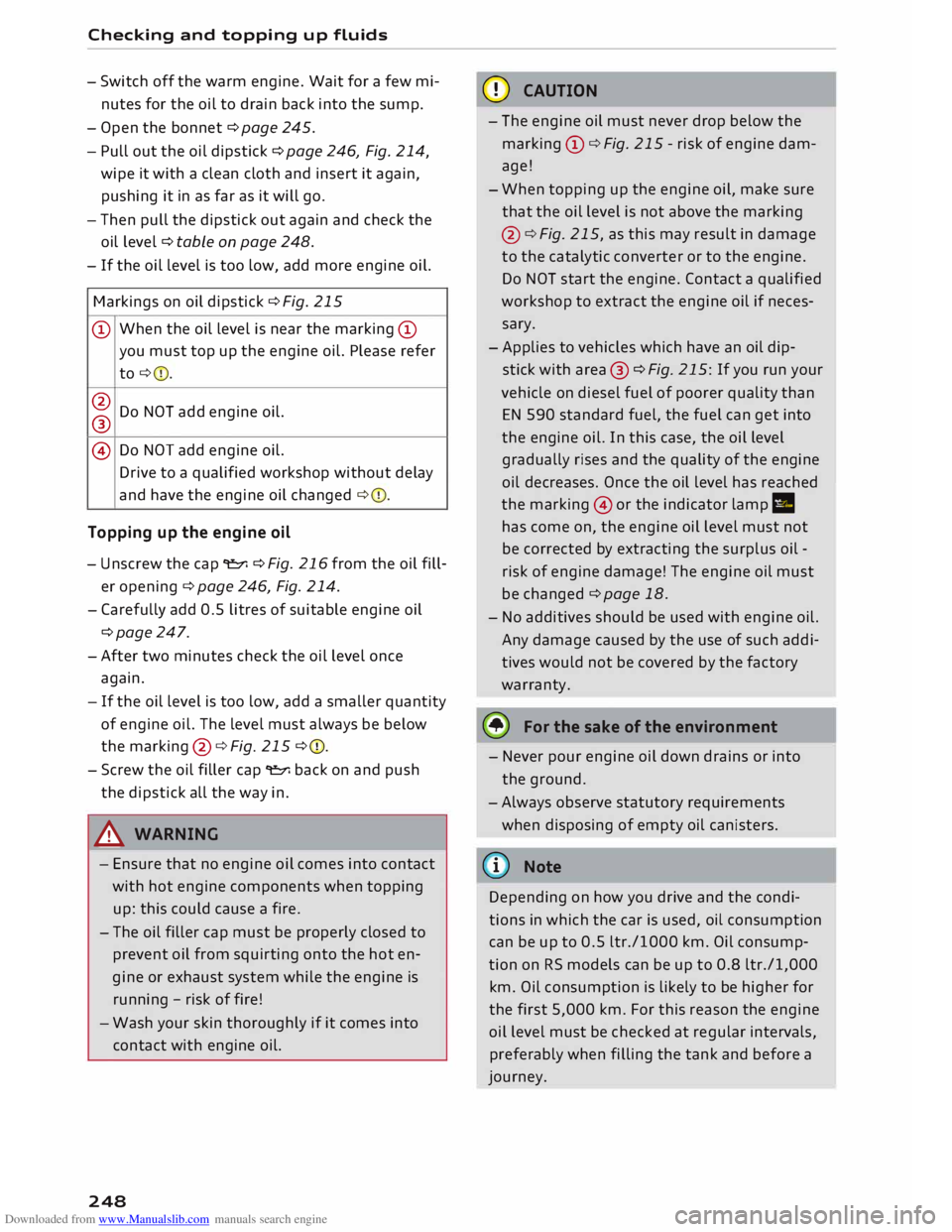
- Switch off the warm engine. Wait for a few mi
nutes for the oil to drain back into the sump.
- Open the bonnet ¢page 245.
- Pull out the oil dipstick ¢page 246, Fig. 214,
wipe it with a clean cloth and insert it again,
pushing it in as far as it will go.
- Then pull the dipstick out again and check the
oil level ¢table on page 248.
- If the oil level is too low, add more engine oil.
Markings on oil dipstick ¢ Fig. 215
@ When
the oil Level is near the marking @
you must top up the engine oil. Please refer
to ¢ 0.
@ Do NOT add engine oil.
®
@ Do
NOT add engine oil.
Drive to a qualified workshop without delay
and have the engine oil changed ¢0.
Topping up the engine oil
- Unscrew the cap "E::71 ¢Fig. 216from the oil fill
er opening ¢ page 246, Fig. 214.
- Carefully add 0.5 litres of suitable engine oil
¢page 247.
-After two minutes check the oil level once
again.
- If the oil level is too low, add a smaller quantity
of engine oil. The level must always be below
the marking @¢Fig. 215 ¢0.
- Screw the oil filler cap "E::71 back on and push
the dipstick all the way in.
A WARNING
- Ensure that no engine oil comes into contact
with hot engine components when topping
up: this could cause a fire.
- The oil filler cap must be properly closed to
prevent oil from squirting onto the hot en
gine or exhaust system while the engine is
running -risk of fire!
- Wash your skin thoroughly if it comes into
contact with engine oil.
248 CD
CAUTION
- The engine oil must never drop below the
marking (!)¢ Fig. 215 -risk of engine dam
age!
- When topping up the engine oil, make sure
that the oil level is not above the marking
@ ¢Fig. 215, as this may result in damage
to the catalytic converter or to the engine.
Do NOT start the engine. Contact a qualified
workshop to extract the engine oil if neces
sary.
- Applies to vehicles which have an oil dip
stick with area® ¢Fig. 215: If you run your
vehicle on diesel fuel of poorer quality than
EN 590 standard fuel, the fuel can get into
the engine oil. In this case, the oil Level
gradually rises and the quality of the engine
oil decreases. Once the oil level has reached
the marking @or the indicator lamp II
has come on, the engine oil level must not
be corrected by extracting the surplus oil -
risk of engine damage! The engine oil must
be changed ¢ page 18.
- No additives should be used with engine oil.
Any damage caused by the use of such addi
tives would not be covered by the factory
warranty.
® For the sake of the environment
- Never pour engine oil down drains or into
the ground.
-Always observe statutory requirements
when disposing of empty oil canisters.
@ Note
Depending on how you drive and the condi
tions in which the car is used, oil consumption
can be up to 0.5 Ltr./1000 km. Oil consump
tion on RS models can be up to 0.8 ltr./1,000
km. Oil consumption is likely to be higher for
the first 5,000 km. For this reason the engine
oil level must be checked at regular intervals,
preferably when filling the tank and before a
journey.
Page 294 of 306
Downloaded from www.Manualslib.com manuals search engine Index
Car care
Washing/cleaning . . . . . . . . . . . . . . . . . . . 263
Car keys . . . . . . . . . . . . . . . . . . . . . . . . . . . . . . 27
Car phone . . . . . . . . . . . . . . . . . . . . . . . 141, 156
Catalytic converter . . . . . . . . . . . . . . . . . . . .
244
CD drive . . . . . . . . . . . . . . . . . . . . . . . . . . . . .
193
Central locking system . . . . . . . . . . . . . . . . . .
27
Boot lid . . . . . . . . . . . . . . . . . . . . . . . . . . . . . 33
Central locking switch . . . . . . . . . . . . . . . . .
31
Electric windows . . . . . . . . . . . . . . . . . . . . .
35
Locking doors manually . . . . . . . . . . . . . . . . 32
Remote control key . . . . . . . . . . . . . . . . . . .
29
Settings .. .. .. .. .. .. .. .. .. .. . . .. .. ..
31
Centre armrest . . . . . . . . . . . . . . . . . . . . . . . .
55
Centre console lighting, adjusting brightness
.48
Cetane number (diesel) . . . . . . . . . . . . . . . .
241
Changing bulbs . . . . . . . . . . . . . . . . . . . . . . .
284
Charging battery (mobile devices) . . . . 198, 199
Chassis number . . . . . . . . . . . . . . . . . . . . . .
287
Child lock . . . . . . . . . . . . . . . . . . . . . . . . . . .
204
Child seats . . . . . . . . . . . . . . . . . . . . . . . . . .
223
Categories . . . . . . . . . . . . . . . . . . . . . . . . .
224
ISOFIX . . . . . . . . . . . . . . . . . . . . . . . . . . . .
225
Side airbags . . . . . . . . . . . . . . . . . . . . . . . .
224
Cigarette lighter . . . . . . . . . . . . . . . . . . . . . . . 56
Cleaning . . . . . . . . . . . . . . . . . . . . . . . . . . . .
263
Cleaning/de-icing windows . . . . . . . . . . . . . 265
Cleaning/treating natural leather . . . . . . . . 266
Cleaning Alcantara . . . . . . . . . . . . . . . . . . . .
266
Cleaning Audi virtual cockpit . . . . . . . . . . . .
265
Cleaning carbon parts . . . . . . . . . . . . . 265, 266
Cleaning controls and displays . . . . . . . . . . 265
Cleaning displays . . . . . . . . . . . . . . . . . . . . . 265
Cleaning fabrics . . . . . . . . . . . . . . . . . . . . . .
266
Cleaning instrument cluster . . . . . . . . . . . .
265
Cleaning leatherette . . . . . . . . . . . . . . . . . . .
266
Cleaning plastic parts . . . . . . . . . . . . . . . . . .
265
Cleaning seat upholstery . . . . . . . . . . . . . . . 266
Cleaning windbreak
Closing 265
Bonnet . . . . . . . . . . . . . . . . . . . . . . . . . . . .
245
Windows ........................... 34
Coasting mode . . . . . . . . . . . . . . . . . . . . . . . .
82
Coat hooks . . . . . . . . . . . . . . . . . . . . . . . . . . .
5 7
Cold engine . . . . . . . . . . . . . . . . . . . . . . . . . . . 66
292 Colour
code . . . . . . . . . . . . . . . . . . . . . . . . . .
287
Coming home . . . . . . . . . . . . . . . . . . . . . . . . . 47
Command see Command (speech dialogue system) . 132
Command (speech dialogue system) . . . . . . 133
Compact temporary spare wheel . . . . . . . . . 276
Compartments . . . . . . . . . . . . . . . . . . . . . . . .
57
Compass in mirror . . . . . . . . . . . . . . . . . . . . .
52
Conference calls . . . . . . . . . . . . . . . . . . . . . . 148
Connection manager 213
Connections see Media . . . . . . . . . . . . . . . . . . . . . .
191, 200
Connection settings . . . . . . . . . . . . . . . . . . .
213
Consumption (fuel)
. . . . . . . . . . . . . . . . 25, 287
Contacts Displaying details.. . . . . . . . . . . . . . . . . . . 154
From another directory . . . . . . . . . . . . . . . 214
Importing/exporting . . . . . . . . . . . . . . . . .
154
Memory capacity . . . . . . . . . . . . . . . . . . . .
156
Searching for . . . . . . . . . . . . . . . . . . . . . . .
154
Storing as a destination...............
175
Control buttons . . . . . . . . . . . . . . . . . . . . . .
123
Controls Multi-function steering wheel..... ...... 21
Controls and displays (overview) . . . . . . . . . . . 8
Control units . . . . . . . . . . . . . . . . . . . . . . . . . 119
Convenience key
Indicator lamp . . . . . . . . . . . . . . . . . . . . . . .
70
Switching off engine (START ENGINE STOP
button) . . . . . . . . . . . . . . . . . . . . . . . . . . . . . 69
Convenience open/close . . . . . . . . . . . . . . . . . 35
Cooling mode (air conditioner) . . . . . . . . 61, 62
Cooling system
Anti-freeze . . . . . . . . . . . . . . . . . . . . . . . . . 249
Checking coolant level . . . . . . . . . . . . . . . . 249
Coolant temperature gauge . . . . . . . . . . . . 10
Topping up coolant . . . . . . . . . . . . . . . . . . 249
Warning lamp . . . . . . . . . . . . . . . . . . . . . . . 14
Cornering light . . . . . . . . . . . . . . . . . . . . . . . 100
Crank (for closing soft top manually) . . . . . . 42
Crosshairs . . . . . . . . . . . . . . . . . . . . . . . . . . . 171
Cruise control system
Adjusting stored speed . . . . . . . . . . . . . . . .
87
Pre-selecting a speed . . . . . . . . . . . . . . . . . .
87
Switching off . . . . . . . . . . . . . . . . . . . . . . . .
87
Switching on . . . . . . . . . . . . . . . . . . . . . . . . . 86
Page 295 of 306
Downloaded from www.Manualslib.com manuals search engine 0
N
,.....
N
......
0
,.....
Vl
CX) Cup
holders . . . . . . . . . . . . . . . . . . . . . . . . . . .
57
D
Data connection . . . . . . . . . . . . . . . . . . . . . .
166
Data protection . . . . . . . . . . . . . . . . . . . . . . . 168
Date . . . . . . . . . . . . . . . . . . . . . . . . . . . . . . . .
212
Daytime running lights . . . . . . . . . . . . . . . . . 44
Deactivating passenger's airbag . . . . . . . . . 237
Defrosting windows . . . . . . . . . . . . . . . . . 61, 63
DEF (instrument cluster) . . . . . . . . . . . . . . . . 24
Deluxe automatic air conditioner
see Air conditioner (automatic) . . . . . . . . . . 62
Diagnostic connection . . . . . . . . . . . . . . . . . 119
Diesel Diesel particulate filter . . . . . . . . . . . . . . . 244
Draining fuel filter . . . . . . . . . . . . . . . . . . . . 18
Engine oil . . . . . . . . . . . . . . . . . . . . . . . . . . 247
Fuel............................... 241
Indicator lamp . . . . . . . . . . . . . . . . . . . . . . .
17
Preheating (glow plugs) . . . . . . . . . . . . . . .
68
Digital compass . . . . . . . . . . . . . . . . . . . . . . .
52
Dimensions Vehicle dimensions . . . . . . . . . . . . . . . . . .
288
Dipped headlights . . . . . . . . . . . . . . . . . . . . . 44
Directional tread (tyres) . . . . . . . . . . . . . . . . 275
Directory see Contacts . . . . . . . . . . . . . . . . . . . . . . . .
153
Display see Audi virtual cockpit (instrument
cluster) . . . . . . . . . . . . . . . . . . . . . . . . . .
21, 23
Distance covered . . . . . . . . . . . . . . . . . . . . . . . 25
Doors Locking doors manually . . . . . . . . . . . . . . . . 32
Door safelock . . . . . . . . . . . . . . . . . . . . . . . . . 32
Downhill speed control . . . . . . . . . . . . . . . . .
80
Draining fuel filter (diesel) . . . . . . . . . . . . . . . 18
Driver information system . . . . . . . . . . . . 21, 23
Driver messages . . . . . . . . . . . . . . . . . . . . . .
11
On-board computer . . . . . . . . . . . . . . . . . . .
25
Outside temperature display. . . . . . . . . . . .
20
Service interval display . . . . . . . . . . . . . . . 252
Warning and indicator lamps . . . . . . . . . . . 11
Drives see Media . . . . . . . . . . . . . . . . . . . . . . 191,
200
Drive select . . . . . . . . . . . . . . . . . . . . . . . . . . 100
Driving on left . . . . . . . . . . . . . . . . . . . . . . . . . 47 Index
Driving on right . . . . . . . . . . . . . . . . . . . . . . . . 47
Driving on right/left . . . . . . . . . . . . . . . . . . . . 44
Driving through water . . . . . . . . . . . . . . . . . .
66
Driving time . . . . . . . . . . . . . . . . . . . . . . . . . .
25
Dust filter
see Pollution filter . . . . . . . . . . . . . . . . . . . . 60
DVD drive (media drives) . . . . . . . . . . . . . . . 192
Dynamic volume control
see System volume .................. 217
E
E-mail
ElO 151
see Ethanol (fuel) .
. . . . . . . . . . . . . . . . . . .
241
Economical driving . . . . . . . . . . . . . . . . . . . . . 67
Economical route . . . . . . . . . . . . . . . . . . . . . 177
EDL see Electronic differential lock . . . . . . . . . 113
Electrical socket . . . . . . . . . . . . . . . . . . . . . . .
56
Electric seat adjustment . . . . . . . . . . . . . . . .
54
Electric windows . . . . . . . . . . . . . . . . . . . . . . . 34
Convenience open/close . . . . . . . . . . . . . . . 35
Malfunction . . . . . . . . . . . . . . . . . . . . . . . . .
35
Electro-mechanical parking brake . . . . . . . . . 74
Electro-mechanical power steering . . . . . . .
116
Indicator lamp . . . . . . . . . . . . . . . . . . . . . . 116
Electronic differential lock . . . . . . . . . . . . . . 113
Electronic immobiliser . . . . . . . . . . . . . . . . . . 27
Electronic stabilisation control (ESC) . . . . . 113
Indicator lamp . . . . . . . . . . . . . . . . . . . . . . . 16
Multicollision brake assist system . . . . . . 113
Sport mode . . . . . . . . . . . . . . . . . . . . . . . . 114
Emergency braking function . . . . . . . . . . . . . 74
Emergency call, making . . . . . . . . . . . . . . . . 152
Emergency key . . . . . . . . . . . . . . . . . . . . . 27, 28
Emission control systems
Catalytic converter . . . . . . . . . . . . . . . . . . .
244
Diesel particulate filter . . . . . . . . . . . . . . .
244
Emission control system (indicator lamp) . . . 17
Emissions . . . . . . . . . . . . . . . . . . . . . . . . . . . 287
Engine Coolant . . . . . . . . . . . . . . . . . . . . . . . . . . . . 249
Jump-starting . . . . . . . . . . . . . . . . . . . . . . .
277
Letting engine warm up/cool down . . . . . . 66
Power output . . . . . . . . . . . . . . . . . . . . . . . 289
Preheating (glow plugs) . . . . . . . . . . . . . . . 68
293