winter tyres AUDI TT ROADSTER 2016 Owners Manual
[x] Cancel search | Manufacturer: AUDI, Model Year: 2016, Model line: TT ROADSTER, Model: AUDI TT ROADSTER 2016Pages: 306, PDF Size: 31.82 MB
Page 70 of 306
Downloaded from www.Manualslib.com manuals search engine Driving
The tyre pressures should always be checked
when the tyres are cold.
Do not use winter tyres all through the year; they
will increase fuel consumption by up to 10 %.
Avoid carrying unnecessary loads
Every kilo of extra weight will increase the fuel
consumption, so it is worth checking the luggage
compartment occasionally to make sure that no
unnecessary loads are being transported.
Save electrical energy
The engine drives the alternator to generate elec
tricity. This means that fuel consumption rises
when more power is required for electrical equip
ment. Switch off electrical equipment when it is
not needed. Electrical equipment which uses a
lot of electricity includes the blower (at a high
setting), the rear window heating and the seat
heating*.
Steering Adjusting the steering wheel position
The height and reach of the steering wheel can
be adjusted as required to suit the driver.
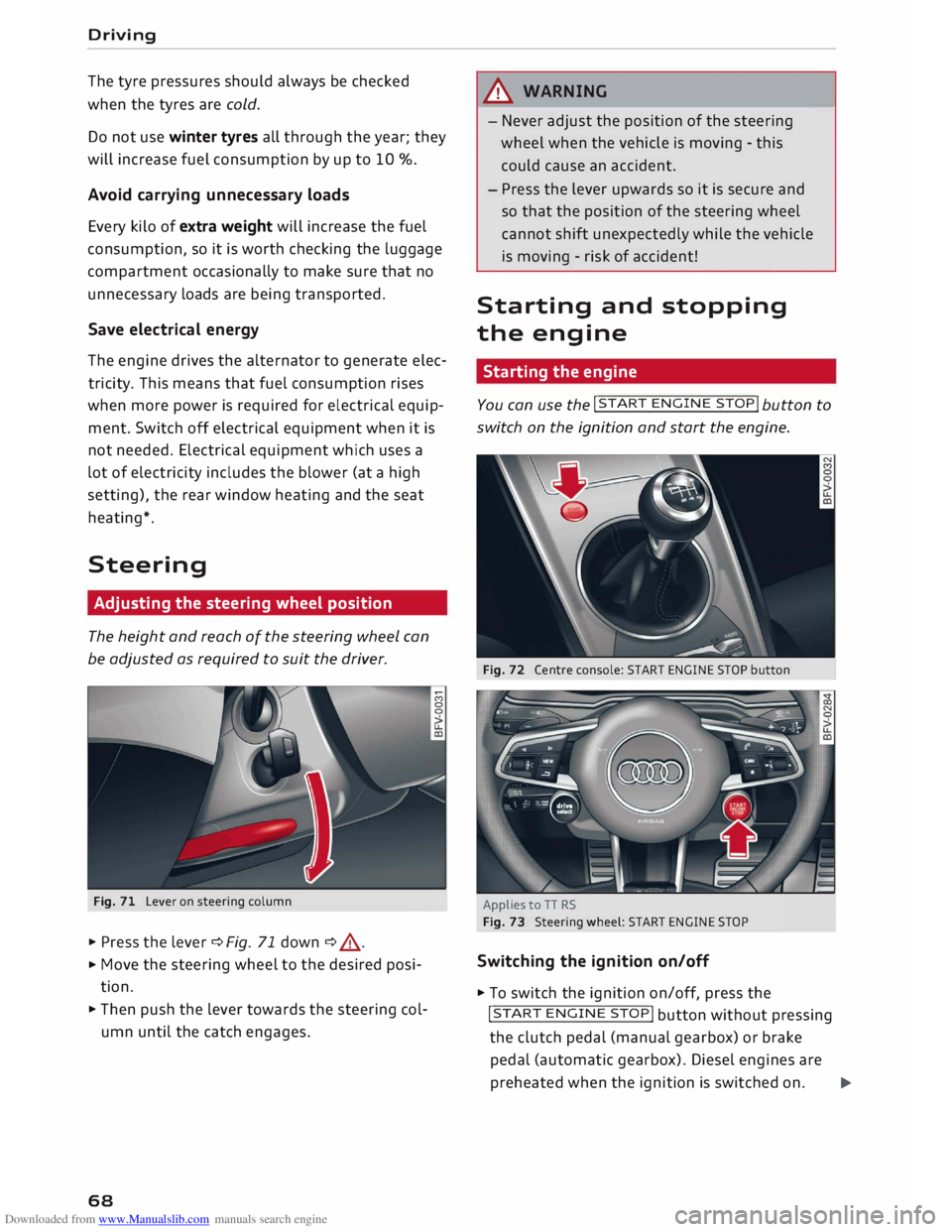
Fig. 71 Lever on steering column
� Press the lever¢ Fig. 71 down ¢ .&, .
� Move
the steering wheel to the desired posi
tion.
� Then push the lever towards the steering col
umn until the catch engages.
68 A
WARNING
- Never adjust the position of the steering
wheel when the vehicle is moving - this
could cause an accident.
- Press the lever upwards so it is secure and
so that the position of the steering wheel
cannot shift unexpectedly while the vehicle
is moving -risk of accident!
Starting and stopping
the engine
Starting the engine -
You can use the !START
ENGINE STOP!
button to
switch on the ignition and start the engine.
Fig. 72 Centre console: START ENGINE STOP button
Applies to TT RS
Fig. 73 Steering wheel: START ENGINE STOP
Switching the ignition on/off
� To switch the ignition on/off, press the
!START ENGINE STOP!
button without pressing
the clutch pedal (manual gearbox) or brake
pedal (automatic gearbox). Diesel engines are
preheated when the ignition is switched on.�
Page 119 of 306
Downloaded from www.Manualslib.com manuals search engine 0
N
,.....
N
....
0
,.....
Vl
CX) Winter
tyres
Thanks to its four-wheel drive, your car will have
plenty of traction in winter conditions, even with
the standard tyres. Nevertheless, we still recom
mend that winter tyres or all-season tyres should
be fitted on all four wheels when winter road
conditions are expected, mainly because this will
give a better braking response.
Snow chains
On roads where snow chains are mandatory, this
also applies to cars with four-wheel drive
¢ page 2 5 7, Snow chains.
Replacing tyres
On vehicles with four-wheel drive, all four tyres
must have the same rolling circumference. Also
avoid using tyres with varying tread depths
¢ page 254, New wheels or tyres.
Off-roader?
Your Audi does not have enough ground clear
ance to be used as an off-road vehicle. It is there
fore best to avoid rough tracks and uneven ter
rain as much as possible.
A WARNING
- Even with four-wheel drive, you should al
ways adjust your speed to suit the condi
tions. Do not Let the extra safety provided
tempt you into taking any risks when driving
- this can cause accidents.
- The braking ability of your car is limited by
the grip of the tyres. In this respect, your
car is no different from a car without four
wheel drive. So do not be tempted to drive
too fast on icy or slippery roads just because
the car still has good acceleration in these
conditions -risk of accident!
- On wet roads bear in mind that the front
wheels may start to "aquaplane" and Lose
contact with the road if the car is driven too
fast. If this should happen, there will be no
sudden increase in engine speed to warn the
driver, as with a front-wheel drive car. So do
not drive too fast in the wet: adjust your
speed to suit the conditions (accident risk). Intelligent
technology
Rear spoiler
Applies to: vehicles with automatic rear spoiler
The automatic rear spoiler increases the car's
stability.
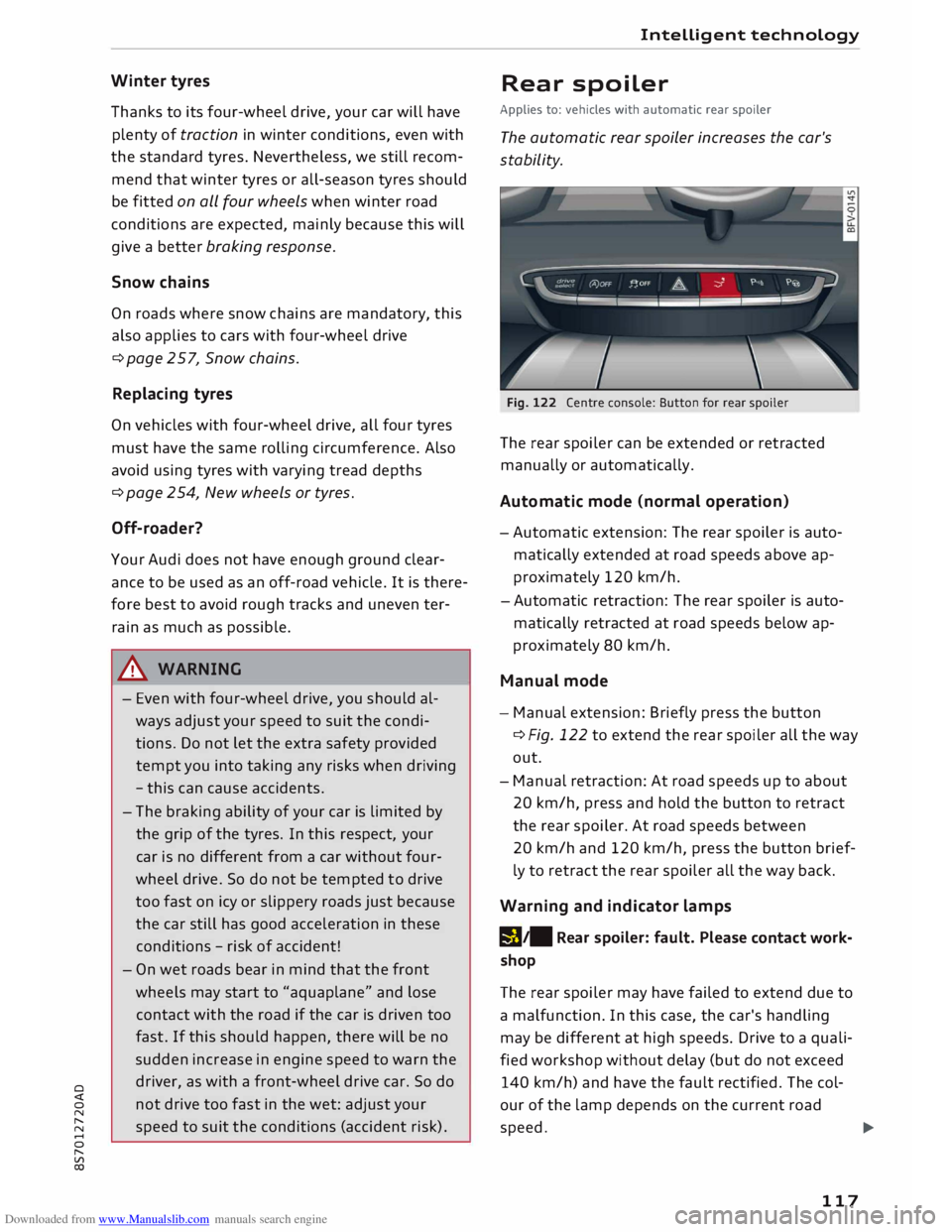
Fig. 122 Centre console: Button for rear spoiler
The rear spoiler can be extended or retracted
manually or automatically.
Automatic mode (normal operation)
- Automatic extension: The rear spoiler is auto
matically extended at road speeds above ap
proximately 120 km/h.
-Automatic retraction: The rear spoiler is auto
matically retracted at road speeds below ap
proximately 80 km/h.
Manual mode
- Manual extension: Briefly press the button
¢Fig. 122 to extend the rear spoiler all the way
out.
- Manual retraction: At road speeds up to about
20 km/h, press and hold the button to retract
the rear spoiler. At road speeds between
20 km/h and 120 km/h, press the button brief
ly to retract the rear spoiler all the way back.
Warning and indicator lamps
1!1 !1111
R
ear
spoiler: fault. Please contact work
shop
The rear spoiler may have failed to extend due to
a malfunction. In this case, the car's handling
may be different at high speeds. Drive to a quali
fied workshop without delay (but do not exceed
140 km/h) and have the fault rectified. The col
our of the Lamp depends on the current road
speed. l)IJ,,
117
Page 256 of 306
Downloaded from www.Manualslib.com manuals search engine Wheels
Wheels
Tyres and rims
General notes
� Inspect the tyres regularly for damage (cuts,
cracks or blisters, etc.). Remove any foreign
bodies embedded in the treads.
� If you have to drive over a kerb or similar obsta
cle, drive very slowly and as near as possible at
a right angle to the kerb.
� Damaged rims or tyres must be replaced imme
diately.
� Keep grease, oil and fuel off the tyres.
� Mark
the wheels before taking them off so that
they rotate in the same direction when refitted.
� When removed, the wheels should be stored
flat in a cool, dry and preferably dark place.
CD CAUTION
- Please note that summer and winter tyres
are optimised for the prevailing road condi
tions at different times of year. We recom
mend that you use winter tyres during the
winter months. At low temperatures, sum
mer tyres lose their elasticity and grip, and
braking performance also suffers as a re
sult. Cracks can form in the tread block on
summer tyres if they are used at very cold
temperatures, and this can cause perma
nent damage to the tyres. An increase in
rolling noise and tyre imbalance may result
from this damage.
- Machined, polished or chrome-plated rims
must not be used in winter conditions. The
process used to manufacture these types of
wheel rim does not provide adequate sur
face protection against corrosion, and the
rims can be permanently damaged by road
salt or similar.
New wheels or tyres
It is best to have all servicing of wheels and tyres
performed by a qualified workshop, since they
l l
COC = Certificate of conformity
254 have
the necessary special tools and replacement
parts in addition to trained personnel.
� New tyres do not yet give maximum grip. When
driving with new tyres, drive at moderate
speeds and be especially careful during the first
500 km.
� All four wheels must be fitted with tyres of the
same type, size (rolling circumference) and
preferably the same tread pattern.
� Tyres should be replaced in pairs and not indi
vidually (i.e. both front tyres or both rear tyres
together).
� We recommend the use of Audi Genuine Tyres.
If you wish to use other tyres, please note that
the actual size can differ from the nominal size
marked on the tyre ¢ A .
� If you wish to purchase a different combination
of rims and tyres than the ones fitted on the ve
hicle during production, it is advisable to con
sult a qualified workshop beforehand ¢ A.
The sizes of the rims and tyres approved for your
vehicle are listed in the vehicle's documents (e.g.
EC Certificate of Conformity or COC document l)).
The vehicle documents vary depending on the
country in which the vehicle is registered.
If the spare wheel* is not the same type as the
tyres fitted on the car (for example if the car has
winter tyres or wide-section tyres) you should on
ly use the spare wheel* if a puncture occurs, and
then only for a short period of time. In this case,
please drive with extra care. Refit a normal road
wheel as soon as possible.
On vehicles with four-wheel drive, all four wheels
must always be fitted with tyres of the same
type, make and tread pattern, as the driveline
could otherwise be damaged by variations in the
wheel speeds. For the same reason, only use a
spare wheel* which has the same rolling circum
ference as the normal road wheels.
Manufacturing date
The manufacturing date is indicated on the tyre
sidewall (possibly only on the inner side of the
wheel): ..,.
Page 259 of 306
Downloaded from www.Manualslib.com manuals search engine 0
N
,.....
N
......
0
,.....
Vl
CX) @
For the sake of the environment
Under-inflated tyres will increase the fuel
consumption. -------------
We recommend always using either the tyre
pressure setting (D for partial loads or the
setting @for full loads.
Wheel bolts and rims
Wheel bolts
The wheel bolts should be clean and turn easily.
A special adapter is required to turn the anti
theft wheel bolts* cc> page 2 73.
Rims Rims with a bolted rim flange* or bolted trim
parts* consist of several components. A special
technique is applied to bolt these components
together. Never attempt to repair or dismantle
them c:::>A.
A WARNING
If the wheel bolts have not been tightened or
serviced correctly, they can come loose, and
you could lose control of the vehicle -risk of
accident! For the correct tightening torque,
refer to cc> page 2 75, A�er changing a wheel.
- Make sure that the wheel bolts and threads
in the wheel hubs are always clean and free
from grease.
- Only use wheel bolts that are designed to
match the rims on your car.
- Always have damaged rims repaired by a
qualified workshop. Never attempt to repair
or dismantle rims yourself -risk of accident!
Winter tyres
In winter road conditions winter tyres will consid
erably improve the car's handling. Due to their
type of construction (width, rubber compound,
tread pattern), summer tyres give less grip on ice
and snow.
� Winter tyres must be fitted on all four wheels . Wheels
� Only use winter tyres of the correct type ap
proved for your vehicle.
� Please note that the maximum permissible
speed for winter tyres may be lower than for
summer tyres cc>.&_ . Your specialist retailer can
advise you of the maximum speed for your
tyres.
� After fitting the wheels you must always check
the tyre pressures cc> page 256.
Winter tyres lose their effectiveness when the
tread is worn down to a depth of 4 mm. The per
formance of winter tyres is also severely impaired
by ageing, even if the tread is still much deeper
than 4 mm.
A WARNING
- Never exceed the maximum approved speed
for your tyres. This causes the tyres to over
heat and can even result in a blow-out -risk
of accident!
- Always adapt your driving style to the pre
vailing road and traffic conditions. Drive
carefully and reduce your speed on icy or
slippery roads. Even winter tyres lose their
grip on black ice.
@ For the sake of the environment
Summer tyres should be fitted again as
soon
as possible; they give better handling on
roads which are free of snow and ice. They are
quieter, do not wear so quickly and reduce
fuel consumption.
(© Note
All-weather tyres can also be used instead of
winter tyres. Please note that winter tyres
with the£ symbol are required by law during
the winter season in some countries.
Snow chains
Snow chains will improve braking ability as well
as traction in winter conditions.
� Snow chains can be used on the front wheels
only. This also applies to vehicles with four-
wheel drive*.
..,.
257
Page 260 of 306
Downloaded from www.Manualslib.com manuals search engine Wheels
... Check that the snow chains are correctly seated
after driving for a few yards; follow the instruc
tions given by the manufacturer.
... Keep your speed below 50 km/h. Please ob-
serve the applicable local regulations.
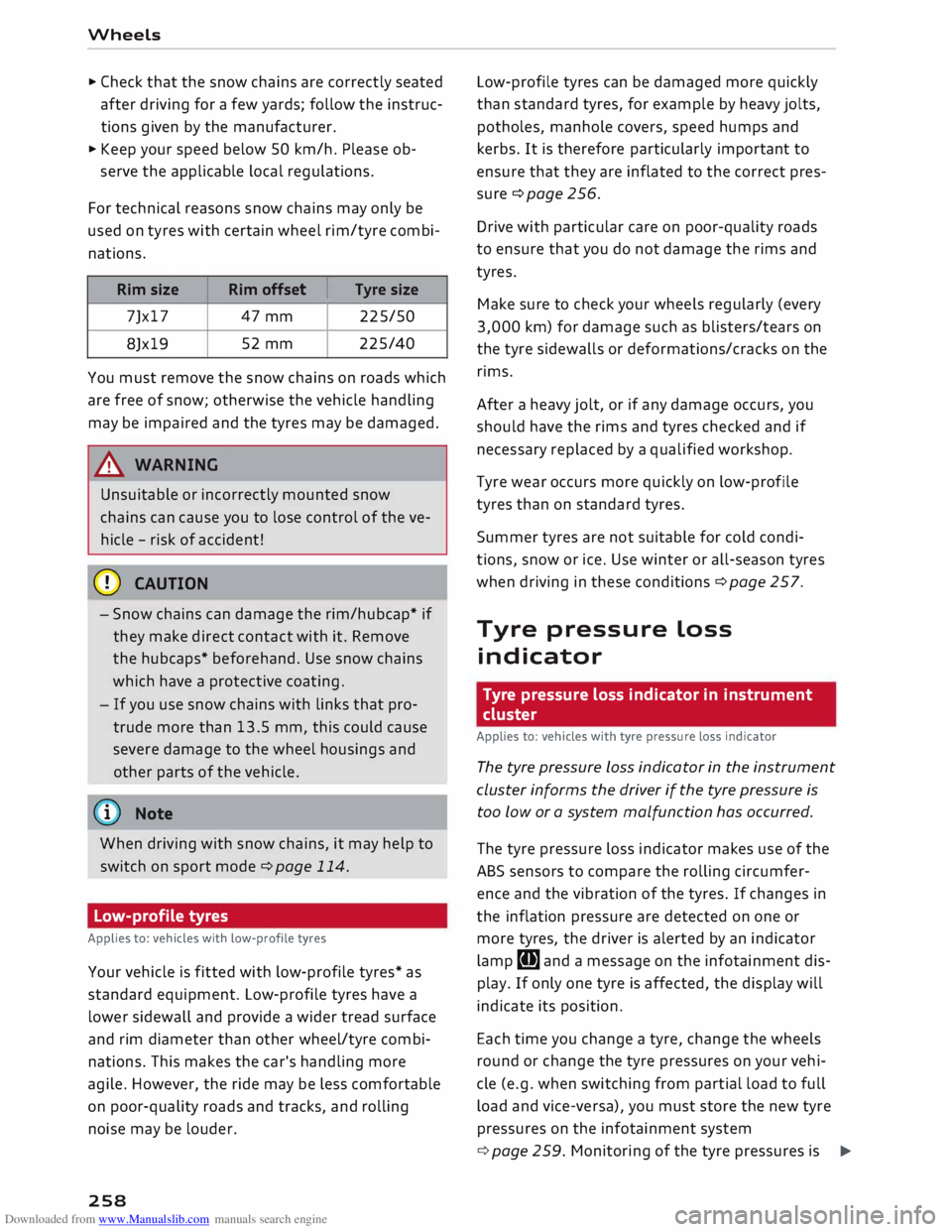
For technical reasons snow chains may only be
used on tyres with certain wheel rim/tyre combi
nations.
Rim size Rim offset Tyre size
7Jx17 47 mm 225/50
8Jx19 52
mm
225/40
You must remove the snow chains on roads which
are free of snow; otherwise the vehicle handling
may be impaired and the tyres may be damaged.
A WARNING
Unsuitable or incorrectly mounted snow
chains can cause you to lose control of the ve
hicle -risk of accident!
CD CAUTION
- Snow chains can damage the rim/hubcap* if
they make direct contact with it. Remove
the hubcaps* beforehand. Use snow chains
which have a protective coating.
- If you use snow chains with links that pro
trude more than 13.5 mm, this could cause
severe damage to the wheel housings and
other parts of the vehicle.
({D Note
When driving with snow chains, it may help to
switch on sport mode ¢ page 114.
Low-profile tyres
Applies to: vehicles with low-profile tyres
Your vehicle is fitted with low-profile tyres* as
standard equipment. Low-profile tyres have a
lower sidewall and provide a wider tread surface
and rim diameter than other wheel/tyre combi
nations. This makes the car's handling more
agile. However, the ride may be less comfortable
on poor-quality roads and tracks, and rolling
noise may be louder.
258 Low-profile
tyres can be damaged more quickly
than standard tyres, for example by heavy jolts,
potholes, manhole covers, speed humps and
kerbs. It is therefore particularly important to
ensure that they are inflated to the correct pres
sure c:>page 256.
Drive with particular care on poor-quality roads
to ensure that you do not damage the rims and
tyres.
Make sure to check your wheels regularly (every
3,000 km) for damage such as blisters/tears on
the tyre sidewalls or deformations/cracks on the
rims.
After a heavy jolt, or if any damage occurs, you
should have the rims and tyres checked and if
necessary replaced by a qualified workshop.
Tyre wear occurs more quickly on low-profile
tyres than on standard tyres.
Summer tyres are not suitable for cold condi
tions, snow or ice. Use winter or all-season tyres
when driving in these conditions c:::> page 257.
Tyre pressure Loss
indicator
Tyre pressure loss indicator in instrument
cluster
Applies to: vehicles with tyre pressure loss indicator
The tyre pressure Loss indicator in the instrument
cluster informs the driver if the tyre pressure is
too Low or a system malfunction has occurred.
The tyre pressure loss indicator makes use of the
ABS sensors to compare the rolling circumfer
ence and the vibration of the tyres. If changes in
the inflation pressure are detected on one or
more tyres, the driver is alerted by an indicator
lamp [tE and a message on the infotainment dis
play. If only one tyre is affected, the display will
indicate its position.
Each time you change a tyre, change the wheels
round or change the tyre pressures on your vehi
cle (e.g. when switching from partial load to full
load and vice-versa), you must store the new tyre
pressures on the infotainment system
c:::> page 259. Monitoring of the tyre pressures is
�
Page 278 of 306
Downloaded from www.Manualslib.com manuals search engine Mobility
...
Put the tools and jack back in the luggage com
partment.
... If the replaced wheel will not fit into the spare
wheel well, stow it safely in the luggage com
partment ¢page 227.
... Check
the tyre pressure of the fitted wheel as
soon as possible.
... Adjust the tyre pressures and store them via
the infotainment system.
... The
wheel bolts should be tightened to 120
Nm. Have this checked as soon as possible with
a torque wrench. Until then, drive with caution .
... Have the flat tyre replaced as quickly as possi
ble.
Spare wheel
General notes
Applies to: vehicles with compact temporary spare wheel
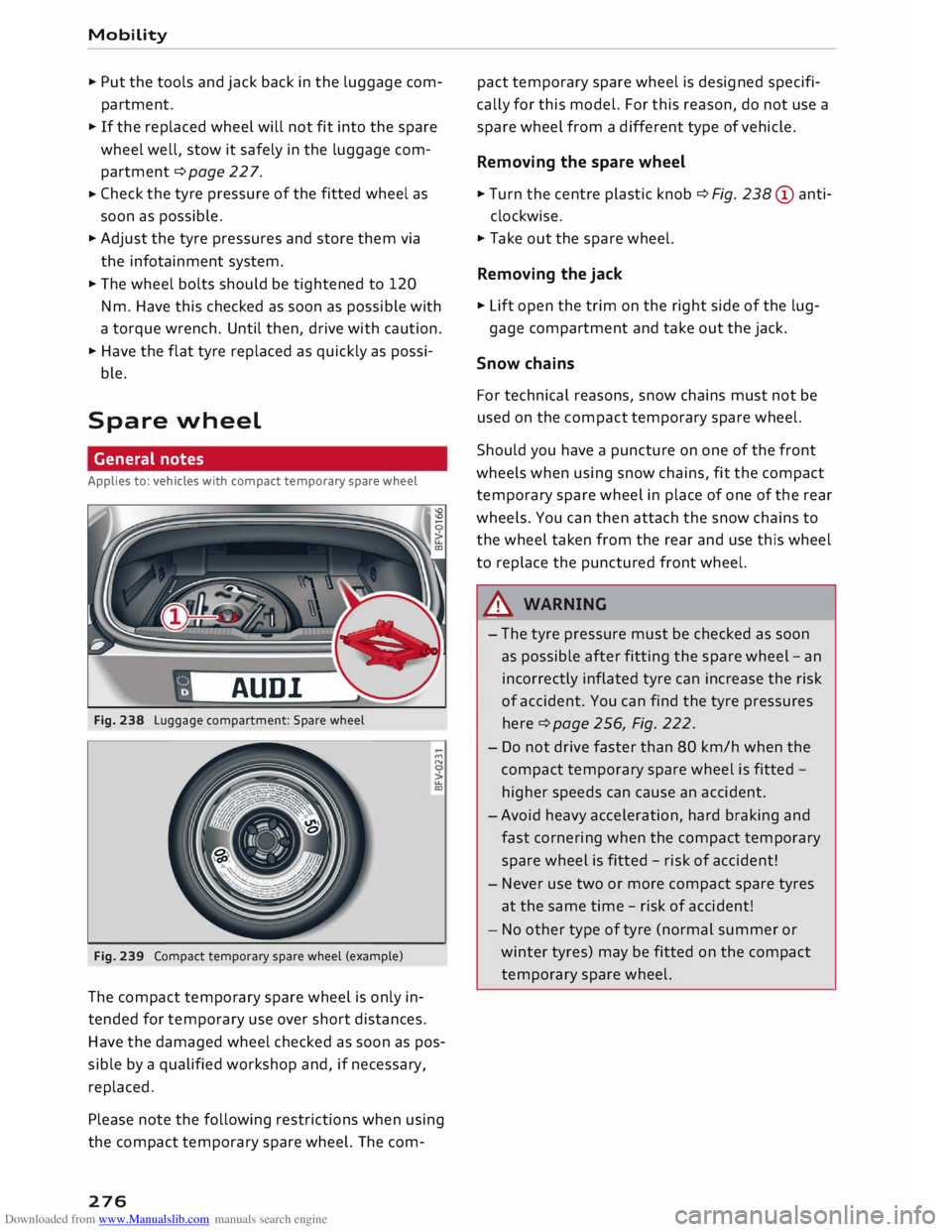
AUD!
Fig. 238 Luggage compartment: Spare wheel
Fig. 239 Compact temporary spare wheel (example) ""
N
u..
co
The compact temporary spare wheel is only in
tended for temporary use over short distances.
Have the damaged wheel checked as soon as pos
sible by a qualified workshop and, if necessary,
replaced.
Please note the following restrictions when using
the compact temporary spare wheel. The com-
276 pact
temporary spare wheel is designed specifi
cally for this model. For this reason, do not use a
spare wheel from a different type of vehicle .
Removing the spare wheel
... Turn the centre plastic knob¢ Fig. 238 © anti-
clockwise.
... Take out the spare wheel.
Removing the jack
... Lift open the trim on the right side of the lug-
gage compartment and take out the jack.
Snow chains
For technical reasons, snow chains must not be
used on the compact temporary spare wheel.
Should you have a puncture on one of the front
wheels when using snow chains, fit the compact
temporary spare wheel in place of one of the rear
wheels. You can then attach the snow chains to
the wheel taken from the rear and use this wheel
to replace the punctured front wheel.
A WARNING
- The tyre pressure must be checked as soon
as possible after fitting the spare wheel -an
incorrectly inflated tyre can increase the risk
of accident. You can find the tyre pressures
here ¢ page 256, Fig. 222.
- Do not drive faster than 80 km/h when the
compact temporary spare wheel is fitted
higher speeds can cause an accident.
- Avoid heavy acceleration, hard braking and
fast cornering when the compact temporary
spare wheel is fitted -risk of accident!
- Never use two or more compact spare tyres
at the same time -risk of accident!
- No other type of tyre (normal summer or
winter tyres) may be fitted on the compact
temporary spare wheel.
Page 304 of 306
Downloaded from www.Manualslib.com manuals search engine Index
Vehicle data
Identification data . . . . . . . . . . . . . . . . . . .
287
Version information . . . . . . . . . . . . . . . . . . .
216
VIEW ................................ 23
VIEW button . . . . . . . . . . . . . . . . . . . . . . . . . . 21
Voice guidance
see Multi-function steering wheel . . . . 21,
23
Volume ............................. 217
Multi-function steering wheel . . . . . . . . . . . 23
Speech dialogue system . . . . . . . . . . . 23, 133
vv
Warm engine . . . . . . . . . . . . . . . . . . . . . . . . . 66
Warning lamps . . . . . . . . . . . . . . . . . . . . . . . . 11
Warning triangle . . . . . . . . . . . . . . . . . . . . . 269
Washer fluid level (indicator lamp) . . . . . . . . 18
Washing . . . . . . . . . . . . . . . . . . . . . . . . . . . .
263
Washing ornamental trim/mouldings . . . . 265
Washing rear lights . . . . . . . . . . . . . . . . . . .
264
Washing tailpipes . . . . . . . . . . . . . . . . . . . . .
264
Washing wheel rims . . . . . . . . . . . . . . . . . . . 264
Waveband . . . . . . . . . . . . . . . . . . . . . . . 185, 187
Waxing ............................. 265
Weights .. . . . . . . . . . . . . . . . . . . . . . . . . . . . 288
Wheel bolt caps
Removing . . . . . . . . . . . . . . . . . . . . . . . . . .
272
Wheel bolts . . . . . . . . . . . . . . . . . . . . . . . . .
257
Anti-theft . . . . . . . . . . . . . . . . . . . . . . . . . . 273
Loosening . . . . . . . . . . . . . . . . . . . . . . . . . .
273
Torque . . . . . . . . . . . . . . . . . . . . . . . . . . . .
275
Wheel imbalance . . . . . . . . . . . . . . . . . . . . .
255
Wheels ............................. 254
Changing ...................... 272, 275
Tyre pressure loss indicator . . . . . . . . . . . . 2
58
Tyre pressure monitoring system . . . . . . . 260
Washing . . . . . . . . . . . . . . . . . . . . . . . . . . . 264
Wi-Fi Audi music stream . . . . . . . . . . . . . . . . . . .
195
Audio players . . . . . . . . . . . . . . . . . . . . . . .
195
Hotspot . . . . . . . . . . . . . . . . . . . . . . . . . . .
165
Online media . . . . . . . . . . . . . . . . . . . . . . . 196
Settings . . . . . . . . . . . . . . . . . . . . . . . . . . . 165
see also Personal Wi-Fi hotspot . . . . . . . .
161
Windbreak . . . . . . . . . . . . . . . . . . . . . . . . . . . 41
302 Windows
Cleaning/de-icing . . . . . . . . . . . . . . . . . . . . 265
Defrosting . . . . . . . . . . . . . . . . . . . . . . . 61, 63
Windscreen Defrosting . . . . . . . . . . . . . . . . . . . . . . . 61, 63
Washing . . . . . . . . . . . . . . . . . . . . . . . . . . . . 50
Windscreen washer system . . . . . . . . . . 50, 252
Reservoir capacity . . . . . . . . . . . . . . . . . . . 288
Windscreen wipers
Changing blades . . . . . . . . . . . . . . . . . . . . . 51
Cleaning wiper blades . . . . . . . . . . . . . . . . . 51
Indicator lamp . . . . . . . . . . . . . . . . . . . . . . . 18
Lifting wipers off windscreen . . . . . . . . . . . 51
Switching on/off . . . . . . . . . . . . . . . . . . . . .
SO
Winter conditions
Cooling system . . . . . . . . . . . . . . . . . . . . . .
249
De-icing windows . . . . . . . . . . . . . . . . . . . .
265
Defrosting windows . . . . . . . . . . . . . . . . 61, 63
Diesel . . . . . . . . . . . . . . . . . . . . . . . . . . . . . 241
Seat heating . . . . . . . . . . . . . . . . . . . . . . . . . 63
Snow chains . . . . . . . . . . . . . . . . . . . . . . . .
257
Tyres . . . . . . . . . . . . . . . . . . . . . . . . . . . . . . 257
Vehicle battery...................... 251
Washing the vehicle . . . . . . . . . . . . . . . . . . 263
Windscreen washer system . . . . . . . . . . . .
252
Winter tyres . . . . . . . . . . . . . . . . . . . . . . . . .
257
Wiper blades, changing . . . . . . . . . . . . . . . . . 51
WLAN see Wi-Fi . . . . . . . . . . . . . . . . . . . . . . . . . . . 195
Wrench . . . . . . . . . . . . . . . . . . . . . . . . . . . . .
270
X
Xenon headlights . . . . . . . . . . . . . . . . . . . . . .
44
z
Zooming (map) ................ 22, 171, 178