lock AUDI TT ROADSTER 2017 Service Manual
[x] Cancel search | Manufacturer: AUDI, Model Year: 2017, Model line: TT ROADSTER, Model: AUDI TT ROADSTER 2017Pages: 314, PDF Size: 76.54 MB
Page 194 of 314
Safe ty belts
-Never remove a safety be lt while the ve hicle
is mov ing . Do ing so will increase your r isk of
being injured or killed.
- Never wear belts twisted.
- Never wear belts over rigid or breakable ob -
jects in or on your cloth ing, such as eye
glasses, pens, keys, etc., as these may cause
injury.
- Never allow safety be lts to become dam
aged by being caught in door or seat hard
ware.
- Do not wear the shoulder part of the belt
under your arm or otherwise out of position.
- Severa l layers of heavy clothing may inter
fere with cor rect positioning of belts and re
duce the overall effectiveness of t he system.
- Always keep belt buckles free of anything
that may prevent the b uckle from latching
secu rely.
- Never use comfort clips or devices that cre
ate slack in the shoulder belt. However, spe
c ial clips may be requ ired for the prope r use
of some chi ld restraint systems.
- Torn or frayed safety belts can tear and
damaged belt hardware can break in an acc i
dent. Inspect belts regula rly .
If webbing,
bind ings, buckles, or ret rac to rs are dam
aged, have belts repl aced by an auth orized
Audi dealer or quali fied workshop.
- Safety belt s th at have been wo rn a nd loaded
in an accident m ust be rep lace d wi th the
c orrect repl acemen t sa fety be lt by an au
t h o rized Aud i dea le r. Replacement may be
necessary even if damage cannot be clear ly
seen. Anchorages that were loaded m ust al
so be inspected.
- Never remove, modify, disassemble, or try
to repair the safety belts yourself.
- Always keep t he be lts clean . Di rty be lts may
not work properly and can impai r the f unc
tion of the inertia reel¢
table Interior
cleaning on page 268.
192
Safety belts
Fastening safety belts
Seat first -everybody buckle up!
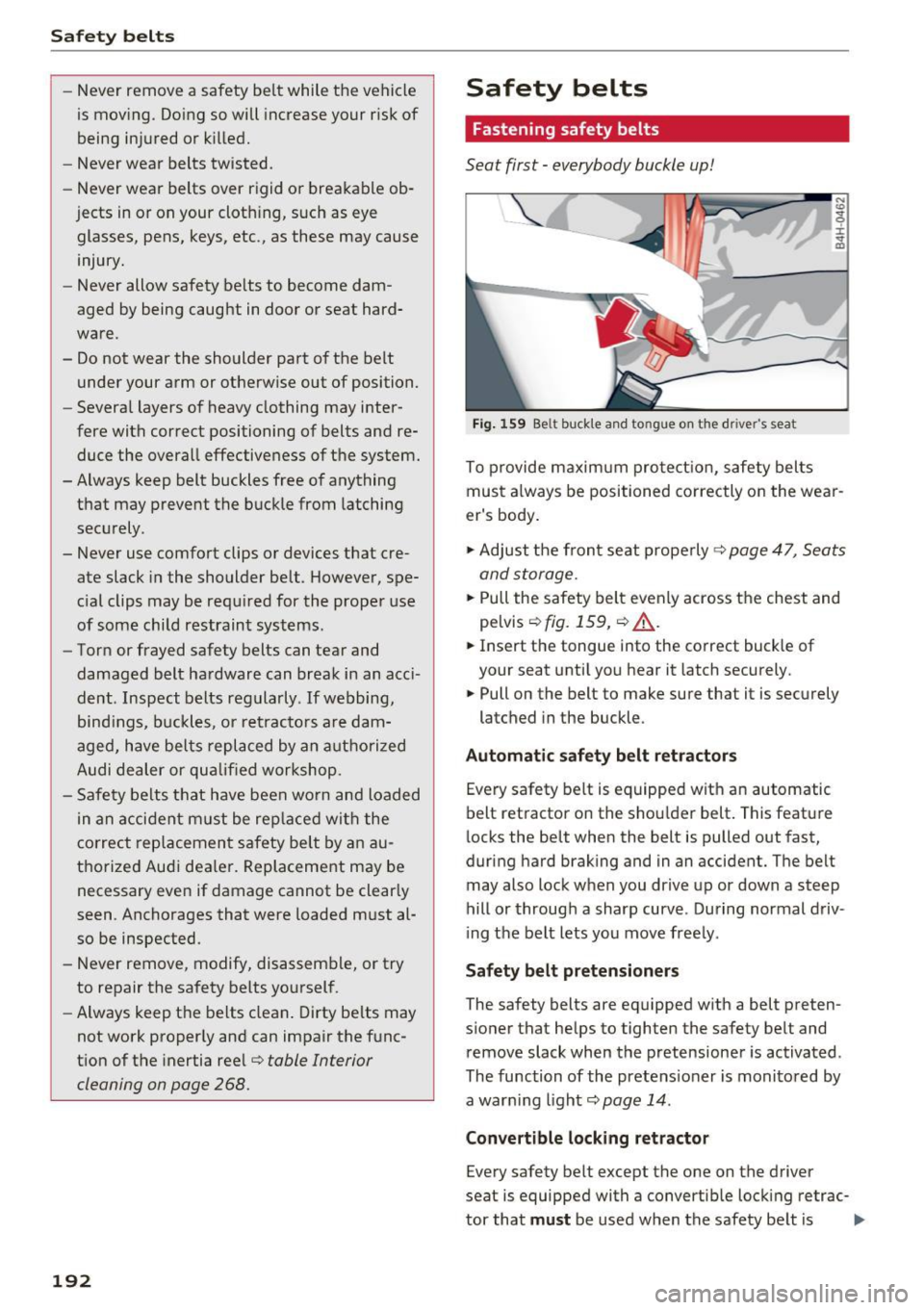
Fig. 159 Be lt buc kle and tongue on the driver 's seat
N
CD
~ ::i: .. a,
To p rovide m axim um pro te ct io n, safety belts
must a lways be positioned co rrectly on the wear
er's body .
.., Ad just the fron t se at prope rly ¢
page 47 , Seats
and storage.
.., Pull the safety belt even ly across the chest and
pe lvis
r::!>fig. 159, ¢ _& .
.., Insert the tongue into the correct buck le of
your seat until you hear it latch securely.
.., Pull on the belt to make sure that it is sec urely
latched in the buckle .
Automatic safety belt ret ractors
Every safety belt is equipped wit h an automatic
belt retractor on the shou lder belt . This feature
locks the belt when the belt is pulled out fast,
during hard brak ing and in an accident. The belt
may also lock when you dr ive up or down a steep
hill or through a sharp curve . During normal driv
i ng t he belt lets you move free ly .
S afety belt pretensioners
The safety belts are equ ipped w ith a belt preten
s ioner that he lps to tighten the safety belt and
remove slack when the pretensioner is activated .
The function of the pretens ioner is monitored by
a war ning light¢
page 14 .
Convertible lock ing retractor
Every safety belt except the one on the driver
seat is equipped with a convertib le lock ing retrac-
tor that
mu st be used when the safety be lt is Ill>-
Page 195 of 314
CD
CD
.... N
" N .... 0 r--. V, co
used to attach a child seat. Be sure to read the
important information about this feature
r::!) page 22 7.
.&_ WARNING
Improperly positioned safety belts can cause
serious injury in an accident
<=>page 193,
Safety belt position.
- Safety belts offer optimum protection only
when the seatback is upright and belts are
properly positioned on the body.
- Never attach the safety belt to the buckle
for another seat. Attaching the belt to the
wrong buckle will reduce safety belt effec
tiveness and can cause serious personal in
JUry.
-A passenger who is not properly restrained
can be seriously injured by the safety belt it
self when it
moves from the stronger parts
of the body into critical areas like the abdo
men.
- Always lock the convertible locking retractor
when you are securing a child seat in the ve
hicle
c> page 228.
(D Tips
For information on safety belt pretensioners,
refer tor::!)
page 194.
Safety belt position
Correct belt position is the key to getting maxi
mum protection from safety belts.
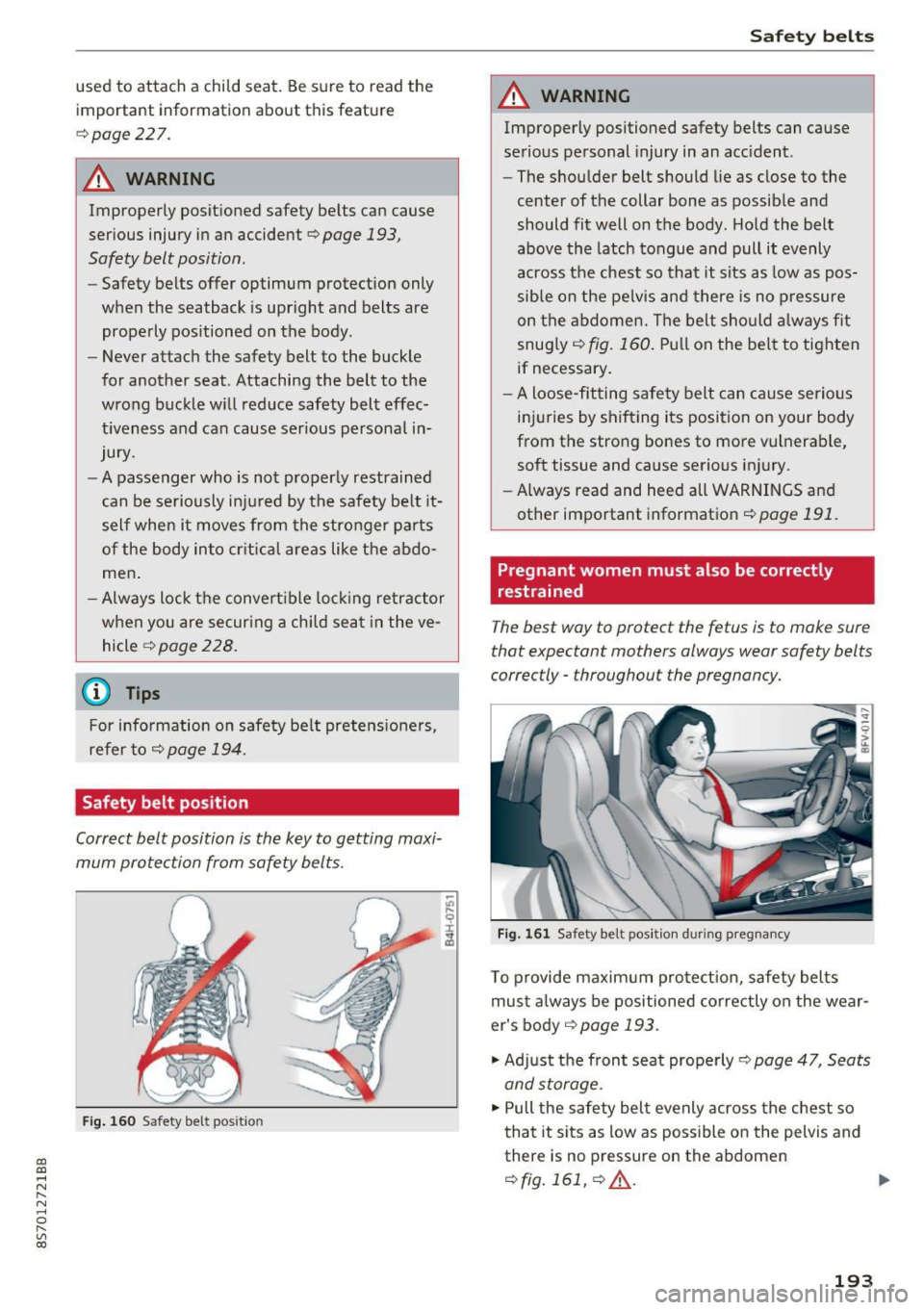
Fig. 160 Safety belt pos itio n
Safety belts
.&_ WARNING """-iiiiiiiii
Improperly positioned safety belts can cause
serious personal injury in an accident.
- The shoulder belt should lie as close to the
center of the collar bone as possible and
should fit well on the body. Hold the belt
above the latch tongue and pull it evenly
across the chest so that it sits as low as pos
sible on the pelvis and there is no pressure
on the abdomen. The belt should always fit
snugly
c> fig. 160. Pull on the belt to tighten
if necessary.
- A loose-fitting safety belt can cause serious
injuries by shifting its position on your body
from the strong bones to more vulnerable
I
soft tissue and cause serious injury.
- Always read and heed all WARNINGS and
other important information
i=;, page 191.
Pregnant women must also be correctly
restrained
The best way to protect the fetus is to make sure
that expectant mothers always wear safety belts
correctly- throughout the pregnancy.
Fig. 161 Safety belt position during pregnancy
To provide maximum protection, safety belts
must always be positioned correctly on the wear
er's body
<=> page 193.
"'Adjust the front seat properly c> page 47, Seats
and storage.
"' Pull the safety belt evenly across the chest so
that it sits as low as possible on the pelvis and
there is no pressure on the abdomen
c>fig .161 ,r=> .&_ .
193
Page 202 of 314
Airbag system
Front airbags
Description of front airbags
The airbag system can provide supplemental
protection to properly restrained front seat occu
pants.
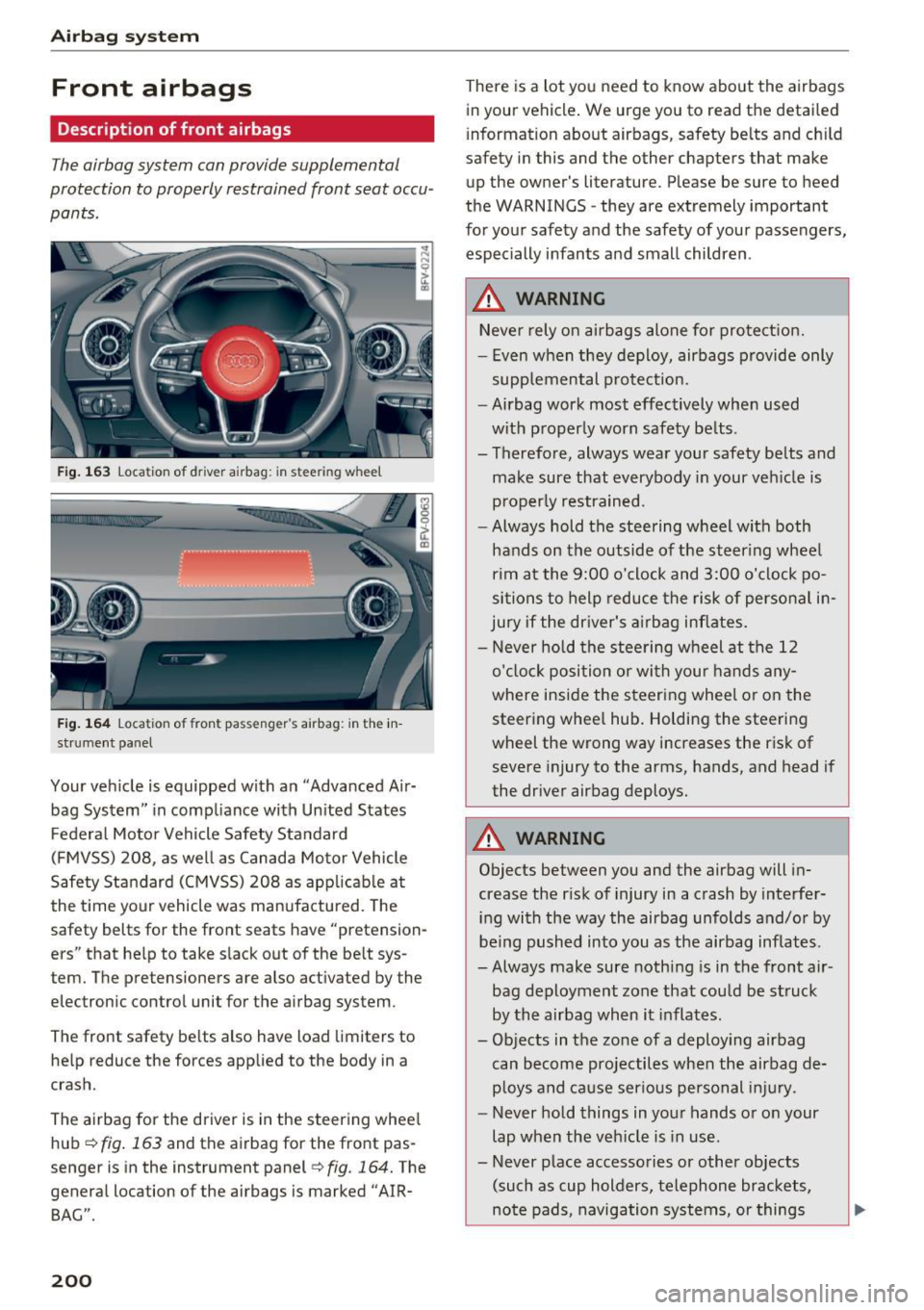
Fig. 163 Location of dr iver airbag: in steering whee l
Fig. 164 Location of front passenger's airbag: in the in
strument panel
Your vehicle is equipped with an "Advanced Air
bag System" in compliance with Un ited States
Federal Motor Vehicle Safety Standard
(FMVSS)
208, as well as Canada Motor Vehicle
Safety Standard (CMVSS)
208 as applicable at
the time your vehicle was manufactured. The
safety belts for the front seats have "pretension
ers" that help to take slack out of the belt sys
tem. The pretensioners are also activated by the
electronic control unit for the airbag system.
The front safety be lts also have load limiters to
help reduce the forces applied to the body in a
crash.
The airbag for the driver is in the steering wheel
hub<=>
fig . 163 and the airbag for the front pas
senger is in the instrument panel
<=>fig. 164. The
general location of the airbags is marked "AIR
BAG".
200
There is a lot you need to know about the airbags
in your vehicle . We urge you to read the detai led
i nformation about airbags, safety belts and ch ild
safety in this and the other chapters that make
up the owner's literature. Please be sure to heed
the WARNINGS -they are extremely important
for your safety and the safety of your passengers,
especially infants and small children .
.&_ WARNING -
Never rely on airbags alone for protection.
- Even when they deploy, airbags provide only
supp lemental protection.
- Airbag work most effectively when used
with properly worn safety belts .
- Therefore, always wear your safety belts and make sure that everybody in your vehicle is
properly restrained.
- Always hold the steering wheel w ith both
hands on the outside of the steering wheel
rim at the 9:00 o'clock and 3:00 o'clock po
sitions to help reduce the risk of personal in
jury if the driver's airbag inflates.
- Never hold the steering wheel at the
12
o'clock position or with your hands any
where inside the steering wheel or on the
steering whee l hub. Holding the steering
wheel the wrong way increases the risk of
severe injury to the arms, hands, and head if
the driver airbag deploys.
.&_ WARNING
Objects between you and the airbag will in
crease the r isk of injury in a crash by interfer
ing with the way the airbag unfolds and/or by
being pushed into you as the airbag inflates.
- Always make sure nothing is in the front air-
bag deployment zone that could be struck
by the airbag when it inflates.
- Objects in the zo ne of a deploying airbag
can become projectiles when the airbag de
ploys and cause serious personal injury.
- Never hold things in your hands or on your
lap when the vehicle is in use.
- Never place accessories or other objects (such as cup holders, telephone brackets,
note pads, navigation systems, or things
-
Page 211 of 314
co
co
.... N
" N .... 0
" "' c:o
met, be sure to check the light regularly to make
certain that the
P A SSENGER AIR BAG OFF '-1;
light stays on continuously whenever the ignition
is on. If the
PAS SENGER AIR BAG OFF '-1; light
does not appear on and does not stay on all the
time, stop as soon as it is safe to do so and
- reactivate the system by turning the ign ition
off for more than 4 seconds and then turning it
on again;
- remove and reinstall the child restraint. Make sure that the child restraint is properly installed and that the safety belt for the front pas
senger seat has been correctly routed through
the child restraint as descr ibed in the child re
straint manufacturer's i nstructions;
- make sure that the convertible locki ng retrac
tor on the safety be lt for the front passenger
seat has bee n activated and that the safety belt
has been pulled tight.
- make sure that no electrical device (such as a
laptop, CD player, electronic games device,
power inverter or seat hea ter for child seats) is
placed or used on the front passenger seat if
the device is connected to the 12•volt socket or
the cigarette lighter socket;
- make sure that no seat heater has been retro
fitted or otherwise added to the front passen
ger seat;
- make sure that nothing can interfere with the
safety belt buckles and that they are not ob
structed;
- make sure that there are no wet objects (such
as a wet towel) and no water or other liquids on
the front passenger seat cush ion.
If the PASSENGER AIR BAG OFF~; light st ill
doe s not come on ...
If the PAS SENGER AIR BA G OFF '-1; light sti ll
does not come on and does not stay on continu
ously (when the ignition is sw itched on),
- take the child restraint off t he front passenger
seat and have the airbag system inspected by
your Audi dealer immed iate ly.
Th e PASSENGER AIR BAG OFF~; light
should NOT come on ...
The PA SSENGER AIR BAG OFF ~ ; light should
NOT come on when the ign ition is on and an
Airb ag sys tem
adult is sitting in a proper seating pos ition on the
front passenger seat. If the
PASSENGER AIR
BAG OFF~;
light comes on and stays on whi le
driv ing, under these c ircumstances, make sure
that:
- the adult on the front passenger seat is proper
ly seated on the center of the seat cushion w ith
his or her back up against the backrest and the backrest is not reclined,
- the adult is not taking we ight off the seat by
holding on to the passenger assist handle
above the front passenger door or support ing
their weight on the armrest,
- the safety belt is being properly worn and that
there is not a lot of slack in the safety belt web
b ing ,
- there are no aftermarket seat covers or cush
ions or other things (such as blankets) on the
front passenger seat that might cause the ca pacitive passenge r detection system to miscal
culate e lectr ica l capaci ta nce.
' Important safety instructions on
monitoring the Advanced Airbag System
A WARNING
--- If the stat us of the Advanced Airbag System
has changed while the vehicle is moving, the
PASSENGER AIR BAG OFF '-1; ON @ light
blin ks for about 5 seconds to cat ch the driv
er 's attent ion . If this happens, a lways stop
as soon as it is sa fe to do so and check the
steps described above .
- If the
PASSENGER AIR BAG OFF~; light
does not go off when an adult who is not
very small is sitting on the front passenger
seat after tak ing the steps described above,
have the airbag system inspected by your
author ized Audi dealer before t ransporting
anyone on the front passenger seat .
A WARNING ....._
An airbag system that is not functioning prop
e rly cannot prov ide supplemental protect io n
i n a fronta l crash.
- If the ai rbag ind icator light
<=:> page 14
comes when the veh icle is being used, have
209
Page 226 of 314
Child safety
-Never install a rearward facing child safety
seat on the front passenger seat unless the
PASSE NGER AIR BAG OFF,;; light comes
on and stays on. If the
PA SSEN GE R AIR
BAG OFF ,;;
light does not come on and stay
on the inf lating airbag w ill hit the child safe
ty seat or infant ca rr ier with great force and
will smash the chi ld safety seat and chi ld
against the backrest, center armrest, door
or roof. Have the airbag system inspected
immediately by your Audi dealer.
- Never place or use any electrical device
(such as a laptop, CD player, electronic
games device, power inverter or seat heater
for child seats) on the front passenger seat
if the device is connected to the 12-volt
socket or the cigarette lighter socket.
- If a seat heater has been retrof itted or oth
erwise added to the front passenger seat,
never install any ch ild restraint system on
this seat .
- Make sure that there are no wet objects
(such as a wet towel) and no water or other
liquids on the front passenger seat cushion.
- Never place objects on the seat (such as a
laptop, CD player, electronic games dev ice,
power inverter or seat heater for child
seats). T hese may influence the e lectr ica l
capacitance measured by the capaci tive pas
senger detection system and can also fly
around in an accident and ca use serious per
sonal injury.
- Always read and heed all WARN INGS when
ever using a child restrained in a vehicle is
being used
Q page 189, Safety belts,
¢ page 196, Airbag system
and
¢ page 218, Important information.
224
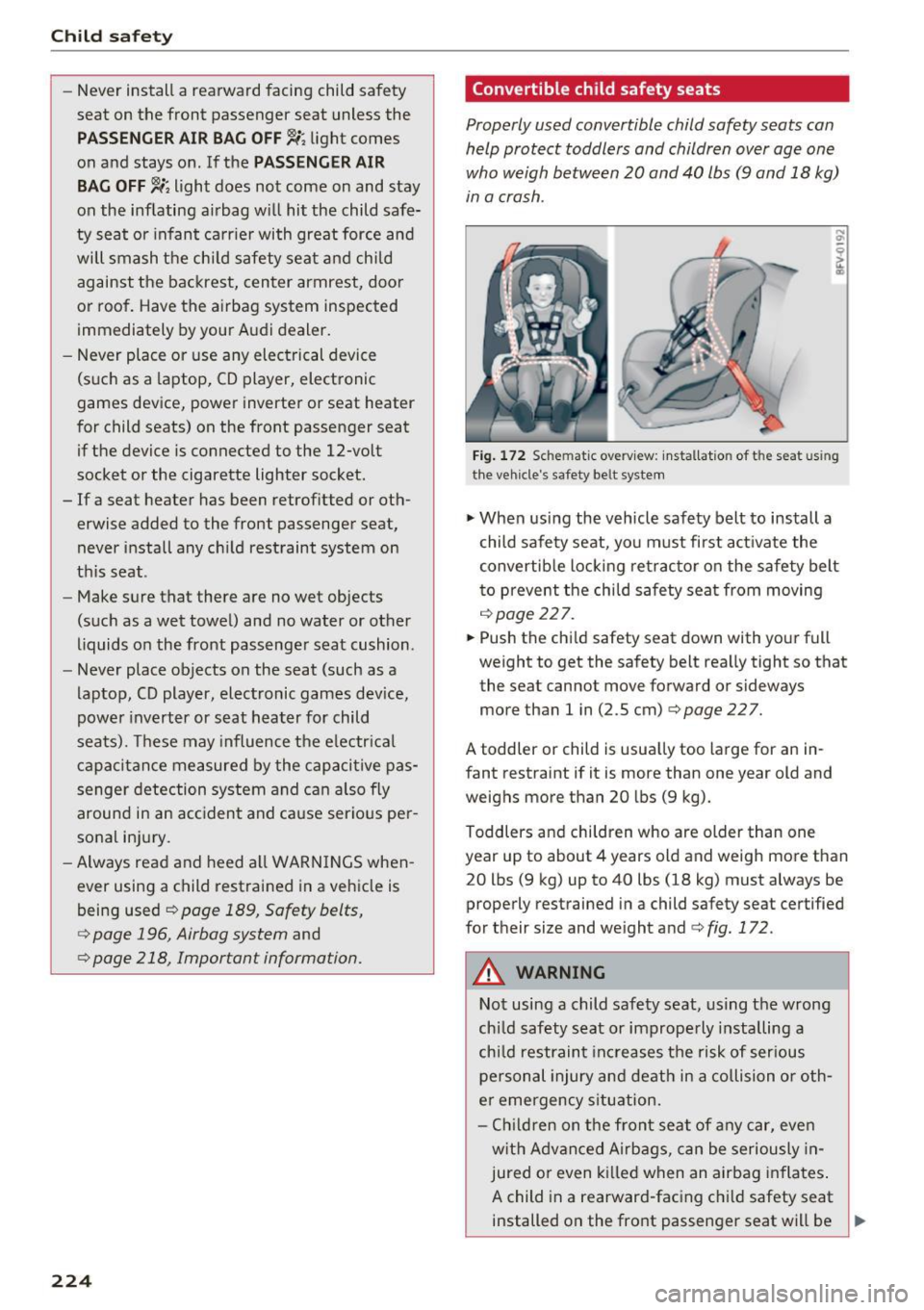
Convertible child safety seats
Properly used convertible child safety seats con
help protect toddlers and children over age one who weigh between 20 and 40 lbs (9 and 18 kg)
in a crash .
.... a,
Fig. 1 72 Sche matic overv iew : installat ion of t he seat using
the vehicle's safety belt system
""When using the vehicle safety belt to install a
child safety seat, yo u must first act ivate the
convertib le locking retractor on the safety belt
t o prevent the chi ld safety seat from moving
¢ page 227.
"" Push the chi ld safety seat down with your full
weight to get the safety belt really tight so that
the seat cannot move forward or sideways
more than 1 in (2.S cm)¢
page 227.
A toddler or child is usua lly too large for an in
fant restraint if it is more than one year old and
weighs more than 20 lbs (9 kg).
Toddlers and children who are older than one
year up to about 4 years old and weigh more than 20 lbs (9 kg) up to 40 lbs (18 kg) must always be
properly restrained in a child safety seat certified
for their size and we ight and ¢
fig. 172 .
A WARNING
Not using a child safety seat, using the wrong
chi ld safety seat or imprope rly installing a
chi ld restrain t inc reases the risk of ser ious
personal injury an d death in a co llision or oth
e r emergency s ituation.
- Ch ild ren on t he front seat of a ny car, eve n
w it h Advanced Airbags, can be seriously in
jured or even kill ed when an airbag inflates .
A child in a rearward-facing ch ild safety seat
installed on the front passenger seat will be .,.
Page 228 of 314
Child safety
The vehicle's safety belts alone will not fit most
childr en until they are at least 4
ft 9 in (57 in/
1.45 m) tall and weigh about 80 lbs (36 kg) .
Booster seats raise these children up so that the
safety belt will pass properly over the s tronger
parts of their bodies and the safety belt can help
protect them in a crash .
"' Do not use the convertible locking retractor
when using the vehicle's safety belt to restrain
a child on a booster seat .
"'The shoulder belt must lie as close to the cen
ter of the child's collar bone as possible and must lie flat and snug on the upper body.
It
must never lie across the throat or neck. The
lap belt must lie across the pelvis and never
across the stomach or abdomen. Make sure the
belt lies flat and snug . Pull on the belt to tight
en if necessary .
Children up to at least 8 years old (over 40 lbs or
18 kg) are best protected in child safety seats de
signed for their age and weight. Experts say that
the skeletal structure, particularly the pelvis, of
these children is not fully developed, and they
must not use the vehicle safety belts without a
suitable child restraint.
It is usually best to put these children in appro
priate booster seats. Be sure the booster seat
meets all applicable safety standards.
Booster seats raise the seating position of the
child and reposition both the lap and shoulder
parts of the safety belt so that they pass across
the child's body in the right places . The routing of
the belt over the child's body is very important
for the child's protection, whether or not a boos
ter seat is used.
Never use the lap belt portion of the vehicle 's
safety belt alone to restrain any child, regardless
of how big the child is. Always remember that
children do not have the pronounced pelvic struc
ture required for the proper function of lap belt
port ion of the vehicle's three point lap and
shoulder belts . The child's safety absolutely re
quires that a lap belt portion of the safety belt be
fastened snugly and as low as possible around the pelvis. Never let the lap belt portion of the
226
safety belt pass over the child's stomach or abdo
men.
In a crash, airbags must inflate w ithin a blink of
an eye and with considerable force. In order to do
its job, the airbag needs room to inflate so that it
will be there to protect the occupant as the occu
pant moves forward into the airbag.
A vehicle occupant who is out of pos it ion and too
close to the airbag gets in the way of an inflating
airbag. When an occupant is too close, he or she
will be struck vio lently and w ill receive serious or
possibly even fatal injury.
In order for the airbag to offer protection, it is
important that all vehicle occupants , especially
any ch ildren, who must be in the front seat be
cause of exceptional circumstances, be properly
restrained and as far away from the airbag as
possible. By keeping room between the child 's
body and the front of the passenger compart
ment, the airbag can inflate completely and pro
vide supplemental protection in certa in frontal
collisions.
,&. WARNING
Not using a booster seat, using the booster
seat improperly, incorrect ly installing a boos
ter seat or using the vehicle safety belt im
proper ly increases the risk of serious personal
injury and death in a collision or other emer
gency situation. To help reduce the risk of se
rious personal injury and/or death:
- The shoulder belt must lie as close to the
center of the child's collar bone as possible
and must lie flat and snug on the upper
body . It must never lie across the throat or
neck . T he lap belt must lie across the pelvis
and never across the stomach or abdomen.
Ma ke sure that the be lt lies flat and snug.
Pull on the belt to tighten if necessary.
- Failure to properly route safety belts over a
child's body will cause severe injuries in an
accident or other emergency situation
<=> page 189.
- The rear side of the chi ld safety seat should
be positioned as close as possible to the
backrest on the veh icle seat.
-
Page 229 of 314
co
co
.... N
" N .... 0
" "' c:o
-Children on the front seat of any car, even
with Advanced Airbags, can be seriously in
jured or even killed when an airbag inflates.
- Never let a child stand or kneel on the seat .
- Never let a child ride in the cargo area of
your vehicle.
-Always remember that a child leaning for ward, sitting sideways or out of position in any way during an accident can be struck by
a deploying airbag. This will result in serious
personal injury or death.
- If you must install a booster seat on the
front passenger seat because of exceptional
c ircumstances the
PA SSENGER AIR BAG
OFF ~;
light must come on and stay on,
whenever the ignition is switched on.
- If the
PAS SENG ER AIR BAG OFF~; light
does not come on and stay on, perform the
checks described ¢
page 207, Monitoring
the Advanced Airbag System.
- If the PASSE NGE R AIR BAG OFF~; light
does not come on and stay on wheneve r the
ignition is switched on the infla ting airbag
will hit the child safety sea t or i nfant c arr ier
with great force and will smash the child safety seat and child against the backrest,
center armrest, door or roof . Have the air
bag system inspected immediately by your
Audi dealer.
- Always read and heed all WARNINGS when
ever using a child restrained in a veh icle is
being used¢
page 189, Safety belts,
¢ page 196, Airbag system
and
¢page 218, Important information .
Securing child seats
Securing a child safety seat using a safety
belt
Safety belts for the front passenger con be
locked with the convertible locking retractor to
properly secure child safety seats .
The safety belt emergency locking retractor for
the front passenger's seat safety belt have a con
vertible locking retractor for chi ld restraints . The
safety belt must be locked so that belt webbing
cannot unreel. The retractor can be activated to
Ch ild safety
lock the safety belt and prevent the safe ty be lt
webbing from loosening up during norma l driv
ing. A chi ld safety seat can only be properly in
stalled when the safety belt is locked so that the child and ch ild safety seat will stay in p lace.
Always remember : Even though your vehicle is
equipped with an Advanced Airbag system, a
child should always r ide in the seat properly re
strained for its age and s ize.
A WARNING .,.__
Improperly installed ch ild safety seats in
crease the risk of serious personal injury and
death in a co llision .
-
-Always make sure that the safety belt re
tractor is locked when installing a child
safety seat. An un locked safety be lt retrac
tor cannot hold the ch ild safety seat in place
du ring normal driving or in a c rash.
- Always buckle the child safety seat fi rm ly in
p lace even if a ch ild is not sitt ing in it. A
loose chi ld safety seat can fly around during
a sudden stop or in a co llision.
- If the backrest is not securely latched, the
child and the ch ild restraint will be thrown
forward together with the backrest and will strike parts of the vehicle interior. The child
can be seriously injured or killed.
- The inflating airbag will hit the ch ild safety
seat or infant carrier with great force and
will smash the child safety seat and child aga inst the backrest, center armrest, door
or roof.
- Forward-facing child safety seats or infant
carriers installed on the front passenger's
seat may interfere w ith the deployment of
the airbag and cause serious in ju ry to the
child.
- Always read and heed all WARNINGS when
eve r us ing a child restrained in a vehicle is
be ing used
¢ page 218. Special p recautions
apply when ins ta lli ng a child safety seat on
the front passenge r seat¢
page 197, Child
restraints on the front seat -some impor -
tant things to know . ..,
227
Page 230 of 314
Child safet y
A WARNING
Always take spec ial precaut ions if you must
install a forward or rearward-fac ing ch ild re
straint on the front passenger's seat in excep
tional situations:
- Whenever a forward or rearwa rd-facing
child restraint is insta lled on the front pas
senger seat, t he
PASSENGER AIR BAG OFF
~; light mus t come on and stay on whenev
e r t he ignition is sw itche d on.
- If the
PASSENGER AIR BAG OFF~; light
does not come on and stay on, perform the
checks described~
page 207, Monitoring
the Advanced Airbag System.
- If the PASSENGER AIR BAG OFF~; light
does not come on and stay on whenever the
ignition is switched on the inflating air bag
will hit the c hild safety seat o r infant carrier
with great force and will smash the child
safety seat and child against the backrest, center armrest, door or roof. Have the air
bag system inspected immediately by your
Audi dealer.
- Improper installation of ch ild restraints can
red uce their effect iveness or even prevent
t h em from p roviding any p rotection .
-An improperly installed c hild rest raint can
interfere w ith the airbag as it deploys and
seriously injure or even kill the child.
- Always carefully follow the manufac turer 's
instructions p rovided w ith the ch ild safety
seat or car rier.
- After checking to ma ke sure that the child
restra int is prope rly installed, ma ke certai n
t h at the child res traint is co rrec tly recog
ni ze d by the c apac it ive passenger detec tion
system in the front passenger sea t and that
the
PASSENGER AIR BAG OFF~. light sig
nals the correct front passenger frontal air
bag status.
A WARNING
Forward-fac ing ch ild rest raints:
- Always make sure the forward-facing seat
has been designed and cert ified by its man
ufact urer for use on a front seat with a pas
senger front and side a irbag .
228
-Never put the fo rwa rd-facing child restraint
up, against o r very near the instrument pan
el.
- Always move the passenge r seat into its
rearmost posit ion in the seat's fo re and aft
ad justment range , as far away from the a ir
bag as poss ible before installing the for
ward-facing chi ld restraint. The back res t
m ust be adjusted to an upr ight position.
- Ma ke sure that the
PASSENGER AIR BAG
OFF ~;
light comes on and stays on all the
time w heneve r the ig nition is switched o n.
A WARNING
R earward-faci ng chi ld restrain ts:
- A child in a rearward-fac ing ch ild safety seat
installed on the fron t passenger seat will be
serious ly injure d and can be killed if t he
front airbag infl ates -even with an Ad
vance d Ai rb ag System.
- The infl ating air bag will h it t he ch ild safety
sea t or i nfan t car rier with great force an d
w ill smash the child safety seat and child
aga inst the backrest, center a rm rest, door
or roof.
- Always be especially carefu l if yo u must in
stall a rea rward facing child safety seat on
the front passenge r seat in exceptiona l cir
cumstances.
- Make sure that the
PASSENGER AIR BAG
OFF ~;
light comes on and stays on all the
time wheneve r the ign it ion is switched on.
- If the
PASSENGER AIR BAG OFF~; light
does not come on and stay on, have the air
bag system inspected by you r Audi dealer.
Activating the convertible locking retractor
Use the convertible locking retractor to secure a
child restraint.
A lways heed the chi ld safety seat manufacturer's
i nst ruct ions when insta lling a child restra int i n
yo ur vehicle. To activate the convertib le locking
r etractor:
.,. Place the chi ld restraint on a seat .
.,. Slowly p ull the belt
all the way out .
Page 231 of 314
co
co
.... N
" N .... 0
" "' c:o
~ Route it around or through the child restraint
belt path
¢ .&_.
~ Push the child safety seat down with your full
weight to get the safety be lt really tight.
~ I nsert the belt tongue into the buckle for that
seating position .
~ Guide the safety belt back into the retractor un
t il the belt lies flat and snug on t he chi ld safety
seat.
~ You should hear a "clicking" no ise as the belt
winds back into the inertia reel. Test the con
vertib le locking retractor by pu lling on the belt .
You should no longer be able to pu ll the belt
out of the retractor. The convertible locking re
tractor is now activated .
~ Make sure that the red release button is facing
away from the child restraint so that it can be
unbuckled qu ickly.
~ Pullon the belt to make sure the safety belt is
properly tig ht and fastened so that the seat
cannot move forward and s ideways more than
1 in (2 .5 cm) .
A WARNING
Using the wrong child restraint or an improp
erly installed child restraint can cause serious
personal injury or death in a crash.
- Always make sure that the safety belt re-
tractor is locked when install ing a child
safety seat. An unlocked safety belt retrac
tor cannot hold the child safety seat in place
dur ing normal driving or in a crash .
- Always buckle the child safety seat firmly in
place even if a child is not sitting in it . A
loose child safety seat can fly around during
a sudden stop or in a crash.
-Always make sure the seat backrest to which the ch ild restraint is installed is in an up
right position. Othe rw ise, the seatback with
the ch ild safety seat attached to it could fly
forward in the event of an accident o r other
emergency sit uation .
- Always read and heed all WARN INGS when
ever using a child res trained in a veh icle is
being used
¢ page 218. Spec ia l precautions
apply when installing a child safety seat on
the front passenger seat ¢
page 19 7, Child
Child safety
restraints on the front seat -some impor
tant things to know.
Deactivating the convertible locking
retractor
The convertible locking retractor for child re
straints will be deactivated automatically when
the belt is wound all the way back into the re
tractor .
~ Press the red button on the safety belt buckle.
The belt tongue will pop out of the buckle.
~ Guide the safety belt all the way back into its
stowed posit ion.
Always let the safety belt retract completely into its stowed posit ion. The safety belt can now be
u sed as an ord inary safety belt without the con
vertible locking retractor for c hild restraints .
If the convertible locking retractor should be ac
t ivated inadvertently, the safety belt must be un
fastened and guided complete ly back into its
stowed pos ition to deactivate th is feature. If the
conve rtible locking retractor is not deactivated,
the safety be lt will g radually become t igh ter and
u ncomfortab le to wear.
A WARNING ,...___ -
Improperly installed child safety seats in
crease the risk of serious personal injury and
death in a co llision.
- Never unfasten the safety belt to deactivate
the convertible locking retractor for child re
stra ints wh ile the vehicle is moving. You
would not be restrained and could be seri
ously injured in an accident .
- Always read and heed all WARNINGS when
ever us ing a child restrained in a vehicle is
be ing used
¢ page 218. Special precautions
apply when instal ling a child safety seat on
the front passenge r seat¢
page 197, Child
restraints on the front seat -some impor
tant things to know.
229
Page 234 of 314
Checking and Filling
-If you a re unable to determine whether or
not a particular fuel blend meets the speci
fications, ask your service station or its fuel
supplier.
- Do not use fuel for which the contents can
not be identified.
- Fuel system damage and performance prob
lems resulting from the use of fuels differ
ent from those specified are not the respon
sibility of Audi and are not covered under
the New Vehicle or the Emission Control
System Warranties.
- If you experience a loss of fuel economy or
driveability and performance problems due
to the use of one of these fuel blends, we
recommend that you switch to unblended
fuel.
Gasoline additives
A major concern among many auto manufactur
ers is carbon deposit build-up caused by the type
of gasoline you use.
Although gasoline grades differ from one manu
facturer to another, they have certain things in
common. All gasoline grades contain substances
that can cause deposits to collect on vital engine
parts, such as fuel injectors and intake valves. Al
though most gasoline brands include additives to keep engine and fuel systems clean, they are not
equally effective .
Audi recommends using TOP TIER Detergent Gas
oline. For more information on TOP TIER Deter
gent Gasoline, please go to the official website (www .toptiergas .com).
After an extended period of using inadequate
fuels, carbon deposit build-ups can rob your en
gine of peak performance.
(D Note
Damage or malfunction due to poor fuel qual
ity is not covered by the Audi New Vehicle
Limited Warranty.
232
Refueling
' Fuel filler neck
The fuel filler neck is located on the right rear
side panel behind the fuel filler flap .
If the power locking system should fail, you can
still open the flap manually -for detailed instruc
tions see
~ page 234.
You can find the fuel tank capacity of your vehicle in
~ page 291.
The label on the inside of the fuel filler flap tells
you the correct fuel for your vehicle. For more in
formation about fuel specifications, see
~ page 231.
Your vehicle fuel tank has an on board refuelling
vapor recovery system. This feature helps to pre
vent fuel vapors from escaping from the tank and
polluting the environment while you refuel your
vehicle . In order to fill the tank properly while
protecting the environment, please follow this
refueling procedure carefully.
.8, WARNING
Under normal operating conditions, never car
ry additional fuel containers in your car. Gas
canisters and other containers used to trans port fuel can be dangerous. Such containers,
full or empty, may leak and could cause a fire
in a collision. If you must transport fuel to
use for your lawn mower, snow blower, etc .,
be very careful and always observe local and
state laws regarding the use, transportation
and storage of such fuel containers. Make cer
tain the container meets industry standards
(ANSI/ASTM F852 -86).
CI) Note
Never drive your vehicle until the fuel tank is
completely empty. The irregular supply of
fuel can cause misfiring. Gasoline could enter
the exhaust system and damage the catalytic
converter.