lock AUDI TT ROADSTER 2017 Workshop Manual
[x] Cancel search | Manufacturer: AUDI, Model Year: 2017, Model line: TT ROADSTER, Model: AUDI TT ROADSTER 2017Pages: 314, PDF Size: 76.54 MB
Page 235 of 314
CD
CD
.... N
" N .... 0 r--. V, co
Fueling procedure
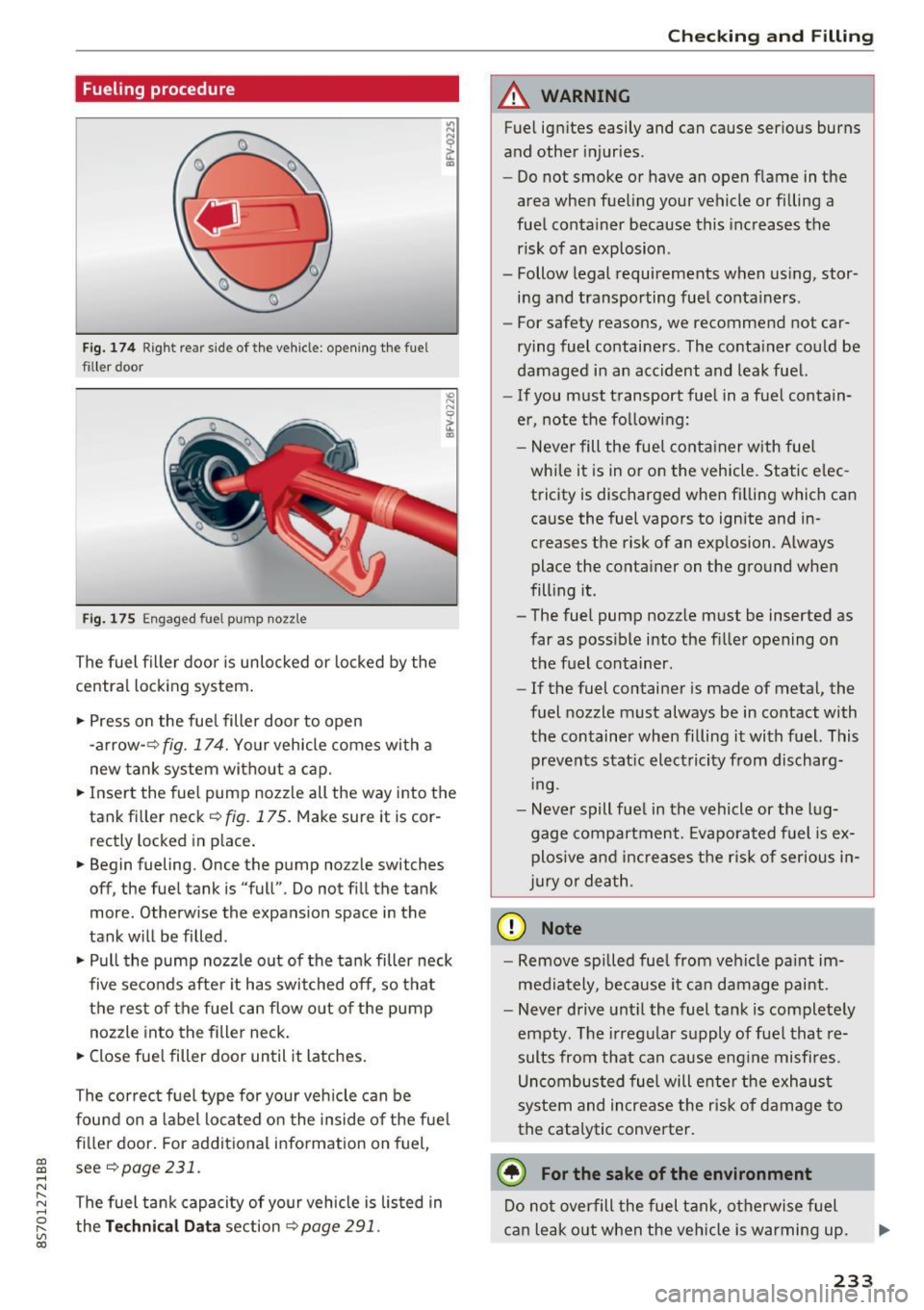
Fig. 174 Right rear side of the vehicle: opening the fue l
filler door
Fig . 175 Engaged fue l pump nozz le
The fuel filler door is unlocked or locked by the
central locking system .
.. Press on the fuel filler door to open
-arrow- ~
fig. 174. Your vehicle comes with a
new tank system without a cap.
.. Insert the fuel pump nozzle all the way into the
tank filler neck¢
fig. 175. Make sure it is cor
rectly locked in place.
• Begin fueling. Once the pump no zzle switches
off, the fuel tank is "full" . Do not fill the tank
more . Otherwise the expansion space in the
tank will be filled .
.. Pull the pump nozz le out of the tank filler neck
five seconds after it has switched off, so that
the rest of the fuel can flow out of the pump
nozzle into the filler neck.
.. Close fue l filler door until it latches.
The correct f uel type for your vehicle can be
found on a label located on the inside of the fuel
filler door. For additional information on fuel,
see ¢
page 231.
The fuel tank capacity of your vehicle is listed in
the
Technical Data section Q page 291 .
Checking and Filling
A WARNING
-Fuel ignites easily and can cause serious burns
and other injuries.
- Do not smoke or have an open flame in the
area when fueling your vehicle or filling a
fuel container because this increases the
risk of an explosion .
- Follow legal requirements when using, stor
ing and transporting fuel containers .
- For safety reasons, we recommend not car
rying fuel containers . The container could be
damaged in an accident and leak fuel.
- If you must transport fuel in a fuel contain
er, note the following:
- Never fill the fuel container with fuel
while it is in or on the vehicle. Static elec
tricity is discharged when filling which can
cause the fuel vapors to ignite and in
creases the risk of an exp losion . Always
place the container on the ground when
fill ing it.
- The fuel pump nozzle must be inserted as
far as poss ible into the filler opening on
the fuel container .
-If the fuel container is made of metal, the
fuel nozzle must always be in contact with
the container when filling it with fuel. This
prevents static electricity from discharg
ing .
- Never spill fuel in the vehicle or the lug
gage compartment. Evaporated fuel is
ex
plosive and increases the risk of serious in
jury or death.
(D Note
-Remove spilled fuel from vehicle pa int im
mediately, because it can damage paint.
- Never drive until the fuel tank is completely
empty . The irregular supply of fue l that re
sults from that can cause engine misfires.
Uncombusted fuel will enter the exhaust
system and increase the risk of damage to
the catalytic converter.
@) For the sake of the environment
Do not overfill the fuel tank, otherwise fuel
can leak out when the veh icle is warming up.
233
Page 236 of 314
Checking and Filling
(D Tips
If adverse weat her conditio ns cause the fuel
filler door to freeze shut, p ress on the center
of the f iller door with the heel of your hand
and then try opening it again.
(!) Tips
- Your vehicle is equipped with a misfueling
guard. It allows the veh icle to be fueled on
l y w ith the correct fuel pump nozzle .
- A worn or damaged nozzle or a nozzle that
is too small may not be able to open the
diesel misfueling guard . If this is the case,
try turning the nozzle before insert ing it in
the fuel filler neck, use a different fuel p ump, o r see an a uthorized Audi deale r or
a uthorized Audi Serv ice Facility fo r ass is
ta nce.
- T he misfueling guard does not open when
adding fue l from a fue l conta iner. When re
fueling with a reserve can ister, you must
use the funne l stored in the luggage com
partment
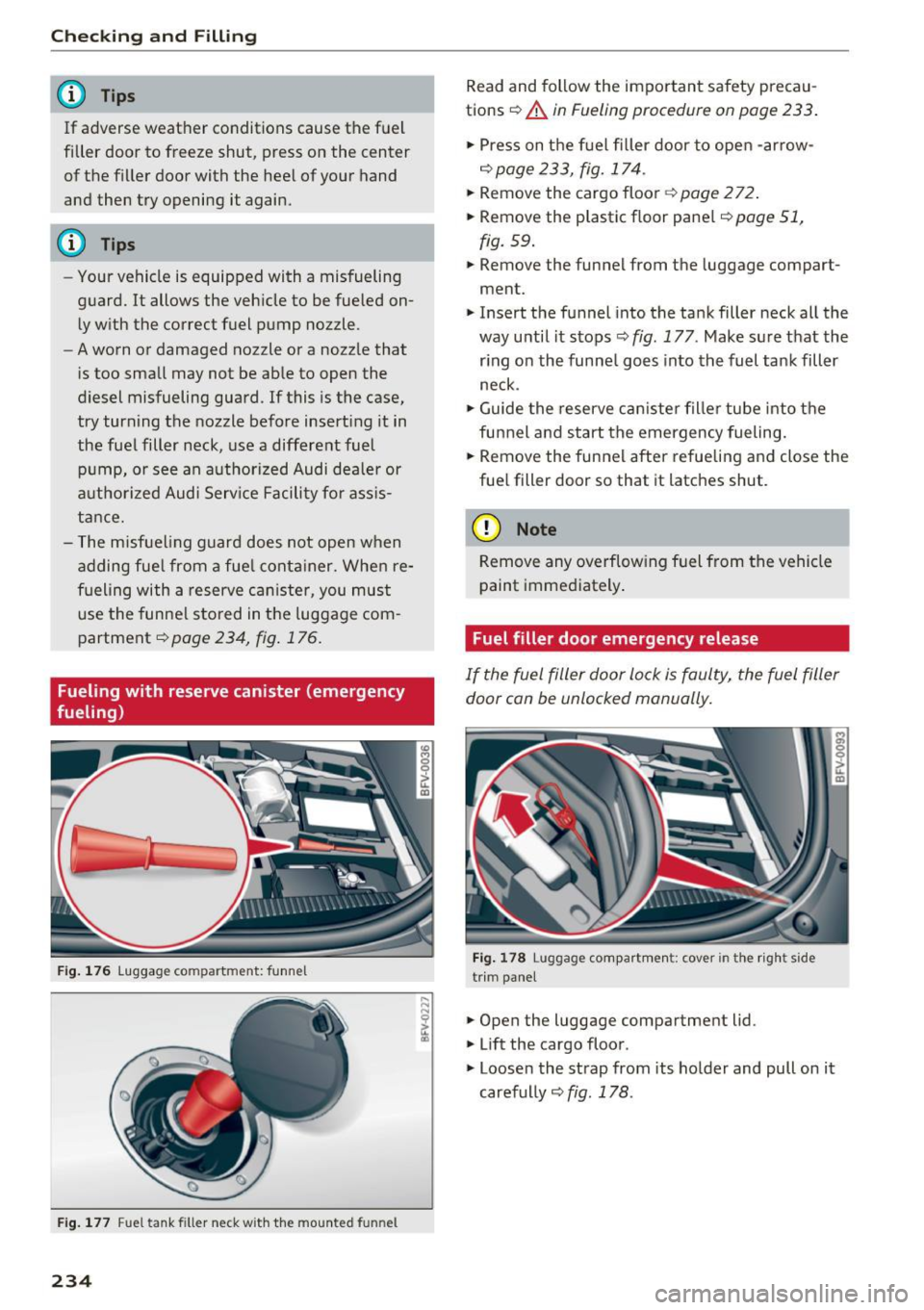
¢ page 234, fig . 176 .
Fueling with reserve canister (emergency
fueling)
F ig . 1 76 lu ggag e co mpar tme nt: funn el
Fig. 1 77 Fu el t ank filler neck w it h th e m ounted funnel
234
Read and follow the important safety precau
tions ¢
A in Fueling procedure on page 233 .
.,. Press on t he fuel filler door to open -arrow-
¢ page 233, fig. 174 .
.,. Remove the cargo floor~ page 2 72 .
.,. Remove the plastic f loor pane l¢
page 51 ,
fig. 59 .
.,. Remove the funnel from the luggage compart
ment.
.,. Insert the funnel into the tank filler neck all the
way until it stops ¢
fig. 177 . Make sure t hat the
r ing on the funne l goes into the fuel tank filler
neck .
.,. Guide the reserve can iste r fille r tube into the
funnel a nd start the emergency fueling.
.,. Remove the funnel after re fueling and close the
fue l fill er door so that it latches shut .
(D Note
Remove any overflowing fuel from the vehicle
paint immediately .
Fuel filler door emergency release
If the fuel filler door lock is faulty, the fuel filler
door can be unlocked manually.
Fig. 178 lu gga ge compar tm en t: cover in the rig ht side
tr im pa nel
.,. Open the luggage compartment lid .
.,. Lift the cargo floor .
M
"'
~ u. m
.,. Loosen the strap from its holder and pull on it
carefully ¢
fig. 178.
Page 238 of 314
Checking and Filling
-Engine exhaust, some of its constituents,
and certain vehicle components contain or
emit chemicals known to the State of Cali
fornia to cause cancer and birth defects and reproduct ive harm . In addition, certain flu
ids contained in veh icles and certain prod
ucts of compo nent wear con tain or emit
c hemicals known to the State of Califo rnia
to cause cance r and birth defects or other
reproductive harm .
- Battery posts, termina ls and re lated acces
sories contain lead and lead compounds, chemicals known to the State of California
to cause cancer and reproductive harms .
Wash hands after handling .
(D Note
When fil lin g flu ids, be sure not to mix the flu
ids up . Otherwise severe ma lfunctions and en
gine damage w ill occur .
@ For the sake of the environment
You shou ld regularly chec k the ground under
your vehicle in order to detect leaks qu ickly. If
there are visible spots from oil or other fluids,
bring your vehicle to an authorized Aud i deal
er or author ized Audi Se rvice Facility to be
checked.
Opening/closing the hood
The hood is released from inside the vehicle.
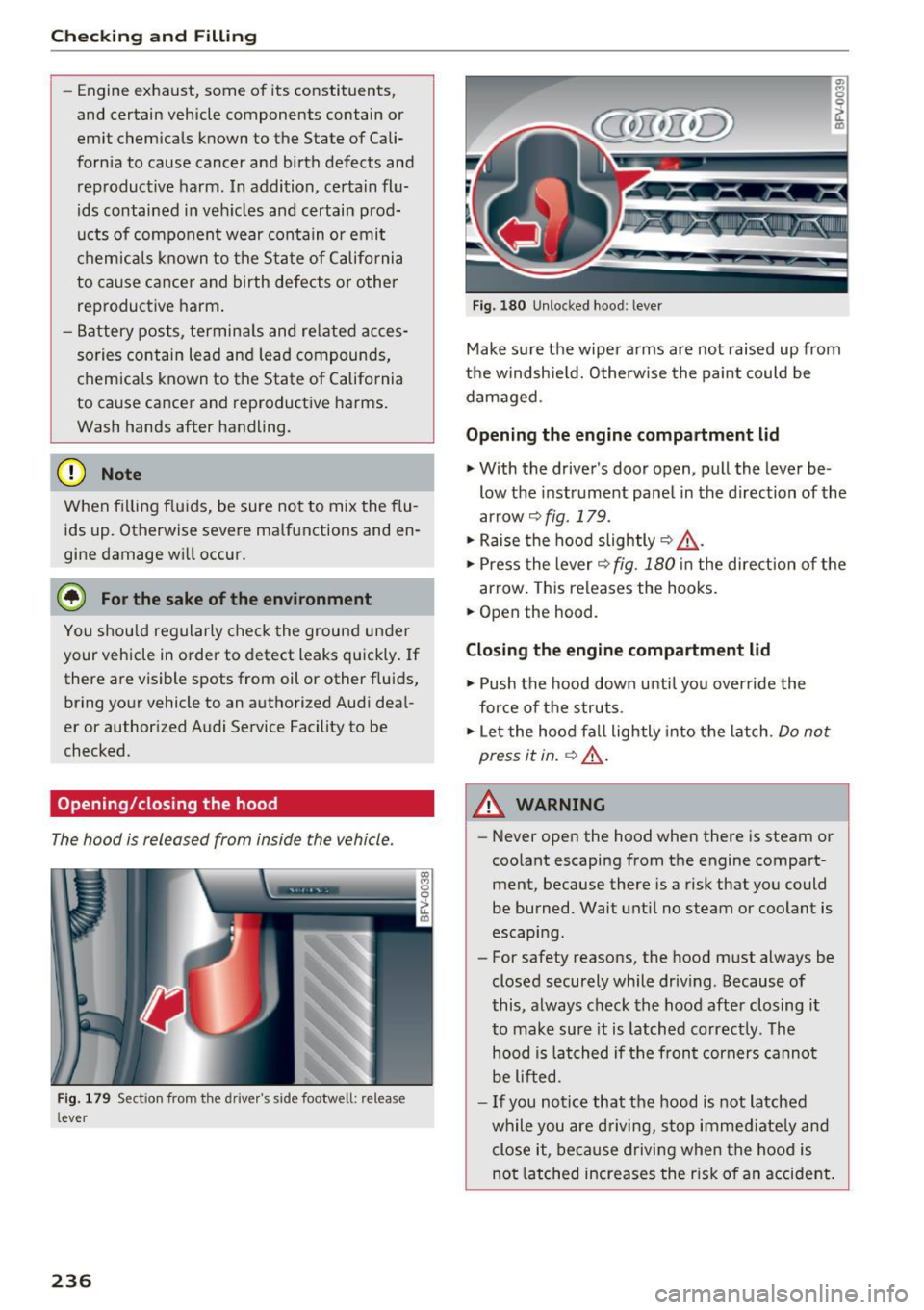
F ig . 17 9 Sect io n from the driv er' s s ide footwell: relea se
l ever
236
~ 0 0
ct Q)
F ig. 1 80 Unlocked hood : lev er
Make su re the wiper a rms are not raised up from
the windshie ld. Otherw ise the paint could be
dam aged .
Opening the engine compartment lid
"With the driver's door open, pull the lever be -
low the instrument pane l in the direction of the
arrow
9 fig . 179 .
" Raise the hood slightly 9 ,& .
"Press the lever 9 fig. 180 in the direct ion of the
arrow . This releases the hooks .
" Open the hood.
Closing the engine compartment lid
" Push the hood down u ntil yo u over ride the
for ce of the s truts .
" Let the hood fa ll lightly into the latch .
Do not
press it in.
~ ,& .
&_ WARNING
-Never open the hood when there is steam o r
coo lant escaping from the engine compart
ment, because there is a risk that yo u could
be burned. Wait unt il no steam or coolant is
escaping.
- For safety reasons, the hood must always be
closed securely while dr iving . Because of
this, always chec k the hood after closing i t
to make sure it is latched correctly . T he
hood is lat ched if the front corners canno t
be lifted .
- If you notice that the hood is not latched
while you are d riving, s top imme diate ly and
close it, because d riving when the hood is
no t latched increases the r isk o f an accident .
Page 243 of 314
co
co
.... N
" N .... 0
" "' c:o
Cooling system
Coolant
The engine cooling system is filled with a mixture
of pur ified water and coolant additive at the fac
tory. This coo lant must not be not changed.
The coolant level is monitored through the. in
dicator light
¢page 12. However , we do recom
mend occasionally check ing the coo lant level
manually.
If you must add coolant, use a mixture of water
and coolant addit ive. Mixing the coolant additive
with distilled water is recommended.
Coolant additive
The coolant additive is made of anti-freez ing and
corros ion protection agents. Only use the follow
ing coolant addit ives . These additives may be
mixed with each other.
Coolant additive Specification
G13 TL 774
J
G12++ TL 774 G
The amount of coo lant add itive that needs to be
mixed with water depends on the climate where
the vehicle will be operated. If the coolant addi tive percentage is too low, the coolant can freeze
and damage the engine.
Coolant addi- Freeze protec-
tive tion
Warm regions min. 40%, m in. -13 °F
max. 45% (-25 °C)
Cold regions min. 50%, max
. -40 °F
max. 55% (-40 °C)
(D Note
- Before the start of winter, have your author
ized Audi dealer or authorized Audi Service
Facility check if the coolant additive in your
vehicle matches the percentage appropriate
for the climate . Th is is especially important
when driving in colder climates.
- If the appropriate coolant additive is not
available in an emergency, do not add any
other additive . You could damage the en-
Checking and Filling
gine. If this happens, only use water and re
store the correct mixture ratio with the
specified coolant add it ive as soon as possi
ble.
- Only refill with new coolant .
- Radiator sealant must not be mixed with
the coolant.
Adding coolant
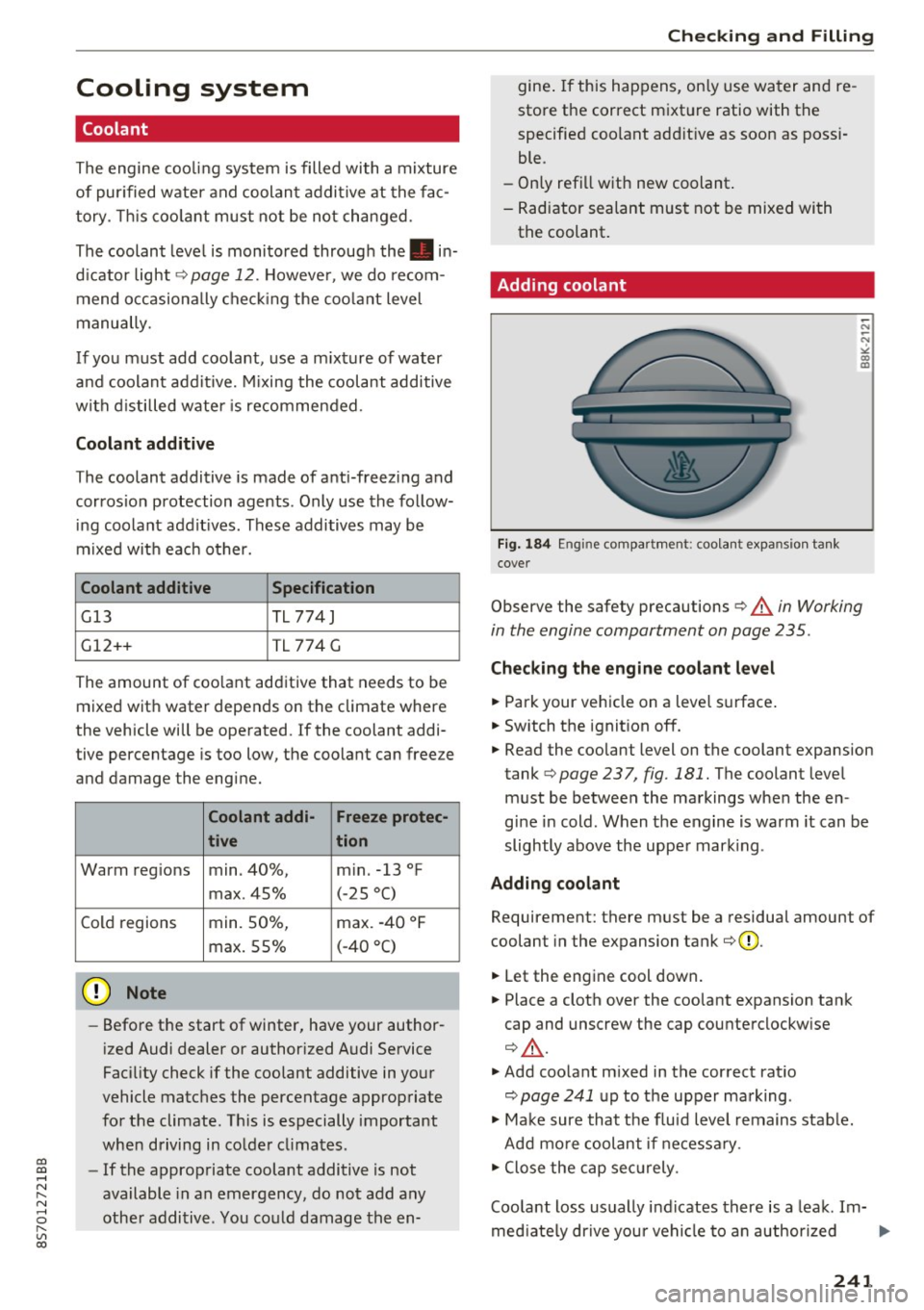
Fig. 184 Engine compartment: coolant expansio n ta nk
cover
-N
-N
"" CD co
Observe the safety precautions ¢ A in Working
in the engine comportment on page 235.
Checking the engine coolant level
.,. Park your vehicle on a leve l surface .
.,. Switch the ignition off.
.,. Read the coolant level on the coolant expansion
tank
¢ page 237, fig . 181. The coolant level
must be between the markings when the en
gine in cold . When the engine is warm it can be
slightly above the upper mark ing .
Adding coolant Requirement: there must be a residual amount of
coolant in the expansion tank
¢ (D .
.,. Let the engine cool down.
.,. Place a cloth over the coolant expansion tank
cap and unscrew the cap counterclockw ise
Q .&, .
.,. Add coolant m ixed in the correct rat io
¢ page 241 up to the upper marking .
.,. Make sure that the fluid level remains stable.
Add more coolant if necessa ry .
.,. Close the cap securely .
Coo lant loss usually indicates there is a leak. Im-
mediately drive your vehicle to an author ized .,..
241
Page 244 of 314
Checking and Filling
Audi dealer or authorized Audi Service Facility
and have the cooling system inspected. If the
cooling system is not leaking, a loss can come
from the coolant boiling through overheating
and being pushed out of the cooling system.
A WARNING
The cooling system is pressurized and can be
come very hot. To reduce the r isk of burns
from hot coolant:
- Do not open the coolant expansion tank cap when the eng ine is hot. This increases the
risk of burns.
- Stop the engine and allow it to cool.
- Protect your face, hands and arms from es-
caping coolant and steam by covering the
coolant tank cap with a large, thick cloth.
- Turn the coolant tank cap counterclockwise
slowly and keep light pressure o n the cap.
- To reduce the risk of burns, do not allow any
antifreeze or coolant to drip onto the ex haust system or hot eng ine components .
T he ethylene glycol in eng ine coolant can
catch fire under certa in circumstances.
- The coo lant add itive and the coolant can be
dange rous to your health. For this reason,
keep the coolan t in the origina l container
and away from children. There is a risk of
poisoning.
- When working in the engine compartmen t,
remember that the radiator fan can switch
on even if the ignition is switched off, which
increases the risk of inj ury.
(D Note
Do not add coolant if the exp ansion tank is
empty . Air could enter the cooling system and
damage the engine . If this is the case, do not
continue driving. See an authorized Audi deal
er or authorized Audi Service Facility for assis
tance.
242
Brake fluid
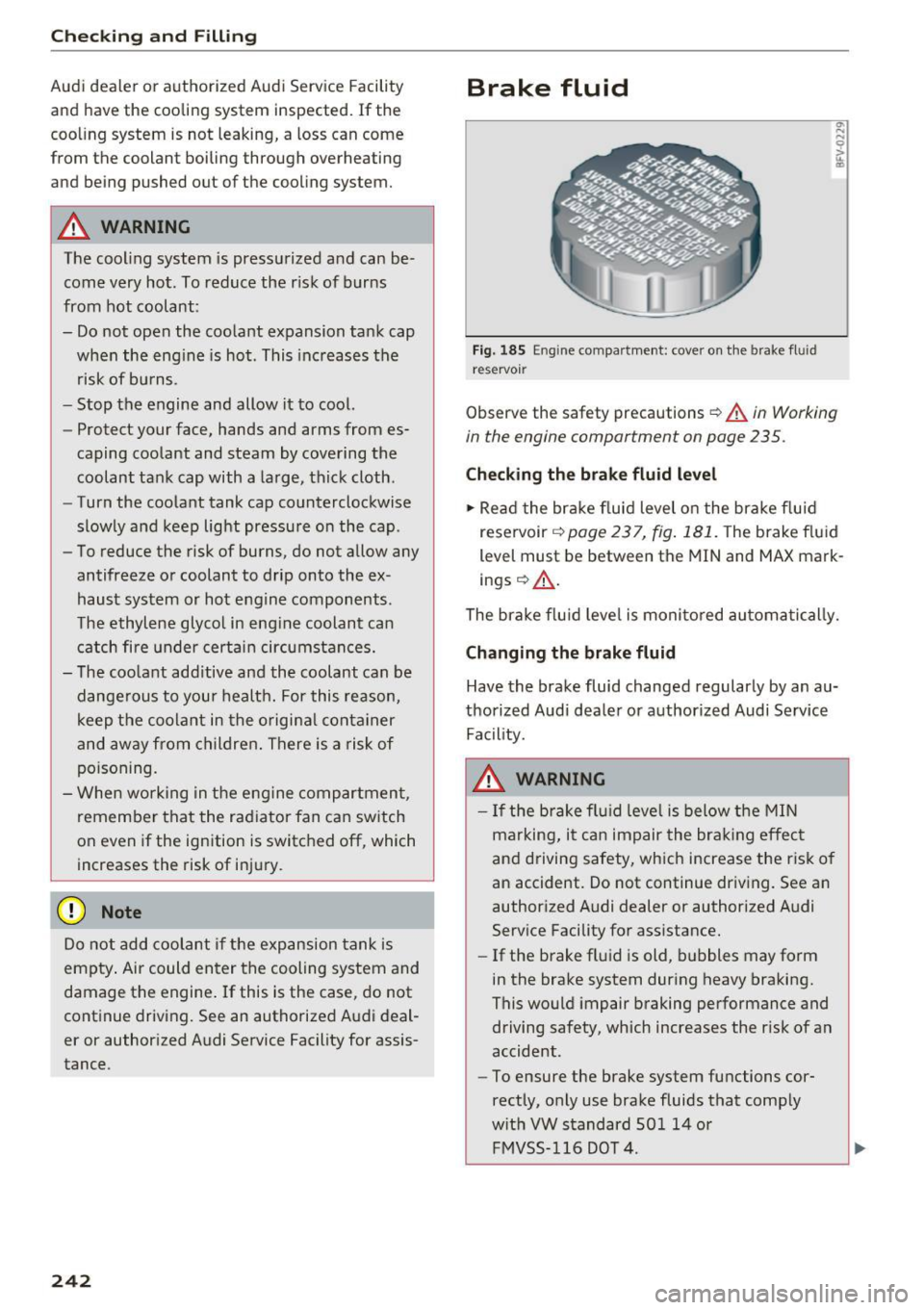
Fig. 1 85 Eng ine compa rtment: cover o n the brake fluid
reservo ir
Observe the safety precautions ¢ A in Working
in the engine compartment on page 235.
Check ing the brake fluid level
... Read the bra ke fluid level o n the bra ke flu id
reservoir
¢ page 237, fig . 181. The brake f luid
level must be between the MIN and MAX mark
ings ¢&_ .
The brake f lu id leve l is monito red au toma tically.
Changing the brake fluid
Have the brake fluid changed regularly by an au
thorized Audi dea ler or authorized Audi Service
Fac ility.
A WARNING
- I f the brake fl uid leve l is below the MIN
marking, it can impair the bra king effec t
and driving safety, which increase the risk o f
an accident . Do not continue driv ing. See a n
author ized Audi dealer or authorized A udi
Serv ice Facility for assistance.
- If the brake fl uid is old, b ubbles may form
in the brake system during heavy braking.
This would impair braking performance and
driving safety, which increases the r isk of an
accident.
- To ensure the brake system functions cor
rectly, only use brake fluids that comply
w it h VW standard SO l 14 or
FMVSS- 116 DO T 4.
Page 270 of 314
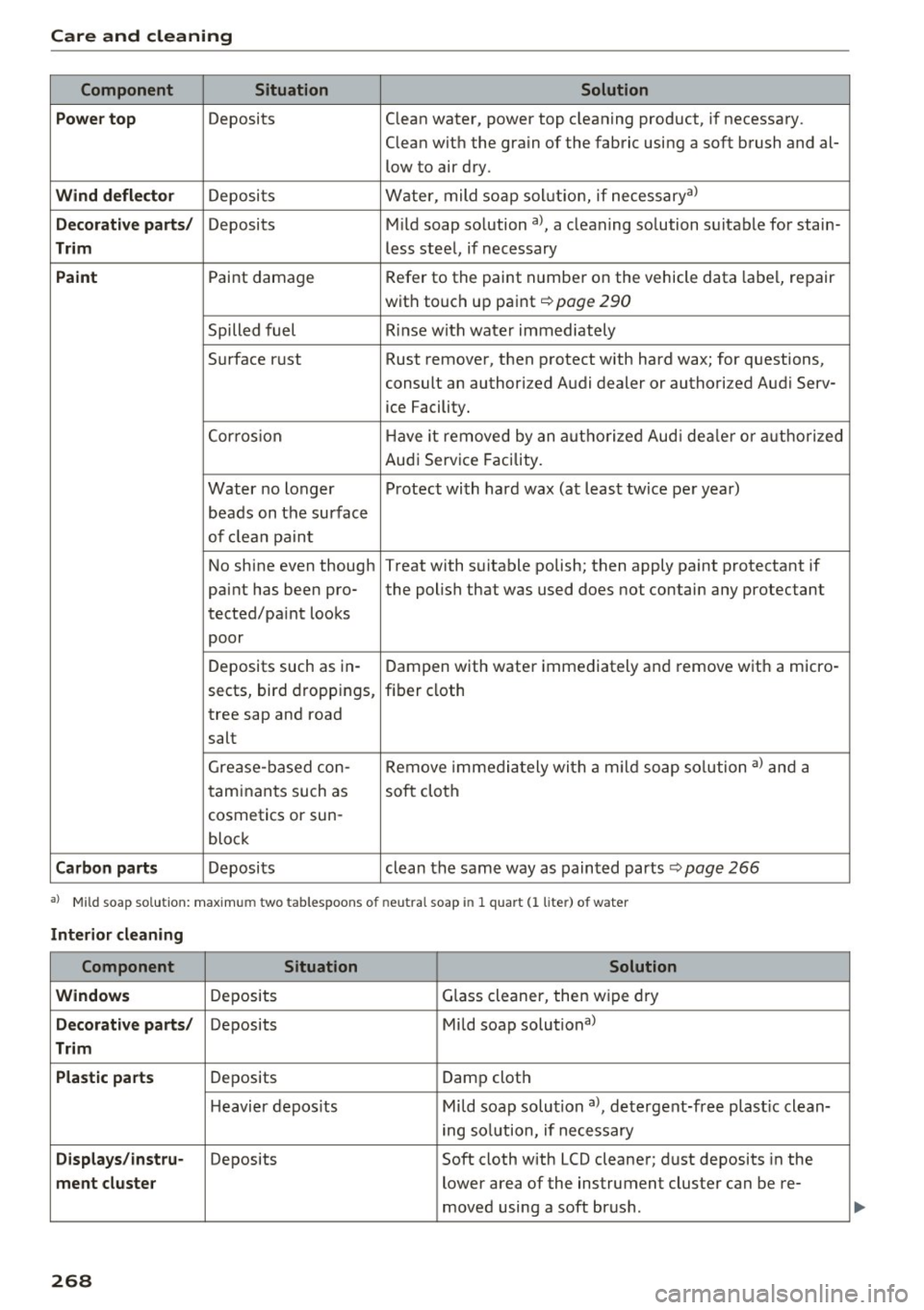
Care and cleaning Component Situation Solution
Power top
Deposits Clean water, power top cleaning product, if necessary.
Clean with the grain of the fabric using a soft brush and al-
low to air dry.
Wind deflector Deposits Water,
mild soap sol ution, if necessaryal
Decorative parts/ Deposits Mild soap solution al, a cleaning solution suitable for stain-
Trim less steel, if necessary
Paint Paint damage Refer to the paint number on the vehicle data label, repair
with touch up paint
¢page 290
Spilled fuel Rin se with wate r immediately
Surface r ust Rust remover, then protect with hard wax; for questions,
consult an 1 authorized Audi dealer or authorized Audi Serv-
ice Facility.
Corrosion Have it removed by an autho rized Aud i dea le r o r authorized
Audi Service Facility.
Water no longer Protect with hard wax (at least twice per year)
beads on the surface
of clean paint
No shine even though Treat with suitable polish; then apply paint protectant if
paint has been pro- the polish that was used does not contain any protectant
tected/pa int looks
poor
Deposits such as in- Dampen with water immediately and remove with a micro-
sects, bird droppings,
fiber cloth
tree sap and road
salt
Grease-based con- Remove immedia tely with a mild soap solution a) and a
taminants such as
soft cloth
cosmetics or sun-
block
Carbon parts Deposits clean the same way as painted parts¢ page 266
a) Mi ld soap so lution: maxim um two tablespoo ns of neut ra l soap i n 1 quart (l lite r) of water
Interior cleaning
Component Situation Solution
Windows
Deposits Glass
cleaner, then wipe dry
Decorative parts/ Deposits Mild soap solutional
Trim
Plastic parts
Deposits Damp cloth
Heavier deposits Mild soap solution al, detergent-free plast ic clean-
ing so lution, if necessary
Displays/instru-Deposits Soft cloth with LCD cleaner; dust deposits in the
ment cluster lower area of the instrument cluster can be re-
moved using a soft brush.
268
Page 274 of 314
Emerg ency assis ta nce
Emergency assistance
Trunk escape latch
In cas e of an emergency , the r ear lid can be
opened from the inside using the trunk escape
latch.
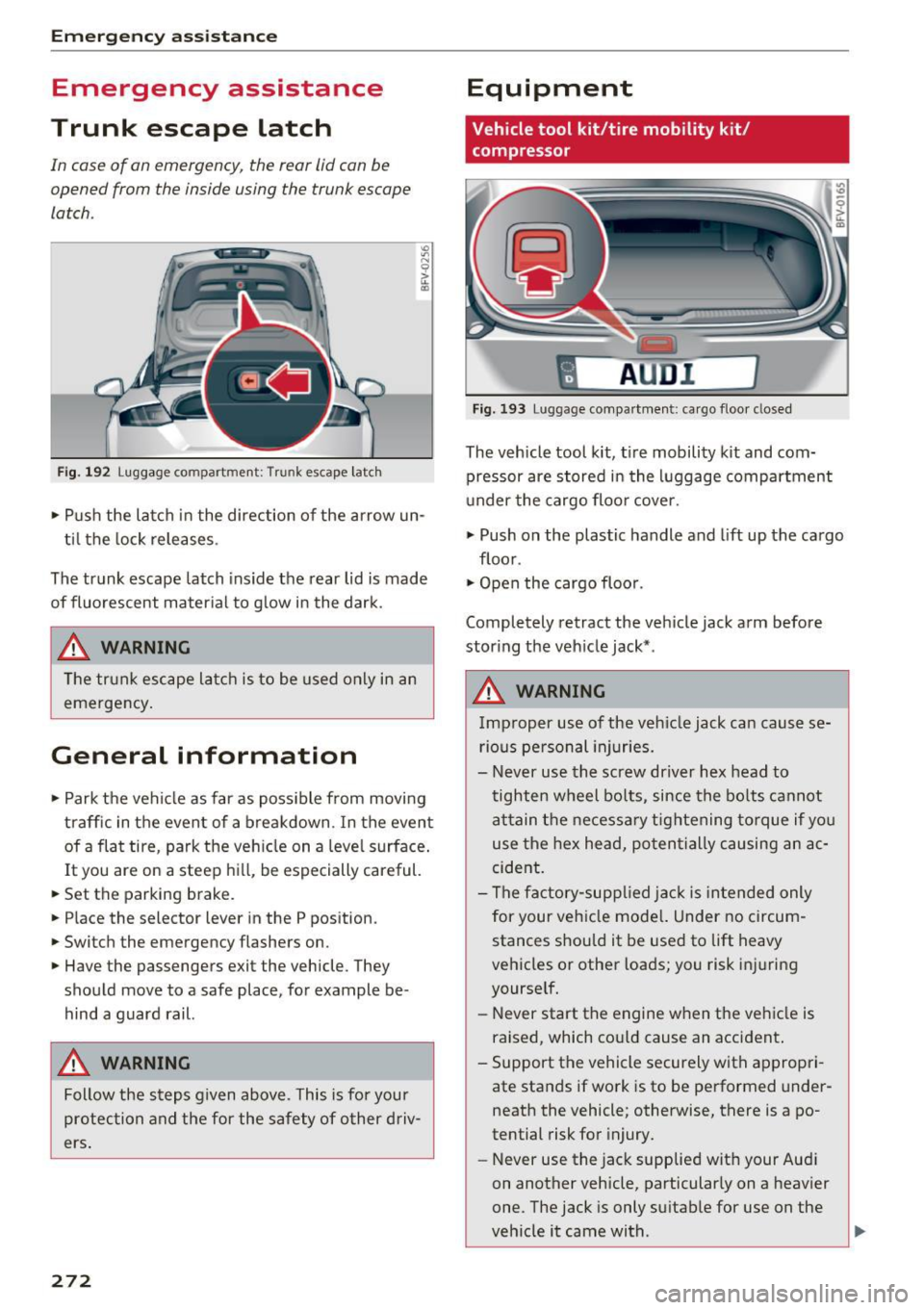
Fig. 192 Luggage compartment: Trunk escape latc h
• Pu sh the latch in the direction of the arrow un
til the lock releases .
The trunk escape latch inside the rear lid is made
of fluorescent material to g low in the dark.
_& WARNING
The trunk escape latch is to be used only in an
emergency.
General information
• Park the vehicle as far as poss ible from moving
traff ic in the event of a breakdown . In the event
of a flat tire , park the vehicle on a level surface .
It you are on a steep hi ll, be especially careful.
• Set the parking brake.
• Place the selector lever in the P position.
• Switch the emergency flashers on.
• Have the passengers exit the vehicle. They
should move to a safe place, for example be
hind a guard rail.
_& WARNING
Follow the steps given above . This is for your
protection and the for the safety of other driv
ers .
272
Equipment
Vehicle tool kit/tire mobility kit/
compressor
I
n
AUD I }
Fig. 193 Lu ggage compa rtmen t: cargo floor closed
The vehicle tool kit, t ire mobility kit and com
pressor are stored in the luggage compartment
u nder the cargo floo r cover .
• Push on the plastic handle and lift up the cargo
floor .
• Open the cargo floor.
Completely retract the vehicle jack a rm before
stor ing the veh icle jack* .
_& WARNING
Improper use of the veh icle jack can cause se
rious pe rsonal injuries.
- Never use the screw driver hex head to
tighten wheel bolts, since the bo lts cannot
attain the necessa ry tightening torque if yo u
use the hex head, potentially causing an ac
cide nt.
- The factory-supplied jack is intended only
for your vehicle mode l. Under no circum
stances should it be used to lift heavy
vehicles or other loads; you risk injuring
yourse lf.
- Never start the engine when the vehicle is
raised , which cou ld cause an accident .
- Support the vehicle securely with appropri
ate stands if work is to be performed under neath the vehicle; otherwise, there is a po
tential risk for injury.
- Never use the jack supplied with your Aud i
on another vehicle, particularly on a heavier
one. The jack is only su itab le for use on the
vehicle it came with .
Page 277 of 314
CD
CD
.... N
" N .... 0 r--. V, co
-If the t ire is t oo severely damaged, see an
aut horized Aud i dealer or authorized Aud i
Service Facility for assistance .
@ For the sake of the environment
You can give the used tire sealant bottle to an
authorized Audi dealer or authorized A udi
Serv ice Facility for disposal.
@ Tips
Remember to obtain a new bottle of sea lant
from an authorized Audi dea ler or authorized
Aud i Service Facility after repair ing a tire.
Replacing wheels
Preparation
You must complete the preparation before
changing a tire .
.,. Read and follow the important safety precau-
t ions
¢ page 272, General information .
.,. Set the parking b rake .
• Se lect the P selector lever pos ition .
.,. Lay out the vehicle tool kit¢
page 2 72 and the
spare tire¢
page 279 .
A WARNING
If you are cha nging a tire on a steep hill, use a
block or similar object to block the oppos ite
wheel to prevent the vehicle from moving.
A WARNING
You or your passenger co uld be injured while
chang ing a wheel if you do not follow these
safety precautions:
- If you have a flat tire, move a safe distance off the road. Turn off the engine, turn the
emergency flashers on and use other warn
ing devices to alert othe r mo to rists.
- Make sure that passengers wa it in a safe
place away from the vehicle and we ll away
from the road and traffic.
- To help prevent the vehicle from movi ng
sudden ly and possibly slipping off the jack,
always fully set t he parking brake and block
t h e whee l di agona lly o ppos ite the wheel be-
Em ergen cy a ssis tanc e
ing changed. When one front whee l is lifted
off the ground, placing the Automatic
Transmiss ion in P (Park) will
not prevent the
veh icle from moving.
- Before you change a wheel, be sure the
ground is leve l and firm.
If necessary, use a
sturdy board under the jack.
- Always store the vehicle tool kit, the jack
and the replaced tire in the luggage com
pa rtment
¢ page 185.
@ Tips
Obey all laws.
Removing the cover
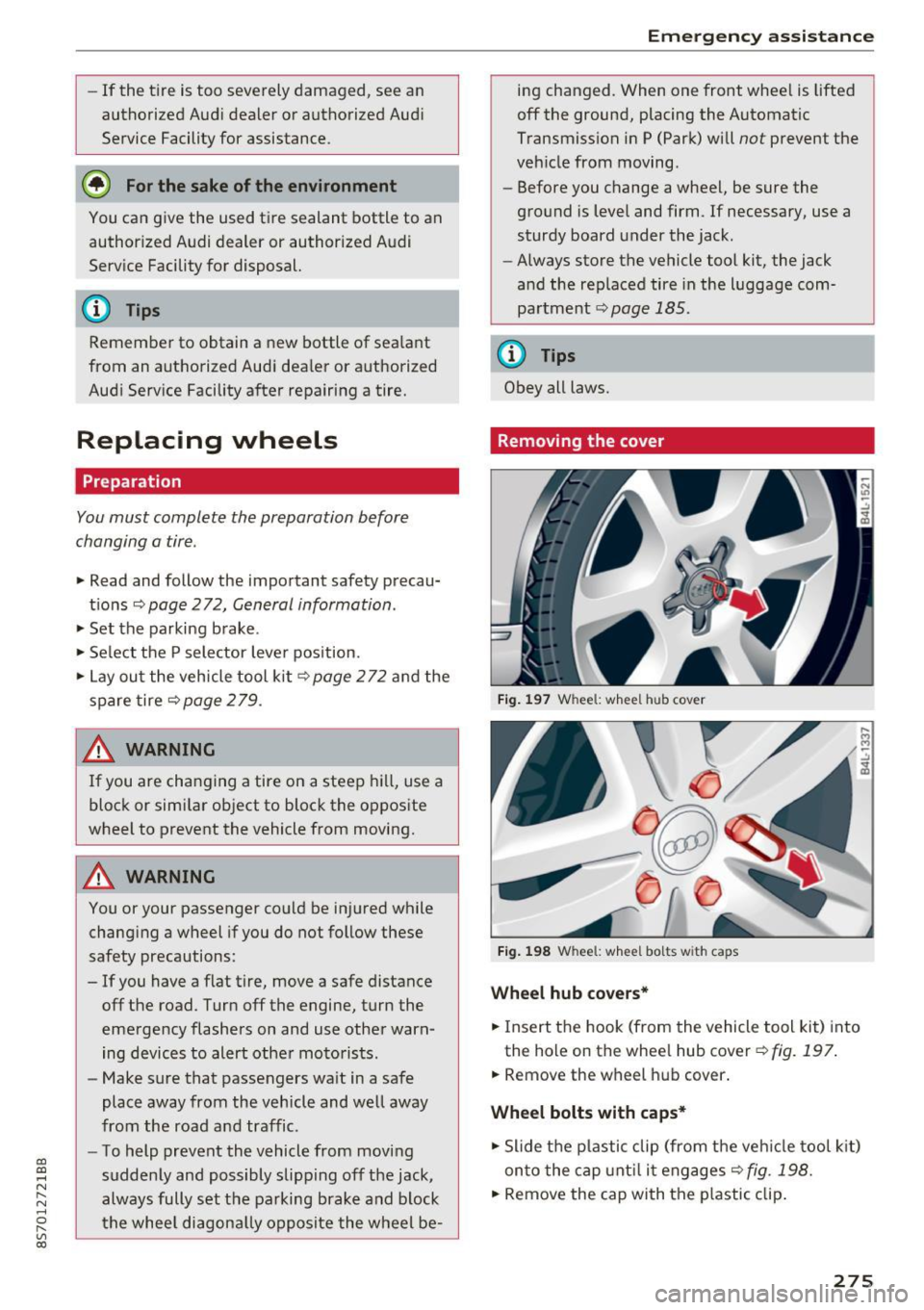
Fig . 1 97 W hee l: whee l hub cover
F ig . 1 98 W hee l: whee l bolts w ith caps
Whe el hub covers*
.,. Insert the hook (from the vehicle tool kit) into
the ho le on the whee l hub cover ¢
fig. 197.
.,. Remove the wheel h ub cover .
Wheel bolts with caps*
.,. Slide the p lastic clip (from t he veh icle too l ki t)
on to the cap unt il it engages
¢ fig . 198.
• Remove the cap with the p lastic clip .
275
Page 281 of 314
CD
CD
.... N
" N .... 0 r--. V, co
-Always store damaged whee l, jack and too ls
securely in the luggage compartment. Oth erwise, in an accident or sudden maneuver
they could fly forward, causing injury to pas
sengers in the vehicle .
Spare tire
General information
Applies to: veh icles with space-saving spa re t ire (compact
spare tire)
A U DI
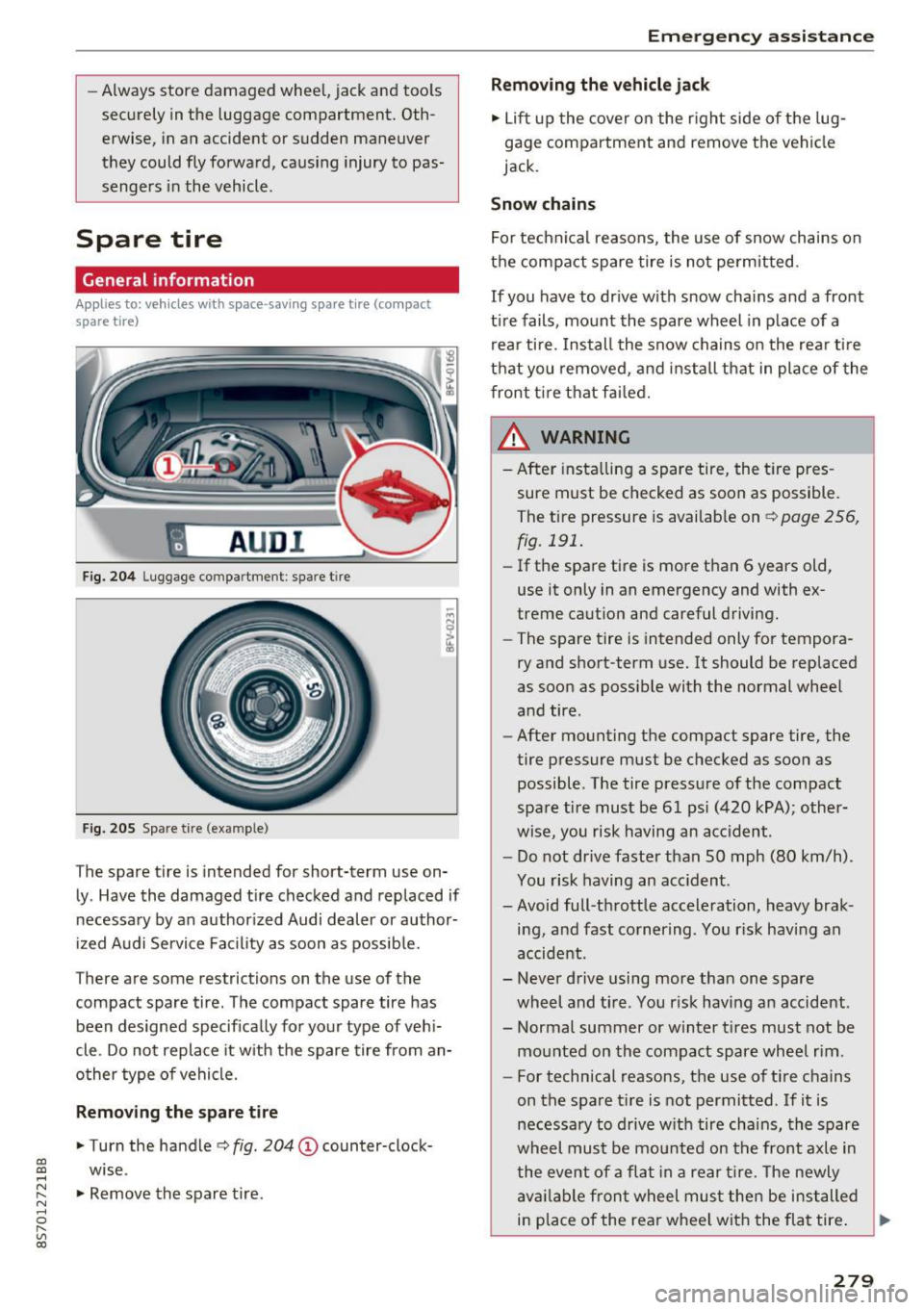
Fig. 204 Luggage co mpa rtment : spar e tir e
Fig. 205 Sp are t ire (ex ample)
The spare tire is intended for short-term use on
ly . Have the damaged t ire checked and replaced if
necessary by an author ized Audi dealer or author
ized Audi Service Fac ility as soon as possib le.
T here are some restrictions on the use of the
compact spare tire . The compact spare tire has
been designed specifica lly for your type of veh i
cle . Do not replace it w ith the spare tire from an
o ther type of vehicle.
Removing the spare t ire
.. Turn the handle c:> fig . 204 © counter-clock
wise .
.. Remove the spare tire .
Emergen cy a ssis tanc e
Removing the vehicle jack
.. Lift up the cover on the right side of the lug
gage compartment and remove the vehicle
jack.
Snow chains
For technical reasons, the use of snow chains on
t h e compact spare tire is not pe rmitted.
If you have to dr ive with snow chains and a front
t ire fails , mount the spare wheel in p lace of a
rear tire . Install the snow chains on the rea r tir e
t h at you removed, and i nstall that in place of the
front t ire that fai led.
A WARNING
-
- After insta lling a spare tire, the tire pres
sure must be checked as soon as possible .
The tire pressure is availab le on ¢
page 256,
fig. 191.
-If the spare tire is more t han 6 years old,
use it only in an emergency and with ex
treme caut ion and careful driving.
- The spare tire is intended only for tempora
ry and short-term use. It should be replaced
as soon as poss ible with the normal whee l
and tire .
- After mounting the compact spare tire, the
tire pressure must be checked as soo n as
possible . The tire pressure of the compact
spa re ti re must be 61 ps i (420 kPA); other
wise, you risk having an accident.
- Do not dr ive faster than SO mph (80 km/h) .
You risk having an acc ident.
-Avoid full -th rottle acceleration, heavy brak
ing, and fast corner ing . You r isk hav ing an
accident .
- Never drive using more than one spare wheel and ti re . You r isk having an accident .
- Normal summer or winter t ires must not be
mounted on the compact spare wheel rim .
- For technical reasons, the use of ti re chains
on the spare t ire is not permitted .
If it is
necessa ry to drive w it h tire cha ins, the spare
wheel mus t be mounted on the front axle in
the event of a flat in a rear t ire. The newly
a vailab le fro nt wheel mus t the n be ins talled
i n place o f the rear wheel wit h the flat tire .
~
279
Page 284 of 314

Fuses and bulbs
Interior fuse assignment
Fig. 208 Vehicle inter ior: fuse assignme nt
No. Equipment
Fl Power top control modu
le (Roadster)
F2 Power top control module (Roadster)
F3 ESC control module
F4 Central computer processor (MIB-2)
FS Gateway
F6 Anti-theft alarm system Climate control system, selector lever (au-
F7 tomatic transmission), parking heater,
rear window heater relay coil
Diagnos is, electrical parking brake switch,
F8 light swi tch, rain/light sensor, interior
lighting
F9 Steering column switch module
Fl0 Display
F ll Haldex clutch
F12 MMI area
F 13 Adaptive dampers control module
F14 Climate control system blower
FlS Electronic steering co lumn lock
F16 MMI components, safety be
lt microphone
(Roadster)
282
No . Equipment
F17 Instrument cluster
F18 Rearview camera
F19 Convenience key system control module
F20 Power lumbar support adjustment
F22 Front passenger's side neck heating (Road-
ster)
F23 R
ig ht exterior lighting, on-board compute r
(right)
F 25 Driver's s
ide door (for example power win-
dows)
F26 Seat heating
F28 AMI H igh med ia port
F29 On-board computer
F31 Left on-board computer
F32 Driver assistance systems
F33 Airbag
Socket relay, interior sound, back-up light
F34 switch, temperature sensor, oil level sen-
sor
Diagnosis, headlight range control system,
F35 air quality sensor, automatic dimming
rearview mirror
F36 Right cornering light/ r ight LED-h eadlight
F37 Left cornering light/ left LED-headlight
F38 E
ng ine control module, ESC control mod-
ul e
F39 Front passenger's side door (for example
power windows)
F40 Cigarette lighter, sockets
F41 SCR relay and delivery unit
F42 Central locking area
F43 On-board computer
F45 Power adjustable driver's side seat
F46 Driver's side neck heat ing (Roadster)
F49 Starter, clutch sensor
FS0 ESC valves
F53 Rear window defogger
The power seats* are protected v ia
circuit break
ers
that automatically switch on after a few sec
onds after the overload has been reduced.