ESP AUDI TT ROADSTER 2017 Repair Manual
[x] Cancel search | Manufacturer: AUDI, Model Year: 2017, Model line: TT ROADSTER, Model: AUDI TT ROADSTER 2017Pages: 314, PDF Size: 76.54 MB
Page 230 of 314
Child safet y
A WARNING
Always take spec ial precaut ions if you must
install a forward or rearward-fac ing ch ild re
straint on the front passenger's seat in excep
tional situations:
- Whenever a forward or rearwa rd-facing
child restraint is insta lled on the front pas
senger seat, t he
PASSENGER AIR BAG OFF
~; light mus t come on and stay on whenev
e r t he ignition is sw itche d on.
- If the
PASSENGER AIR BAG OFF~; light
does not come on and stay on, perform the
checks described~
page 207, Monitoring
the Advanced Airbag System.
- If the PASSENGER AIR BAG OFF~; light
does not come on and stay on whenever the
ignition is switched on the inflating air bag
will hit the c hild safety seat o r infant carrier
with great force and will smash the child
safety seat and child against the backrest, center armrest, door or roof. Have the air
bag system inspected immediately by your
Audi dealer.
- Improper installation of ch ild restraints can
red uce their effect iveness or even prevent
t h em from p roviding any p rotection .
-An improperly installed c hild rest raint can
interfere w ith the airbag as it deploys and
seriously injure or even kill the child.
- Always carefully follow the manufac turer 's
instructions p rovided w ith the ch ild safety
seat or car rier.
- After checking to ma ke sure that the child
restra int is prope rly installed, ma ke certai n
t h at the child res traint is co rrec tly recog
ni ze d by the c apac it ive passenger detec tion
system in the front passenger sea t and that
the
PASSENGER AIR BAG OFF~. light sig
nals the correct front passenger frontal air
bag status.
A WARNING
Forward-fac ing ch ild rest raints:
- Always make sure the forward-facing seat
has been designed and cert ified by its man
ufact urer for use on a front seat with a pas
senger front and side a irbag .
228
-Never put the fo rwa rd-facing child restraint
up, against o r very near the instrument pan
el.
- Always move the passenge r seat into its
rearmost posit ion in the seat's fo re and aft
ad justment range , as far away from the a ir
bag as poss ible before installing the for
ward-facing chi ld restraint. The back res t
m ust be adjusted to an upr ight position.
- Ma ke sure that the
PASSENGER AIR BAG
OFF ~;
light comes on and stays on all the
time w heneve r the ig nition is switched o n.
A WARNING
R earward-faci ng chi ld restrain ts:
- A child in a rearward-fac ing ch ild safety seat
installed on the fron t passenger seat will be
serious ly injure d and can be killed if t he
front airbag infl ates -even with an Ad
vance d Ai rb ag System.
- The infl ating air bag will h it t he ch ild safety
sea t or i nfan t car rier with great force an d
w ill smash the child safety seat and child
aga inst the backrest, center a rm rest, door
or roof.
- Always be especially carefu l if yo u must in
stall a rea rward facing child safety seat on
the front passenge r seat in exceptiona l cir
cumstances.
- Make sure that the
PASSENGER AIR BAG
OFF ~;
light comes on and stays on all the
time wheneve r the ign it ion is switched on.
- If the
PASSENGER AIR BAG OFF~; light
does not come on and stay on, have the air
bag system inspected by you r Audi dealer.
Activating the convertible locking retractor
Use the convertible locking retractor to secure a
child restraint.
A lways heed the chi ld safety seat manufacturer's
i nst ruct ions when insta lling a child restra int i n
yo ur vehicle. To activate the convertib le locking
r etractor:
.,. Place the chi ld restraint on a seat .
.,. Slowly p ull the belt
all the way out .
Page 233 of 314
co
co
.... N
" N .... 0
" "' c:o
Checking and Filling Fuel
Gasoline grade
The correct gasoline grade is stated on the inside
of the fuel filler door .
The vehicle is equipped with a catalytic converte r
and must only be d riven w it h
unleaded gasoline .
Audi recommends using TOP TIER Detergent Gas
oline. Additiona l information on TOP TIER Deter
gent Gasoline can be found on the offic ial web
site (www .topt iergas.com).
The individ ua l gasoline grades a re differentiated
by
o ctane ratings . This value is given with (R +M)/
2 equating to AKI or in RON.
The fo llow ing headings ma tch the correspon ding
sticker in the fue l filler door .
UNLEADED FUEL ONLY MIN. (R+M)/2 87
Regula r/ MIN. RON
91 Regular
Use reg ular gaso line wi th minim um 87 AK I/
91 RON ~ 0 .
The m aximum engine power is only reache d if
p rem ium gaso line 91 AKI/ 95 R ON is use d .
UNLEADED FUEL ONLY PREMIUM MIN . (R
+M )/2
91 / SUPER MIN. RON 95
Using prem ium gaso line wit h minim um 91 AKI/
9 5 RON is recommende d.
If premium gasoline is not availab le, yo u can also
use reg ular gasoline 87 A KI/ 91 RO N. Howeve r
this does reduce t he engine powe r sli ght ly.
CD Note
- Fill ing the tank just one t ime with lead ed
fuel or o ther meta llic additives will cause
p erm anen t de ter io rat io n to the ca taly tic
c onve rter fu nctio n.
- W hen g asoline wi th an octane ratin g th at is
t oo low is used, high speed s or heavy eng ine
l o ad ca n lea d to eng ine damage.
Checking and Filling
{!) Tips
The vehicle may be filled with fuel t hat has a
higher octane rating than w hat is requ ired by
the eng ine .
Blended gasoline
Use of gasoline containing alcohol or MTBE (methyl tertiary butyl ether)
You may use unleaded gasoline b lended with al
cohol o r MTBE (commonly referre d to as oxygen
a tes) if the blende d m ixt ure meets the fo llow ing
cr it e ria :
Blend of gasoline methanol (wood alcohol or
methyl alcohol)
-Anti-knock index must be 87 AKI or higher.
- Blend must contain no more than
3% metha-
nol.
- Blend must contain more than
2% co-solvents.
Blend of gasoline and ethanol (grain alcohol or
ethyl alcohol )
-Ant i-kno ck ind ex mus t be 87 AKI or hig her.
- Blend must not co nta in mo re than
15% etha-
nol.
Blend of gasoline and MTBE
- Anti-knoc k index must be 87 AKI or h igher .
- Blend mus t contain no t mo re than
15% M TBE .
Seasonally adjusted gasoline
Many gasoline grades are blended to pe rform es
pecially well for w inter or s ummer dr iving . D ur
i ng seasonal cha nge-ove r, we sugges t that yo u
fill up a t busy gas stat ions where the seasonal
adjus tme nt is mo re li ke ly to be m ade in time .
CD Note
- Metha nol fuels which do not meet these re
quireme nts may cause cor rosion and dam
a ge to p last ic and r ubber co mpon ents i n t he
fue l sys te m .
- D o not use f ue ls tha t fa il to mee t the speci
fie d cr iteria in thi s ch ap te r.
231
Page 234 of 314
Checking and Filling
-If you a re unable to determine whether or
not a particular fuel blend meets the speci
fications, ask your service station or its fuel
supplier.
- Do not use fuel for which the contents can
not be identified.
- Fuel system damage and performance prob
lems resulting from the use of fuels differ
ent from those specified are not the respon
sibility of Audi and are not covered under
the New Vehicle or the Emission Control
System Warranties.
- If you experience a loss of fuel economy or
driveability and performance problems due
to the use of one of these fuel blends, we
recommend that you switch to unblended
fuel.
Gasoline additives
A major concern among many auto manufactur
ers is carbon deposit build-up caused by the type
of gasoline you use.
Although gasoline grades differ from one manu
facturer to another, they have certain things in
common. All gasoline grades contain substances
that can cause deposits to collect on vital engine
parts, such as fuel injectors and intake valves. Al
though most gasoline brands include additives to keep engine and fuel systems clean, they are not
equally effective .
Audi recommends using TOP TIER Detergent Gas
oline. For more information on TOP TIER Deter
gent Gasoline, please go to the official website (www .toptiergas .com).
After an extended period of using inadequate
fuels, carbon deposit build-ups can rob your en
gine of peak performance.
(D Note
Damage or malfunction due to poor fuel qual
ity is not covered by the Audi New Vehicle
Limited Warranty.
232
Refueling
' Fuel filler neck
The fuel filler neck is located on the right rear
side panel behind the fuel filler flap .
If the power locking system should fail, you can
still open the flap manually -for detailed instruc
tions see
~ page 234.
You can find the fuel tank capacity of your vehicle in
~ page 291.
The label on the inside of the fuel filler flap tells
you the correct fuel for your vehicle. For more in
formation about fuel specifications, see
~ page 231.
Your vehicle fuel tank has an on board refuelling
vapor recovery system. This feature helps to pre
vent fuel vapors from escaping from the tank and
polluting the environment while you refuel your
vehicle . In order to fill the tank properly while
protecting the environment, please follow this
refueling procedure carefully.
.8, WARNING
Under normal operating conditions, never car
ry additional fuel containers in your car. Gas
canisters and other containers used to trans port fuel can be dangerous. Such containers,
full or empty, may leak and could cause a fire
in a collision. If you must transport fuel to
use for your lawn mower, snow blower, etc .,
be very careful and always observe local and
state laws regarding the use, transportation
and storage of such fuel containers. Make cer
tain the container meets industry standards
(ANSI/ASTM F852 -86).
CI) Note
Never drive your vehicle until the fuel tank is
completely empty. The irregular supply of
fuel can cause misfiring. Gasoline could enter
the exhaust system and damage the catalytic
converter.
Page 237 of 314
co
co
.... N
" N .... 0
" "' c:o
Engine compartment
Working in the engine compartment
Special care is required if you are working in the
engine compartment
F or wo rk in th e en gine c ompar tment su ch as
ch eckin g and fi llin g flu id s, th ere is a risk of in
j u ry , sca lding , acci dent s, a nd b urn s. Fo r this
re aso n, follow all the warnin gs and ge nera l
saf ety pr eca uti ons pr ov ided in the follow in g i n·
form ation . Th e e ng ine c ompartm en t is a d an
ger ous a re a .
¢ ,&. .
A WARNING
- T urn the engine off.
- Switch the ign ition off .
- Set the parking brake .
- Place the selector lever in the P pos it ion.
- Let the engine cool down.
- Never open the hood when there is steam or coolant escaping from the eng ine compart
ment, because there is a risk that you could
be burned . Wait until no steam or coolant is
escaping .
- Keep children away from the engine com
partment .
- Never spill fluids on a hot engine. These flu
ids (such as the freeze protection contained
in the coolant) can catch fire .
- Avoid short circu its in the electrical system,
especially to the battery .
- When working in the engine compartment ,
remember that the radiator fan can sw itch
on even if the ign ition is switched off , which
increases the risk of pe rsonal injury.
- Never open the cap on the coolant expan sion tank when the eng ine is warm . The
cooling system is under pressu re .
- To protect your face, hands, and arms from
hot steam or coolant, cover the cap with a
large cloth when opening.
- Do not remove the engine cover under any
circumstances. This increases the risk of
burns.
- If tests need to be performed w ith the en
gine running, there is additional dange r due
Ch eck ing and Filling
to moving components (such as the ribbed
be lt, alternator and radiator fan) and from
the high voltage ignition system.
- Do not press the acce lerator pedal inadver
tently if a gear is selected when the vehicle
is stationary and the engine is running. Oth
erwise, the vehicle will start to move imme
diate ly and this could result in an accident .
- Pay attent ion to the following warnings list
ed when work on the fuel system or on the
electrical equipment is required.
- Do not smoke .
- Never wor k near open flames .
- Always have a working fi re extingu isher
nearby
- All work on the battery or electrical system
in your veh icle can result in inju ries, chemi
cal burns, acc idents or burns . Because of
this, all work must be performed
onl y by an
authorized Audi dealer or authorized Audi
Service Facility.
- To reduce the risk of electric shock and in
jury, never touch the following components
when the engine is running or is being start·
ed:
- Ign it ion cable
- Other components in the electronic high -
voltage ign ition system
- If you must check or perform work on the
engine wh ile it is running:
- Set the parking brake and place the selec
tor lever in the P (park) position first .
- Always proceed w ith extreme caution so
that clothing, jewelry or long hair do not
become caught in the radiator fan , fan
belt or other moving components or do
not come into contact with hot compo
nents. Tie back long hair before beginning
work and do not wear clothing that can hang down into the engine .
- Lim it your exposure to exhaust and chemi
cals to as short a time as possible
¢ ,&. .
A WARNING '"--
California Proposition 65 Warning:
235
Page 243 of 314
co
co
.... N
" N .... 0
" "' c:o
Cooling system
Coolant
The engine cooling system is filled with a mixture
of pur ified water and coolant additive at the fac
tory. This coo lant must not be not changed.
The coolant level is monitored through the. in
dicator light
¢page 12. However , we do recom
mend occasionally check ing the coo lant level
manually.
If you must add coolant, use a mixture of water
and coolant addit ive. Mixing the coolant additive
with distilled water is recommended.
Coolant additive
The coolant additive is made of anti-freez ing and
corros ion protection agents. Only use the follow
ing coolant addit ives . These additives may be
mixed with each other.
Coolant additive Specification
G13 TL 774
J
G12++ TL 774 G
The amount of coo lant add itive that needs to be
mixed with water depends on the climate where
the vehicle will be operated. If the coolant addi tive percentage is too low, the coolant can freeze
and damage the engine.
Coolant addi- Freeze protec-
tive tion
Warm regions min. 40%, m in. -13 °F
max. 45% (-25 °C)
Cold regions min. 50%, max
. -40 °F
max. 55% (-40 °C)
(D Note
- Before the start of winter, have your author
ized Audi dealer or authorized Audi Service
Facility check if the coolant additive in your
vehicle matches the percentage appropriate
for the climate . Th is is especially important
when driving in colder climates.
- If the appropriate coolant additive is not
available in an emergency, do not add any
other additive . You could damage the en-
Checking and Filling
gine. If this happens, only use water and re
store the correct mixture ratio with the
specified coolant add it ive as soon as possi
ble.
- Only refill with new coolant .
- Radiator sealant must not be mixed with
the coolant.
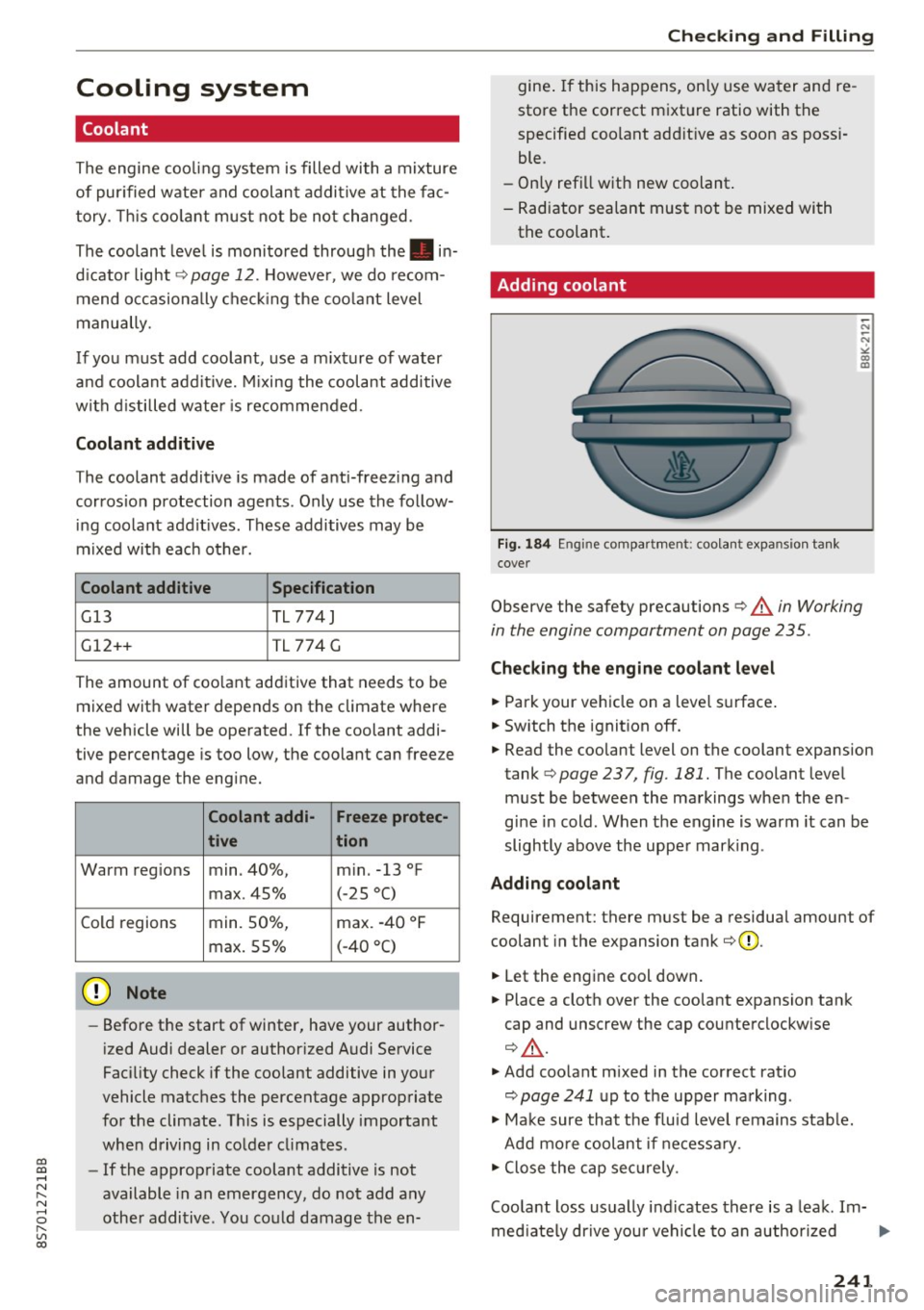
Adding coolant
Fig. 184 Engine compartment: coolant expansio n ta nk
cover
-N
-N
"" CD co
Observe the safety precautions ¢ A in Working
in the engine comportment on page 235.
Checking the engine coolant level
.,. Park your vehicle on a leve l surface .
.,. Switch the ignition off.
.,. Read the coolant level on the coolant expansion
tank
¢ page 237, fig . 181. The coolant level
must be between the markings when the en
gine in cold . When the engine is warm it can be
slightly above the upper mark ing .
Adding coolant Requirement: there must be a residual amount of
coolant in the expansion tank
¢ (D .
.,. Let the engine cool down.
.,. Place a cloth over the coolant expansion tank
cap and unscrew the cap counterclockw ise
Q .&, .
.,. Add coolant m ixed in the correct rat io
¢ page 241 up to the upper marking .
.,. Make sure that the fluid level remains stable.
Add more coolant if necessa ry .
.,. Close the cap securely .
Coo lant loss usually indicates there is a leak. Im-
mediately drive your vehicle to an author ized .,..
241
Page 246 of 314
Checking and Filling
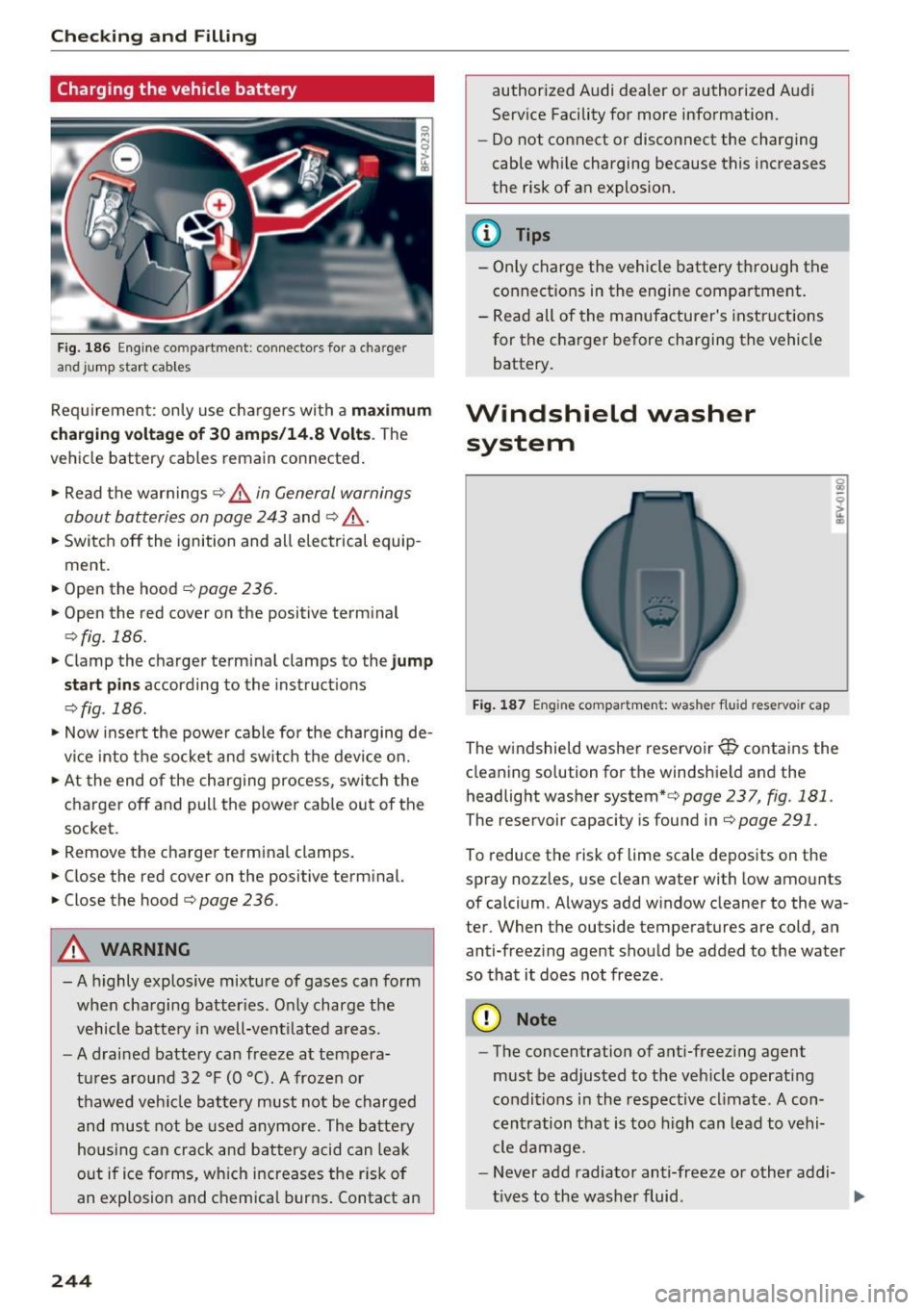
Charging the vehicle battery
Fig. 186 Engine co mpa rtment : connec tors for a c harger
and jump start cab le s
Req uirement: only use chargers with a m aximum
c hargi ng vo lta ge of 30 amp s/14.8 Volt s.
The
vehicle battery cables remain connected .
.,. Read the warnings
c> .&. in General warnings
about batteries on page 243
and c> ,&. .
.,. Switch off the ignition and all electrical equip
ment .
.,. Open the hood ¢
page 236 .
.,. Open the red cover on the positive terminal
c> fig. 186 .
.,. Clamp the charger terminal clamps to the jump
s ta rt pin s
according to the instruct ions
c> fig . 186 .
.,. Now inse rt the powe r cable for the charging de
v ice into the socket and sw itch the device on.
.,. At the end of the charging process, switch the
charger off and pull the powe r cab le out of the
socket .
.,. Remove the charger terminal clamps.
.,. Close the red cover on the positive term inal.
.,. Close the hood¢
page 236.
A WARNING
- A highly explosive mixture of gases can form
when cha rging batter ies. Only charge the
vehicle batte ry in well-vent ilated areas.
- A drai ned battery can freeze at tempera
t ur es a round 32 °F (0 °C) . A frozen or
thawed veh icle battery must not be charged
and must not be used anymore. The batte ry
housing can crac k and battery acid can leak
o ut if ice fo rms, wh ich increases the risk of
an explosion and chemical burns . Contact an
244
author ized Audi dealer or authorized A udi
Service Facility for more information.
- Do not connect or disconnect the charging
cable whi le charging because this increases
the risk of an explos ion.
@ Tips
- Only charge the vehicle battery t hrough the
connect ions in the engine compartme nt.
- Read all of the manufacturer's instructions
for the charger before charging the vehicle
battery.
Windshield washer system
Fi g. 18 7 Engine compar tm ent: washer flui d res ervoir cap
The windshield washer reservoir~ contains the
cleaning so lu ti on for th e windshield and the
headlight washer system*c>
page 237 , fig. 181 .
The reservoir capaci ty is found in c> page 291.
To reduce the risk of lime scale depos its on the
spray nozzles, us e clean water with low amo unts
of calcium . Always add w indow cleaner to the wa
ter . When the ou tside temperatures a re cold , an
anti-freez ing agent should be added to the water
so that it does not freeze .
(D Note
-The concentration of ant i-freez ing agent
must be adjusted to the veh icle operat ing
conditions i n the respective cl imate. A con
cen tration that is too high can lead to vehi-
cle damage.
- Never add radiato r anti-freeze or other addi-
t ives to the washer fluid . ...,
Page 247 of 314
co
co
.... N
" N .... 0
" "' c:o
-Do not use a glass cleaner that contains
paint solvents, because this could damage
the pa int.
Service interval display
The service interval display detects when your ve
hicle is due for service.
The service interval display works in two stages:
- Inspection or oil change reminder: after a cer-
tain distance driven, a message appears in the
Infotainment system display each time the ig
nition is switched on or off. The remaining dis
tance or time is displayed briefly.
- Inspection or oil change due: if your vehicle
has reached an inspection or oil change interval
or both intervals at the same time, the mes
sage
Inspection due! or Oil change due! or Oil
change and inspection duel
appears briefly af
ter switching the ignition on/off .
Checking service intervals
You can check the remaining distance or time un
til the next oil change or next inspection. Select
in the Infotainment system: the !MENU ! button>
Vehicle > left control button > Service & checks >
Service intervals .
(D Note
-Following the service intervals is critical to
maintain ing the service life and value of
your vehicle, especially the engine. Even if
the mileage on the vehicle is low, do not ex
ceed the time for the next service.
- Calcu lating the time to the next oil change
i s interrupted when the vehicle battery is
disconnected~
page 271.
Checking and Filling
245
Page 250 of 314
Wheels
able to provide you with more in
formation.
® Mud and snow capability
"M/S" or "M+S" indicates the tire
has properties making it suitable
to drive in mud or snow.
& indi
cates a w inter t ire.
@ Compos ition of the tire cord
and materials
The number of plies indicates the
number of rubberized fabric lay
ers in the tire . In general: the
more layers, the more weight a
tire can carry. Tire manufacturers must also specify the materia ls
used in the tire. These include
steel, nylon, polyester and other
materials .
@ Maximum permitted load
This number indicates the maxi
mum load in k ilograms and
pounds that the tire can carry.
@ Uniform tire quality grade
standards for treadwear,
traction and temperature
resistance
Tread wear, t raction and temper
ature ranges ¢
page 262.
248
@ Running direction
~ Maximum permitted
inflation pressure
This number indicates the maxi
mum pressure to wh ich a t ire can
be inflated unde r normal operat
ing condit ions .
Glossary of tire and loading
terminology
Accessory weight
means the combined weight (in
excess of those standard items
which may be replaced) of auto
matic transmission , power steer
ing , power brakes , power win
dows, power seats , radio, and
heater, to the extent that these
items a re available as fac tory-in
stalled equipment (whet her in
stalled or no t).
Aspect ratio
means the rat io of the height to
the width of the tire in pe rcent.
Numbers of 55 or lower indicate a
low sidewall fo r imp roved steer
ing response and better overa ll
handling on dry pavement .
Bead
means the part of the tire that is
made of steel wires, wrapped or ...
Page 257 of 314
a, a, ... N
" N ... 0
" V, a:,
-Have the wheels rebalanced if an
imbalance is causing noticeable
vibration in the steering wheel. If you do not, the tires and other
vehicle components could wear
more quickly.
Treadwear indicator
Original equipment tires contain
treadwear indicators in the tread pattern, which are bars that are
1/16 in (1.6 mm) high and are
spaced evenly around the tire per
pendicular to the running direc
tion¢
fig. 189. The letters "TWI"
or triangles on the tire sidewall indicate the location of the tread
wear indicators.
The tires have reached the mini mum tread depth
l) when they
have worn down to the tread wear
indicators. Replace the tires with
new ones ¢.&.
Tire rotation
Rotating the tires regularly is rec
ommended to ensure the tires
wear evenly. To rotate the tires,
install the tires from the rear axle
on the front axle and vice versa.
This will allow the tires to have
l) Obey any applicable regulations in your
country.
Wheels
approximately the same length of
service life.
For unidirectional tires, make
sure the tires are installed accord
ing to the running direction indi
cated on the tire sidewall
¢ page 278.
Hidden damage
Damage to tires and rims can of
ten occur in locations that are hidden. Unusual vibrations in the
vehicle or pulling to one side may indicate that there is tire damage.
Reduce your speed immediately.
Check the tires for damage. If no
damage is visible from the out
side, drive slowly and carefully to
the nearest authorized Audi deal
er or authorized Audi Service Fa cility to have the vehicle inspect
ed.
.&_ WARNING
Tread that has worn too low or
different tread depths on the
tires can reduce driving safety.
This can especially have a nega
tive effect on handling, on the risk aquaplaning when driving
through water, when driving ..
255
Page 264 of 314
Wheels
The low aspect ratio of these tires is i ndicated by
a numeral of
55 or less in the tire's si ze designa
tion. The numera l rep resents the rat io o f the
tire's sidewall he ight in relat ion to its tread width
expressed in percentage . Conventional tires have
a height/w idt h rat io of 60 o r more.
The performance of low -aspect-ratio tire s is par ·
ticularly sensitive to improper inflation pres
sure.
It i s therefore important that low aspect
ratio tires ar e inflat ed to the specifi ed pr essure
and that the inflation pre ssure is regularly
checked and maintained . Tire pre ssure s should
be checked at le ast once a month and always
before a long trip¢
page 256.
What you can do to avoid tire and rim
damage
Low aspect rat io tires can be damaged more easi
ly by impact wi th potholes, cu rbs, g ullies or
ridges on the road, pa rt ic ul arly if the tire is un
derinflated .
I n order to minim ize t he oc currence of impac t
d a mage to the t ires of your ve hicle, we recom
mend that you ob5erve the following precau
tions:
- Always mai nta in recommended inf lation pres
s ur es . Che ck your tire p ress ure every 2,000
miles (3, 000 km) and ad d air if necessary .
- Drive caref ully on roads with potho les, deep
gull ies or r idges . The im pact from d riving
th rough or ove r su ch obs tacles can damage
your tires. Impact with a curb may also cause
damage to your tires.
-A fter any impact, immediately inspect your
ti res or have them inspected by the nearest au
thori zed Audi dea ler. Replace a damaged tire as
soon as possib le.
- Inspect yo ur tires every 2,000 miles (3,000 km)
for damage and wear. Damage is not always easy to see. Damage can lead to loss of air and
underinflation, which cou ld eventually cause
ti re failure . If you believe that a tire may have
been damaged, re place the t ire as soon as pos
s ible.
- T hese tires may wear more qu ick ly than othe rs .
- Please a lso remember t hat, w hile these tires
deliver responsive handling, they may r ide less
262
comforta bly and make more noise than o ther
choices .
Reduced performance in winter/cold season
condition s
All tires are des igned for certain purposes . The
l ow aspect ratio , ultra h igh performance tires
o rigina lly installed on your vehicle are intended
for maximum d ry and wet road perfo rmance and
handling. They a re not suitable for co ld, snowy or
i cy weather conditions . If you drive under those
c ircumstances, you should equip you r vehicle
with all-season o r winter tires, which offer better
t ra ct ion unde r th ose condi tio ns. We suggest yo u
u se the recommen ded snow or a ll-season tires
spe cified for your vehicle, o r th e ir equiv alent.
Refer to¢
pag e 260 for more detailed informa
t ion regard ing winter tires.
Uniform tire quality grading
- Tr ea d wea r
- Tr actio n AA ABC
- T empe ratu re ABC
Quality grades can be found where applicable on
the tire side wall between tread shoulder and
max imum section width
¢ page 246, fig . 188.
For example : Tread wear 200 , Traction AA , Tem
perature
A .
All passenge r ca r tir es must conform to Federal
Safety Req uirements in a ddition to these grades.
Tread wear
The tread wear grade is a compa rative rating
based on the wea r ra te o f the tire w hen tested
u nder con trolled cond itions on a specified gov
ernment test course .
Fo r example, a tire g raded 150 wou ld wea r one
a n d one half (1 1/2) times as well o n the govern
ment cou rse as a t ire graded 100.
The re lative pe rformance of tires depends upon
t h e ac tual cond itions of the ir use, however, and
m ay dep art significan tly from the no rm due to
variations in driv ing habi ts, service pract ices and
diffe rences in road characteristics and climate. ..,.