warning light AUDI TT ROADSTER 2018 Service Manual
[x] Cancel search | Manufacturer: AUDI, Model Year: 2018, Model line: TT ROADSTER, Model: AUDI TT ROADSTER 2018Pages: 310, PDF Size: 46.95 MB
Page 107 of 310
Cl 00 .-< N r-N .-< 0 r-Vl 00
Voice recognition system Operating
Applies to: vehicles with voice recognitio n system
You con operate many Infotainment functions
conveniently by speaking.
Requirement: the ignition and the MM I must be
switched on, there m ust be no phone call in p rog
ress and the park ing system must not be active.
~ Switching on : briefly p ress t h e ~ but ton @
¢page 19, fig . 9 on the multif unction steering
whee l and say th e desi red command after the
Beep .
~ Switching off : press and hold the ~ button .
Or: say the command Cancel.
~ Pausing : say the command Pause . To resume,
press
the~ b utt on .
~ Corr ecting : press t h e ~ button one t ime ®
¢ page 18, fig. 7. Or: say the co mmand Correc
tion .
Input assistance
The system g uides you throug h the input with
v isua l and aud io feedback .
-Visual input assistance : after switching on
vo ice recogn it io n, a display with a se lection of
poss ible commands appears . The command
display can be sw itched on/off under
I M EN U I >
Setting s> left contro l butto n > MMI setting s>
Speech dialog system .
- Audio input assistance:
to have the poss ible
c omma nds read, press t he
10, I bu tton o n the
mul tifunc tion steering w heel b riefly and say
Help.
For the system to understand you:
Speak clearly and dis tinct ly a t a normal vo lume .
Speak lo uder when d riving faste r.
Emphasi ze the words in the commands even ly
a n d do not leave long pauses .
Do not spea k a command when the voice recogni
tion system is m aking an a nno uncement.
C lose the doors, the windows and the sunroof* to
r e duce background noise. Make s ure that passe n-
Voice recognition system
gers are not speaking w hen you are g iv ing a voice
comman d.
D o no t direct the vents towa rd the handsfree mi
c rophone, wh ic h is near the fro nt inter ior lights
on the roof headline r or on the dr iver's safety
belt*. Fo r additional informat io n on th e safety
belt m ic rophone, see
¢ pag e 122 .
Only use the system from the dr ive r's sea t be
ca use the hands -free microphone is di rected to
ward that s eat .
Additional settings
See ¢ page 178, Voice recognition system.
_&. WARNING
- D ir e ct y ou r full a tte ntio n to dr iv in g. A s t he
dr iver, you have com ple te re spon sibility fo r
safety in t raff ic . O nly use the functions in
such a way t hat you a lways maintai n com
p lete contro l over your vehicle in all traffic
situations.
- Do not use t he voice recognition system in
emergencies beca use your voice may change
in st ressfu l s ituations. It may ta ke longe r to
d ia l the number o r th e system may not be
ab le to d ia l it at all. Dia l the emergency
number manually .
(D Tips
-The d ialog pauses w hen the re is a n incom
ing phone call a nd will con tinue if yo u ig
nore the ca ll. The dia log ends if yo u answer
t he ca ll.
- There are no vo ice gu idance* prompts when
a dialog is ac tive .
- Yo u ca n select a n item in the list us ing ei
t her the vo ice recogn ition sys tem o r the
cont ro l knob .
Command overview
information
Applies to: vehicles with voice recognition system
T he following overv iews des crib e the co m man ds
t h at can be used to oper ate the MMI using the
vo ice recognit ion system.
..,.
105
Page 136 of 310
Navigation
Navigation
Opening navigation
Applies to: vehicles with navigation system
The navigation system directs you to your destination, around traffic incidents and on alternative
routes, if desired.
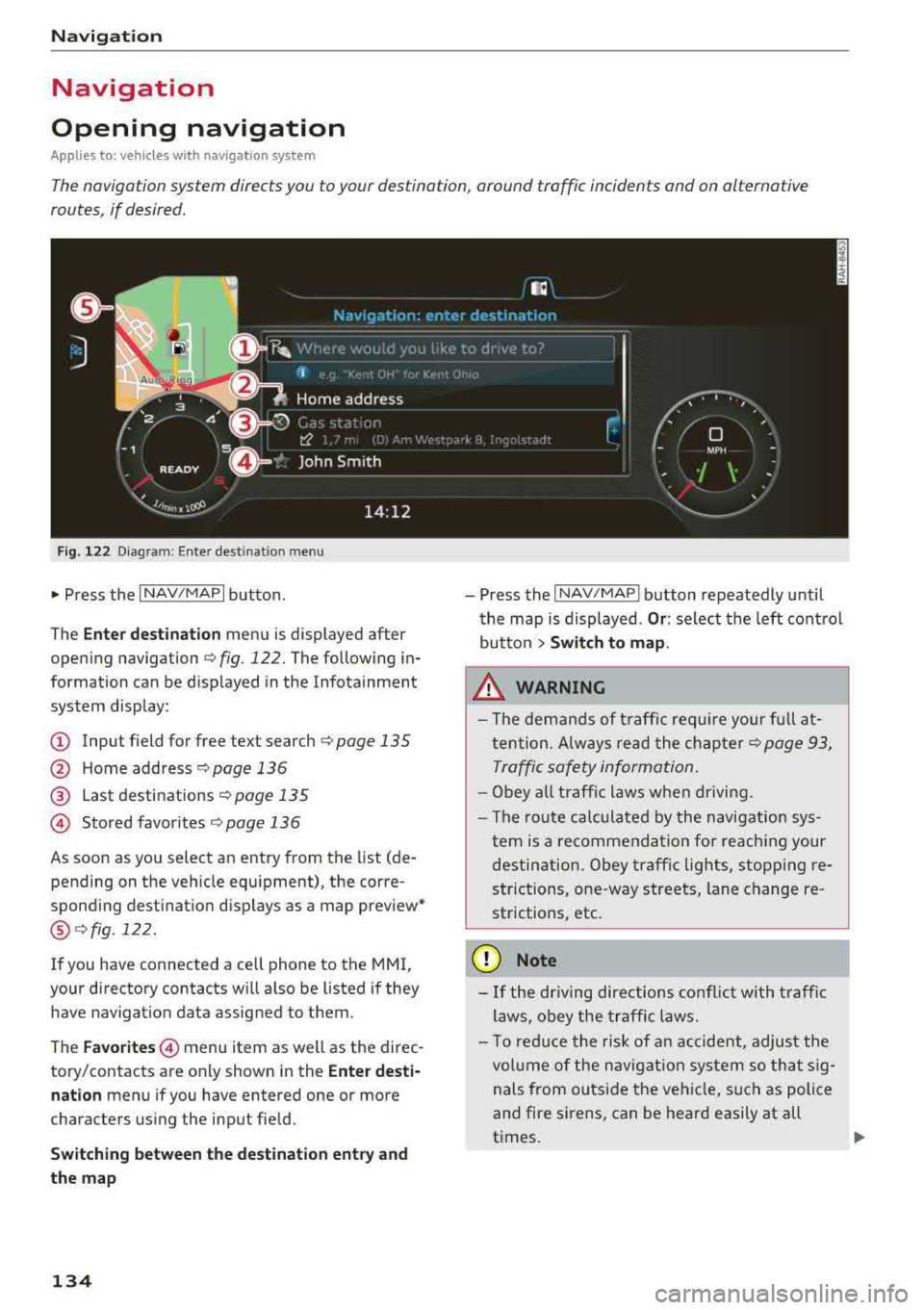
F ig. 122 Diagram: Ente r dest inat io n menu
~ Press the I NAV/MAPI button .
The
Enter destination menu is displayed after
opening navigation
¢ fig . 122. The following in
formation can be displayed in the Infotainment
system display:
@ Input field for free text search r:::;, page 135
@ Home address c;,poge 136
@ Last destinations r:::;, page 135
© Stored favor ites r:::;, page 136
As soon as you select an entry from the list (de
pending on the vehicle equipment), the corre
spond ing destination displays as a map preview*
@ c;,fig .122.
If you have connected a cell phone to the MMI,
your directory contacts will also be listed if they
have navigation data assigned to them .
The
Favorites © menu item as well as the direc
tory/contacts are only shown in the
Enter desti·
nation
menu if you have entered one or more
characters using the input field.
Switching between the destination entry and
the map
134
-Press the I NAV/MAPI button repeatedly until
the map is displayed .
Or: select the left control
button
> Switch to map.
& WARNING
-The demands of traffic require your full at
tention . A lways read the chapter
c;, page 93,
Traffic safety information.
-Obey all traffic laws when driving.
-The route calculated by the navigation sys-
tem is a recommendation for reaching your
destination . Obey traffic lights, stopp ing re
strictions, one-way streets, lane change re
strictions, etc.
(D Note
-If the driving directions conflict with traffic
laws, obey the traffic laws.
-To reduce the risk of an accident, adjust the
vol um e of the navigation system so that sig
nals from outside the vehicle, such as police
and fire sirens, can be heard easily at all
t imes.
-
Page 181 of 310
Cl 00 .-< N r--N .-< 0 r--Vl 00
Safe driving Basics
Safe driving habits
Please remember -safety first!
The individua l safety features of your vehicle can
work together as a system to help protect you
and your passengers in a wide range of accidents.
These features cannot work as a system if they
are not always correctly adjusted and correctly
used .
This chapter contains important informat ion,
tips, instruct ions and warn ings that you need to
read and observe for your own safety, the safety
of your passenge rs and others . We have summar
i zed here w hat you need to know about safety
be lts, a irbags, child restra ints as well as child
safety. Yo ur safety is for us priority number 1. Al
ways observe the information and warnings in
this section - for your own safety as well as that
of your passengers.
The informa tion in t his sect ion app lies to all
model versions of your vehicle. Some of the fea
tures described in t his sections may be standard
eq uipment on some models, or may be optional
equ ipment on others. If you are not sure, ask
your author ized Audi dealer.
A WARNING
-Always make sure that you follow the in
st ruct ions and heed the WAR NINGS in t his
Manua l. It is in your i nterest a nd in the in
t e res t of your passengers .
-
-Always keep the complete Owner's Litera
t ur e in yo ur Audi whe n you lend or se ll yo ur
vehicle so tha t this import ant information
w ill a lways be available to t he d rive r and
passengers.
-Alw ays keep t he Owne r's lite rature h andy so
that you can f ind it easily if yo u have ques
tions .
Safe dri ving
Important things to do before driving
Safety is everybody 's job ! Vehicle and occupant
safety always depends on the informed and care
ful driver .
For your safety and the safety of your passenger,
b efor e driving alw ay s:
.. Make sure that a ll lights and s ignals are operat
ing correctly.
.. Make sure tha t the tire pressure is correct .
.. Make sure that all windows are clean and afford
good vis ibility to the outs ide .
.. Secure all luggage and othe r items ca refully
c::> page 183, c::> page 49.
.. M ak e sure tha t not hing c an in terfere wi th the
peda ls .
.. Adj ust seat and mirrors correctly for your
height .
.. Make sure to use the right child restra int cor
rectly to protect children
c::> page 216, Child
safety.
.. Sit properly in your seat and make sure that
your passenger do the
same ¢ page 46, Front
seats.
.. Fasten yo ur safety belt and wear i t properly. Al
so inst ru ct yo ur passenge r to fas ten his safety
be lt properly
¢ page 187.
What impairs driving safety?
Safe driving is dire ctly related to the condition of
the vehicle, the driver as well as the driver's abili
ty to concentrate on the road without being dis
tracted.
T he dr iver is responsib le for the sa fe ty of the ve
hicle and a ll of its occupants. If your ability to
drive is impai red, safety risks for everybody in the
vehicl e inc rease and you a lso become a hazard to
everyone else on the road
¢ A_ . Therefore:
.. Do not let yourse lf be distracted by passenge r
or by using a ce llular telephone .
.. NEVER drive when your driving ability is im
pa ired (by med ications, alcohol, drugs, etc.) .
.. Observe all traffic laws, rules of the road and
speed lim its and plain common sense .
.. ALWAYS adjust your speed to road, traffic and
weather conditions .
.,.
179
Page 182 of 310
Safe dri ving
,.. Take frequent breaks on long trips. Do not drive
for more than two hours at a stretch.
,.. Do NOT drive when you are tired, under pres
sure or when you are stressed.
A WARNING
Impaired driving safety increases the risk of
serious personal injury and death whenever a
vehicle is being used.
Correct passenger
seating positions
Proper seating position for the driver
The proper driver seating position is important
for safe, relaxed driving.
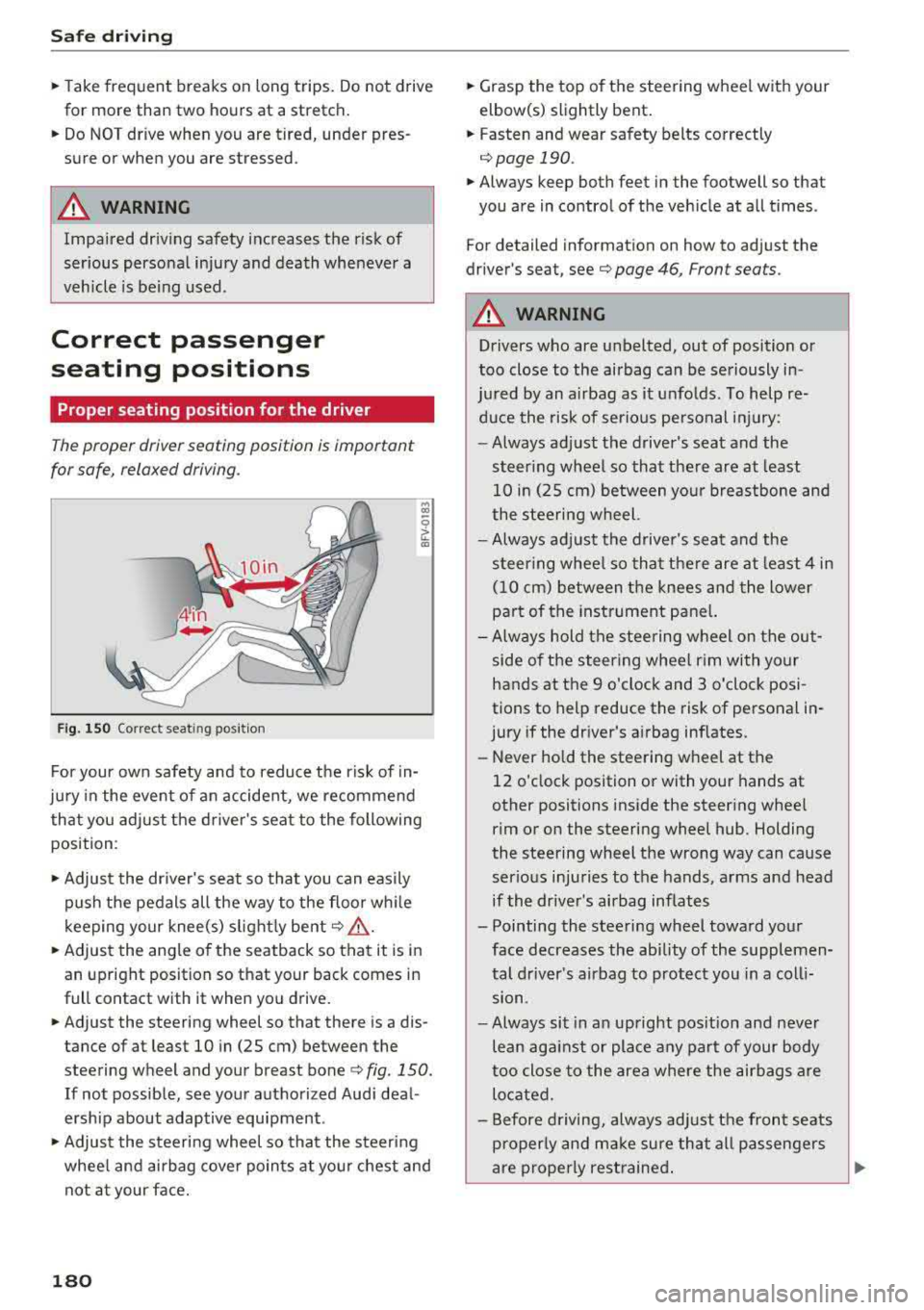
F ig. 150 Correct seat in g posi tion
.., CD
~ CD
For your own safety and to reduce the risk of in
jury in the event of an accident, we recommend
that you adjust the driver's seat to the following
position :
,.. Adjust the driver's seat so that you can easily
push the pedals all the way to the floor wh ile
k eeping your knee(s) s lightly bent
c:> .&_ .
,.. Adjust the angle of the seatback so that it is in
an upright position so that your back comes in
full contact with it when you drive.
,.. Adjust the steering wheel so that there is a dis
tance of at least 10 in (25 cm) between the
steering wheel and your breast bone
c:> fig. 150.
If not possible, see your authorized Audi deal
ersh ip about adaptive equipment .
,.. Adjust the steering wheel so that the steering
whee l and airbag cover points at you r chest and
not at your face.
180
,.. Grasp the top of the steering wheel with your
elbow(s) slightly bent.
,.. Fasten and wear safety belts correctly
c:> page 190 .
,.. Always keep both feet in the footwell so that
you are in control of the vehicle at all times .
For detailed information on how to adjust the
driver's seat, see
c:> page 46, Front seats.
A WARNING
Drivers who are unbelted, out of position or
too close to the airbag can be seriously in -
ju red by an airbag as it unfolds. To help re-
duce the risk of serious pe rsonal injury:
-Always adjust the driver's seat and the
steer ing wheel so that the re are at least
10 in (25 cm) between your breastbone and
the steering wheel.
-Always adjust the driver's seat and the
steer ing whee l so that there are at least 4 in
(10 cm) between the knees and the lower
pa rt of the instrument pane l.
- Always hold the steering wheel on the out
side of the steering wheel rim with your
hands at the 9 o'clock and 3 o'clock posi
tions to help reduce the risk of personal in
jury if the dr iver's a irbag inflates.
- Never hold the steering wheel at the
12 o'clock position or with your hands at
other positions inside the steering whee l
rim or on the steering wheel hub . Holding
the steering wheel the wrong way can cause
serious injuries to the hands, arms and head
if the driver's airbag inflates
- Pointing the steering wheel toward your face decreases the ability of the supplemen
tal driver's airbag to protect you in a coll i
sion.
- Always sit in an upright pos it ion and never
lean against or place any part of your body
too close to the area where the airbags are
located.
- Before driving, always adjust the front seats
properly and make sure that all passengers
-
are properly restrained . ..,.
Page 189 of 310
Cl 00 .-< N r-N .-< 0 r-Vl 00
Safety belts
General notes
Always wear safety belts!
Wearing safety belts correctly saves lives!
This chapter exp lains why safety be lts are neces
sary, how they work and how to adjust and wear
them correctly.
• Read all the information that follows and heed
all of the instructions and WARNINGS.
A WARNING
Not wearing safety belts or wearing them im
properly increases the risk of serious personal
injury and death.
- Safety belts are the s ingle most effective
means ava ilable to reduce the risk of serious
injury and death in automobile accidents.
For your protection and that of your passen
gers, always correctly wear safety belts
when the vehicle is moving.
- Pregnant women, injured, or physically im
paired persons must also use safety belts.
Like all vehicle occupants, they are more
likely to be seriously injured if th ey do not
wear safety belts. The best way to protect a
fetus is to protect the mother -throughout
the entire pregnancy.
Number of seats
Your veh icle has two seating positions. Each seat
ing position has a safety belt.
A WARNING
Not wearing safety belts or wearing them im
properly increases the risk of serious personal
injury and death.
- Never strap more than one person, includ
ing sma ll ch ildren, into any belt.
It is espe
ci ally da ngerous to place a safety belt over a
ch ild sitting on your lap.
- Never let more people ride in the vehicle
than there are safety belts available.
Safety belts
-Be sure everyone riding in the vehicle is
properly restrained with a separate safety
belt or child restraint.
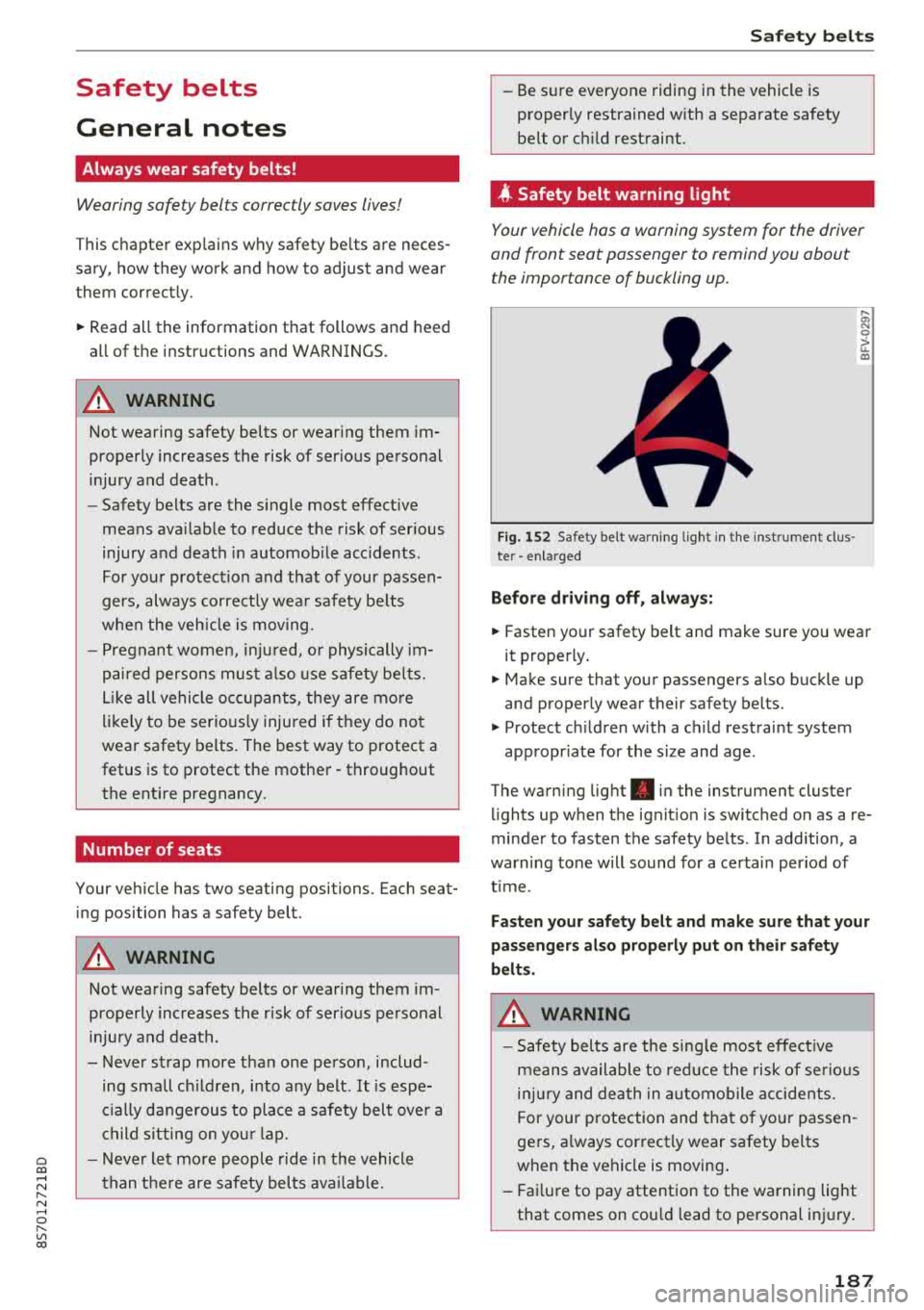
4 Safety belt warning light
Your vehicle has a warning system for the driver
and front seat passenger to remind you about the importance of buckling up.
Fig. 152 Safety belt warn ing ligh t in the instrument clus
ter -en larged
Before driving off, always:
l,; N 0
> ... m
• Fasten your safety belt and make sure you wear
it properly.
• Make sure that your passengers also buckle up
and properly wear their safety belts.
• Protect ch ildren with a child restraint system
appropr iate for the size and age .
The warning light . in the instrument cluster
lights up when the ignit ion is switched on as a re
minder to fasten the safety belts . In add ition, a
warning tone will sound for a certain period of
time .
Fasten your safety belt and make sure that your
passengers also properly put on their safety
belts.
A WARNING
-
- Safety belts are the single most effect ive
means available to red uce the risk of serious
i njur y and death in automobile accidents.
Fo r your protection and that of yo ur passen
gers, always correctly wear safety belts
when the vehicle is moving .
- Fail ure to pay attention to the warning light
that comes on cou ld lead to personal injury.
187
Page 198 of 310
Airbag system
The PASSENGER AIR BAG OFF~; light in the
headliner tells you when the front Advanced Air
bag on the passenger side has been turned off by
the electronic control unit.
E ach time you turn on the ignition, the
PASSEN
GER AIR BAG OFF
"1; ON@ light will come on
for a few seconds and:
- PASSENGER AIR BAG OFF ~; will come on if
the front passenger seat is not occupied,
-PASSENGER AIR BAG OFF ~; will come on if
t h e e lectrica l capacitance measured by the ca
pacitive passenger detection system for the
front passenger seat equa ls the combined ca
pacitance of an infant up to about one year of
age and one of the rearward-facing or forward
facing child restraints listed in Federal Motor
Vehicle Safety Standard 208 w ith which the Ad
vanced Airbag System in your vehicle was certi
fied. For a listing of the ch ild restraints that
were used to cert ify your vehicle 's compliance
with the U.S. Safety Standard
¢page 218.
- PASSENGER AIR BAG OFF~; will come on if
there is a small child or ch ild rest raint on the
front passenger seat,
-PASSENGER AIR BAG ON @w ill go off if the
front passenger seat is occupied by an adult as
registered by the capacitive passenger detec
tion system ¢
page 205, Monitoring the Ad
vanced Airbag System .
The PASSENGER AIR BAG OFF~; light comes on
when electrical capacitance registered on t he
front passenger seat is equa l to or less than the
combined capacitance of a typica l 1 year -o ld in
fant and one of the rearward-facing or forward
facing ch ild restraints listed in Federal Motor Ve
h icle Safety Standard 208 with wh ich the Ad
vanced A irbag System in your vehicle was cert i
f ie d.
If the tota l electrical capac itance registered on
the front passenger seat is more than that of a
typical 1 year-old child but less than the we ight
of a small adult, the front a irbag on the passen
ge r side ca n deploy (the
PASSENGER AIR BAG
OFF
"1; light does not come on).
If the
PASSENGER AIR BAG OFF "1; light does
not come on, the front a irbag on the passenger
196
side has not been turned off by the electronic
contro l unit and can deploy if the contro l unit
senses an impact that meets the conditions stor
ed in its memory.
For example , the airbag may deploy
if:
-a small c hild that is heav ier than a typica l 1
year-old child is on the front passenger seat
(regard less of whethe r the child is in one of the
child sa fety seats listed ¢
page 218), or
- a child who has outgrown child restraints is on
the front passenger seat.
If the front passenger a irbag is turned off, the
PASSENGER AIR BAG OFF~; light comes on in
the headliner and stays on.
If the front passenger airbag deploys, the Feder
al Standard requires the airbag to meet the "low
r isk" dep loyment cr iteria to reduce the r isk of in
jury through interaction w ith the airbag. "Low
risk" deployment occurs in those crashes that
take place at lower decelerations as defined in
the e lectronic contro l unit ¢
page 206, PASSEN
GER AIR BAG
OFF~; ON~ light.
A lways remember, a child seat or infant carrier
installed on the front seat may be struck and
knocked out of position by the rapidly inflating
passenger's airbag in a frontal col lision. The air
bag could great ly reduce the effectiveness of the
c hi ld restraint and even ser iously injure the child
during inflat io n.
A WARNING
A child in a rearward-facing child seat instal
led on the front passenger seat will be seri
ously injured and can be killed if the front air
bag inflates
-even with an Advanced Airbag
System.
- The inflat ing airbag will hit the child seat or
infant carrier with great force and will
smash the child seat and child against the
backrest, center armrest, door or roof.
- Forward-facing child seats installed on the
front passenger's seat may interfere with
the deployment of the airbag and cause se
r ious personal injury to the ch ild.
Page 199 of 310
Cl 00 .-< N r-N .-< 0 r-Vl 00
A WARNING
If, in exceptional circumstances, you must in
stall a forward-facing child restraint on the
front passenger's seat:
- Always make sure the forward-fac ing seat
has been designed and certified by its man
ufacturer for use on a front seat with a pas
senger front and s ide a irbag.
- Never put the forward-facing child restraint
up against or ve ry near the instrument pan
el.
- Always move the front passenger seat to
the highest position in the up and down ad
justment range and move it back to the
re ar most position in the se at's fore and aft
adjustment range, as fa r away from the air
bag as possib le, before insta lling the for
ward-facing child restraint .
-Always make sure that the safety belt upper
anchorage is behind the child restraint and
not next to or in front of the chi ld restraint
so that the safety belt will be properly pos i
t ioned.
- Make sure that the
PASSENGER AIR BAG
OFF ~; light comes on and stays on a ll the
t ime whenever the ignition is switched on.
A WARNING
To red uce the risk of serious in jury, make s ure
that the
PASSENGER AIR BAG OFF ~; light
w ill be displayed whenever a child restra int is
installed on the front passenge r seat and the
ign ition is swi tched on.
-If the PASSENGER AIR BAG OFF ~; light
does not stay on, perfo rm the che cks descri
bed
¢ page 205, Monitoring the Advanced
Airbag System .
-Have the airbag system inspe cte d by your
Audi dealer imme diately.
- Always caref ully follow instru ctions from
ch ild res tra int m anufa ctu rers when instal
ling child restraints .
Airbag syste m
A WARNING
--
If, in exceptional c ircumstances, you must in
stall a forward or rearward-facing child re
stra int on the fron t passenger 's seat :
- Imp roper installat ion of child restraints can
reduce the ir effectiveness or even prevent
them from providing any pro tect ion .
- An improperly installed child restra int can
interfere wi th the airbag as it deploys and
serio usly injure or even kil l the chi ld -even
wit h an Advanced A irbag System.
- Always carefully follow the manufacturer's
instr uctions provided with the child seat or
earner.
- Always make sure that there is noth ing on
the front passenge r seat tha t will cause the
capacitive p assenge r de te ction system in
the sea t to signal to the Airb ag System th at
the seat is occup ied by a person when i t is
not, or to signal that it is occupied by some
one who is heavier than the person actually
sitt ing on the seat. The presence of addi
tional objects could cause the passenger
front ai rbag to be turned on when it should
be off, or cou ld cause the ai rbag to work in a
way that is different from the way it wou ld
h ave wo rked withou t the objec t on the seat.
197
Page 202 of 310
Airbag syste m
airbag on the passenger side may or may not
deploy.
The
PAS SENGER AIR B AG OFF ~; light comes o n
when the e lectron ic control un it detects a total
e lectrica l capacitance on the front passenger seat
that requires the front airbag to be turned
off . If
the
PASSENGER AIR BAG OFF '1; light does not
come on, the front airbag on the passenger side has not been turned
off by the control unit and
can deploy if the control unit senses an impact
that meets the conditions stored in its memory .
If the tota l electrical capac itance registered on
the front passenger seat is more than that of a
typical 1 year -old, but less than the weight of a
small adult , the front airbag on the passenger
side may deploy (the
PASSENGER AIR BAG OFF
~ ; light does not come on).
For exampl e, th e airbag may d eploy if:
- a small child that is heavier than a typical 1
year-old ch ild is on the front passenger seat
(regardless of whether the child is in one of the
ch ild seats listed
r=;,page 218),
- a chi ld who has outgrown child restraints is on
the front passenger seat .
If the front passenger airbag is turned off , the
P ASS ENGER AIR BA G OFF~; light in the head
liner will come on and stay on .
I f the front passenger airbag dep loys, the Feder
a l Standard requires the airbag to meet the "low
risk" deployment criteria to help reduce the risk
of injury through interaction with the airbag.
"Low risk" deployment occurs in those crashes
that take place at lower decelerations as def ined
i n the electronic control
un it ¢ page 205 .
Alw ays remember: Please be sure to read the im
portant information in the sections that follow
and be sure to heed all of the WARNINGS .
A WARNING
To red uce the risk of inju ry when an a irbag in
flates, a lways wear safety belts p roperly.
- If you are unrestrained, lean ing forward, s it
t ing s ideways or out of pos ition in any way,
yo ur r isk of i njur y is m uch higher.
200
-You will a lso receive serious injuries and
could even be killed if yo u are up against the
airbag or too close to it when it inflates -
eve n with a n Advanced
Airbag ¢ page 194.
A WARNING
A child in a rearward-facing child seat instal
led on t he front passenger seat will be seri
ously injured and ca n be killed if the front air
bag inflates -even with an Advanced Airbag
Sys tem.
- Altho ugh the Advanced Airbag System in
your veh icle is des igned to tur n
off the front
air bag w hen a rearward -fac ing c hild re
s traint has been installed on the front pas
senger seat, nobody can abso lute ly guaran
tee t hat dep loyment is impossib le in all con
ceivab le situat ions that may happen d uring
the useful life of your vehicle.
- The inflating airbag will h it the ch ild seat or
infant carrier with great force and will
smash the child seat and child against the backrest, center armrest, door, or roof .
- If you m ust install a rearward facing child
safety seat on the front passenger seat be
cause of except ional circ umstances and the
PASSENGER AIR BAG OFF ~; light does not
come on and stay on have t he a irbag system
inspected by yo ur Audi dea ler.
A WARNING
I f, in exceptional c ircumstances , you must in
s tall a forward -fa cing ch ild res trai nt on the
front passenger's seat:
- Always make sure the forward -fa cing sea t
has bee n des igned and certified by its man
ufacturer for use on a front seat with a pas
senge r front and side airbag.
- Never put the fo rward -facing chi ld restrain t
up against o r very near the instr ument pan
el.
- Always move the front passenger seat to
the highest position in the up and down ad
justment range and move it bac k to the
rearmost posit io n in the seat's fo re and aft
Page 203 of 310
Cl 00 .-< N r--N .-< 0 r--Vl 00
adjustment range, as far away from the air
bag as possib le, before insta lling the for
ward-facing child restra int.
- Always make sure that the safety belt upper
anchorage is beh ind the child restraint and
not next to or in front of the chi ld restraint
so that the safety belt will be properly pos i
t ioned.
- Always make sure that there is nothing on
the front passenger seat that w ill cause the
capacit ive passenger detection system in
the seat to signa l to the Airbag System that
the seat is occupied by a person w hen it is
not, or to sign al that it is occ upied by some
one who is heavier than t he pe rson actua lly
sitting on the seat . The presence of addi
tiona l objects could ca use the passenge r
front airbag to be turned on when it shou ld
be off, or could cause the airbag to work in a
way that is different from the way it would
have worked wi tho ut the object on t he seat .
- Make sure that the
PASSENGER AIR BAG
OFF ~; light comes on and stays on all the
t ime w henever the ignition is sw itc hed on.
Advanced Airbag System components
The front passenger seat in you r vehicle has a lot
of very impo rtant parts of the Advanced Airbag
Sys tem in it. These pa rts in cl ude the capaci tive
passenger detection system, w iring, brac kets,
and more. The control unit monitors the system
on the front passenger seat when the ignition is
switched on and turns the airbag indicator light
on when a malfunct ion in the one of the system
components is detected
¢ page 206. Because
the front passenger seat contains important
pa rts of the Advanced Airbag System, you must
take ca re to prevent it from be ing damaged .
D amage to the seat may p reve nt the Advanced
A irbag System fo r the fron t passenger seat from
doi ng its job in a crash.
The front Advanced Airbag System consists
of the following :
-Cr ash sensors in the front of the vehicle t hat
measure vehicle accelerat ion/dece lerat ion to
Airbag syste m
prov ide information to the Advanced A irbag
System about the severity of the cras h.
- An electronic contro l uni t, with integrated
cras h sensors for front and side impacts . The
control unit "decides" whether to fire the front
airbags based on the information rece ived from
the crash sensors . The control unit also "de
cides" whether the safety belt pretensioners
should be activated.
- An Advanced A irbag w it h gas generator for the
driver inside the steering wheel hub .
- An Advanced A irbag w ith gas generator inside
the instrument panel for the front passenger.
- A capacit ive passenger detection system under
neat h the front passenger seat cover. This sys
tem meas ures the e lectr ica l capacitance of the
person in the seat. The informat ion registered
is sent cont inuously to the elect ronic contro l
un it to reg ulate dep loymen t of the front Ad
vance d Airbag on the p assenger side.
- An airbag monitor ing system and ind icator
ligh t
El in the inst rument cl uste r.
- A sensor in each front seat registe rs the d is
t ance betwee n the respective seat and the
s teer ing whee l o r i nst rument p anel. The infor
mation registered is sent con tinuous ly to the
elect ronic contro l unit to regu late dep loyment
of the front Advanced Airbags .
- The
PASSENGER AIR BAG OFF ~; lig ht comes
on and stays on in the
headliner¢ page 206,
fig. 164 and tells you when the front Advanced
Airbag on the passenger side has been turned
off.
- A sensor in the safety be lt latch for the driver
and for the front seat passenger that senses
whether that safety be lt is latched or not and
transmits this information to the e lectronic
control un it .
A WARNING
-
Damage to the front passenge r seat can pre
vent the front airbag from wo rk ing prope rly.
- Imp roper repair or d isassembly of the front
passenger and driver seat will p reve nt the
Advanced A irbag Sys tem from f unct io ni ng
p roperly .
201
Page 204 of 310
Airbag syste m
-Repairs to the front passenger seat must be
performed by qua lified and properly trained
workshop personnel.
- Never remove the front passenger or driver
seat from the vehicle.
- Never remove the upho lstery from the front
passenger seat.
- Never disassemble or remove parts from the
seat or disconnect wires from it.
- Never carry sharp objects in your pockets or
put them on the seat . The capacitive pas
senger detection mat in the front passenger
seat will not function properly if it is punc
tured.
- Never carry things on your lap or carry ob
jects on the front passenger seat. Such ob
jects can influence the capac itance regis
tered by the capac itive passenger detection
system, so that incorrect information is p ro
vided to the airbag control unit.
- Never store items under the front passenger
seat. Parts of the Advanced Airbag System
under the passenger sea t could be dam
aged, preventing them and the airbag sys
tem from working properly.
- Never place seat covers o r rep lacemen t up
holstery that have not been spec ifically ap
proved by Audi on the front seats.
- Seat covers can prevent the Advanced Air
bag System from recogn izing child re
straints or occupants on the front passenge r
seat and prevent the side airbag in the seat
backrest from dep loying properly.
- If a seat heater has been retrofitted or oth
erwise added to the front passenge r seat,
never install any ch ild restraint system on
this seat.
- Never use cush ions, pillows, blankets, or
similar items on the front passenger seat.
The add it iona l layers prevent the capacitive
passenger detection system from accurate ly
measuring the capac itance of the ch ild safe
ty seat and/or the pe rson on the seat and
th us keep the Advanced Airbag System from
wor king p roperly.
- Never place o r use any electrical device
(s uch as a laptop, CD player, elect ronic
games dev ice, power inverter or seat heater
202
for child seats) on the front passenger seat
if the device is connected to the 12-volt
socket or the cigarette lighter socket. Such
dev ices can influence the capac itance regis
tered by the capacitive passenger detection
system, so that incorrect informat ion is pro
vided to the airbag cont rol unit.
- If you must use a child restra int on the fron t
passenger seat and the child restraint man
ufacturer's instructions requ ire the use of a
towel, foam c ushion or someth ing else to
proper ly posit ion the child res tra int, ma ke
certain that the
PASSENGER AIR BAG OFF
~ ; light comes on and stays on whenever
the child restraint is installed on the front
passenger seat.
- If the
PASSENGER AIR BAG OFF ~; light
does not come on and stay on, have the air bag system inspected by your Audi dealer.
A WARNING
If the front passenger seat gets wet, dry it im
mediately .
-If liquid soaks into the front passenger seat,
this can keep the airbag system from work
ing properly and may, for instance, deacti
vate the passenger frontal airbag.
If this
happens, the
PASSENGER AIR BAG OFF ~'
light will come on and s tay on together w ith
t he air bag indica to r li gh t
El in the instru
ment cluster .
- If liqu id is pooled on the sea t, but has not
soaked in, th is may also keep the airbag sys
tem from wor king p roper ly and cause the
passenger fronta l airbag to be enabled
(turned on), even though there is a properly
installed child restraint system on the seat.
Wet towels or other wet things on the seat
cushion can have the same effect . If the
front passenger fronta l airbag is turned on,
the
PASSENGER AIR BAG OFF ~, light will
turn off.
How the Advanced Airbag System
components work together
The front Advanced Airbag System and the side
airbags supp lement the protection offered by the
.,.