Passenger airbag AUDI TT ROADSTER 2018 Owners Manual
[x] Cancel search | Manufacturer: AUDI, Model Year: 2018, Model line: TT ROADSTER, Model: AUDI TT ROADSTER 2018Pages: 310, PDF Size: 46.95 MB
Page 9 of 310
Cl 00 .-< N r-N .-< 0 r-Vl 00
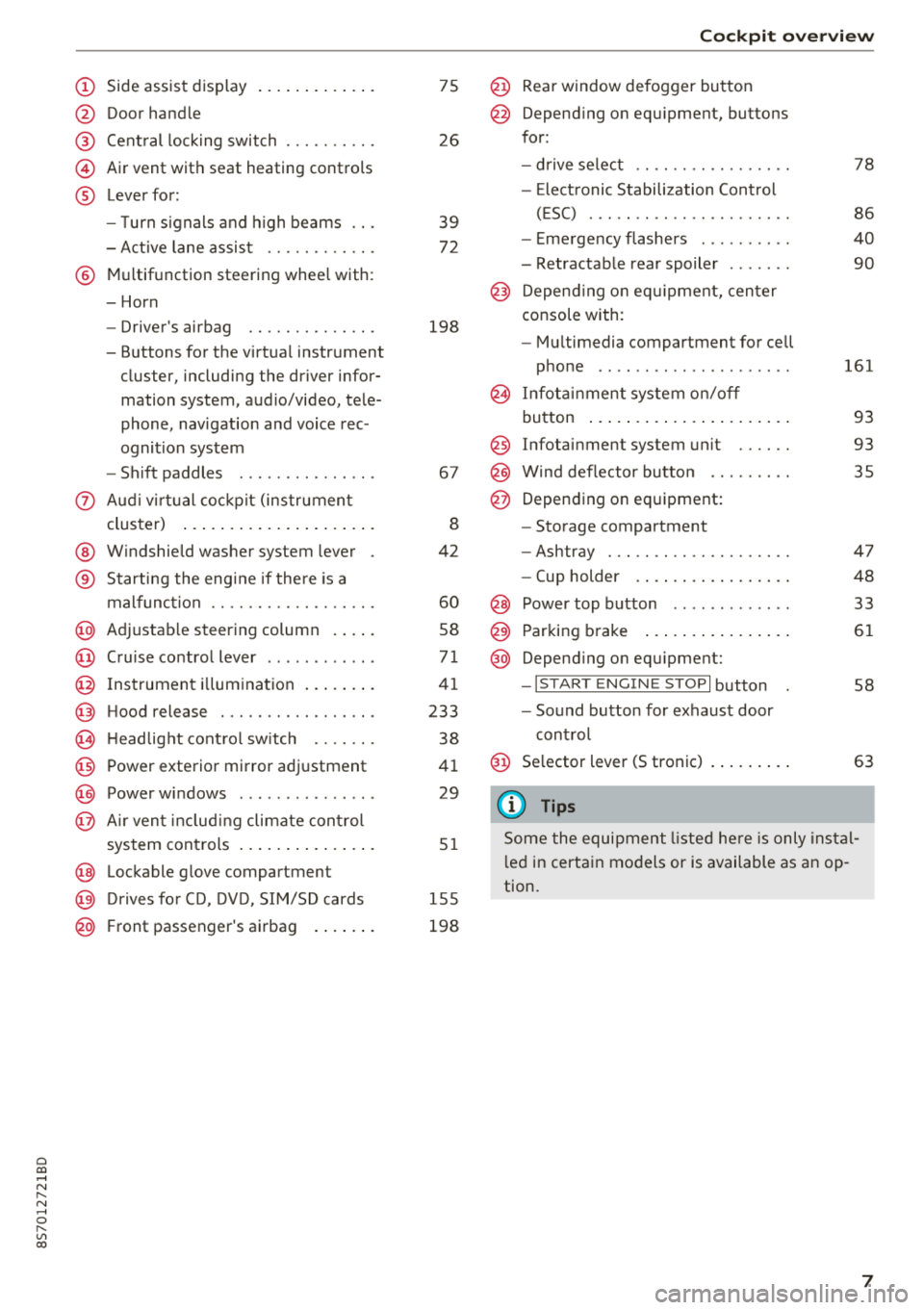
(D Side assist disp lay ..... ... .. .. .
@ Door handle
@ Cent ral locking swit ch ..... .. .. .
@ Air vent with seat heating controls
® Lever for:
- T urn s ignals and high beams
- Act ive lane assist ....... .. .. .
® M ultifunction steering whee l with :
- Horn
- Driver's airbag ........... .. .
- Buttons for the virtua l instr ument
cluster, including the dr iver infor
mation system, audio/video, tele
phone, navigation and voice rec
ognit ion system
- Shift paddles ............. . .
(J) A ud i v irtu al coc kp it (instrument
cluster) ... ... .. ..... ... .. .. .
@ W indshield washer system lever
® Starting the eng ine if the re is a
malfunc tion ............... .. .
@ Ad justable steer ing column . ... .
@ Cruise contro l lever .......... . .
@ Ins trumen t il lum ination ... .. .. .
@ Hood release .............. .. .
€3) H eadlight cont ro l sw itch .... .. .
@ Power exterio r mirror adj ustment
@) Power windows .............. .
@ A ir ven t incl uding climate con trol
system controls .. ..... ... .. .. .
@ Lockable g love compartment
@) D rives fo r CD, DV D, SIM/SD cards
@ Front passenger's ai rbag . ... .. .
75
26
39
7 2
198
67
8
42
60
58
71
41
233
38
4 1
29
5 1
1 55
198
Coc kpit o ver view
@ Rear window defogger button
@ Depend ing on equ ipment, buttons
for:
- drive select .. .............. .
- Elect ronic Stabili zation Cont rol
( E SC) . .. .. .. .............. .
- E me rge ncy flashers ......... .
- Retractable rear spoiler ...... .
@ Depending o n eq uipment, cen ter
console with:
- Mu ltimedia compartment for cell
p hone .. .. .. .. ............ .
@ In fota inment system o n/off
bu tton ... .... .. ... .. ..... .. .
@ Infotai nment system unit ..... .
@ Wind deflector butto n ........ .
@ Depending on eq uipment:
- Storage compartment
- Ashtray . .. .. .............. .
- Cup holder .... ... .. ..... .. .
@ Power top b utton ............ .
@ Parking b rake ... ... .. ..... .. .
@ Depend ing on eq uipment:
-I S TAR T ENGI NE STOP I button
- So und button for exhaust door
cont rol
@ Se lector lever (S tronic)
(D Tips
78
86
40
90
161
93
93 35
47
48
33
61
58
63
Some the equi pment listed he re is only ins tal
l e d in certa in models or is available as an op
tion.
7
Page 182 of 310
Safe dri ving
,.. Take frequent breaks on long trips. Do not drive
for more than two hours at a stretch.
,.. Do NOT drive when you are tired, under pres
sure or when you are stressed.
A WARNING
Impaired driving safety increases the risk of
serious personal injury and death whenever a
vehicle is being used.
Correct passenger
seating positions
Proper seating position for the driver
The proper driver seating position is important
for safe, relaxed driving.
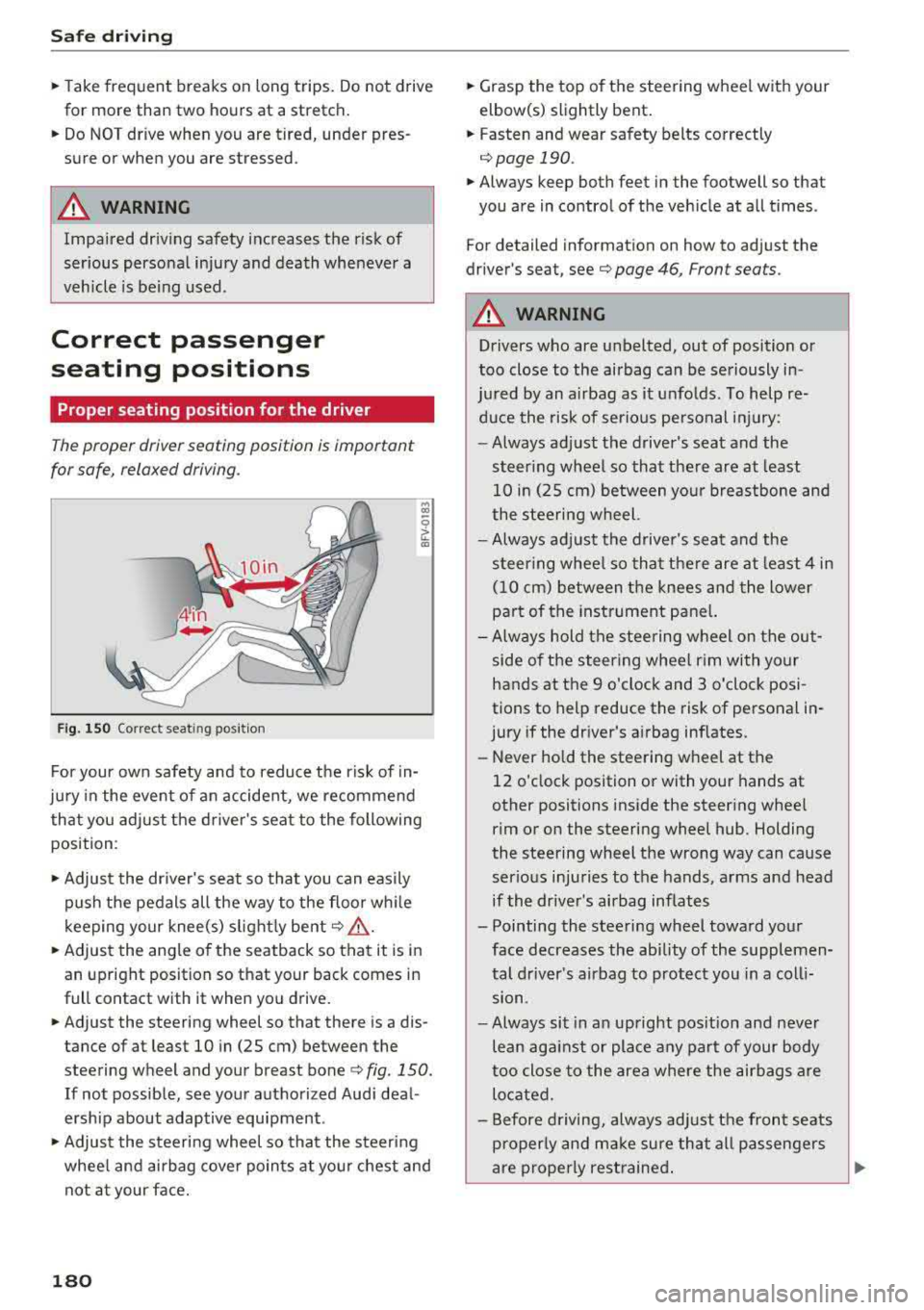
F ig. 150 Correct seat in g posi tion
.., CD
~ CD
For your own safety and to reduce the risk of in
jury in the event of an accident, we recommend
that you adjust the driver's seat to the following
position :
,.. Adjust the driver's seat so that you can easily
push the pedals all the way to the floor wh ile
k eeping your knee(s) s lightly bent
c:> .&_ .
,.. Adjust the angle of the seatback so that it is in
an upright position so that your back comes in
full contact with it when you drive.
,.. Adjust the steering wheel so that there is a dis
tance of at least 10 in (25 cm) between the
steering wheel and your breast bone
c:> fig. 150.
If not possible, see your authorized Audi deal
ersh ip about adaptive equipment .
,.. Adjust the steering wheel so that the steering
whee l and airbag cover points at you r chest and
not at your face.
180
,.. Grasp the top of the steering wheel with your
elbow(s) slightly bent.
,.. Fasten and wear safety belts correctly
c:> page 190 .
,.. Always keep both feet in the footwell so that
you are in control of the vehicle at all times .
For detailed information on how to adjust the
driver's seat, see
c:> page 46, Front seats.
A WARNING
Drivers who are unbelted, out of position or
too close to the airbag can be seriously in -
ju red by an airbag as it unfolds. To help re-
duce the risk of serious pe rsonal injury:
-Always adjust the driver's seat and the
steer ing wheel so that the re are at least
10 in (25 cm) between your breastbone and
the steering wheel.
-Always adjust the driver's seat and the
steer ing whee l so that there are at least 4 in
(10 cm) between the knees and the lower
pa rt of the instrument pane l.
- Always hold the steering wheel on the out
side of the steering wheel rim with your
hands at the 9 o'clock and 3 o'clock posi
tions to help reduce the risk of personal in
jury if the dr iver's a irbag inflates.
- Never hold the steering wheel at the
12 o'clock position or with your hands at
other positions inside the steering whee l
rim or on the steering wheel hub . Holding
the steering wheel the wrong way can cause
serious injuries to the hands, arms and head
if the driver's airbag inflates
- Pointing the steering wheel toward your face decreases the ability of the supplemen
tal driver's airbag to protect you in a coll i
sion.
- Always sit in an upright pos it ion and never
lean against or place any part of your body
too close to the area where the airbags are
located.
- Before driving, always adjust the front seats
properly and make sure that all passengers
-
are properly restrained . ..,.
Page 183 of 310
Cl 00 .-< N r-N .-< 0 r-Vl 00
-Never adjust the seats while the vehicle is
moving. Your seat may move unexpectedly
and you could lose control of the vehicle.
- Never drive with the backrest reclined or
tilted far back! The farther the backrests are
tilted back, the greater the risk of injury due
to incorrect positioning of the safety belt
and improper seating position .
- Children must always ride in child seats
¢page 216. Special precautions apply
when installing a child seat on the front
passenger seat ¢
page 194.
Proper seating position for the front
passenger
The proper front passenger seating position is
important for safe, relaxed driving.
For your own safety and to reduce the risk of in
jury in the event of an accident, we recommend
that you adjust the seat for the front passenger
to the following position:
.,. Adjust the angle of the seatback so that it is in
an upright position and your back comes in full
contact with it whenever the vehicle is moving .
.,. Keep both feet flat on the floor in front of the
front passenger seat .
.,. Fasten and wear safety belts correctly
¢ page 190.
For detailed information on how to adjust the
front passenger's seat, see ¢
page 46.
A WARNING
Front seat passengers who are unbelted, out
of position or too close to the airbag can be
seriously injured or killed by the airbag as it
unfolds . To help reduce the risk of serious
personal injury:
- Passengers must always sit in an upright po
sition and never lean against or place any
part of their body too close to the area
where the airbags are located.
- Passengers who are unbelted, out of posi
tion or too close to the airbag can be seri
ously injured by an airbag as it unfolds with
great force in the blink of an eye .
Safe driving
-Always make sure that there are at least
10 in (25 cm) between the front passen
ger's breastbone and the instrument panel.
- Always make sure that there are at least 4 in
(10 cm) between the front passenger's
knees and the lower part of the instrument
panel.
- Each passenger must always sit on a seat of
their own and properly fasten and wear the
safety belt belonging to that seat.
- Before driving, always adjust the front pas
senger seat properly.
- Always keep your feet on the floor in front
of the seat. Never rest them on the seat, in
strument panel, out of the window, etc . The
airbag system and safety belt will not be
able to protect you properly and can even in
crease the risk of injury in a crash .
- Never drive with the backrest reclined or
tilted far back! The farther the backrests are
tilted back, the greater the risk of injury due
to incorrect positioning of the safety belt
and improper seating position .
- Children must always ride in child seats
¢
page 216. Special precautions apply
when installing a child seat on the front
passenger seat ¢
page 194.
Examples of improper seating positions
The occupant restraint system can only reduce
the risk of injury if vehicle occupants are properly
seated.
Improper seating positions can cause serious in
jury or death. Safety belts can only work when
they are properly positioned on the body. Im
proper seating positions reduce the effectiveness
of safety belts and will even increase the risk of
injury and death by moving the safety belt to crit
ical areas of the body . Improper seating positions
also increase the risk of serious injury and death
when an airbag deploys and strikes an occupant
who is not in the proper seating position. A driver
is responsible for the safety of all vehicle occu-
pants and especially for children. Therefore:
IJJ,,
181
Page 184 of 310
Safe dri ving
~ Never allow anyone to assume an incorrect
seating position when the vehicle is being used
¢A .
The fo llowing bulletins list only some sample po
sitions that wi ll increase the risk of serious injury
and deat h. Our hope is that these examples wi ll
make you more aware of seating positions that
are dangerous.
Therefor e, when ever th e veh icle is mo ving :
-never stand up in t he vehicle
- never s tand on the seats
- never knee l on the seats
- never r ide with the seatback reclined
- never lie down on the seats
- never lean up against the instrument pane l
- never sit on the edge of the seat
- never sit sideways
- never lean out the w indow
- never put you r feet out the window
- never put your feet on the instrument panel
- never rest your feet on the sea t cushion or back
of the seat
- never ride in the footwell
- never ride in the cargo area
A WARNING
Improper seat ing posit ions increase the r isk
of serious personal injury and deat h whenever
a vehicle is being used .
- Always make sure that a ll vehicle occupants
stay in a proper seat ing pos ition and are
properly restra ined whenever the vehicle is
being used .
Driver and passenger
side footwell
Important safety instructions
A WARNING
Alw ays ma ke sure that t he knee ai rbag can in
flate without interferen ce. Obje cts between
yourse lf and the airbag can increase the risk
of injury in an accident by interfering with the
182
way the airbag dep loys o r by being pushed in
to you as the airbag dep loys.
- No persons (chi ldren) o r anima ls should ride
in the footwell in front of the passenger
seat.
If the airbag deploys, this can resu lt in
serious or fatal injuries.
- No objects of any kind should be carried in the footwell area in front of the dr iver's or
passenger's seat . Bu lky objects (shopping
bags, for examp le) can hamper or prevent
proper dep loyment of the a irbag. Sma ll ob
jects ca n be thrown th ro ugh t he ve hicle if
the airbag deploys a nd injur e you or your
p a sse ngers.
Pedal area
Pedals
The pedals must always be free to move and
must never be interfered with by a floor mat or
any other object.
Make sure that all pedals move free ly without in
terference and t hat nothing prevents them from
returning to their orig inal positions .
Only use floor mats t hat leave the pedal area free
and can be secured with floor mat fasteners.
If a bra ke circuit fails , in creased bra ke pedal trav
el is req uired to b ring the vehicle to a fu ll stop.
A WARNING
Pedals that cannot move freely can cause loss
of vehicle contro l and increase the risk of se ri
ous injury .
- Never p lace any objects in the driver's foot
we ll. An object could get into the peda l area
and interfere with pedal funct ion. In case of
sudden b raking or an acc ident, you would
not be able to brake or acce lerate!
- Always make sure that nothing can fall or move into the driver's footwel l.
Page 190 of 310
Safety belts
Why safety belts?
Frontal collisions and the law of physics
Frontal crashes create very strong forces for peo
ple riding in vehicles .
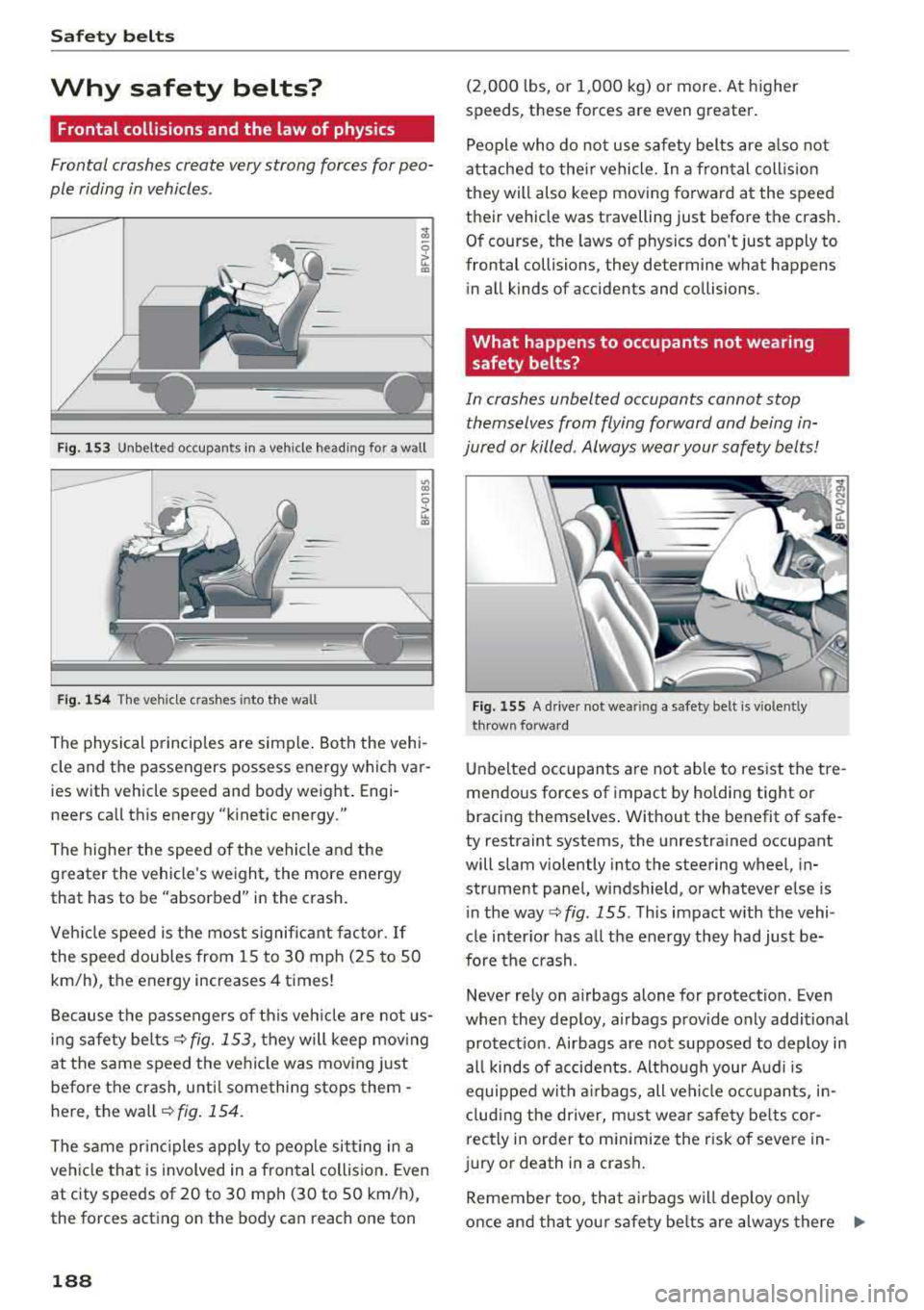
Fig . 153 Unbelted occupants in a veh icle headi ng fo r a wall
Fig. 154 T he vehicle c rashes into the wall
The physical principles are simple. Both the vehi
cle and the passengers possess energy which var
ies w ith vehicle speed and body weight. Engi
neers call this energy "k inetic energy."
The higher the speed of the vehicle and the
greater the vehicle's weight, the more energy
that has to be "absorbed" in the crash.
Vehicle speed is the most significant factor .
If
the speed doubles from 15 to 30 mph (25 to 50
km/h), the energy increases 4 times!
Because the passengers of this vehicle are not us
i ng safety belts
c::>fig. 153, they will keep moving
at the same speed the vehicle was moving just
before the crash, unti l something stops them -
here, the wall
c::> fig . 154.
The same principles apply to people sit ting in a
vehicle that is involved in a frontal collision . Even
at c ity speeds of 20 to 30 mph (30 to 50 km/h),
the forces acting on the body can reach one ton
188
(2,000 lbs, or 1,000 kg) or more . At higher
speeds, these forces are even greater.
People who do not use safety belts are also not
attached to their vehicle. In a frontal collis ion
they will also keep moving forward at the speed
their vehicle was travelling just before the crash.
Of course, the laws of physics don't just apply to
frontal collisions, they determine what happens
in all kinds of accidents and collisions .
What happens to occupants not wearing
safety belts?
In crashes unbelted occupants cannot stop
themselves from flying forward and being in
jured or killed . Always wear your safety belts!
Fig. 155 A drive r not wea ring a safety belt is vio len tly
t hrow n fo rward
Unb elted occupants are not able to resist the tre
mendous forces of impact by holding tight o r
bracing themselves . Without the benefit of safe
ty restraint systems, the unrestrained occupant
will slam violently into the steering wheel, in
strument panel, windshield, or whatever else is
i n the way
c::> fig . 155 . This impact w ith the vehi
cle inter ior has all the energy they had just be
fore the crash.
Never rely on a irbags alone for protection . Even
when they deploy, a irbags provide only addit ional
protection. Airbags are not supposed to deploy in
all kinds of accidents. Although your Audi is
equipped with airbags, all veh icle occupants, in
cluding the driver, must wear safety belts cor
rectly in order to minimize the risk of severe in
ju ry or death in a crash .
Remember too, that airbags will deploy only
once and that your safety be lts are always there
IJJ,,
Page 191 of 310
Cl co .... N ,....
N ...... 0 ,....
Vl co
to offer protection in those accidents in which
airbags are not supposed to deploy or when they
have a lready deployed. Unbelted occupants can
also be thrown out of the vehicle where even
more severe or fatal injuries can occur.
Safety belts protect
People think it's possible to use the hands to
brace the body in a minor collision. It's simply
no t true!
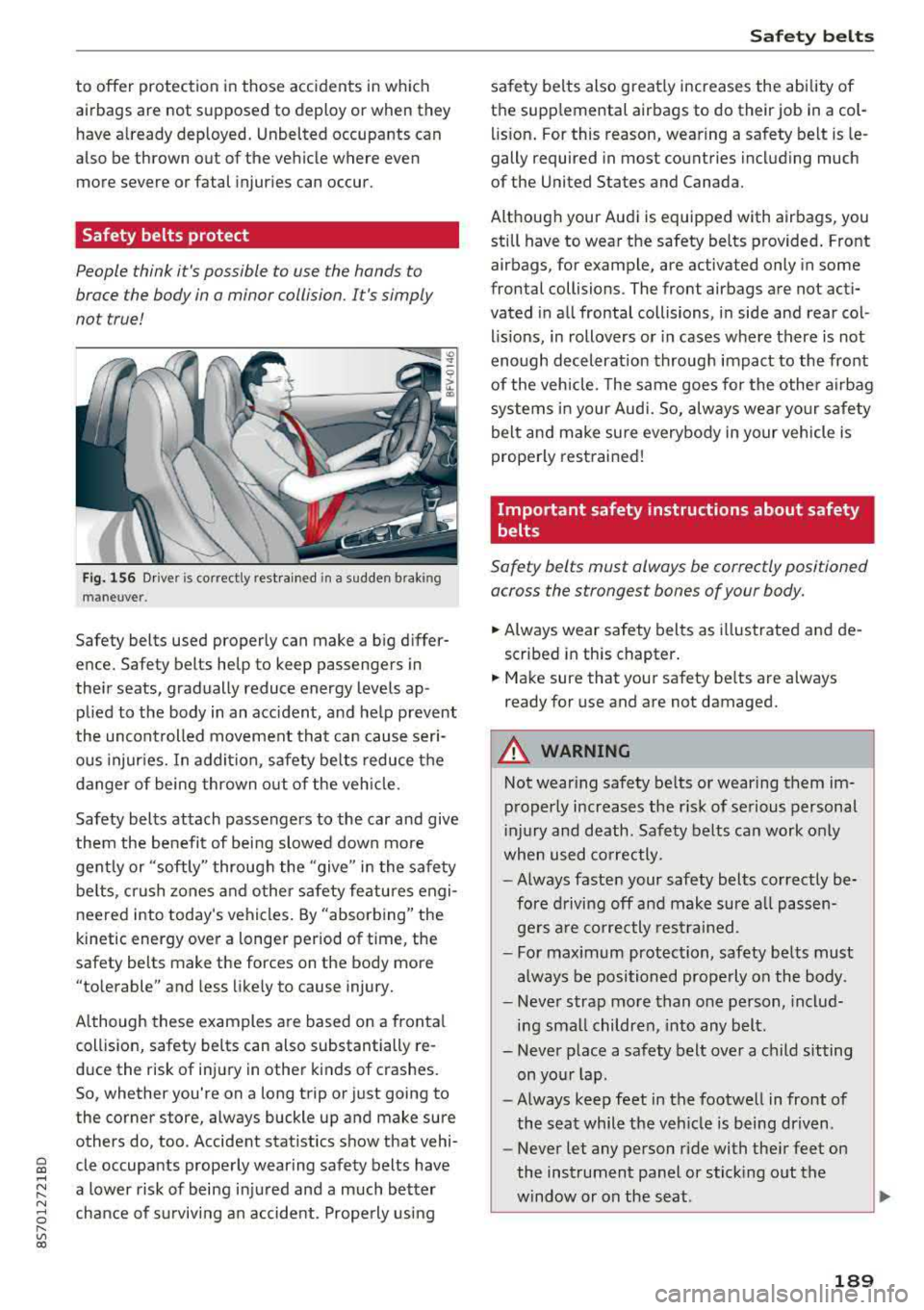
Fig. 156 Drive r is correctly restra ined in a s udde n brak ing
ma neuver .
Safety belts used properly can make a big differ
ence. Safety belts help to keep passengers in
their seats, gradually reduce energy levels ap
p lied to the body in an accident , and he lp prevent
the uncon trolled movement tha t can cause seri
ous injur ies. In addi tion , safety belts reduce the
danger of being thrown out of the veh icle.
Safety belts attach passengers to the car and give
them the benefi t of bei ng slowed down more
gent ly or "softly" through the "give" i n the safe ty
be lts, crush zones and other safety features engi
neered into today's vehicles . By "absorbing" the
kinetic energy ove r a longer period of time, the
safety belts make the forces on the body more
"to lerable" and less likely to cause injury.
Although these examples are based on a fronta l
coll is ion, safety belts can also substantially re
duce th e risk of inj ury in other kinds of crashes.
So, whether you're on a long trip or just going to
the corner store, always buckle up and make sure
others do, too . Accident stat istics s how that vehi
cle occupants properly wearing safety belts have
a lower risk of being in ju red and a much better
chance of s urviv ing a n accide nt. Prope rly us ing
Safet y bel ts
sa fety belts also great ly increases the ability of
the supp lemental airbags to do their job in a col
li sion . For this reason, wearing a safety belt is le
gally required in most countries including much
of the United States and Canada.
Although your Audi is equipped with airbags, you still have to wear the safety belts p rovided . Front
airbags, for example, are activated only in some
frontal collisions. The front airbags are not acti
vated in a ll frontal collisions, i n side and rear col
lis ions, in rollovers o r in cases where there is not
enough decelerat ion through impact to the front
of the veh icle. The same goes for the othe r air bag
systems in your Aud i. So, always wear yo ur safe ty
belt an d make sure everybody in your vehicle is
prope rly restrained!
Important safety instructions about safety
belts
Safety belts must always be correctly positioned
across the strongest bones of your body.
.,. Always wear safety belts as i llustrated and de
scribed in this chapter.
.,. Make sure that your saf ety be lts are always
ready for use and are not damaged.
A WARNING
Not wear ing safety be lts o r wearing t hem im
p roperly increases the r is k of serious personal
i njury and death . Safety belts can work only
when used correctly.
- Always fasten your safety belts co rrectly be
fore d riving off and make sure a ll passen
ge rs a re co rrectly res trained.
- For maximum protection, safety belts must
always be positioned properly o n the body .
- Never strap more than one person, includ
ing smal l children , into any belt .
- Never p lace a safety belt over a child sitting
on yo ur lap .
- Always keep feet in the footwe ll in front of
the seat while the veh icle is being driven .
- Never let any person ride with the ir feet on
the instrument panel or stick ing out the
window or on the seat.
189
Page 196 of 310
Airbag system
Airbag system
Important information
Importance of wearing safety belts and
sitting properly
Airbags are only supplemental restraints . For
airbags to do their job, occupants must always
properly wear their safety belts and be in a prop er seating position.
For your safety and the safety of your passen
gers , before driving off, always :
.,. Adjust the driver's seat and steering wheel
properly ~ page 180,
.,. Adjust the front passenge r's seat properly
~ page 181,
.,. Wear safety belts p roperly ~ page 189,
.. Always properly use the proper child restraint
to protect chi ldren
~ page 216.
In a coll is ion airbags must inflate within the blink
of an eye and with considerable force. The sup
p lemental airbags can cause injuries if the driver
or the front seat passenger is not seated proper ·
ly. T herefore in order to help the airbag to do its
job, it is important, both as a dr iver and as a pas
senger to sit properly at all t imes .
By keeping room between your body and the
steering whee l and the front of the passenger
compartment, the a irbag can inflate fully and
completely and provide supplemental protect ion
in certain frontal
coll isions ¢ page 180, Correct
passenger seating positions .
For details on the
operation of the seat adjustment controls
¢page 46.
It's especially important that children are proper
ly restrained
¢page 216 .
There is a lot that the driver and the passenger
can and must do to help the ind iv idual safety fea
tures installed in your Audi work together as a
system .
Proper seating posit ion is important so that the
front airbag on the driver side can do its job. If
you have a physical impairment or cond ition that
prevents you from s itting properly on the driver
seat with the safety be lt properly fastened and
194 reaching
the pedals, or if you have concerns with
regard to the function or operation of the Ad
vanced Airbag System, please contact your au
thori zed Audi dea ler or qualified workshop, or
ca ll Audi Customer Relations at 1-800-822-2834
for poss ible modifications to your vehicle .
When the airbag system dep loys, a gas generator
will fill the airbags, break open the padded cov ers, and inflate between the steering wheel and
the driver and between the instrument panel and
the front passenger . Th e a irbags w ill deflate im
med iate ly after deployment so that the front oc
cupants can see t hrough the windsh ield aga in
without interruption.
All of th is takes place in the blink of an eye, so
fast that many people don't even realize that the
a irbags have deployed. The airbags also inflate
with a great deal of force and nothing should be
in the ir way when they deploy. Front airbags in
combination with properly worn safety belts slow
down and limit the occupant's forward move
ment . Together they help to prevent the driver
and passenger from hitting parts of the inside
the vehicle while reducing the forces acting on
the occupant during the crash . In this way they
help to reduce the risk of injury to the head and
upper body in the crash . Airbags do not protect
the arms or the lowe r parts of the body.
Both front airbags will not inflate in all frontal
collisions . The triggering of t he a irbag system de
pends on the vehicle deceleration rate caused by
the collis ion and regis tered by the electronic con
trol unit . If this rate is be low the refe rence value
programmed into the control unit, the airbags
will not be triggered, even tho ugh t he car may be
badly damaged as a resu lt of the co llision . Vehi
cle damage, repair costs or even the lack of vehi
cle damage is not necessarily an indication of
whether an a irbag should inflate or not.
Since the circumstances wi ll vary considerab ly
between one collision and another, it is not possi
ble to define a range of veh icle speeds that will
cover every poss ible kind and angle of impact
that w ill always trigger the airbags . Important
factors include, for example, the nature (hard or
soft) of the object which the car hits, the angle of
im pact , vehicle speed, etc. The front airbags will
..,.
Page 197 of 310
Cl 00 .-< N r--N .-< 0 r--Vl 00
also not inflate in side or rear co llisions, or in
ro llovers .
Alwa ys re memb er: Airbags will deploy only o nce,
and on ly in ce rtain k inds of coll is ions. Yo ur safety
be lts are always there to offer protection in those
situations in which airbags are not supposed to
deploy, or when they have already deployed; for
examp le, when your vehicle str ikes or is struck by
another vehicle after the first coll is ion.
This is just one of the reasons why an airbag is a
supp lementary restraint and is not a substitute
for a safety belt. The airbag system works most
effect ively when used with the safety belts.
Therefore, always properly wear your safety belts
<=:> page 187 .
A WARNING
Sitting too close to the steer ing whee l o r i n
st rument panel w ill decrease the effe ct ive
ness of the airbags and will inc rease the risk
of persona l injury in a co llision.
- Never si t close r than 10 in (25 cm) to t he
steering wheel o r inst rument pane l.
- If you cannot sit mo re than 10 in (25 cm)
from the steer ing whee l, invest iga te wheth
er adaptive eq uipme nt may be avai lab le to
held you reach the pedals and increase you r
seating distance from the steering wheel.
- If you are unrestrained, leaning fo rwa rd, s it
ting sideways or o ut of position in any way,
your risk of inj ury is much higher .
- Yo u will also receive serious injuries and
cou ld even be killed if you are up against the
airbag or too close to it when it inf lates -
even with an Advanced Airbag.
- To reduce the risk of inj ury when an airbag
inflates, a lways wear safety be lts proper ly
¢ page 190, Safety belts.
- If children are not properly restrained, they
may be severely in jured or killed when an
airbag inflates.
- Never let children ride unrestrained or im properly restrained in the veh icle. Adjust the
front seats properly.
- Always sit as far as poss ible from the steer
ing w heel or the inst rument panel
¢ page 180.
-
Airbag syste m
- Always sit upright w ith your back against
the backrest of your seat .
- Never p lace your feet on the instrument
panel or on the seat. Always keep bot h feet
on the floor in front of the seat to help pre
vent ser ious injuries to the legs and hips if
the airbag inflates.
A WARNING
-
A irbags that have deployed in a cras h must be
r eplaced.
- Use o nly orig inal equipment airbags ap
proved by Audi and installed by a trained
technicia n who has the necessary tools and
d iagnost ic equipment to prope rly replace
a ny a irbag i n yo ur vehicle and ass ure system
effe ct iveness in a crash .
- Neve r pe rmit salvaged or recycled airbags to
be inst alled in you r vehicle.
Child restraints on the front seat - some
important things to know
.,. Be sure to read the important information and
head the WARNINGS for important detai ls
about ch ildren and Advanced A irbags
¢page 216 .
The airbag on the passenger side makes the front
seat a potent ially dangerous place for a child to
ride. The front seat is not the safest place for a
child in a forward -fac ing child safety seat . It can
be a very dangerous place for an infant or a ch ild
in a rearward-fac ing seat.
The Advanced A irbag System in your vehicle has
been certified to comply with the requirements
of United States Federal Motor Ve hicle Safety
Standard (FMVSS) 208, as we ll as Canada Moto r
Vehicle Safety Standard (C MVSS) 208 as appl ica
ble at the time you r vehi cle was manuf actured.
According to requirements , the front Advanced
Airbag System on the passenger side has been
certified for "suppression" for infants of abo ut
12 month o ld and younger and for " low risk de
ployment" for chi ldren aged 3 to 6 years old (as
defined in the standard).
Iii>
195
Page 198 of 310
Airbag system
The PASSENGER AIR BAG OFF~; light in the
headliner tells you when the front Advanced Air
bag on the passenger side has been turned off by
the electronic control unit.
E ach time you turn on the ignition, the
PASSEN
GER AIR BAG OFF
"1; ON@ light will come on
for a few seconds and:
- PASSENGER AIR BAG OFF ~; will come on if
the front passenger seat is not occupied,
-PASSENGER AIR BAG OFF ~; will come on if
t h e e lectrica l capacitance measured by the ca
pacitive passenger detection system for the
front passenger seat equa ls the combined ca
pacitance of an infant up to about one year of
age and one of the rearward-facing or forward
facing child restraints listed in Federal Motor
Vehicle Safety Standard 208 w ith which the Ad
vanced Airbag System in your vehicle was certi
fied. For a listing of the ch ild restraints that
were used to cert ify your vehicle 's compliance
with the U.S. Safety Standard
¢page 218.
- PASSENGER AIR BAG OFF~; will come on if
there is a small child or ch ild rest raint on the
front passenger seat,
-PASSENGER AIR BAG ON @w ill go off if the
front passenger seat is occupied by an adult as
registered by the capacitive passenger detec
tion system ¢
page 205, Monitoring the Ad
vanced Airbag System .
The PASSENGER AIR BAG OFF~; light comes on
when electrical capacitance registered on t he
front passenger seat is equa l to or less than the
combined capacitance of a typica l 1 year -o ld in
fant and one of the rearward-facing or forward
facing ch ild restraints listed in Federal Motor Ve
h icle Safety Standard 208 with wh ich the Ad
vanced A irbag System in your vehicle was cert i
f ie d.
If the tota l electrical capac itance registered on
the front passenger seat is more than that of a
typical 1 year-old child but less than the we ight
of a small adult, the front a irbag on the passen
ge r side ca n deploy (the
PASSENGER AIR BAG
OFF
"1; light does not come on).
If the
PASSENGER AIR BAG OFF "1; light does
not come on, the front a irbag on the passenger
196
side has not been turned off by the electronic
contro l unit and can deploy if the contro l unit
senses an impact that meets the conditions stor
ed in its memory.
For example , the airbag may deploy
if:
-a small c hild that is heav ier than a typica l 1
year-old child is on the front passenger seat
(regard less of whethe r the child is in one of the
child sa fety seats listed ¢
page 218), or
- a child who has outgrown child restraints is on
the front passenger seat.
If the front passenger a irbag is turned off, the
PASSENGER AIR BAG OFF~; light comes on in
the headliner and stays on.
If the front passenger airbag deploys, the Feder
al Standard requires the airbag to meet the "low
r isk" dep loyment cr iteria to reduce the r isk of in
jury through interaction w ith the airbag. "Low
risk" deployment occurs in those crashes that
take place at lower decelerations as defined in
the e lectronic contro l unit ¢
page 206, PASSEN
GER AIR BAG
OFF~; ON~ light.
A lways remember, a child seat or infant carrier
installed on the front seat may be struck and
knocked out of position by the rapidly inflating
passenger's airbag in a frontal col lision. The air
bag could great ly reduce the effectiveness of the
c hi ld restraint and even ser iously injure the child
during inflat io n.
A WARNING
A child in a rearward-facing child seat instal
led on the front passenger seat will be seri
ously injured and can be killed if the front air
bag inflates
-even with an Advanced Airbag
System.
- The inflat ing airbag will hit the child seat or
infant carrier with great force and will
smash the child seat and child against the
backrest, center armrest, door or roof.
- Forward-facing child seats installed on the
front passenger's seat may interfere with
the deployment of the airbag and cause se
r ious personal injury to the ch ild.
Page 199 of 310
Cl 00 .-< N r-N .-< 0 r-Vl 00
A WARNING
If, in exceptional circumstances, you must in
stall a forward-facing child restraint on the
front passenger's seat:
- Always make sure the forward-fac ing seat
has been designed and certified by its man
ufacturer for use on a front seat with a pas
senger front and s ide a irbag.
- Never put the forward-facing child restraint
up against or ve ry near the instrument pan
el.
- Always move the front passenger seat to
the highest position in the up and down ad
justment range and move it back to the
re ar most position in the se at's fore and aft
adjustment range, as fa r away from the air
bag as possib le, before insta lling the for
ward-facing child restraint .
-Always make sure that the safety belt upper
anchorage is behind the child restraint and
not next to or in front of the chi ld restraint
so that the safety belt will be properly pos i
t ioned.
- Make sure that the
PASSENGER AIR BAG
OFF ~; light comes on and stays on a ll the
t ime whenever the ignition is switched on.
A WARNING
To red uce the risk of serious in jury, make s ure
that the
PASSENGER AIR BAG OFF ~; light
w ill be displayed whenever a child restra int is
installed on the front passenge r seat and the
ign ition is swi tched on.
-If the PASSENGER AIR BAG OFF ~; light
does not stay on, perfo rm the che cks descri
bed
¢ page 205, Monitoring the Advanced
Airbag System .
-Have the airbag system inspe cte d by your
Audi dealer imme diately.
- Always caref ully follow instru ctions from
ch ild res tra int m anufa ctu rers when instal
ling child restraints .
Airbag syste m
A WARNING
--
If, in exceptional c ircumstances, you must in
stall a forward or rearward-facing child re
stra int on the fron t passenger 's seat :
- Imp roper installat ion of child restraints can
reduce the ir effectiveness or even prevent
them from providing any pro tect ion .
- An improperly installed child restra int can
interfere wi th the airbag as it deploys and
serio usly injure or even kil l the chi ld -even
wit h an Advanced A irbag System.
- Always carefully follow the manufacturer's
instr uctions provided with the child seat or
earner.
- Always make sure that there is noth ing on
the front passenge r seat tha t will cause the
capacitive p assenge r de te ction system in
the sea t to signal to the Airb ag System th at
the seat is occup ied by a person when i t is
not, or to signal that it is occupied by some
one who is heavier than the person actually
sitt ing on the seat. The presence of addi
tional objects could cause the passenger
front ai rbag to be turned on when it should
be off, or cou ld cause the ai rbag to work in a
way that is different from the way it wou ld
h ave wo rked withou t the objec t on the seat.
197