fold seats AUDI TT ROADSTER 2018 Owners Manual
[x] Cancel search | Manufacturer: AUDI, Model Year: 2018, Model line: TT ROADSTER, Model: AUDI TT ROADSTER 2018Pages: 310, PDF Size: 46.95 MB
Page 50 of 310
Seats and stor age
Cigarette lighter and
socket
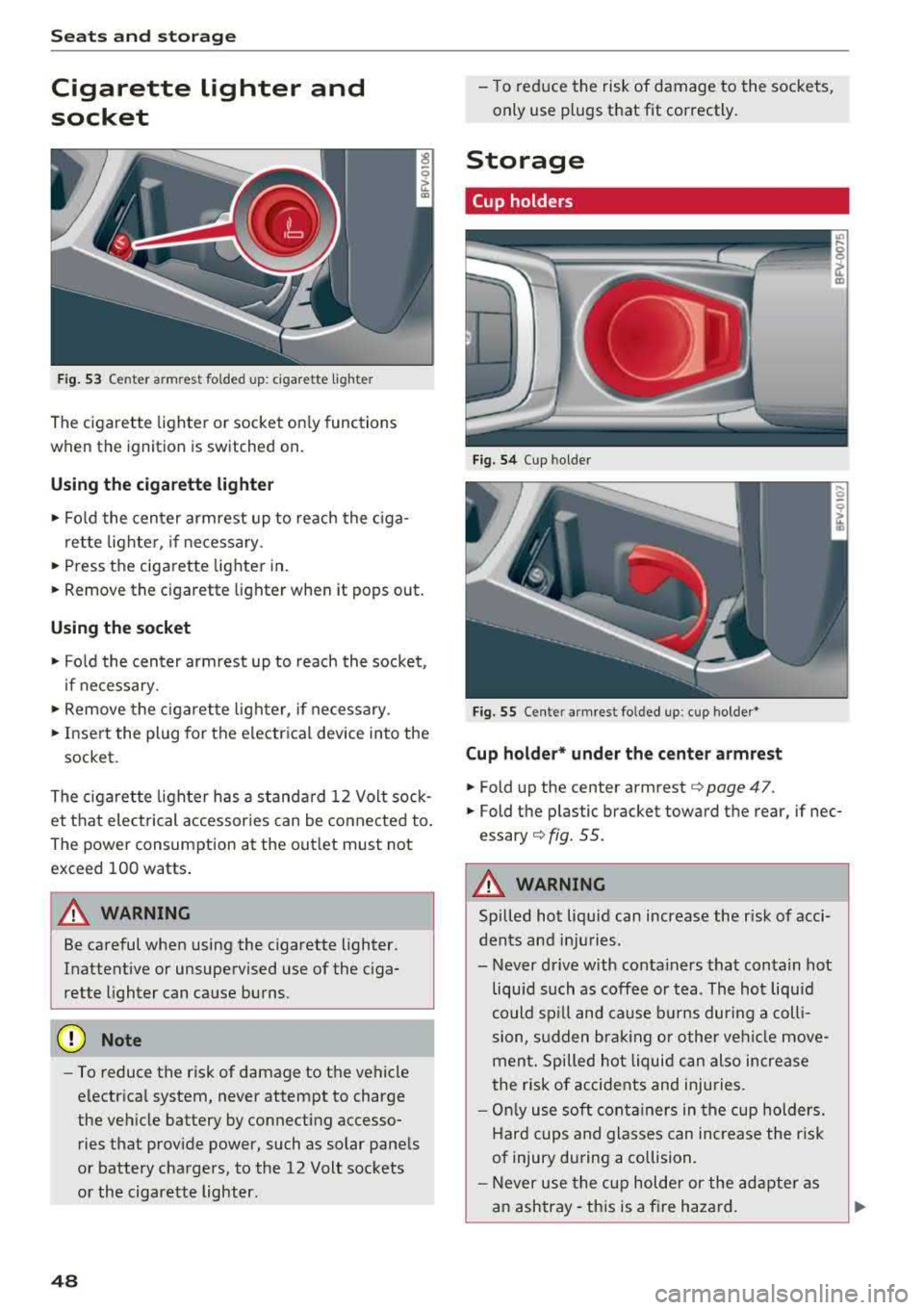
F ig. 53 Cen te r armre st fo ld ed u p: cig arette ligh te r
The cigarette lighter o r socket on ly functions
when the ignition is switched on.
Using the cigarette li ghter
• Fo ld the center armrest up to reach the c iga-
rette lighter, if necessary .
• Press the ciga re tte lighter in .
.. Remove the cigarette lighter when it pops out.
Using the socket
• Fo ld the cen ter armrest up to reach the socket ,
i f necessary .
... Remove the cigarette lighter, if necessary .
.. Insert the plug for the e lectrica l device into the
socket.
The cigaret te lighter has a standa rd 12 Volt sock
et that electrical accessor ies can be conne cted to .
Th e power consumption a t the out let must not
exceed 100 watts .
A WARNING
Be careful when using the cigarette lighter.
Inattentive or unsupervised use of the c iga
rette lighter can cause burns.
(D Note
- To reduce the risk of damage to the vehicle
electrical system, never attempt to charge
the veh icle battery by connecting accesso
ries that prov ide power, such as solar panels
or battery chargers , to the 12 Volt sockets
or the cigarette lighter.
48
- To reduce the risk of damage to the sockets,
only use plugs that fit correctly .
Storage
Cup holders
Fig. 54 Cup hol der
Fig. 5 5 Cente r armres t fo lded up : cup holder *
Cup holder* und er the center armrest
• Fold up the cente r armrest¢ page 47.
.. Fold the p lastic bracket toward the rear, if nec
essary ¢ fig. 55.
A WARNING
Spilled hot liqu id can increase the r isk of acci
dents and in ju ries .
- Never d rive with conta iners that contain hot
liquid such as coffee or tea . The hot liquid
could sp ill and cause b urns dur ing a coll i
sion, s udden bra king or other vehi cle move
men t. Spilled hot liquid can also increase
the risk of accidents and injuries.
- On ly use soft cont ainers in the cup holders.
Hard cups and glasses can increase the r isk
of injury dur ing a collision.
- Never use the c up holder or the adapte r as
a n ashtray- th is is a fire hazard.
Page 52 of 310
Seats and stor age
,.. Press the release button and fold the cover for
the pass-through towards the luggage com
partment
¢ fig . 57.
,.. Slide the bag from the luggage compartment
into the vehicle interior w ith the zipper facing
toward the rear
cc> &.
.. Load the sk i bag.
Secur ing
.. Secure the carab ine r hooks on both st raps in
the corresponding rear tie-downs <=>
fig. 58.
A WARNING
After loading the bag, it must be t ied down
w ith both straps.
@ Tips
- Only fold the ski bag up if it is dry.
- Lay skis in the bag with the points facing
forward and ski pole points facing the rear.
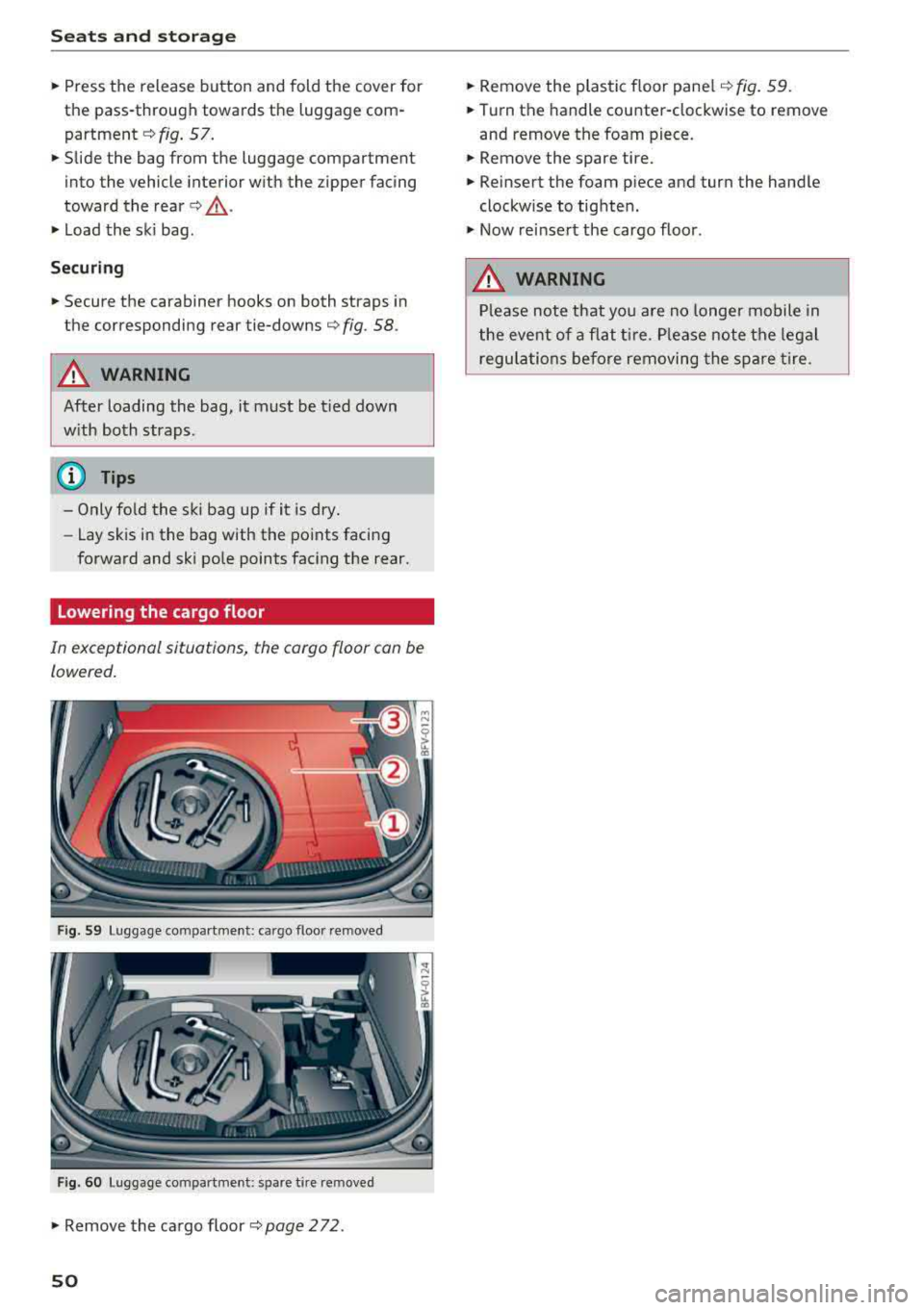
Lowering the cargo floor
In exceptional situations, the cargo floor can be lowered .
Fig . S9 Luggage com partment : ca rgo f loo r re m oved
Fig. 60 Luggage co mpartment : spa re t ire re m oved
.. Remove the cargo floor ¢page 272 .
50
.. Remove the plastic floor pane l¢ fig. 59 .
.. Turn th e handle counter-clockw ise to remove
and remove the foam piece.
.. Remove the spare tire .
.. Reinsert the foam p iece and turn the hand le
clockwise to tighten .
.. Now re insert the cargo floor .
A WARNING
Please note that you are no longe r mobile in
the eve nt of a flat ti re . P lease note the legal
regula tions before removing the spare tire.
Page 182 of 310
Safe dri ving
,.. Take frequent breaks on long trips. Do not drive
for more than two hours at a stretch.
,.. Do NOT drive when you are tired, under pres
sure or when you are stressed.
A WARNING
Impaired driving safety increases the risk of
serious personal injury and death whenever a
vehicle is being used.
Correct passenger
seating positions
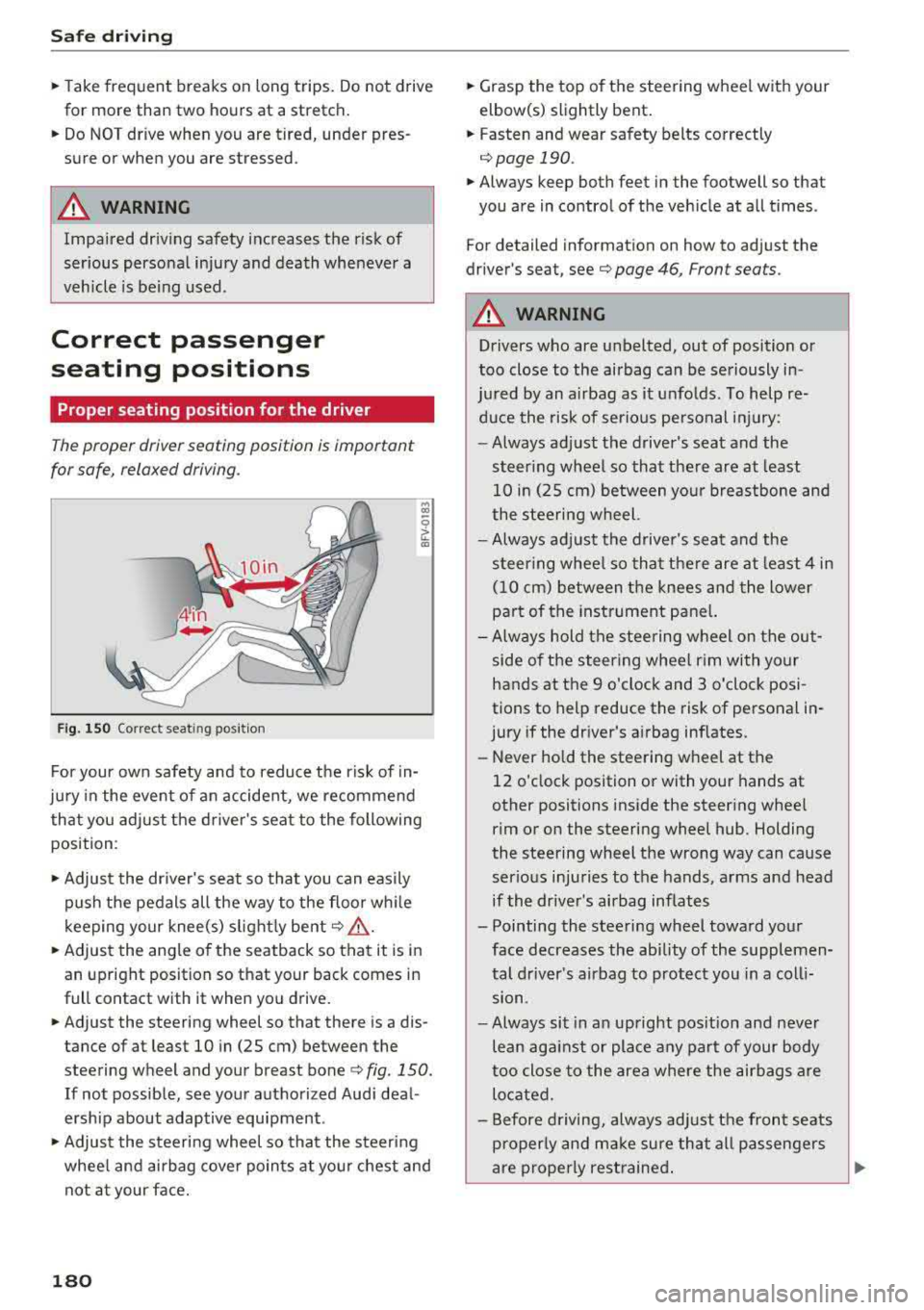
Proper seating position for the driver
The proper driver seating position is important
for safe, relaxed driving.
F ig. 150 Correct seat in g posi tion
.., CD
~ CD
For your own safety and to reduce the risk of in
jury in the event of an accident, we recommend
that you adjust the driver's seat to the following
position :
,.. Adjust the driver's seat so that you can easily
push the pedals all the way to the floor wh ile
k eeping your knee(s) s lightly bent
c:> .&_ .
,.. Adjust the angle of the seatback so that it is in
an upright position so that your back comes in
full contact with it when you drive.
,.. Adjust the steering wheel so that there is a dis
tance of at least 10 in (25 cm) between the
steering wheel and your breast bone
c:> fig. 150.
If not possible, see your authorized Audi deal
ersh ip about adaptive equipment .
,.. Adjust the steering wheel so that the steering
whee l and airbag cover points at you r chest and
not at your face.
180
,.. Grasp the top of the steering wheel with your
elbow(s) slightly bent.
,.. Fasten and wear safety belts correctly
c:> page 190 .
,.. Always keep both feet in the footwell so that
you are in control of the vehicle at all times .
For detailed information on how to adjust the
driver's seat, see
c:> page 46, Front seats.
A WARNING
Drivers who are unbelted, out of position or
too close to the airbag can be seriously in -
ju red by an airbag as it unfolds. To help re-
duce the risk of serious pe rsonal injury:
-Always adjust the driver's seat and the
steer ing wheel so that the re are at least
10 in (25 cm) between your breastbone and
the steering wheel.
-Always adjust the driver's seat and the
steer ing whee l so that there are at least 4 in
(10 cm) between the knees and the lower
pa rt of the instrument pane l.
- Always hold the steering wheel on the out
side of the steering wheel rim with your
hands at the 9 o'clock and 3 o'clock posi
tions to help reduce the risk of personal in
jury if the dr iver's a irbag inflates.
- Never hold the steering wheel at the
12 o'clock position or with your hands at
other positions inside the steering whee l
rim or on the steering wheel hub . Holding
the steering wheel the wrong way can cause
serious injuries to the hands, arms and head
if the driver's airbag inflates
- Pointing the steering wheel toward your face decreases the ability of the supplemen
tal driver's airbag to protect you in a coll i
sion.
- Always sit in an upright pos it ion and never
lean against or place any part of your body
too close to the area where the airbags are
located.
- Before driving, always adjust the front seats
properly and make sure that all passengers
-
are properly restrained . ..,.
Page 183 of 310
Cl 00 .-< N r-N .-< 0 r-Vl 00
-Never adjust the seats while the vehicle is
moving. Your seat may move unexpectedly
and you could lose control of the vehicle.
- Never drive with the backrest reclined or
tilted far back! The farther the backrests are
tilted back, the greater the risk of injury due
to incorrect positioning of the safety belt
and improper seating position .
- Children must always ride in child seats
¢page 216. Special precautions apply
when installing a child seat on the front
passenger seat ¢
page 194.
Proper seating position for the front
passenger
The proper front passenger seating position is
important for safe, relaxed driving.
For your own safety and to reduce the risk of in
jury in the event of an accident, we recommend
that you adjust the seat for the front passenger
to the following position:
.,. Adjust the angle of the seatback so that it is in
an upright position and your back comes in full
contact with it whenever the vehicle is moving .
.,. Keep both feet flat on the floor in front of the
front passenger seat .
.,. Fasten and wear safety belts correctly
¢ page 190.
For detailed information on how to adjust the
front passenger's seat, see ¢
page 46.
A WARNING
Front seat passengers who are unbelted, out
of position or too close to the airbag can be
seriously injured or killed by the airbag as it
unfolds . To help reduce the risk of serious
personal injury:
- Passengers must always sit in an upright po
sition and never lean against or place any
part of their body too close to the area
where the airbags are located.
- Passengers who are unbelted, out of posi
tion or too close to the airbag can be seri
ously injured by an airbag as it unfolds with
great force in the blink of an eye .
Safe driving
-Always make sure that there are at least
10 in (25 cm) between the front passen
ger's breastbone and the instrument panel.
- Always make sure that there are at least 4 in
(10 cm) between the front passenger's
knees and the lower part of the instrument
panel.
- Each passenger must always sit on a seat of
their own and properly fasten and wear the
safety belt belonging to that seat.
- Before driving, always adjust the front pas
senger seat properly.
- Always keep your feet on the floor in front
of the seat. Never rest them on the seat, in
strument panel, out of the window, etc . The
airbag system and safety belt will not be
able to protect you properly and can even in
crease the risk of injury in a crash .
- Never drive with the backrest reclined or
tilted far back! The farther the backrests are
tilted back, the greater the risk of injury due
to incorrect positioning of the safety belt
and improper seating position .
- Children must always ride in child seats
¢
page 216. Special precautions apply
when installing a child seat on the front
passenger seat ¢
page 194.
Examples of improper seating positions
The occupant restraint system can only reduce
the risk of injury if vehicle occupants are properly
seated.
Improper seating positions can cause serious in
jury or death. Safety belts can only work when
they are properly positioned on the body. Im
proper seating positions reduce the effectiveness
of safety belts and will even increase the risk of
injury and death by moving the safety belt to crit
ical areas of the body . Improper seating positions
also increase the risk of serious injury and death
when an airbag deploys and strikes an occupant
who is not in the proper seating position. A driver
is responsible for the safety of all vehicle occu-
pants and especially for children. Therefore:
IJJ,,
181
Page 205 of 310
Cl co .... N ,....
N .... 0 ,....
Vl co
front three-point safety belts to help reduce the
risk of injury in a wide range of accident and
crash situations. Be sure to read the important
information about safety and heed the WARN
INGS in this chapter.
Deployment of the Advanced A irbag System and
the activation of the safety belt pretensioners de
pend on the deceleration measured by the crash
sensors and registered by the electronic control
unit . Crash severity depends on speed and decel
eration as well as the mass and stiffness of the
vehicle or object involved in the crash .
On the passenger side, regardless of safety belt
use, the front passenger frontal airbag will be
turned off if the electrical capacitance measured
by the capacitive passenger detection system on
the front passenger seat is less than the amount
programmed in the electronic control unit. The
front passenger frontal airbag will also be turned
off if the capacitance measured by the system for
the front passenger seat equals that of an infant
of about one year of age in one of the child seats
that was used to certify the Advanced Airbag Sys
tem under Federal Motor Vehicle Safety Standard
208. The
PASSENGER AIR BAG OFF '1; light
comes on and stays on to tell you when the front
Advanced Airbag System on the passenger side
has been turned off
Q page 206.
A WARNING
To reduce the risk of injury when an airbag in
flates, always wear safety belts properly.
- If you are unrestrained, leaning forward, sit
ting sideways or out of position in any way,
your risk of injury is much higher.
- You will also receive serious injuries and
could even be killed if you are up against the
airbag or too close to it when it inflates
-
even with an Advanced Airbag Qpoge 194.
Airbag system
More important things to know about front
airbags
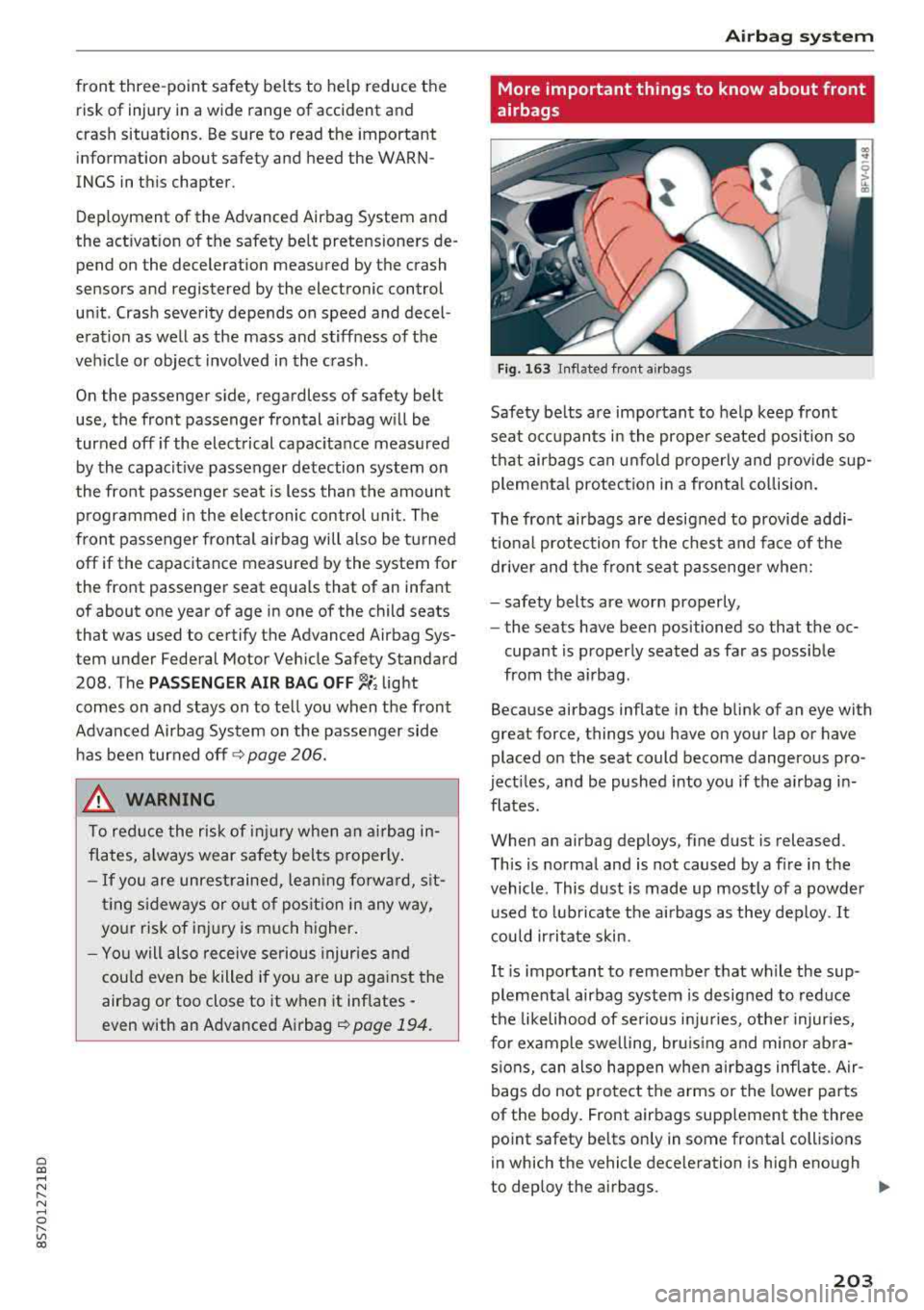
Fig. 163 Inflated front airbags
Safety belts are important to help keep front
seat occupants in the proper seated position so
that airbags can unfold properly and provide sup
plemental protection in a frontal collision.
The front airbags are designed to provide addi
tional protection for the chest and face of the
driver and the front seat passenger when:
- safety belts are worn properly,
- the seats have been positioned so tha t the oc-
cupant is properly seated as far as possible
from the airbag.
Because airbags inflate in the blink of an eye with
great force, things you have on your lap or have
placed on the seat could become dangerous pro
jectiles, and be pushed into you if the airbag in
flates.
When an airbag deploys , fine dust is released.
This is normal and is not caused by a fire in the
vehicle . This dust is made up mostly of a powder
used to lubricate the airbags as they deploy.
It
could irritate skin.
It is important to remember that while the sup
plemental airbag system is designed to reduce
the likelihood of serious injuries, other injuries,
for example swelling, bruising and minor abra
sions, can also happen when airbags inflate. Air
bags do not protect the arms or the lower parts
of the body. Front airbags supp lement the three
point safety belts only in some frontal collisions
in which the vehicle deceleration is high enough
to deploy the airbags.
IJII,-
203