top BMW 323Ci CONVERTIBLE 2000 E46 Owner's Guide
[x] Cancel search | Manufacturer: BMW, Model Year: 2000, Model line: 323Ci CONVERTIBLE, Model: BMW 323Ci CONVERTIBLE 2000 E46Pages: 199, PDF Size: 1.77 MB
Page 90 of 199

90n
Tire Pressure Control (RDC)
*
Flat tireIf there is a tire failure with loss of pres-
sure, the indicator lamp comes on with
a red lamp. In addition, an acoustic sig-
nal goes off.
If this occurs, reduce vehicle speed im-
mediately and stop the vehicle. Avoid
hard brake applications. Do not over-
steer. Replace the wheel and flat tire.
The space-saver spare tire is pro-
vided for temporary use only in the
case of a tire failure. It does not have
RDC electronics and is not monitored.<
RDC cannot inform you of sudden
and severe tire damage caused by
external influences.<
Have the tires changed by your
BMW center.
Your BMW center is familiar with, and
has the special tools necessary, for
working on the RDC.<
System interferenceThe RDC may encounter interference
from outside equipment or devices
which use the same radio frequency.
The indicator lamp will come on with a
yellow lamp during the malfunction.
The indicator lamp also comes on
>in the event of a system fault
>if a wheel is mounted without RDC
electronics
>or if additional wheels using RDC
electronics are transported.
Please contact your BMW center for
additional information.
Page 97 of 199

97n
IndexDataTechnologyRepairsCar careControlsOverview
Automatic climate controlAir supply
By pressing the left or right half
of the button, you can vary the
air supply. By doing this, you switch off
the automatic control for the air supply.
Nevertheless, the automatic air distri-
bution remains unchanged.
When you set the lowest blower speed
by pressing the left half of the button,
all of the displays are canceled: the
blower, heater and air conditioner are
switched off, and the air supply stops.
You can reactivate the system by
pressing any button of the automatic
climate control.
Defrost the windshield and side
windows
This program quickly removes
ice and condensation from the
windshield and side windows.
Air conditioner
The air is cooled and dehumidi-
fied and – depending on the tem-
perature setting – rewarmed when the
air conditioner system is switched on.
Depending on the weather, the wind-
shield may fog over briefly when the
engine is started.
Use the button to switch the air condi-
tioner off when outside air temperatures
are below approx. 41 7 (+5 6). This
will help to prevent the windows from
fogging over.
If the windows fog over after switching
the air conditioner off, switch it back on.
Condensation forms in the air
conditioner system during opera-
tion, which then exits under the vehicle.
Traces of condensed water of this kind
are thus normal.<
Automatic recirculated air
control (AUC)
If there are unpleasant odors or
pollutants in the outside air, you
can temporarily block the air flow from
the outside. The system then recircu-
lates the air already within the vehicle.
By repeated actuation of the button,
you can select three different operating
modes.
>Indicator lamps off: fresh air flows
into the vehicle
>Left-hand indicator lamp on – AUC
mode: the system detects pollutants
in the outside air and responds by
deactivating the outside air flow as
required. The system then recircu-
lates the air already within the vehicle.
Depending on air quality require-
ments, the system automatically
switches between outside air supply
and recirculation of the air already
within the vehicle
>Right-hand indicator lamp on: the
flow of outside air is permanently
blocked. The system recirculates the
air already within the vehicle.
If the windows fog over in the
recirculated air mode, switch this
mode off and increase the air supply
as required.<
Page 100 of 199
100n
BMW Universal Transmitter
*
The concept The BMW Universal Transmitter re-
places up to three hand-held transmit-
ters for different devices such as ga-
rage-door openers, alarm systems, or
door-locking systems. The BMW Uni-
versal Transmitter recognizes and
"learns" the transmitted signal of each
of the original hand-held transmitters.
The signal of an original hand-held
transmitter can be programmed on one
of the three channel keys. Following
that, each of the devices can be actu-
ated with the appropriately pro-
grammed channel key. The indicator
lamp flashes to confirm transmission
of the signal.
If the vehicle is sold, the memory of the
channel keys should be cleared as de-
scribed on page 102.
During programming and before
every remote actuation of a pro-
grammed device by the BMW Universal
Transmitter, check to be sure that there
are no persons, animals or objects
within the actuation range of the device
in order to prevent possible injuries or
damage. Also, comply with the safety
precautions of the original hand-held
transmitter.<
To Canadian residents:
During programming, your hand-
held transmitter may automatically stop
transmitting after two seconds. This
may not be long enough to program the
BMW Universal Transmitter. If you are
programming from one of these hand-
held transmitters, the Universal Trans-
mitter's light may begin to flash in a
series of double-blinks. If this occurs,
continue to hold the button of the Uni-
versal Transmitter while you reactivate
your hand-held transmitter. You may
have to repeat this function several
times while programming.<
Before programming, read the
"User information" section on
page 102.<
Original hand-held transmitter
If this symbol is present on the
packaging or in the instructions
of the original hand-held trans-
mitter, it may be assumed that this
hand-held transmitter is compatible
with the BMW Universal Transmitter.
Checking for the conversion code To determine whether the original
hand-held transmitter has a conver-
sion-code system, you may either read
the instructions for the original hand-
held transmitter or program a channel
key as described on the next page (left-
hand column under "Programming").
Then press and hold the programmed
channel key of the BMW Universal
Transmitter. If the indicator lamp of
the BMW Universal Transmitter flashes
for two seconds and then stays on
steadily, the original hand-held trans-
mitter is equipped with a conversion-
code system. Using the conversion-
code system, program the channel keys
as described on the next page (right-
hand column under "Programming a
hand-held transmitter using conversion
code").
If you have additional questions,
please consult your BMW center
or call 1-800-355-3515.
You can also visit this website:
www.bmwusa.com.<
Page 102 of 199
102n
BMW Universal Transmitter
*
Storage compartments
Clearing the channel keys
Read and comply with the safety
precautions on page 100.<
The memory of individual channel keys
cannot be deleted. However, the three
channel keys can be cleared together
as follows:
>Press and hold both outside keys of
the BMW Universal Transmitter until
the indicator lamp flashes, and then
release them.
All of the channel keys are cleared.
User informationDo not use this BMW Universal Trans-
mitter with any garage door opener that
lacks safety "stop" and "reverse" fea-
tures as required by federal safety stan-
dards (this includes any garage door
opener model manufactured before
April 1, 1982).
This device complies with Section 15 of
the FCC Rules. Operation is subject to
the following two conditions: as defined
in the regulations, this device must not
emit harmful interference, and must be
shielded against interference from ex-
ternal sources to prevent unauthorized
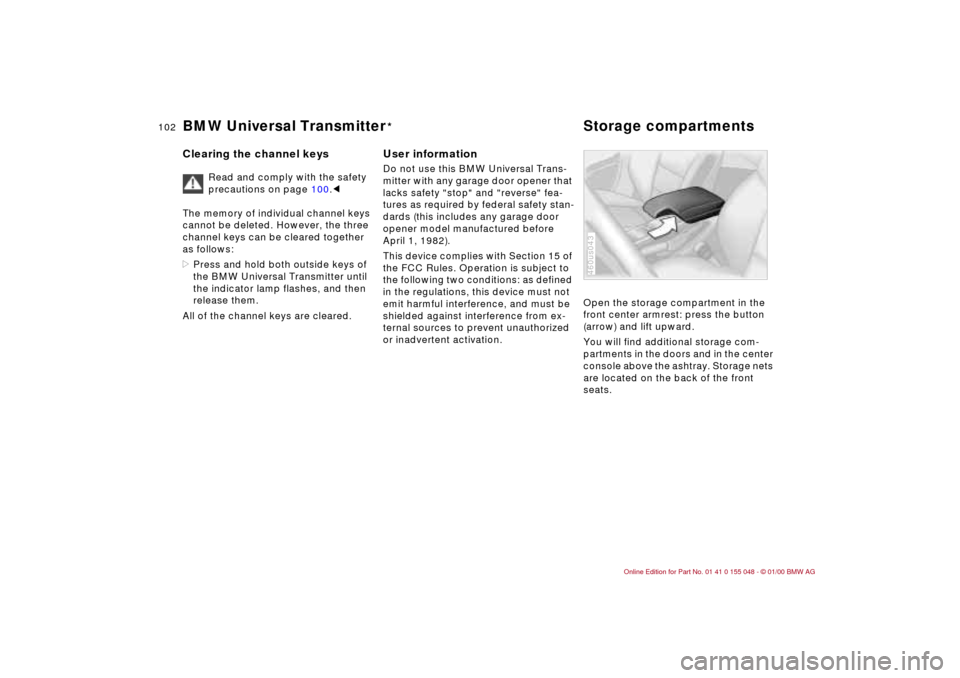
or inadvertent activation.Open the storage compartment in the
front center armrest: press the button
(arrow) and lift upward.
You will find additional storage com-
partments in the doors and in the center
console above the ashtray. Storage nets
are located on the back of the front
seats.
460us043
Page 106 of 199
106n
Ski bag
*
Cargo loading
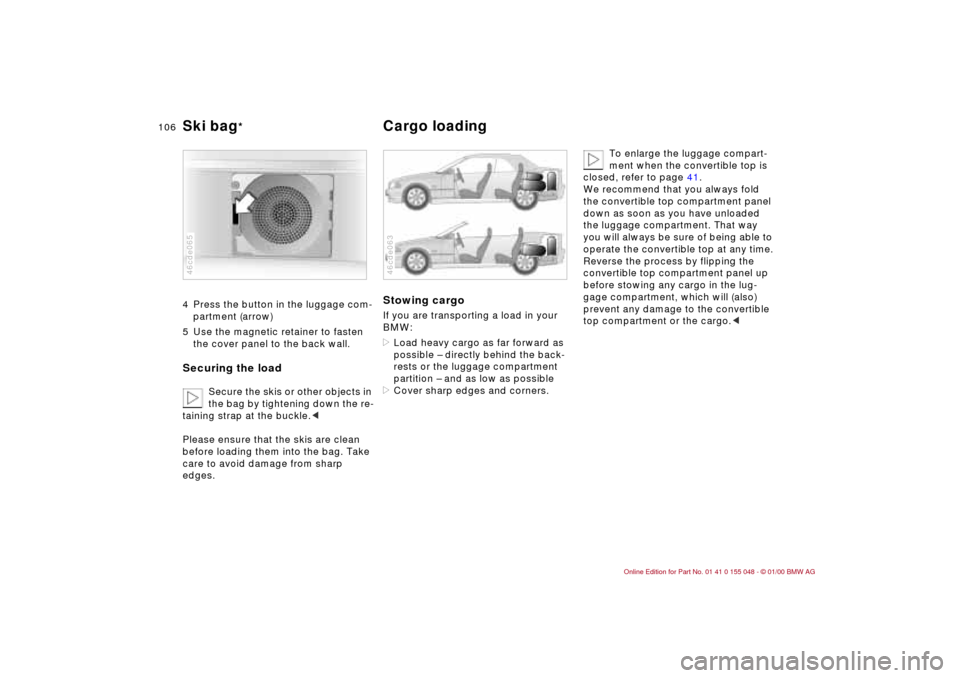
4 Press the button in the luggage com-
partment (arrow)
5 Use the magnetic retainer to fasten
the cover panel to the back wall.Securing the load
Secure the skis or other objects in
the bag by tightening down the re-
taining strap at the buckle.<
Please ensure that the skis are clean
before loading them into the bag. Take
care to avoid damage from sharp
edges.
46cde065
Stowing cargo If you are transporting a load in your
BMW:
>Load heavy cargo as far forward as
possible – directly behind the back-
rests or the luggage compartment
partition – and as low as possible
>Cover sharp edges and corners.46cde063
To enlarge the luggage compart-
ment when the convertible top is
closed, refer to page 41.
We recommend that you always fold
the convertible top compartment panel
down as soon as you have unloaded
the luggage compartment. That way
you will always be sure of being able to
operate the convertible top at any time.
Reverse the process by flipping the
convertible top compartment panel up
before stowing any cargo in the lug-
gage compartment, which will (also)
prevent any damage to the convertible
top compartment or the cargo.<
Page 108 of 199
108n
Luggage rack for the hardtop
*
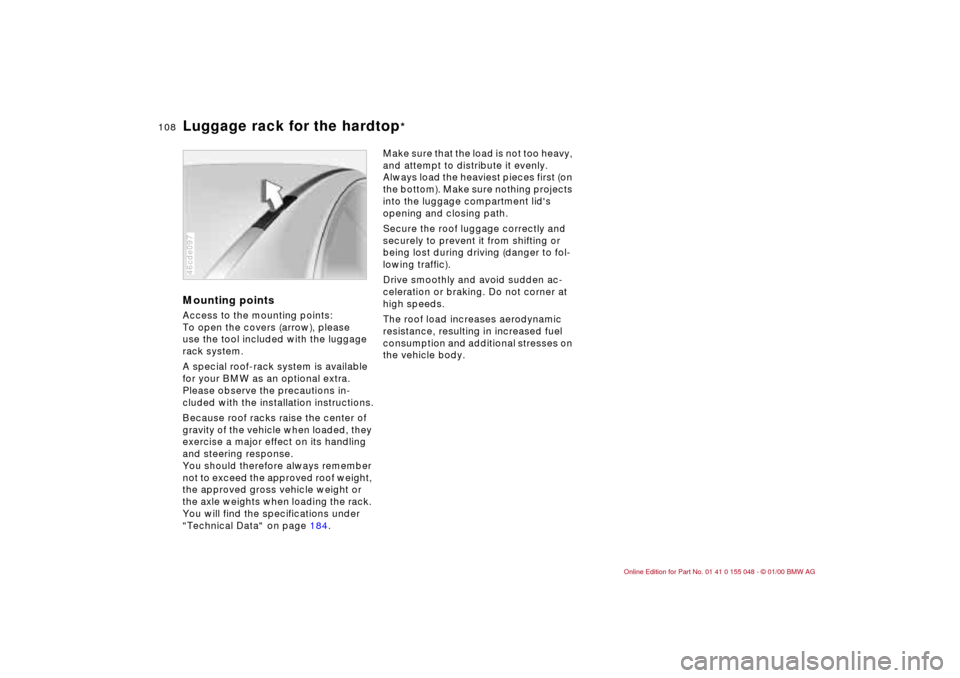
Mounting pointsAccess to the mounting points:
To open the covers (arrow), please
use the tool included with the luggage
rack system.
A special roof-rack system is available
for your BMW as an optional extra.
Please observe the precautions in-
cluded with the installation instructions.
Because roof racks raise the center of
gravity of the vehicle when loaded, they
exercise a major effect on its handling
and steering response.
You should therefore always remember
not to exceed the approved roof weight,
the approved gross vehicle weight or
the axle weights when loading the rack.
You will find the specifications under
"Technical Data" on page 184.46cde097
Make sure that the load is not too heavy,
and attempt to distribute it evenly.
Always load the heaviest pieces first (on
the bottom). Make sure nothing projects
into the luggage compartment lid's
opening and closing path.
Secure the roof luggage correctly and
securely to prevent it from shifting or
being lost during driving (danger to fol-
lowing traffic).
Drive smoothly and avoid sudden ac-
celeration or braking. Do not corner at
high speeds.
The roof load increases aerodynamic
resistance, resulting in increased fuel
consumption and additional stresses on
the vehicle body.
Page 111 of 199

Overview
Controls and features
Operation, care
and maintenance
Owner service procedures
Technical data
Index Advanced technology
111n
IndexDataTechnologyRepairsCar careControlsOverview
Special operating instructions:
Break-in procedures112
Driving notes113
Catalytic converter113
Antilock Brake System
(ABS)114
Disc brakes116
Brake system117
Winter operation118
Power steering120
Cellular phone120
Radio reception120
Hardtop121
Wheels and tires:
Tire inflation pressure123
Tire condition123
Tire replacement124
Tire rotation125
Wheel and tire
combinations126
Winter tires127
Snow chains127
Approved wheel and tire
specifications128Under the hood:
Hood129
Engine compartment130
Washer fluids132
Washer nozzles132
Engine oil133
Coolant135
Brake fluid136
Vehicle Identification
Number137
Care and maintenance:
The BMW Maintenance
System138
Caring for your vehicle139
Cleaning and caring for your
convertible top144
Airbags146
Vehicle storage147
Laws and regulations:
Technical modifications to the
vehicle148
OBD interface socket149
Car care
Page 113 of 199

113n
IndexDataTechnologyRepairsCar careControlsOverview
Brakes:
Do not drive with your foot resting
on the brake pedal. Even light but con-
sistent pedal pressure can lead to high
temperatures, brake wear, and possibly
to brake failure.
Aquaplaning:
When driving on wet or slushy roads,
reduce vehicle speed. If you do not, a
wedge of water may form between the
tires and the road surface. This phe-
nomenon is referred to as aquaplaning
or hydroplaning. It is characterized by a
partial or complete loss of contact be-
tween the tires and the road surface.
The ultimate results are loss of steering
and braking control.
Driving through water:
Do not drive through water over the
road if it is deeper than 1 ft (30 cm), and
then only at walking speed, otherwise
the engine, electrical system and trans-
mission could be damaged.
Clothes hooks (when hardtop
* is
mounted):
When suspending clothing from the
hooks, ensure that they will not obstruct
the driver's vision. Do not hang heavy
objects on the hooks. If you do, they
could cause personal injury during
braking or evasive maneuvers.<
The catalytic converter reduces harmful
exhaust emissions. It is designed for
use with unleaded fuel only.
Even minute quantities of lead would be
enough to permanently damage both
the catalytic converter and the system
oxygen sensor.To ensure efficient, trouble-free engine
operation and to avoid potential damage:>Be sure to comply with the scheduled
maintenance requirements
>Fill the fuel tank well before it is
empty
>Tow-start only when the engine is
cold. If you attempt to tow-start with
a warm engine, unburned residual
fuel in the catalytic converter could
ignite and cause damage. It is better
to jump-start the vehicle with outside
assistance
>Avoid other situations in which the
fuel is not burned, or burns incom-
pletely, such as engaging the starter
frequently or for extended periods, or
repeated start attempts in which the
engine does not start (stopping and
restarting an engine which is running
properly does not present a problem).
Never allow the engine to run with
any of the spark plug cables
disconnected.Be sure to observe the instruc-
tions above to prevent unburned
fuel from reaching the catalytic con-
verter, otherwise, the catalytic con-
verter could overheat and be damaged.
High temperatures occur in every vehi-
cle equipped with a catalytic converter.
Heat shields are installed adjacent to
some sections of the exhaust system.
Never remove these shields; do not
apply undercoating to their surfaces.
When driving, standing at idle, and
parking the vehicle, take extra care to
avoid contact between the exhaust sys-
tem and flammable materials (grass,
hay, leaves, etc.). Such contact could
lead to a fire, resulting in serious per-
sonal injury and property damage.<
Driving notes Catalytic converter
Page 114 of 199

114n
Antilock Brake System (ABS)The concept ABS enhances active driving safety
by helping to prevent the wheels from
locking while braking. This is because
locked wheels are dangerous. When
the front wheels slide, the driver loses
steering control over the vehicle.
Traction loss at the rear wheels can
cause the rear end to break into an
uncontrolled skid.
ABS is designed to meet two essential
requirements during every brake appli-
cation:
>To help provide vehicle stability
>To help maintain steering control and
maneuverability – on all types of road
surfaces (asphalt, concrete, mud, wet
road surfaces, snow, ice).
The system can achieve the shortest
braking distances possible under most
conditions (on straight aways and in
curves, on asphalt, ice, wet road sur-
faces, etc.).
Braking with ABSThe system is operative once the vehi-
cle exceeds a speed of approx. 6 mph
(10 km/h). It is deactivated once again
below approx. 4 mph (6 km/h). This
means that the wheels can lock in the
final phase of a panic stop – a factor of
no significance in actual use.
If you are in a situation that requires full
braking, you will exploit the full benefits
of the ABS system if you apply maxi-
mum brake pressure ("panic stop").
Since the vehicle maintains steering
responsiveness, you can nevertheless
avoid possible obstacles with a mini-
mum of steering effort.
The ABS closed-loop control circuit
cycles in fractions of a second. A pulsa-
tion at the brake pedal, together with
the sounds associated with the hydrau-
lic controls, tells you that the brake sys-
tem is within its maximum limit range,
and reminds you that you should adapt
road speed to the road conditions.
On road surfaces that have a loose
surface layer on a firm base with good
traction (on gravel or snow, for exam-
ple), or when snow chains are mounted,
braking distances may be longer than
with locked wheels. However, ABS continues to provide
enhanced vehicle stability and steering
response under these conditions.
Information for your safetyNot even ABS can suspend the laws of
physics. ABS cannot prevent the conse-
quences of brake applications with inad-
equate clearances for safety between
vehicles, when exceeding the speed
limit in curves, or the risks involved
when aquaplaning occurs. Responsibil-
ity for these types of situations remains
in the hands (and at the feet) of the
driver. You should never allow the
added safety of ABS to lull you into a
false sense of security, or mislead you
into taking increased risks that could
affect your own safety and that of others.
Do not make any modifications to
the ABS system.
Service procedures on ABS are to be
performed by authorized technicians
only.<
Page 118 of 199

118n
Winter operationWinter is often accompanied by rapid
changes in weather, requiring not only
a different driving style, but also certain
preparations to the vehicle itself to en-
sure that your vehicle operates safely
and trouble free throughout the winter
months.CoolantBe sure that the coolant mixture con-
tains the year-round ratio of 50:50
water and antifreeze/corrosion protec-
tion. This mixture provides protection
against freezing down to approx. –34 7
(–37 6). Replace the coolant every four
years.LocksBMW door lock deicer can be used to
free them if frozen. This deicer also
contains lubricant.
After its use, treatment with BMW lock
barrel grease is recommended.
Rubber seals and components To prevent the weather stripping from
freezing, apply a spray-on rubber treat-
ment or silicone spray to the door, hood
and luggage compartment lid seals.
A full range of car care products is
available from your BMW center.
them in pairs on the rear wheels only
and comply with the manufacturer's
safety precautions. Do not exceed a
maximum speed of 30 mph (50 km/h).
In this type of exceptional situation
where the snow chains are mounted,
deactivate the DSC. Refer to page 88.
Starting offWhen starting off from a full stop in
deep snow or when "rocking" the vehi-
cle to free it, it may be effective to
deactivate the DSC system for a short
period. Refer to page 88.Driving on low-traction road
surfacesUse smooth, gentle pressure to control
the accelerator pedal. Avoid excessive
engine speeds and shift to the next
higher gear at an early point. On down-
hill grades or slopes, shift down to the
next lower gear at an early point. Main-
tain an adequate distance between
yourself and the vehicle ahead.