top BMW 323Ci CONVERTIBLE 2000 E46 Service Manual
[x] Cancel search | Manufacturer: BMW, Model Year: 2000, Model line: 323Ci CONVERTIBLE, Model: BMW 323Ci CONVERTIBLE 2000 E46Pages: 199, PDF Size: 1.77 MB
Page 119 of 199

119n
IndexDataTechnologyRepairsCar careControlsOverview
Winter operationBrakesWinter road conditions substantially
reduce the amount of traction available
between the tires and the road surface.
Keep this in mind, because the braking
distance increases substantially.
ABS is intended to prevent the wheels
from locking during brake applications,
thus helping to maintain vehicle stability
and steering response.
If the ABS does not respond in a critical
braking situation and the wheels lock,
reduce the pressure on the brake pedal
until the wheels just start to roll again
while still maintaining enough force to
continue braking. Then increase the
pressure, reduce the pressure when the
wheels lock, reapply pressure, etc.
This staggered braking procedure will
reduce stopping distances while help-
ing you maintain steering control.
You can then attempt to steer around
hazards after you have reduced pres-
sure on the brake pedal.Do not shift down on slick road
surfaces. Doing so could cause
the rear wheels to lose traction and
skid, which could result in the loss of
vehicle control.<
Depress the clutch during hard
braking on road surfaces that pro-
vide only poor or uneven traction.<
Skid control Depress the clutch and release the ac-
celerator pedal, or place the selector
lever of the automatic transmission into
the "Neutral" position. Countersteer
carefully and attempt to regain control
of the vehicle.
ParkingEngage first or reverse gear. If your
vehicle is equipped with an automatic
transmission, place the selector lever in
Park. On vehicles with manual trans-
mission, also apply the parking brake
when parking on inclined surfaces. In
order to prevent the parking brake pads
from locking due to frost or corrosion,
dry them by gently applying the parking
brake as the vehicle is coming to a
stop. Make sure that following traffic
is not endangered.
The brake lamps do not come
on when the parking brake
is applied.<
Page 121 of 199
121n
IndexDataTechnologyRepairsCar careControlsOverview
Hardtop*It is not necessary to remove the fabric
top even in the winter, when the hard-
top is generally in constant use. But you
can take it off at any time with no prob-
lem. Before the fabric top is stored in
the convertible top compartment, it
must be absolutely dry in order to keep
water and mildew from forming.
The hardtop offers reading lamps as
well as clothes hooks in the rear, which
can be used simply by pressing on
them. In addition, a luggage rack sys-
tem can also be mounted on the hard-
top. If you have a problem in this re-
gard, please contact your BMW center.
When suspending clothing from
the hooks, ensure that they will
not obstruct the driver's vision. Do not
hang heavy objects on the hooks. If you
do so, they could cause personal injury
during braking or evasive maneuvers.<
Two persons are required for installing
or removing the hardtop. Work with
extreme caution in order to avoid paint
damage and damage to the body or
hardtop.
To facilitate the installation or removal of
the hardtop, you can purchase either a
specially designed hardtop lift
* or hard-
top roller carrier
* at your BMW center.
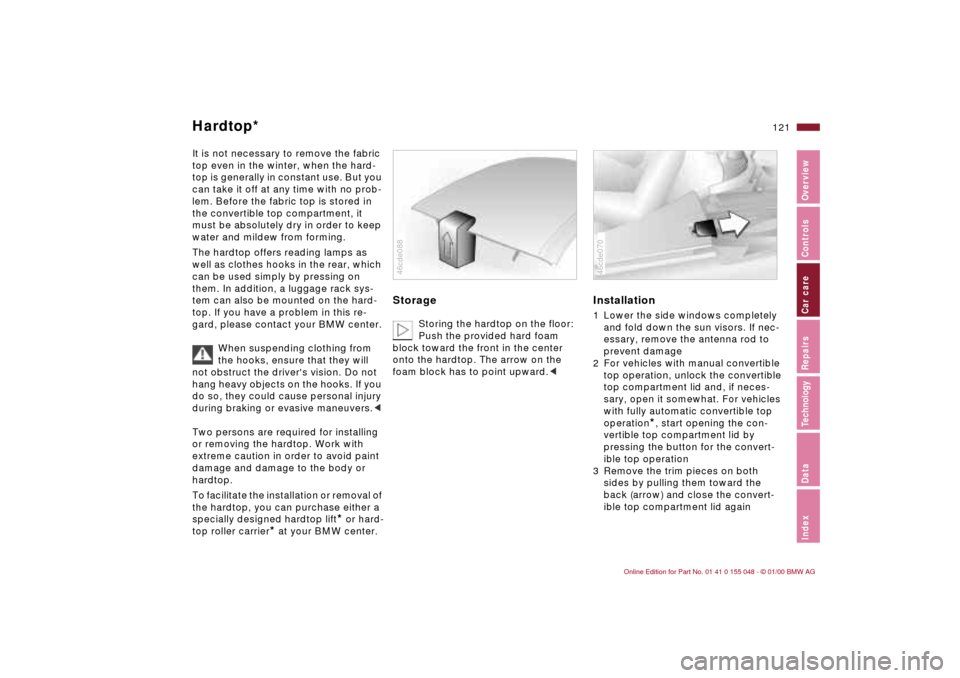
Storage
Storing the hardtop on the floor:
Push the provided hard foam
block toward the front in the center
onto the hardtop. The arrow on the
foam block has to point upward.<
46cde088
Installation1 Lower the side windows completely
and fold down the sun visors. If nec-
essary, remove the antenna rod to
prevent damage
2 For vehicles with manual convertible
top operation, unlock the convertible
top compartment lid and, if neces-
sary, open it somewhat. For vehicles
with fully automatic convertible top
operation
*, start opening the con-
vertible top compartment lid by
pressing the button for the convert-
ible top operation
3 Remove the trim pieces on both
sides by pulling them toward the
back (arrow) and close the convert-
ible top compartment lid again
46cde070
Page 122 of 199
122n
Hardtop
*
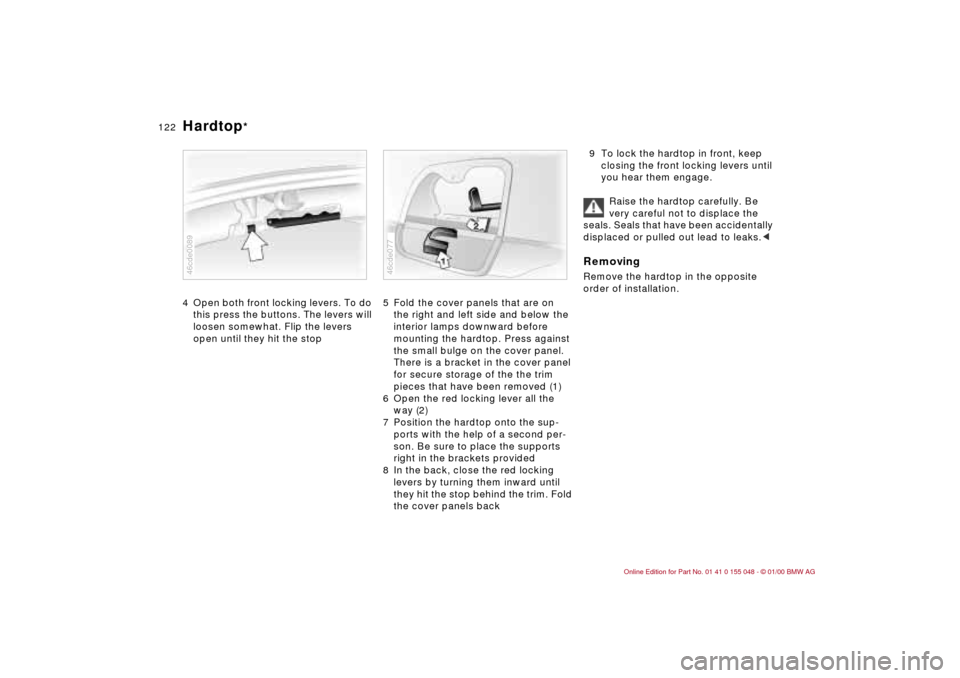
4 Open both front locking levers. To do
this press the buttons. The levers will
loosen somewhat. Flip the levers
open until they hit the stop46cde0089
5 Fold the cover panels that are on
the right and left side and below the
interior lamps downward before
mounting the hardtop. Press against
the small bulge on the cover panel.
There is a bracket in the cover panel
for secure storage of the the trim
pieces that have been removed (1)
6 Open the red locking lever all the
way (2)
7 Position the hardtop onto the sup-
ports with the help of a second per-
son. Be sure to place the supports
right in the brackets provided
8 In the back, close the red locking
levers by turning them inward until
they hit the stop behind the trim. Fold
the cover panels back 46cde077
9 To lock the hardtop in front, keep
closing the front locking levers until
you hear them engage.
Raise the hardtop carefully. Be
very careful not to displace the
seals. Seals that have been accidentally
displaced or pulled out lead to leaks.cRemovingRemove the hardtop in the opposite
order of installation.
Page 124 of 199

124n
To maintain good handling and vehicle
response, use only tires of a single
tread configuration from a single manu-
facturer. BMW tests and approves
wheel/tire combinations. Refer to
page 128.
DOT Quality GradesTreadwear
Traction AA A B C
Temperature A B C
In addition to the tire grades listed
above, all passenger car tires must
conform to Federal Safety Require-
ments as well.< TreadwearThe treadwear grade is a comparative
rating based on the wear rate of the tire
when tested under controlled condi-
tions on a specified government test
course.
For example, a tire graded 150 would
wear one and one-half (1-1/2) times as
well on the government course as a tire
graded 100. The relative performance
of tires depends upon the actual condi-
tions of their use, however, and may
depart significantly from the norm due
to variations in driving habits, service
practices and differences in road
characteristics and climate.TractionThe traction grades, from highest to
lowest, are AA, A, B, and C.
Those grades represent the tire's ability
to stop on wet pavement as measured
under controlled conditions on speci-
fied government test surfaces of as-
phalt and concrete. A tire marked C
may have poor traction performance.
The traction grade assigned to
this tire is based on straight-
ahead braking traction tests, and
does not include acceleration, corner-
ing, hydroplaning, or peak traction
characteristics.< TemperatureThe temperature grades are A (the high-
est), B, and C, representing the tire's re-
sistance to the generation of heat and
its ability to dissipate heat when tested
under controlled conditions on a speci-
fied indoor laboratory test wheel.
Sustained high temperature can cause
the tire material to degenerate and re-
duce tire life, and excessive tempera-
ture can lead to sudden tire failure. The
Grade C corresponds to a level of per-
formance which all passenger car tires
must meet under the Federal Motor
Vehicle Safety Standard No. 109.
Grades B and A represent higher levels
of performance on the laboratory test
wheel than the minimum required by law.
The temperature grade for this tire
is established for a tire that is prop-
erly inflated and not overloaded. Exces-
sive speed, underinflation, or excessive
loading, either separately or in combina-
tion, can cause heat buildup and possi-
ble tire failure.< Uniform Tire Quality Grading Quality grades can be found where
applicable on the tire sidewall between
tread shoulder and maximum section
width. For example:
Tread wear 200 Traction AA
Temperature A
Do not use retreaded tires ("caps").
Driving safety may be impaired by
their use. This due to the possible varia-
tions in casing structures and, in some
cases, to their extreme age, factors
which can lead to a decrease in their
durability.<
Tire replacement
Page 129 of 199
129n
IndexDataTechnologyRepairsCar careControlsOverview
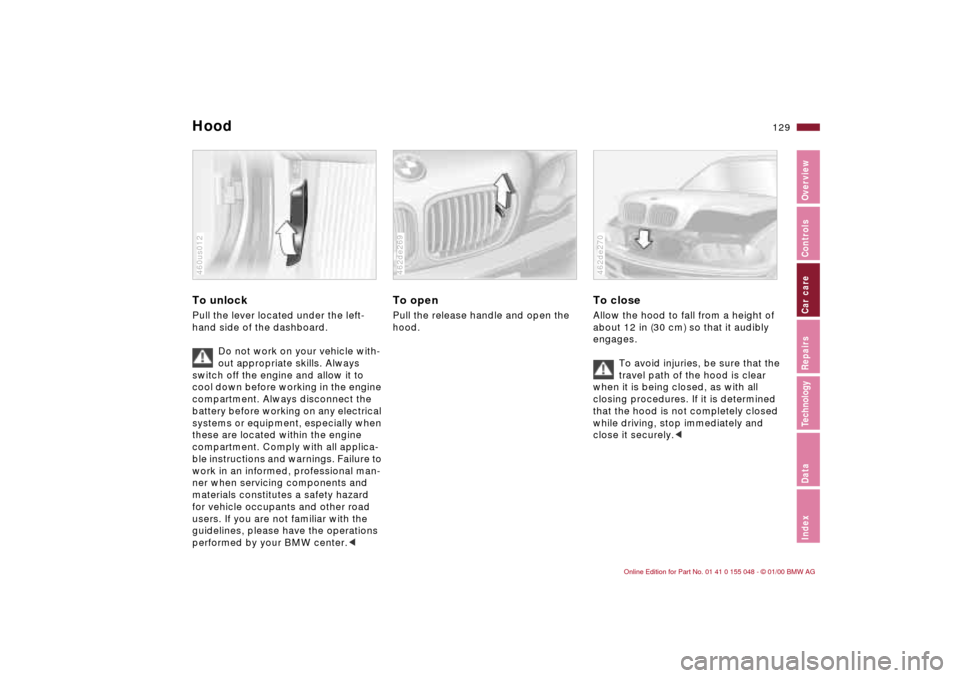
To unlock Pull the lever located under the left-
hand side of the dashboard.
Do not work on your vehicle with-
out appropriate skills. Always
switch off the engine and allow it to
cool down before working in the engine
compartment. Always disconnect the
battery before working on any electrical
systems or equipment, especially when
these are located within the engine
compartment. Comply with all applica-
ble instructions and warnings. Failure to
work in an informed, professional man-
ner when servicing components and
materials constitutes a safety hazard
for vehicle occupants and other road
users. If you are not familiar with the
guidelines, please have the operations
performed by your BMW center.<460us012
To openPull the release handle and open the
hood.462de269
To closeAllow the hood to fall from a height of
about 12 in (30 cm) so that it audibly
engages.
To avoid injuries, be sure that the
travel path of the hood is clear
when it is being closed, as with all
closing procedures. If it is determined
that the hood is not completely closed
while driving, stop immediately and
close it securely.<462de270
Hood
Page 134 of 199
134n
Engine oil Specified engine oilsThe quality of the engine oil is extremely
important for the function and life of an
engine. Based on extensive testing,
BMW has approved only certain types
of engine oils.
Use only approved "BMW High Perfor-
mance Synthetic Oil".
If you are unable to obtain "BMW High
Performance Synthetic Oil", you may
use small volumes of other approved
synthetic oils for topping off between oil
changes. Use only oils with the specifi-
cation API SH or higher.
Ask your BMW center for details
concerning the specific "BMW
High Performance Synthetic Oil" or syn-
thetic oils that have been approved.<
You can also call BMW of North Amer-
ica at 1-800-831-1117 or visit this web-
site: www.bmwusa.com to obtain this
information.
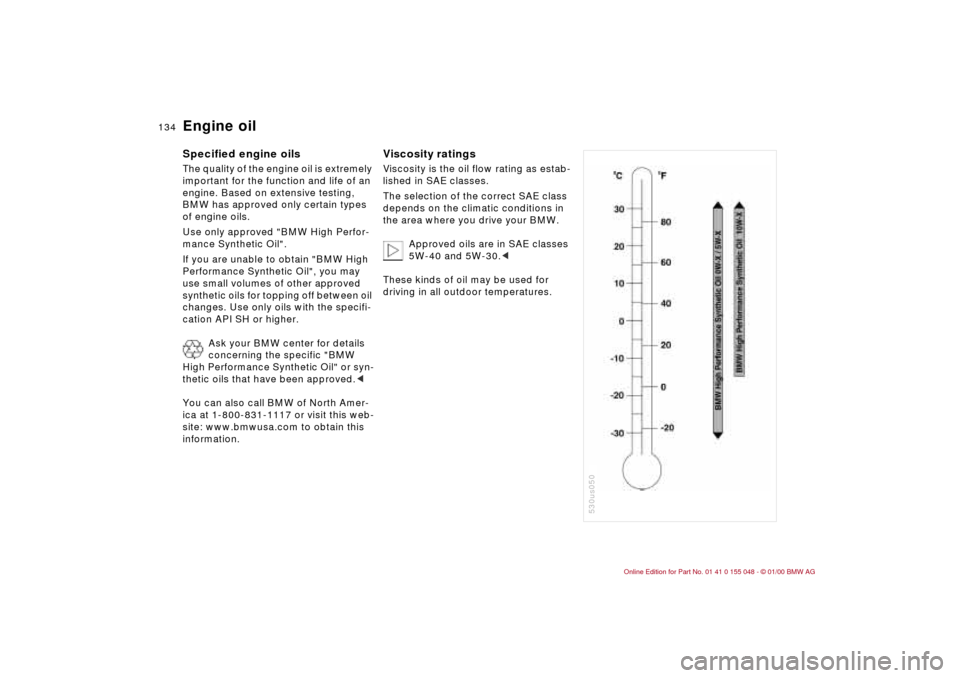
Viscosity ratings Viscosity is the oil flow rating as estab-
lished in SAE classes.
The selection of the correct SAE class
depends on the climatic conditions in
the area where you drive your BMW.
Approved oils are in SAE classes
5W-40 and 5W-30.<
These kinds of oil may be used for
driving in all outdoor temperatures.
530us050
Page 136 of 199
136n
Coolant Brake fluidAdding coolant Wait until the engine cools before re-
moving the cap from the expansion
tank. The coolant gauge needle in the
instrument cluster must be located in
the blue zone. If it is not, there is a
danger of scalding.
1 Turn the cap slightly counterclock-
wise in order to allow accumulated
pressure to escape. Then open
the cap
2 If the coolant is low, slowly add
coolant until the correct level is
reached – do not overfill.
The coolant is a mixture of water and
extended-duty antifreeze with corrosion
inhibitor. Always maintain the pre-
scribed all-season 50:50 mixture ratio
for year-round protection against inter-
nal corrosion. No other additives are
required.
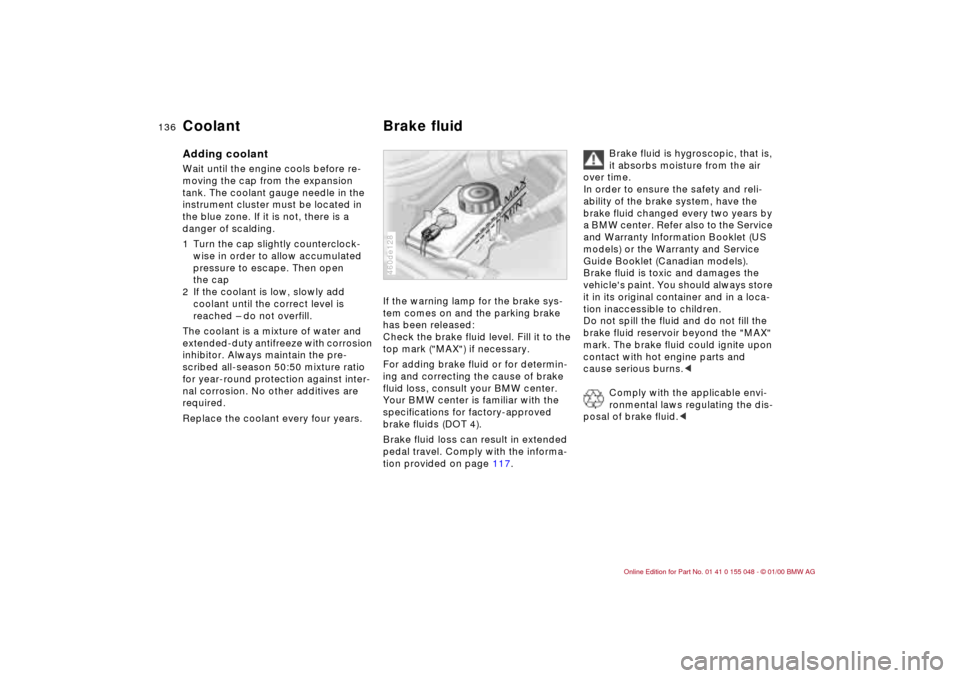
Replace the coolant every four years.If the warning lamp for the brake sys-
tem comes on and the parking brake
has been released:
Check the brake fluid level. Fill it to the
top mark ("MAX") if necessary.
For adding brake fluid or for determin-
ing and correcting the cause of brake
fluid loss, consult your BMW center.
Your BMW center is familiar with the
specifications for factory-approved
brake fluids (DOT 4).
Brake fluid loss can result in extended
pedal travel. Comply with the informa-
tion provided on page 117.
460de128
Brake fluid is hygroscopic, that is,
it absorbs moisture from the air
over time.
In order to ensure the safety and reli-
ability of the brake system, have the
brake fluid changed every two years by
a BMW center. Refer also to the Service
and Warranty Information Booklet (US
models) or the Warranty and Service
Guide Booklet (Canadian models).
Brake fluid is toxic and damages the
vehicle's paint. You should always store
it in its original container and in a loca-
tion inaccessible to children.
Do not spill the fluid and do not fill the
brake fluid reservoir beyond the "MAX"
mark. The brake fluid could ignite upon
contact with hot engine parts and
cause serious burns.<
Comply with the applicable envi-
ronmental laws regulating the dis-
posal of brake fluid.<
Page 140 of 199

140n
Caring for your vehicleExterior finish To provide effective corrosion protec-
tion, multilayer paintwork is applied at
the factory. Cataphoretic immersion
priming techniques are supplemented
with special body-cavity protectants,
by applying specially developed and
extensively tested materials.
A layer of flexible PVC is first applied to
the undercarriage. Following this, a
comprehensive undercoating treat-
ment with a wax-based protectant is
applied. Regular maintenance makes
an important contribution to maintaining
the safety and value of your vehicle.
Increasing awareness of the effects of
harmful environmental factors on vehi-
cle finishes have led paint and vehicle
manufacturers to initiate programs de-
signed to further improve the durability
of their finishes. Despite this, environ-
mental factors that occur locally or re-
gionally can have negative effects on
the finish of your vehicle. Use the fac-
tors to determine the frequency and
extent of your efforts to maintain the
vehicle finish.
Depending upon material and type of
impact (perforation of paint layer), phys-
ical stresses from sand, road salt, gravel, etc., can cause corrosion to
start extending beneath the finish, start-
ing at the point of impact.
Road dirt, tar spots, dead insects, ani-
mal droppings (strong alkali effect) and
tree excretions (resins and pollen) all
contain substances capable of causing
damage when allowed to remain on the
finish of your vehicle for any extended
period of time. This includes spots,
etching, flaking, and separations in the
top coat.
In industrial areas, flue dust deposits,
lime, oily soot, precipitation containing
sulfur-dioxide (acid rain) and other envi-
ronmental pollutants will damage the
vehicle's finish unless adequate care is
provided – even though this is generally
limited to the outside horizontal sur-
faces.
In coastal regions, high levels of atmo-
spheric salt and humidity promote
corrosion.
In tropical zones, temperatures of over
105 7 (+40 6) in the shade prevail, in
addition to heavy ultraviolet radiation
and high humidity. Under these condi-
tions, light paints can reach tempera-
tures up to 175 7 (+80 6) and dark
paints up to 250 7 (+120 6).
Caring for the vehicle finish Regular washing is a preventive mea-
sure against long-term effects from
substances that are harmful to the vehi-
cle's finish, especially if you drive your
vehicle in areas with high levels of air
pollution or aggressive natural sub-
stances (tree resins, pollen).
Nevertheless, you should immediately
remove especially aggressive sub-
stances. Failure to do so can lead to
changes in the paint's chemical struc-
ture or to discoloration. Gasoline spilled
during refueling, oil, grease and brake
fluid should always be cleaned away
immediately, as should bird droppings.
Any contamination remaining on the
surface of the vehicle will be especially
conspicuous after washing. Use clean-
ing fluid or alcohol with a clean cloth or
cotton pad to remove. Remove tar
spots with tar remover. After cleaning,
the affected areas should be waxed to
ensure continued protection.
Use the cleaning and car-care
products available at your BMW
center.<
Page 141 of 199

141n
IndexDataTechnologyRepairsCar careControlsOverview
Caring for your vehicleWaxing your vehicle Protect the finish using only carnauba
or synthetic-based waxes.
The best way to determine when the
finish needs to be waxed is by noting
when water stops beading on the
surface.
You can use a glass cleaner to remove
any wax or silicone that may have been
left on the windows during waxing.
Use the cleaning and car-care
products available at your BMW
center.<
Paint damageYou can touch up small areas of paint
damage with a BMW spray paint or a
BMW touchup stick.
The paint color code for your vehicle is
provided on a sticker located on the
right hand side under the hood and on
the first page of your Service and War-
ranty Information Booklet (US models)
or Warranty and Service Guide (Cana-
dian models).
Damage caused by flying stones,
scratches, etc., must be touched up
without delay to prevent rust from
forming.
If corrosion has started to form in an
area with paint damage, remove all rust
and clean the area. Then prime the area
with a BMW Primer Stick. Finally, apply
the finish coat. Wait a few days, then
polish the repaired area. Finish by ap-
plying a wax preservative.
More extensive paint damage should
be repaired professionally in accor-
dance with the manufacturer's instruc-
tions. Your BMW center uses original
BMW finish materials in accordance
with approved repair procedures.
Caring for other vehicle
components and materials Light-alloy wheels should be treated
with alloy wheel cleaner, especially dur-
ing the winter months. However, do not
use aggressive products containing ac-
ids, strong alkalis or abrasives. Do not
use steam cleaners operating at tem-
peratures above 140 7 (+60 6). Fol-
low the manufacturer's instructions.
If your vehicle has chrome parts
*, such
as the window frames and door han-
dles, clean these parts carefully with
ample clean water and a shampoo sup-
plement if desired, especially if they
have an accumulation of road salt.
Use a chrome polish for an additional
treatment.
You can use window and glass cleaner
to clean inside window surfaces and
mirrors without smearing and streaking.
Never use polishing pastes or abrasive
(quartz) cleansers on mirror lenses.
Page 142 of 199

142n
Caring for your vehiclePlastic components, vinyl upholstery,
the headliner (with the hardtop
*), lamp
lenses, the clear cover for the instru-
ment cluster and dull black surfaces can
be cleaned with either water and possi-
bly a cleaner designed to be used on
plastic. Do not soak the seats or the
headliner (this applies to the hardtop
*).
Never use solvents such as lacquer thin-
ner, heavy-duty grease remover, fuels,
or similar substances.
Rubber components should be cleaned
with water only; a rubber treatment or
silicone spray may also be applied.
Clean the wiper blades with soapy wa-
ter. The wiper blades should be re-
placed twice a year – before and after
winter. This is especially important for
vehicles with a rain sensor
*.
Use only wiper blades approved
by BMW.<
Do not remove safety belts to clean
them. Clean them with mild soapy wa-
ter only. Do not use chemicals or dry
cleaners to clean safety belts, since this
could damage the belt fabric.
After cleaning, never allow the inertia
reel to retract the belts until they are
completely dry. Dirty safety belts pre-
vent the inertia reel mechanism from
retracting the strap properly, and thus
constitute a safety hazard.
Heavily soiled floor carpets and mats
*
can be cleaned with an interior cleaner.
The floor mats can be removed from
the vehicle for cleaning.
Use only a damp cloth to clean trim
panels made of real wood
* and other
parts constructed of real wood
*. Follow
up by drying with a soft cloth.
Use the cleaning and car-care
products available at your BMW
center.<
Care of upholstery materials Depressions in the upholstery that re-
sult from everyday use can be brushed
smooth by brushing against the nap
with a lightly dampened brush.
The tendency of the pile to lie in a par-
ticular direction on velour upholstery is
not a quality defect, and, just as on
home textiles or clothing, cannot be
avoided.
Lint on upholstery materials, textile or
leather remnants that have been worn
into the upholstery may be removed
with a lint brush or a Velcro brush. A
cleaning glove is available for especially
"stubborn" lint. Stains and fairly large
areas of dirt should be cleaned off with-
out delay, using lukewarm water and an
interior cleaner, stain remover or appro-
priate cleaning fluid. Brush the fabric
afterwards to restore its appearance.
If the vehicle is to be stored for an
extended period, or if it is exposed to
intense sunlight, cover all the seats or
the windows to prevent fading.
Use the cleaning and car-care
products available at your BMW
center.<