Oul BMW 540i 1999 E39 Workshop Manual
[x] Cancel search | Manufacturer: BMW, Model Year: 1999, Model line: 540i, Model: BMW 540i 1999 E39Pages: 1002
Page 559 of 1002
Downloaded from www.Manualslib.com manuals search engine
Clutch
- Remove flywheel locking tool
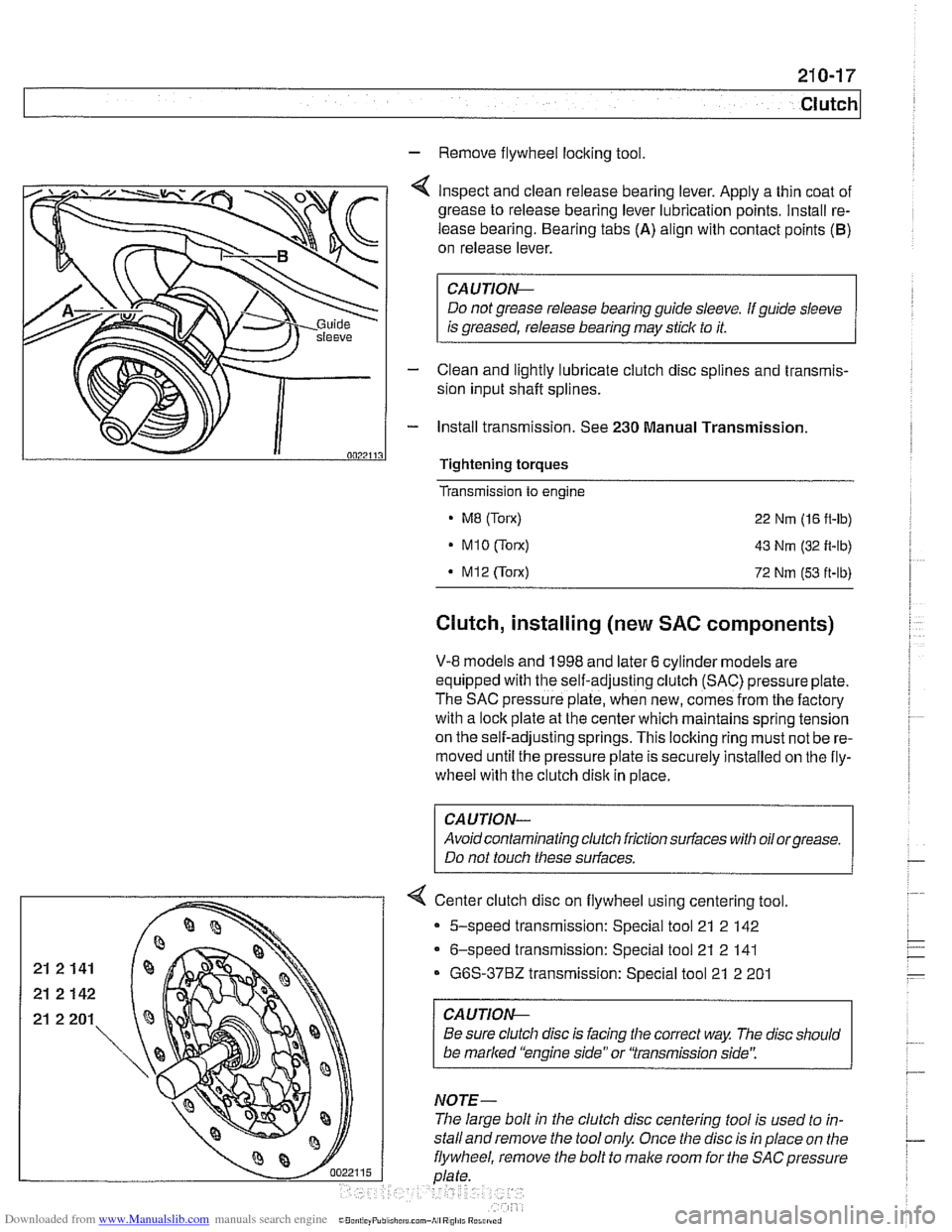
4 Inspect and clean release bearing lever. Apply a thin coat of
grease to release bearing lever lubrication points. Install re-
lease bearing. Bearing tabs
(A) align with contact points (B)
on release lever.
CAUTION-
Do not grease release bearing guide sleeve. If guide sleeve
is greased, release bearing may stick to it.
- Clean and lightly lubricate clutch disc splines and transmis-
sion input shaft splines.
- Install transmission. See 230 Manual Transmission
.
Transmission to engine
MB (Torx) 22 Nm (16 fl-lb)
MlO(Torx) 43 Nm (32 fl-lb)
Clutch, installing (new SAC components)
V-8 models and 1998 and later 6 cylinder models are
equipped with the self-adjusting clutch (SAC) pressure plate.
The SAC pressure plate, when new, comes from the factory
with a lock plate at the center which maintains spring tension
on the self-adjusting springs. This
loclting ring must not be re-
moved until the pressure plate is securely installed on tlie fly-
wheel with the clutch disk in place.
CAUTION-
Avoidcontaminating clutch friction surfaces with oilorgrease.
Do not touch these surfaces.
< Center clutch disc on flywheel using centering tool.
5-speed transmission: Special tool 21 2
142
- 6-speed transmission: Special tool 21 2 141
G6S-3782 transmission: Special tool 21 2 201
CAUTION-
Be sure clutch disc is facing the correct way The disc should
be marked "engine side" or "transmission side':
The large bolt in the clutch disc centering tool is used to
in-
stalland remove the tool only. Once the disc is in place on the
eel, remove the bolt to male room for tlie
SACpressure
Page 561 of 1002
Downloaded from www.Manualslib.com manuals search engine
Clutch
Clutch, installing (used SAC components)
When reinstalling a previously used self-adjusting clutch
(SAC), special tools are needed to reset the self-adjusting
ring to its original position.
CAUTIOI\C
Avoidcontaminating clutch friction suifaces with oilorgrease.
Do not touch these
suifaces.
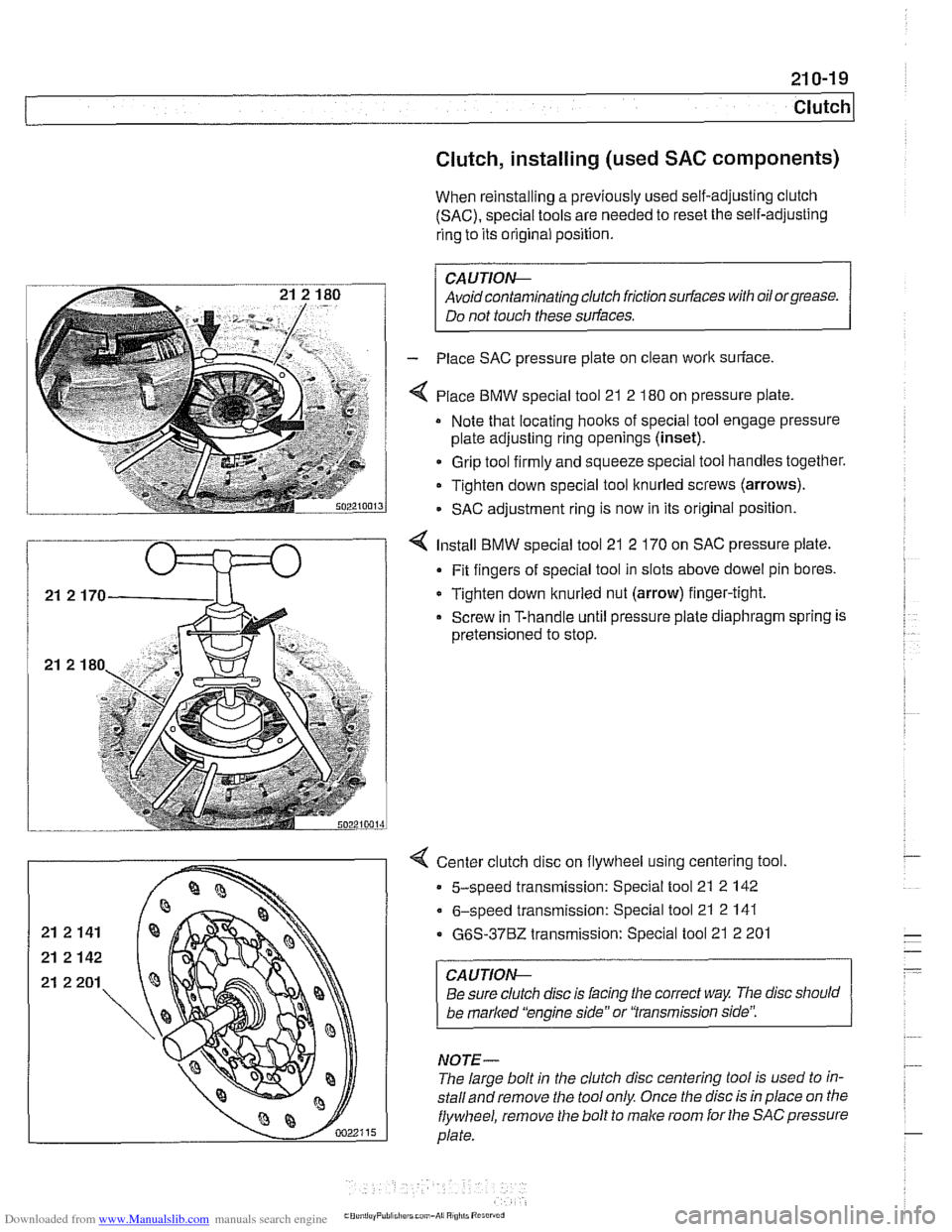
- Place SAC pressure plate on clean worlc suriace.
4 Place BMW special tool 21 2 180 on pressure plate
Note that locating hoolts of special tool engage pressure
plate adjusting ring openings
(inset).
Grip tool firmly and squeeze special tool handles together.
Tighten down special tool knurled screws (arrows).
- SAC adjustment ring is now in its original position.
4 Install BMW special tool 21 2 170 on SAC pressure plate.
Fit fingers of special tool in slots above dowel pin bores.
Tighten down knurled nut (arrow) finger-tight.
Screw in T-handle until pressure plate diaphragm spring is
pretensioned to stop.
< Center clutch disc on flywheel using centering tool.
5-speed transmission: Special tool 21 2 142
6-speed transmission: Special tool 21 2 141
G6S-3762 transmission: Special tool 21 2 201
CAUTION--
Be sure clutch disc is lacing the correct way The disc should
be
marked 'kngine side" or 'Transmission side':
NOTE-
The large bolt in the clutch disc centering tool is used to in-
stalland remove the tool only Once the disc is in place on tlie
flywheel, remove the bolt to male room for the SACpressure
plate.
Page 591 of 1002
Downloaded from www.Manualslib.com manuals search engine
Automatic Transmission
- Raise and safely support vehicle.
CA U JIOG
Male sure the car is stable and well supported at all times.
Use a professional automotive lift
orjack stands designed for
the purpose. A floorjack is not adequate support
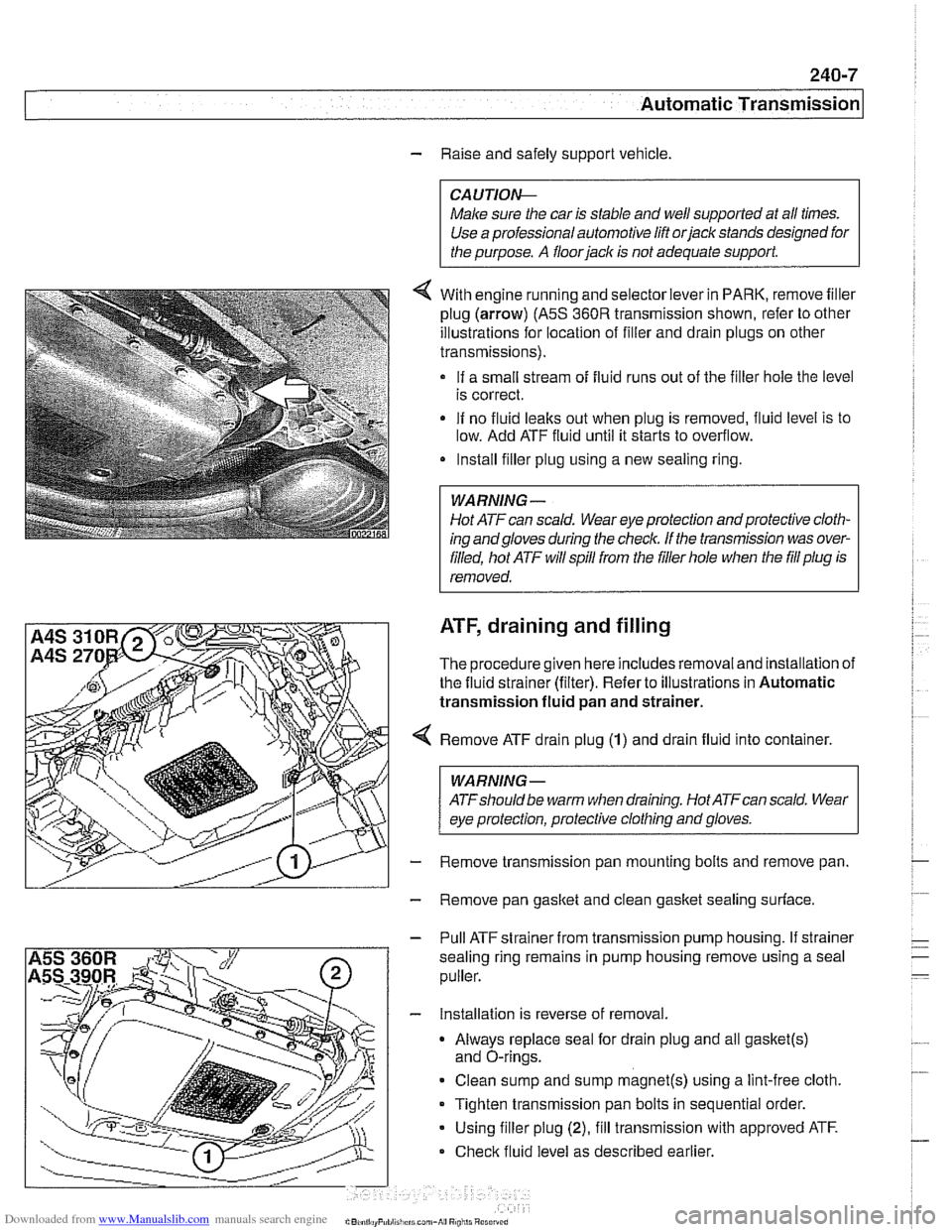
4 With engine running and selector lever in PARK, remove filler
plug (arrow)
(A5S 360R transmission shown, refer to other
illustrations for location of filler and drain plugs on other
transmissions).
If a small stream of fluid runs out of the filler hole the level
is correct.
If no fluid
leaks out when plug is removed, fluid level is to
low. Add ATF fluid until it starts to overflow.
Install filler plug using a new sealing ring.
Hot ATF can scald. Wear eye protection and protective cloth-
ing andgloves during
the check. If the tmnsmission was over-
filled, hot ATF will spill from the filler hole when the
fill plug is
removed.
ATF, draining and filling
The procedure given here includes removal and installation of
the fluid strainer (filter). Refer to illustrations in Automatic
transmission fluid
pan and strainer.
Remove ATF drain plug
(1) and drain fluid into container.
WARNING-
ATFshould be warm when draining. Hot ATFcan scald. Wear
eye protection, protective clothing and gloves.
Remove transmission pan mounting bolts and remove pan.
Remove pan gasket and clean
gasket sealing surface.
- Pull ATF strainer from transmission pump housing. If strainer
sealing ring remains in pump housing remove using a seal
puller.
- Installation is reverse of removal.
Always replace seal for drain plug and all
gasket(s)
and O-rings.
Clean sump and sump
magnet(s) using a lint-free cloth.
Tighten transmission pan bolts in sequential order.
Using filler plug
(2), fill transmission with approved ATF.
Check fluid level as described earlier.
Page 605 of 1002
Downloaded from www.Manualslib.com manuals search engine
250-7
Gearshift ~inka~el
Automatic shiftlock, checking function (automatic transmission)
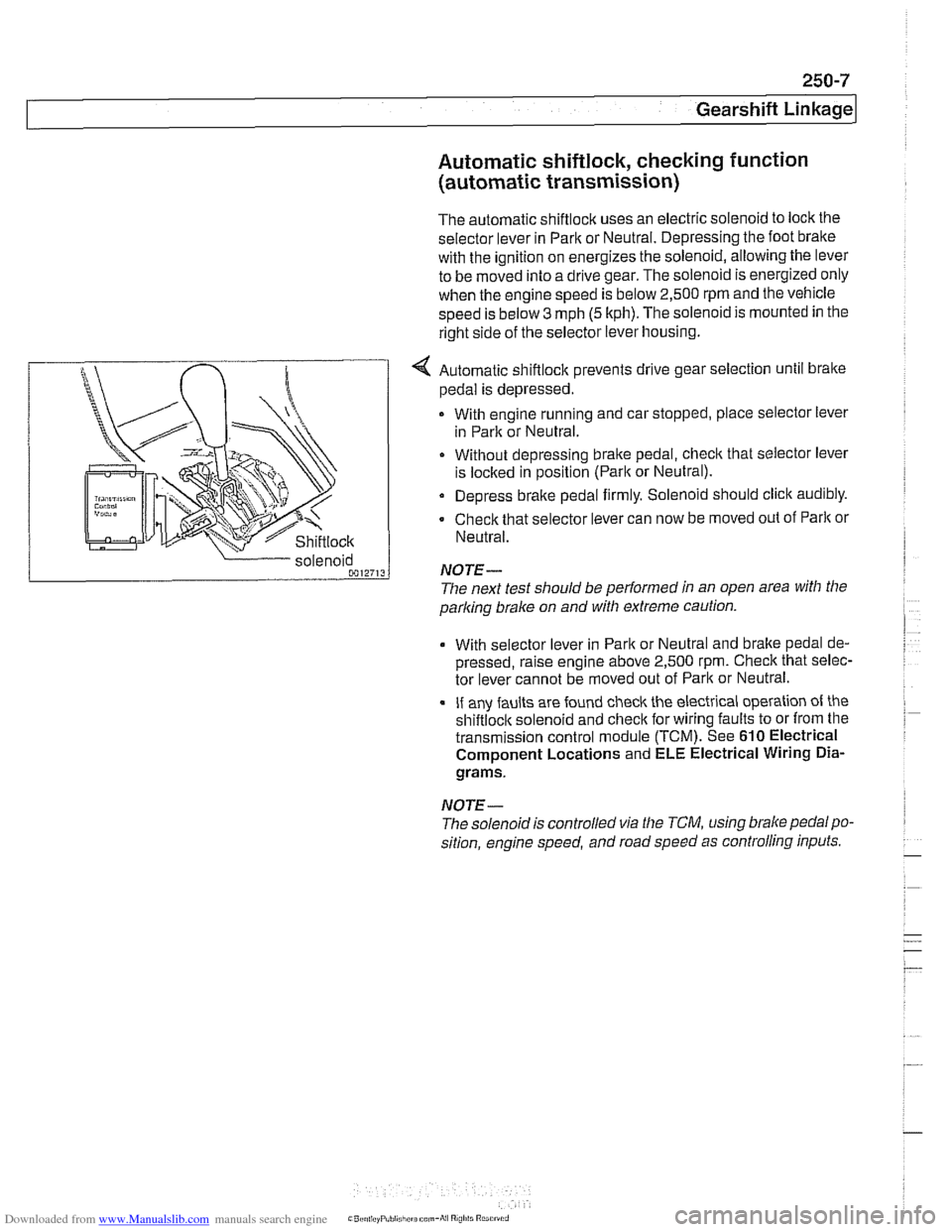
The automatic shiftlock uses an electric solenoid to lock the
selector lever in Park or Neutral. Depressing the foot bralte
with the ignition on energizes the solenoid, allowing the lever
to be moved into a drive gear. The solenoid is energized only
when the engine speed is below 2,500 rpm and the vehicle
speed is below
3 mph (5 kph). The solenoid is mounted in the
right side of the selector lever housing.
... nir r
Shiftlock
4 Automatic shiftlock prevents drive gear selection until brake
pedal is depressed.
With engine running and car stopped, place selector lever
in Park or Neutral.
Without depressing bralte pedal, check that selector lever
is
loclted in position (Parlt or Neutral).
Depress brake pedal firmly. Solenoid should click audibly.
Check that selector lever can now be moved out of
Parlt or
Neutral.
parking
brake on and with extreme caution.
solenoid
0012713
With selector
lever in Park or Neutral and bralte pedal de-
pressed, raise engine above 2,500
rpm. Check that selec-
tor lever cannot be moved out of Park or Neutral.
If any faults are found check the electrical operation of the
shiftloclt solenoid and checlt for wiring faults to or from the
transmission control module (TCM). See
610 Electrical
Component Locations and ELE Electrical Wiring
Dia-
grams.
NOTE-
NOTE-
The solenoidis controlled via the TCM, using brake pedalpo-
sition, engine speed, and road speed as controlling inputs.
The
next test should be performed in an open area with the
Page 606 of 1002
Downloaded from www.Manualslib.com manuals search engine
250-8
Gearshift Linkage
-;Ag Gate "",?it.,
Shift interlock, checking function
(automatic transmission)
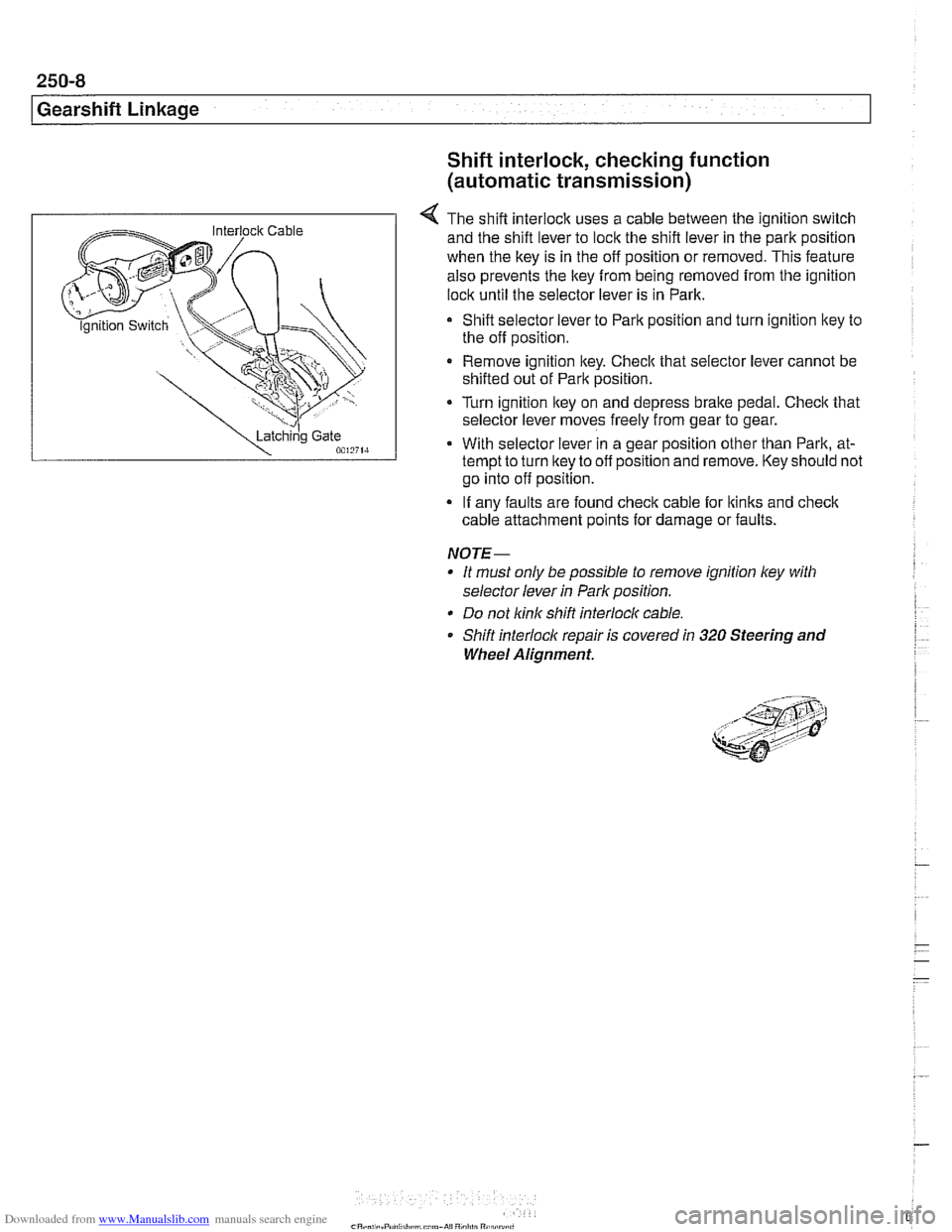
4 The shift interlock uses a cable between the ignition switch
and the shift lever to lock the shift lever in the park position
when the key is in the off position or removed. This feature
also prevents the key
from being removed from the ignition
lock until the selector lever is in Park.
Shift selector lever to Park position and turn ignition key to
the off position.
Remove ignition key. Checlc that selector lever cannot be
shifted out of Park position.
Turn ignition lkey on and depress
brake pedal. Checlc that
selector lever moves freely from gear to gear.
With selector lever in a gear position other than Park, at-
tempt to turn lkey to off position and remove. Key should not
go into off position.
If any faults are found check cable for lkinks and
check
cable attachment points for damage or faults.
NOTE-
* It must only be possible to remove ignition ley with
selector lever
in Park position.
* Do not link shift interlocl( cable.
Shift interlock repair is covered
in 320 Steering and
Wheel Alignment.
Page 609 of 1002
Downloaded from www.Manualslib.com manuals search engine
Driveshaft
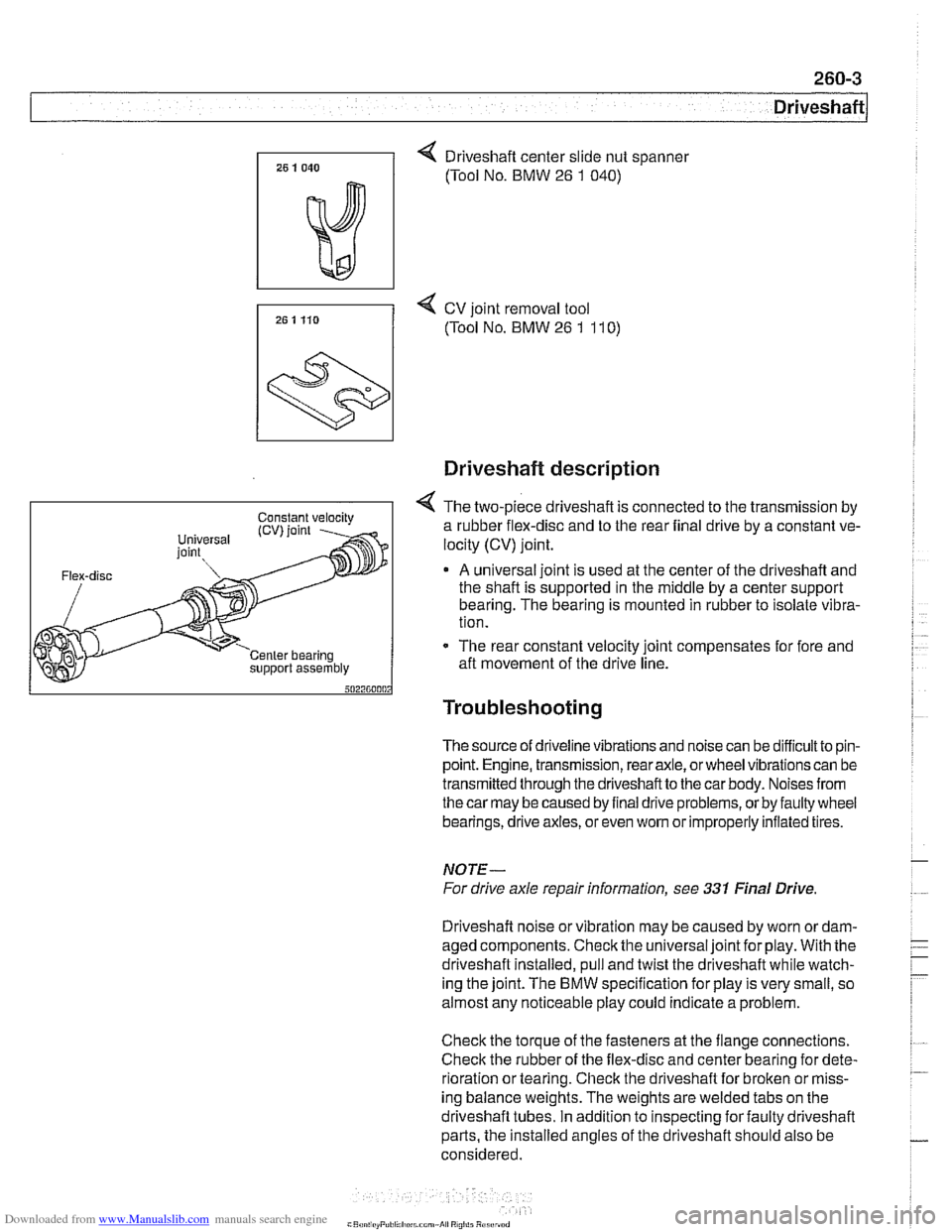
4 Driveshaft center slide nut spanner
(Tool No. BMW
26 1 040)
7, 25 1 Ho 4 cv joint removal tool
(Tool No. BMW 26 1 11 0)
support assembly
Driveshaft description
4 The two-piece driveshaft is connected to the transmission by
a rubber flex-disc and to the rear final drive by a constant ve-
locity (CV) joint.
A universal joint is used at the center of the driveshaft and
the shaft is supported in the middle by a center support
bearing. The bearing is mounted in rubber to isolate vibra-
tion.
- The rear constant velocity joint compensates for fore and
aft movement of the drive line.
Troubleshooting
The source of driveline vibrations and noise can be difficultto pin-
point. Engine, transmission, rear axle, or wheel vibrations can be
transmitted through thedriveshaftto the car body. Noises from
thecar may be caused by final drive problems, or by faulty wheel
bearings, drive axles, or even
wom or improperly inflated tires.
NOTE-
For drive axle repair information, see 331 Final Drive
Driveshaft noise or vibration may be caused by worn
ordam-
aged components. Check the universal joint for play. With the
driveshaft installed, pull and twist the driveshaft while watch-
ing the joint. The
BMW specification for play is very small, so
almost any noticeable play could indicate a problem.
Check the torque of the fasteners at the flange connections.
Check the rubber of the flex-disc and center bearing for dete-
rioration or tearing. Check the driveshaft for broken or miss-
ing balance weights. The weights are welded tabs on the
driveshaft tubes. In addition to inspecting for faulty driveshaft
parts, the installed angles of the driveshaft should also be
considered.
Page 610 of 1002
Downloaded from www.Manualslib.com manuals search engine
1 Driveshaft
Further inspection requires removal of the driveshaft. Checlc
the front centering guide on the transmission output flange for
damage or
misalignment. Also check runout at the transmis-
sion output fiange and output shaft, and at the final drive input
fiange. Check the bolt hole bores in the flange for wear and
elongation.
Driveshaft flange
runout (max. allowable)
Transmission
flange
- Axial play 0.10 mm (0.004 in.)
Radial play 0.07
mm (0.003 in.)
Spin the driveshaft center bearing and
check ior smooth op-
eration without play. Check the constant velocity joint
forwear
or play. Checlc the universal joint for wear or binding. If it is
difficult to move or binds, the driveshaft section should be
replaced.
Universal joint
play
Maximum allowable 0.15
mm (0.006 in.)
NOTE-
With the driveshaft installed, the actual amount that the drive-
shaftjoint pivots is limited. For the most accurate test, check
joint
in its normal range of movement.
If inspection reveals nothing wrong with the driveshaft, it may
need to be rebalanced. This can be done by a speciality drive-
shaft repair shop. Also,
checlc driveshaft alignment as de-
scribed below.
NOTE-
Minor driveshaft vibrations can often be corrected simply by
disconnecting the driveshaft at the final drive and reposition-
ing it go", 180" or 270" in relation to the final drive input
flange.
The troubleshooting table below lists symptoms
oi driveshaft
problems and their probable causes. Most of the repair infor-
mation is contained within this repair group. There are refer-
ences to other repair groups, where applicable.
Page 612 of 1002
Downloaded from www.Manualslib.com manuals search engine
Driveshaft
Repair kits for the universal joint are not available for BMW
driveshafts.
A worn or damaged universal joint usually require
replacement of the driveshaft.
The driveshaft is balanced to close tolerances. Whenever it is
to be removed or disassembled, the mounting flanges and
driveshaft sections should be marked with paint or a punch
before proceeding with work. This will ensure that the
drive-
shaft can be reassembled and installed in exactly the original
orientation.
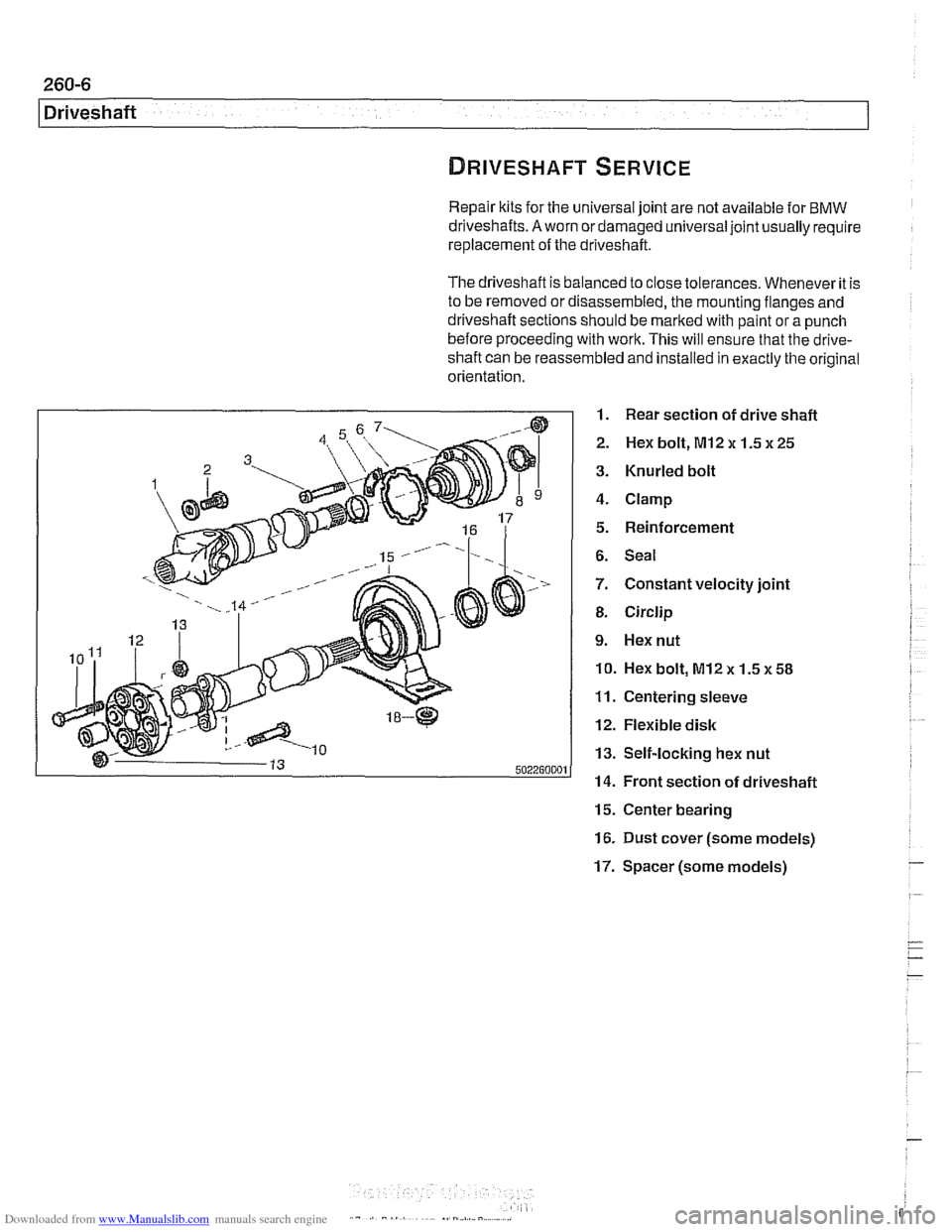
1. Rear section of drive shaft
2. Hex bolt, MI2 x 1.5 x 25
3. Knurled bolt
4. Clamp
5. Reinforcement
6. Seal
7. Constant velocity joint
8. Circlip
9. Hex nut
10. Hex bolt, M12x 1.5~58
11. Centering sleeve
12. Flexible disk
13. Self-locking hex nut
14. Front section of driveshaft
15. Center bearing
16. Dust cover (some models)
17. Spacer (some models) -
Page 613 of 1002
Downloaded from www.Manualslib.com manuals search engine
Driveshaft, aligning
The alignment of the driveshaft does not normally need to be
checked unless the engineltransmission or the final drive
have been removed and installed. if ail other parts of the
driveshaft have been inspected and found to be okay, but
there is still noise or vibration, driveshaft alignment should be
checked.
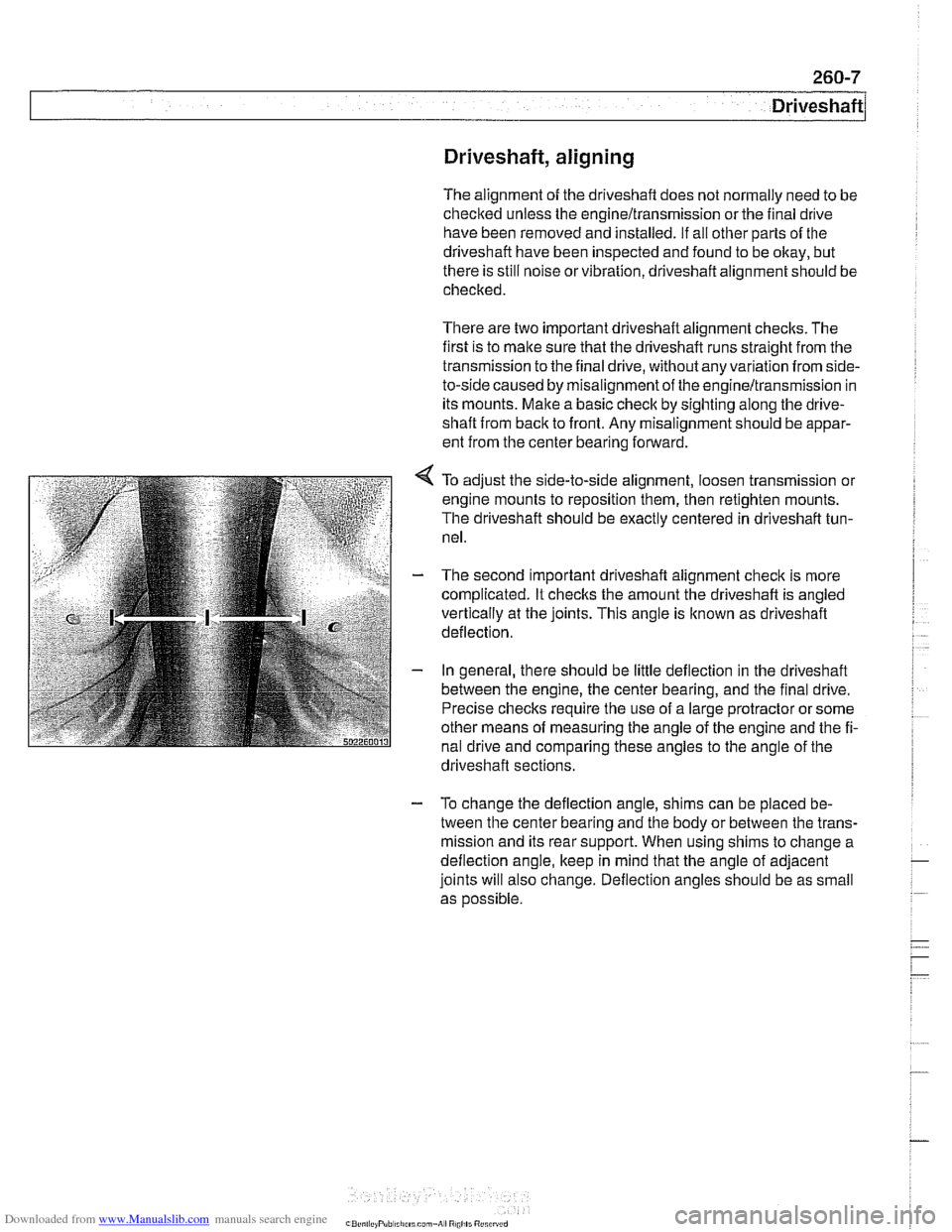
There are two important driveshaft alignment checks. The
first is to make sure that the driveshaft runs straight from the
transmission to the final drive, without any variation from
side-
to-side caused by misalignment of the engineltransmission in
its mounts. Make a basic check by sighting along the
drive-
shaft from back to front. Any misalignment should be appar-
ent from the center bearing forward.
To adjust the side-to-side alignment, loosen transmission or
engine mounts to reposition them, then retighten mounts.
The driveshaft should be exactly centered in driveshaft tun-
nel.
The second important driveshaft alignment check is more
complicated. It checlts the amount the driveshaft is angled
vertically at the joints. This angle is
lknown as driveshaft
deflection.
In general, there should be little deflection in the driveshaft
between the engine, the center bearing, and the final drive.
Precise checks require the use of a large protractor or some
other means of measuring the angle of the engine and the fi-
nal drive and comparing these angles to the angle of the
. . driveshaft sections.
- To change the deflection angle, shims can be placed be-
tween the center bearing and the body or between the trans-
mission and its rear support. When using shims to change a
deflection angle, keep in mind that the angle of adjacent
joints will also change. Deflection angles should be as small
as
oossible.
Page 614 of 1002
Downloaded from www.Manualslib.com manuals search engine
-.- .
/ Driveshaft Driveshaft, removing
CAUTION-
. Be sure the wheels are off the ground before removing the
driveshak Set the parl(ing brake before removing the
driveshaft.
Once the driveshaft has been removed, the vehicle can
roll regardless of whether the transmission is in gear or
not.
The driveshaft is mounted to the transmission and final
drive
with self-locliing nuts. These nuts are designed to
be used only once and should be replaced during reas-
sembly.
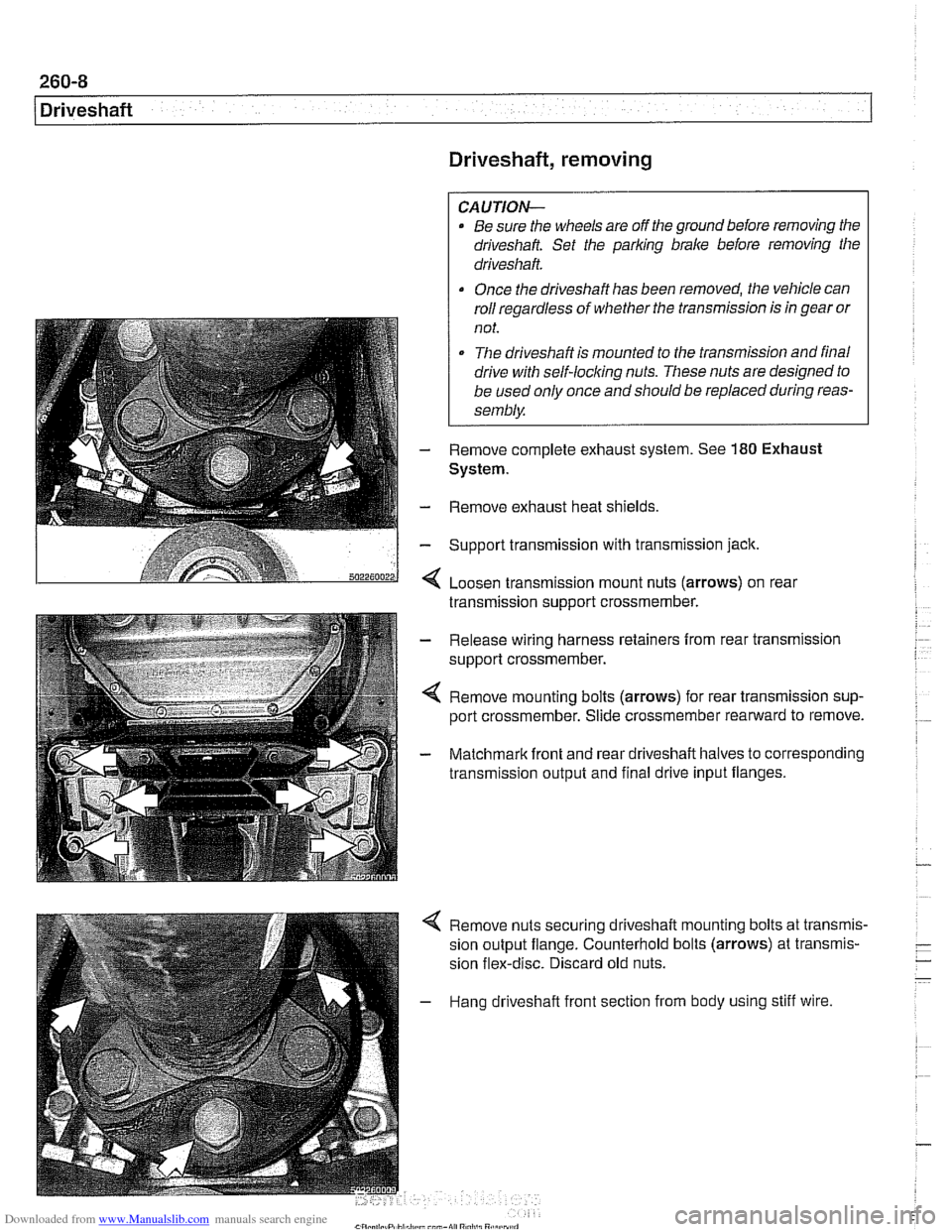
Remove complete exhaust system. See
180 Exhaust
System.
- Remove exhaust heat shields.
- Support transmission with transmission jack.
< Loosen transmission mount nuts (arrows) on real
transmission support crossmember.
- Release wiring harness retainers from rear transmission
support crossmember.
< Remove mounting bolts (arrows) for rear transmission sup-
port crossmember. Slide crossmember rearward to remove.
- Matchmark front and rear driveshaft halves to corresponding
transmission output and final drive input flanges.
4 Remove nuts securing driveshaft mounting bolts at transmis-
sion output flange. Counterhold bolts (arrows) at transmis-
sion flex-disc. Discard old nuts.
- Hang driveshaft front section from body using stiff wire.