Oul BMW 540i 1999 E39 Workshop Manual
[x] Cancel search | Manufacturer: BMW, Model Year: 1999, Model line: 540i, Model: BMW 540i 1999 E39Pages: 1002
Page 730 of 1002
Downloaded from www.Manualslib.com manuals search engine
(Rear Suspension
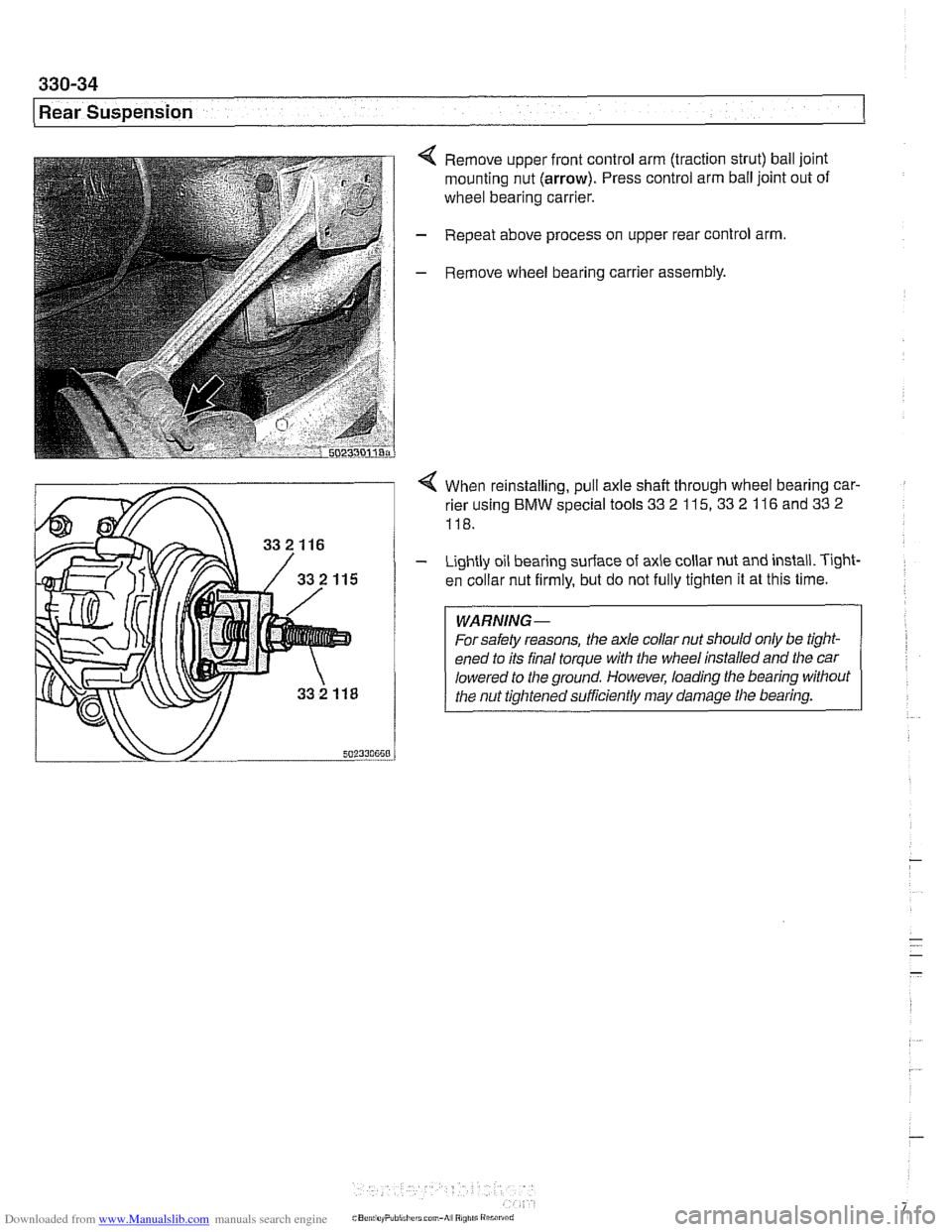
< Remove upper front control arm (traction strut) ball joint
mounting nut
(arrow). Press control arm ball joint out of
wheel bearing carrier.
- Repeat above process on upper rear control arm.
- Remove wheel bearing carrier assembly.
4 When reinstalling, pull axle shaft through wheel bearing car-
rier using
BMW special tools 33 2 115, 33 2 116 and 33 2
118.
- Lightly oil bearing surface of axle collar nut and install. T~ght-
en collar nut firmly, but do not fully tighten it at this time.
WARNING-
For safety reasons, the ale collar nut should only be tight-
ened to its final torque with the wheel installed and the car
lowered to
the ground. However, loading the bearing without
the nut tightened sufficiently may damage tlie bearing.
Page 734 of 1002
Downloaded from www.Manualslib.com manuals search engine
I Rear Suspension
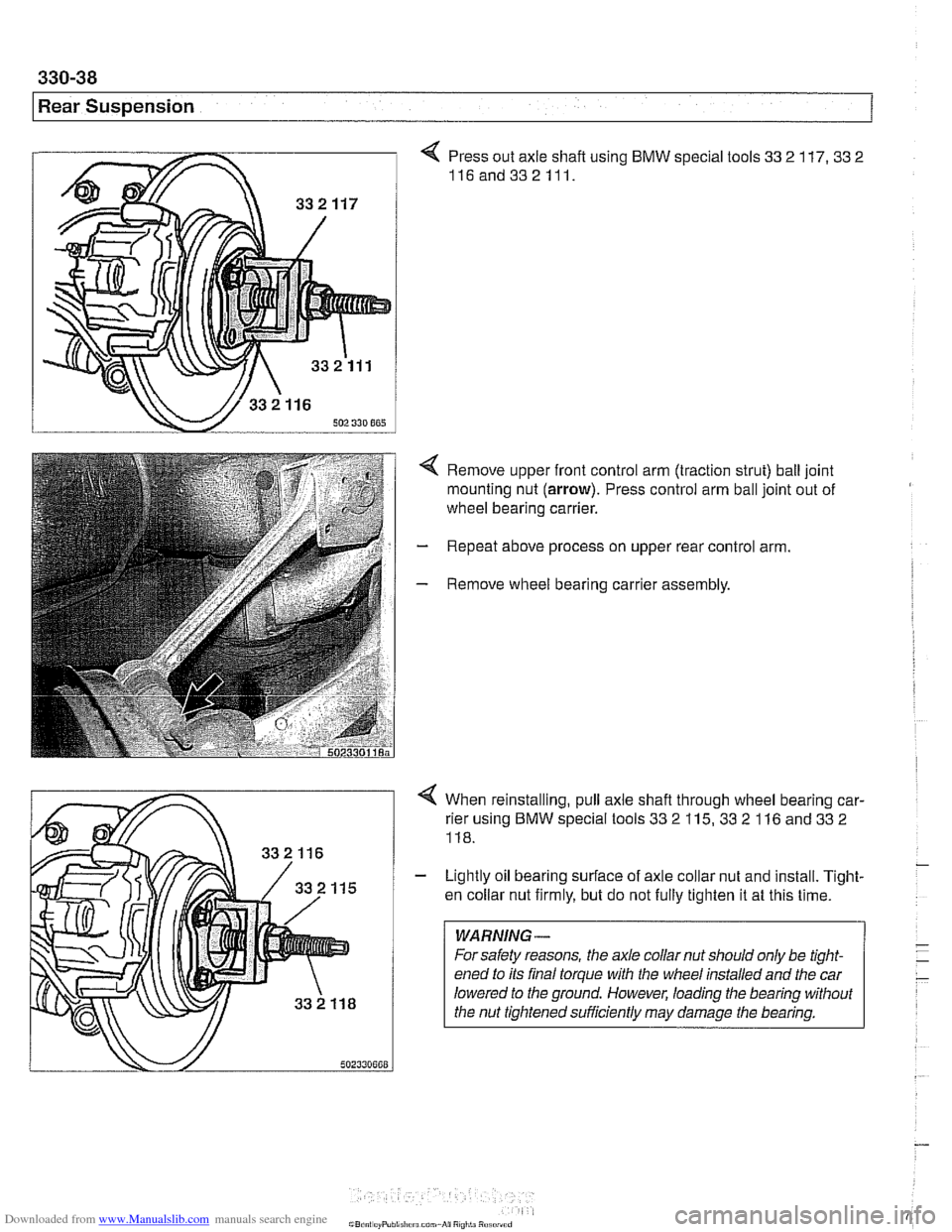
4 Press out axle shaft using BMW special tools 33 2 117. 33 2
116and332111.
4 Remove upper front control arm (traction strut) ball joint
mounting nut (arrow). Press control arm ball joint out of
wheel bearing carrier.
- Repeat above process on upper rear control arm.
- Remove wheel bearing carrier assembly.
4 When reinstalling, pull axle shafl through wheel bearing car-
rier using BMW special tools 33
2 115, 33 2 116 and 33 2
118.
- Lightly oil bearing surface of axle collar nut and install. Tight-
en collar nut firmly, but do not fully tighten it at this time.
WARNING-
For safety reasons, the axle collar nut should only be tight-
ened to its final torque with the wheel installed and the car
lowered to the ground. However, loading the bearing without
the nut tiqhtened
suificiently may darnaqe the bearina.
Page 737 of 1002
Downloaded from www.Manualslib.com manuals search engine
--. ..
Rear Suspension
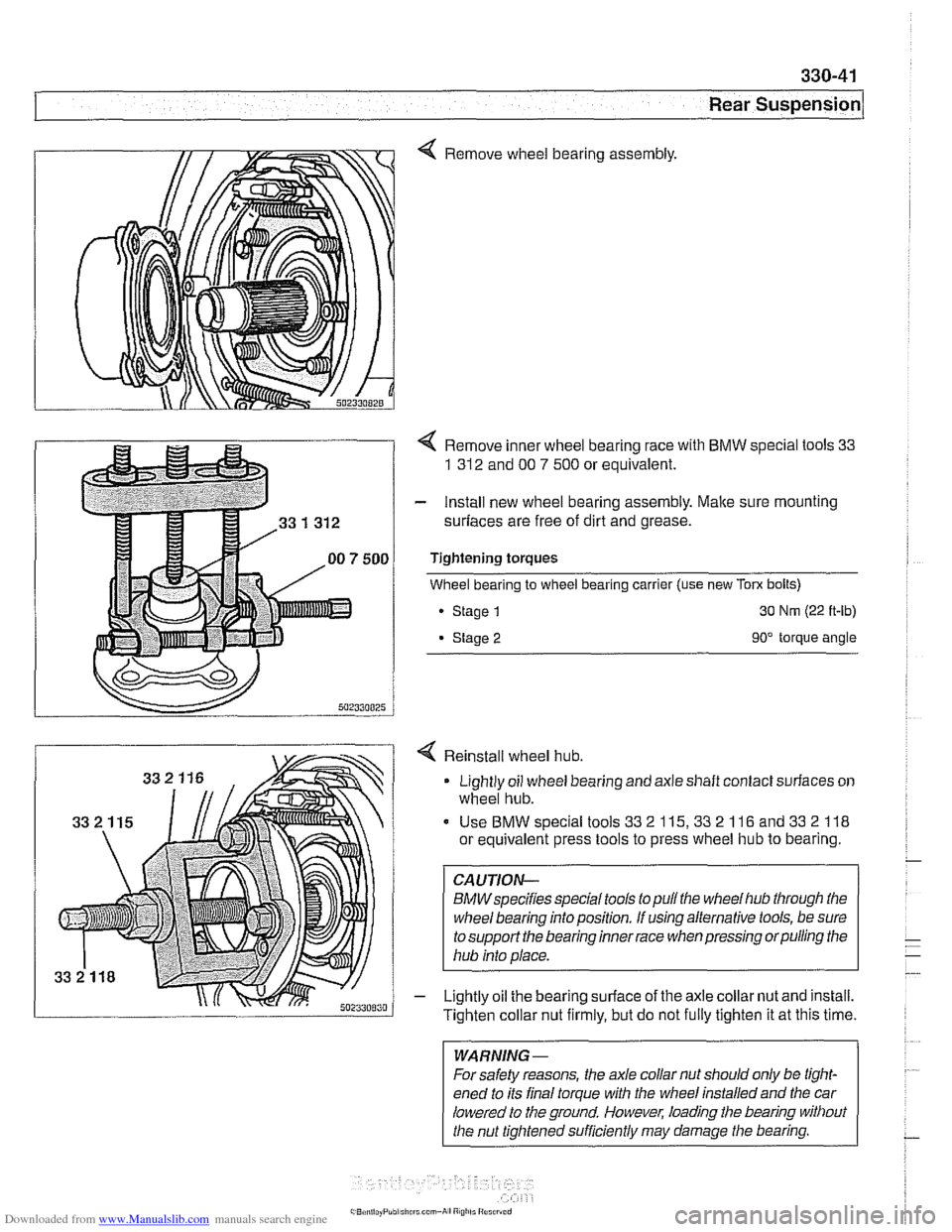
4 Remove wheel bearing assembly.
4 Remove inner wheel bearing race with BMW special tools 33
1 312
and 00 7 500 or equivalent.
- Install new wheel bearing assembly. Malte sure mounting
surfaces are free of dirt and grease.
Tightening torques
Wheel bearing to wheel bearing carrier (use new
Tom bolts)
Stage
1 30 Nm (22 ft-lb)
Stage 2 90" torque angle
4 Reinstall wheel hub.
Lightly oil wheel bearing and axle shaft contact surfaces on
wheel hub.
Use BMW special tools
33 2 115,33 2 116 and 33 2 118
or equivalent press tools to press wheel hub to bearing.
CAUTION-
BMWspecifies speclaltools to pull the wheel hub through the
wheel bearing into position. If using alternative tools, be sure
to support the bearing inner race when pressing orpulling the
hub into place.
- Lightly oil the bearing surface of the axle collar nut and install.
Tighten collar nut firmly, but do not fully tighten it at this time.
WARNING-
For safety reasons, the axle collar nut should only be tight-
ened to its final torque with the wheel installed and the car
lowered to the ground. However, loading the bearing without
the nut tightened sufficiently may damage
the bearing.
Page 750 of 1002
Downloaded from www.Manualslib.com manuals search engine
Final Drive
Tightening torques
F~nal drive to rear axle carrier 105 Nm (77 it-lb)
Driveshaft CV joint to final drive flange
- MlO (Torx bolt) 70
Nm (51 ft-lb)
- M8 (compression nut) 32 Nm (24
ft-lb)
Drive axle to final drive
ilange
Torx bolts (M10) 83 Nm (61 ft-lb)
Torx bolt with
rlbbed teeth (M10) 64 Nm (47 ft-lb)
Torx bolt
wlth ribbed teeth (MI0 sliver) 80 Nm (59 ft-lb)
Torx
bolt with ribbed teeth (M10 black) 100 Nm (74 ft-lb)
* Torx bolt with ribbed teeth (M12) 135 Nm (100 ft-lb)
Differential oil level, checking
The E39 differential is filled with lifetime oil that ordinarily
does not need to be changed. BMW recommends using only
a specially formulated synthetic gear oil
(SAF-XO) that is
available through an authorized BMW dealer parts depart-
ment. For additional information on this lubricant and any oth-
er lubricants that may be compatible, contact an authorized
BMW dealer service department.
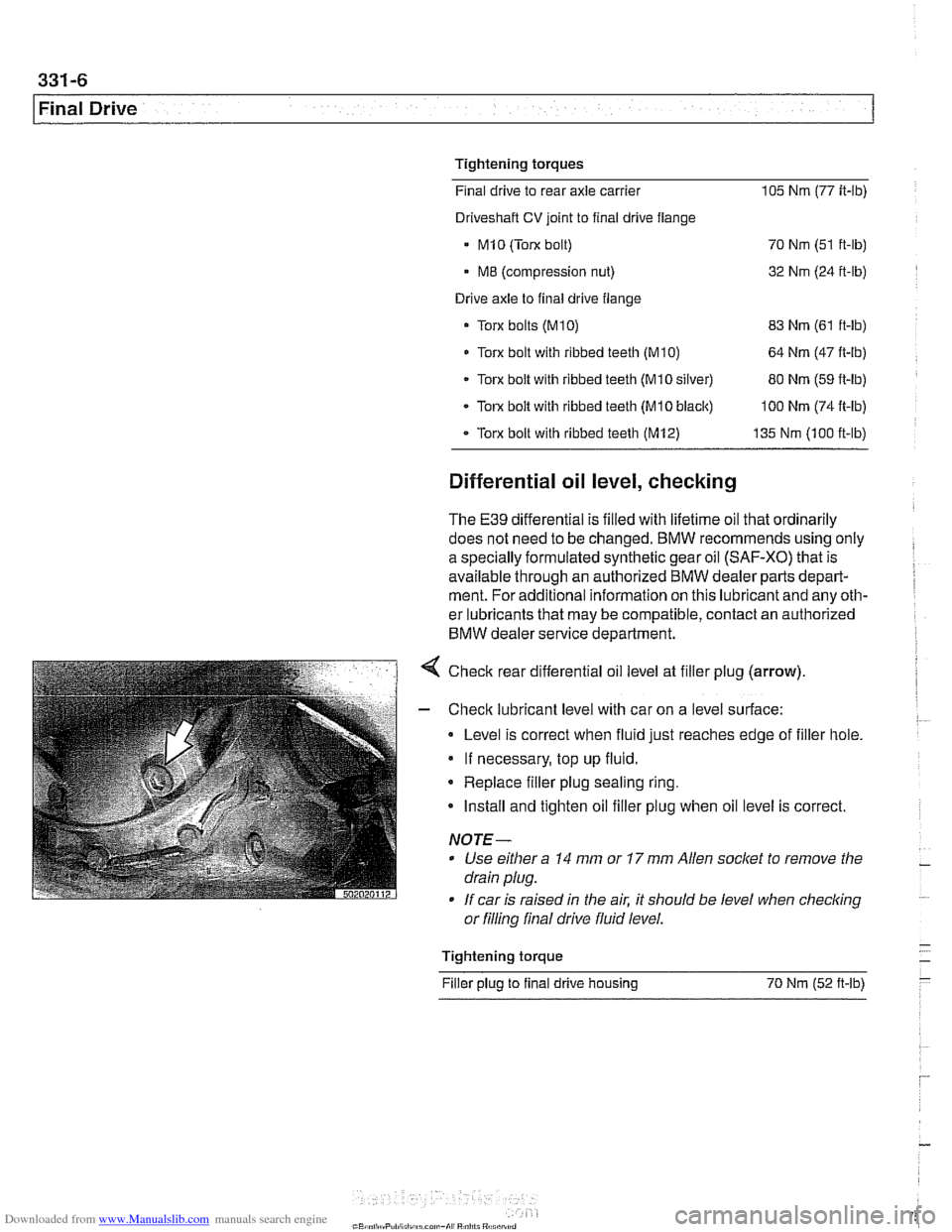
< Check rear differential oil level at filler plug (arrow).
- Check lubricant level with car on a level surface:
Level is correct when fluid just reaches edge of filler hole.
If necessary, top up fluid.
* Replace filler plug sealing ring.
Install and tighten oil filler plug when oil level is correct.
NOTE-
Use either a 14 mm or 17 mm Allen socket to remove the
drain plug.
If car is raised in the air. it should be level when
checkino " or filling final drive fluid level.
- Tightening torque -
Filler plug to final drive housing 70 Nm (52
ft-lb) -
Page 757 of 1002
Downloaded from www.Manualslib.com manuals search engine
Final Drive
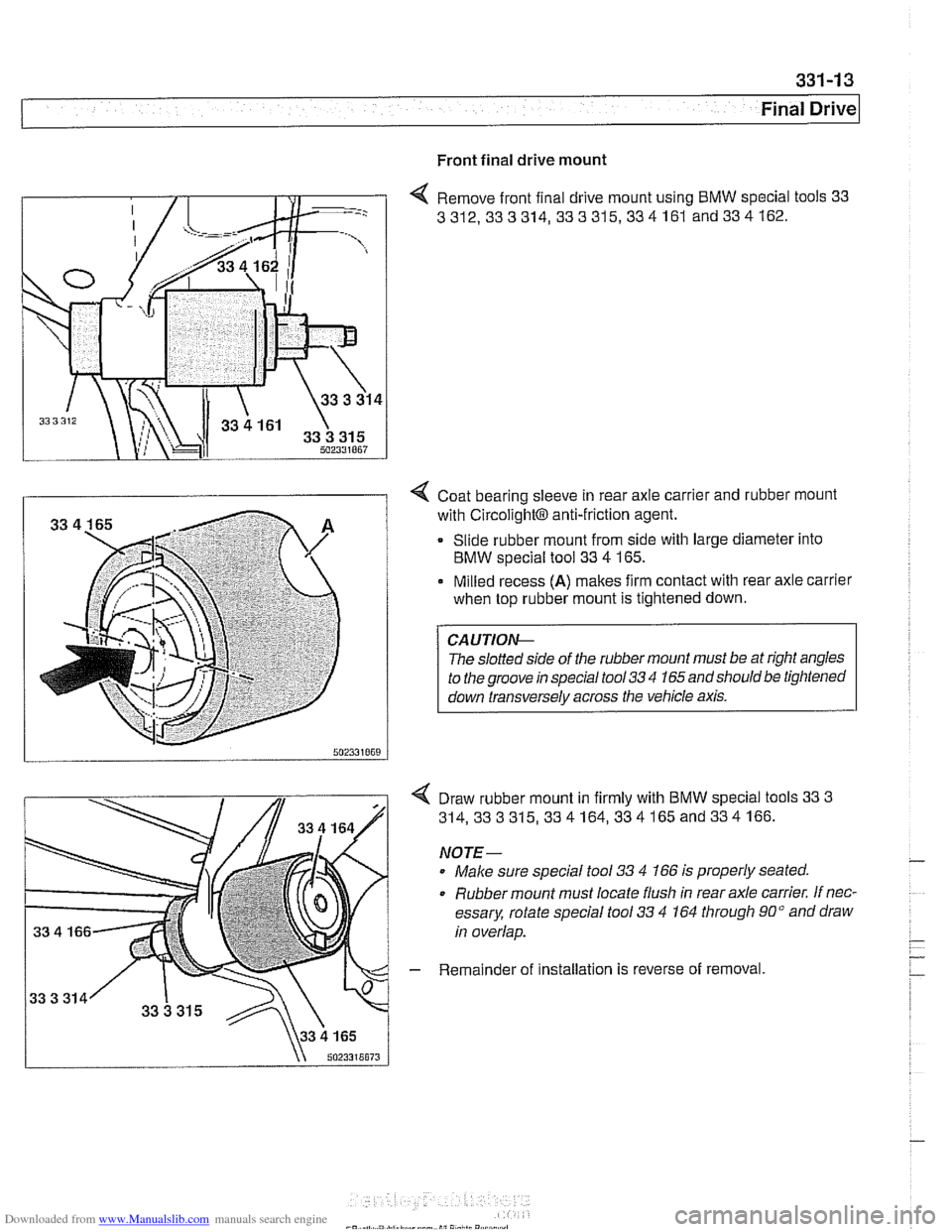
Front final drive mount
4 Remove front final drive mount using BMW special tools 33
3312,333314, 333315,334161
and334162.
I i 4 Coat bearing sleeve in rear axle carrier and rubber mount
with
~ircolight~ anti-friction agent.
Slide rubber mount from side with large diameter into
BMW special tool 33
4 165.
Milled recess
(A) makes firm contact with rear axle carrier
when top rubber mount is tightened down.
The
slolled srde ot r11e rubber mounl must be ar r#ghl angles
lo
rhe groove rn specal roo/ 33 '1 165 and shoulo be lrghrened
I down ~ransversely across the vehicle axis. I
Draw rubber mount in firmly with BMW special tools 33 3
314,333315,334164,334165and334166.
NOTE-
Male sure special tool 33 4 166 is properly seated.
0 Rubber mount must locate flush in rear axle carrier. If nec-
essary, rotate special tool
33 4 164 through 90" and draw
in overlap.
- Remainder of installation is reverse of removal
Page 770 of 1002
Downloaded from www.Manualslib.com manuals search engine
340-8
1 Brakes
Brake bleeding is usually done for one of two reasons: either
to replace old brake fluid as part of routine maintenance or to
expel trapped air in the system that resulted
from opening the
brake hydraulic system during repairs.
Read the
Warnings listed below before beginning the bleed-
ing procedure an on any
E39 car. If air enters the ACS or DSC
hydraulic unit, the factory BMW Service Tester MUST be
used in conjunction with a bralte pressure bleeder before the
vehicle is driven.
The BMW
ServiceTester (DISpluslGT1iMoDiC) must be
used to bleed the braltes if:
Any hydraulic brake system components are replaced, in-
cluding bralte lines.
Air has enter the
ABSIASC or ABSlDSC hydraulic unit.
WARNING -
* The ASC and DSC systems use electronic controls and a
sophisticated hydraulic unit Once air enters the hydraulic
unit, it is very difficult to remove using traditional methods.
For this reason, pressure
brake bleeding should be done
in conjunction with the BMW
Sewice Tester (DIS-
plus/GTl/MoDiC). The tester electrically cycles the hy-
draulic unit solenoids in the hydraulic unit while
pressurized brake fluid is forced through the system.
When flushing the brake fluid from the system, use ex-
treme care to not let the
brale fluid reservoir run dry If
air enters the hydraulic unit, the BMW Service Tester
MUST be used to bleed the brale system before the
vehicle is driven.
Always use new brake fluid from an unopened container. It is
important to bleed the entire system when any part of the hy-
draulic system has been opened. Be sure to have the special
equipment needed before beginning the job.
When bleeding the
braltes, start atthe wheel farthest from the
master cylinder and progress in the following order:
right rear brake
left rear brake
* right front brake
left front brake
Page 780 of 1002
Downloaded from www.Manualslib.com manuals search engine
.- -
Brakes
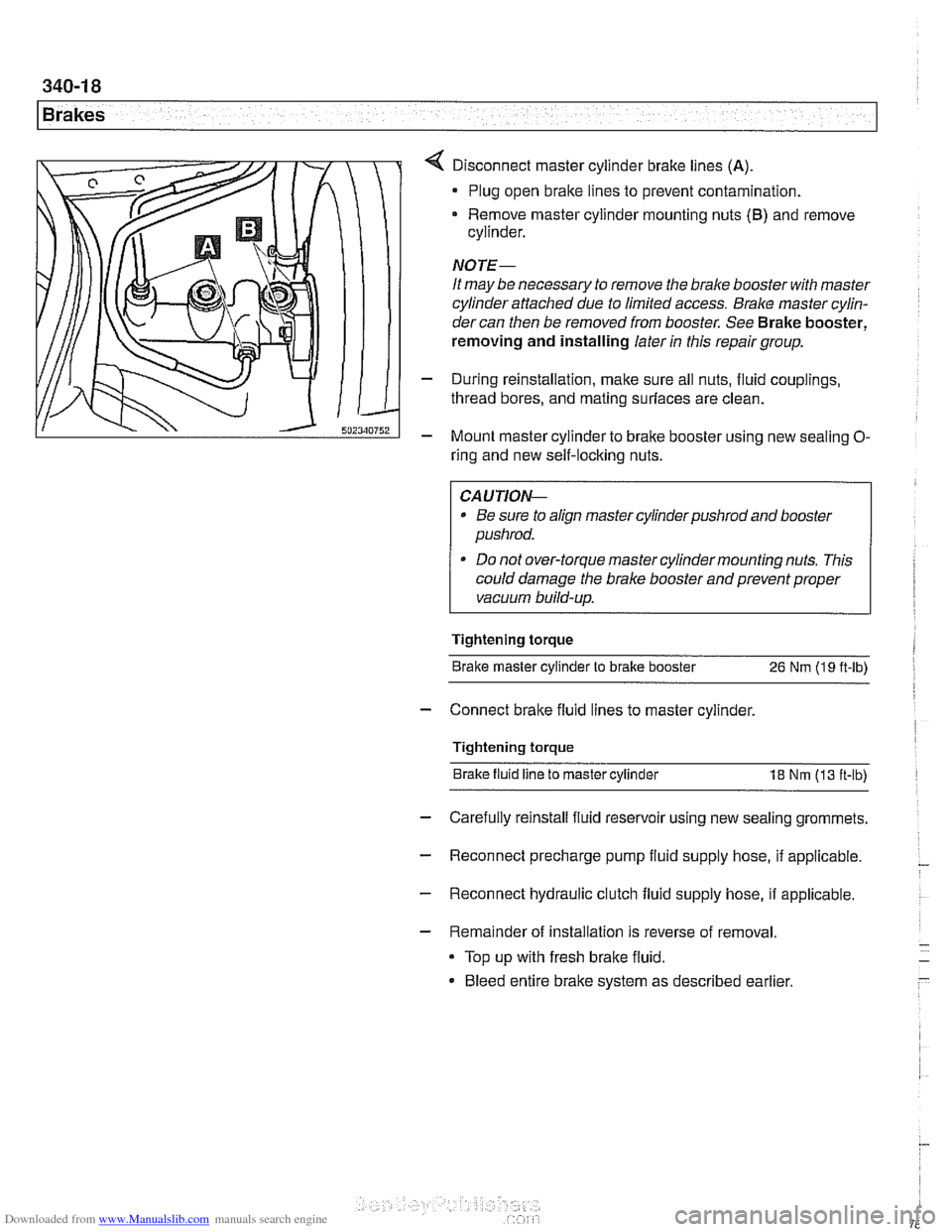
Disconnect master cylinder brake lines (A)
Plug open brake lines to prevent contamination.
Remove master cylinder mounting nuts
(6) and remove
cylinder.
NOTE-
It may be necessary to remove the brake booster with master
cylinder attached due to limited access.
Bralce master cylin-
dercan then be removed from booster. See Brake booster,
removing and installing later
in this repair group.
- During reinstallation, make sure all nuts, fluid couplings,
thread bores, and mating surfaces are clean.
- Mount master cylinder to bralte booster using new sealing O-
ring and new self-locking nuts.
CAUTIOI\C
* Be sure to align master cylinderpushrod and booster
pushrod.
* Do not over-torque master cylinder mounting nuts. This
could damage the brake booster and prevent proper
vacuum build-up.
Tightening torque Brake master cylinder to brake booster
26 Nm (19 ft-lb)
- Connect bralte fluid lines to master cylinder.
Tightening torque Brake fluid line to master cylinder
18 Nm (13 ft-lb)
- Carefully reinstall fluid reservoir using new sealing grommets.
- Reconnect precharge pump fluid supply hose, if applicable. -
- Reconnect hydraulic clutch fluid supply hose, if applicable.
- Remainder of installation is reverse of removal.
Top up with fresh brake fluid.
Bleed entire brake system as described earlier
Page 783 of 1002
Downloaded from www.Manualslib.com manuals search engine
1 Brakes
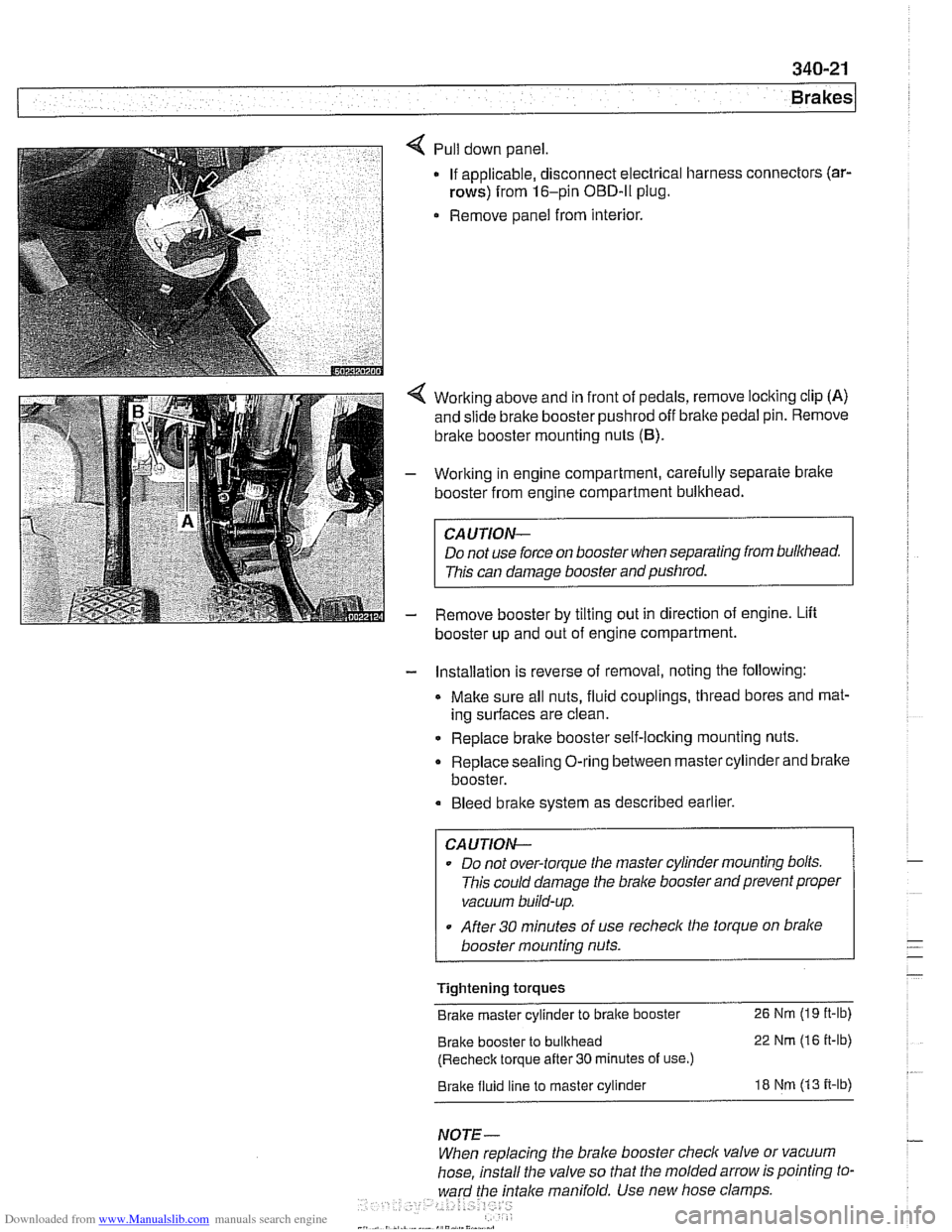
Pull down panel
If applicable, disconnect electrical harness
rows) from 16-pin OBD-ll plug.
Remove panel from interior. connectors
(ar-
Working
above and in front of pedals, remove locking clip (A)
and slide brake booster pushrod off bralte pedal pin. Remove
brake booster mounting nuts
(6).
Working in engine compartment, carefully separate bralte
booster from engine compartment bulkhead.
CAUTION-
Do not use force on booster when separating from bulkhead.
This can damage booster and pushrod.
Remove booster by tilting out in direction of engine. Lift
booster up and out of engine compartment.
- Installation is reverse of removal, noting the following:
Make sure all nuts, fluid couplings, thread bores and mat-
ing surfaces are clean.
Replace bralte booster self-locking mounting nuts.
Replace sealing O-ring between master cylinder and bralte
booster.
Bleed bralte system as described earlier.
CAUTION--
Do not over-torque tlie master cylinder mounting bolts.
This could damage the
bralce booster and prevent proper
vacuum build-up.
After
30 minutes of use recheclc the torque on bralce
booster mounting nuts.
Tightening torques
Brake master cylinder to brake booster
26 Nm (19 it-lb)
Brake booster to bulkhead 22 Nm (16 it-lb)
(Recheck torque after
30 minutes of use.)
Brake fluid line to master cylinder 18 Nm (13 it-lb)
NOTE-
When replacing the brake booster check valve or vacuum
hose, install the valve so that the molded arrow is pointing to-
ward the
fntalce manifold. Use new hose clamps
Page 801 of 1002
Downloaded from www.Manualslib.com manuals search engine
Body-General
SAFETY AND SECURITY FEATURES
A number of new or improved safety and security features are
incorporated in
E39 cars.
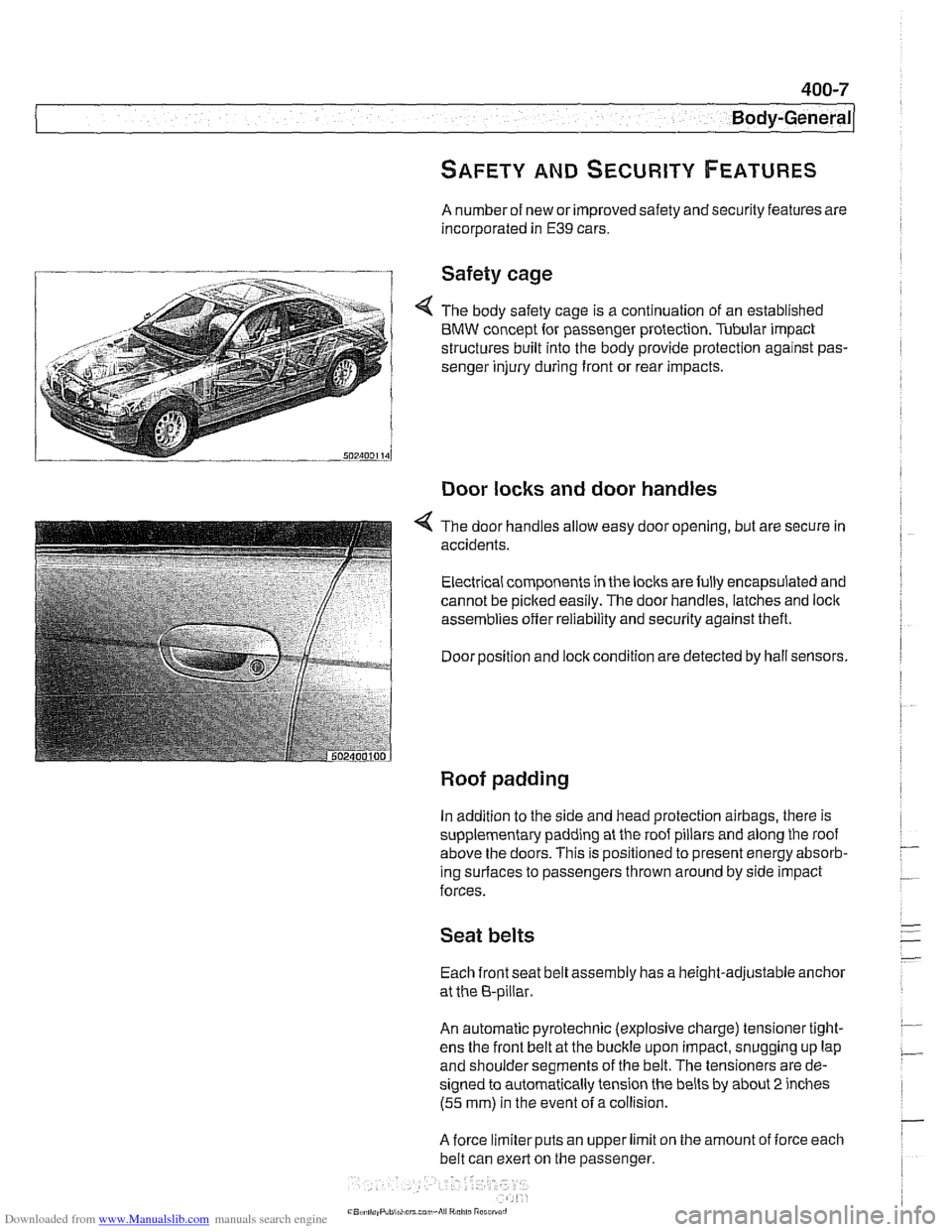
Safety cage
4 The body safety cage is a continuation of an established
BMW concept for passenger protection. Tubular impact
structures built into the body provide protection against pas-
senger injury during front or rear impacts.
Door locks and door handles
4 The door handles allow easy door opening, but are secure in
accidents.
Electrical components in the locks are fully encapsulated and
cannot be picked easily. The door handles, latches and
loclc
assemblies offer reliability and security against theft.
Door position and
loclc condition are detected by hall sensors.
Roof padding
In addition to the side and head protection airbags, there is
supplementary padding at the roof pillars and along the roof
above the doors. This is positioned to present energy absorb-
ing
surlaces to passengers thrown around by side impact
forces.
Seat belts
Each front seat belt assembly has a height-adjustable anchor
at the 8-pillar.
An automatic pyrotechnic (explosive charge) tensioner tight-
ens the front belt at the buckle upon impact, snugging up lap
and shoulder segments of the belt. The tensioners are de-
signed to automatically tension the belts by about
2 inches
(55 mm) in the event ofa collision.
A force limiter puts an upper limit on the amount of iorce each
belt can exert on the passenger.
Page 814 of 1002
Downloaded from www.Manualslib.com manuals search engine
41 0-8
(Fenders, Engine Hood
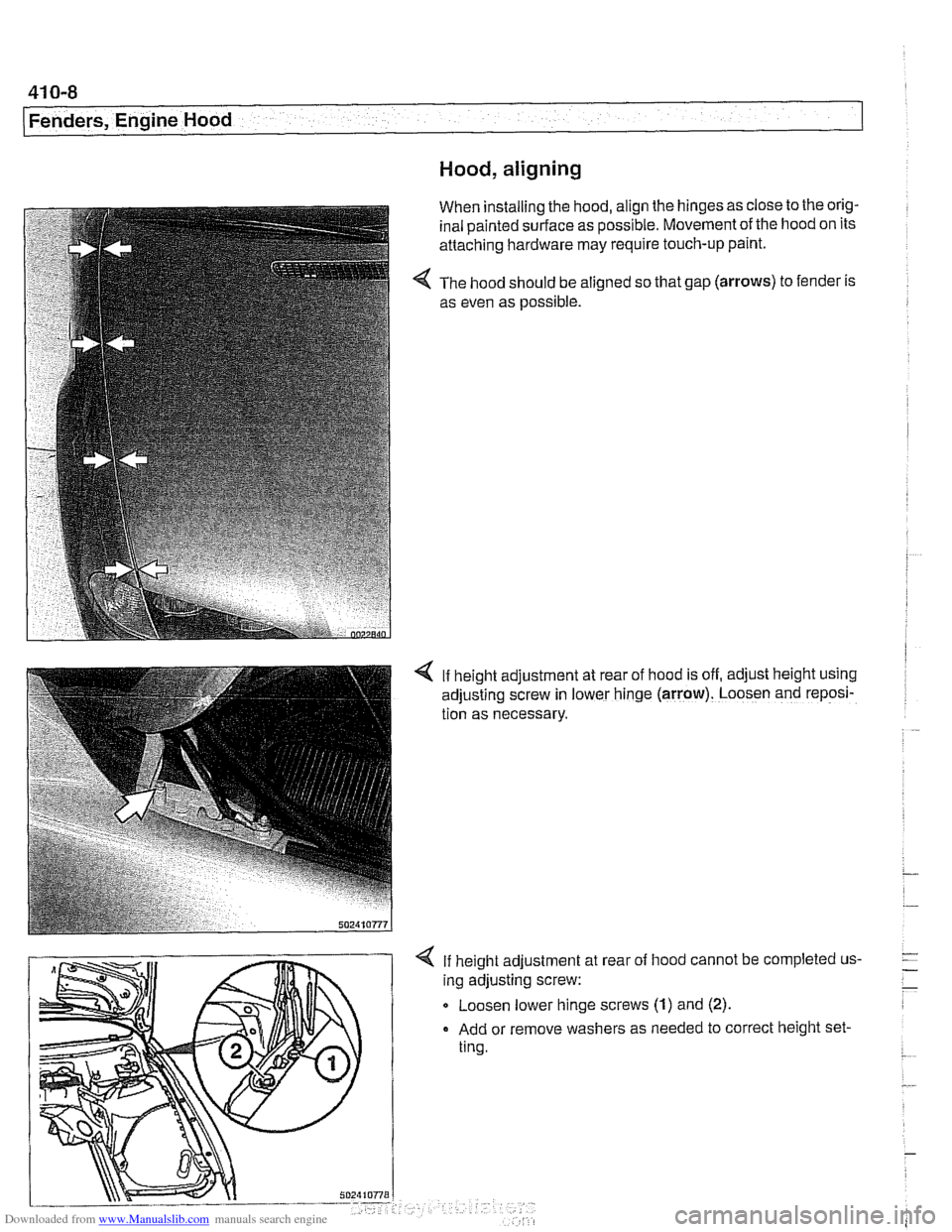
Hood, aligning
When installing the hood, align the hinges as close to the orig-
inal painted surface as possible. Movement of the hood on its
attaching hardware may require touch-up paint.
The hood should be aligned so that gap
(arrows) to fender is
as even as possible.
4 If height adjustment at rear of hood is off, adjust height using
adjusting screw in lower hinge
(arrow). Loosen and reposi-
tion as necessary.
If height adjustment at
ing adjusting screw: rear
of
hood cannot be completed us-
Q Loosen lower hinge screws (1) and (2).
Add or remove washers as needed to correct height set-
ting.