brake BMW M3 COUPE 2002 E46 Owner's Guide
[x] Cancel search | Manufacturer: BMW, Model Year: 2002, Model line: M3 COUPE, Model: BMW M3 COUPE 2002 E46Pages: 151, PDF Size: 2.14 MB
Page 102 of 151

102n
Brake system Brake fluid level Low brake fluid level in the reservoir
combined with longer than usual pedal
travel may indicate a defect in one of
the brake system's hydraulic circuits.
Proceed to the nearest BMW
center. Higher brake application
pressure may be necessary when stop-
ping, and the vehicle may exhibit a
slight tendency to pull to one side.
Brake distances may even be longer.
Please remember to adapt your driving
style accordingly.<
Disc brakesWhen the vehicle is driven only occa-
sionally, during extended periods when
the vehicle is not used at all, and in
operating conditions where brake appli-
cations are less frequent, there is an
increased tendency for corrosion of the
rotors and accumulation of contamina-
tion on the brake pads. This occurs
because the minimal pressure that must
be exerted by the pads to clean the
rotors by brake applications is not
reached.
Corrosion on brake rotors is signaled by
a pulsation during braking; even
extended subsequent braking will not
cure this phenomenon.
It is a good idea to periodically dry the
brakes with a gentle brake application
when driving in rain and on wet roads.
Monitor traffic conditions to ensure that
this maneuver does not endanger other
road users. The heat generated in this
process helps dry the pads and rotors
to ensure that your brake system will
respond with undiminished efficiency
when you need it.Extended or steep mountain descents
should be driven in the gear in which
only minimal periodic brake applica-
tions are required. This helps avoid
placing excessive loads on the brake
system. Stay within the allowable rpm
range. For additional information, refer
to page 70.
Do not coast with the clutch
depressed or with the gearshift
lever in idle. Do not coast with the
engine switched off. If you do so the
engine provides no braking effect and
there is no power assist for braking or
steering when the engine is not
running.<
Brake pads
For your own safety: Use only
brake pads which BMW has
approved for your specific vehicle
model. BMW cannot evaluate non-
approved brake pads to determine if
they are suited for use, and therefore
cannot ensure the operating safety of
the vehicle if they are installed.<
Page 108 of 151
108n
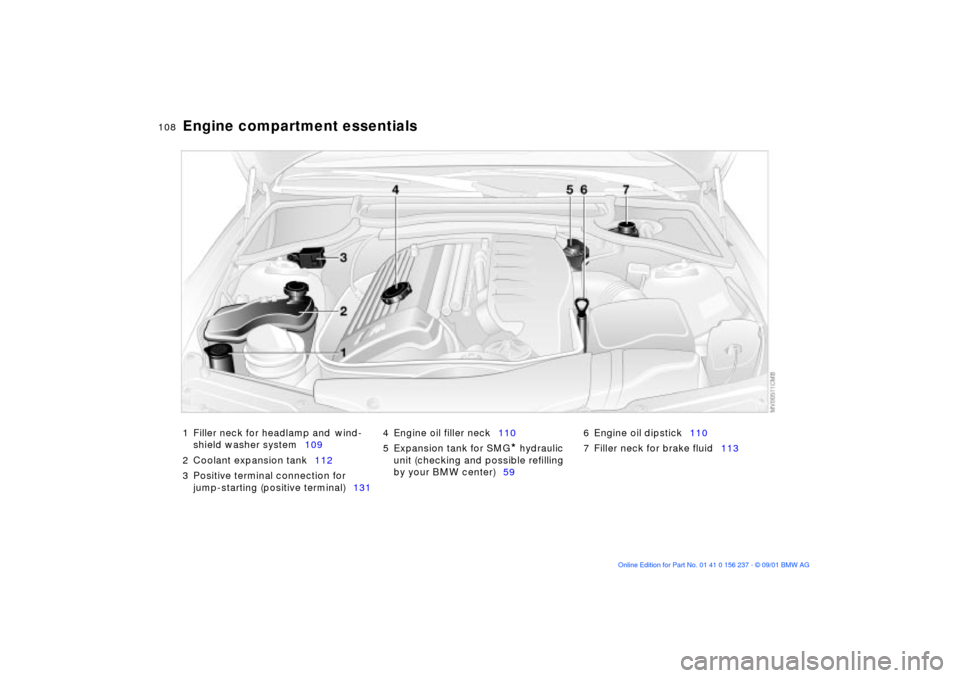
Engine compartment essentials1 Filler neck for headlamp and
wind-
shield washer system109
2 Coolant expansion tank112
3 Positive terminal connection for
jump-starting (positive terminal)131 4 Engine oil filler neck110
5 Expansion tank for SMG
* hydraulic
unit (checking and possible refilling
by your BMW center)596 Engine oil dipstick110
7 Filler neck for brake fluid113
Page 113 of 151
113n
OverviewControlsMaintenanceRepairsDataIndex
Brake fluid
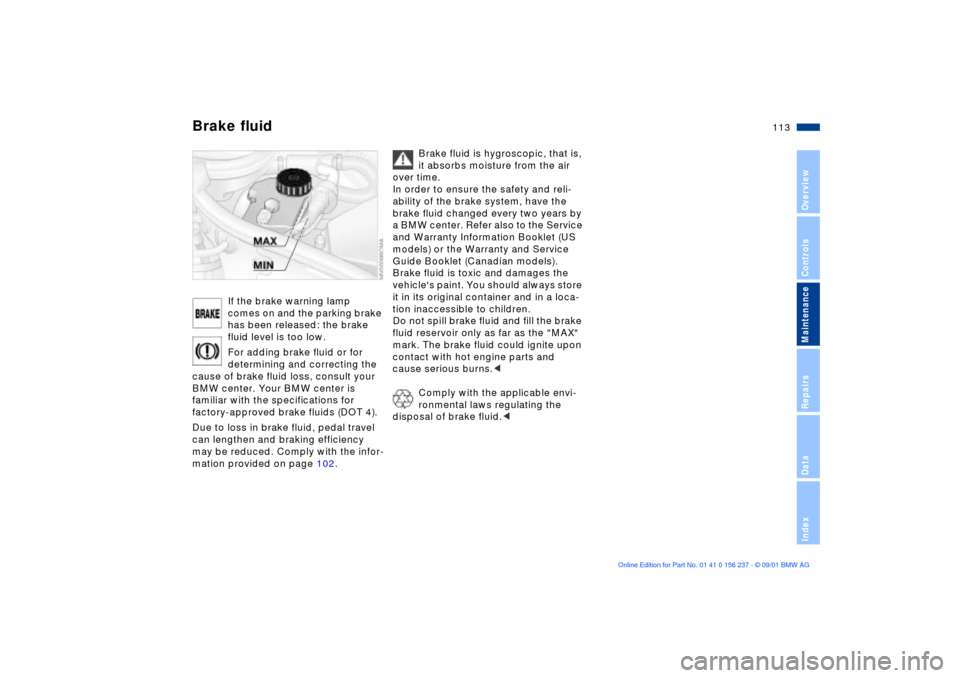
If the brake warning lamp
comes on and the parking brake
has been released: the brake
fluid level is too low.
For adding brake fluid or for
determining and correcting the
cause of brake fluid loss, consult your
BMW center. Your BMW center is
familiar with the specifications for
factory-approved brake fluids (DOT 4).
Due to loss in brake fluid, pedal travel
can lengthen and braking efficiency
may be reduced. Comply with the infor-
mation provided on page 102.
Brake fluid is hygroscopic, that is,
it absorbs moisture from the air
over time.
In order to ensure the safety and reli-
ability of the brake system, have the
brake fluid changed every two years by
a BMW center. Refer also to the Service
and Warranty Information Booklet (US
models) or the Warranty and Service
Guide Booklet (Canadian models).
Brake fluid is toxic and damages the
vehicle's paint. You should always store
it in its original container and in a loca-
tion inaccessible to children.
Do not spill brake fluid and fill the brake
fluid reservoir only as far as the "MAX"
mark. The brake fluid could ignite upon
contact with hot engine parts and
cause serious burns.<
Comply with the applicable envi-
ronmental laws regulating the
disposal of brake fluid.<
Page 123 of 151
123n
OverviewControlsMaintenanceRepairsDataIndex
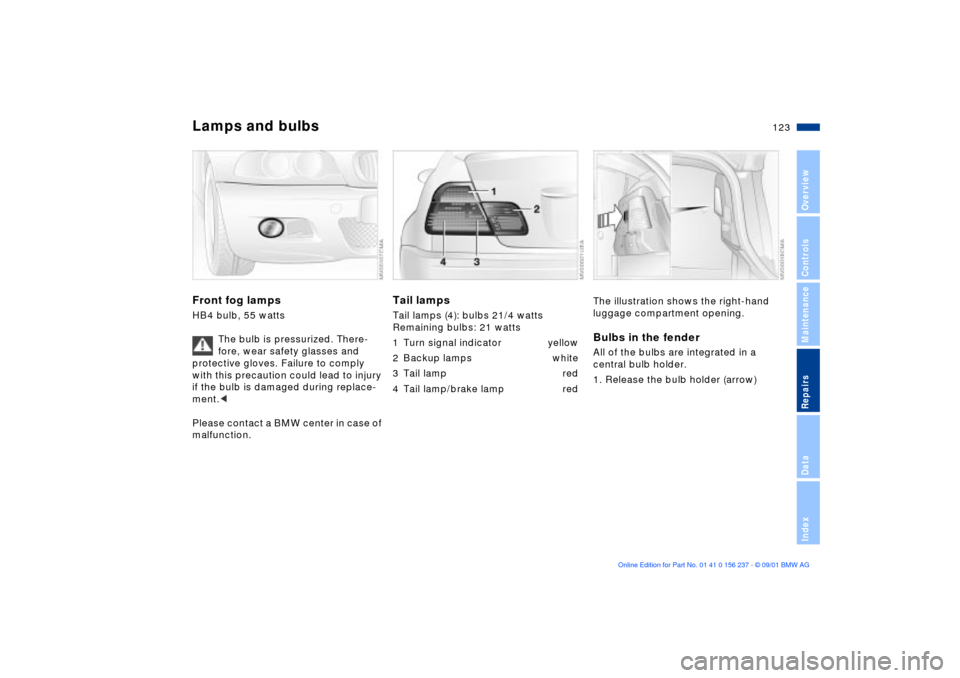
Lamps and bulbsFront fog lamps HB4 bulb, 55 watts
The bulb is pressurized. There-
fore, wear safety glasses and
protective gloves. Failure to comply
with this precaution could lead to injury
if the bulb is damaged during replace-
ment.<
Please contact a BMW center in case of
malfunction.
Tail lampsTail lamps (4): bulbs 21/4 watts
Remaining bulbs: 21 watts
1 Turn signal indicator yellow
2 Backup lamps white
3 Tail lamp red
4 Tail lamp/brake lamp red
The illustration shows the right-hand
luggage compartment opening.Bulbs in the fenderAll of the bulbs are integrated in a
central bulb holder.
1. Release the bulb holder (arrow)
Page 125 of 151
125n
OverviewControlsMaintenanceRepairsDataIndex
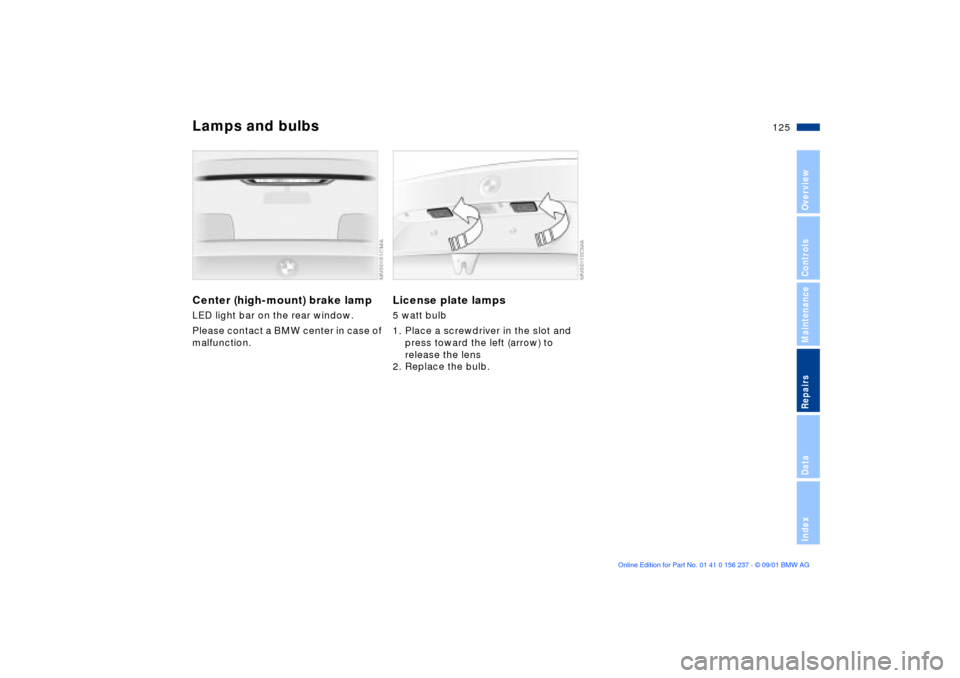
Lamps and bulbsCenter (high-mount) brake lamp
LED light bar on the rear window.
Please contact a BMW center in case of
malfunction.
License plate lamps 5 watt bulb
1. Place a screwdriver in the slot and
press toward the left (arrow) to
release the lens
2. Replace the bulb.
Page 126 of 151
126n
Repairing a flat tire
Precautions in case of a flat tire:
Stop the vehicle as far as possible
from passing traffic; switch on the
hazard warning flashers.
Turn the steering wheel to the straight-
ahead position and engage the steering
lock. Shift into 1st or reverse and
engage the parking brake.
All passengers should be outside the
vehicle and well away from your imme-
diate working area (behind a guardrail,
for instance).
If a warning triangle or portable hazard
warning lamp is available, set it up on
the roadside at an appropriate distance
from the rear of the vehicle.
Comply with all safety guidelines and
regulations.<
M Mobility systemWith the BMW M3, you will find an M
Mobility system for fixing flat tires. With
the aid of this system, you can apply a
liquid sealant to the inside of the tire,
thereby sealing off the damaged area,
and then continue driving.
The M Mobility system makes trans-
porting a spare wheel superfluous,
thereby reducing the amount of weight
you have to carry around. Using the M Mobility systemTo repair a flat tire using the M Mobility
system, proceed as follows:
>Prepare the M Mobility system for
use, refer to the next column
>This is part of the M Mobility system,
refer to page 127
>Filling with sealant, refer to page 127
>Distributing sealant, refer to
page 128
>Inflating tire to correct pressure, refer
to page 129.
Preparing the M Mobility system
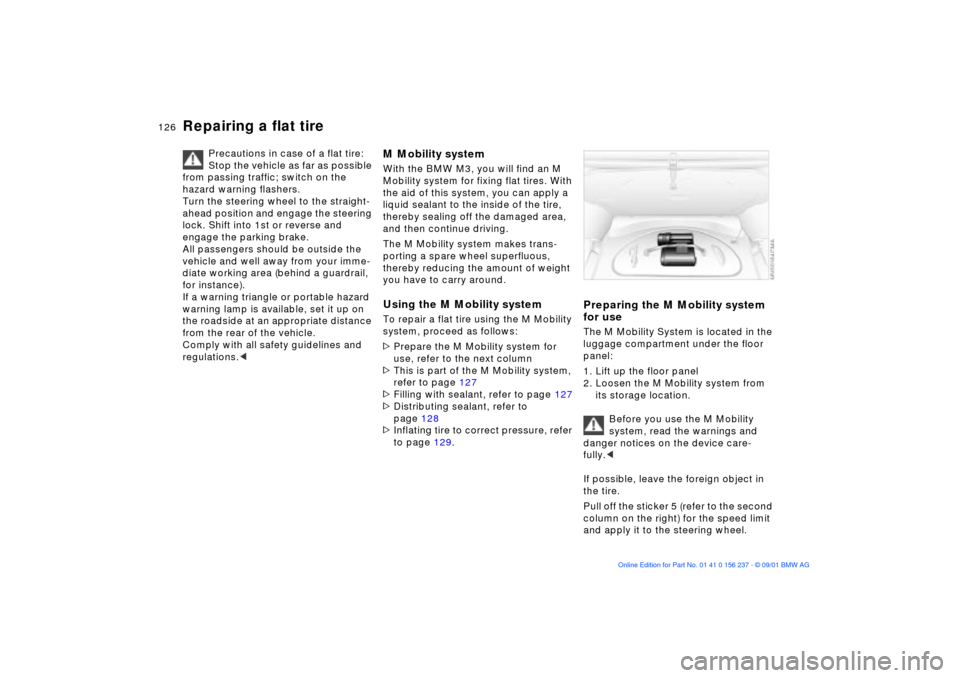
for useThe M Mobility System is located in the
luggage compartment under the floor
panel:
1. Lift up the floor panel
2. Loosen the M Mobility system from
its storage location.
Before you use the M Mobility
system, read the warnings and
danger notices on the device care-
fully.<
If possible, leave the foreign object in
the tire.
Pull off the sticker 5 (refer to the second
column on the right) for the speed limit
and apply it to the steering wheel.
Page 133 of 151
133n
OverviewControlsMaintenanceRepairsDataIndex
Towing the vehicleTowing a vehicle1. Shift lever in Neutral
2. Towing speed:
Max. 45 mph (70 km/h)
3. Towing distance:
Max. 95 miles (150 km)
4. Leave the ignition key at position 1 to
ensure that the brake lamps, turn
signal indicators, horn and wind-
shield wipers remain operative, and
to prevent the steering lock detent
from engaging
5. Switch on the hazard-warning
system (observe applicable legal
regulations).
Find some means of identifying the
vehicle in tow, for instance, place a sign
or warning triangle in the rear window.
Make sure that the ignition key
remains in position 1 even when
the electrical system has failed to
prevent the steering lock from
engaging.
The steering and brakes are without
power assist when the engine is off.
This means that increased effort is
required for steering and braking.c
Vehicles with sequential M gearbox
*
SMG II:
To push or tow, engage selector lever
in position 0.
Never work on the vehicle with a
driving position engaged.c
Towing with a commercial tow
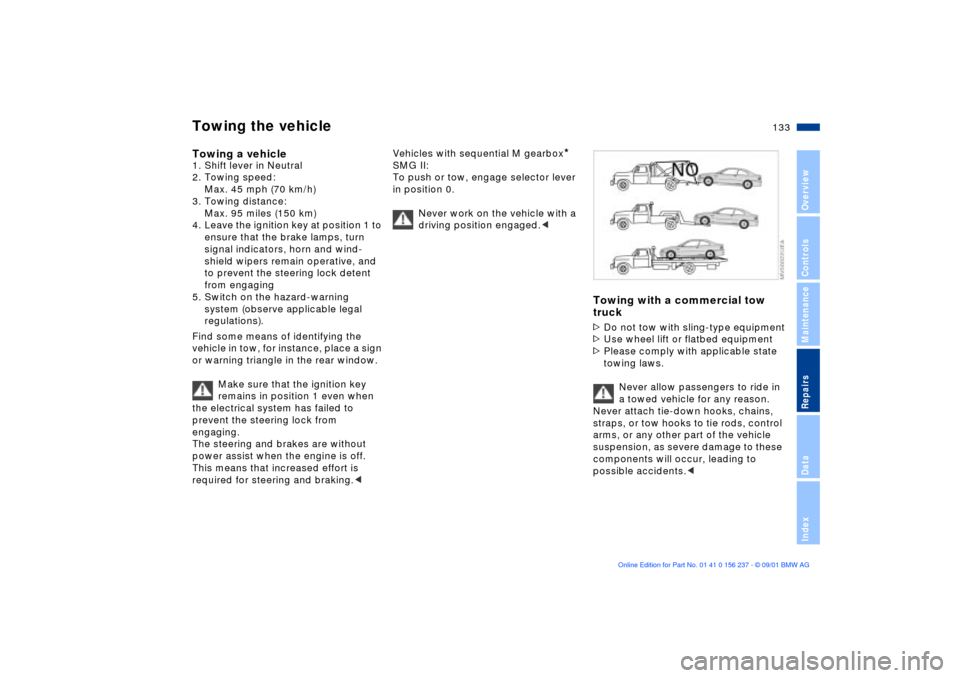
truck>Do not tow with sling-type equipment
>Use wheel lift or flatbed equipment
>Please comply with applicable state
towing laws.
Never allow passengers to ride in
a towed vehicle for any reason.
Never attach tie-down hooks, chains,
straps, or tow hooks to tie rods, control
arms, or any other part of the vehicle
suspension, as severe damage to these
components will occur, leading to
possible accidents.c
Page 143 of 151

Everything from A to Z
143n
OverviewControlsMaintenanceRepairsDataIndex
Caring for headlamp covers,
refer to the "Caring for your
vehicle" manual
Caring for your vehicle's
paintwork, refer to the
"Caring for your vehicle"
manual
CBC (Cornering Brake
Control)101
warning lamp18
Cellular phone92
refer also to the separate
Owner's Manual
Center (high-mount) brake
lamp125
Center armrest91
Central locking system28
key33
Check Control72
Checking
engine coolant112t
engine oil level110t
tire inflation
pressures24t
Child seat security54
Child-restraint systems52
Cigarette lighter93
Clean the headlamps67 Clean the windshield67
Clock72
also refer to the "Radio
Owner's Manual"
Clothes hooks93
Cockpit14
Coin box91
Combination switch65
Compression136
Computer72
refer also to the "Onboard
Computer Owner's
Manual"
Configuring individual
settings with Vehicle and
Key Memory55
Connecting car vacuum
cleaner93
Consumption74
Consumption display71
Control elements14
Coolant112
Coolant system,
capacity139
Coolant temperature
gauge71
Copyright4 Cornering Brake Control
(CBC)101
warning lamp18
Cover, sun blinds89
Cruise control68
Cruising range74
Curb weight138
D
Data
dimensions137
engine136
technical136
weights138
Daytime driving lamps80
DBC (Dynamic Brake
Control)77
Deep water101
Defrostable rear window88
Defroster, rear window84
Defrosting windows87
Dimensions137
Dipstick, engine oil110
Disc brakes102
Displacement136
Display lighting81
Distance warning75
Divided rear backrest94
Door key28 Doors
electrical
malfunction29t
manual operation29t
operating manually29
remote control30
unlocking and
locking29, 30
Draft-free ventilation85, 88
Driving notes
aquaplaning101
brakes101
DSC (Dynamic Stability
Control)76
indicator lamp19
Dynamic Brake Control
(DBC)77
Dynamic Stability Control
(DSC)76
indicator lamp19
E
Electric power windows39
Electrical malfunction
doors29t
fuel filler door22t
luggage compartment
lid34
sliding/tilt sunroof41t
Page 144 of 151

Everything from A to ZEmergency release of
luggage compartment lid
from luggage
compartment's interior36
Engine
displacement136
starting56t
torque136
Engine compartment
essentials108
Engine coolant112
add112t
checking112t
Engine cooling system,
capacity139
Engine data136
Engine oil
adding110t
capacity139
consumption110
for low ambient
temperatures111
level, checking110t
level, indicator lamp17
pressure17
pressure, indicator
lamp17
quality111 specifications111
thermometer70
viscosity111
Engine speed136
Entry to the rear45
Exterior mirrors48
F
Failure messages72
Filling capacities139
Filling the washer
reservoir109t
First-aid kit22
Flat tire103
repairing126
Flat Tire Monitor77
indicator lamp17, 19
Fog lamps82
bulb replacement123t
Folding rear backrest94
Follow me home lamps80
Footbrake102
Footwell lamps82
Front seat adjusting42
Frost protection,
radiator112
Fuel24
Fuel consumption74 Fuel consumption
display71
Fuel filler door22
electrical
malfunction22t
manual operation22t
Fuel gauge71
Fuel quality24
Fuel reserve indicator
lamp71
Fuel tank capacity139
Fuel tank gauge71
G
Gasoline24
Gasoline gauge71
Gearshift lever58
Glove compartment90
Gross vehicle weight138 H
Handbrake58
Hands-free system92
Hazard warning triangle22
Head restraints44
adjusting44 Headlamp cleaning
system108
Headlamp control80
Headlamp flasher81
Headlamp washer
system139
Heated seats47
Heavy loads96
Height137
HiFi system90
High beams65, 81
indicator lamps20
Holder for beverages91
Hood release107t
Horn14
I
Ice warning73
Identification, tires105
Ignition key28
Ignition key positions56
Ignition lock56
Imprint4
Indicator lamps17
Individual settings with
Vehicle and Key
Memory55
Inflation pressure,
tires24, 103
Page 146 of 151

Everything from A to ZOil change intervals, see the
Service and Warranty
Information Booklet (US
models) or the Warranty
and Service Guide Booklet
(Canadian models).
Oil consumption110
Oil filter change139
Oil level, indicator lamp19
OILSERVICE71
Onboard computer72
refer to the "Onboard
Computer Owner's
Manual"
Onboard tool kit120
Opening and closing
from inside33
via remote control30
via the door lock29
Operating vehicle at low
ambient
temperatures111
Outside temperature
display73
P
Park Distance Control
(PDC)75
Parking brake58
Parking help75
Parking lamps80
PDC (Park Distance
Control)75
Performance136
Pollen filter85, 89
Power windows39 R
Radiator139
Radio navigation system,
refer to the "Radio Owner's
Manual"
Radio, refer to the separate
Owner's Manual
Rain sensor66
Reading lamps82
Rear backrest, folding94
Rear lamps, refer to tail
lamps123t
Rear view mirror48
Rear window
defroster84, 88
Rear-entry assist45 Recirculated-air
mode84, 88
Reclining seat42
Refueling22
Releasing
fuel filler door following an
electrical
malfunction22t
Remote control30
Removing condensation
from the windows87
Repairing a flat tire126
Replace windshield wiper
blades120t
Replacement key28t
Replacing bulbs120t
Reporting safety defects11
Roller sun blind89
Roof load capacity138
Roof-mounted luggage
rack97
S
Safety belts45
height adjustment45
three-point safety belt94
Safety buttons33
Safety feature39
Seat heating47
Seat memory46
Seats, adjusting42
Securing cargo96
Securing loads96
Self-defrosting mirrors48
Sequential M gearbox SMG
II59
Service and Warranty
Information Booklet114
Service Interval
Display71, 114
Side airbags49
Side impact Head Protection
System49
Side turn signals
bulb replacement122t
Ski bag95