wheel BMW M4 2016 Workshop Manual
[x] Cancel search | Manufacturer: BMW, Model Year: 2016, Model line: M4, Model: BMW M4 2016Pages: 228, PDF Size: 4.88 MB
Page 176 of 228
Tyre sizes
The pressure values apply for the tyre sizes
categorised by the vehicle manufacturer as
suitable and the tyre makes recommended for
the respective vehicle type.
More information regarding wheels and tyres
can be enquired with a Service Partner or a
qualified specialist workshop.
Tyre tread
Summer tyres
The tyre tread depth should not be less than
3 mm, 0.12 in.
Below a tread depth of 3 mm, approximately
0.12 in, there is a high risk of aquaplaning.
Winter tyres The tyre tread depth should not be less than4 mm, approximately 0.16 in.
Below a tread depth of 4 mm, approximately
0.16 in, suitability for vehicle operation in win‐
ter is restricted.
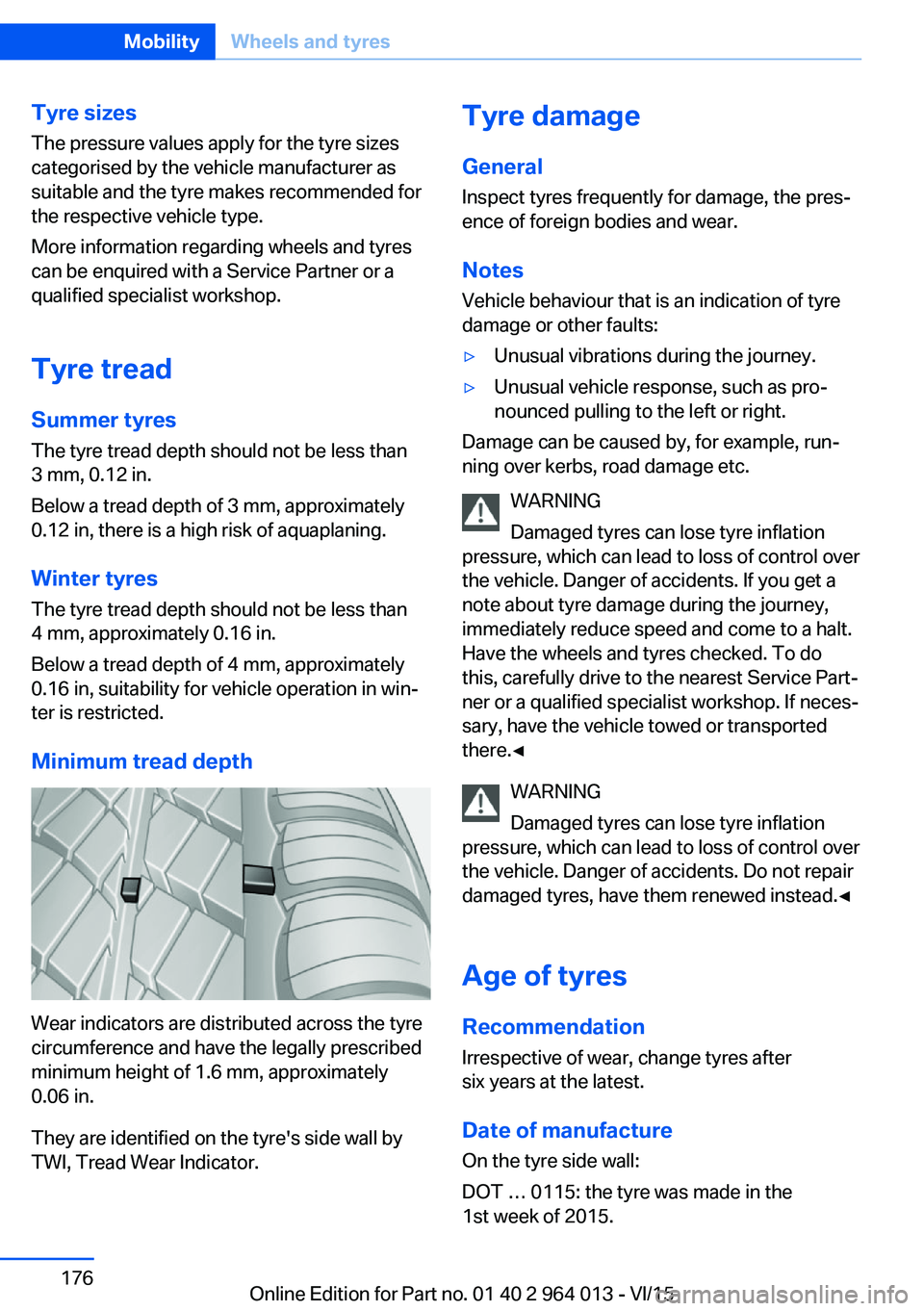
Minimum tread depth
Wear indicators are distributed across the tyre
circumference and have the legally prescribed
minimum height of 1.6 mm, approximately
0.06 in.
They are identified on the tyre's side wall by
TWI, Tread Wear Indicator.
Tyre damage
General Inspect tyres frequently for damage, the pres‐
ence of foreign bodies and wear.
Notes
Vehicle behaviour that is an indication of tyre
damage or other faults:▷Unusual vibrations during the journey.▷Unusual vehicle response, such as pro‐
nounced pulling to the left or right.
Damage can be caused by, for example, run‐
ning over kerbs, road damage etc.
WARNING
Damaged tyres can lose tyre inflation
pressure, which can lead to loss of control over
the vehicle. Danger of accidents. If you get a
note about tyre damage during the journey,
immediately reduce speed and come to a halt.
Have the wheels and tyres checked. To do
this, carefully drive to the nearest Service Part‐
ner or a qualified specialist workshop. If neces‐
sary, have the vehicle towed or transported
there.◀
WARNING
Damaged tyres can lose tyre inflation
pressure, which can lead to loss of control over
the vehicle. Danger of accidents. Do not repair
damaged tyres, have them renewed instead.◀
Age of tyres
Recommendation
Irrespective of wear, change tyres after
six years at the latest.
Date of manufacture
On the tyre side wall:
DOT … 0115: the tyre was made in the
1st week of 2015.
Seite 176MobilityWheels and tyres176
Online Edition for Part no. 01 40 2 964 013 - VI/15
Page 177 of 228
Replacement of wheels and
tyres
Fitting Have fitting and balancing performed by a
Service Partner or a qualified specialist work‐
shop.
Wheel and tyre combination The correct wheel and tyre combination and
rim designs for the vehicle can be consulted at
a Service Partner or a qualified specialist work‐
shop.
Incorrect wheel and tyre combinations will in‐
terfere with the proper functioning of various
systems, such as ABS and DSC.
To maintain good vehicle handling, always fit
tyres of the same make and tread pattern to all
wheels.
After a tyre has been damaged, fit the original
wheel and tyre combination again.
WARNING
Wheels and tyres that are categorised as
unsuitable by the vehicle manufacturer can
damage parts of the vehicle, for example by
touching the bodywork as a result of toleran‐
ces, in spite of having the same nominal size.
Danger of accidents. Use wheels and tyres that
have been categorised as suitable for the re‐
spective vehicle type by the vehicle manufac‐
turer.◀Recommended makes of tyre
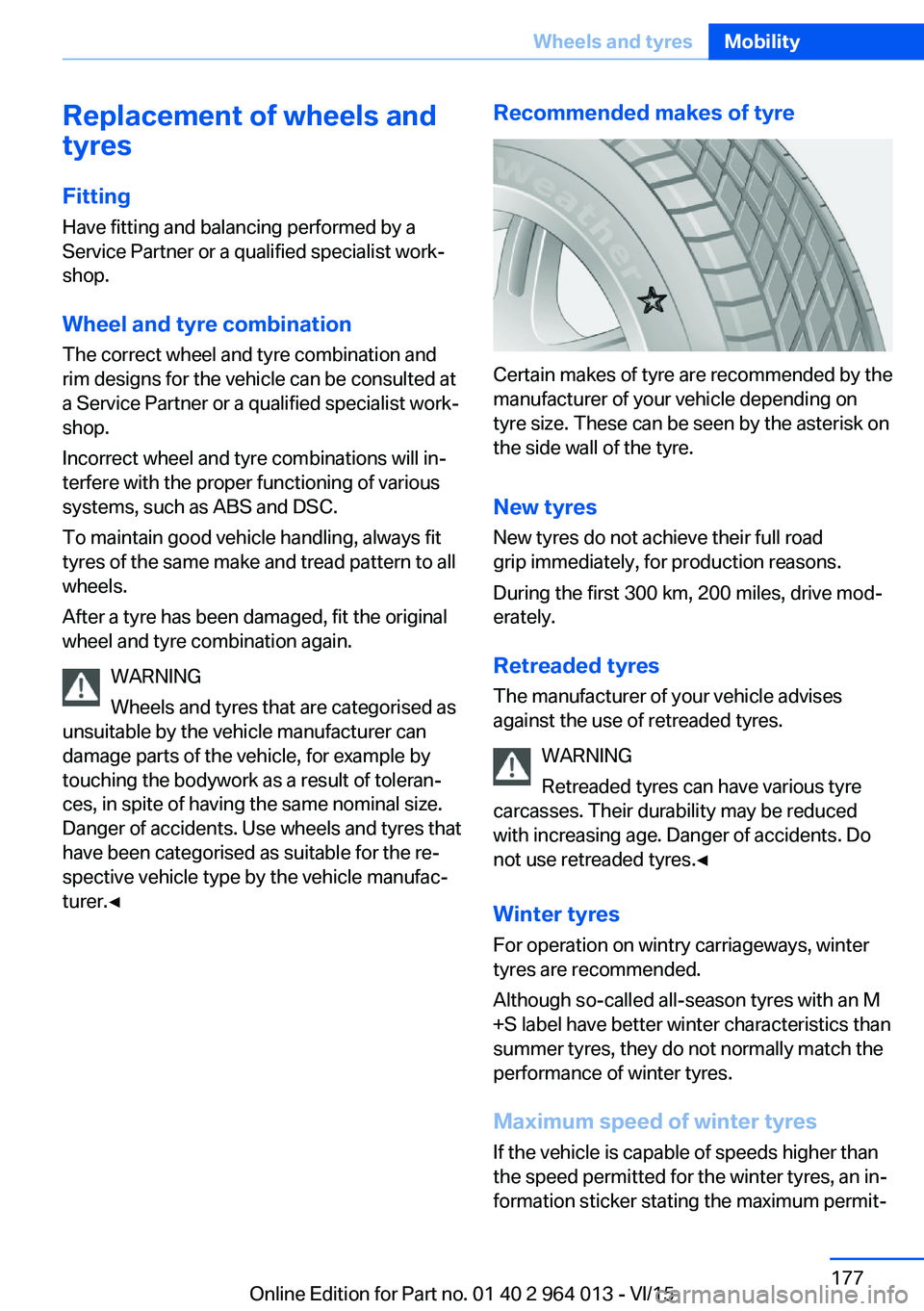
Certain makes of tyre are recommended by the
manufacturer of your vehicle depending on
tyre size. These can be seen by the asterisk on
the side wall of the tyre.
New tyres New tyres do not achieve their full road
grip immediately, for production reasons.
During the first 300 km, 200 miles, drive mod‐
erately.
Retreaded tyres The manufacturer of your vehicle advises
against the use of retreaded tyres.
WARNING
Retreaded tyres can have various tyre
carcasses. Their durability may be reduced
with increasing age. Danger of accidents. Do
not use retreaded tyres.◀
Winter tyres For operation on wintry carriageways, winter
tyres are recommended.
Although so-called all-season tyres with an M
+S label have better winter characteristics than
summer tyres, they do not normally match the
performance of winter tyres.
Maximum speed of winter tyres
If the vehicle is capable of speeds higher than
the speed permitted for the winter tyres, an in‐
formation sticker stating the maximum permit‐
Seite 177Wheels and tyresMobility177
Online Edition for Part no. 01 40 2 964 013 - VI/15
Page 178 of 228
ted speed for the tyres fitted must be dis‐
played in the driver's field of view. The sticker
is available from a Service Partner or a qualified
specialist workshop.
If winter tyres are fitted, observe and comply
with the respectively permitted maximum
speed.
Interchanging front and rear wheels
The manufacturer of your vehicle advises
against interchanging the front and rear
wheels. This could impair vehicle handling
Such a change is not permitted in vehicles with
different tyre or rim dimensions on the front
and rear axles.
Tyre storage
Store wheels and tyres in a cool, dry and pref‐
erably dark place when not in use.
Protect tyres against contamination from oil,
grease and fuel.
Do not exceed the maximum tyre pressure in‐
dicated on the tyre's side wall.
Remedying flat tyres Safety measures▷Park the vehicle on a solid surface and as
far away from moving traffic as possible.▷Switch on hazard warning lights.▷Protect the vehicle against rolling, by ap‐
plying the parking brake.▷Engage the steering wheel lock in the
straight ahead position of the wheels.▷Allow all vehicle occupants get out of the
vehicle and guide them out of the danger
area, for example behind the crash barrier.▷Set up warning triangle an appropriate dis‐
tance away.Mobility system
Principle With the mobility system, minor tyre damage
can be quickly sealed, to allow you to drive on.
To do that, liquid sealant is pumped into the
tyres which encloses the damage from the in‐ side when it hardens.
The compressor can be used to check the tyre
inflation pressure.
Notes▷Please observe the notes on the applica‐
tion of the Mobility system which are on
the compressor and the sealant container.▷Applying the Mobility system can be inef‐
fective for tyre damage as from a size of
approximately 4 mm.▷Contact a Service Partner or a qualified
specialist workshop if you are unable to put
the tyre back in operation.▷If possible, foreign matter that has penetra‐
ted the tyre should remain inside the tyre.▷Remove the speed limit sticker from the
sealant container and attach to the steer‐
ing wheel.▷Using sealants can damage the TPM wheel
electronics. If sealant is used, check the
electronics as soon as you get an opportu‐
nity and have them replaced if necessary.
DANGER
A blocked exhaust pipe or inadequate
ventilation can allow harmful exhaust fumes to
penetrate the vehicle. The exhaust gas con‐
tains carbon monoxide, which is colourless and
odourless, but highly toxic. In enclosed spaces,
the exhaust fumes can also build up outside
the vehicle. Danger of fatal injury. Keep the ex‐
haust pipe clear and ensure sufficient ventila‐
tion.◀
Storage
Mobility system is located under boot floor.
Seite 178MobilityWheels and tyres178
Online Edition for Part no. 01 40 2 964 013 - VI/15
Page 179 of 228
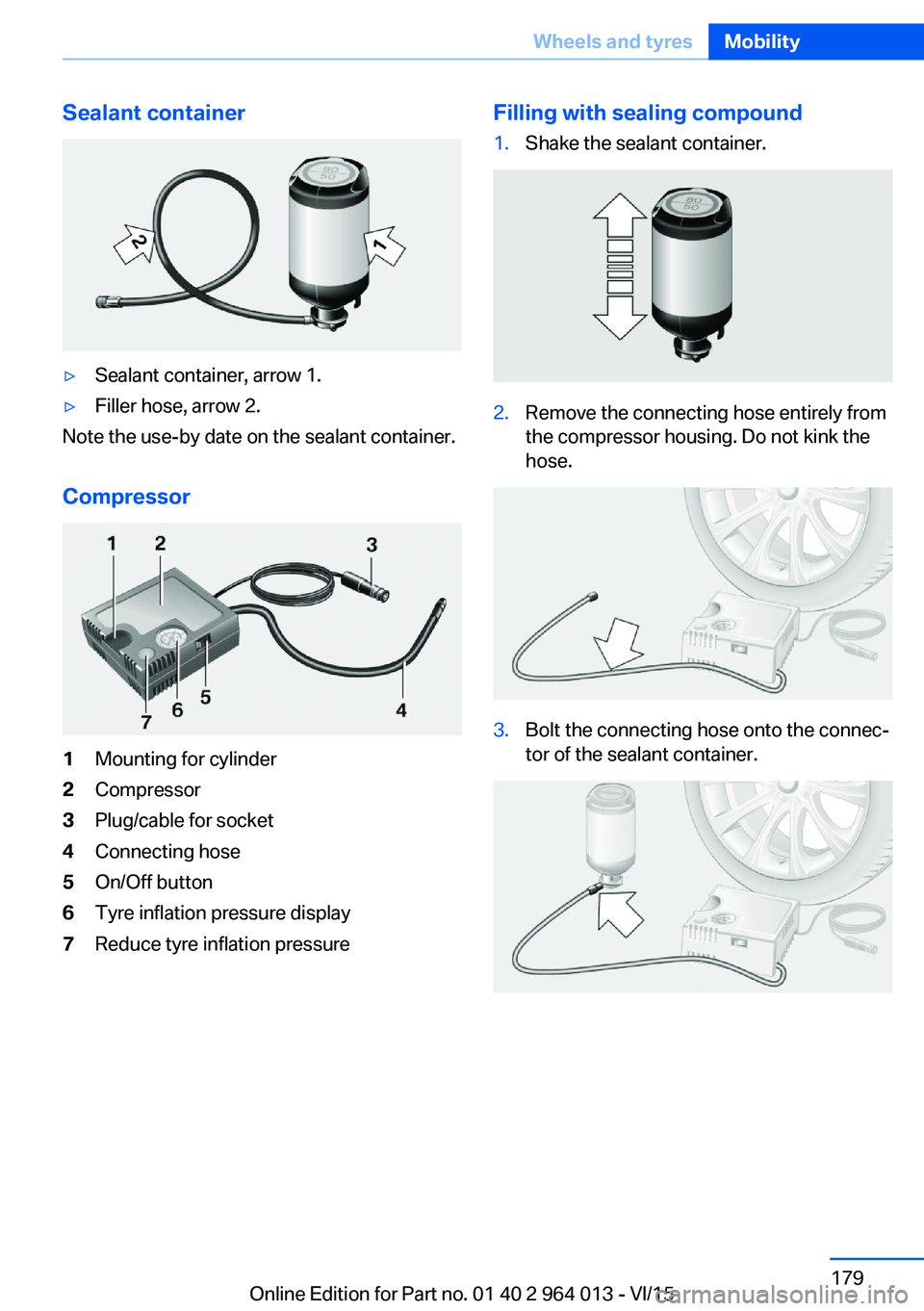
Sealant container▷Sealant container, arrow 1.▷Filler hose, arrow 2.
Note the use-by date on the sealant container.
Compressor
1Mounting for cylinder2Compressor3Plug/cable for socket4Connecting hose5On/Off button6Tyre inflation pressure display7Reduce tyre inflation pressureFilling with sealing compound1.Shake the sealant container.2.Remove the connecting hose entirely from
the compressor housing. Do not kink the
hose.3.Bolt the connecting hose onto the connec‐
tor of the sealant container.Seite 179Wheels and tyresMobility179
Online Edition for Part no. 01 40 2 964 013 - VI/15
Page 180 of 228
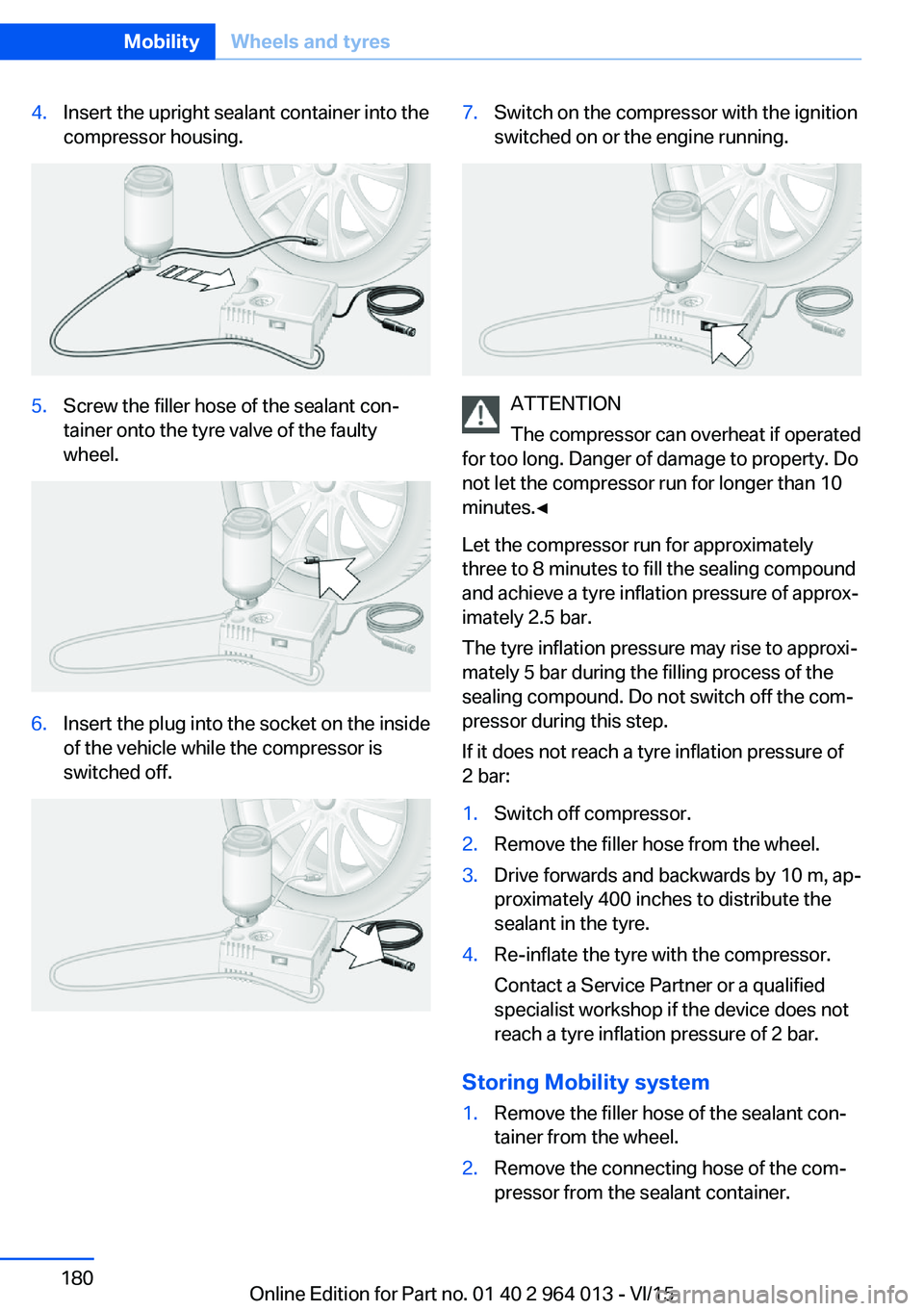
4.Insert the upright sealant container into the
compressor housing.5.Screw the filler hose of the sealant con‐
tainer onto the tyre valve of the faulty
wheel.6.Insert the plug into the socket on the inside
of the vehicle while the compressor is
switched off.7.Switch on the compressor with the ignition
switched on or the engine running.
ATTENTION
The compressor can overheat if operated
for too long. Danger of damage to property. Do
not let the compressor run for longer than 10
minutes.◀
Let the compressor run for approximately
three to 8 minutes to fill the sealing compound
and achieve a tyre inflation pressure of approx‐
imately 2.5 bar.
The tyre inflation pressure may rise to approxi‐
mately 5 bar during the filling process of the
sealing compound. Do not switch off the com‐
pressor during this step.
If it does not reach a tyre inflation pressure of
2 bar:
1.Switch off compressor.2.Remove the filler hose from the wheel.3.Drive forwards and backwards by 10 m, ap‐
proximately 400 inches to distribute the
sealant in the tyre.4.Re-inflate the tyre with the compressor.
Contact a Service Partner or a qualified
specialist workshop if the device does not
reach a tyre inflation pressure of 2 bar.
Storing Mobility system
1.Remove the filler hose of the sealant con‐
tainer from the wheel.2.Remove the connecting hose of the com‐
pressor from the sealant container.Seite 180MobilityWheels and tyres180
Online Edition for Part no. 01 40 2 964 013 - VI/15
Page 181 of 228
3.Take the filler hose of the sealant container
that was previously connected to the tyre
valve and connect it to the free connection
on the sealant container.
This can prevent sealant residues from es‐
caping from the container.4.Pack empty sealant container to avoid soil‐
ing in the boot.5.Store Mobility system in the vehicle again.
Spreading sealant compound
Immediately drive for approximately
10 km/5 mi to evenly distribute the sealing
compound in the tyre.
Do not exceed a speed of 80 km/h/50 mph.
If possible, do not drive slower than
20 km/h/12 mph.
Correcting the tyre inflation pressure
1.Stop in a suitable area.2.Bolt the connecting hose of the compres‐
sor directly onto the tyre valve.3.Insert the plug into the socket on the inside
of the vehicle.4.Correct tyre inflation pressure to 2.5 bar.▷Increase pressure: switch on the com‐
pressor with the engine running or the
ignition switched on.▷Reduce pressure: press the button on
the compressor.
Continuing with journey
Do not exceed maximum permitted speed of
80 km/h, approximately 50 mph.
Reinitialise runflat indicator.
Reinitialise Tyre Pressure Monitor.
Have the punctured tyre and the sealant con‐
tainer of the Mobility system replaced as soon
as possible.
Snow chains
Fine-link snow chains Only certain fine-link snow chains have been
tested, found safe for use in traffic, and cate‐
gorised as suitable by the manufacturer of your
vehicle.
Information regarding suitable snow chains is
available from a Service Partner or a qualified
specialist workshop.
Using Snow chains may only be used in pairs on the
rear wheels with tyres of the following sizes:▷255/40 R 18.▷255/35 R 19.
Observe the snow chain manufacturer's notes.
Ensure that the snow chains are always ade‐
quately taut. Re-tighten them if necessary in
accordance with the chain manufacturer's in‐
structions.
Do not initialise the runflat indicator with snow
chains fitted, as the instrument might other‐
wise issue an incorrect reading.
Do not initialise the Tyre Pressure Monitor with
snow chains fitted, as the instrument might
otherwise issue an incorrect reading.
When driving with snow chains, activate M Dy‐
namic Mode briefly if necessary.
Maximum speed with snow chains
When snow chains are fitted, do not exceed
50 km/h, 30 mph.
Seite 181Wheels and tyresMobility181
Online Edition for Part no. 01 40 2 964 013 - VI/15
Page 195 of 228
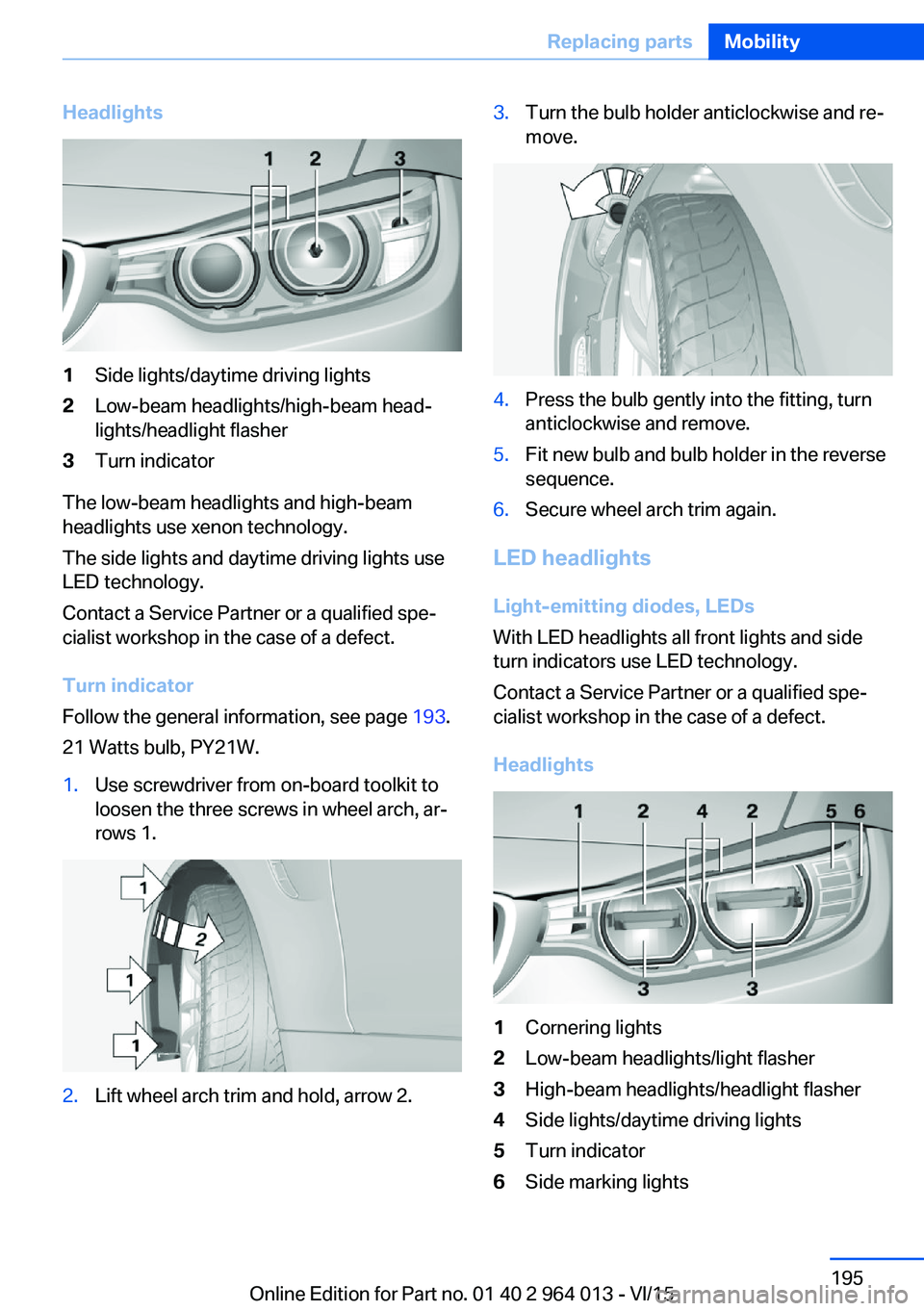
Headlights1Side lights/daytime driving lights2Low-beam headlights/high-beam head‐
lights/headlight flasher3Turn indicator
The low-beam headlights and high-beam
headlights use xenon technology.
The side lights and daytime driving lights use
LED technology.
Contact a Service Partner or a qualified spe‐
cialist workshop in the case of a defect.
Turn indicator
Follow the general information, see page 193.
21 Watts bulb, PY21W.
1.Use screwdriver from on-board toolkit to
loosen the three screws in wheel arch, ar‐
rows 1.2.Lift wheel arch trim and hold, arrow 2.3.Turn the bulb holder anticlockwise and re‐
move.4.Press the bulb gently into the fitting, turn
anticlockwise and remove.5.Fit new bulb and bulb holder in the reverse
sequence.6.Secure wheel arch trim again.
LED headlights
Light-emitting diodes, LEDs
With LED headlights all front lights and side
turn indicators use LED technology.
Contact a Service Partner or a qualified spe‐
cialist workshop in the case of a defect.
Headlights
1Cornering lights2Low-beam headlights/light flasher3High-beam headlights/headlight flasher4Side lights/daytime driving lights5Turn indicator6Side marking lightsSeite 195Replacing partsMobility195
Online Edition for Part no. 01 40 2 964 013 - VI/15
Page 199 of 228
5.Install the cable on the handle of the emer‐
gency release and engage the handle into
the fastening.6.Fit the bracket for the warning triangle.7.Attach the warning triangle.
Tail lights, number plate lights and
centre brake light
These lights use LED technology. Contact a
Service Partner or a qualified specialist work‐
shop in the case of a defect.
Changing a wheel
Notes
When using sealants, immediate wheel change
in the event of loss of tyre pressure in case of
puncture is not required.
As a result, no spare wheel is available.
The tools for changing wheels are available as
optional accessories from a Service Partner or
a qualified specialist workshop.
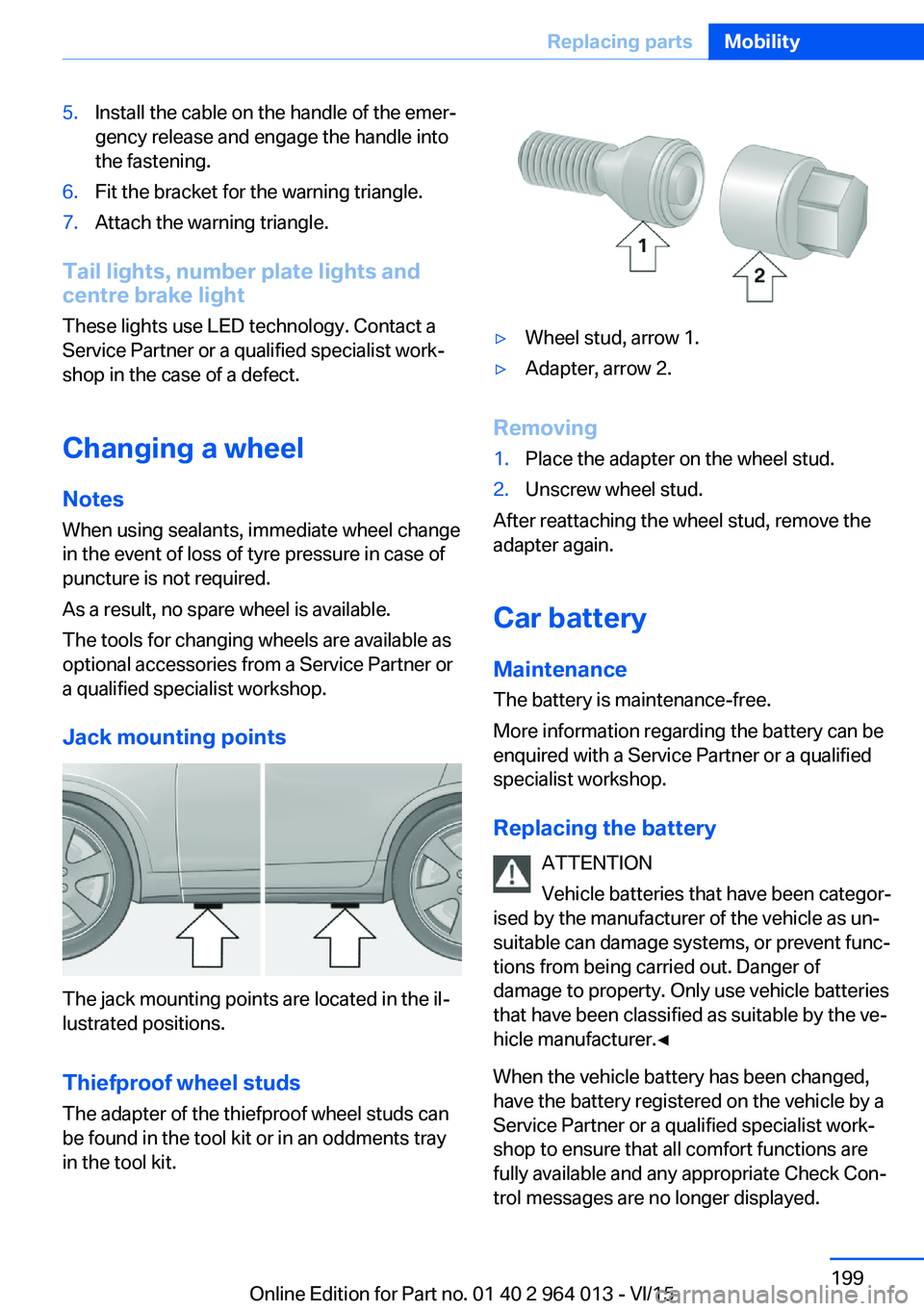
Jack mounting points
The jack mounting points are located in the il‐
lustrated positions.
Thiefproof wheel studs
The adapter of the thiefproof wheel studs can
be found in the tool kit or in an oddments tray
in the tool kit.
▷Wheel stud, arrow 1.▷Adapter, arrow 2.
Removing
1.Place the adapter on the wheel stud.2.Unscrew wheel stud.
After reattaching the wheel stud, remove the
adapter again.
Car battery Maintenance
The battery is maintenance-free.
More information regarding the battery can be
enquired with a Service Partner or a qualified
specialist workshop.
Replacing the battery ATTENTION
Vehicle batteries that have been categor‐
ised by the manufacturer of the vehicle as un‐
suitable can damage systems, or prevent func‐
tions from being carried out. Danger of
damage to property. Only use vehicle batteries
that have been classified as suitable by the ve‐
hicle manufacturer.◀
When the vehicle battery has been changed,
have the battery registered on the vehicle by a
Service Partner or a qualified specialist work‐
shop to ensure that all comfort functions are
fully available and any appropriate Check Con‐
trol messages are no longer displayed.
Seite 199Replacing partsMobility199
Online Edition for Part no. 01 40 2 964 013 - VI/15
Page 205 of 228
Systems, for example approach control warn‐
ing with light braking function. Danger of acci‐
dents. Switch off all Intelligent Safety Systems
before tow-starting/towing.◀
Manual gearboxGearshift lever in idle position.
Being towed Observe the following information:▷Make sure that the ignition is switched on,
otherwise low-beam headlights, rear lights,
turn indicators and wipers would not be
available.▷Do not tow the vehicle with the rear axle
raised, otherwise the steering can turn.▷When the engine is not running, there is no
power assistance and the brake servo is
out of action. The steering and brakes will
require extra effort to operate.▷Greater steering wheel movements are
necessary.▷The towing vehicle must not be lighter
than the towed vehicle, otherwise it may be
unable to keep the towed vehicle reliably
under control.▷Do not exceed a towing speed of on
50 km/h, 30 mph.▷Do not exceed a towing distance of 50 km,
30 miles.Towing truck
With driven rear axle
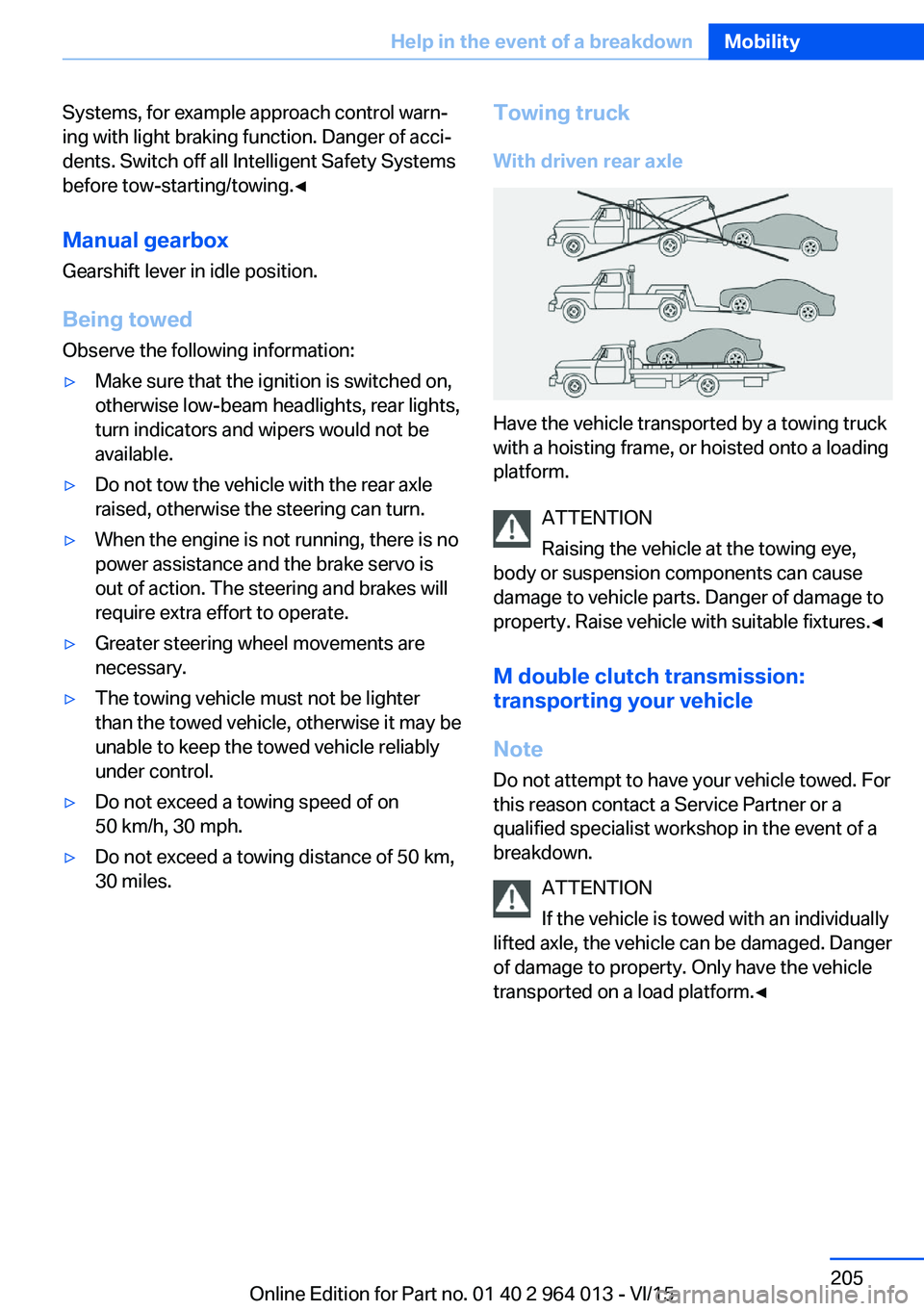
Have the vehicle transported by a towing truck
with a hoisting frame, or hoisted onto a loading
platform.
ATTENTION
Raising the vehicle at the towing eye,
body or suspension components can cause
damage to vehicle parts. Danger of damage to
property. Raise vehicle with suitable fixtures.◀
M double clutch transmission:
transporting your vehicle
Note
Do not attempt to have your vehicle towed. For
this reason contact a Service Partner or a
qualified specialist workshop in the event of a
breakdown.
ATTENTION
If the vehicle is towed with an individually
lifted axle, the vehicle can be damaged. Danger
of damage to property. Only have the vehicle
transported on a load platform.◀
Seite 205Help in the event of a breakdownMobility205
Online Edition for Part no. 01 40 2 964 013 - VI/15
Page 208 of 228
General careVehicle equipment
This chapter describes all standard, national
and special equipment provided in the model
series. Equipment not available in the vehicle is
therefore also described, for example the se‐
lected special equipment or national version.
This also applies to safety-relevant functions
and systems. Comply with the relevant na‐
tional regulations when using the correspond‐
ing functions and systems.
Washing the vehicle
General Regularly remove foreign bodied, for example,
leaves, with the bonnet opened in the area be‐
neath with windscreen.
Especially in winter, wash the car more fre‐
quently. Very high levels of dirt and spreading
salt can cause damage to the car.
Steam-jet cleaners and high-pressure
cleaners
Notes ATTENTION
When cleaning with high-pressure clean‐
ers, excessive pressure or excessive tempera‐
tures can damage various components. Dan‐
ger of damage to property. Ensure a sufficient
distance and do not spray for an extended pe‐
riod of time. Comply with the instructions for
the high-pressure cleaner.◀
Distances and temperature▷Maximum temperature: 60 ℃/140 ℉.▷Minimum distance to sensors, cameras,
seals: 30 cm, approx. 12 in.▷Minimum distance to the Glass Roof:
80 cm, approx. 31.5 in.
Automatic car washes.
Notes ATTENTION
Water can penetrate in the window area
due to high pressure washers. Danger of dam‐
age to property. Avoid high pressure wash‐
ers.◀
▷Textile car washes or systems using soft
brushes are preferable, to avoid damage to
the paintwork.▷Make sure the wheels and tyres are not
damaged by the conveying mechanism.▷Fold in the exterior mirrors, as they could
otherwise sustain damage due to the vehi‐
cle's width.▷Deactivate the rain sensor, see page 72, to
avoid unintentional operation of the wipers.▷In some instances, depending on the inte‐
rior movement detector of the alarm sys‐
tem, a false alarm may be triggered. Ob‐
serve the notes on avoiding false alarm,
see page 43.
ATTENTION
Excessively high guide rails in car
washes can damage parts of the body. Danger
of damage to property. Avoid washing bays or
car washes with guide rails more than 10 cm,
approximately 4 in high.◀
Entering a car wash
Follow the below steps so that the vehicle can
be driven into a vehicle wash:
Seite 208MobilityGeneral care208
Online Edition for Part no. 01 40 2 964 013 - VI/15