flat tire BMW M5 SEDAN 2002 User Guide
[x] Cancel search | Manufacturer: BMW, Model Year: 2002, Model line: M5 SEDAN, Model: BMW M5 SEDAN 2002Pages: 154, PDF Size: 2.17 MB
Page 111 of 154

111n
OverviewControlsMaintenanceRepairsDataIndex
Tire replacement Wheel and tire combinations
Do not use retreaded tires, since
driving safety may be impaired.
This is due to the possible variations in
casing structures and, in some cases,
to their extreme age, which can lead to
a decrease in their durability.<
Tire ageThe date on which the tire was manu-
factured is indicated by the code on the
sidewall:
DOT ... 3401 indicates that the tire was
manufactured in week 34 of the year
2001.
Although tires may have a theoretical
service life of up to 10 years, BMW
strongly recommends that you replace
all tires after an absolute maximum of
6 years.
The right choice
Never mount wheels and tires that
have not been specifically
approved by BMW for use on your
particular model. Although other wheels
and tires may theoretically have the
same dimensions, variations in factors
such as manufacturing tolerances can
result in contact between tire and body-
work, ultimately leading to serious acci-
dents. If non-approved wheels and tires
are used, BMW cannot evaluate their
suitability, and therefore cannot be held
liable for driving safety.<
BMW has tested certain tires for each
tire size, rated them according to road
safety and approved them. Your BMW
center can inform you which tires have
been tested in this way. Observe
possible national guidelines, e.g.
regarding entry into vehicle documents.
Because various systems on your
vehicle, such as ABS, DSC and
the Flat Tire Monitor, rely on the correct
combination of tires and wheels for
optimal operation, their operation may
be adversely affected if other tires and/
or wheels are mounted .
You should therefore ensure that tires
from a single manufacturer with the
same tread pattern are mounted at all
four wheels. After installing a spare in
response to a flat tire you should
always ensure that a tire of the original
specifications is remounted as soon as
possible.<
The use of rims and wheel bolts
that do not meet the specifica-
tions of the original factory-installed
equipment will affect the safe operation
of your vehicle and may cause an acci-
dent and personal injury.
Never mix tires of different design, such
as steel-belted radials with radial bias-
belted or bias-ply tires, etc. Mixing tire
types will adversely affect roadholding and can lead to loss of vehicle control.
possible. Protect the tires against
contact with oil, grease and fuel.
Page 112 of 154

112n
Special characteristics of winter tires Snow chains
*
Choosing the right tireBMW recommends winter tires (M+S
radial tires) for driving in adverse winter
road conditions. While "all-season"
tires (M+S designation) provide better
winter traction than summer tires with
the load ratings H, V, W, Y and ZR, they
generally do not achieve the perfor-
mance of winter tires.
In the interests of safe tracking and
steering response, install radial tires
made by the same manufacturer and
with the same tread configuration on all
four wheels if you elect to mount winter
tires.
Never exceed the maximum speed
approved for your speciÞc winter
tires.
Unprofessional attempts by laymen to
service tires can lead to damage and
accidents.
Have this work performed by skilled
professionals only. Any BMW center
has the required technical knowledge
and the proper equipment and will be
happy to assist you.<
Tire condition, tire pressureWhen the tread wears to a depth of less
than 0.16 in (4 mm) there is a substan-
tial reduction in the tire's ability to
provide adequate traction under winter
driving conditions. To ensure continued
safety, tires with this amount of tread
wear should always be replaced.
Comply with the specified tire inflation
pressures Ð and be sure to have the
wheel and tire assemblies balanced
every time you change the tires.The use of narrow-link BMW snow
chains on winter tires is approved only
in pairs and only on the rear wheels.
Comply with all manufacturer's safety
precautions when mounting the chains.
Do not exceed a speed of 30 mph
(50 km/h) while driving with mounted
snow chains.
It is not possible to mount snow
chains with 18-inch wheels and
tires.<
Page 128 of 154
128n
Lamps and bulbs Repairing a flat tire
Precautions in case of a flat tire:
Stop the vehicle as far as possible
from passing traffic. Switch on the
hazard warning flashers.
Turn the steering wheel to the straight-
ahead position, remove the key and
engage the steering lock. Shift into 1st
or reverse and engage the parking
brake.
All passengers should be outside the
vehicle and well away from your imme-
diate working area (behind a guardrail,
for instance).
If necessary, set up your warning
triangle or portable hazard warning
lamp on the roadside at an appropriate
distance from the rear of the vehicle.
Comply with all safety guidelines and
regulations.<
M Mobility systemFor repairing a flat tire, you will find an
M Mobility system in the BMW M5. With
the aid of this system, you can apply a
liquid sealant to the inside of the tire,
thereby sealing off the damaged area,
and then continue driving.
The M Mobility system makes the trans-
port of a spare wheel superfluous and
minimizes the curb weight.
The M Mobility system is located in the
luggage compartment under the floor
mat:
1. Lift up the floor mat and then raise
the front cover panel
2. Loosen the M Mobility system from
its storage location.
Please note that the system's
sealant container must be
replaced every three years by your
BMW center if the device is not used.<39mde132
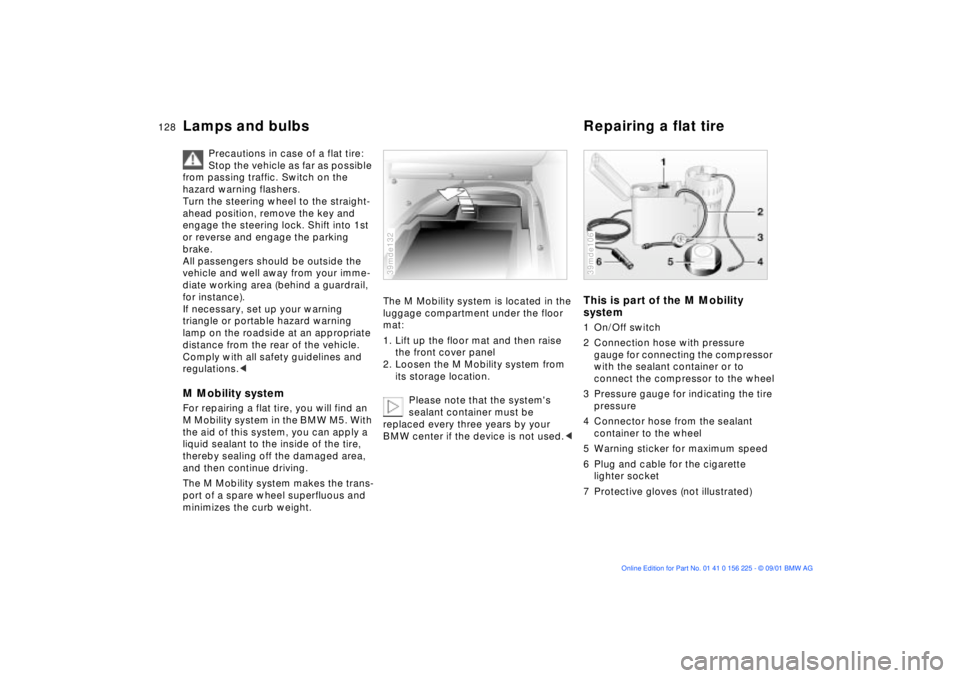
This is part of the M Mobility
system1 On/Off switch
2 Connection hose with pressure
gauge for connecting the compressor
with the sealant container or to
connect the compressor to the wheel
3 Pressure gauge for indicating the tire
pressure
4 Connector hose from the sealant
container to the wheel
5 Warning sticker for maximum speed
6 Plug and cable for the cigarette
lighter socket
7 Protective gloves (not illustrated)39mde106
Page 129 of 154
129n
OverviewControlsMaintenanceRepairsDataIndex
Repairing a flat tireUse the M Mobility system
If possible, leave the foreign
object in the tire.<
Do not exceed the maximum
speeds indicated below, as an
accident could result.
Before you use the M Mobility system,
read the warnings and danger notices
on the device carefully.<
1. Remove the warning sticker 5 for
maximum speed that is located on
top of the device and affix it to the
steering wheel
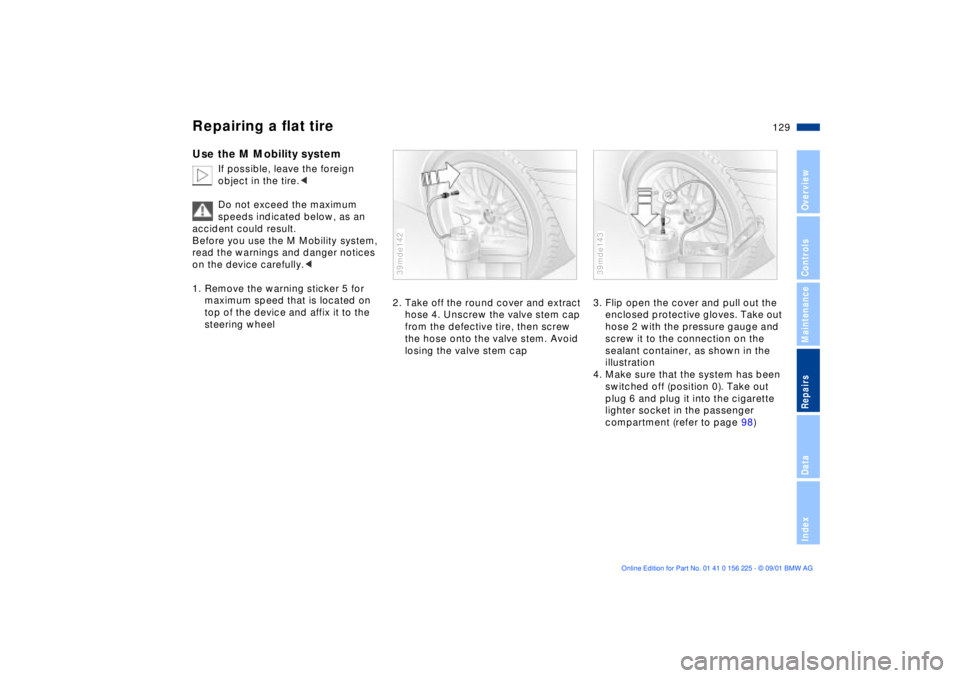
2. Take off the round cover and extract
hose 4. Unscrew the valve stem cap
from the defective tire, then screw
the hose onto the valve stem. Avoid
losing the valve stem cap39mde142
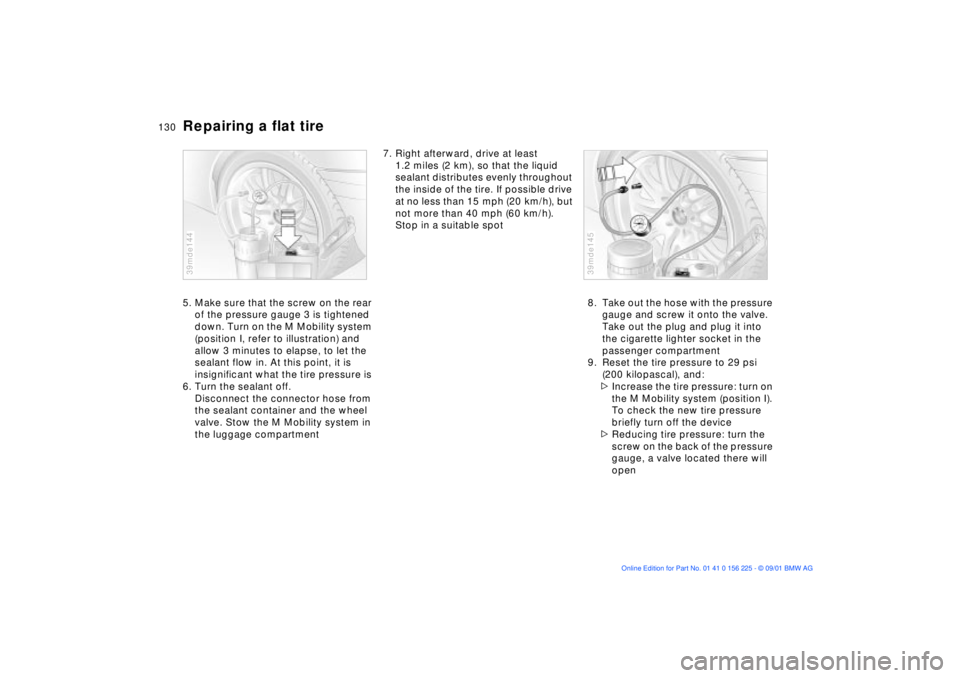
3. Flip open the cover and pull out the
enclosed protective gloves. Take out
hose 2 with the pressure gauge and
screw it to the connection on the
sealant container, as shown in the
illustration
4. Make sure that the system has been
switched off (position 0). Take out
plug 6 and plug it into the cigarette
lighter socket in the passenger
compartment (refer to page 98)39mde143
Page 130 of 154
130n
Repairing a flat tire5. Make sure that the screw on the rear
of the pressure gauge 3 is tightened
down. Turn on the M Mobility system
(position I, refer to illustration) and
allow 3 minutes to elapse, to let the
sealant flow in. At this point, it is
insignificant what the tire pressure is
6. Turn the sealant off.
Disconnect the connector hose from
the sealant container and the wheel
valve. Stow the M Mobility system in
the luggage compartment39mde144
7. Right afterward, drive at least
1.2 miles (2 km), so that the liquid
sealant distributes evenly throughout
the inside of the tire. If possible drive
at no less than 15 mph (20 km/h), but
not more than 40 mph (60 km/h).
Stop in a suitable spot
8. Take out the hose with the pressure
gauge and screw it onto the valve.
Take out the plug and plug it into
the cigarette lighter socket in the
passenger compartment
9. Reset the tire pressure to 29 psi
(200 kilopascal), and:
>Increase the tire pressure: turn on
the M Mobility system (position I).
To check the new tire pressure
briefly turn off the device
>Reducing tire pressure: turn the
screw on the back of the pressure
gauge, a valve located there will
open
39mde145
Page 131 of 154

131n
OverviewControlsMaintenanceRepairsDataIndex
Repairing a flat tire Battery
If the inflation pressure does not
hold, complete step 10 and then
repeat steps 7 through 10.
The use of the M Mobility system may
be ineffective if the damaged area in
the tire is larger than approx. 0.15 in
(4 mm). If it should prove impossible to
restore the tire to operational status
using the M Mobility system, please
contact the nearest BMW center or
BMW Roadside Assistance at
1-800-332-4269.<
10. Unscrew the hose from the valve
and stow the M Mobility system in
the luggage compartment. Screw
the cap back onto the valve stem.
When you start driving again, do not
exceed the permissible maximum
speed of 50 mph (80 km/h).
You will find corresponding instructions
for using the M Mobility system on the
device.
Replace the defective tire as soon as
possible and have the wheel and tire
balanced. Reactivate the Flat Tire
Monitor, for additional information refer
to page 82. Have the M Mobility system
recharged. Contact your BMW center
for this.
Protect valve stems and valves from dirt
using screw-on valve stem caps. Dirty
valve stems frequently lead to slow
pressure loss.Battery posts, terminals and
related accessories contain lead
and lead compounds. Wash hands after
handling.<
Battery careThe battery is completely maintenance-
free. That means that the original elec-
trolyte will normally last for the service
life of the battery under moderate
climatic conditions.
Please consult the staff at your
BMW center whenever you have
any questions concerning the battery.
The battery is completely maintenance-
free; the following section is provided
for your information only.<
Never disconnect the battery
when the engine is running; the
ensuing voltage surge would seriously
damage the vehicle's onboard elec-
tronic systems.<
Page 148 of 154

Everything from A to ZEngine oil
checking level115
consumption115
dipstick115
disposal116
grades117
level16
pressure16
temperature gauge64
Engine performance140
Estimated time of arrival75
Exterior mirrors48
automatic dimming48
electrical heating48 F
Failure messages66
Filling capacities143
First-aid kit20
Fittings, tow starting and
towing135t
Flashlight96
Flat tire109
Flat Tire Monitor82
Fog lamps85
bulb replacement126t
Folding rear backrest99
Follow me home lamps84 Frost protection,
radiator118
Fuel consumption75
average75
Fuel filler door20
manual operation20t
Fuel gauge64
Fuel quality22
Fuel specifications22
Fuel tank capacity143
Fuse replacement132t
G
Gasoline gauge64
Gasoline quality22
Glove compartment96
Gross vehicle weight142 H
Handbrake17, 58
Hands-free system97
Hazard warning triangle20
Head protection airbags49
Head restraints43
adjusting43
Headlamp cover,
care125t
Headlamp flasher59
Headlamp washer
system115 Headlamp washers61
Headrests43
Heating with vehicle
stopped90
Heavy cargo102
Height141
Height adjustment
seats41
steering wheel47
High beams18, 59, 85
High Performance Synthetic
Oil117
High-mount brake lamp127
Holder for canned
beverages97
Hood113
release113t
Horn14
Hydraulic Braking Assistant,
refer to DBC17, 80
I
Ice warning63
Identification, tires111
Ignition key26
Ignition lock56
Imprint4
Indicator lamps16 Inflation
pressure22t, 109
INSPECTION65
Instrument cluster15
Instrument lighting85
Instrument panel15
Intensive cleaning
system115
Interface socket for Onboard
Diagnostics (OBD)121
Interior lamps86
Interior mirrors48
Interior motion sensor36
deactivate29
J
Jump-starting133t K
Key Memory55
Key with remote control26
Keys26 L
Lamps and bulbs124
Leather care, refer to the
"Caring for your vehicle"
manual
Page 151 of 154

Everything from A to Z
151n
OverviewControlsMaintenanceRepairsDataIndex
Time of arrival,
estimated75
Timer70
Tire
condition109
damage109t
inflation
pressure22t, 109
labeling111
pressure monitor82
tread109
Tire Quality Grading110
Tools124t
Torque140
Tow fittings135t
Towing the vehicle135t
Track141
Traction Control System
refer to DSC80
Transmitter key26
Tread depth, tires109
Tread wear indicator109
Trip odometer63
Trunk, refer to luggage
compartment32
Turn signal indicator18, 59
bulb replacement125t
Turning circle141
U
Uniform Tire Quality Grading
(UTQR)110
Universal Transmitter93
Use antifreeze,
radiator118t
Used batteries132 V
Vehicle battery131
Vehicle key26
Vehicle Memory55
Ventilation91
Ventilation in the rear91
Ventilation while parked92
activating72
refer also to the "Onboard
Computer Owner's
Manual"
Ventilation, draft-free91 W
Warm feet Ð cool head91
Warning lamps16
Warning messages66
Warning triangle20
Warranty and Service Guide
Booklet (Canadian
models)119 Washer fluids115t
Washer reservoir,
filling115t
Washer system60
Washing your vehicle, refer
to the "Caring for your
vehicle" manual
Water on the roads107
Wear indicator in the
tires109
Weights142
Wheel and tire
combinations111
Wheelbase141
Width141
Windows36
convenience operation27
defrosting89
Windshield washer60
reservoir, filling115t
Windshield wiper60
Winter tires112
Wiper system60
Work in the engine
compartment113t
X
Xenon lamp125
Page 152 of 154
To ensure that you always have conve-
nient access to all essential information
when you stop for fuel, we recommend
that you take the time to fill out the
adjoining chart by entering the data that
apply to your vehicle.
Consult the index for individual specifi-
cations.
Fuel Please enter your preferred fuel here. Engine oil The space between the two marks on
the dipstick corresponds to approx.
1.1 US quarts (1 liter). Designation
QualityTire inflation pressures
Summer tires Winter tires
front rear front rear
Up to 4 persons
5 persons or 4 plus luggage
Fuel stops