ABS BMW MOTORRAD G650 XMOTO 2007 Rider's Manual (in English)
[x] Cancel search | Manufacturer: BMW MOTORRAD, Model Year: 2007, Model line: G650 XMOTO, Model: BMW MOTORRAD G650 XMOTO 2007Pages: 132, PDF Size: 2.83 MB
Page 54 of 132
Brake system with
BMW Motorrad ABS
OE
How does ABS work?The amount of braking force that
can be transferred to the road
depends on factors hat include
the coefficient of friction of the
road surface. Loose stones, ice
and snow or a wet road all have
much lower coefficients of fric-
tion than a clean, dry asphalt sur-
face. The lower the coefficient
of friction, the longer the braking
distance.
If the rider increases braking
pressure to the extent that brak-
ing force exceeds the maxim-
um transferrable limit, the wheels
start to lock and the motorcycle
loses its directional stability; a fall
is imminent. Before this situation
can occur, ABS intervenes and
adapts braking pressure to the
maximum transferrable braking
force, so the wheels continueto turn and directional stability
is maintained irrespective of the
condition of the road surface.
What are the effects of
surface irregularities?Humps and surface irregularit-
ies can cause the wheels to lose
contact temporarily with the road
surface; if this happens the brak-
ing force that can be transmit-
ted to the road can drop to zero.
If the brakes are applied under
these circumstances the ABS
has to reduce braking force to
ensure that directional stability
is maintained when the wheels
regain contact with the road sur-
face. At this instant the BMW
Motorrad ABS must assume an
extremely low coefficient of fric-
tion, so that the wheels will con-
tinue to rotate under all imagin-
able circumstances, because this
is the precondition for ensuring
directional stability. As soon as
is registers the actual circum-
stances, the system reacts in-
stantly and adjusts braking force
accordingly to achieve optimum
braking.
Rear wheel liftEven under severe braking, a
high level of tyre grip can mean
that the front wheel does not
lock up until very late, if at all.
Consequently, ABS does not in-
tervene until very late, if at all.
Under these circumstances the
rear wheel can lift off the ground,
and the outcome can be a high-
siding situation in which the mo-
torcycle can flip over.
Severe braking can cause
the rear wheel to lift off the
ground.
When you brake, bear in mind
that ABS control cannot be relied
on in all circumstances to prevent
the rear wheel from lifting clear of
the ground.
652zEngineering details
Page 55 of 132
What is the design
baseline for BMW
Motorrad ABS?Within the limits imposed by
physics, BMW Motorrad ABS en-
sures directional stability on any
surface. The system is not op-
timised for special requirements
that apply under extreme com-
petitive situations off-road or on
the track.Special situationsThe speeds of the front and rear
wheels are compared as one
means of detecting a wheel's
incipient tendency to lock. If the
system registers implausible val-
ues for a lengthy period the ABS
function is deactivated for safety
reasons and an ABS fault mes-
sage is issued. Self-diagnos-
is has to complete before fault
messages can be issued.
In addition to problems with the
BMW Motorrad ABS, exceptionalriding conditions can lead to a
fault message being issued.
Exceptional riding
conditions:
Riding for a lengthy period with
the front wheel lifted off the
ground (wheelie).
Rear wheel rotating with the
motorcycle held stationary by
applying the front brake (burn-
out).
Heating up with the motorcycle
on the centre stand or an auxil-
iary stand, engine idling or with
a gear engaged.
Rear wheel locked for a lengthy
period, for example while des-
cending off-road.
If a fault message is issued on
account of exceptional riding
conditions as outlined above, you
can reactivate the ABS function
by switching the ignition off and
on again.
What significance
devolves on regular
maintenance?
Invariably, a technical sys-
tem cannot perform beyond
the abilities dictated by its level
of maintenance.
In order to ensure that the BMW
Motorrad ABS is always main-
tained in optimum condition, it
is essential for you to comply
strictly with the specified inspec-
tion intervals.
Reserves for safetyThe potentially shorter braking
distances which BMW Motorrad
ABS permits must not be used
as an excuse for careless riding.
ABS is primarily a means of en-
suring a safety margin in genuine
emergencies.
Take care when cornering. When
you apply the brakes on a corner,
the motorcycle's weight and
653zEngineering details
Page 56 of 132
momentum take over and even
BMW Motorrad ABS is unable to
counteract their effects.
654zEngineering details
Page 74 of 132
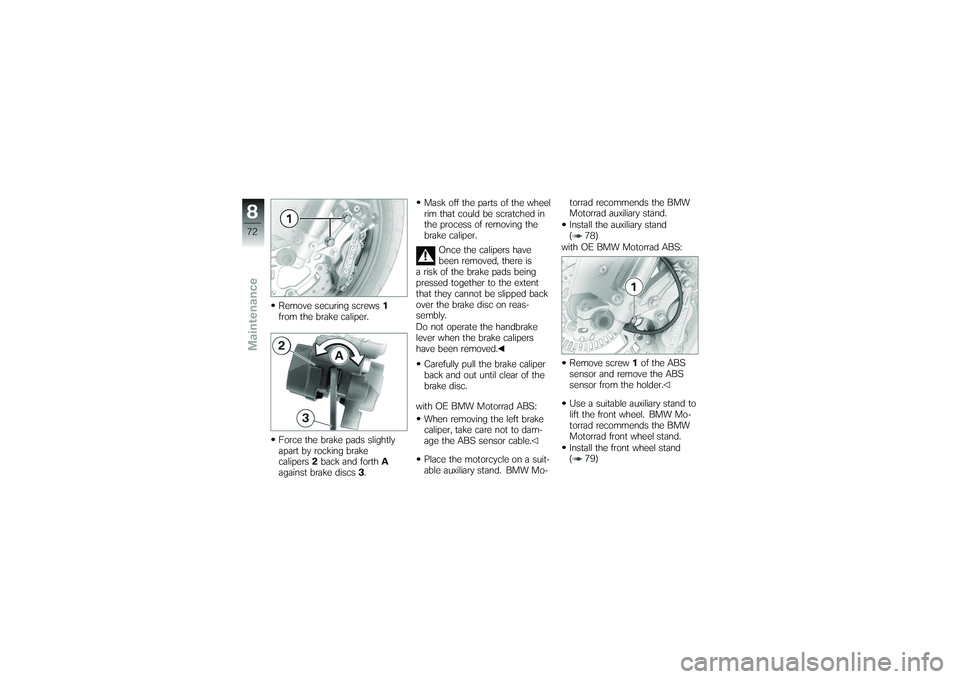
Remove securing screws1
from the brake caliper.
Force the brake pads slightly
apart by rocking brake
calipers 2back and forth A
against brake discs 3. Mask off the parts of the wheel
rim that could be scratched in
the process of removing the
brake caliper.
Once the calipers have
been removed, there is
a risk of the brake pads being
pressed together to the extent
that they cannot be slipped back
over the brake disc on reas-
sembly.
Do not operate the handbrake
lever when the brake calipers
have been removed.
Carefully pull the brake caliper
back and out until clear of the
brake disc.
with OE BMW Motorrad ABS: When removing the left brake
caliper, take care not to dam-
age the ABS sensor cable.
Place the motorcycle on a suit-
able auxiliary stand. BMW Mo- torrad recommends the BMW
Motorrad auxiliary stand.
Install the auxiliary stand
( 78)
with OE BMW Motorrad ABS:
Remove screw 1of the ABS
sensor and remove the ABS
sensor from the holder.
Use a suitable auxiliary stand to
lift the front wheel. BMW Mo-
torrad recommends the BMW
Motorrad front wheel stand.
Install the front wheel stand
( 79)
872zMaintenance
Page 77 of 132
release; repeat the procedure
several times.
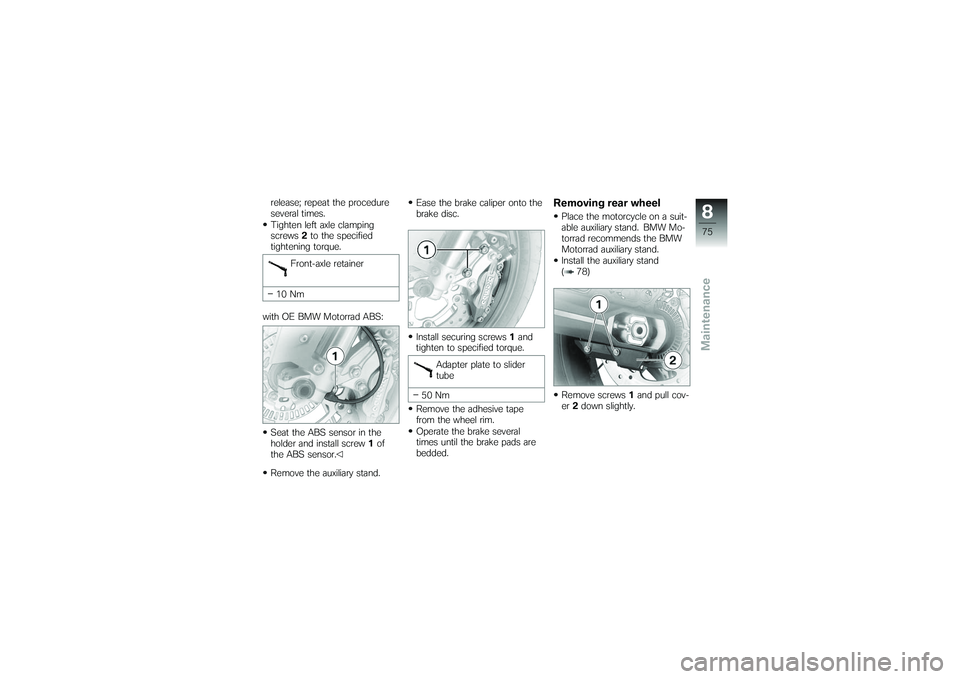
Tighten left axle clamping
screws2to the specified
tightening torque.
Front-axle retainer
10 Nm
with OE BMW Motorrad ABS:
Seat the ABS sensor in the
holder and install screw 1of
the ABS sensor.
Remove the auxiliary stand. Ease the brake caliper onto the
brake disc.
Install securing screws
1and
tighten to specified torque.
Adapter plate to slider
tube
50 Nm
Remove the adhesive tape
from the wheel rim.
Operate the brake several
times until the brake pads are
bedded.
Removing rear wheelPlace the motorcycle on a suit-
able auxiliary stand. BMW Mo-
torrad recommends the BMW
Motorrad auxiliary stand.
Install the auxiliary stand
( 78)
875zMaintenance
Remove screws 1and pull cov-
er 2down slightly.
Page 83 of 132
FusesRemoving fuse
Risk of fire if an attempt is
made to jumper defective
fuse.
Always replace defective fuses
with new fuses of the correct
amperage rating.
Switch off the ignition.
Remove the seat ( 38)
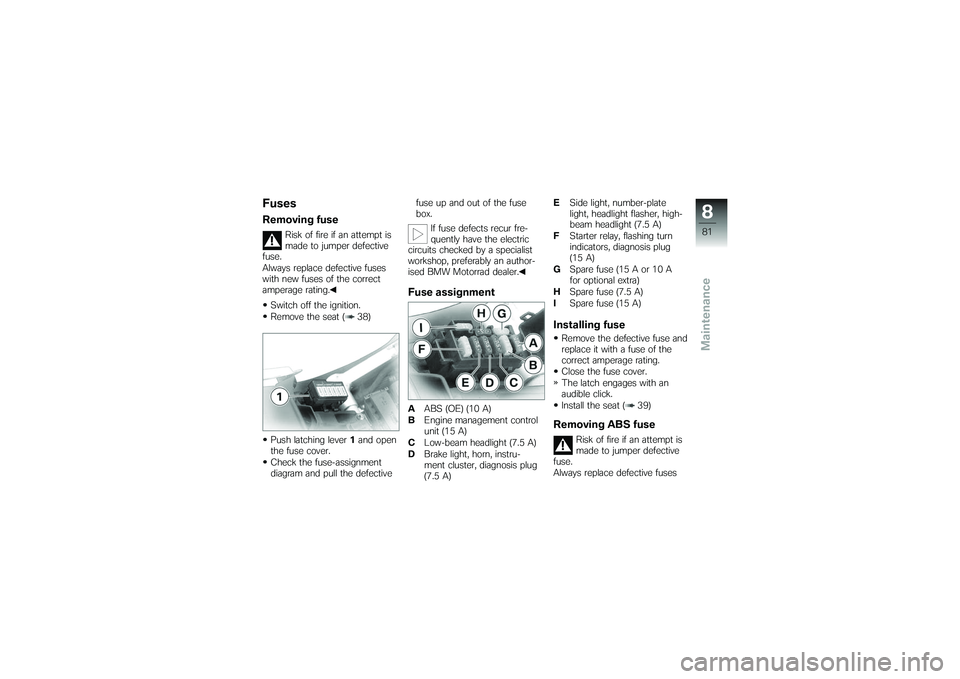
Push latching lever 1and open
the fuse cover.
Check the fuse-assignment
diagram and pull the defective fuse up and out of the fuse
box.
If fuse defects recur fre-
quently have the electric
circuits checked by a specialist
workshop, preferably an author-
ised BMW Motorrad dealer.
Fuse assignmentA ABS (OE) (10 A)
B Engine management control
unit (15 A)
C Low-beam headlight (7.5 A)
D Brake light, horn, instru-
ment cluster, diagnosis plug
(7.5 A) E
Side light, number-plate
light, headlight flasher, high-
beam headlight (7.5 A)
F Starter relay, flashing turn
indicators, diagnosis plug
(15 A)
G Spare fuse (15 A or 10 A
for optional extra)
H Spare fuse (7.5 A)
I Spare fuse (15 A)
Installing fuseRemove the defective fuse and
replace it with a fuse of the
correct amperage rating.
Close the fuse cover.
The latch engages with an
audible click.
Install the seat ( 39)Removing ABS fuse
Risk of fire if an attempt is
made to jumper defective
fuse.
Always replace defective fuses
881zMaintenance
Page 84 of 132
with new fuses of the correct
amperage rating.Switch off the ignition.
Remove the right side panel
( 93)
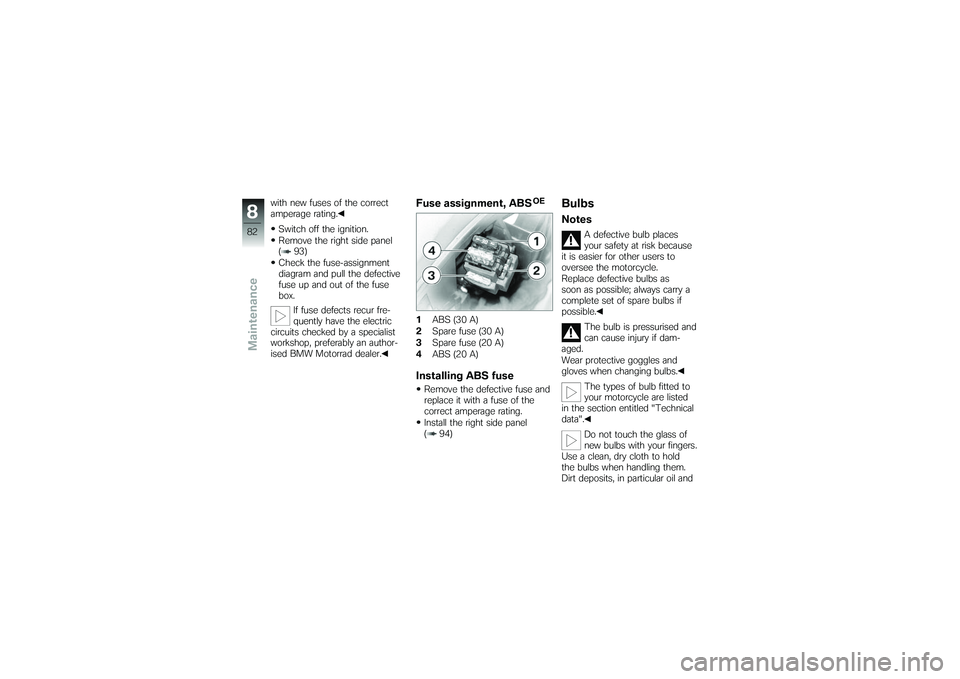
Check the fuse-assignment
diagram and pull the defective
fuse up and out of the fuse
box. If fuse defects recur fre-
quently have the electric
circuits checked by a specialist
workshop, preferably an author-
ised BMW Motorrad dealer.
Fuse assignment, ABS
OE
1 ABS (30 A)
2 Spare fuse (30 A)
3 Spare fuse (20 A)
4 ABS (20 A)Installing ABS fuseRemove the defective fuse and
replace it with a fuse of the
correct amperage rating.
Install the right side panel
( 94)
BulbsNotes
A defective bulb places
your safety at risk because
it is easier for other users to
oversee the motorcycle.
Replace defective bulbs as
soon as possible; always carry a
complete set of spare bulbs if
possible.
The bulb is pressurised and
can cause injury if dam-
aged.
Wear protective goggles and
gloves when changing bulbs.
The types of bulb fitted to
your motorcycle are listed
in the section entitled "Technical
data".
Do not touch the glass of
new bulbs with your fingers.
Use a clean, dry cloth to hold
the bulbs when handling them.
Dirt deposits, in particular oil and
882zMaintenance
Page 112 of 132
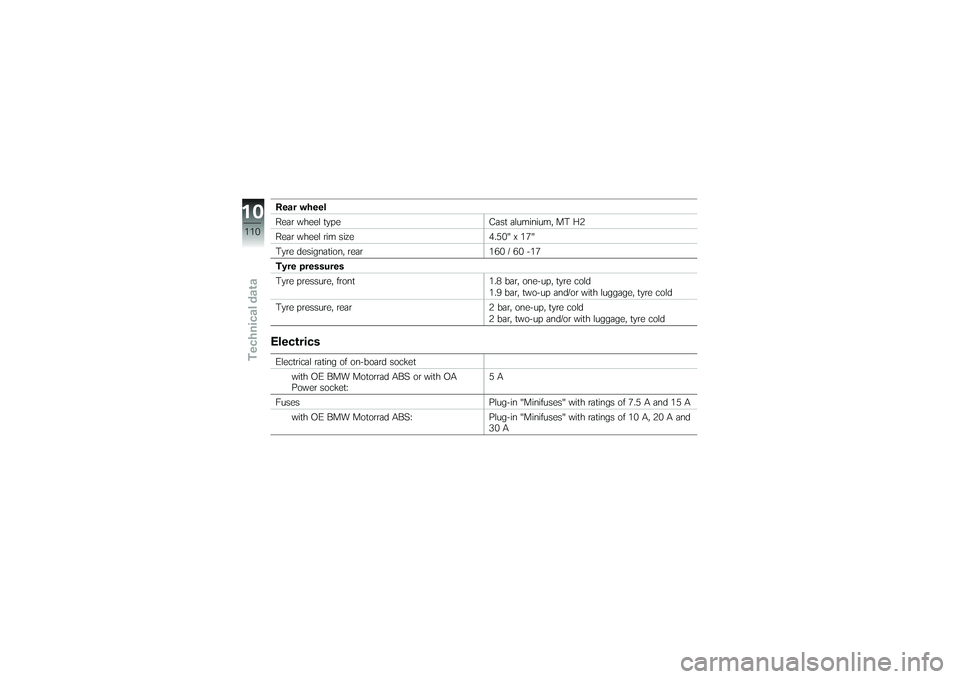
Rear wheel
Rear wheel typeCast aluminium, MT H2
Rear wheel rim size 4.50" x 17"
Tyre designation, rear 160 / 60 -17
Tyre pressures
Tyre pressure, front 1.8 bar, one-up, tyre cold
1.9 bar, two-up and/or with luggage, tyre cold
Tyre pressure, rear 2 bar, one-up, tyre cold
2 bar, two-up and/or with luggage, tyre coldElectricsElectrical rating of on-board socket
with OE BMW Motorrad ABS or with OA
Power socket: 5A
Fuses Plug-in "Minifuses" with ratings of 7.5 A and 15 A with OE BMW Motorrad ABS: Plug-in "Minifuses" with ratings of 10 A, 20 A and 30 A
10110zTechnical data
Page 113 of 132
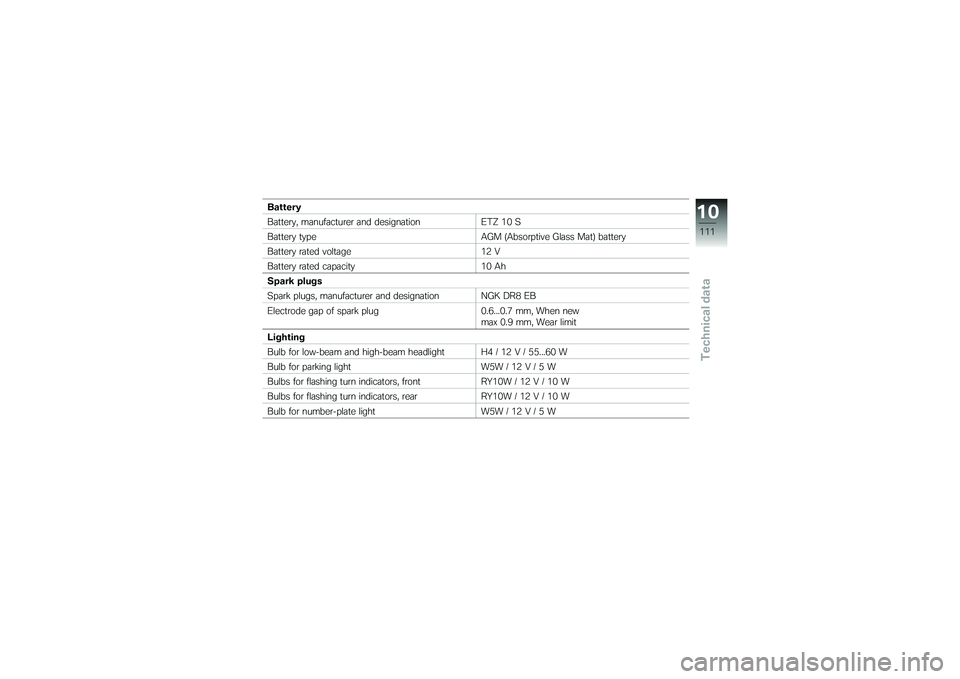
Battery
Battery, manufacturer and designationETZ 10 S
Battery type AGM (Absorptive Glass Mat) battery
Battery rated voltage 12 V
Battery rated capacity 10 Ah
Spark plugs
Spark plugs, manufacturer and designation NGK DR8 EB
Electrode gap of spark plug 0.6...0.7 mm, When new
max 0.9 mm, Wear limit
Lighting
Bulb for low-beam and high-beam headlight H4 / 12 V / 55...60 W
Bulb for parking light W5W / 12 V / 5 W
Bulbs for flashing turn indicators, front RY10W / 12 V / 10 W
Bulbs for flashing turn indicators, rear RY10W / 12 V / 10 W
Bulb for number-plate light W5W / 12 V / 5 W
10111zTechnical data
Page 127 of 132
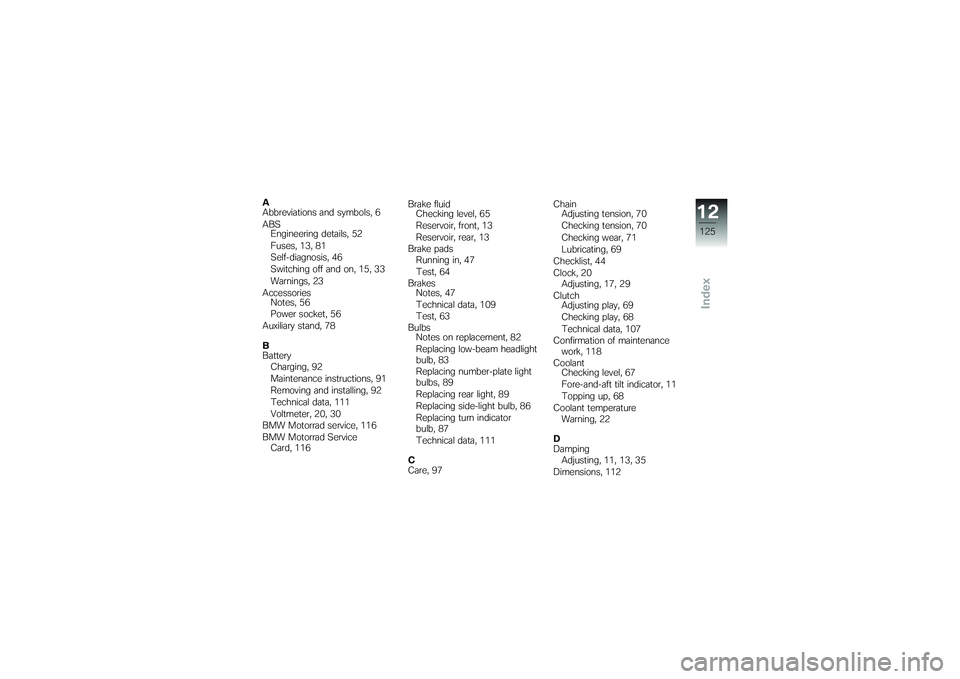
A
Abbreviations and symbols, 6
ABSEngineering details, 52
Fuses, 13, 81
Self-diagnosis, 46
Switching off and on, 15, 33
Warnings, 23
Accessories Notes, 56
Power socket, 56
Auxiliary stand, 78
B
Battery Charging, 92
Maintenance instructions, 91
Removing and installing, 92
Technical data, 111
Voltmeter, 20, 30
BMW Motorrad service, 116
BMW Motorrad Service Card, 116 Brake fluid
Checking level, 65
Reservoir, front, 13
Reservoir, rear, 13
Brake pads Running in, 47
Test, 64
Brakes Notes, 47
Technical data, 109
Test, 63
Bulbs Notes on replacement, 82
Replacing low-beam headlight
bulb, 83
Replacing number-plate light
bulbs, 89
Replacing rear light, 89
Replacing side-light bulb, 86
Replacing turn indicator
bulb, 87
Technical data, 111
C
Care, 97 Chain
Adjusting tension, 70
Checking tension, 70
Checking wear, 71
Lubricating, 69
Checklist, 44
Clock, 20 Adjusting, 17, 29
Clutch Adjusting play, 69
Checking play, 68
Technical data, 107
Confirmation of maintenance work, 118
Coolant Checking level, 67
Fore-and-aft tilt indicator, 11
Topping up, 68
Coolant temperature Warning, 22
D
Damping Adjusting, 11, 13, 35
Dimensions, 112
12125zIndex