wheel BMW X3 3.0I 2004 E83 Owner's Guide
[x] Cancel search | Manufacturer: BMW, Model Year: 2004, Model line: X3 3.0I, Model: BMW X3 3.0I 2004 E83Pages: 132, PDF Size: 3.62 MB
Page 90 of 132
Wheels and tires
88
Tire identification marks
Knowledge of the labeling on the side of
the tire makes it easier to identify and
choose the right tires.
Tire size
Speed code letter
T = up to 118 mph/190 km/h
H = up to 131 mph/210 km/h
V = up to 150 mph/240 km/h
W = up to 167 mph/270 km/h
Y = up to 186 mph/300 km/h
Tire Identification Number
Tires with DOT codes meet the guidelines
of the U.S. Department of Transport.
DOT code:
Tire age
The tire's date of manufacture is indicated
on the sidewall:
DOT ... 3603 indicates that a tire was man-
ufactured in week 36 of the year 2003.
BMW recommends that you replace all
tires after 6 years at the latest, indepen-
dently of the fact that tires can reach an age
of 10 years.
Uniform Tire Quality Grading
Quality grades can be found where appli-
cable on the tire sidewall between tread
shoulder and maximum section width.
For example:
Tread wear 200 Traction AA
Temperature A
DOT Quality Grades
Treadwear
Traction AA A B C
Temperature A B C
All passenger car tires must conform
to Federal Safety Requirements in
addition to these grades.<
Treadwear
The treadwear grade is a comparative rat-
ing based on the wear rate of the tire when
tested under controlled conditions on a
specified government test course.
For example, a tire graded 150 would wear
one and one-half (1 g) times as well on the
government course as a tire graded 100.
The relative performance of tires depends
upon the actual conditions of their use,
however, and may depart significantly from
the norm due to variations in driving habits,
service practices and differences in road
characteristics and climate.
Traction
The traction grades, from highest to lowest,
are AA, A, B, and C.
Those grades represent the tire's ability to
stop on wet pavement as measured under
controlled conditions on specified govern-
ment test surfaces of asphalt and concrete.
A tire marked C may have poor traction
performance.
The traction grade assigned to this
tire is based on straight-ahead brak-
ing traction tests, and does not include
acceleration, cornering, hydroplaning, or
peak traction characteristics.<
Temperature
The temperature grades are A Ð the
highest Ð B, and C, representing the tire's e.g.
Nominal width
in mm
Aspect ratio in X
Radial type
Rim diameter in inches
Load rating
(not on ZR tires)
Speed rating
(before R on ZR tires)
205/60 R1591W
e.g.
Manufacturer code
for tire make
Tire size and
tire design
Tire ageDOT xxxx xxx 3603
Page 91 of 132
Reference
At a glance
Controls
Driving tips
Mobility
89
resistance to the generation of heat and its
ability to dissipate heat when tested under
controlled conditions on a specified indoor
laboratory test wheel.
Sustained high temperature can cause the
material of the tire to degenerate and
reduce tire life, and excessive temperature
can lead to sudden tire failure. The grade C
corresponds to a level of performance
which all passenger car tires must meet
under the Federal Motor Vehicle Safety
Standard No. 109. Grades B and A repre-
sent higher levels of performance on the
laboratory test wheel than the minimum
required by law.
The temperature grade for this tire is
established for a tire that is properly
inflated and not overloaded. Excessive
speed, underinflation, or excessive load-
ing, either separately or in combination,
can cause heat buildup and possible tire
failure.<
M+S
Winter and all-season tires.
These have better winter properties than
summer tires.
Tire condition
Inspect your tires frequently for treadwear,
signs of damage and for foreign objects
lodged in the tread. Check the tread pat-
tern depth.
Tire tread
The tread depth should not drop below
0.12 in/3 mm, although, for example, Euro-
pean legislation only specifies a minimum
tread depth of 0.063 in/1.6 mm. At tread
depths below 0.12 in/3 mm, there is an
increased risk of high-speed hydroplaning,
even when only small amounts of water are
present on the road surface.
As winter tires display a noticeable loss in
their ability to cope with cold-weather driv-
ing conditions once the tread wears to
below 0.16 in/4 mm, to ensure continued safety you should always have such tires
replaced.
Wear indicators at the tread-groove base,
refer to arrow, are distributed over the tire's
circumference and are marked on the tire
sidewall with TWI Ð Tread Wear Indicator.
At a tread depth of 0.063 in/1.6 mm these
indicators, signal that the tires have
reached the legally permissible wear limit.
Tire damage
Unusual vibrations encountered dur-
ing normal vehicle operation can indi-
cate tire failure or some other vehicle
defect. This can, for example, be caused by
driving over curbs. These kinds of prob-
lems may also be signaled by other
changes in vehicle response, such as a
strong tendency to pull to the left or right.
Should this occur, respond by immediately
reducing your speed. Proceed carefully to
the nearest BMW Sports Activity Vehicle
Center or professional tire center, or have
the vehicle towed in to have it, its wheels
and tires inspected.
Tire damage, extending to sudden and
complete loss of pressure in extreme
cases, can pose a potentially lethal safety
hazard for the vehicle's occupants and
other road users alike.<
Replacing wheels/tires
Unprofessional attempts by laymen to
service tires can lead to damage and
accidents.
Have this work performed by skilled pro-
fessionals only. All BMW Sports Activity
Vehicle Centers will be happy to help you
Page 92 of 132
Wheels and tires
90 with specialized knowledge and corre-
sponding equipment.<
The correct wheel and tire combination
affects various systems whose function
would otherwise be impaired, e.g. ABS,
DSC or xDrive.
Have the wheel and tire assemblies bal-
anced every time either a wheel or a tire is
replaced.
BMW does not recommend the use of
retreaded tires, as otherwise driving
safety may be reduced. Possible variations
in the design and the age Ð which could be
substantial Ð of the carcasses can lead to
unusually rapid wear.<
The right wheels and tires
BMW recommends that you use only
wheel and tire combinations that
BMW has tested and approved for your
particular vehicle. Variations in factors such
as manufacturing tolerances mean that
even wheels and tires with identical official
size ratings could actually have different
dimensions than the approved units Ð these
differences could lead to body contact, and
with it the risk of severe accidents. If non-
approved wheels and tires are used, BMW
cannot evaluate their suitability, and there-
fore cannot be held liable for driving
safety.<
To maintain good handling and vehicle
response, use only tires of a single tread
configuration from a single manufacturer.
After a flat tire, always remember to have
the specified wheel and tire combination
remounted on the vehicle as soon as pos-
sible.
Recommended tire brands
BMW tests certain tire brands for each tire
size, classifies them as road-safe and
approves them. You can obtain a list of
these from your BMW Sports Activity Vehi-
cle Center. Observe any country-specific
regulations, e.g. on making a correspond-
ing entry in the vehicle documents.
The factory-mounted tires have been spe-
cially selected to provide optimized perfor-mance when installed on your vehicle; if
properly cared for, they will provide a com-
bination of safety and excellent ride com-
fort.
Special characteristics of winter
tires
BMW recommends winter tires for use in
cold winter driving conditions. Although all-
season M+S tires provide better winter
traction than summer tires, they generally
fail to provide the same levels of cold-
weather performance as winter tires.
When switching to winter tires, observe the
descriptions at Tire condition and Replac-
ing wheels/tires, refer to page 89.
Observing speed ratings
Never exceed the maximum speed for
which the winter tires are rated.
Unprofessional attempts by laymen to ser-
vice tires can lead to damage and acci-
dents. Have this work performed by skilled
professionals only. The technicians at your
BMW Sports Activity Vehicle Center will be
glad to assist you with the required profes-
sional knowledge and specialized equip-
ment.<
Storage
Store wheels or tires in a cool, dry place,
protecting them against light whenever
possible. Protect the tires against contact
with oil, grease and fuel.
Do not exceed the maximum tire inflation
pressure specified on the side of the tire.
Snow chains*
Do not exceed a vehicle speed of
30 mph/50 km/h with snow chains
mounted.<
Only certain snow chains have been tested
by BMW and classified and approved as
safe. You can obtain a list of these from
your BMW Sports Activity Vehicle Center.
BMW recommends the use of approved
narrow-link snow chains only. These snow
chains are approved exclusively for use on
Page 93 of 132

Reference
At a glance
Controls
Driving tips
Mobility
91
summer or winter tires in pairs on the rear
wheels.
Observe the manufacturer's instructions
when installing snow chains.
After mounting snow chains, do not
initialize the Flat Tire Monitor.
When you are driving with snow chains, it
can be beneficial to switch off DSC briefly,
refer to page 51.<
Page 105 of 132
Reference
At a glance
Controls
Driving tips
Mobility
103
Tailgate lamp
5 Watt bulb
1.Pull off the bulb holder
2.Replace the bulb.
Light-emitting diodes LEDs
Light-emitting diodes installed behind
translucent lenses serve as the light source
for many of the controls and displays in
your vehicle. These light-emitting diodes,
which operate using a concept similar to
that applied in conventional lasers, are offi-
cially designated as Class 1 light-emitting
diodes.
Do not remove the covers, and never
stare into the unfiltered light for sev-
eral hours, as irritation of the retina could
result.<
Changing a wheel
Safety precautions to observe in the
event of a flat tire and during all tire
changes:
Park the vehicle as far as possible from
passing traffic. Park on a firm, flat, surface.
Switch on the hazard warning flashers.
Lock the steering wheel in straight-ahead
setting of the wheels. Set the handbrake
and engage first gear, reverse gear or
selector-lever position P.
All passengers should be outside the vehi-
cle and well away from your immediate
working area, behind a guardrail, for
instance.
If a warning triangle or portable hazard
warning lamp is required, set it up on the
roadside at an appropriate distance from
the rear of the vehicle. Comply with all safety guidelines and regulations.
Change the wheel only on a level, firm sur-
face which is not slippery. The vehicle or
the jack could slip to the side if you attempt
to raise the vehicle on a soft or slippery sur-
face such as snow, ice, tiles, etc.
Position the jack on a firm support surface.
Do not use a wooden block or similar
object as a support base for the jack, as
this would prevent it from extending to its
full support height and reduce its load-car-
rying capacity.
To avoid serious or fatal injury: never lie
under the vehicle, and never start the
engine while it is supported by the jack.<
What you will need
Open tailgate and raise or remove floor
cover, refer to page 72.
1Vehicle jack
2Chock
3Lug wrench
In order to avoid rattling noises later, note
the position of the tools when you remove
them and return them to their original posi-
tion when you are through using them.
Compact wheel
The compact wheel is located under the
cargo area on the floor of the vehicle.
Page 106 of 132
Replacing components
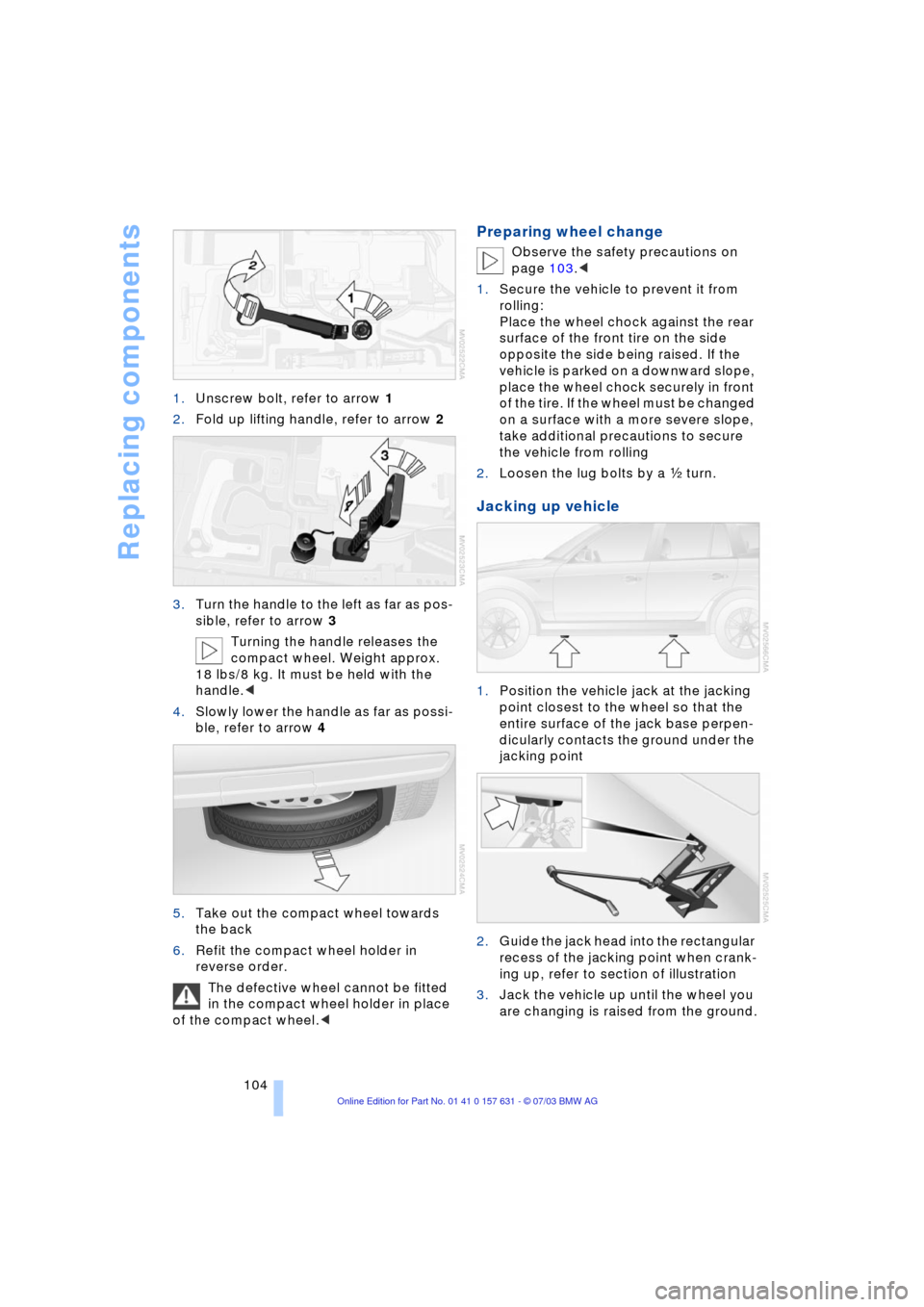
104 1.Unscrew bolt, refer to arrow 1
2.Fold up lifting handle, refer to arrow 2
3.Turn the handle to the left as far as pos-
sible, refer to arrow 3
Turning the handle releases the
compact wheel. Weight approx.
18 lbs/8 kg. It must be held with the
handle.<
4.Slowly lower the handle as far as possi-
ble, refer to arrow 4
5.Take out the compact wheel towards
the back
6.Refit the compact wheel holder in
reverse order.
The defective wheel cannot be fitted
in the compact wheel holder in place
of the compact wheel.<
Preparing wheel change
Observe the safety precautions on
page 103.<
1.Secure the vehicle to prevent it from
rolling:
Place the wheel chock against the rear
surface of the front tire on the side
opposite the side being raised. If the
vehicle is parked on a downward slope,
place the wheel chock securely in front
of the tire. If the wheel must be changed
on a surface with a more severe slope,
take additional precautions to secure
the vehicle from rolling
2.Loosen the lug bolts by a g turn.
Jacking up vehicle
1.Position the vehicle jack at the jacking
point closest to the wheel so that the
entire surface of the jack base perpen-
dicularly contacts the ground under the
jacking point
2.Guide the jack head into the rectangular
recess of the jacking point when crank-
ing up, refer to section of illustration
3.Jack the vehicle up until the wheel you
are changing is raised from the ground.
Page 107 of 132
Reference
At a glance
Controls
Driving tips
Mobility
105
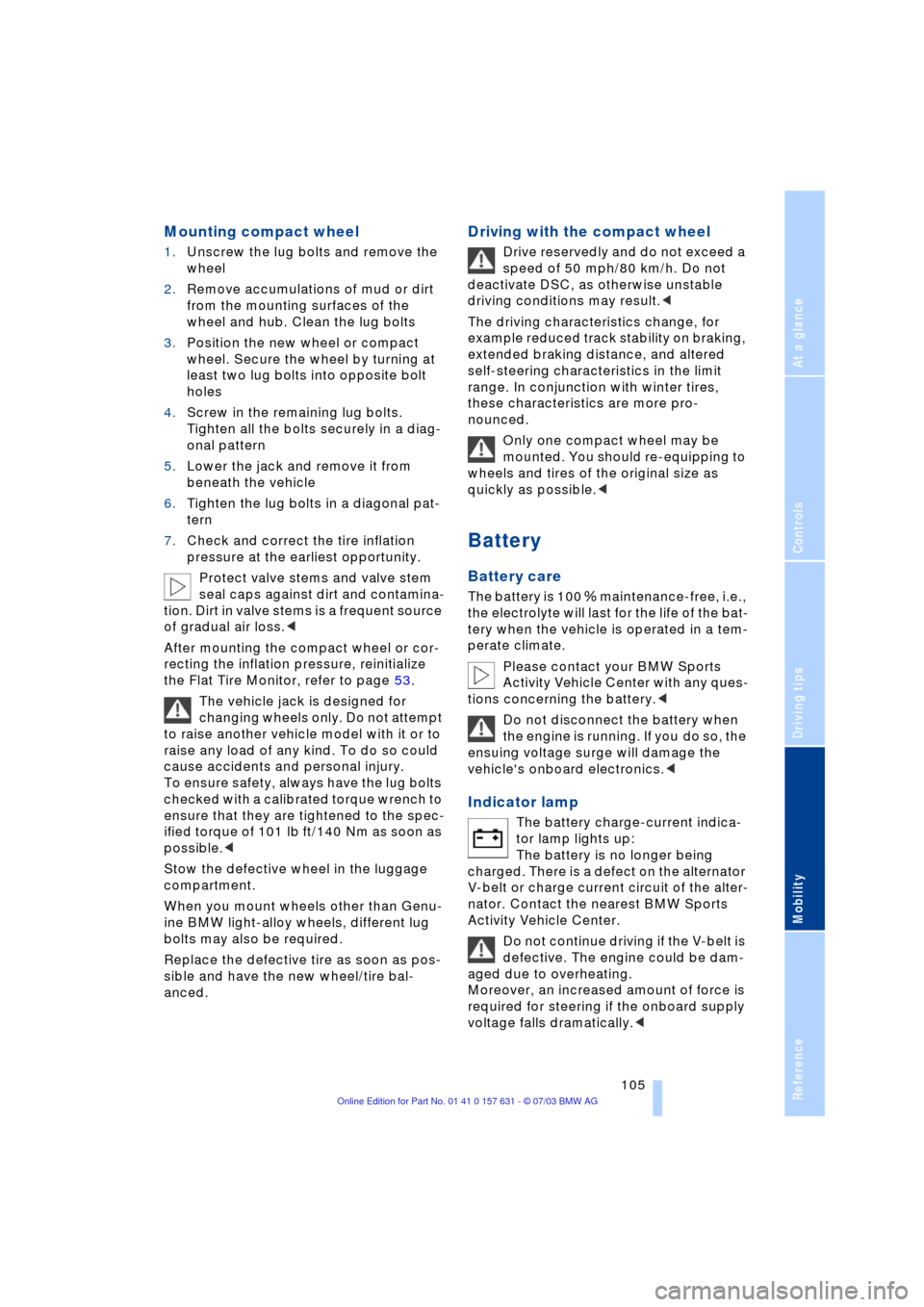
Mounting compact wheel
1.Unscrew the lug bolts and remove the
wheel
2.Remove accumulations of mud or dirt
from the mounting surfaces of the
wheel and hub. Clean the lug bolts
3.Position the new wheel or compact
wheel. Secure the wheel by turning at
least two lug bolts into opposite bolt
holes
4.Screw in the remaining lug bolts.
Tighten all the bolts securely in a diag-
onal pattern
5.Lower the jack and remove it from
beneath the vehicle
6.Tighten the lug bolts in a diagonal pat-
tern
7.Check and correct the tire inflation
pressure at the earliest opportunity.
Protect valve stems and valve stem
seal caps against dirt and contamina-
tion. Dirt in valve stems is a frequent source
of gradual air loss.<
After mounting the compact wheel or cor-
recting the inflation pressure, reinitialize
the Flat Tire Monitor, refer to page 53.
The vehicle jack is designed for
changing wheels only. Do not attempt
to raise another vehicle model with it or to
raise any load of any kind. To do so could
cause accidents and personal injury.
To ensure safety, always have the lug bolts
checked with a calibrated torque wrench to
ensure that they are tightened to the spec-
ified torque of 101 lb ft/140 Nm as soon as
possible.<
Stow the defective wheel in the luggage
compartment.
When you mount wheels other than Genu-
ine BMW light-alloy wheels, different lug
bolts may also be required.
Replace the defective tire as soon as pos-
sible and have the new wheel/tire bal-
anced.
Driving with the compact wheel
Drive reservedly and do not exceed a
speed of 50 mph/80 km/h. Do not
deactivate DSC, as otherwise unstable
driving conditions may result.<
The driving characteristics change, for
example reduced track stability on braking,
extended braking distance, and altered
self-steering characteristics in the limit
range. In conjunction with winter tires,
these characteristics are more pro-
nounced.
Only one compact wheel may be
mounted. You should re-equipping to
wheels and tires of the original size as
quickly as possible.<
Battery
Battery care
The battery is 100% maintenance-free, i.e.,
the electrolyte will last for the life of the bat-
tery when the vehicle is operated in a tem-
perate climate.
Please contact your BMW Sports
Activity Vehicle Center with any ques-
tions concerning the battery.<
Do not disconnect the battery when
the engine is running. If you do so, the
ensuing voltage surge will damage the
vehicle's onboard electronics.<
Indicator lamp
The battery charge-current indica-
tor lamp lights up:
The battery is no longer being
charged. There is a defect on the alternator
V-belt or charge current circuit of the alter-
nator. Contact the nearest BMW Sports
Activity Vehicle Center.
Do not continue driving if the V-belt is
defective. The engine could be dam-
aged due to overheating.
Moreover, an increased amount of force is
required for steering if the onboard supply
voltage falls dramatically.<
Page 111 of 132
Reference
At a glance
Controls
Driving tips
Mobility
109
on page 93. The symbol + is embossed on
the cover.
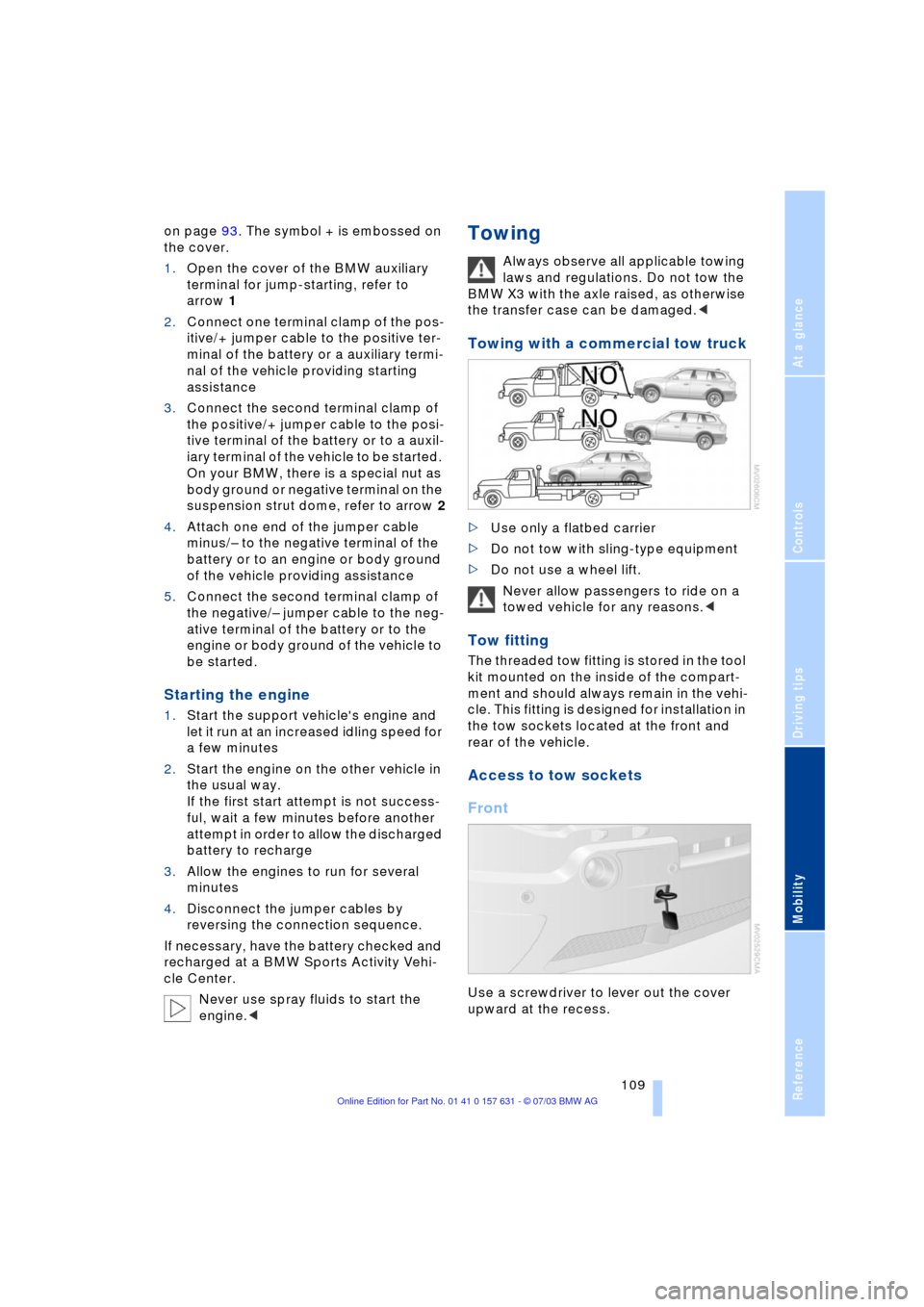
1.Open the cover of the BMW auxiliary
terminal for jump-starting, refer to
arrow 1
2.Connect one terminal clamp of the pos-
itive/+ jumper cable to the positive ter-
minal of the battery or a auxiliary termi-
nal of the vehicle providing starting
assistance
3.Connect the second terminal clamp of
the positive/+ jumper cable to the posi-
tive terminal of the battery or to a auxil-
iary terminal of the vehicle to be started.
On your BMW, there is a special nut as
body ground or negative terminal on the
suspension strut dome, refer to arrow 2
4.Attach one end of the jumper cable
minus/Ð to the negative terminal of the
battery or to an engine or body ground
of the vehicle providing assistance
5.Connect the second terminal clamp of
the negative/Ð jumper cable to the neg-
ative terminal of the battery or to the
engine or body ground of the vehicle to
be started.
Starting the engine
1.Start the support vehicle's engine and
let it run at an increased idling speed for
a few minutes
2.Start the engine on the other vehicle in
the usual way.
If the first start attempt is not success-
ful, wait a few minutes before another
attempt in order to allow the discharged
battery to recharge
3.Allow the engines to run for several
minutes
4.Disconnect the jumper cables by
reversing the connection sequence.
If necessary, have the battery checked and
recharged at a BMW Sports Activity Vehi-
cle Center.
Never use spray fluids to start the
engine.<
Towing
Always observe all applicable towing
laws and regulations. Do not tow the
BMW X3 with the axle raised, as otherwise
the transfer case can be damaged.<
Towing with a commercial tow truck
>Use only a flatbed carrier
>Do not tow with sling-type equipment
>Do not use a wheel lift.
Never allow passengers to ride on a
towed vehicle for any reasons.<
Tow fitting
The threaded tow fitting is stored in the tool
kit mounted on the inside of the compart-
ment and should always remain in the vehi-
cle. This fitting is designed for installation in
the tow sockets located at the front and
rear of the vehicle.
Access to tow sockets
Front
Use a screwdriver to lever out the cover
upward at the recess.
Page 122 of 132

Everything from A to Z
120 Bottle holder, refer to
Beverage holders 67
Brake fluid 96
Ð indicator lamp 96
Ð level 96
Ð replacing 96
Brake force display 54
Brake lamps
Ð defect 57
Ð indicator lamp 12
Ð replacing the bulbs 102
Brake pads and rotors
Ð breaking-in procedure 76
Brakes 77, 96
Ð ABS 77
Ð brake fluid 96
Ð break-in procedure 76
Ð handbrake 38
Ð indicator/warning
lamp 38
Brake system
Ð brake-fluid level 96
Ð brake pads 96
Ð corrosion 77
Ð disc brakes 76, 77
Ð indicator lamp 96
Ð rotors 76, 77
Brake wear warning
Ð brake pads 96
Ð indicator lamp 96
Break-in procedures 76
Bulbs and lamps 99
Buttons in steering
wheel 14
C
California Proposition
65 Warning 98
Capacities 117
Car care, refer to Caring for
your vehicle brochure
Car-care products, refer to
Caring for your vehicle
brochure
Care, refer to Caring for
your vehicle brochureCargo area 71
Ð capacity 116
Ð cover 71
Ð floor cover 72
Ð folding rear seat
backrest 71
Ð increasing volume 71
Ð lashing eyes 73
Ð manual unlocking 21
Ð opening, remote
control 19
Ð opening/closing 21
Ð opening from the
outside 21
Ð sockets 73
Ð volume 116
Cargo bay, refer to Cargo
area 71
Cargo loading 78
Caring for leather, refer to
Caring for your vehicle
brochure
Caring for the carpet, refer
to Caring for your vehicle
brochure
Caring for the vehicle finish,
refer to Caring for your
vehicle brochure
Car keys, refer to Key
set 18
Car phone preparation 70
Car wash 77
Car wash, refer to Caring
for your vehicle brochure
Catalytic converter, refer to
High temperatures 76
Central locking system 18
Ð interior 20
Changes, technical, refer to
For your own safety 6
Changing a wheel 103
Check Gas Cap
Ð indicator lamp 12, 84
Checking inflation
pressure 86
Child's seats, refer to
Child-restraint
systems 34
Child-restraint systems 34
Child-safety locks 36
Chock 103Chrome parts, care, refer to
Caring for your vehicle
brochure
Cigarette lighter
Ð front 69
Ð rear 69
Circulation of air, refer to
Recirculated-air
mode 61, 64
Cleaning, vehicle, refer to
Caring for your vehicle
brochure
Cleaning the windshield 42
Cleaning windows,
reservoir 94
Clean the rear window 42
Clock 46
Ð 12/24 hour mode 48
Ð setting, refer also to
Owner's Manual for
Radio/Onboard
computer 46
Clutch 76
Ð breaking in 76
Cockpit 10
Cold start, refer to Starting
the engine 37
Comfort operation
Ð panorama glass roof 20
Compact wheel
Ð wheel changes 103
Compression ratio, refer to
Engine data 114
Computer 47
Computer, functions 48
Condensation, refer to A/C
operation 61, 64
Connecting a vacuum
cleaner, refer to Lighter
socket 69
Consumption, refer to
Average fuel
consumption 48
Consumption indicator,
refer to Fuel gauge 45
Contents 3
Controls, refer to
Cockpit 10
Convenience operation
Ð from outside 20
Ð windows 20
Page 123 of 132
Reference
At a glance
Controls
Driving tips
Mobility
121
Coolant 95
Ð indicator lamp 95
Ð level 96
Ð temperature gauge 45
Coolant temperature
gauge 45
Cooling, refer to
Temperature 61
Copyright 2
Cruise control
Ð buttons in steering
wheel 14
Ð indicator lamp 43
Cruise control, refer to
Ð Programmable cruise
control 43
Cruising range 48
Cup holder, refer to
Beverage holders 67
Curb weight 116
Cylinders, refer to Engine
data 114
D
Dashboard system, refer to
Cockpit 10
Data, technical
Ð dimensions 115
Ð engine 114
Ð filling capacities 117
Ð weights 116
Daytime driving lamp 57
DBC Dynamic Brake
Control 50
Ð indicator lamp 50
Decommissioning the
vehicle, refer to Caring for
your vehicle brochure 97
Defect, refer to Manual
operation
Defects 7
Defrosting, windows 61
Ð air conditioner 62
Ð automatic climate
control 64
Ð rear window
defroster 61, 65Defrosting windows and
removing condensation
Ð air conditioner 62
Ð automatic climate
control 64
Defrosting windshield, refer
to Defrosting
windows 62, 64
Defrost position, refer to
Defrosting
windows 62, 64
Digital clock 46
Dimensions 115
Dipstick, engine oil 94
Directional indicators, refer
to Turn signal
indicators 41
Discs brakes 76, 77
Displacement, refer to
Engine data 114
Display lighting, refer to
Instrument lighting 58
Displays, refer to
Instrument
cluster 11
Disposal
Ð batteries 106
Ð oil 95
Doors
Ð locking and unlocking 20
Ð manual operation 20
DOT Quality Grades 88
Draft-free ventilation 61, 65
Drawbar support load 116
Driving lamps, refer to
Parking lamps/low
beams 57
Driving notes 76
Driving on bad roads 80
Driving stability control
systems 50
Driving through water 80
DSC Dynamic Stability
Control 50
Ð indicator lamp 51
E
Electrical malfunction
Ð door lock 20
Ð doors 20
Ð driver's door 20
Ð fuel filler door 84
Ð panorama glass roof 24
Ð tailgate 21
Electric power windows 22
Electronic Stability
Program ESP, refer to
Dynamic Stability
Control 50
Emergency actuation, refer
to Manual operation
Emergency call 107
Engine
Ð breaking in 76
Ð data 114
Ð indicator lamp 37
Ð malfunction in electronic
circuitry 38
Ð speed 45
Engine compartment 93
Engine coolant 95
Engine hood 92
Engine oil 95
Ð indicator/warning
lamp 94
Ð prescribed oils 95
Engine oil grades 95
Engine oil level 94
Ð indicator/warning
lamp 94
Engine oil pressure 94
Ð indicator/warning
lamp 94
Engine oil sensor 94
Ð indicator/warning
lamp 94
Engine output, refer to
Engine data 114
Engine temperature, refer
to Coolant
temperature 45
Equipment range, refer to
Service and Warranty
Information Booklet for