transmission BMW X5 4.4I 2000 User Guide
[x] Cancel search | Manufacturer: BMW, Model Year: 2000, Model line: X5 4.4I, Model: BMW X5 4.4I 2000Pages: 201, PDF Size: 1.93 MB
Page 99 of 201
IndexDataTechnologyRepairsCar careControlsOverview
99n
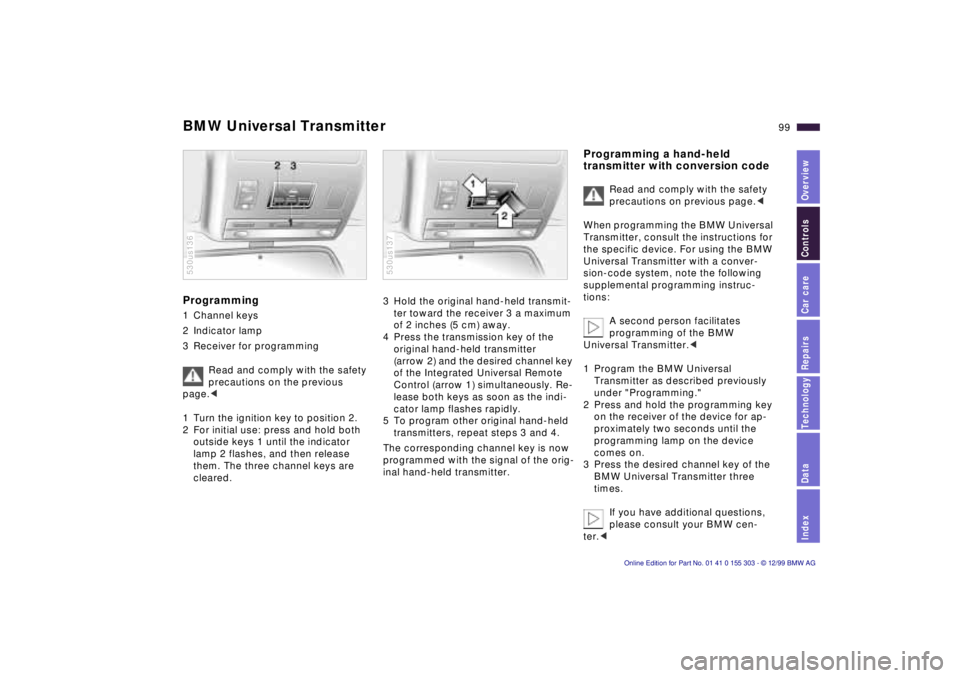
BMW Universal TransmitterProgramming 1 Channel keys
2 Indicator lamp
3 Receiver for programming
Read and comply with the safety
precautions on the previous
page.<
1 Turn the ignition key to position 2.
2 For initial use: press and hold both
outside keys 1 until the indicator
lamp 2 flashes, and then release
them. The three channel keys are
cleared.530us136
3 Hold the original hand-held transmit-
ter toward the receiver 3 a maximum
of 2 inches (5 cm) away.
4 Press the transmission key of the
original hand-held transmitter
(arrow 2) and the desired channel key
of the Integrated Universal Remote
Control (arrow 1) simultaneously. Re-
lease both keys as soon as the indi-
cator lamp flashes rapidly.
5 To program other original hand-held
transmitters, repeat steps 3 and 4.
The corresponding channel key is now
programmed with the signal of the orig-
inal hand-held transmitter. 530us137
Programming a hand-held
transmitter with conversion code
Read and comply with the safety
precautions on previous page.<
When programming the BMW Universal
Transmitter, consult the instructions for
the specific device. For using the BMW
Universal Transmitter with a conver-
sion-code system, note the following
supplemental programming instruc-
tions:
A second person facilitates
programming of the BMW
Universal Transmitter.<
1 Program the BMW Universal
Transmitter as described previously
under "Programming."
2 Press and hold the programming key
on the receiver of the device for ap-
proximately two seconds until the
programming lamp on the device
comes on.
3 Press the desired channel key of the
BMW Universal Transmitter three
times.
If you have additional questions,
please consult your BMW cen-
ter.<
Page 137 of 201
IndexDataTechnologyRepairsCar careControlsOverview
137n
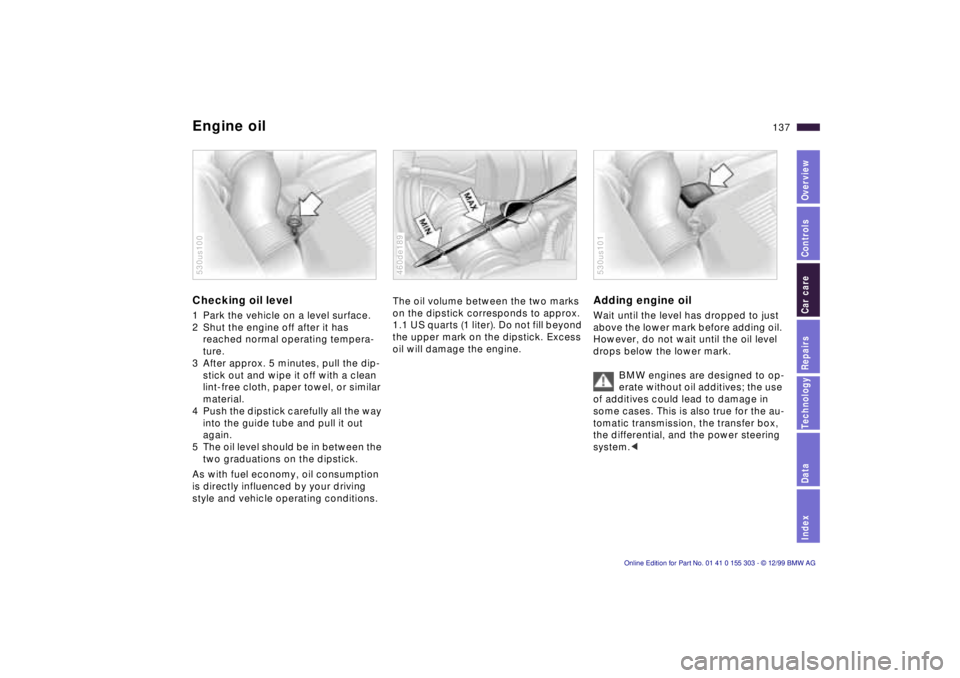
Engine oil Checking oil level 1 Park the vehicle on a level surface.
2 Shut the engine off after it has
reached normal operating tempera-
ture.
3 After approx. 5 minutes, pull the dip-
stick out and wipe it off with a clean
lint-free cloth, paper towel, or similar
material.
4 Push the dipstick carefully all the way
into the guide tube and pull it out
again.
5 The oil level should be in between the
two graduations on the dipstick.
As with fuel economy, oil consumption
is directly influenced by your driving
style and vehicle operating conditions. 530us100
The oil volume between the two marks
on the dipstick corresponds to approx.
1.1 US quarts (1 liter). Do not fill beyond
the upper mark on the dipstick. Excess
oil will damage the engine. 460de189
Adding engine oil Wait until the level has dropped to just
above the lower mark before adding oil.
However, do not wait until the oil level
drops below the lower mark.
BMW engines are designed to op-
erate without oil additives; the use
of additives could lead to damage in
some cases. This is also true for the au-
tomatic transmission, the transfer box,
the differential, and the power steering
system.< 530us101
Page 175 of 201
IndexDataTechnologyRepairsCar careControlsOverview
Overview
Controls and features
Operation, care
and maintenance
Owner service procedures
Technical data
Index Advanced technology
175n
Airbags176
Adaptive Transmission Control
(ATC)176
Four-wheel drive177
Dynamic Stability Control
(DSC)177
Radio reception178
Safety belt tensioner178
DSP sound system179
Rearview mirrors with automatic
dimmer179
Rain sensor180
Integrated rear suspension180
Level control system181
Xenon lamps181
Technol-
Page 176 of 201
176n
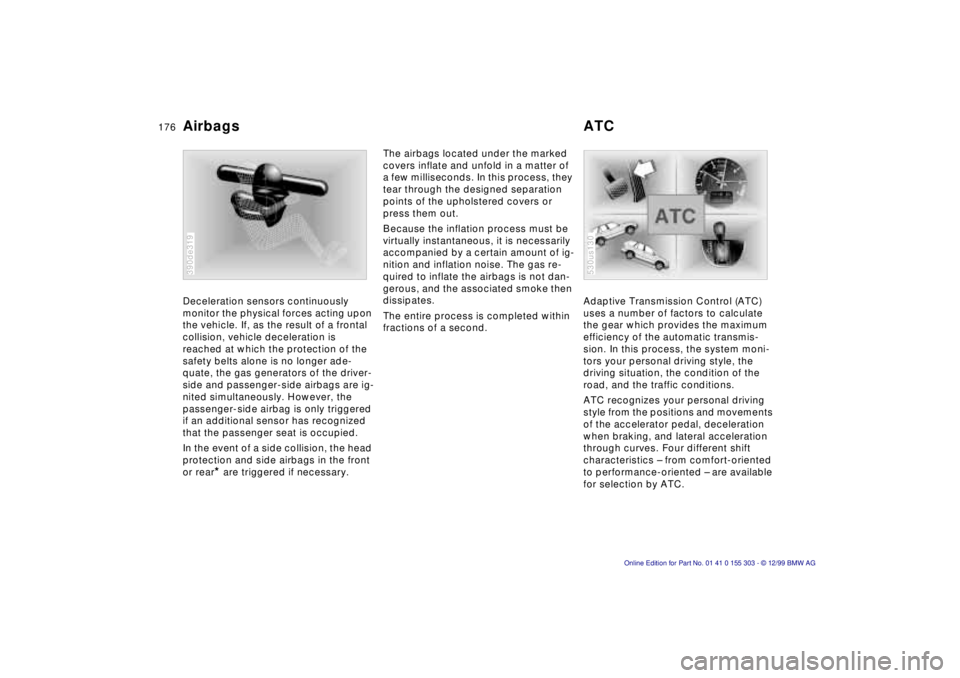
Deceleration sensors continuously
monitor the physical forces acting upon
the vehicle. If, as the result of a frontal
collision, vehicle deceleration is
reached at which the protection of the
safety belts alone is no longer ade-
quate, the gas generators of the driver-
side and passenger-side airbags are ig-
nited simultaneously. However, the
passenger-side airbag is only triggered
if an additional sensor has recognized
that the passenger seat is occupied.
In the event of a side collision, the head
protection and side airbags in the front
or rear
* are triggered if necessary.
390de319
The airbags located under the marked
covers inflate and unfold in a matter of
a few milliseconds. In this process, they
tear through the designed separation
points of the upholstered covers or
press them out.
Because the inflation process must be
virtually instantaneous, it is necessarily
accompanied by a certain amount of ig-
nition and inflation noise. The gas re-
quired to inflate the airbags is not dan-
gerous, and the associated smoke then
dissipates.
The entire process is completed within
fractions of a second. Adaptive Transmission Control (ATC)
uses a number of factors to calculate
the gear which provides the maximum
efficiency of the automatic transmis-
sion. In this process, the system moni-
tors your personal driving style, the
driving situation, the condition of the
road, and the traffic conditions.
ATC recognizes your personal driving
style from the positions and movements
of the accelerator pedal, deceleration
when braking, and lateral acceleration
through curves. Four different shift
characteristics Ð from comfort-oriented
to performance-oriented Ð are available
for selection by ATC.
530us130
Airbags ATC
Page 177 of 201
IndexDataTechnologyRepairsCar careControlsOverview
177n
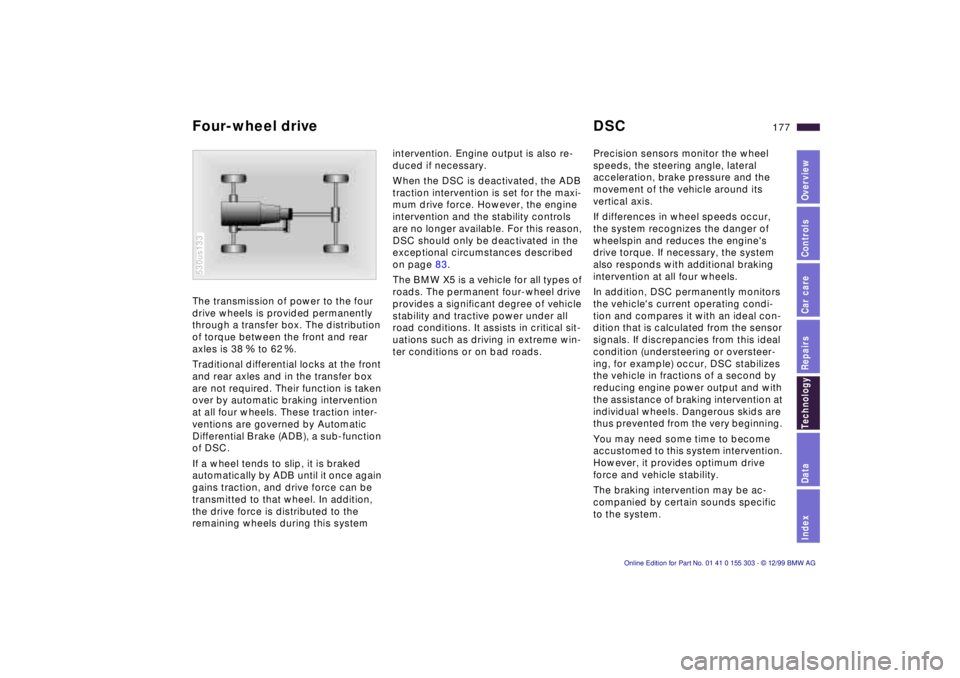
The transmission of power to the four
drive wheels is provided permanently
through a transfer box. The distribution
of torque between the front and rear
axles is 38% to 62%.
Traditional differential locks at the front
and rear axles and in the transfer box
are not required. Their function is taken
over by automatic braking intervention
at all four wheels. These traction inter-
ventions are governed by Automatic
Differential Brake (ADB), a sub-function
of DSC.
If a wheel tends to slip, it is braked
automatically by ADB until it once again
gains traction, and drive force can be
transmitted to that wheel. In addition,
the drive force is distributed to the
remaining wheels during this system
530us133
intervention. Engine output is also re-
duced if necessary.
When the DSC is deactivated, the ADB
traction intervention is set for the maxi-
mum drive force. However, the engine
intervention and the stability controls
are no longer available. For this reason,
DSC should only be deactivated in the
exceptional circumstances described
on page 83.
The BMW X5 is a vehicle for all types of
roads. The permanent four-wheel drive
provides a significant degree of vehicle
stability and tractive power under all
road conditions. It assists in critical sit-
uations such as driving in extreme win-
ter conditions or on bad roads. Precision sensors monitor the wheel
speeds, the steering angle, lateral
acceleration, brake pressure and the
movement of the vehicle around its
vertical axis.
If differences in wheel speeds occur,
the system recognizes the danger of
wheelspin and reduces the engine's
drive torque. If necessary, the system
also responds with additional braking
intervention at all four wheels.
In addition, DSC permanently monitors
the vehicle's current operating condi-
tion and compares it with an ideal con-
dition that is calculated from the sensor
signals. If discrepancies from this ideal
condition (understeering or oversteer-
ing, for example) occur, DSC stabilizes
the vehicle in fractions of a second by
reducing engine power output and with
the assistance of braking intervention at
individual wheels. Dangerous skids are
thus prevented from the very beginning.
You may need some time to become
accustomed to this system intervention.
However, it provides optimum drive
force and vehicle stability.
The braking intervention may be ac-
companied by certain sounds specific
to the system.
Four-wheel drive DSC
Page 186 of 201

186n
Weights
BMW X5 4.4i
Curb weight (with one person, ready for operation, full tank of fuel, options not included)
with manual transmission
with automatic transmissionlbs.(kg)
lbs.(kg)Ð
4,795 (2,175)
Approved gross vehicle weight
with manual transmission
with automatic transmissionlbs.(kg)
lbs.(kg) 5,842 (2,650)
Approved front axle weight lbs.(kg) 2,712 (1,230)
Approved rear axle weight lbs.(kg) 3,219 (1,460)
Approved roof load capacity lbs.(kg) 220 (100)
Never exceed either the approved axle weights or the gross vehicle weight.
Cargo area capacity cu ft (l) 16.1 - 54.4 (455 - 1,540)
Page 187 of 201

IndexDataTechnologyRepairsCar careControlsOverview
187n
Capacities
Notes
Fuel tank
Reserve gal. (liters)
gal. (liters) approx. 24.2 (approx. 92)
approx. 2.6 (approx. 10) Fuel specification: page 30
Windshield washer system
with headlamp washer system quarts (liters) approx. 8.2 (approx. 7.8) For details: page 136
Cooling system including
heater circuit quarts (liters) 12.7 (12.0) For details: page 140
Engine oil and filter change quarts (liters) 8.5 (8.0) "BMW High Performance
Synthetic Oil".
For details: page 138
Automatic transmission, transfer box
and differential Ð Ð Lifetime fluid, no fluid
change required
Page 192 of 201

Everything from A to ZAABS (Antilock Brake
System)119
Accessories6
Activated-charcoal filter95
Adaptive Transmission
Control (ATC)176
Adding engine oil137
Adding washer fluid136
Adjusting seats48
Adjusting the steering
wheel51
Adjusting the
temperature92
Air conditioner93
Air distribution92
Air nozzles90
Air outlets90
Air pressure30, 127
Air supply93
Airbags23, 57, 148, 176
Alarm system43
Antennas126
Antifreeze140
Antifreeze, radiator123
Antilock Brake System
(ABS)119
Anti-theft alarm system43
Anti-theft protection37
Approved gross vehicle
weight186
Aquaplaning118, 127
Ashtray103AUC (Automatic recirculated
air control)93
Automatic car washes143
Automatic climate
control90
Removing condensation
from the windows93
Automatic cruise control72
Automatic curb monitor54
Automatic dimming, interior
rearview mirror53
Automatic recirculated air
control (AUC)93
Automatic steering wheel
adjustment52
Automatic transmission with
Steptronic66
Average fuel
consumption80
Average speed80
Axle loads186
BBackup lamps67
Bulb replacement157
Battery165, 188
Capacity188
Charge166
Discharged170
Belts56
Beverage holder102
Blower93
BMW comfort seat50BMW High Performance
Synthetic Oil138
BMW sports seat50
BMW Universal
Transmitter98
Body-cavity protectant144
Brake fluid141
Brake hydraulic system22
Brake lamps, bulb
replacement157
Brake pads24
Brakes122
Malfunctions123
Break-in procedures116
Bulb replacement155
CCapacities187
Car Memory55
Car radio
reception126, 178
Car wash143
Care, exterior144
Care, interior146
Cargo area42, 107
Capacity186
Opening from the
inside41
Cargo area cover107
Cargo area lamps87
Cargo floor, pull-out111
Cargo loading112Caring for the vehicle
finish145
Catalytic converter118
CBC (Cornering Brake
Control)120
Cellular phones102, 126
refer to the separate
Owner's Manual
Center (high-mount) brake
lamp157
Central locking system36
Button40
Changing a tire160
Changing a wheel160
Charge indicator lamp22
Check air pressure30
CHECK button77
Check Control77
Check engine oil level137
Checking tire pressure30
Child restraint systems57
Child's seat57
Child-safety locks62
Cigarette lighter103
Clean the windshield70
Climate control in the rear
passenger area94
Clock, refer to the Radio or
Onboard Computer
Owner's Manual
Cockpit16
Code, refer to the Radio
Owner's Manual126
Page 196 of 201

Everything from A to ZRestraint system57
Reverse67
Rims130
Roof load capacity186
Roof-mounted luggage
rack113
Rubber parts124SSafety belt height
adjustment56
Safety belt tensioner178
Safety belts56
Safety lock buttons40
Seat heating96
Seat memory54
Seat, power48
Securing cargo42, 112
Securing the load112
Selector lever, automatic
transmission66
Service and Warranty
Information Booklet (US
models)142
Service Interval
Display76, 142
Servotronic125
Shiftlock66
Shoulder support50
Shutting off the engine65
Side airbags57
Side Impact Head Protection
System57Side lamps86
Bulb replacement156
Ski bag105
Skidcontrol125
Sliding/Tilt sunroof46
Closing following an
electrical malfunction168
Convenience
operation36
Power loss47
Remote control38
Slippery roads124
Snow chains124, 131
Socket104
Spare key34
Spare tire161
Spare wheel161
Spark plugs188
Speaker102
Special wash program70
Speed control72
Speedometer18, 20
Sports seat50
Starting64
Starting problems
64, 118, 170, 171
Steering125
Steering wheel
adjustment51
Automatic52
Steering wheel heating96
Steering wheel lock63
Steering wheel memory54Steptronic66
Storage compartments101
Storage compartments in the
cargo area109
Storing the vehicle148
Summer tires130
Sun visors53
Switching off the vehicle65
Symbols4
Synthetic oils138
TTachometer75
Tail lamps157
Bulb replacement157
Tailgate42
Opening from the
inside41
Opening from the
outside41
Radio control
operation39
Release following an
electrical malfunction168
Technical
modifications6, 149
Telephone hookup102
Telephone, refer to the
separate Owner's Manual
Temperature display,
outside
temperature74, 80
Temperature gauge76Temperature layering94
Thigh support
adjustment50
Third brake lamp157
Tilt alarm38, 44
Tilt function, passenger side
mirror54
Timer, refer to the Radio
Owner's Manual
Tire code130
Tire damage127
Tire inflation
pressure31, 127
Tire renewal128
Tire rotation between front
and rear129
Tire specifications132
Tire tread127
Tools154
Torque184
Tow fittings171
Towing171
Tow-starting172
Track width185
Traction Control System
refer to DSC83
Transmission66
Tread depth, tires127
Trip odometer74
Turn signal indicator69
Bulb
replacement156, 157
Turning circle185